The Smell of Molten Projects in the Morning

Ed Nisley's Blog: Shop notes, electronics, firmware, machinery, 3D printing, laser cuttery, and curiosities. Contents: 100% human thinking, 0% AI slop.

Tag: Repairs

If it used to work, it can work again

  • Universal Socket to Quarter-Inch Hex Adapter Stack

    Universal Socket to Quarter-Inch Hex Adapter Stack

    Being that type of guy, I wanted to salvage a loooong square-head bolt from the utility pole stub formerly holding up the mailboxes, which would require a few gazillion turns of its square head with the Adjustable Elephant Wrench. After verifying I couldn’t just hammer the mumble thing through the pole, I gave a few turns of the Universal Socket on a ratchet:

    Universal Socket Wrench
    Universal Socket Wrench

    It’s intended for goobered hex heads up to 1-¼ inch, but the pins slide down around pretty much anything that sticks out and jam against the shell, so it’s handy for those last-ditch extraction events.

    After verifying doing this by hand would occupy me until just before the heat death of the universe, I followed Mad Phil’s signal connector adage: “If you can get to BNC, you can get to anything.”

    Some rummaging produced this unsteady mechanical ziggurat:

    Universal Socket to quarter-inch hex - adapter stack
    Universal Socket to quarter-inch hex – adapter stack

    From bottom to top:

    • Universal Socket with ½ inch square drive socket
    • 1/2 inch square drive to ¾ inch hex
    • 19 mm (close enough to ¾ inch) 12-point socket to ⅜ inch square drive socket
    • ⅜ inch square drive to ¼ inch square drive socket
    • ¼ inch square drive to ¼ inch hex drive

    Then stick the teeny end into the hand drill, rig engines for reverse running, and whine away on that bolt, which obligingly backed right out.

    After the fact, I found the obviously missing ¼ to ½ inch square drive adapter hiding in the Drawer o’ Sockets:

    Universal Socket - short adapter stack
    Universal Socket – short adapter stack

    Which doesn’t make any more sense, but is less likely to fall apart under normal use.

    Aaaaand one more adapter makes this possible:

    Improper square drive adapter stack
    Improper square drive adapter stack

    That’s a 50 mm socket turned by ¼ inch hex drive in four easy steps, although I’m reasonably sure it still won’t get the idler bogies off my armored personnel carrier.

    The stray adapter steps down from ½ square to ⅜ square, should a need for a breaker bar occur during eyeball surgery.

  • RCA Alarm Clock: Recapping

    RCA Alarm Clock: Recapping

    A power failure apparently pushed the ancient RCA alarm clock over the edge into a mode where it ignored its pushbuttons and displayed a time based on a hitherto unknown exoplanet. Popping the case revealed it’s been simmering in its own juices for quite a while:

    RCA Alarm Clock - PCB overheat
    RCA Alarm Clock – PCB overheat

    There’s nothing obviously scorched on the underside of the PCB, although a large SMD resistor might be the source of the problem.

    Having been around this block a few times, I unsoldered that big electrolytic cap with its guts protruding from the overwrap:

    RCA Alarm Clock - failed cap value
    RCA Alarm Clock – failed cap value

    Nope, that’s not really an electrolytic cap any more.

    Lacking a 2200 µF cap of suitable voltage rating, but knowing cap tolerances allow for considerable windage, this worked out well enough:

    RCA Alarm Clock - replacement caps
    RCA Alarm Clock – replacement caps

    Two smaller caps measuring on the low side of OK now reside in the e-waste box.

    The white diffuser over the last digit improves it in ways I do not profess to understand, but am pleased to implement:

    RCA Alarm Clock - in place
    RCA Alarm Clock – in place

    It’s held in place by two strips of LSE tape to see how it reacts to prolonged shear force, no matter how gentle.

  • Car vs. Mailbox: Replacement Boxes

    Car vs. Mailbox: Replacement Boxes

    Combining a new mailbox with a post and an old mailbox I had on hand, upcycling some scrap wood, then sticking on a few digits and a seasonal decoration found on a walk, should shake loose the mail currently stuck in the USPS delivery system:

    Mailboxes - south view
    Mailboxes – south view

    That’s an Extra Large mailbox, suitable for most packages arriving by USPS, and dwarfing the ordinary mailbox on the north side:

    Mailboxes - north view
    Mailboxes – north view

    The post is just uphill from the utility pole stub formerly supporting the previous mailboxes. Much to my astonishment, my post hole digger got 30 inches down before hitting The Final Rock, deep enough for the task at hand.

    The boxes sit on slabs harvested from an old door and screwed to two layers of Chinese plywood from the laser cutter’s shipping crate, all unpainted / untreated interior-grade (at best) wood cut with a circular saw. My assumption is they’ll last long enough for the purpose and, not having formed a deep emotional bond with them, I won’t feel too bad when the assembly gets pulverized.

    The whole affair sports a rakish tilt toward the street, in the hope of encouraging rainwater to run off, rather than soak in, but I fully expect the untreated plywood to act as a sponge and delaminate / curl / splay in a spectacular & amusing fashion.

    The pale rectangle across the vertical post is a (laser cut!) Chinese plywood plate intended to hold the crossbar together. The vertical and horizontal posts meet in a simple cross lap joint that surely wasn’t intended to support nearly so much weight: reinforcement seems appropriate.

    Next project: sort out the insurance claim …

  • Toilet Flush Valve Re-chaining

    Toilet Flush Valve Re-chaining

    I don’t think I flushed the pot any more vigorously than usual, but the plastic chain snapped off at the flush valve:

    Flush valve chain - broken plastic
    Flush valve chain – broken plastic

    Some rummaging in the Chain Locker produced a steel chain from a long-ago flush valve that snapped into place:

    Flush valve chain - steel
    Flush valve chain – steel

    Despite what you may think, I do not enjoy fiddling with this stuff, so I locked the link in place with a dab of hot melt glue:

    Flush valve chain - steel glued
    Flush valve chain – steel glued

    Having recently repaired the other pot in the house, perhaps they’ll stay fixed for a while. It could happen!

  • Acrylic Engraving Dust

    Acrylic Engraving Dust

    The MDF signs I made last year disintegrated pretty much on the expected schedule, so it’s time for something more durable:

    Please Close The Gate - acrylic engraving
    Please Close The Gate – acrylic engraving

    The idea is to engrave both sides of a 3 mm orange acrylic sheet, shoot it with rattlecan black paint, and declare victory. The second step awaits warmer weather, but at least I’m doing my part to prepare for the new gardening season.

    Vaporizing that much acrylic produces a fair bit of debris:

    Please Close The Gate - acrylic dust on laser head
    Please Close The Gate – acrylic dust on laser head

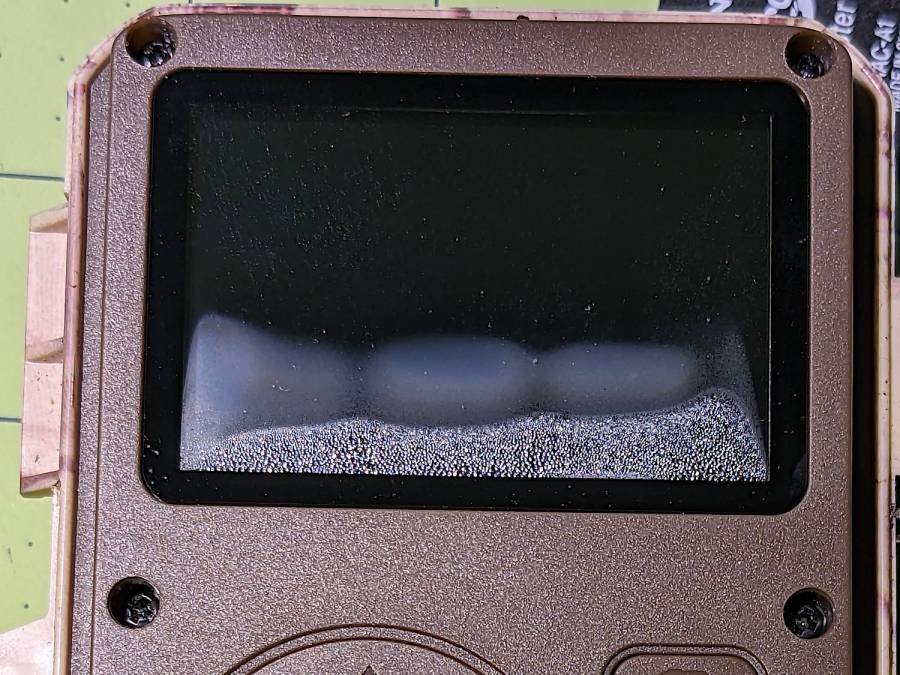
    Some dust / vapor accumulates / condenses on the honeycomb platform beyond the orange sign, but most of it gets through to the baffle on the exhaust duct:

    Please Close The Gate - acrylic dust on exhaust port
    Please Close The Gate – acrylic dust on exhaust port

    A closer look shows it really does grow out from the perimeter of each hole:

    Please Close The Gate - acrylic dust on exhaust port - detail
    Please Close The Gate – acrylic dust on exhaust port – detail

    Now, if that doesn’t trip your trypophobia, nothing will …

    A few passes with the trusty Electrolux vacuum’s dust brush brought the visible surfaces back to normal.

    By now, the duct fan blades have surely layered on a good coating, too, which shall remain undisturbed until I find a better reason to open the duct.

  • Ersatz Library Card: Fixed

    Ersatz Library Card: Fixed

    Sharper eyes than mine pointed out I misspelled Poughkeepsie, so I took advantage of the opportunity to make the whole thing look better:

    Library card tag - revised front
    Library card tag – revised front

    It turns out the low-surface-energy tape stuck like glue to the acrylic tag (because that’s what it’s designed for) and peeled right off the laminating film on the printed paper. So I stuck some ordinary adhesive film to the back of the new paper label, left its protective paper on the other side, cold laminated the film+paper, laser-cut the outline, peeled off the back side of the laminating film with the protective paper, and stuck the new adhesive to the LSE tape still on the tag.

    I have no idea how well this will work out in the long term, what with two adhesive layers bonded to each other, but this whole thing is in the nature of an experiment.

  • Eyeglass Spring Temple: Screw Hole Tweak

    Eyeglass Spring Temple: Screw Hole Tweak

    A screws in one of Mary’s eyeglasses unscrewed itself, but, miraculously, we found it and I retired to the shop.

    Because the glasses have spring temples, the screw would not align no matter what force I applied to it:

    Eyeglass spring temple - screw misalignment
    Eyeglass spring temple – screw misalignment

    So I just embiggened the hole until the available force did the trick:

    Eyeglass spring temple - hole filing
    Eyeglass spring temple – hole filing

    Dots of Loctite worked into the threads should prevent that from happening again, but I’ve learned to never say never.

    In retrospect, the temple pivots have an exposed slot that I think would allow jamming a block in place after pulling the spring-loaded pivot outward. Temple springs are impossibly stiff and I have previously failed to budge them in glasses without the slots, so I don’t know how well that might work.

    Verily: If brute force isn’t working for you, then you’re not using enough of it.