The Smell of Molten Projects in the Morning

Ed Nisley's Blog: Shop notes, electronics, firmware, machinery, 3D printing, laser cuttery, and curiosities. Contents: 100% human thinking, 0% AI slop.

Category: Science

If you measure something often enough, it becomes science

  • Squidwrench Electronics Workshop: Session 2

    Some ex post facto notes from the second SquidWrench Electronics Workshop. This turned out much more intense than the first session, with plenty of hands-on measurement and extemporized explanations.

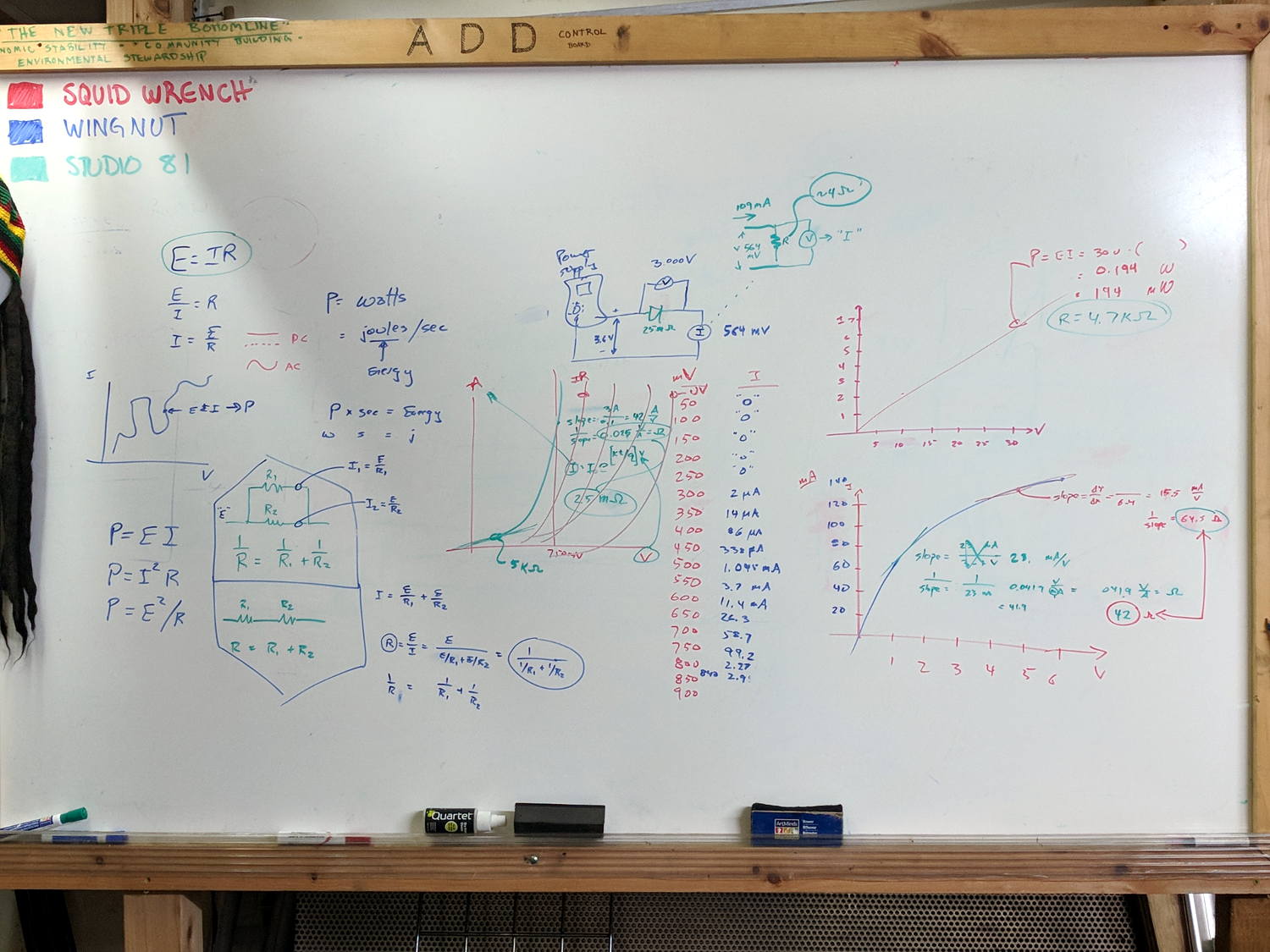
    Measure voltage across and current through 4.7 kΩ 5 W resistor from 0.5 V to 30 V. Note importance of writing down what you intend to measure, voltage values, units. Plot data, find slope, calculate 1/slope.

    Introduce parallel resistors: 1/R = 1/R1 + 1/R2. Derive by adding branch currents, compute overall resistance, factor & reciprocal.

    Review metric prefixes and units!

    Introduce power equation (P = E I) and variations (P = I² R, P = E²/R)

    Measure voltage across  and current through incandescent bulb (6 V flashlight) at 0.1 through 6 V, note difference between voltage at power supply and voltage across bulb. Plot data, find slopes at 1 V and 5 V, calculate 1/slopes.

    Measure voltage across ammeter with bulb at 6 V, compute meter internal resistance, measure meter resistance. Note on ammeter resistance trimming.

    Measure voltage across and current through hulking power diode from 50 mV – 850 mV. Note large difference between power supply voltage and diode voltage above 750-ish mV. Note power supply current limit at 3 A. Plot, find slopes at 100 mV and 800 mV, calculate 1/slopes. Compare diode resistance with ammeter resistance.

    Review prefixes and units!

    The final whiteboard:

    Whiteboard - Session 2
    Whiteboard – Session 2

    Hand-measured data & crude plots FTW!

  • Squidwrench Electronics Workshop: Session 1

    Some ex post facto notes from the first SquidWrench Electronics Workshop, in the expectation we’ll run the series from the start in a while. I should have taken pictures of my scribbles on the whiteboard.

    Define:

    • Voltage – symbol E (Electromotive Force or some French phrase), unit V = volt
    • Current – symbol I (French “intensity” or some such), unit A = ampere
    • Resistance – symbol R (“resistance”), unit Ω (capital Greek Omega) = ohm

    Introduce Ohm’s Law & permutations, postpone calculations.

    Measure the actual voltage of assorted cells & batteries. Identify chemistry, internal wiring:

    • 1.2 = nickel-cadmium or nickel-metal-hydride
    • 1.5 = carbon-zinc or alkaline
    • 2 V = lead-acid
    • 3.0 = primary lithium
    • 3.6 – 3.7 = rechargeable lithium, several variations
    • 4.8 = 4 x 1.2 V
    • 7.2 = 6 x 1.2 V
    • 7.4 = 2 x 3.6 V
    • 9.6 = 8 x 1.2 V
    • 10.8 = 3 x 3.6 V
    • 12 = 6 x 2 V

    Measure various resistors, favoring hulking finger-friendly sandstone blocks.

    Introduce metric prefixes:

    • Engineering notation uses only multiple-of-three exponents
    • μ = micro = 10-6
    • m = milli = 10-3
    • k = kilo = 103
    • M = mega = 106

    Discuss resistor power dissipation vs. size vs. location, postpone power formula.

    Clip-lead various resistors to various batteries, measure voltage & current.

    Introduce fixed & variable power supplies, repeat resistor measurements.

    Now compute permutations of Ohm’s Law using actual data!

  • Monthly Science: As Seen On Radio

    This showed up when I looked at our APRS tracks after a recent ride:

    Balloon chase - KJ5HY-9
    Balloon chase – KJ5HY-9

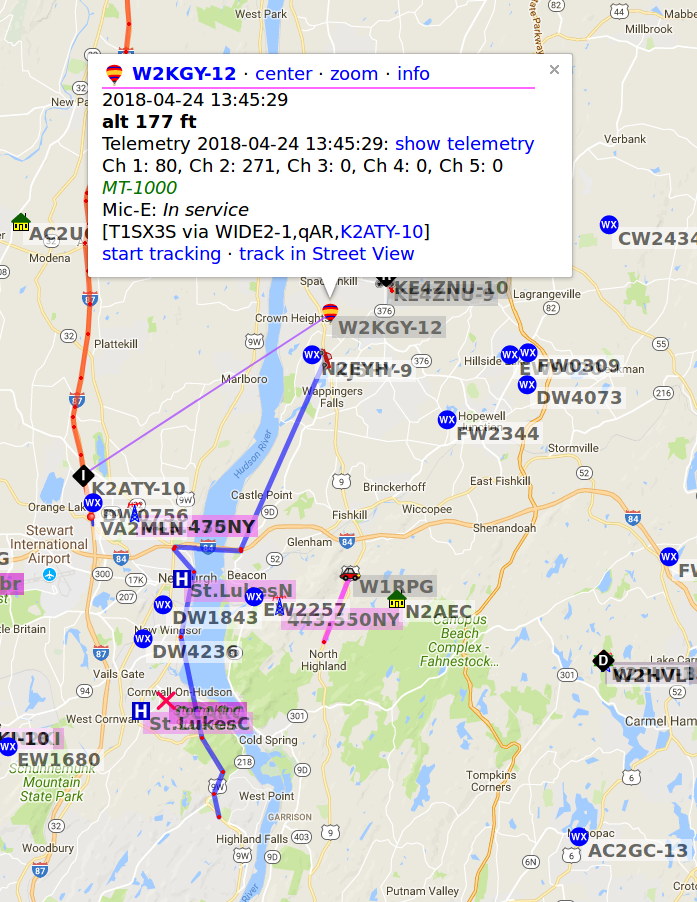
    Poking around a bit showed the target:

    Balloon chase - W2KGY-12
    Balloon chase – W2KGY-12

    Contrary to what I thought, it didn’t come up the Hudson River from West Point:

    Balloon chase - W2KGY-12 track - 2018-04-21 to 2018-04-24
    Balloon chase – W2KGY-12 track – 2018-04-21 to 2018-04-24

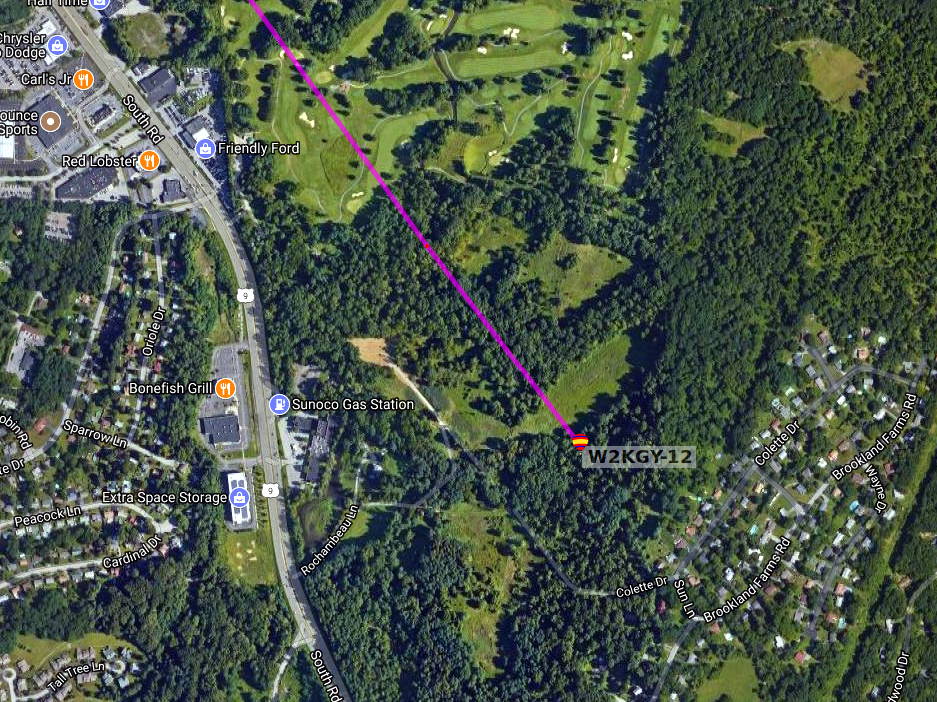
    Knowledge of the Universal Law of the Conservation of Perversity informs you a balloon will never land in the middle of a putting green:

    Balloon chase - W2KGY-12 landing site
    Balloon chase – W2KGY-12 landing site

    Apparently the launch is part of a regular class project at West Point. Good clean fun!

  • Magnetic Field Visualization

    Thinking about springs to apply downforce on plotting pen holders suggested magnets, so I extricated some neodymium bars from my collection of power toothbrush heads:

    Magnets - single
    Magnets – single

    A snippet of magnetic field visualization film shows a dipole pattern:

    Magnets - single - field visualization
    Magnets – single – field visualization

    Snapping two of them together in line:

    Magnets - in line
    Magnets – in line

    … produces a quadrupole:

    Magnets - in line - field visualization
    Magnets – in line – field visualization

    Now, if only I had some magnetic monopoles, this whole thing would be easier!

  • Monthly Science: Hawk and Squirrel, with Turkeys

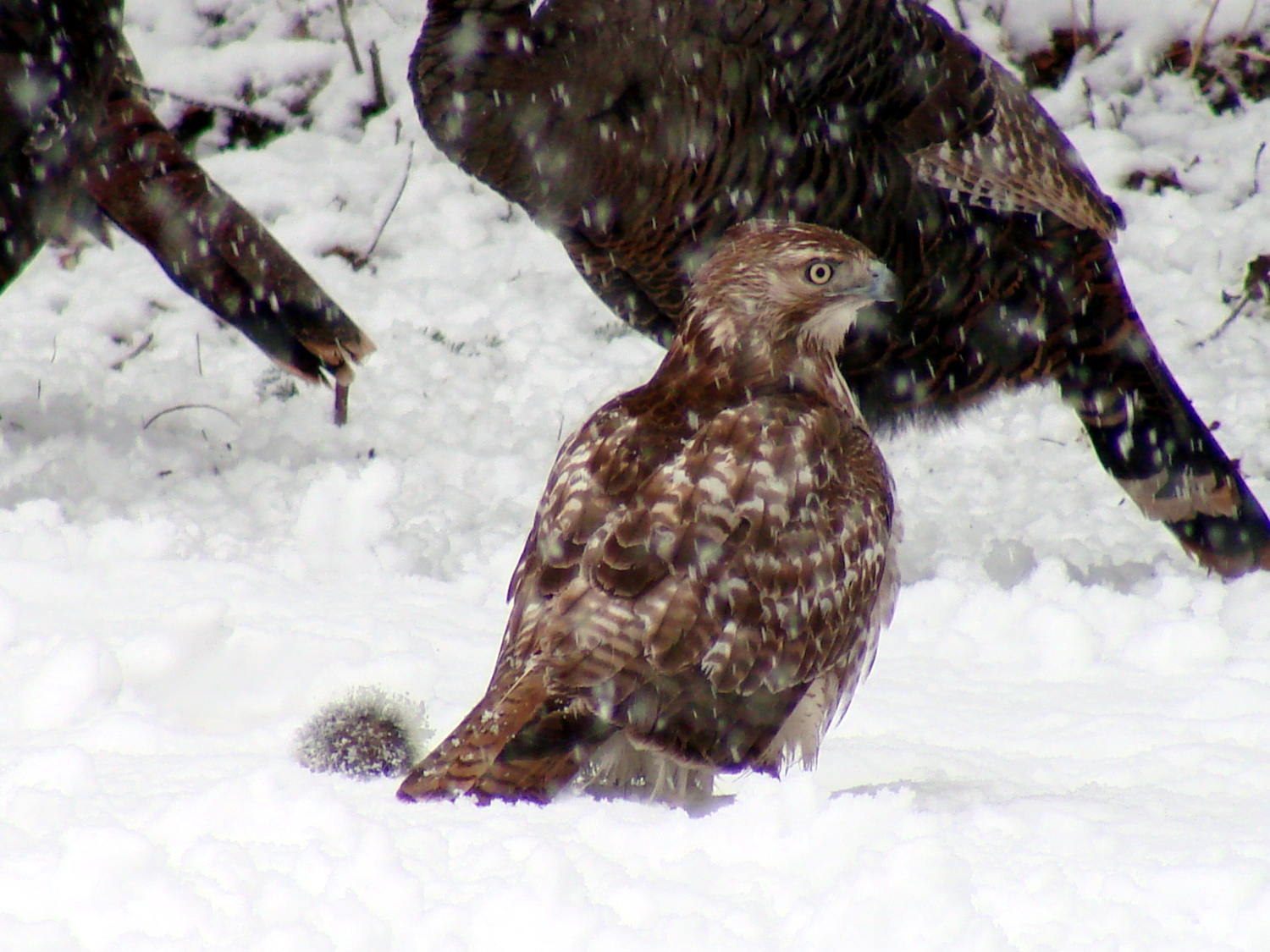
    All of the local turkeys come together during snow storms, often lingering in the circle of pine trees in our back yard to get some protection from the wind. Mary spotted a Cooper’s Hawk in the midst of the turkey flock, with its wings spread around a recently captured meal:

    Hawk with squirrel - wings spread
    Hawk with squirrel – wings spread

    When she first saw it, the hawk had its back to us and looked like a cluster of dead pine branches; the recent back-to-back storms have cleared out quite a bit of deadwood.

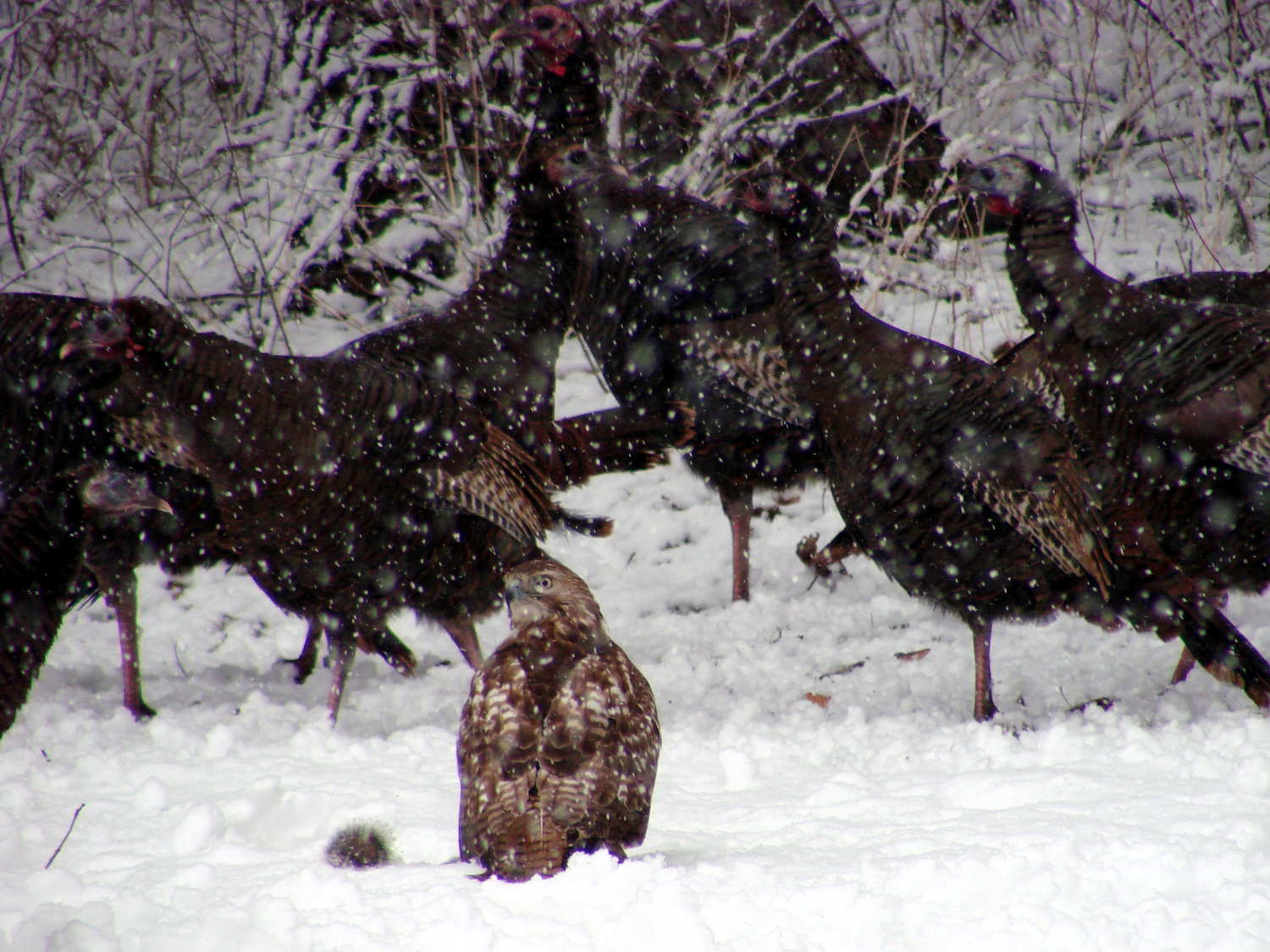
    When I quietly opened the back door for a better view, the hawk noticed and gave me the stinkeye from 100 feet away:

    Hawk with squirrel - 2
    Hawk with squirrel – 2

    The flock had moved out of the pine circle to surround the hawk and examine the situation, although they weren’t harassing it:

    Hawk with squirrel - 3
    Hawk with squirrel – 3

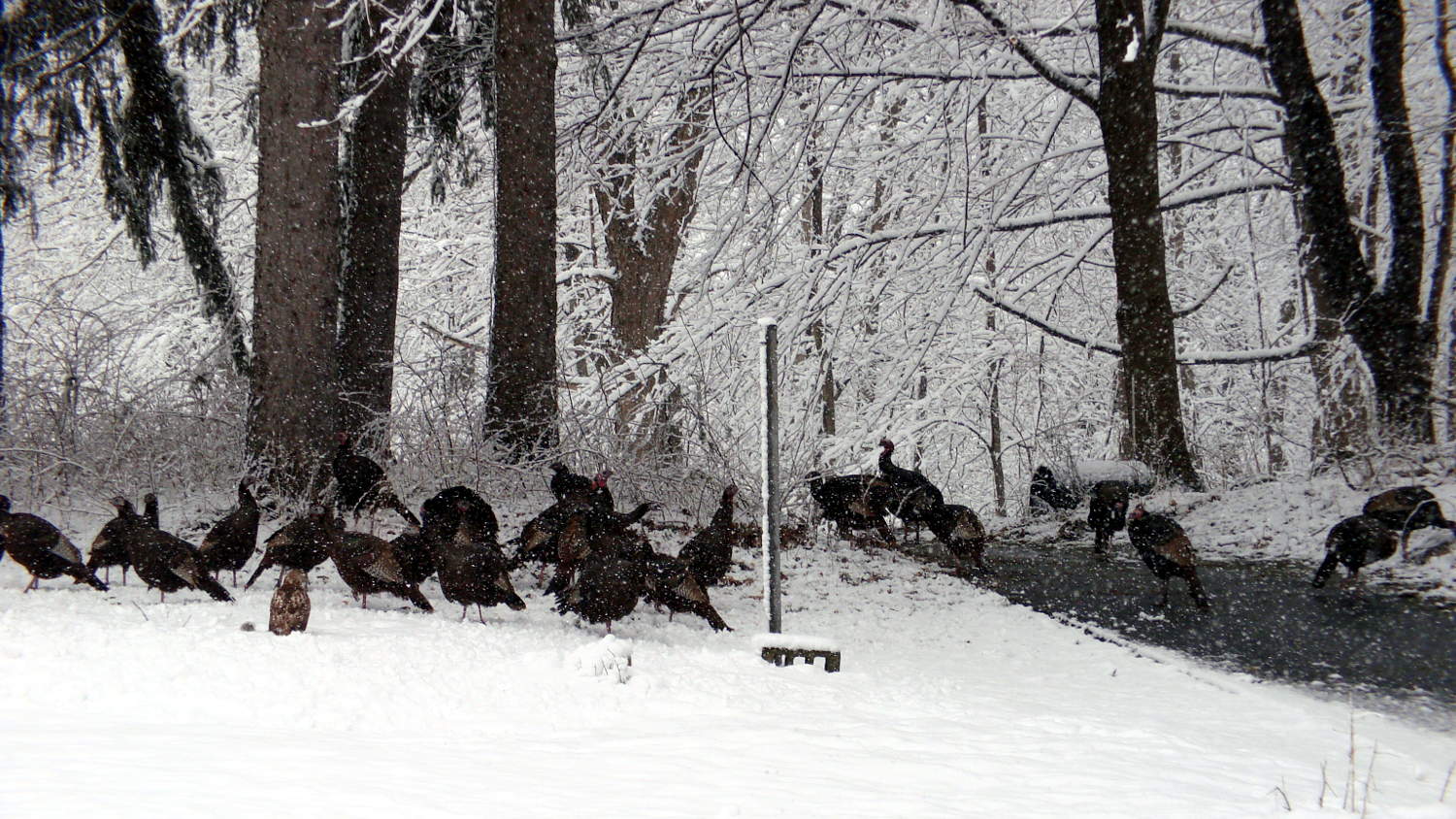
    We’ve counted 27 turkeys, more or less, on some days, well and truly outnumbering the hawk:

    Hawk with squirrel - overview
    Hawk with squirrel – overview

    Fortunately, turkeys feed mainly on insects and seeds, rather than tearing into carrion, so they’re not competing for the prize:

    Hawk with squirrel - detail
    Hawk with squirrel – detail

    Shortly after I gave up and went back inside, the hawk sank her (?) talons into the squirrel, lifted heavily into the air, circled around the pines, and flew off toward the Mighty Wappinger Creek out back.

    A casual search suggests both the hawk and the squirrel weigh about 1 lb = 500 g: I’ll never complain about heavy grocery bags again!

  • MPCNC: Makerbot-style Endstop Switch Spring Constant

    Using a lever-arm switch as a tool length probe works surprisingly well:

    MPCNC Tool Length Probe - Plotter Pen
    MPCNC Tool Length Probe – Plotter Pen

    However, probing a pen mounted in a compliant holder means the actual trip point depends on the relative spring constants. Having measured the pen holder’s 100 g/mm spring constant by poking a scale with the pen, I did much the same thing with the endstop Z-axis Autolevel probe:

    IMG_20180305_161831 - MPCNC - Z Autolevel probe force.jpg

    Which produced a similar graph:

    MB Endstop Switch - spring constant
    MB Endstop Switch – spring constant

    The force increases linearly at 30 g/mm up to the trip point, drops by maybe 16 grams, then increases linearly again.

    Obviously, the “constant” applies only to switches on MBI-style endstops in the lot I happen to have, but given the ubiquity of parts from the usual eBay sellers, any identical lever switches may have the same “constant”:

    Endstop lever switch - detail
    Endstop lever switch – detail

    Your mileage will vary, fer shure.

    Poking a pen into a similar switch used as a tool setter means the Z-axis coordinate of the trip point will depend on the opposing springs. That’s unlike the situation with a cutter mounted in the DW660 spindle, which (by definition) shouldn’t move in response to the pressure from a little bitty switch.

    Eyeballing the graph, the switch travels 2.2 mm to the trip point, where it exerts 64 g of force. The pen holder opposes that force and therefore deflects (64 g) / (100 g/mm) = 0.64 mm just before the switch trips: the trip point will be the same as with a rigid tool, but the tool’s Z axis coordinate will be 0.64 mm lower.

    I’d been touching off pens in the springy holder, with enough pressure to draw a decent line. Setting Z=0 with the holder deflected upward by 0.3 mm means the pen first touches the height probe at Z=+0.3 and the switch trips at Z=-0.3 mm (-ish), making the force on the paper 60 g, rather than the 30 g I expected.

    I think the pen plots worked out pretty well, despite not getting the numbers and, thus, pen positions, quite right.

  • BLDC Fan RPM vs. PWM Duty Cycle

    A simpleminded MOSFET circuit provides PWM drive for the BLDC blower:

    BLDC Fan PWM Test Fixture - schematic
    BLDC Fan PWM Test Fixture – schematic

    The Tek P6302 current probe looms much larger in real life than in the schematic:

    BLDC fan PWM Test Fixture
    BLDC fan PWM Test Fixture

    A quick dataset shows the RPM variation against PWM duty cycle:

    BLDC Blower - RPM vs PWM - doodles
    BLDC Blower – RPM vs PWM – doodles

    Unsurprisingly, the RPM curve resembles the earlier results against a variable DC supply voltage:

    BLDC Blower - RPM I P vs V
    BLDC Blower – RPM I P vs V

    Capturing the current waveform is stalled behind another project, but it has exactly the voltage spikes you’d expect from forcibly switching an inductive load.