The Smell of Molten Projects in the Morning

Ed Nisley's Blog: Shop notes, electronics, firmware, machinery, 3D printing, laser cuttery, and curiosities. Contents: 100% human thinking, 0% AI slop.

Category: Science

If you measure something often enough, it becomes science

  • Gulfstream V on Final to KPOU

    This corner on Maloney Rd is almost exactly one mile from the end of Hudson Valley Regional Airport Runway 24:

    Maloney to KPOU map
    Maloney to KPOU map

    So it’s not unusual to ride under a small plane on final approach. Having a Gulfstream V fly directly overhead, however, is a real attention-getter:

    Gulfstream V on final - Maloney Rd - 2018-08-26
    Gulfstream V on final – Maloney Rd – 2018-08-26

    What’s not at all obvious from the picture is how big a GV looks when seen directly overhead through those trees just ahead on the corner where our paths crossed. There’s a 360 ft (above sea level) hill directly on the flight path, so it’s at maybe 600 ft ASL and 400-ish ft AGL.

    Thrust-reversal thunder rolled over us 50 seconds later, as we rode up the rail trail access ramp. Figuring we’re 15 sound-seconds from the strip, the GV was 30 seconds from touchdown.

  • M2 DIY Thermistor Rebuild: Autopsy

    Not much to my surprise, my hack-job thermistor rebuild went bad:

    M2 - thermistor - assembly 2
    M2 – thermistor – assembly 2

    Having nothing to lose, I heated the brass tube over a butane flame to wreck the epoxy, which blew out with a satisfactory bang and filled the Basement Laboratory with The Big Stink.

    Much to my surprise, the active ingredient still worked:

    M2 DIY thermistor corpse
    M2 DIY thermistor corpse

    The multimeter reported absolutely no intermittent dropouts for as long as I was willing to watch the trace while doing other things:

    DIY Thermistor Autopsy - Resistance Trend
    DIY Thermistor Autopsy – Resistance Trend

    So it must be my crappy soldering technique.

    A brace of real M2 thermistors will arrive shortly …

  • Burnett Blvd at Rt 55: More Speed On Red

    We’re waiting at the end of Burnett Blvd, with the signal red and the clock at T = -0.17 seconds (photo numbers in 1/60 second frames):

    RedRunner-0194
    RedRunner-0194

    You can’t hear the car (barely visible) approaching on the far left, but we can.

    T = 0.00 – We get a green light and the (more visible) car is accelerating hard:

    RedRunner-0204
    RedRunner-0204

    T = 1.00 – The car reaches the crosswalk:

    RedRunner-0264
    RedRunner-0264

    Note that the driver of the car to our right isn’t moving, either.

    T = 2.03 – Car passes through intersection:

    RedRunner-0326
    RedRunner-0326

    The view from above, showing the distance between those two positions is 100 feet:

    Burnett at Rt 55 - Distance along Rt 55
    Burnett at Rt 55 – Distance along Rt 55

    Do the math: 100 ft / 1.03 s = 97 ft/s = 66 mph.

    There’s a reason we don’t start moving instantly when a traffic signal turns green.

    T = 3.17 – We start moving, as does the car to our right, with our signal still green:

    RedRunner-0394
    RedRunner-0394

    T = 4.88 – Whoops, our signal turns yellow:

    RedRunner-0497
    RedRunner-0497

    T = 9.28 – Our signal turns red:

    RedRunner-0761
    RedRunner-0761

    The signal timing hasn’t changed over the years:

    • Green = 4.88 s
    • Yellow = 4.40 s

    Elapsed time from green to red: 9.28 seconds. No problem if you’re a car, death if you’re a bike.

    T = 10.42 – We’re pedaling hard in the intersection:

    RedRunner-0829
    RedRunner-0829

    The white car to our far right started moving into the intersection about the time we did. If you’re going to say we shouldn’t run the light, you gotta deal with cars first, OK?

    Note the car approaching from the right on the far side of Rt 55. That’s a 40 mph zone, the driver sees a green light, and we’re still in the intersection.

    T = 12.50 – We’ve been moving for 9.33 s, which puts Mary directly in the path of the oncoming car:

    RedRunner-0954
    RedRunner-0954

    T = 14.83 – The oncoming driver having spotted us and slowed down, we’re asymptotically approaching the right-hand lane of Rt 55, passing beyond the steel manhole cover:

    RedRunner-1067
    RedRunner-1067

    If you plunk “burnett signal” into the search box at the upper right, you’ll find plenty of previous incidents along these lines.

    Despite bringing this hazard to their attention many times (“We appreciate and share your interest in making our highway systems safe and functional for all users.“), NYS DOT obviously doesn’t care.

    If any of their employees commuted to their office building (which overlooks this very intersection), perhaps they would care, but they don’t: we have yet to see a bicycle in the DOT’s token bike rack.

    DOT says they’re in favor of Complete Streets, but, seven years on, it’s just another day on the only route between Arlington and the Overocker Trailhead of the Dutchess County Rail Trail.

  • Park Spoke Tension Meter vs. 20 inch Wheel Spokes

    Obviously, the good folks at Park Tool never anticipated a three-cross spoke pattern on a 20 inch wheel:

    Park Tool Spoke Tension Meter vs 406 wheel
    Park Tool Spoke Tension Meter vs 406 wheel

    It’s my trusty Park Tool TM-1 Spoke Tension Meter, unchanged since shortly after the turn of the millennium.

    For future reference, the rebuilt wheel spoke tensions came out around 25, slightly lower than the 27-ish I measured on Mary’s bike; it didn’t occur to me to measure the tension until after I’d relaxed the spokes. I’ll ride it for a while before doing any tweakage.

    The spoke pattern is pretty close to four-cross, due to the large-flange Phil Wood hubs:

    Tour Easy Front Spoke Pattern
    Tour Easy Front Spoke Pattern

    Which makes for a hella-strong wheel, particularly seeing as how it’s very lightly loaded. The Tour Easy we got for our lass came with a radially spoked rim around a Phil hub.

    I transferred the hub and laced spokes intact to the new rim by the simple expedient of duct-taping the spokes into platters, removing the nipples, stacking the rims, sliding the spokes across into their new homes, reinstalling the nipples, then tightening as usual.

  • Monthly Science: Cheese Slicer Epoxy Coating vs. Water

    Ten months ago, I cleaned the corrosion off our favorite cheese slicer:

    Cheese slicer - aluminum corrosion
    Cheese slicer – aluminum corrosion

    After cleaning, I coated it with XTC-3D epoxy:

    Cheese Slicer - epoxy coat - detail
    Cheese Slicer – epoxy coat – detail

    We’ve been using it daily ever since and it spends most of its life drip-drying in the dish drainer. I added a third opening to the cheerful orange measuring spoon holder just for the slicer.

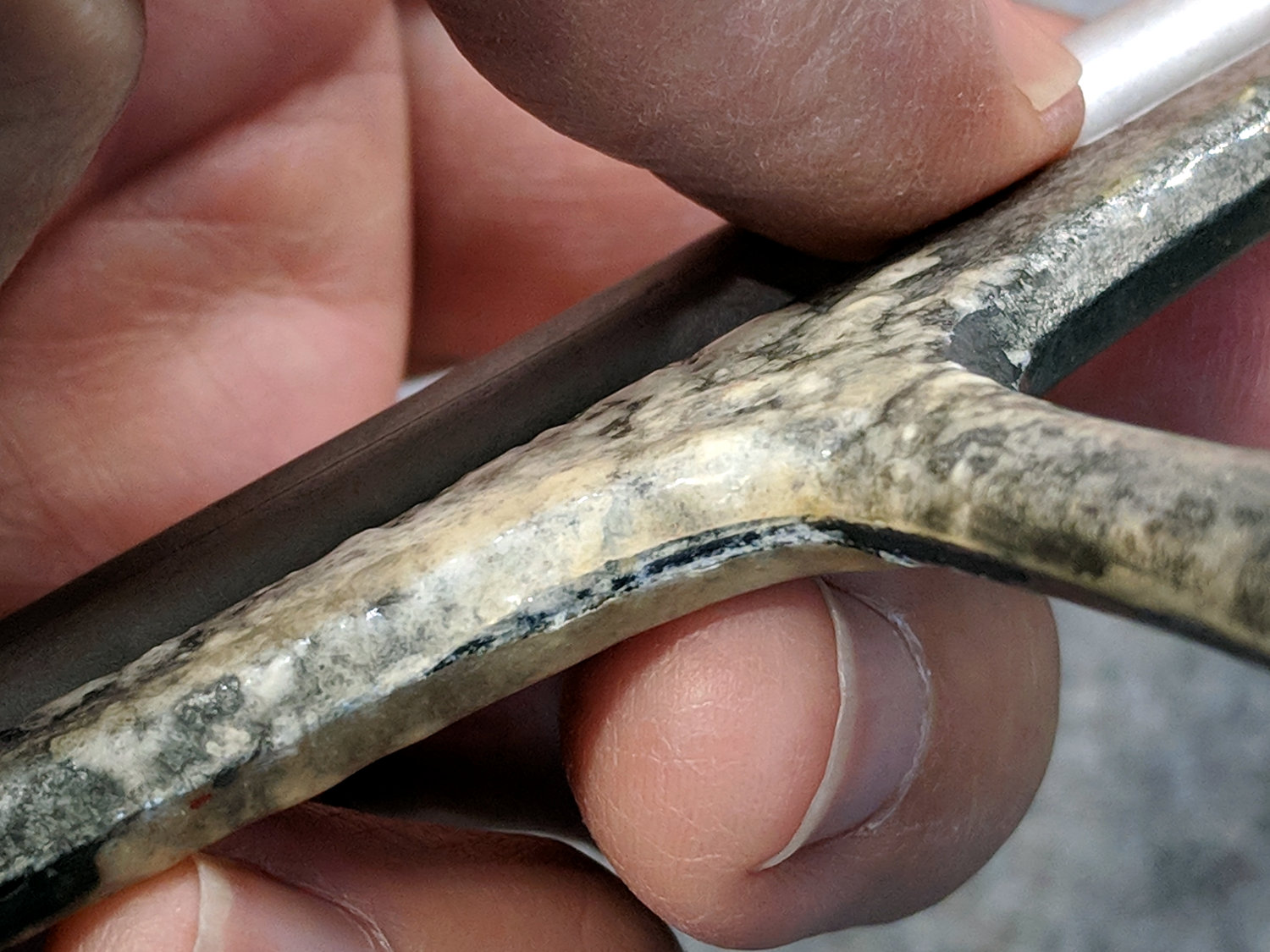
    A few weeks ago I noticed corrosion once again growing on the handle:

    Cheese Slicer - epoxy coat - corrosion - detail
    Cheese Slicer – epoxy coat – corrosion – detail

    I think the rot comes from water diffusing through the epoxy, rather than gross leaks through damage or pinholes. The tip of the handle has the most corrosion, probably due to the water drop hanging there, even though it also has the thickest epoxy coating: it cured with the handle pointing downward.

    Verily, rust never sleeps …

  • Tek A6302 Current Probe Derating

    Most currents around here come in tens-of-milliamps, maybe a few hundred, tops, but it’s worth noting some curves from the Tektronix AM503 current amplifier manual for A6302 Hall effect probes:

    Tek A6302 Calibration Setup
    Tek A6302 Calibration Setup

    The maximum current drops from 20 A for frequencies above 20 kHz:

    Tek A6302 Current Probe - Max Current Frequency Derating
    Tek A6302 Current Probe – Max Current Frequency Derating

    There’s a 100 A·μs pulse charge limit:

    Tek A6302 Current Probe - Specified Operating Area
    Tek A6302 Current Probe – Specified Operating Area

    Because the probe is actually a pulse transformer, its internal termination imposes a (small) load on the input circuit:

    Tek A6302 Current Probe - Insertion Impedance
    Tek A6302 Current Probe – Insertion Impedance

    The specs are 100 mΩ at 1 MHz and 500 mΩ at 50 MHz, which means the load is essentially zilch for the circuits and signals I deal with.

    The Tektronix Probes for Current Measurement Systems has some useful descriptions.

    Memo to Self: Should any of those limits matter, rethink what you’re doing.

    An interesting story about the AM503 design from someone who lived through it.

  • Gamified Cycling

    OK, it’s not as exciting as a Strava KOM:

    Sheriff Speed Meter - 8 mph
    Sheriff Speed Meter – 8 mph

    Apparently folks have been going around the curve in front of the Dutchess County BOCES site at a pretty good clip. I didn’t spot any scars in the grass off the high side, but ya never know.

    We’re at the top of an uphill section and, riding together, we’re not sprinting for town line signs.