The Smell of Molten Projects in the Morning

Ed Nisley's Blog: Shop notes, electronics, firmware, machinery, 3D printing, laser cuttery, and curiosities. Contents: 100% human thinking, 0% AI slop.

Author: Ed

  • Mystery Not-Copper Line Cord

    Mystery Not-Copper Line Cord

    Harvesting a line cord for a widowmaker test setup revealed its inner secret:

    Mystery not-copper wire - as found
    Mystery not-copper wire – as found

    The conductors are as thin as I’ve ever seen in an AC line cord, with 0.5 mm² = just under 20 AWG. The color code doesn’t match USA-ian standards, but neither does the labeling, so I’m not surprised.

    If the individual strands seem unnaturally straight, they are, because they’re made of (presumably) copper plated on a (presumably) metallic core. Here’s what they look like after bending them sharply around my fingernail:

    Mystery not-copper wire - bending
    Mystery not-copper wire – bending

    Wonderfully springy, utterly non-magnetic, and surprisingly durable.

    Scraping the 0.02 mm strands with a sharp blade reveals a silvery interior, so it’s (presumably) not copper-coated plastic. Aluminum springs (ahem) to mind, but I’d expect tiny aluminum strands would snap (or at least deform) when bent and erode quickly when scraped.

    Each wire measures about 1 Ω / m from the plug (a convenient 40 inch = 1 m away), which is the resistance you’d get from a single hair-fine 5 mil = 0.13 mm strand of 35 AWG solid copper. An 18 AWG aluminum wire would have the same resistance as a 20 AWG copper wire, both of which should be 32 mΩ / m: a factor of 30 less than this crap.

    I have no idea what low-end Chinese factories use in place of copper, but it’s gotta be really cheap.

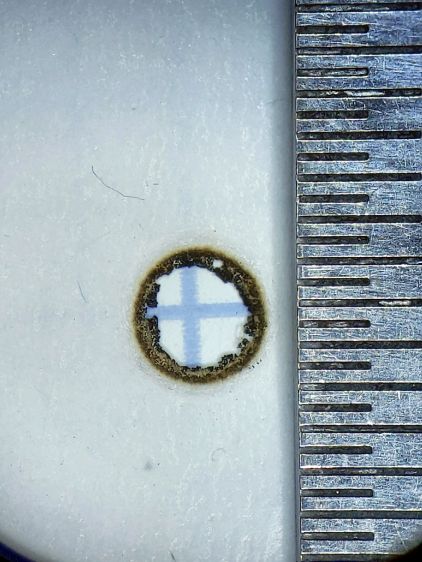
    A hank of the wire goes into the Box o’ Springs, in the event I ever need a tiny straight spring rod; you definitely can’t wind this stuff into a coil! It might be fine enough for a crosshair / reticle, at least for crude optics.

  • Stylus Cover: Tiny Threading Tool

    Stylus Cover: Tiny Threading Tool

    For unknown reasons, Mary’s Pixel 3a phone sometimes does not react to her fingertip, so she now has a stylus for such occasions. The cap covers the delicate fine-tip end (with the weird clear disk), leaving the rounded mesh end exposed to dock the cap.

    I made a pair of covers for the mesh end, mostly because the styli came in a two-pack and I carry mine in a pocket pouch that will likely abrade the mesh:

    Stylus Covers
    Stylus Covers

    They’re made from 3/8 inch = 9.52 mm acetal / Delrin rod, turned down to match the 9.4 mm stylus OD. The thread resembles a standard M8×1.25 with very rounded crests:

    Stylus Covers - thread
    Stylus Covers – thread

    While it’s possible to tap such a thinwalled cylinder with some exterior reinforcement, the (standard / normal / regulation / crispy) thread form of the hitherto entirely unused M8×1.25 tap cowering in the back of the drawer seemed a poor fit and, not being a bottoming tap, it wouldn’t cut full threads where they’re needed.

    Besides, what’s the fun in that?

    Lacking a threading tool small enough to fit inside the 7.4 mm bore, I gnawed one from a snippet of spring steel wire harvested from a dead box spring. The first pass was much too wide, but gave me the opportunity to make a few mistakes while shaping the tip:

    Tiny Threading Tool - first pass
    Tiny Threading Tool – first pass

    The discoloration on the shank betrays the torching required to knock the hardness down to something file-able. A little more Dremel cutoff wheel / grinder / file action produced a tiny tooth matching the rounded thread form on the stylus:

    Tiny Threading Tool - second pass
    Tiny Threading Tool – second pass

    A side / bottom view shows the crude grinding and excessive angles:

    Tiny Threading Tool - side view
    Tiny Threading Tool – side view

    A real machinist would harden and temper it, but I didn’t bother for a tool cutting two non-critical threads in plastic.

    Somewhat to my surprise, the mini-lathe can cut a 1.25 mm thread without any fancy metric change gears: a simple 35-40-45-50 train did the trick. Running dead slow gave me enough time to poke the power button and let it coast down as it approached the carriage stop marking the end of the thread: cutting plastic is much less exciting than, say, Real Steel.

    When all the cutting was done, I beveled the cap for my stylus to fit better into the bottom of the pouch, but that’s definitely in the nature of fine tuning:

    Stylus Cover - bevels
    Stylus Cover – bevels

    The second one went much faster and I should have made a third while I was hot.

    A doodle giving the key dimensions:

    Stylus Cover - dimensions
    Stylus Cover – dimensions

    Another day of Quality Shop Time™!

  • Dremel Flex Shaft Oiling

    Dremel Flex Shaft Oiling

    While using a Dremel cutoff wheel to shape a lathe bit, the flexible shaft sounded not quite noisy, if slightly less smooth than before, so easing some oil into the drive shaft might be a Good Idea. The springy shaft slides out of the motor end without disassembly, but, just for completeness, I took a look inside the handpiece:

    Dremel flex shaft - handpiece internals
    Dremel flex shaft – handpiece internals

    Before removing the two obvious screws holding the handpiece together, remember to remove the steel ring at each end. The tail ring is obvious:

    Dremel flex shaft - tail ring
    Dremel flex shaft – tail ring

    The nose ring wasn’t where I expected it, but released easily after the obvious mistake revealed itself:

    Dremel flex shaft - nose ring
    Dremel flex shaft – nose ring

    The steel shaft spun freely in its bearings and the matching end of the flex drive shaft had plenty of grease:

    Dremel flex shaft - drive detail
    Dremel flex shaft – drive detail

    So I just reassembled everything in reverse order. The trick is to line up the existing indentations in the outer sheath with the bumps inside the handpiece shell:

    Dremel flex shaft - housing detail
    Dremel flex shaft – housing detail

    After all that, spreading a few drops of high-speed spindle oil along the spring drive shaft seemed appropriate.

    Didn’t make the least bit of difference to the sound, but I feel better.

  • MicroMark Bandsaw Cover Screw Knobs

    MicroMark Bandsaw Cover Screw Knobs

    These descend directly from the LMS Mini-Lathe cover knobs:

    Micro-Mark bandsaw cover screw knob
    Micro-Mark bandsaw cover screw knob

    The top pair of screw heads aren’t quite flush with the cover, so the knobs have 1 mm extensions:

    Micromark Bandsaw - cover screw knobs - upper
    Micromark Bandsaw – cover screw knobs – upper

    The bottom pair sit inside 4 mm recesses, so those knobs get matching extensions:

    Micromark Bandsaw - cover screw knobs - lower
    Micromark Bandsaw – cover screw knobs – lower

    Attacking an anonymous 5 mm hex wrench with a Dremel cutoff wheel produced a quartet of 12 mm shafts and reduced drawer clutter by one unit.

    In retrospect, I should have dismantled the cover, grabbed the screws in a vise with their shafts vertical, and epoxied all the knobs with perfect alignment. Next time, maybe.

  • Tektronix AM503: Adjustment

    Tektronix AM503: Adjustment

    Having put the Tek AM503 with the 4 MHz oscillation (B075593) on the shelf pending arrival of what might be the world’s last remaining NOS 2625 op amp in the “screened and tested” 156-0317-03 grade, I figured I might as well go through the adjustment procedure on one of the bench units (B064098) to reset the gain and reduce the peaky leading edges (green trace):

    Tek AM503 - B031510 B064098 - 10mA-div
    Tek AM503 – B031510 B064098 – 10mA-div

    I conjured a low-budget Special Adapter to feed signals into the front-panel connector:

    Tektronix AM503 Special Adapter
    Tektronix AM503 Special Adapter

    I also used a somewhat smaller resistor in place of the required 3 Ω 3 W wire-wound unit:

    Tek AM503 - 3 ohm test resistor
    Tek AM503 – 3 ohm test resistor

    It need only soak up a few seconds of the degaussing signal and never even got warm, so it’s all good.

    To my surprise, the square-wave output of the JDS6600 Function Generator meets the 10 ns risetime requirement:

    JDS6600 Fn Gen - risetime 50 ohm
    JDS6600 Fn Gen – risetime 50 ohm

    Perhaps half an hour of adapter shuffling and trimmer twiddling later, the AM503 output looked better:

    Tek AM503 - compensation adj
    Tek AM503 – compensation adj

    The (purple) input comes from the function generator output through a BNC tee and an unterminated foot of coax, so the leading edge ringing is perfectly normal.

    With the scope input now providing the 50 Ω termination and the Hall probe clamped around one wire of a clip-to-clip pair of BNC-to-alligator-clip adapters, we’re still not talking RF-grade interconnection quality:

    Tek AM503 - 1 MHz square
    Tek AM503 – 1 MHz square

    Even through it’s not factory spec, the output tracks the input well enough for my simple needs.

    Good old Tek instruments: gotta love ’em!

  • Tektronix AM503: Balance Pot Bushing

    Tektronix AM503: Balance Pot Bushing

    One of the Tekronix AM503 current probe amplifiers arrived without the panel bushing for the Balance trim pot. Back in the day, you could presumably order part number 350-0301-02 and have it delivered (most likely) by your local Tek representative:

    Balance pot panel bushing - Tek part listing
    Balance pot panel bushing – Tek part listing

    Those days are over.

    A few minutes produced a doodle with pretty-close measurements:

    Balance pot panel bushing - dimension doodle
    Balance pot panel bushing – dimension doodle

    The as-built bushing turned out just a smidge too long, so make yours a scant eighth of an inch. Maybe the Tek dimension is the overall length?

    An SLA resin printer might crank out such a thing, but it’s well below the looks-good / fits-well resolution limit of an ordinary fused-filament printer.

    Applying the mini-lathe to a 1/4 inch white acrylic rod produced a reasonable facsimile:

    Tek AM503 Balance pot bushing - front
    Tek AM503 Balance pot bushing – front

    The side view:

    Tek AM503 Balance pot bushing - side
    Tek AM503 Balance pot bushing – side

    Acrylic is definitely the wrong material for the job, but it came readily to hand while pondering the Shelf o’ Rods. Acetal would be better, as you could easily trim off the aforementioned excess length with a knife.

    All’s well that ends well:

    Tek AM503 Balance pot bushing - installed
    Tek AM503 Balance pot bushing – installed

    A dab of white acrylic adhesive around the raw opening holds the bushing in place and it looks good enough to me.

    The motivation for this boils down to having the bushing center the pot twiddler required to set the balance, which I must do every time I fire up the amps, even after waiting for the half-hour required to stabilize them at their operating temperature.

  • Bafang Battery Charge Port: Autopsy

    Bafang Battery Charge Port: Autopsy

    My friends in Raleigh sent a small box with the various tools I made, along with the scorched Bafang battery charge port. As it turned out, none of the tools were useful and the real fix required opening the battery cover enough to remove and replace the charge connector.

    A view looking straight into the connector, with the side contact on the top of the image:

    Bafang Battery Charge Port - damage overview
    Bafang Battery Charge Port – damage overview

    Gutting the connector shows why my homebrew shell drill wasn’t going to work:

    Bafang Battery Charge Port - components
    Bafang Battery Charge Port – components

    There’s not much left of the central pin: the nugget hanging on its side is much larger than I expected. Most of the pin melted into that nugget, with a bonus droplet on the near side.

    The rectangular chunk (upper right) is the switch terminal, with the tab from the side contact (on the right) welded to it.

    Fortunately, none of the mayhem (including a few small sparks during the connector replacement) damaged the battery management circuitry or triggered a shutdown, so the reset tool wasn’t needed.

    It’ll make a great 3D printing show-n-tell exhibit, in the unlikely event I ever do an in-person talk