The Smell of Molten Projects in the Morning

Ed Nisley's Blog: Shop notes, electronics, firmware, machinery, 3D printing, laser cuttery, and curiosities. Contents: 100% human thinking, 0% AI slop.

Author: Ed

  • LED Garage Light: Desk Lamp Upcycling

    LED Garage Light: Desk Lamp Upcycling

    One of the heatsink panels from the defunct LED garage light now casts a uniform warm-white glow on my desk:

    LED Garage Light - desk light
    LED Garage Light – desk light

    A PCB intended as a lithium battery charger serves as a constant-current supply:

    LED Garage Light - constant current driver
    LED Garage Light – constant current driver

    The three trimpots, from left to right:

    • Constant-voltage limit adjustment
    • Full-charge current setpoint (irrelevant here)
    • Constant-current limit adjustment

    The as-received trimpot settings will be wildly inappropriate for a nominal 10 W COB LED array, so:

    • Connect the output to about 10 Ω of power resistors
    • … with an ammeter in series
    • Connect the input to a 12 VDC / 1-ish A wall wart
    • Adjust the output voltage to 10 V
    • Adjust the output current to 900 mA

    As long as the voltage limit is over about 10 V, it will (likely) never matter, as the LED forward drop doesn’t vary much with temperature. Setting it to something sensible keeps it out of the way.

    The middle trimpot apparently sets a voltage for a comparator to light an LED when the battery current drops below that level as it reaches full charge.

    Although the regulator touts its high efficiency, it does run hot and a heatsink seemed in order:

    LED Garage Light - heatsink
    LED Garage Light – heatsink

    Stipulated: the fins run the wrong way and it’s sitting in the updraft from the main heatsink. It’s Good Enough™.

    The switch on the top comes from the collection of flashlight tailcap switches and controls the 12 V input power. It’s buried up to its button in a generous dollop of JB Kwik epoxy, which seemed the least awful way to get that done.

    The solid model looks about like you’d expect:

    LED Lamp Driver case - switch housing - show solid model
    LED Lamp Driver case – switch housing – show solid model

    The OpenSCAD code exports the (transparent) lid as an SVG so I can import it into LightBurn and laser-cut some thin acrylic. Two tape snippets hold the lid in place pending more power-on hours, after which I’ll apply a few dots of cyanoacrylate adhesive and call it done.

    The case builds in two pieces that glue together to avoid absurd support structures:

    LED Lamp Driver case - switch housing - build solid model
    LED Lamp Driver case – switch housing – build solid model

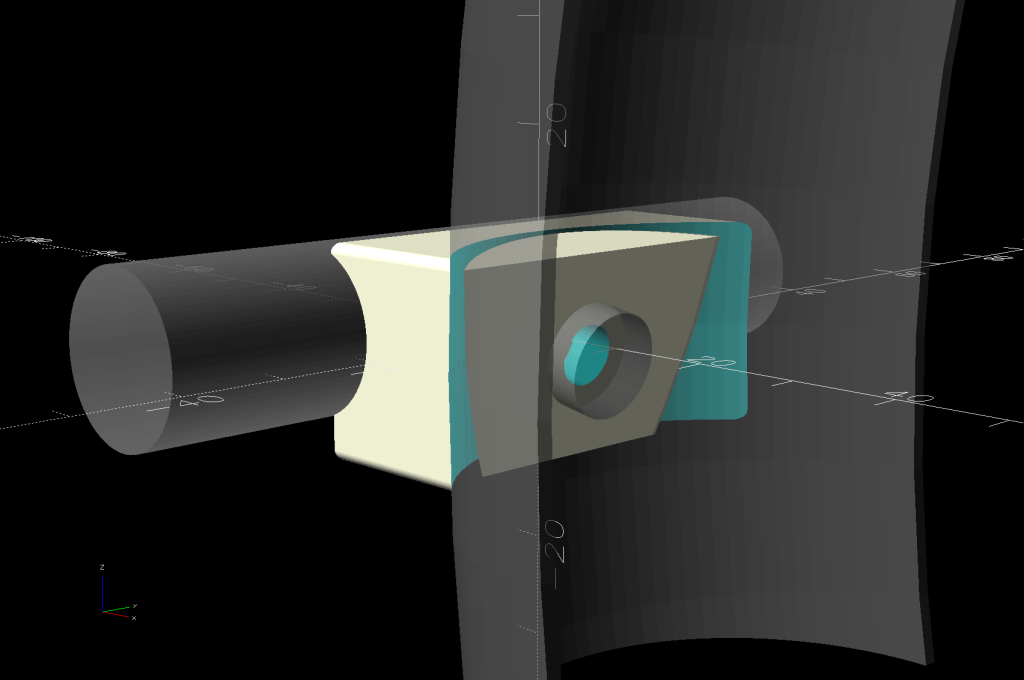
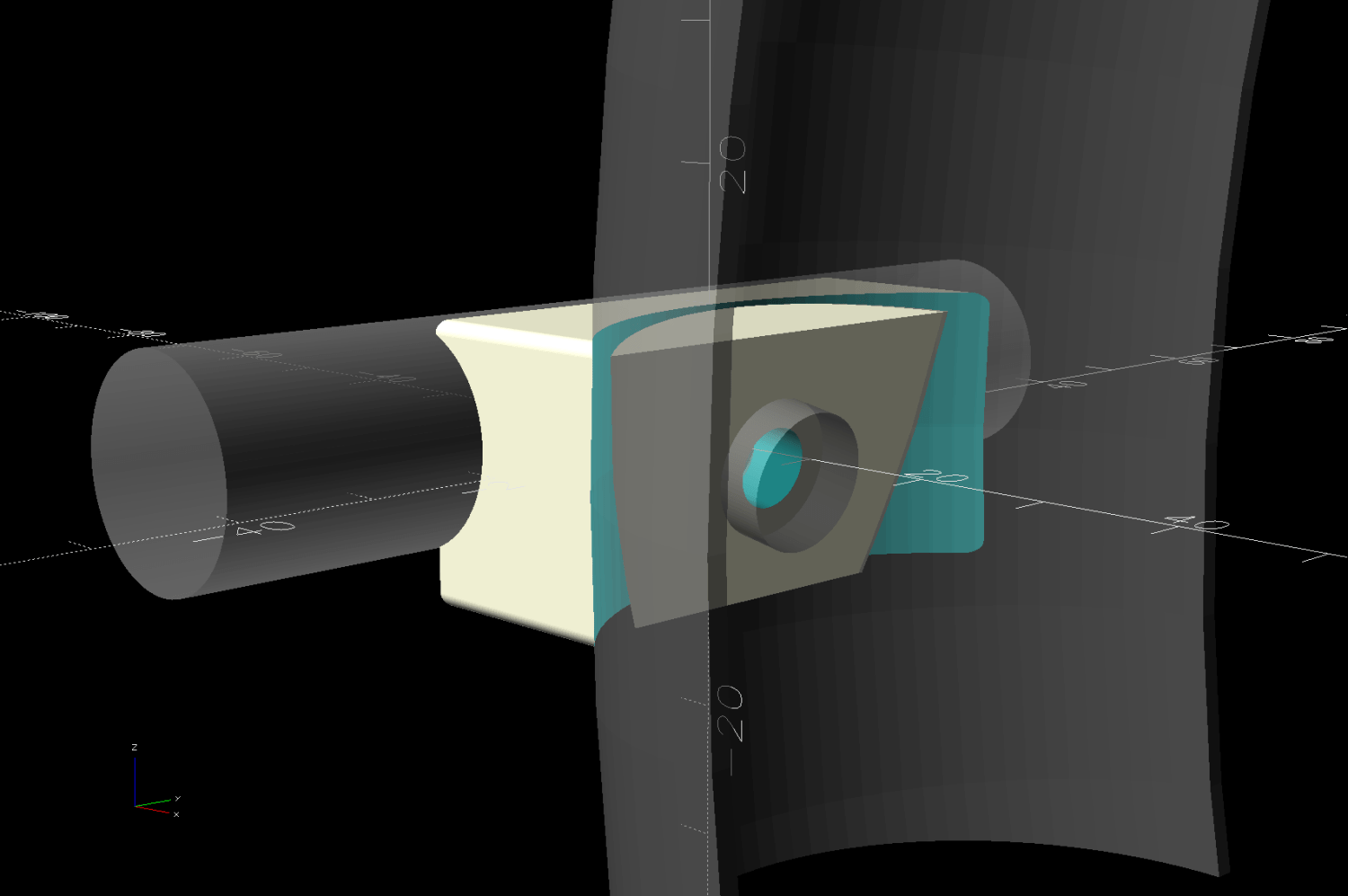
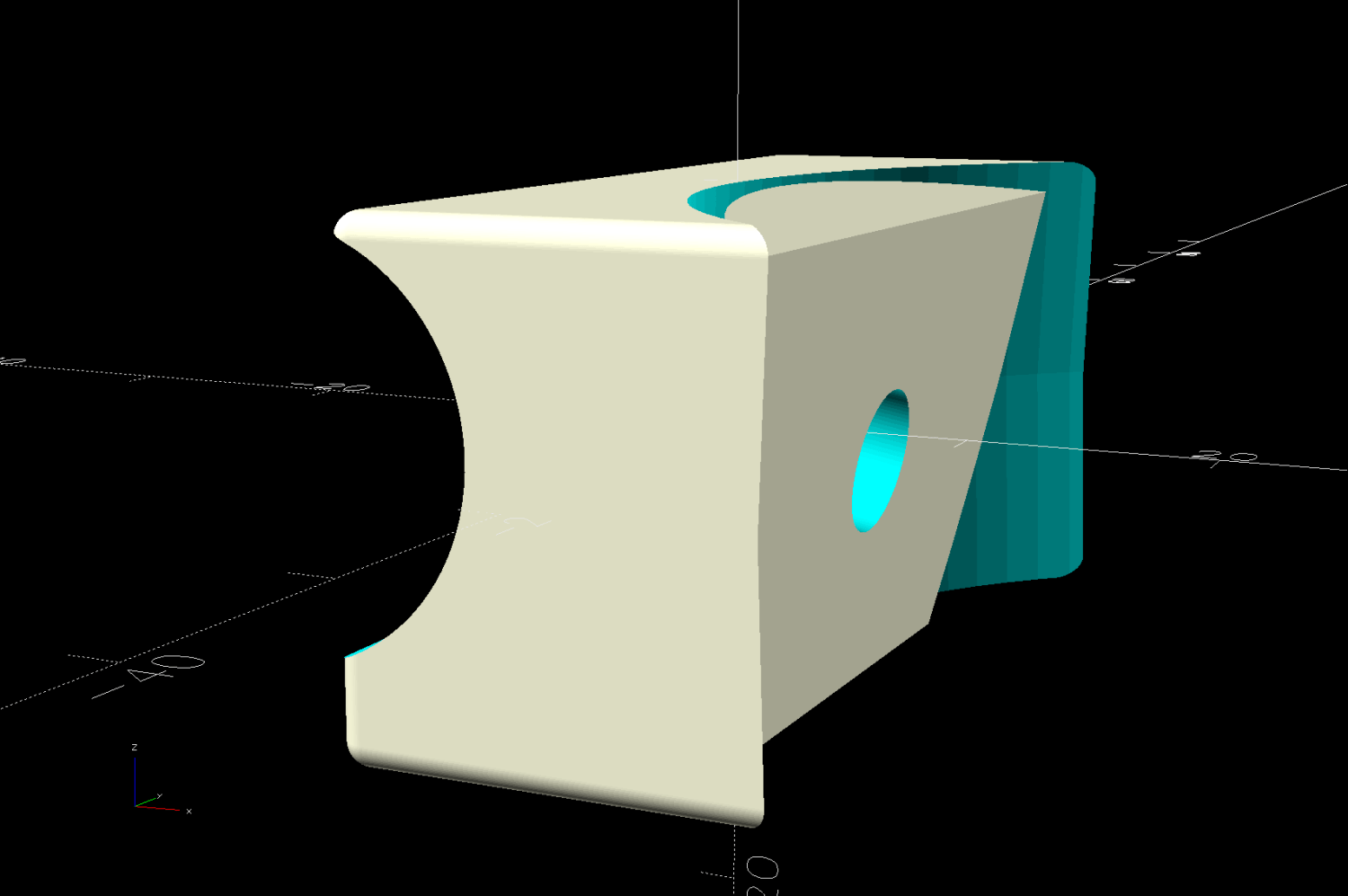
    A 3D printed adapter goes between the desk lamp arm and the lamp heatsink bolt:

    LED Lamp Driver case - arm adapter - solid model
    LED Lamp Driver case – arm adapter – solid model

    The OpenSCAD source code files for the case and adapter arm as a GitHub Gist:

    // LED Lamp arm adapter
    // Ed Nisley – KE4ZNU
    // 2026-03-18
    include <BOSL2/std.scad>
    Layout = "Adapter"; // [Show,Build,ArmClamp,SinkClamp,Adapter]
    /* [Hidden] */
    HoleWindage = 0.2;
    Protrusion = 0.01;
    Gap = 5.0;
    $fn=5*3*4;
    HoleOC = 45.0;
    ArmRad = 7.5;
    ArmWidth = 11.3;
    SinkOD = 11.5;
    SinkThick = 3.2;
    SinkOC = 20.0;
    ClampThick = 5.0; // outside sink, watch thinning due to hull()
    // Define things
    // Screw & bushings in lamp arm bracket
    // … over-long bushings to prevent coincident surfaces
    module ArmClamp() {
    BushingThick = 1.5;
    BushingOD = 9.0;
    union() {
    ycyl(ArmWidth,d=4.0 + HoleWindage); // central M4 screw
    for (j=[-1,1]) {
    back(j*(ArmWidth – BushingThick + Protrusion)/2)
    ycyl(BushingThick + Protrusion,d=BushingOD);
    back(j*(ArmWidth + 10)/2)
    cuboid([2*ArmRad,10,2*ArmRad]);
    }
    }
    }
    module SinkClamp() {
    union() {
    ycyl(2*SinkOC,d=6.0 + HoleWindage); // central M6 screw
    for (j=[-1,1])
    back(j*SinkOC/2) {
    ycyl(SinkThick + Protrusion,d=SinkOD);
    cuboid([SinkOD,SinkThick + Protrusion,2*SinkOD]);
    }
    }
    }
    module Adapter() {
    difference() {
    hull() {
    right(HoleOC)
    ycyl(ArmWidth,r=ArmRad);
    ycyl(SinkOC + SinkThick + 2*ClampThick,d=SinkOD);
    }
    right(HoleOC)
    ArmClamp();
    SinkClamp();
    }
    }
    // Build it
    if (Layout == "ArmClamp")
    ArmClamp();
    if (Layout == "SinkClamp")
    SinkClamp();
    if (Layout == "Adapter")
    Adapter();
    if (Layout == "Build")
    up(SinkOD/2)
    yrot(-atan((ArmRad – SinkOD/2)/HoleOC))
    Adapter();
    // LED Constant-current driver case
    // Ed Nisley – KE4ZNU
    // 2026-03-15
    include <BOSL2/std.scad>
    Layout = "Show"; // [Show,Build,Case,Lid,LidSVG,Switch]
    /* [Hidden] */
    ThreadThick = 0.2;
    HoleWindage = 0.2;
    Protrusion = 0.01;
    Gap = 5.0;
    WallThick = 1.8;
    TapeThick = 1.5;
    DriverOA = [48.5,13.5 + TapeThick,23.5]; // PCB forward Y, pots along top to rear
    SinkOA = [31.5,12.0,15.5]; // fins forward
    SinkOffset = [(DriverOA.x – SinkOA.x)/2,0,2.0]; // from lower left front corner of PCB
    AdjPots = [14,24,34]; // screwdriver adjust offsets
    AdjOD = 3.0; // … access hole dia
    CaseOA = DriverOA + [2*WallThick,2*WallThick,2*WallThick];
    echo(CaseOA=CaseOA);
    LidOA = [CaseOA.x – WallThick,CaseOA.z – WallThick,1.0];
    Cables = [8.0,3.0 + WallThick/2,LidOA.z];
    SwitchWireOC = DriverOA.x – 6.0;
    SwitchCapBase = [DriverOA.x + WallThick,DriverOA.y + WallThick];
    SwitchCapTop = [DriverOA.x,12.0];
    SwitchCavity = [25.0,10.5,5.5];
    // Define things
    module Lid() {
    difference() {
    cuboid(LidOA,anchor=BOTTOM+FWD+LEFT);
    for (i = AdjPots)
    translate([i,LidOA.y – AdjOD/2 – WallThick/2,-Protrusion])
    cyl(LidOA.z + 2*Protrusion,d=AdjOD,anchor=BOTTOM,$fn=8,spin=180/8);
    translate([LidOA.x/2,-Protrusion,-Protrusion])
    cuboid(Cables + [0,Protrusion,2*Protrusion],rounding=1.0,edges=[BACK+LEFT,BACK+RIGHT],anchor=BOTTOM+FWD);
    }
    }
    module SwitchBox() {
    difference() {
    prismoid(SwitchCapBase,SwitchCapTop,SwitchCavity.z,anchor=BOTTOM);
    down(Protrusion)
    cuboid(SwitchCavity + [0,0,2*Protrusion],anchor=BOTTOM);
    hull()
    for (i=[-1,1])
    right(i*SwitchWireOC/2)
    zcyl(CaseOA.z,d=3.0,$fn=8,spin=180/8);
    }
    }
    module Case() {
    difference() {
    cuboid(CaseOA,chamfer=WallThick/2,anchor=BOTTOM+FWD+LEFT);
    translate([WallThick,WallThick + Protrusion,WallThick])
    cuboid(DriverOA + [0,WallThick + Protrusion,0],anchor=BOTTOM+FWD+LEFT);
    translate(SinkOffset + [WallThick,WallThick + 2*Protrusion,WallThick])
    cuboid(SinkOA,anchor=BOTTOM+BACK+LEFT);
    for (i=[-1,1])
    translate([i*SwitchWireOC/2 + CaseOA.x/2,CaseOA.y/2,CaseOA.z/2])
    zcyl(CaseOA.z,d=2.0,anchor=BOTTOM,$fn=8,spin=180/8);
    translate([WallThick/2,(CaseOA.y + LidOA.z),WallThick/2])
    xrot(90)
    scale([1,1,2])
    Lid();
    }
    }
    // Build it
    if (Layout == "Switch")
    SwitchBox();
    if (Layout == "Case")
    Case();
    if (Layout == "Lid")
    Lid();
    if (Layout == "LidSVG")
    projection(cut=true)
    Lid();
    if (Layout == "Show") {
    Case();
    translate(SinkOffset + [WallThick,WallThick + 2*Protrusion,WallThick])
    color("Gray",0.7)
    cuboid(SinkOA,anchor=BOTTOM+BACK+LEFT);
    translate([CaseOA.x/2,CaseOA.y/2,CaseOA.z])
    SwitchBox();
    translate([WallThick/2,CaseOA.y,WallThick/2])
    xrot(90)
    color("Gray",0.7)
    Lid();
    }
    if (Layout == "Build") {
    fwd(Gap)
    xrot(90)
    Case();
    translate([CaseOA.x/2,(Gap + CaseOA.y/2),0])
    SwitchBox();
    }
  • HQ Sixteen: Bobbin Winder Adjustment and Unwind Adapter

    HQ Sixteen: Bobbin Winder Adjustment and Unwind Adapter

    The Industrial Age bobbin winder for Mary’s HQ Sixteen long-arm machine bunched the thread on one end of the bobbin, rather than distributing it in even layers as it should. Tinkering with the thread tension setting being unavailing, I settled in for some debugging.

    After filling two bobbins from a spool of the thread Mary uses for practice quilts, I decided I should reuse the thread. Mounting the filled bobbin on a 6 mm horizontal shaft attached to the vertical pin normally locating the spool let the thread pay out in the proper orientation, with a duct-tape lashup holding the shaft in place:

    HQ Sixteen bobbin unwind adapter - expedient version
    HQ Sixteen bobbin unwind adapter – expedient version

    I added the stack of washers to keep the bobbin away from the duct tape after having the tape’s adhesive migrate onto the spinning bobbin.

    The thread from the spool or, in my case, a filled bobbin, passes between a pair of tension disks on its way to the bobbin spun by the motor:

    HQ Sixteen bobbin winder - thread path
    HQ Sixteen bobbin winder – thread path

    A conical spring presses the tension disks together, with the thread clamped between them:

    HQ Sixteen bobbin winder - tension disk overview
    HQ Sixteen bobbin winder – tension disk overview

    The instructions suggest using “the lightest tension possible”, but backing the nut off to hang by its fingernails had no effect. The spring has a bent end passing through the slotted shaft, so rotation of the disks won’t unscrew the nut.

    The washer under the mounting screw left slight scars in the black oxide finish on the fixture, presumably from previous attempts to adjust the thing:

    HQ Sixteen bobbin winder - tension disk base
    HQ Sixteen bobbin winder – tension disk base

    The threaded shaft is not exactly parallel to the base, because the upright arm is slightly over-bent, but I think that has no effect on the outcome, because the thread path doesn’t depend on the disk angle.

    Because the thread accumulated on the outer side of the bobbin (to the right in that picture), I loosened the mounting screw and shoved the fixture all the way to the left. That should, if anything, bias the thread accumulation to the other (inner) side of the bobbin.

    As it turned out, relocating the tension disks caused the thread to distribute evenly across the bobbin, with only occasional hesitations and no significant accumulations; Mary pronounced the result entirely satisfactory.

    The motor dataplate says it runs at 7000 RPM, so the 3/4 inch O-ring drives the 4 inch wheel at about 1300 RPM. This was sufficiently terrifying I immediately set up a triac speed control (intended for a router) to throttle it down, but with the bobbins now filling properly we run the motor at full speed and it fills a bobbin in 23 seconds flat.

    After we filled half a dozen bobbins with blue thread for the quilt project, I conjured an adapter from the vasty digital deep for a snippet of 6 mm rod with a D-shaped end:

    Bobbin Unwind Adapter - solid model - show
    Bobbin Unwind Adapter – solid model – show

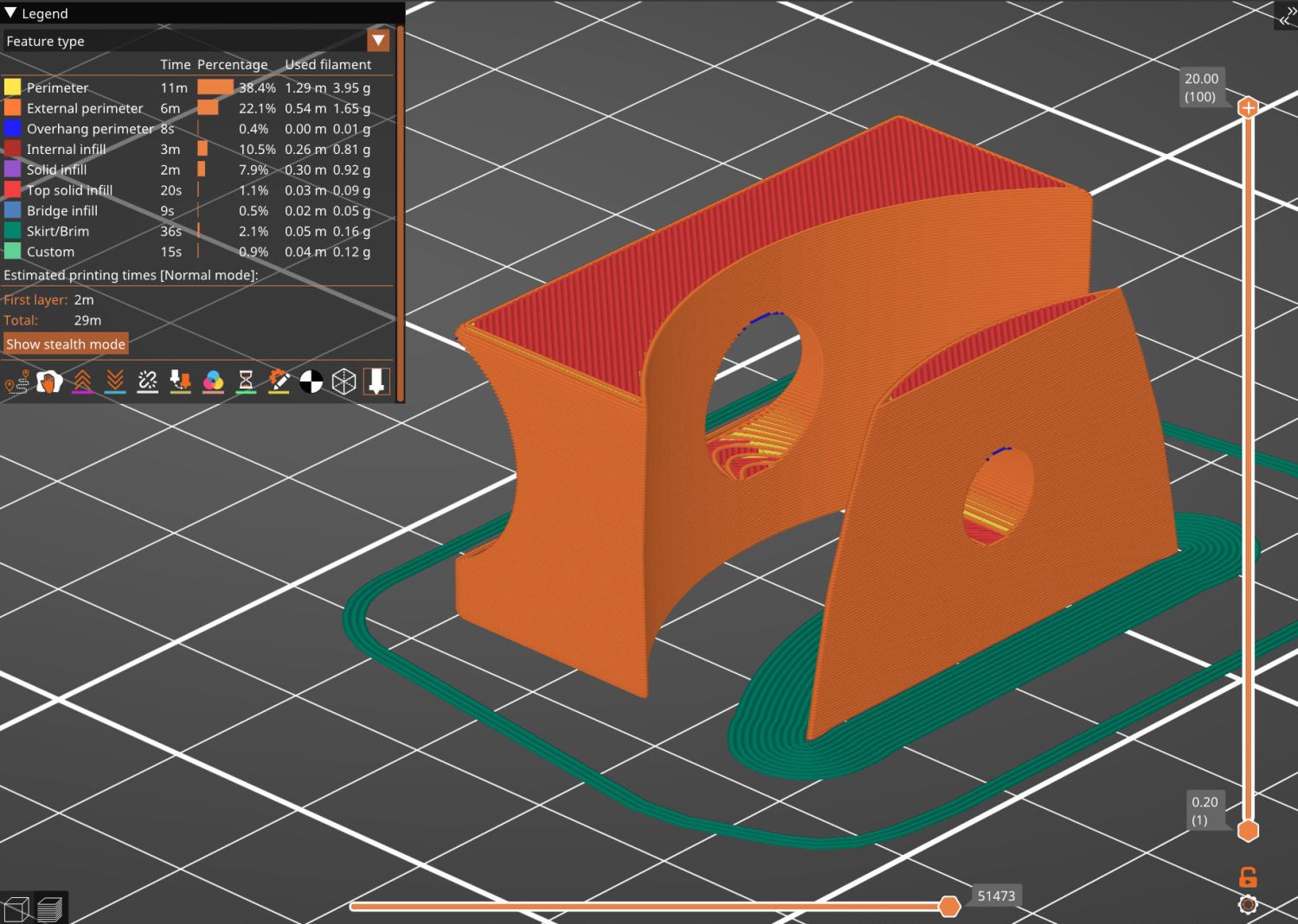
    The adapter builds on one leg, with a brim for stability:

    HQ Sixteen bobbin unwind adapter - on platform
    HQ Sixteen bobbin unwind adapter – on platform

    And looks like it belongs there:

    HQ Sixteen bobbin unwind adapter - installed
    HQ Sixteen bobbin unwind adapter – installed

    It’s now in the box of HQ Sixteen bobbins, where we both hope it will remain undisturbed forevermore.

    Although the vertical pin locating the spools (and holding the adapter) is nominally 6 mm, burrs in the chrome plating prevented the bobbin’s 6 mm bore from sliding over it. In retrospect, that prevented me from just dropping the bobbin on the pin and unwinding the thread over the side of the bobbin, which likely avoided some serious-to-lethal thread tangles.

    After all that debugging, I had several bobbins full of well-worn thread, so:

    • Chuck a chopstick in the mini-lathe
    • Tape thread to chopstick
    • Put bobbin on another 6 mm shaft
    • Run lathe at a reasonable speed
    • Produce what looks very much like a cocoon
    HQ Sixteen bobbin unwind adapter - thread cocoon
    HQ Sixteen bobbin unwind adapter – thread cocoon

    All’s well that ends well.

    The OpenSCAD source code as a GitHub Gist:

    // HQ Sixteen Bobbin Winder – Unwind adapter
    // Ed Nisley – KE4ZNU
    // 2026-03-27
    include <BOSL2/std.scad>
    Layout = "Show"; // [Show,Build]
    /* [Hidden] */
    HoleWindage = 0.2;
    Protrusion = 0.01;
    Gap = 5.0;
    $fn=5*3*4;
    WallThick = 2.0;
    SpoolRodOD = 6.03; // vertical spool rod
    Kerf = 0.5;
    BobbinRodOD = 6.0 + HoleWindage; // horizontal bobbin rod
    BobbinRodDee = 4.95; // … remaining rod
    DeeLength = 20.0; // … recess depth
    DeeRodCyl = 28.0; // … overall rod length
    AdapterOD = BobbinRodOD + 2*WallThick;
    AdapterOAH = 1.5*AdapterOD;
    AdapterOAL = AdapterOD + DeeLength;
    //—–
    // Define things
    // Surplus-deal 6 mm rod with a lengthy flat on one end
    module DeeRod() {
    union() {
    intersection() {
    xcyl(DeeLength + Protrusion,d=BobbinRodOD,anchor=RIGHT);
    down((BobbinRodOD – BobbinRodDee)/2)
    cuboid([DeeLength + Protrusion,BobbinRodOD,BobbinRodDee],anchor=RIGHT);
    }
    xcyl(DeeRodCyl,d=BobbinRodOD,anchor=LEFT);
    }
    }
    module Adapter() {
    difference() {
    union() {
    cyl(AdapterOAH,d=AdapterOD,rounding=WallThick/2);
    xcyl(AdapterOAL – AdapterOD/2,d=AdapterOD,anchor=LEFT);
    }
    zcyl(AdapterOAH + 2*Protrusion,d=SpoolRodOD);
    cuboid([AdapterOD+2*Protrusion,Kerf,AdapterOAH+2*Protrusion]);
    right(AdapterOD/2 + DeeLength + Protrusion)
    DeeRod();
    }
    }
    //—–
    // Build it
    if (Layout == "Show") {
    Adapter();
    color("Green",0.5)
    zcyl(3*AdapterOAH,d=SpoolRodOD);
    color("Magenta",0.5)
    right(AdapterOD/2 + DeeLength + Protrusion)
    DeeRod();
    }
    if (Layout == "Build")
    up(AdapterOD/2 + DeeLength)
    yrot(90)
    Adapter();

  • Sickly Skunk

    Sickly Skunk

    Skunks are generally crespecular animals, so seeing this critter in broad daylight was unusual:

    Sickly Skunk
    Sickly Skunk

    That’s taken through two layers of half-century old glass, for obvious reasons.

    What may not be obvious: that skunk was not behaving at all like the ones in our previous sightings. It had unkempt fur, staggered around the house twice while twitching uncontrollably, slumping face-down, and falling on its side. I am not qualified to diagnose animal diseases, but rabies seems likely.

    It eventually staggered off and, we hope, died quietly in a very secluded spot.

    The Town of Poughkeepsie’s Animal Control officer now specializes in dog problems across several towns, with “all other animals” handled by the county’s Department of Health.

  • Corbin K436 Padlock: Shackle Reshaping

    Corbin K436 Padlock: Shackle Reshaping

    After approximately forever, the shackle on the Corbin K436 padlock securing the tandem-length cable we use for the Tour Easy ‘bents refused to push into the body. Lubrication being unavailing, I soaked it in acetone and shook it around for a day to get the inevitable crud out, then pondered the problem.

    Peering into the hole where the shackle enters the body showed the situation:

    Corbin padlock - cam damage
    Corbin padlock – cam damage

    Half a century (more or less: it didn’t accumulate those nicks & dings & tarnish last year) of pushing the shackle into the lock eroded the locking cam, to the extent that the cam no longer slides sideways to let the shackle slide the rest of the way into the body.

    So I introduced the shackle to Mr Bench Grinder and reshaped the end to hit the cam farther down on its angled side:

    Corbin padlock - reshaped shackle
    Corbin padlock – reshaped shackle

    While that certainly reduces the strength of the shackle, there’s a similar notch engaging a similar cam on the other end of the shackle, so it remains as secure as it must be for our simple needs.

    Spraying silicone lube into the body and applying a dab of silicone grease to the cam restored the lock to (nearly) new condition.

    The riding season approaches!

  • Quilting Ruler Pencil Guides: Acrylic

    Quilting Ruler Pencil Guides: Acrylic

    I cut some transparent acrylic pencil guides to go along with the 45° Triangle Ruler:

    Quilting Ruler Pencil Guides
    Quilting Ruler Pencil Guides

    The guides along the rear are the 3D printed versions from a decade ago.

    The three transparent guides taught us:

    • 4 mm is better than 3 mm
    • Entirely transparent guides vanish on the table

    So the engraved ring on the two in the front row carries a cheerful Sharpie color to make them stand out. I wanted to use fluorescent acrylic, but I don’t have any 4 mm sheets and stacking a pair of 3 mm sheets → 6 mm will be too thick for the pencil tip.

    What looks like dirt on the red guide comes from internal reflections or the lack thereof: it’s perfectly transparent in person, honest.

  • Custom 45° Triangle Quilting Ruler

    Custom 45° Triangle Quilting Ruler

    Mary’s current quilt project has a corner design with an essentially infinite number of 45° triangles, which another custom ruler will simplify:

    45° Quilting Ruler - finished
    45° Quilting Ruler – finished

    That’s the end result of several iterations, proceeding from doodles to sketches to increasingly accurate laser-cut prototypes:

    45° Quilting Ruler - prototypes
    45° Quilting Ruler – prototypes

    A “ruler” in quilting parlance is a thing guiding the sewing machine’s “ruler foot” across the fabric (or, for sit-down machines, the fabric under the foot) in specific directions:

    45° Quilting Ruler - in use
    45° Quilting Ruler – in use

    That’s a practice quilt on scrap fabric: quilters need prototypes, too!

    The foot is 0.5 inch OD, within a reasonable tolerance, which accounts for the slot width in the ruler. It’s also intended to run against 1/4 inch thick rulers, which accounts for the thickness of that slab of acrylic.

    The engraved lines & arcs are on the bottom of the ruler to eliminate parallax errors against the fabric, so the bottom is upward and the text is mirrored for the laser:

    45° Quilting Ruler - cutting
    45° Quilting Ruler – cutting

    Although fluorescent green acrylic may have higher visibility, clear seems adequate for the fabric in question:

    45° Quilting Ruler - colored fabric
    45° Quilting Ruler – colored fabric

    I very carefully trimmed the arcs against the ruler outline using LightBurn’s Cut Shapes, which turned out to be a Bad Idea™, because the high-current pulse as the laser fires causes a visible puncture wound at the still-to-be-cut edge:

    45° Quilting Ruler - edge damage
    45° Quilting Ruler – edge damage

    Those are not straight lines and the plastic isn’t bent!

    A closer look:

    45° Quilting Ruler - edge damage - detail
    45° Quilting Ruler – edge damage – detail

    The arcs without wounds started from their other end and stopped at the edge, which is perfectly fine.

    The wounds are unsightly, not structural, but the next time around I’ll extend the markings a millimeter beyond the edges into the scrap material.

    The overall design looks busier than it is, because I put different features on different layers in case they needed different settings:

    45 Degree Quilting Ruler - LightBurn layout
    45 Degree Quilting Ruler – LightBurn layout

    The LightBurn SVG layout as a GitHub Gist:

    Loading
    Sorry, something went wrong. Reload?
    Sorry, we cannot display this file.
    Sorry, this file is invalid so it cannot be displayed.
  • Star Quilting Ruler Salvage: Laser Recutting

    Star Quilting Ruler Salvage: Laser Recutting

    Mary picked up a pair of Star quilting rulers from the Quilting Guild’s “exchange” table:

    Star quilting ruler - finished
    Star quilting ruler – finished

    They’re 1/4 inch laser-cut acrylic slabs dating back to the turn of the millennium, when laser cuttery wasn’t nearly as common as today. Apparently, the (now long gone) Gadget Girls had a problem with their laser: the larger star had eight of its ten lines not cut completely through the acrylic. The protective paper on the back had small perforations along a few of the lines, but nothing for most of them.

    Well, I can fix that.

    Lay the slab on the platform and lock it in place so it cannot move:

    Star quilting ruler - laser setup
    Star quilting ruler – laser setup

    That’s with the original bottom side facing upward, so the laser beam will hit the uncut part of the lines.

    Focus the laser atop some scrap 1/4 inch acrylic, then verify the red dot pointer is exactly concentric with the CO₂ beam by firing a test pulse, as in this punched card:

    Red dot vs printed target vs laser spot alignment
    Red dot vs printed target vs laser spot alignment

    Adjust as needed.

    Jog the laser to put the red dot pointer exactly at a star point:

    Star quilting ruler - laser point alignment
    Star quilting ruler – laser point alignment

    Hit Get Position in the Laser window so LightBurn knows where the laser head is located.

    I’ve added the targets I normally use for LightBurn’s Print and Cut alignment to its Art Library, so I dragged one to the workspace, then hit Move to Laser Position to snap the target directly onto that point of the star.

    Repeat for vertices along the star, then draw a multi-segment line = path between the target centers:

    Star Ruler Re-cutting - LightBurn layout
    Star Ruler Re-cutting – LightBurn layout

    That’s one continuous path from the upper right, counterclockwise around the star, ending in the center right. The missing pair of lines (and the vertex between them) were already cut, so I didn’t need to locate them.

    The camera view shows the alignment, although IMO the camera simply isn’t capable of such finicky alignment:

    Star Ruler Re-cutting - LightBurn layout overlay
    Star Ruler Re-cutting – LightBurn layout overlay

    As a confidence builder, I selected each target, moved the laser to that point, then fired a test pulse to verify the hole hit the vertex. In most cases, I couldn’t see the hole because it was within the original cut.

    My 60 W laser can’t cut through 1/4 inch = 6 mm acrylic in a single pass, so I use a 10 mm/s @ 60% pass to get most of the way through and a 20 mm/s @ 60% pass to complete the cut. That seemed excessive for a mostly cut path, but a single 20 mm/s @ 60% pass didn’t completely clear the uncut sections.

    So I used the normal two-pass cut and the star lifted right out:

    Star quilting ruler - victory
    Star quilting ruler – victory

    Happy dance!

    Although it is not obvious from the pictures, the star is not symmetric: it fits into the sheet in only one of its ten possible orientations. I will never know if that was a deliberate stylin’ decision or the result of hand layout before CAD spread throughout the land.

    I managed to locate the vertices so accurately that the repeated cuts left edges indistinguishable from the original cuts on the two free sides, which was a pleasant surprise.

    Mary promises to do something with those stars when she’s done with her current project(s). She may want the slab of acrylic around the large star trimmed into a smaller and more manageable decagon, in which case I will suddenly have a bounty of thick fluorescent green acrylic.