Ed Nisley's Blog: Shop notes, electronics, firmware, machinery, 3D printing, laser cuttery, and curiosities. Contents: 100% human thinking, 0% AI slop.
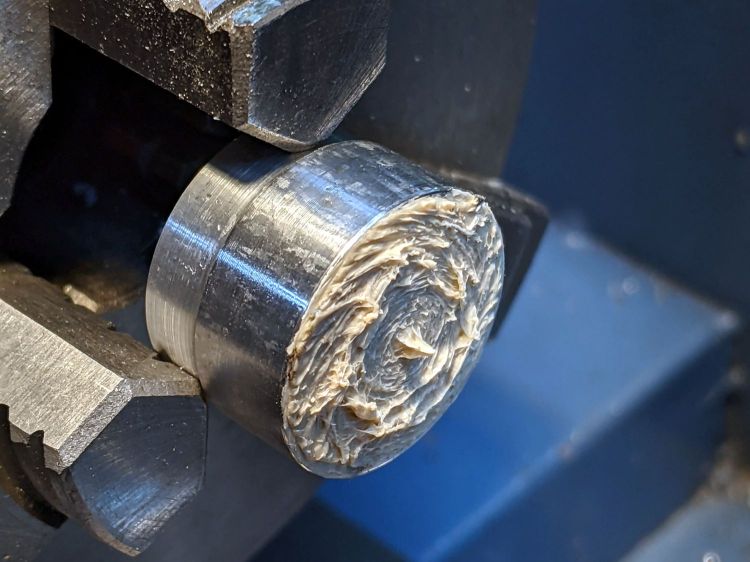
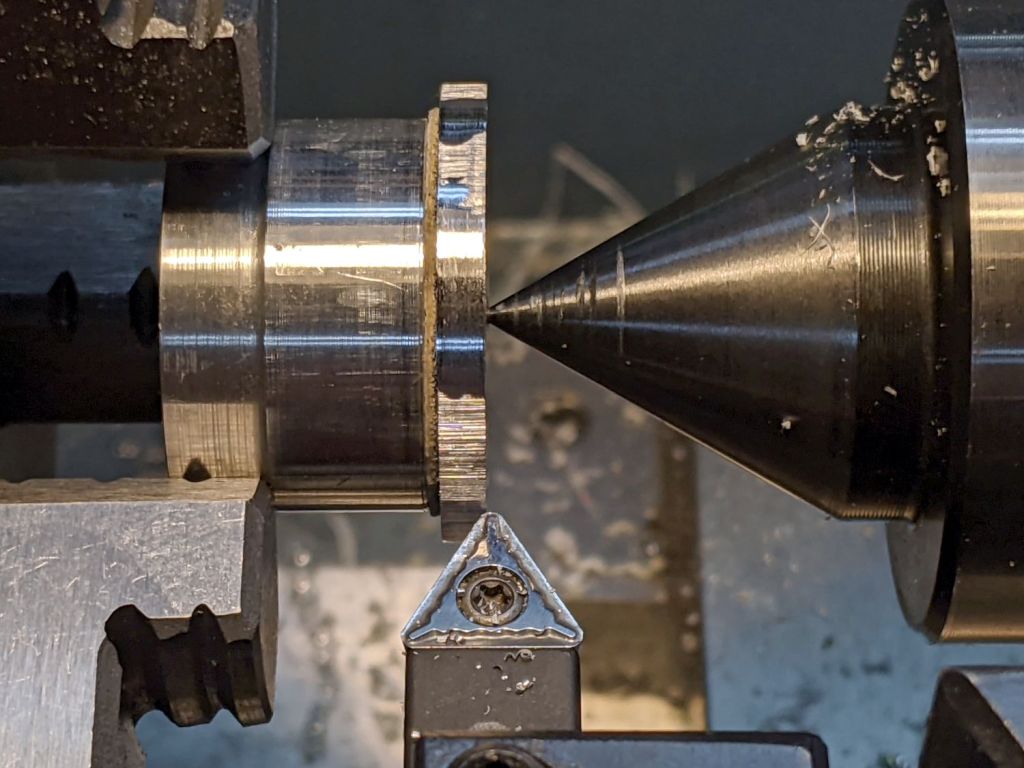
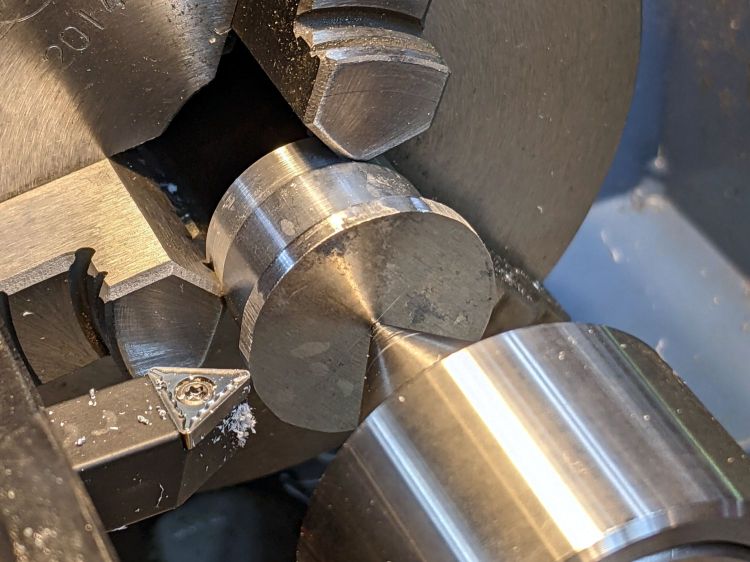
The same lathe fixture and double-sided duct tape trick I used for the amber running light’s end cap should have worked for this one, but only after I re-learned the lesson about taking sissy cuts:
Tour Easy Rear Running Light – end cap fixture – swirled adhesive
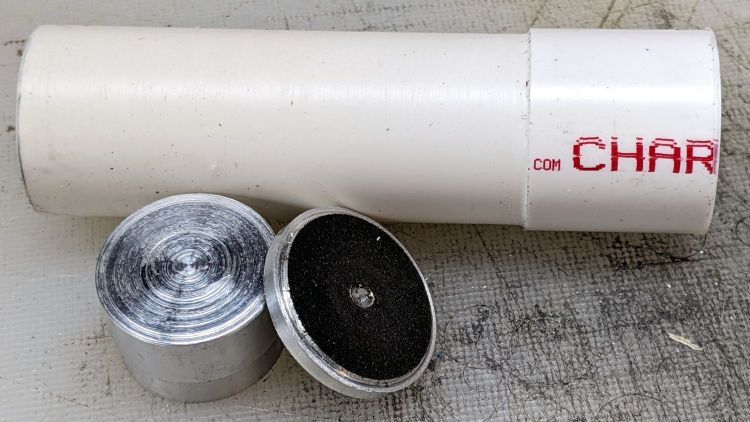
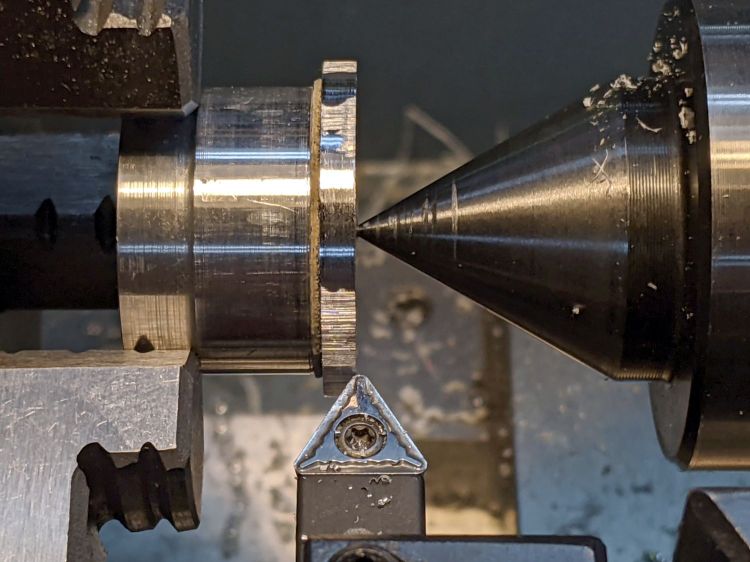
Yet another snippet of tape and sissy cuts produced a better result:
Tour Easy Rear Running Light – end cap
Protip: when you affix an aluminum disk bandsawed from a scrap of nonstick griddle to a lathe fixture, the adhesive will grip the disk in only one orientation.
The Micro-Mark bandsaw has a metal blade guide below the table that contributes to the awful noise it makes while running, even when it’s not cutting anything. Having recently touched the Delrin = acetal rod stash, a simple project came to mind.
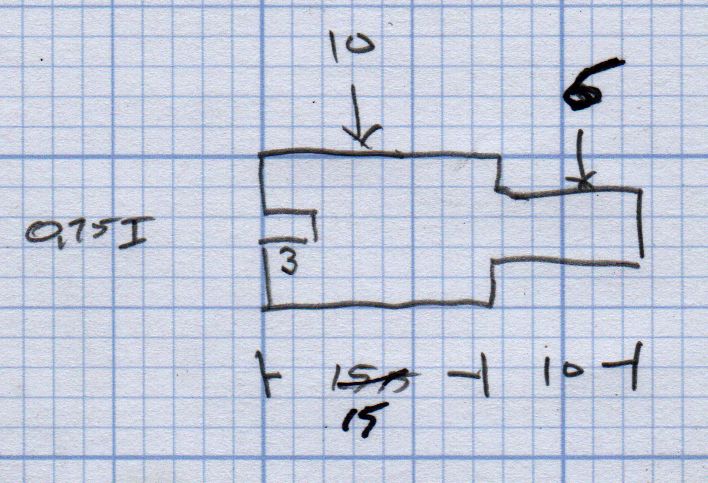
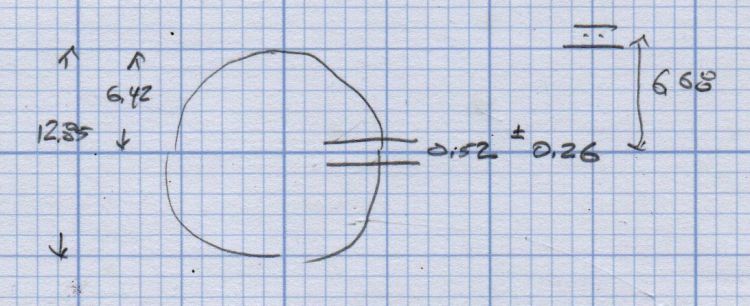
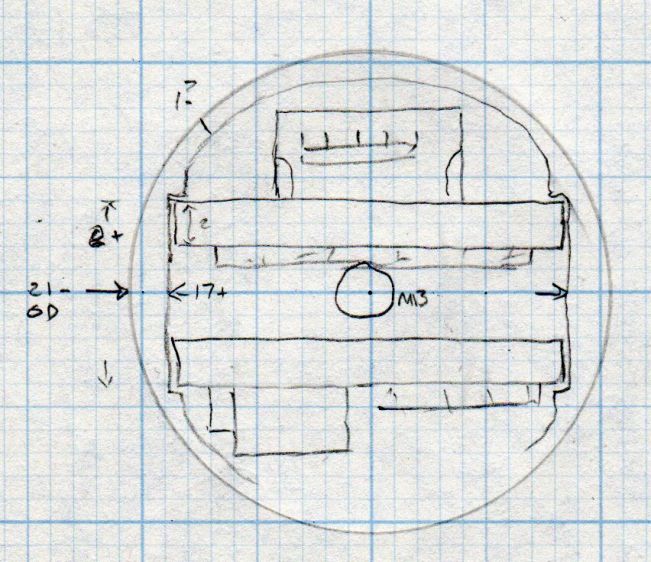
A doodle with the original metal guide dimensions:
Micro-Mark Bandsaw – metal blade guide dimensions
The 10 mm dimension is non-critical, so I started with a 1/2 inch acetal rod and turned the stub end to match.
A doodle suggested how to carve the slot with a 20.5 mil = 0.52 mm slitting saw, with the offset from a Z touchoff at the top:
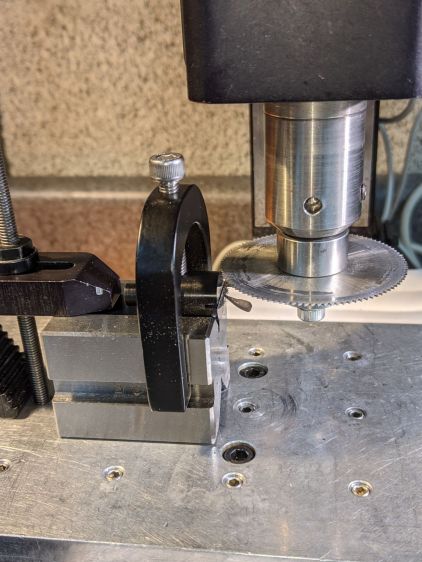
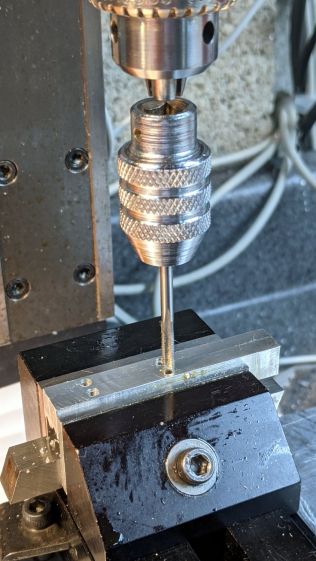
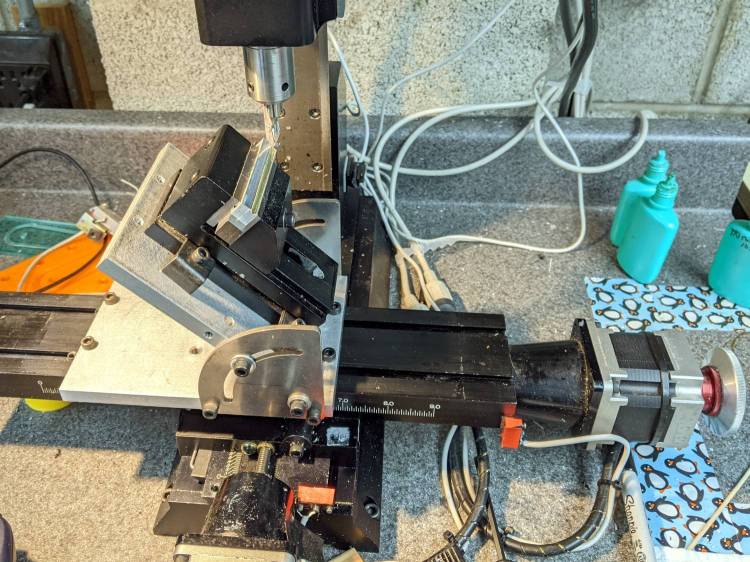
The V block setup required swapping out the overly long OEM screw for a shorter 5 mm SHCS to clear the Sherline’s motor:
Micro-Mark Bandsaw – acetal guide slitting
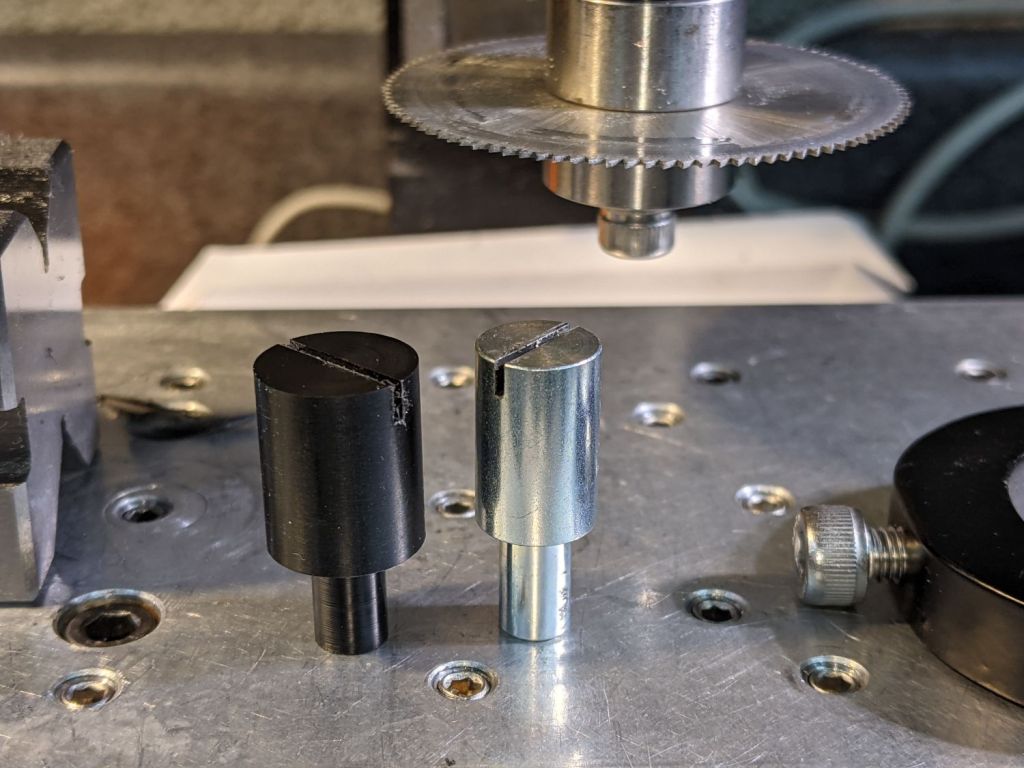
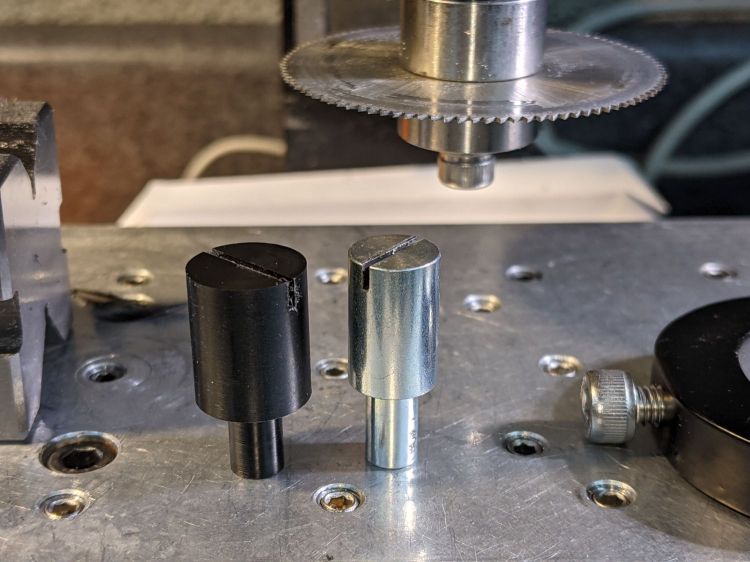
The end result looked pretty good:
Micro-Mark Bandsaw – acetal vs steel blade guides
And it looks like it pretty much belongs in the saw:
Micro-Mark Bandsaw – acetal blade guide installed
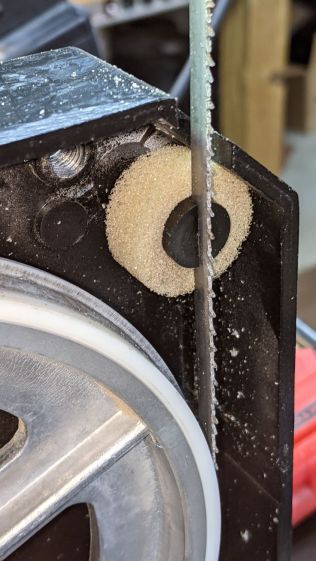
The 6 mm stud goes into a hole in the frame, where a setscrew holds it in place. You must remove the blade to extract / replace the guide, with the correct position having the end of the slot just touching the back of the blade.
The foam ring apparently keeps crud away from the stud on the backside; I doubt it’s mission-critical.
The saw became somewhat quieter; the ball bearing guides above the table now generate most of the racket. At some point I’ll try replacing them with a block, probably made from UHMW, with a simple slit to guide the blade.
Plastic guides may not last as long as the steel ones, but occasional replacements will be worth it if the saw runs quieter.
A depth gauge arrived with a 3/8 inch = 9.5 mm mounting rod that fit one of my magnetic bases, but another base in my collection has a 5/16 inch = 7.9 mm clamp. Having recently rummaged through the aluminum rod stash, this happened:
Depth Gauge mounting rods
The original rod at the top has an M6 thread, the drawer of random M6 screws provided suitable volunteers, and a bit of lathe work removed / shaped their heads accordingly.
The shorter rod has a blind hole, with a dab of epoxy holding the headless screw in place. Not that it matters, but the lathe held them in alignment for curing:
Depth Gauge mounting rod – epoxy alignment
The longer rod got drilled all the way through, with more epoxy holding the screw, and, even with a relatively loose fit, no worries about alignment.
The longer rod gets the clamp away from the depth gauge’s base plate for better positioning:
My initial doodles suggested an end cap with an opening for the Arduino’s USB port and something for the power cable from the Bafang controller:
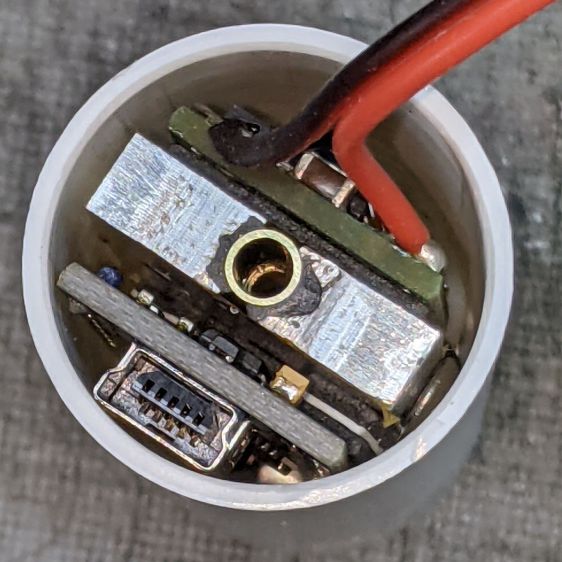
1 W LED Running Light – internal assembly
Common sense finally broke out and I made a simple disk cover held in place with an M3 screw:
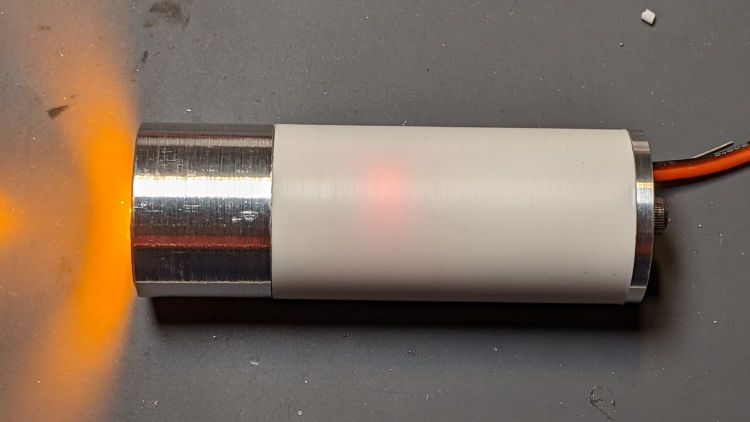
1 W Amber Running Light – bench test
Unfortunately, I cut the PVC shell flush with the USB port, which meant the cap couldn’t have a little shoulder to stabilize it on the shell. Maybe next time?
Machining the disk required using the scrap of aluminum rod left over from the heatsink as a fixture with a piece of sandpaper stuck to the front surface:
1 W Amber Running Light – end cap setup
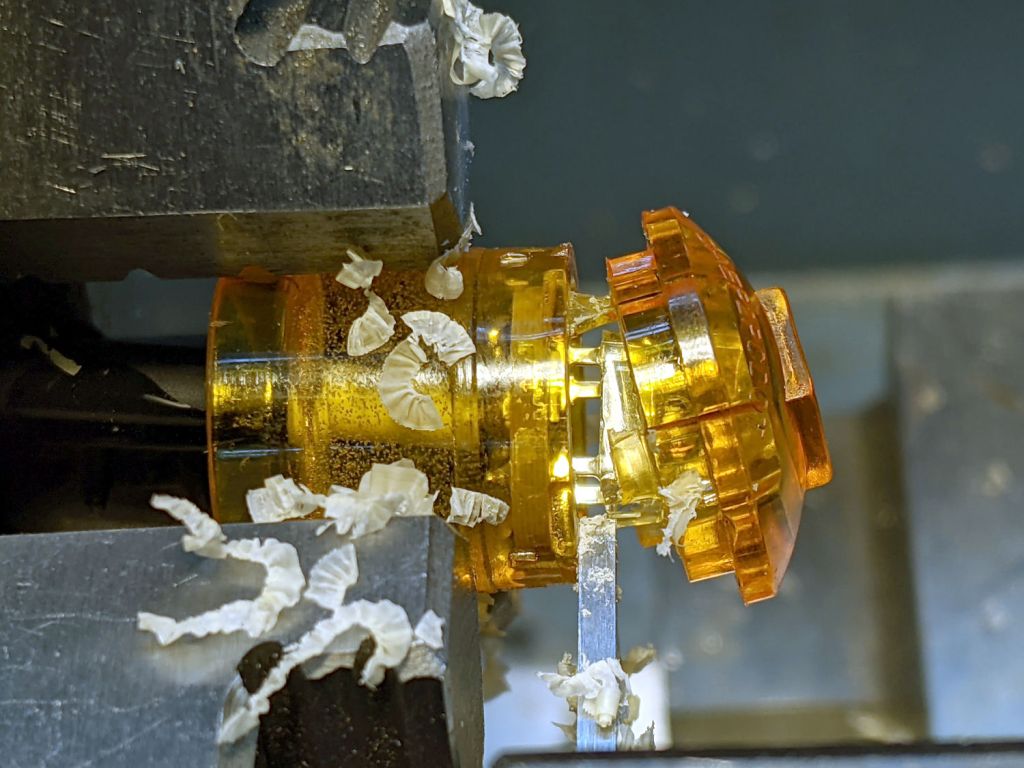
The live center presses the bandsawed + disk sanded cap against the sandpaper, providing barely enough traction for sissy cuts reducing the disk to the proper diameter:
1 W Amber Running Light – end cap turning
It actually worked pretty well, although next time I’ll skip the sandpaper, affix the disk directly to the double sided duct tape, and be done with it.
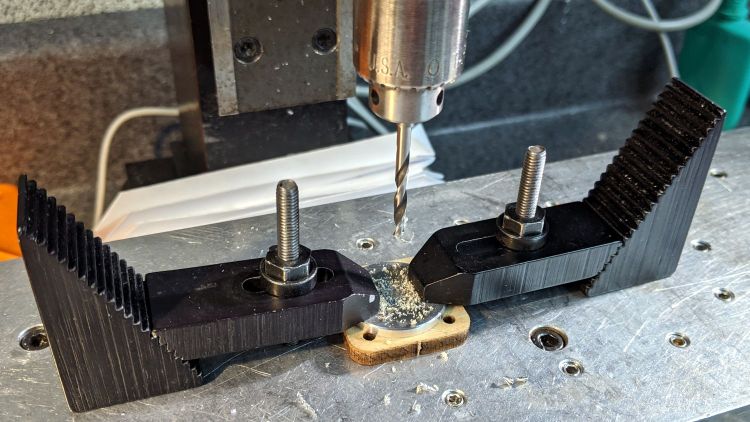
Line up the center punch dimple and drill a hole for the M3 screw:
1 W Amber Running Light – end cap drilling
The power cable port turned into a little slot bandsawed into the edge of the disk with the sharp edges filed off.
Basically, the thing needs some road testing before I build one for real …
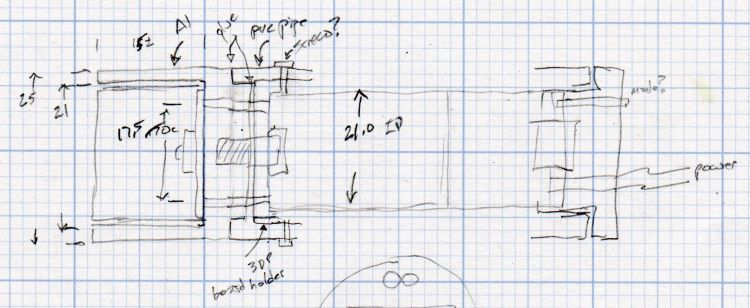
A somewhat more detailed doodle of the end view prompted me to bore the PVC pipe out to 23 mm:
Amber running light – board layout doodle – end
The prospect of designing a 3D printed holder for the boards suggested Quality Shop Time combined with double-stick foam tape would ensure a better outcome.
So I bandsawed the remains of a chunky angle bracket into a pair of rectangles, flycut All The Sides to square them up, and tapped a pair of M3 holes along one edge of each:
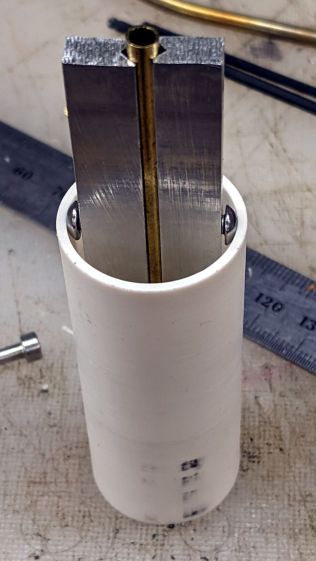
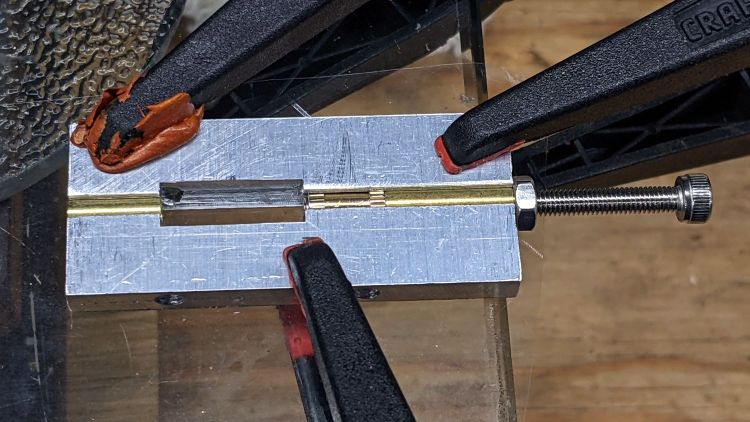
The groove holds a length of 4 mm OD (actually 5/32 inch, but don’t tell anybody) brass tubing:
1 W LED Running Light – baseplate trial fit
The M3 button head screws are an admission of defeat, as I could see no way of controlling the width + thickness of the aluminum slabs to get a firm push fit in the PVC tube. The screws let me tune for best picture after everything else settled out.
A little more machining opened up the top of the groove:
1 W LED Running Light – baseplate dry assembly
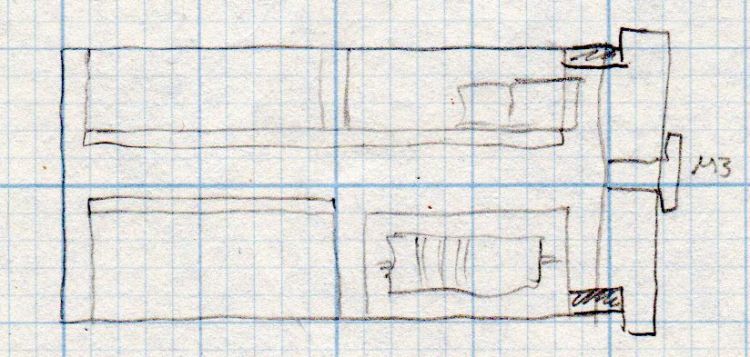
A short M3 button head screw (with its head turned down to 4 mm) drops into the slot and holds the slab to the threaded hole in the LED heatsink. The long screw is holding the threaded insert in place for this dry fit.
I doodled a single long screw through the whole thing, but having it fall off the heatsink when taking the rear cover off seemed like a Bad Idea™. An M3 button head screw uses a 2 mm hex key that fits neatly through the threaded insert, thereby making it work.
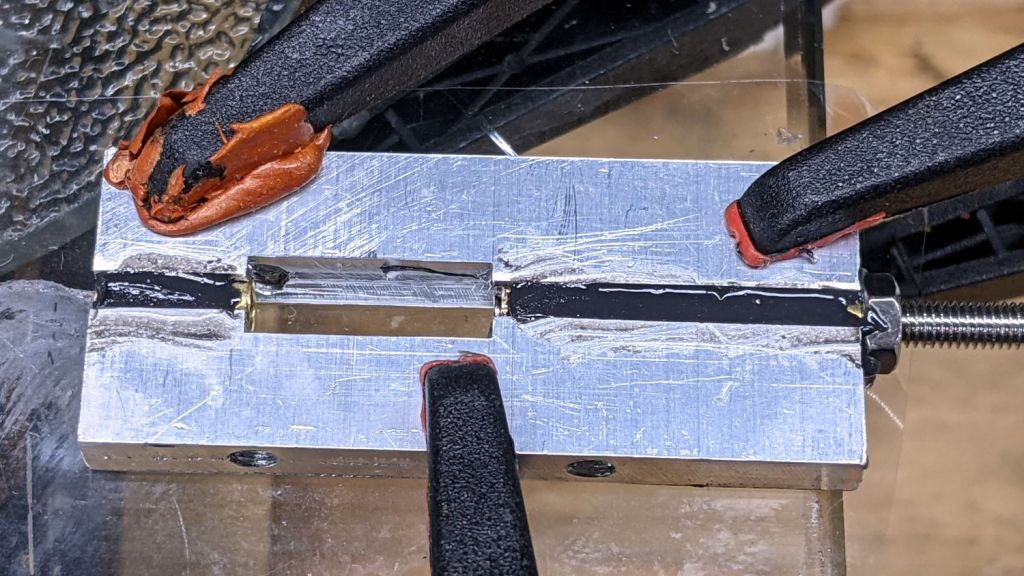
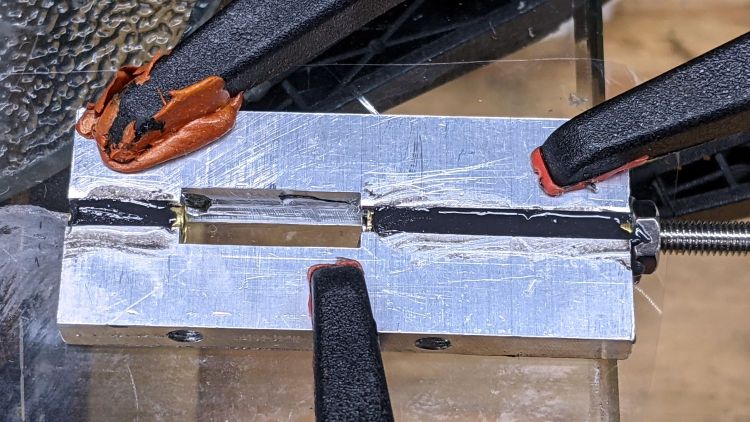
Butter it up with epoxy, scrape off the excess, and let things cure:
A pleasant evening at a virtual Squidwrench meeting produced the raw shape of the front end from a 1 inch aluminum rod:
1 W LED Running Light – heatsink raw
Trace the outline of the LED’s PCB inside the cylinder just for comfort, align to the center, and drill two holes with a little bit of clearance:
1 W LED Running Light – heatsink drilling
For the 24 AWG silicone wire I used, a pair of 2 mm holes 8.75 mm out from the center suffice:
1 W LED Running Light – heatsink fit
Gnaw some wire clearance in the lens holder:
1 W LED Running Light – wiring
Tap the central hole for an M3×0.5 screw, which may come in handy to pull the entire affair together.
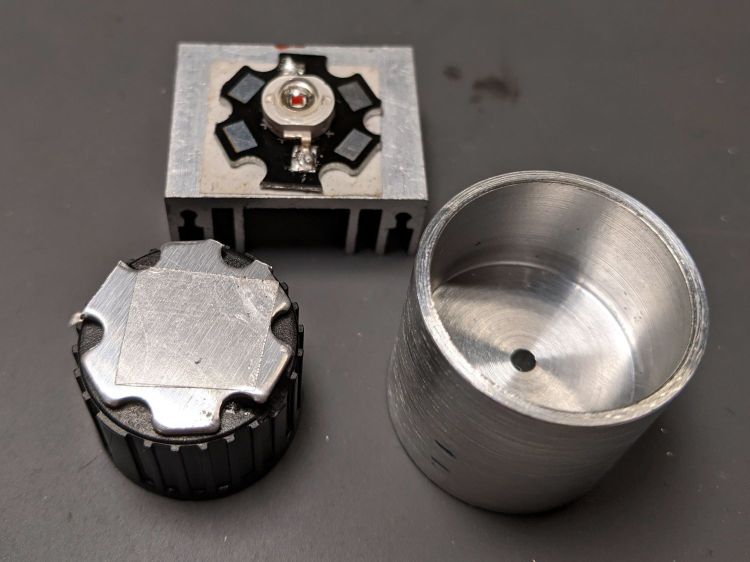
Epoxy the PCB onto the heatsink with the lens holder keeping it aligned in the middle:
1 W LED Running Light – heatsink clamp
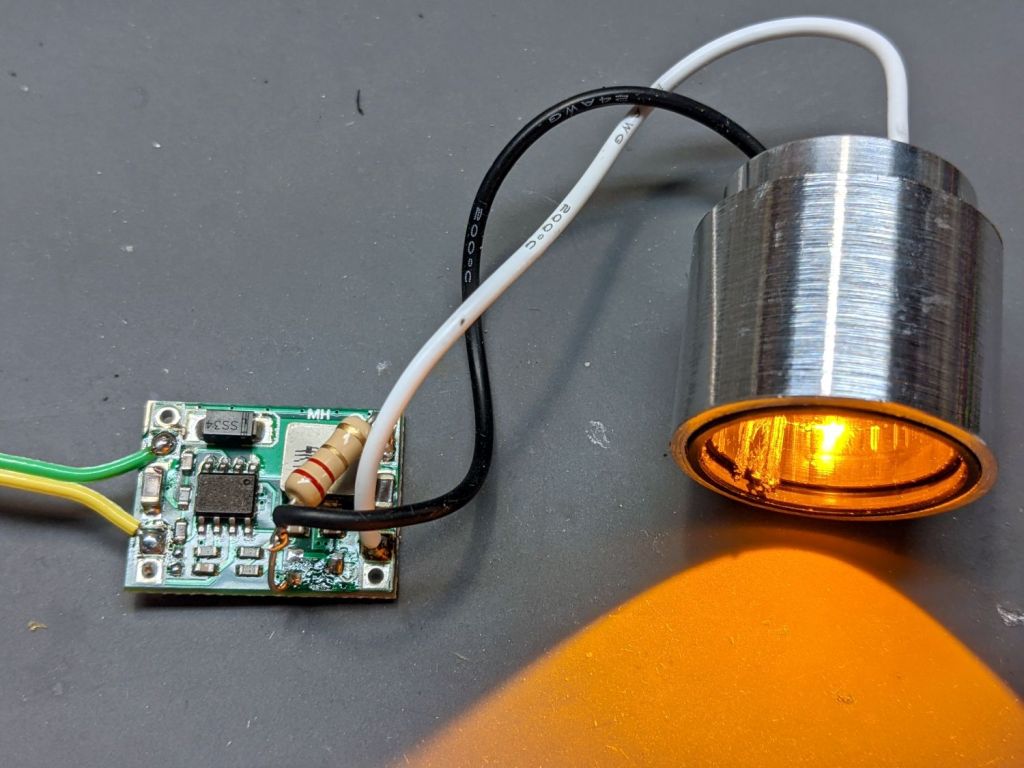
Then see how hot it gets dissipating 900 mW with 360 mA of current from a 2.2 Ω resistor:
1 W LED Running Light – heatsink test
As you might expect, it gets uncomfortably warm sitting on the bench, so it lacks surface area. The first pass will use a PVC cylinder for easy machining, but a full aluminum shell would eventually be a nice touch.
A doodle with some dimensions and aspirational features:
Running Light – 1 W LED case doodle
Even without a lens and blinkiness, it’s attention-getting!
The cut is just in front of the PCB and went slowly to avoid clobbering the SMD resistors very near the edge.
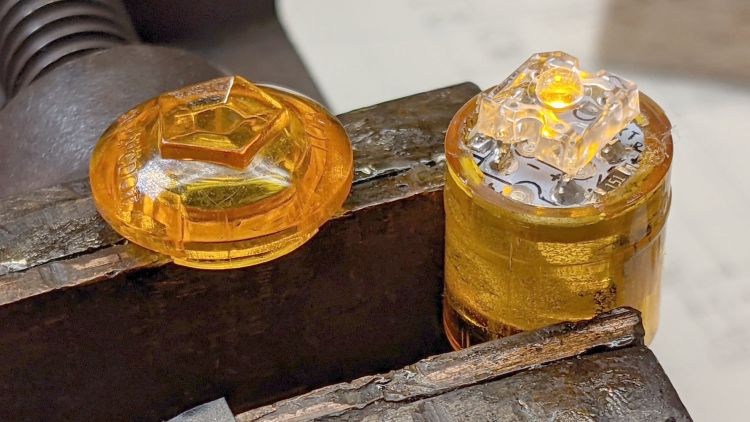
The cataract turned out to be crud adhered to the LED lens:
Side Marker E – LED cataract
Brutal surgery removed the LED and installed a replacement:
Side Marker E – replacement LED
The PCB had two 150 Ω SMD resistors for use with 12-ish V automotive batteries. While I had the hood up, I removed one and shorted across its pads to make the LED work with the 6 V switched headlight supply from the Bafang motor.
In round numbers, 6 V minus 2.2 V forward drop divided by 150 Ω is about 25 mA. The original LED ran at 35-ish mA, but it’s close enough.
Glue the lens back in place:
Side Marker E – clamping case
The bubbly stuff is solid epoxy from the original assembly, which is why removing the PCB is not an option.
The new LED is no more off-center than any of the others:
Side Marker E – new LED – front
It does, however, sit much closer to the lens, due to the ring of plastic I cut away to get inside. As a result, the beam is mostly a single centered lobe with only hints of the five side lobes; there isn’t much waste light from the side of the LED into those facets.






 The Smell of Molten Projects in the Morning