The Smell of Molten Projects in the Morning

Ed Nisley's Blog: Shop notes, electronics, firmware, machinery, 3D printing, laser cuttery, and curiosities. Contents: 100% human thinking, 0% AI slop.

Tag: Mini-lathe

Tweaking an LMS 5200 Mini-Lathe

  • Worm Bin Valve Transplant

    Worm Bin Valve Transplant

    For reasons not relevant here, I have a spare water heater drain valve with a thread matching the drain valve for the Can-o-Worms bin:

    Can-o-worms drain valve vs. water heater valve
    Can-o-worms drain valve vs. water heater valve

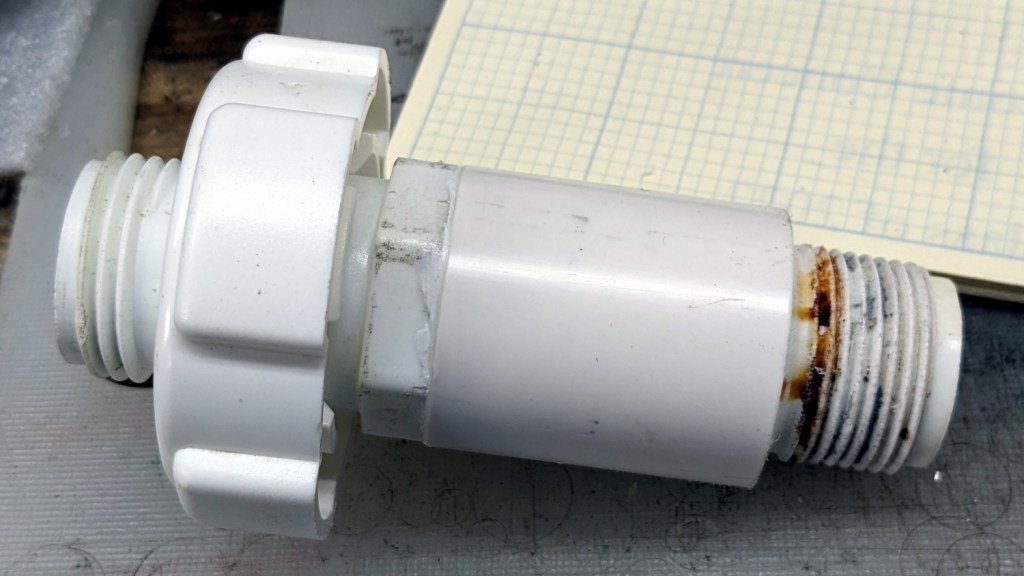
    It lacks the flange required to seal the O-ring against the outside of the bin, but I can fix that:

    Can-o-worms - sleeved valve
    Can-o-worms – sleeved valve

    It’s a chunk of PVC pipe faced to the proper length, bored to fit the valve body, then gooped in place with acrylic caulk.

    Snug the nut inside the bin and it’s all good:

    Can-o-worms - new valve installed
    Can-o-worms – new valve installed

    The original valve depended on having a smooth plug turning inside the outer shell, but years of grit scarred the interface enough to produce a slow drip. It also had the annoying mis-feature of aiming the opening inward, between the bin legs, where a jug didn’t quite fit.

    The water heater valve depends on compressing a smaller O-ring against a seat inside the body, which may tend to clog with crud. We added a mesh filter to hold back the worst of the gunk, so this is in the nature of an experiment using free hardware.

  • Mini-Lathe Carriage Stop Rebuild

    Mini-Lathe Carriage Stop Rebuild

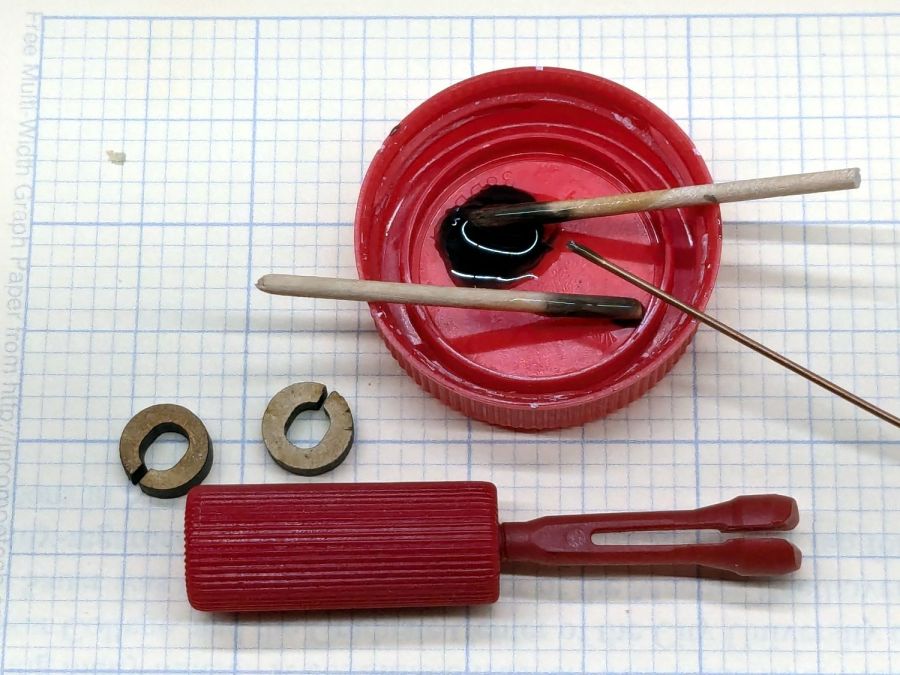
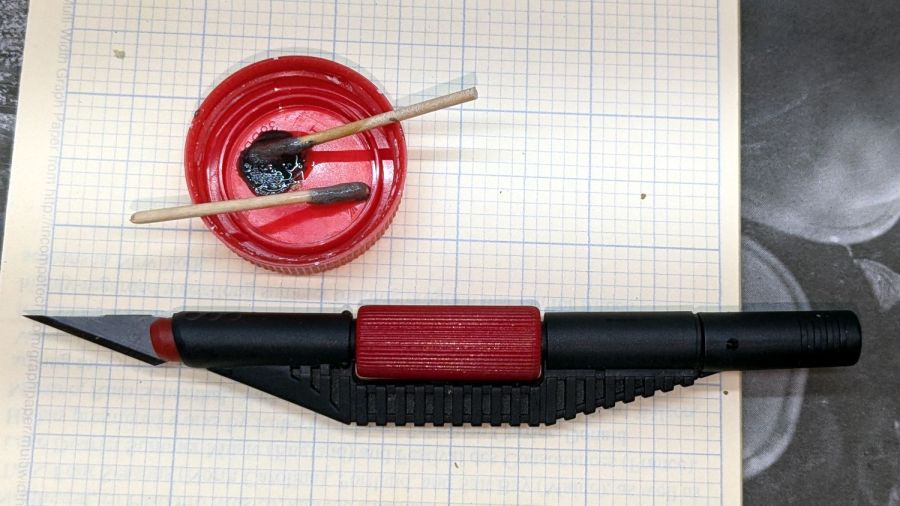
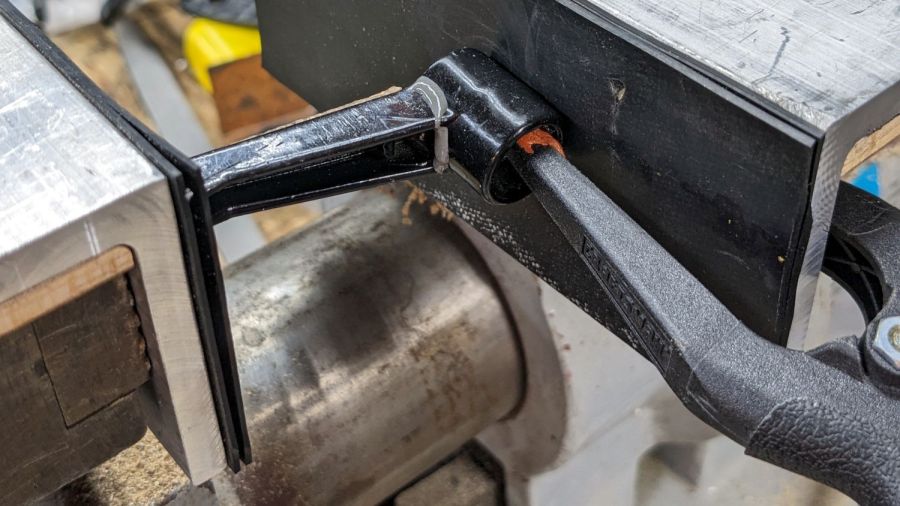
    I finally managed to whack the mini-lathe’s carriage stop handle with the chuck, prompting a quick repair:

    Carriage Stop - handle epoxy clamping
    Carriage Stop – handle epoxy clamping

    I probably should have epoxied a rod into the recess under the handle, seated in a drilled hole into the hub, but let’s see how long this quick-n-dirty version lasts.

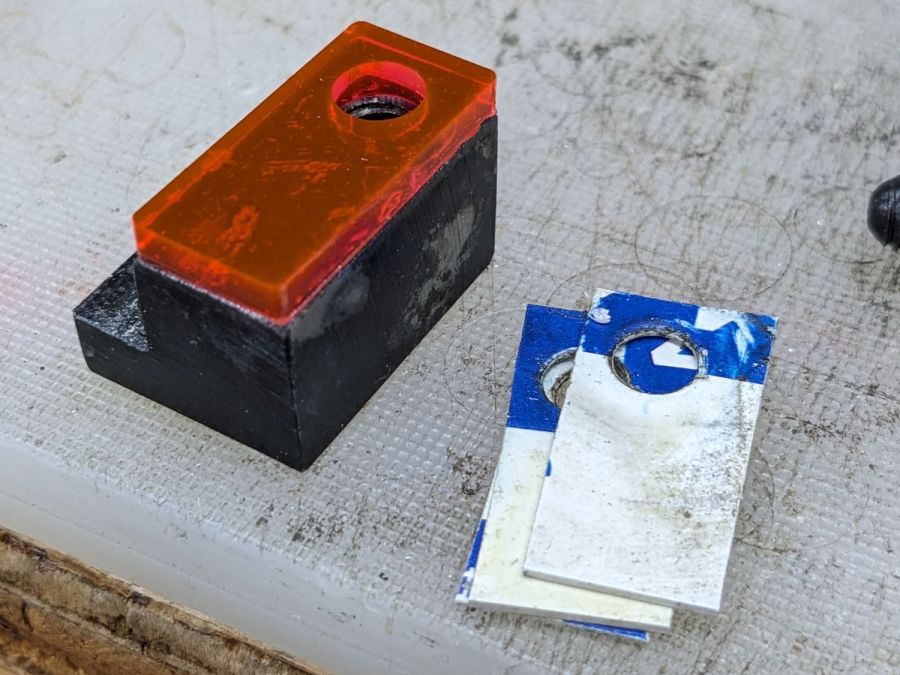
    While I had the hood up epoxy was curing, I lasered a block of edge-lit acrylic to replace the credit card shims:

    Carriage Stop - spacer
    Carriage Stop – spacer

    Which turned out to be one itsy too thick. Rather than sand / machine it down, the step over on the left grew a little brass shim:

    Carriage Stop - spacer and shim
    Carriage Stop – spacer and shim

    Both pieces depend on snippets of adhesive sheet to hold them in place, which seems reasonable because they’re always in compression. That also eliminates the hole and pin I originally thought would be necessary; living in the future is just grand.

    Thing looks like it grew there:

    Carriage Stop - installed
    Carriage Stop – installed

    The orange stripe on the handle is laser-safe PSA vinyl.

    That was easy …
  • Mini-lathe Chuck Stops

    Mini-lathe Chuck Stops

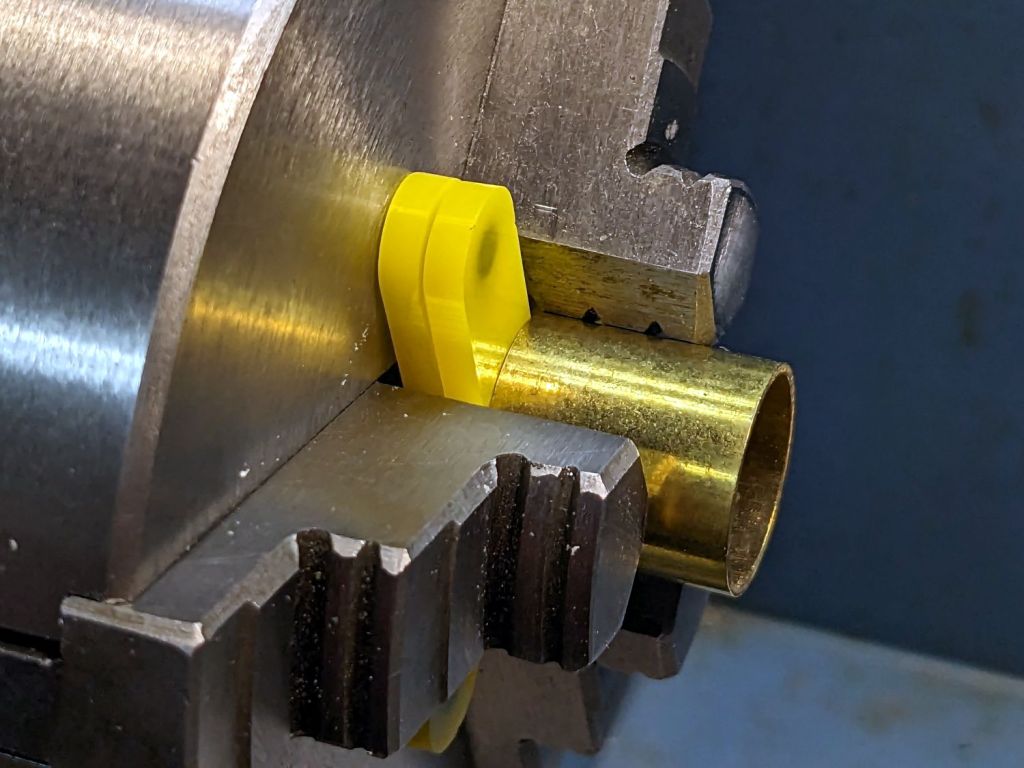
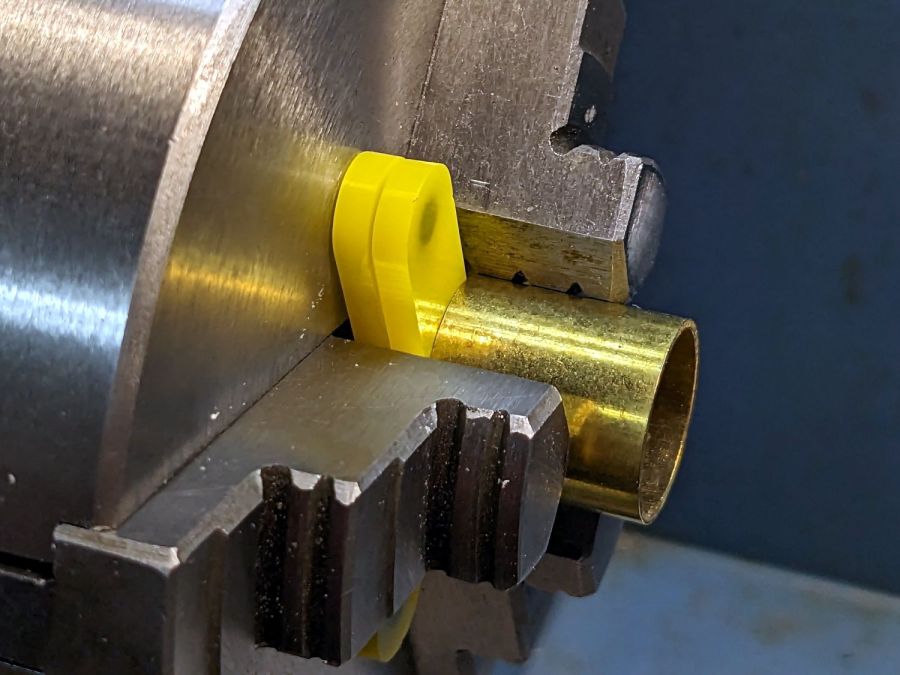
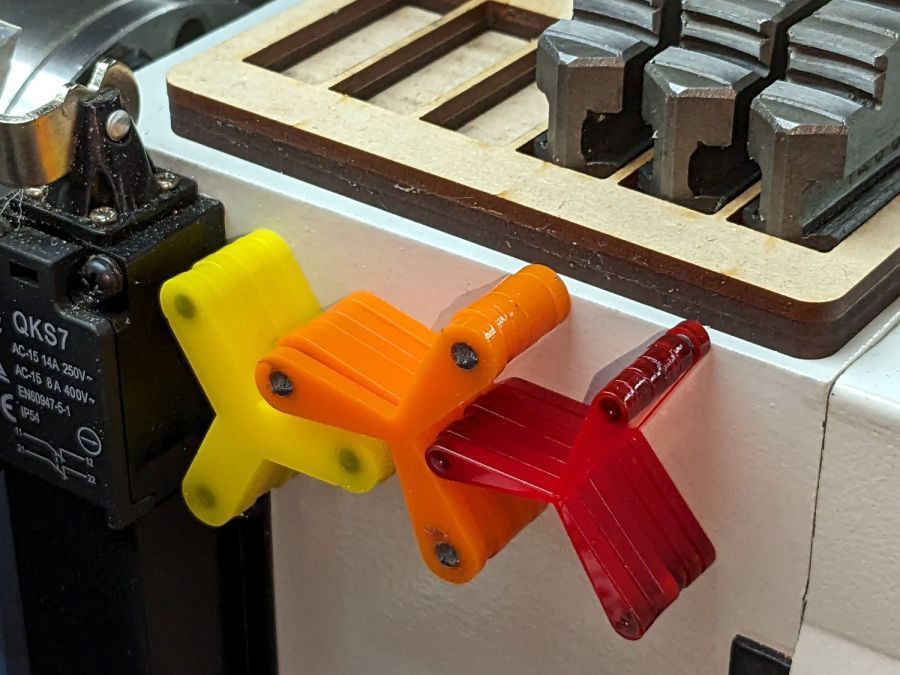
    Having occasionally been in need of a lathe chuck stop, I finally cleared that project off the heap:

    Lathe Chuck Stops - demo setup
    Lathe Chuck Stops – demo setup

    These are definitely not up to commercial standards, but also don’t cost fifty bucks each. A trio of 4×2 mm neodymium disk magnets stick the stop to the chuck (and to each other) with enough force to hold it there, but not enough to make removing it a hassle.

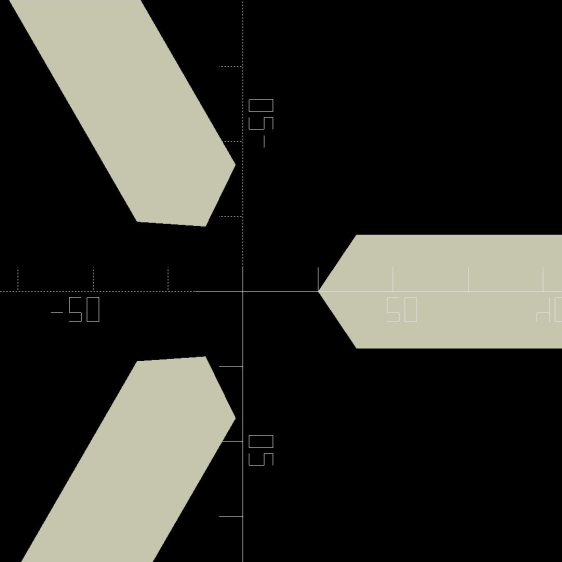
    I imported the Z axis orthogonal view of the chuck jaws from the ball fixture for the running lights:

    Lathe Chuck Jaws - solid model axial
    Lathe Chuck Jaws – solid model axial

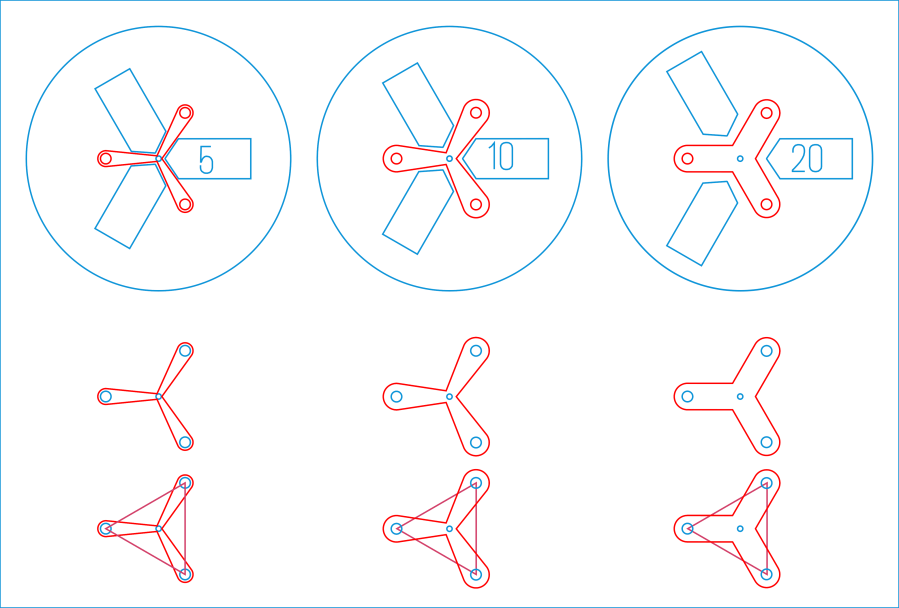
    Trace the right-side jaw, clean it up, put the tip a known distance from the origin, make a circular array, and draw a comfort circle the size of the chuck OD.

    The stop geometry comes from a hull wrapped around a circle a few millimeters larger than the 4 mm magnet (out 20 mm from the center) and a circle at the center sized so the hull clears the jaws:

    Lathe Chuck Stops - LB layout
    Lathe Chuck Stops – LB layout

    Then a small circle at the center allows me to drop the stop atop a known coordinate and rotate it around the circle, because the XY coordinate center is not at the geometric center.

    I cut out a few chipboard samples to verify the sizes, a few more from scrap acrylic to set up the pocketing operation, then half a dozen of each in cheerful kindergarten colors:

    Lathe Chuck Stops - on-lathe storage
    Lathe Chuck Stops – on-lathe storage

    The 5 mm stop is obviously too fragile for commercial success, but I figured it’ll survive long enough around here. Worst case, I can make another handful as needed.

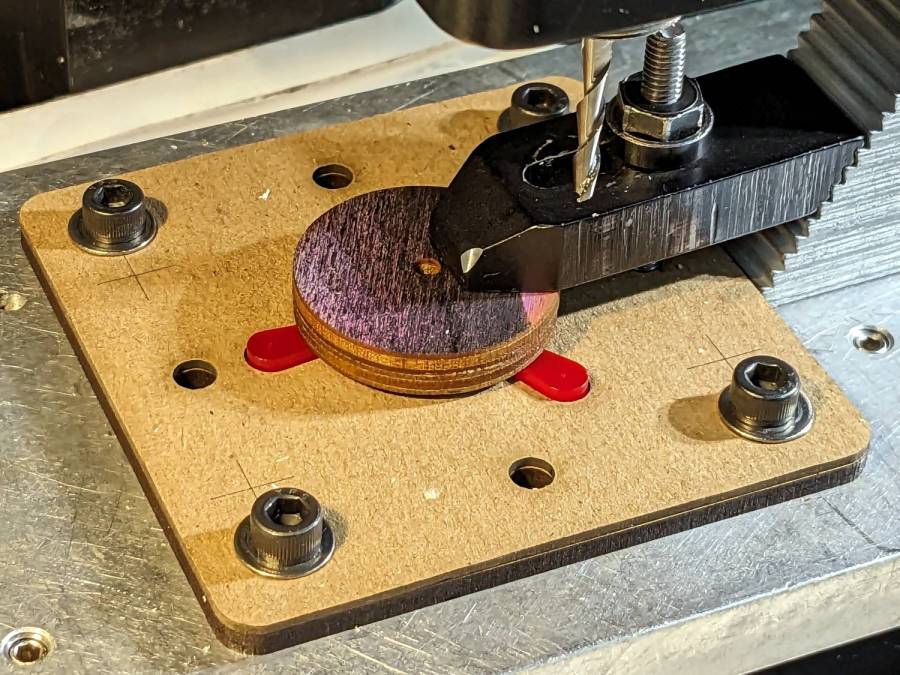
    Although I have laser-engraved pockets in plywood, a few experiments in acrylic confirmed the surface finish is terrible and the depth control is iffy, at best. Given that I need a 2.2 mm deep pocket in 3 mm acrylic, a CNC mill seems the right way to poke the pockets:

    Lathe Chuck Stops - pocketing setup
    Lathe Chuck Stops – pocketing setup

    More on that tomorrow.

    The LightBurn SVG layout as a GitHub Gist:

    Loading
    Sorry, something went wrong. Reload?
    Sorry, we cannot display this file.
    Sorry, this file is invalid so it cannot be displayed.
  • MaxLite Candelabra CFL: FAIL

    MaxLite Candelabra CFL: FAIL

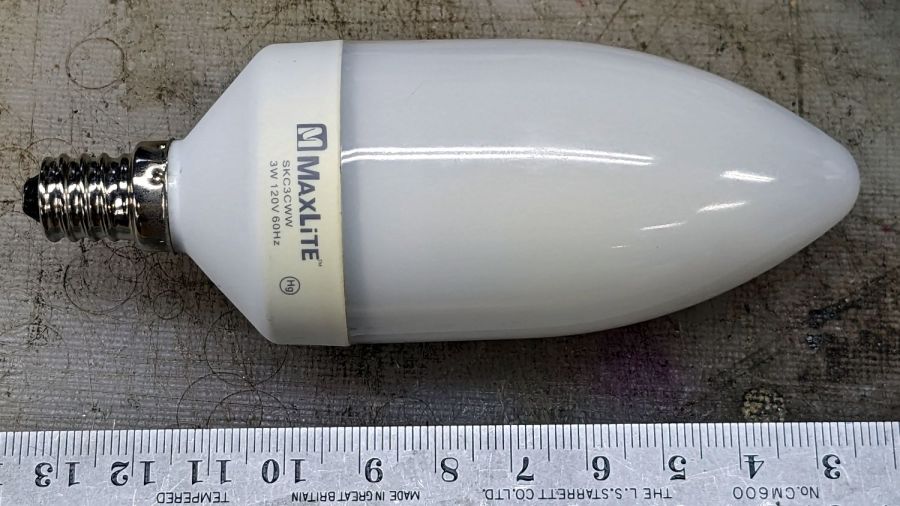
    The bathroom ceiling fixture has a nightlight position that we use occasionally, but eventually the little 7 W Christmas Tree bulb failed and I installed this hulk from a box of CFL bulbs a friend scrapped out after switching to LED bulbs:

    MaxLite CFL - overview
    MaxLite CFL – overview

    I never tested whether it actually drew 3 W, but, hey I could feel good. Right? Right?

    Anyhow, this one failed after a few years, too. The “bulb” envelope looked like it might make an attractive blinkie or glowie, so I decided to harvest it.

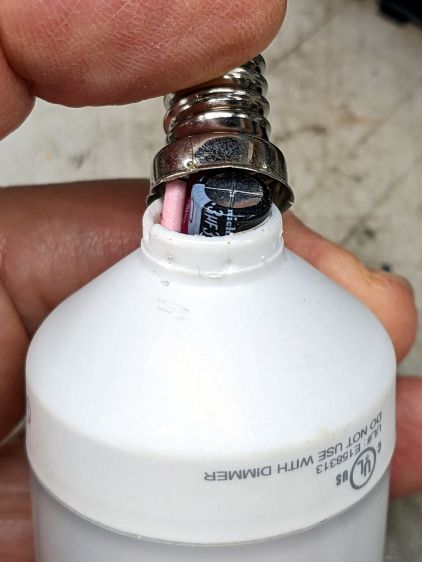
    The candelabra screw base felt loose and popped off with a push:

    MaxLite CFL - overflow cap
    MaxLite CFL – overflow cap

    Perhaps they chose the envelope before finalizing the circuitry?

    This is why you need a lathe in your shop:

    MaxLite CFL - lathe cutting
    MaxLite CFL – lathe cutting

    It wasn’t particularly well centered, so that was done dead slow and finished with a few hand turns of the chuck. Obviously, I need a crank for the spindle.

    The rest of the circuitry is pretty well packed under that tall cap:

    MaxLite CFL - circuitry
    MaxLite CFL – circuitry

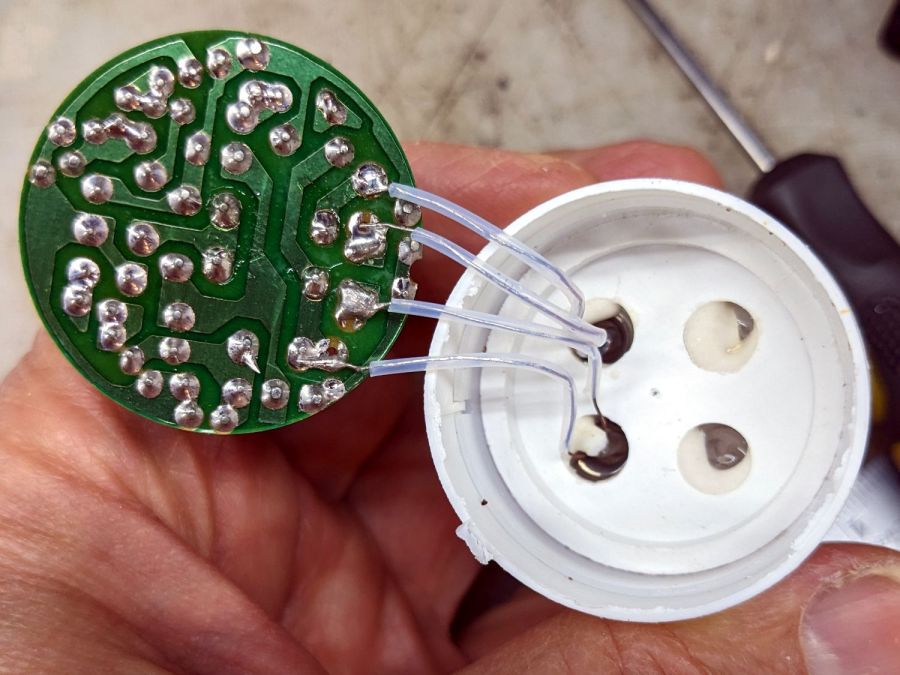
    Pulling the PCB out revealed the tube wiring:

    MaxLite CFL - tube wires
    MaxLite CFL – tube wires

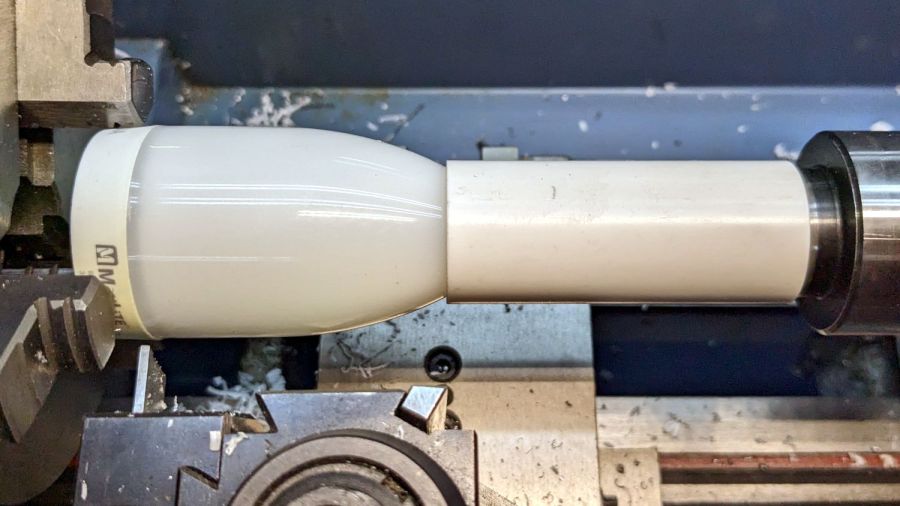
    Cut the wires and chuck it up again:

    MaxLite CFL - envelope turning setup
    MaxLite CFL – envelope turning setup

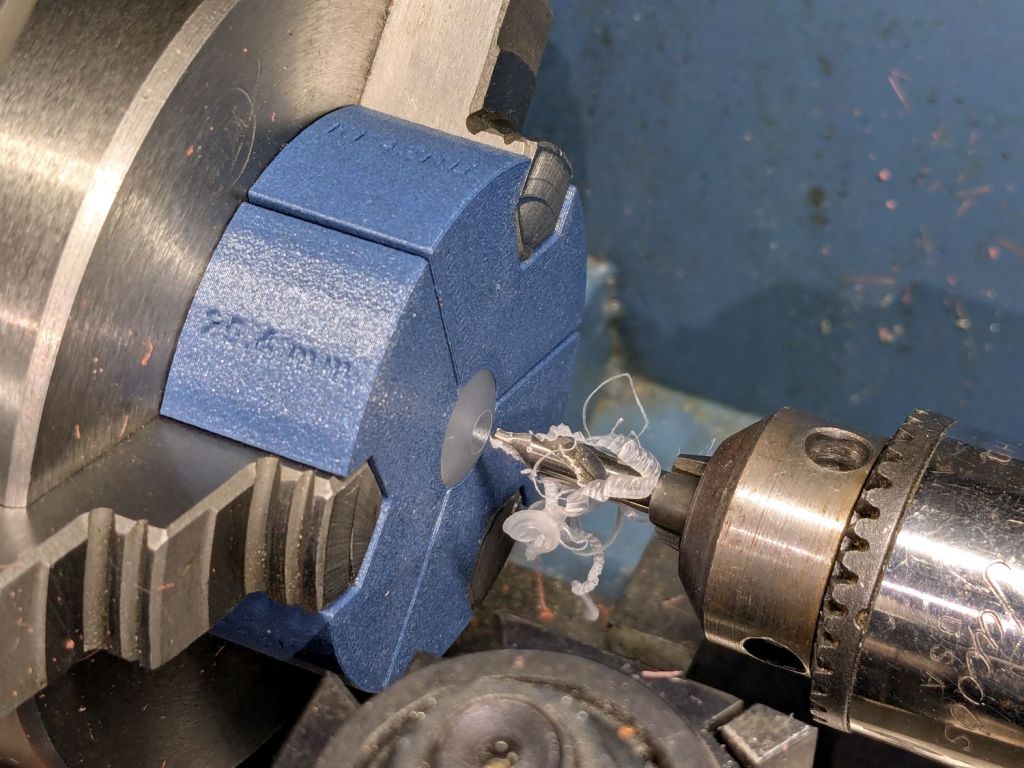
    Turn dead slow again until it breaks through:

    MaxLite CFL - envelope breakthrough
    MaxLite CFL – envelope breakthrough

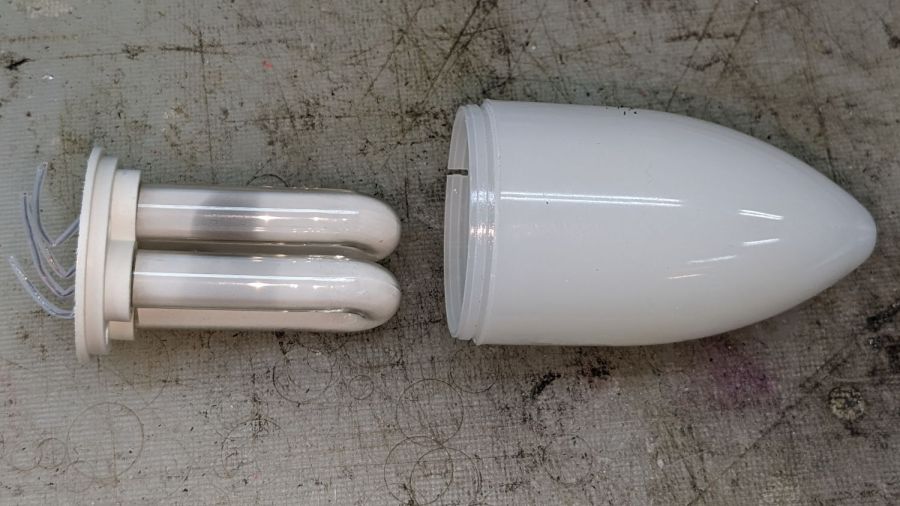
    Then finish by hand:

    MaxLite CFL - tube and envelope
    MaxLite CFL – tube and envelope

    It’s too cute to throw out, but … sheesh you can see why recycling this stuff is so difficult.
    For whatever it’s worth, I replaced it with a 3 W LED candelabra bulb that is way too bright.

  • Tour Easy Running Light: Heatsink Machining

    Tour Easy Running Light: Heatsink Machining

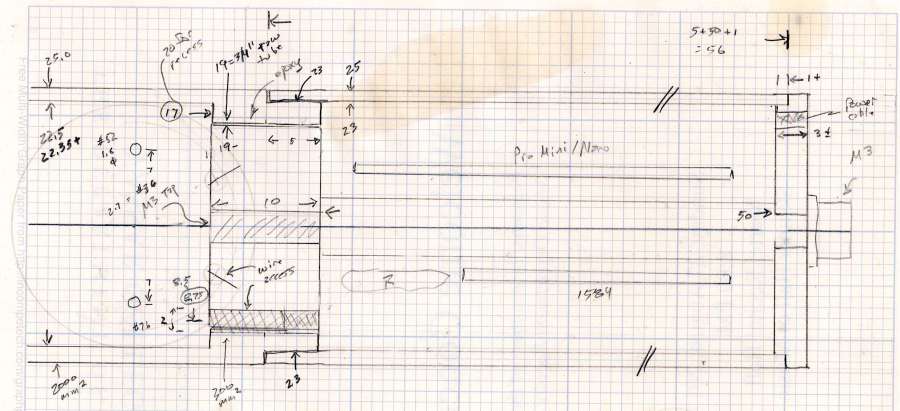
    Having acquired some thick-wall (1 inch OD, ¾ inch ID) aluminum tube, making the LED heatsink and lens holder for a running light generates a lot less scrap. A new doodle gives the dimensions in a rather Picasso-ish layout:

    Running Light - dimension doodles
    Running Light – dimension doodles

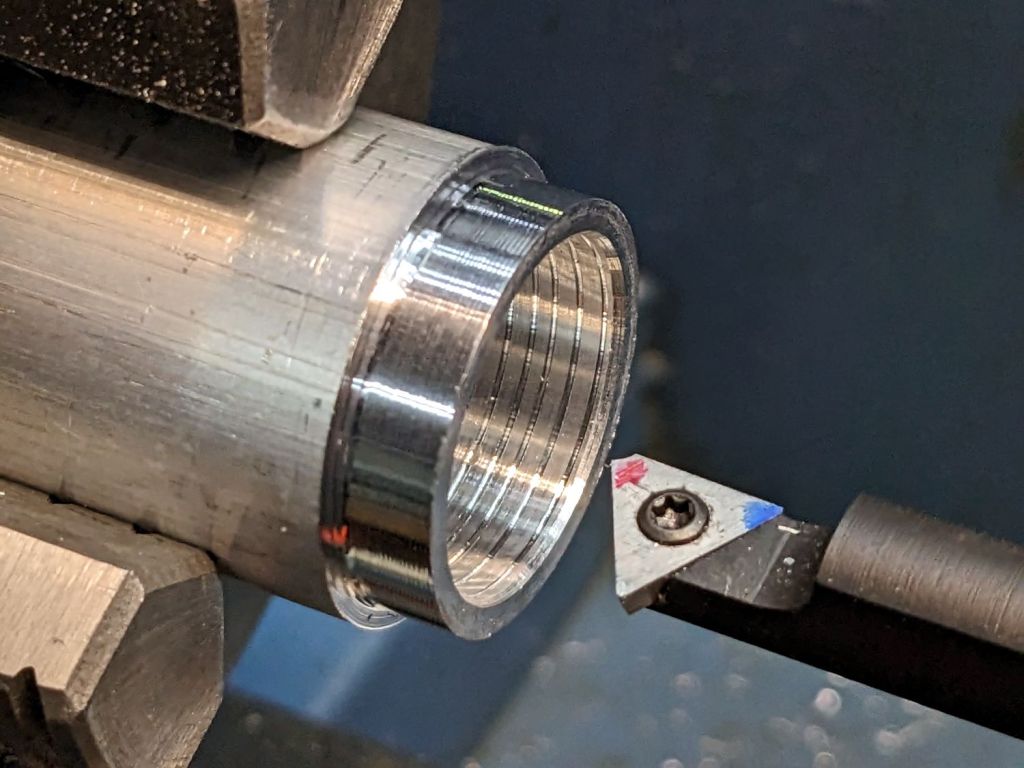
    The back end of the tube gets turned down to 23 mm OD and cleaned up to 19 mm ID, then scored to give the epoxy something to grip:

    Front Running Light - Heatsink shell scoring
    Front Running Light – Heatsink shell scoring

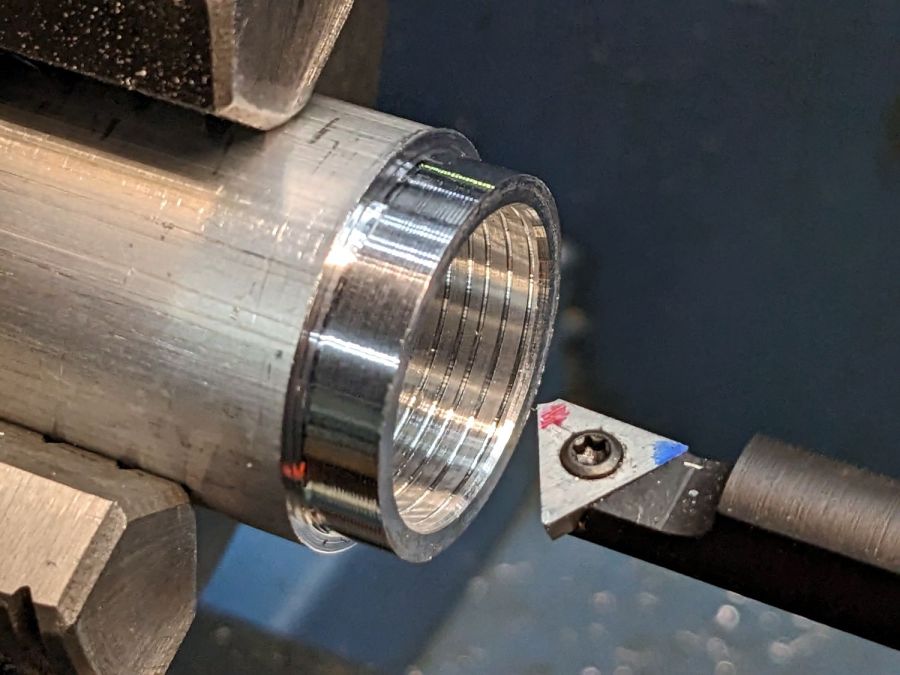
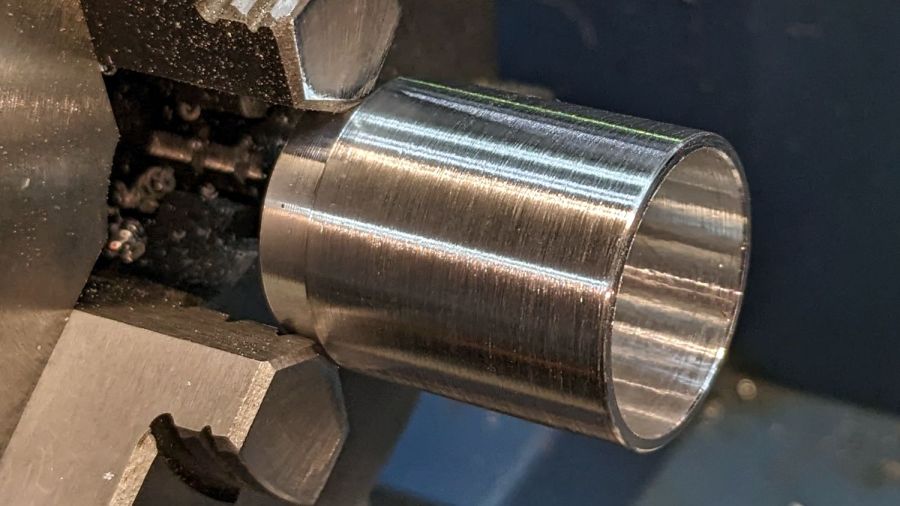
    The front end gets bored to 22.5 mm for the lens holder and has its OD cleaned up to 25 mm:

    Front Running Light - finished shell
    Front Running Light – finished shell

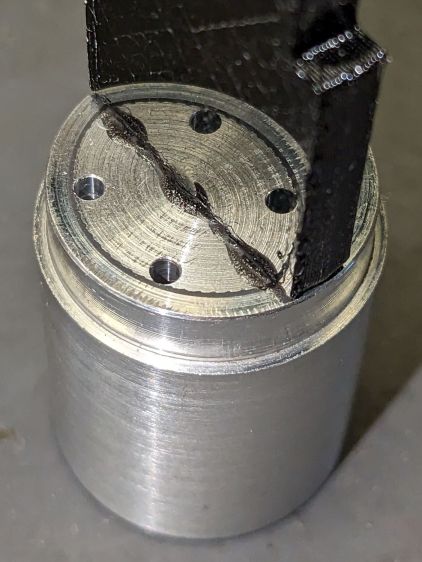
    Clean up the end of a ¾ inch rod to 19 mm OD, knurl it a little to increase the OD ever so slightly and improve its griptivity, slice off a bit more than 10 mm, butter it up with JB Weld epoxy, and shove it into the shell with its front end aligned and its back end sticking out:

    Front Running Light - epoxied plug in shell - rear
    Front Running Light – epoxied plug in shell – rear

    Face off the back end and the front end looks fine as assembled:

    Front Running Light - epoxied plug in shell - front
    Front Running Light – epoxied plug in shell – front

    Grab it in the Sherline mill’s three jaw chuck to:

    • Drill & tap the M3 central hole for the stud holding the circuit plate to the back end
    • Drill 1.6 mm blind holes for the circuit plate pins
    • Drill 2 mm through holes for the LED wires, 60° apart

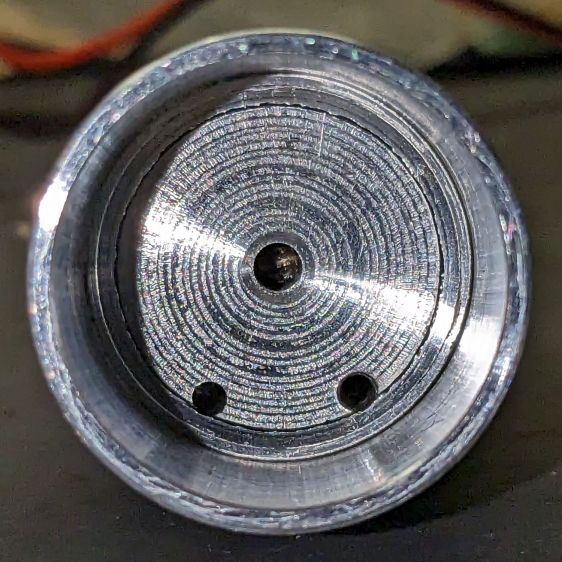
    Which looks like this from the front:

    Front Running Light - drilled heatsink - front
    Front Running Light – drilled heatsink – front

    And like this with the circuit plate screwed & glued to the rear:

    Front Running Light - circuit plate mounted
    Front Running Light – circuit plate mounted

    Clean up the OD of some ¾ inch PVC pipe to 25 mm, bore it out to 23 mm.

    While the Sherline is set up, drill a pair of 2 mm holes in the lens holder for the wires, aligned so they’ll match the heatsink holes.

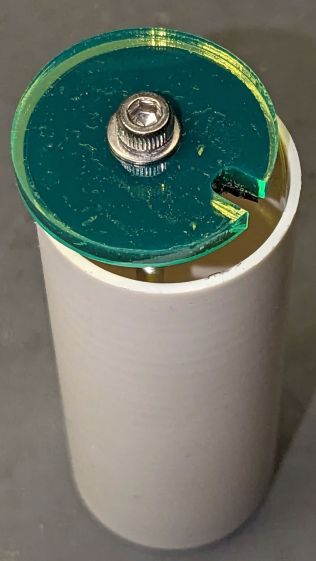
    Because we live in the future, laser-cut the rear cap from some edge-lit acrylic with a black inner disk:

    Front Running Light - PVC tube - end cap
    Front Running Light – PVC tube – end cap

    Cutting that cap with the notch included is now trivially easy, compared to the previous machining.

    Now for some circuitry …

  • Mini-lathe Chuck Jaw Holder

    Mini-lathe Chuck Jaw Holder

    While swapping chuck jaws I realized I didn’t have to pile them on a shop rag atop the lathe headstock, no matter how neatly cut those rags might be:

    Lathe chuck jaw holder - installed
    Lathe chuck jaw holder – installed

    It’s three layers of MDF cut to hold all six jaws from the 4 inch 3 jaw chuck, stuck together with wood glue.

    You really need only four sockets: one empty for the jaw you just removed, then work your way around the chuck. But, hey, MDF is cheap and I usually remove all three at once anyway.

    When it starts walking away, it’ll sprout silicone feet.

    The LightBurn SVG layout as a GitHub Gist:

    Loading
    Sorry, something went wrong. Reload?
    Sorry, we cannot display this file.
    Sorry, this file is invalid so it cannot be displayed.

    That was easy!

  • CO₂ Laser Cutter: Improved PIN-10D Photodiode Filter Holder

    CO₂ Laser Cutter: Improved PIN-10D Photodiode Filter Holder

    Anything would be better than just taping some gel filters to the front of the bare photodiode package:

    Laser output - photodiode kludge
    Laser output – photodiode kludge

    Right?

    I heaved the slab of ½ inch black acrylic left over from the Totally Featureless (WWVB) Clock into the laser cutter and, two passes at 90% power later, had a somewhat lumpy 32 mm donut with an 11 mm hole in the middle. Because acrylic is opaque to the IR light from a CO₂ laser (which is why it cuts so well) and black acrylic is opaque to visible light (which is what the photodiode is designed for), this is at least as good as an aluminum housing and much easier to make.

    Chuck the donut into Tiny Lathe and bore out the hole:

    PIN-10D photodiode filter holder - boring ID
    PIN-10D photodiode filter holder – boring ID

    When it’s a snug fit to ½ inch brass tube (about the same size as the photodiode’s active area), flip it around, and bore the other size out to fit the photodiode case.

    Ram the tube in place, grab the large recess, and center the tube:

    PIN-10D photodiode filter holder - centering snout
    PIN-10D photodiode filter holder – centering snout

    That’s the chuck-in-chuck trick I used with the coasters, because the neither of the larger four-jaw chucks close far enough to get their inside jaws inside those little holes.

    [Edit: Got that backwards: I bored the big recess first.]

    Skim most of the OD down, then, because I am a dolt forgot to put a spacer in there, flip it around again, get it running true (the chuck aligns the flat side):

    PIN-10D photodiode filter holder - turning OD
    PIN-10D photodiode filter holder – turning OD

    Then skim the rest of the OD to clean it up.

    Cut some filter gels to fit inside the recess:

    PIN-10D photodiode filter holder - filter disc cutting
    PIN-10D photodiode filter holder – filter disc cutting

    Even though they’re pretty much transparent to thermal IR, a focused IR laser beam cuts them just fine. The little tab at 6 o’clock (remember round clocks with hands?) keeps the cut circle from falling out.

    Drill & tap for an M3 setscrew to hold the photodiode in place:

    PIN-10D photodiode filter holder - parts
    PIN-10D photodiode filter holder – parts

    Put them all together:

    PIN-10D photodiode filter holder - assembled
    PIN-10D photodiode filter holder – assembled

    I must conjure a better mount for the thing, because this is way too precarious:

    PIN-10D photodiode filter holder - test install
    PIN-10D photodiode filter holder – test install

    Early results suggest it works better than the previous hack job, without ambient light sneaking around the edges of the filter pack.