The Smell of Molten Projects in the Morning

Ed Nisley's Blog: Shop notes, electronics, firmware, machinery, 3D printing, laser cuttery, and curiosities. Contents: 100% human thinking, 0% AI slop.

Category: Photography & Images

Taking & making images.

  • MPCNC: bCNC Probe Camera Refresh

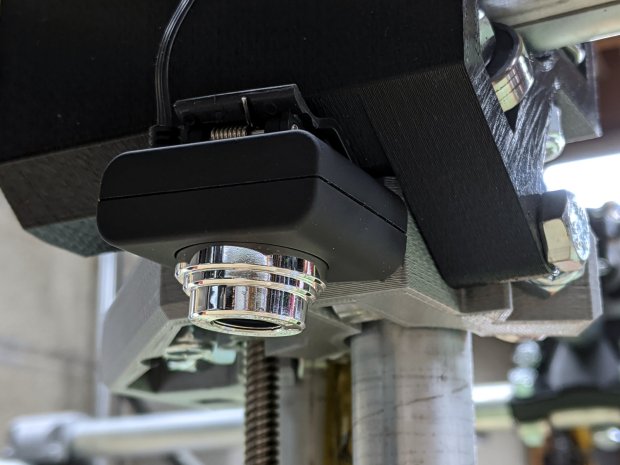
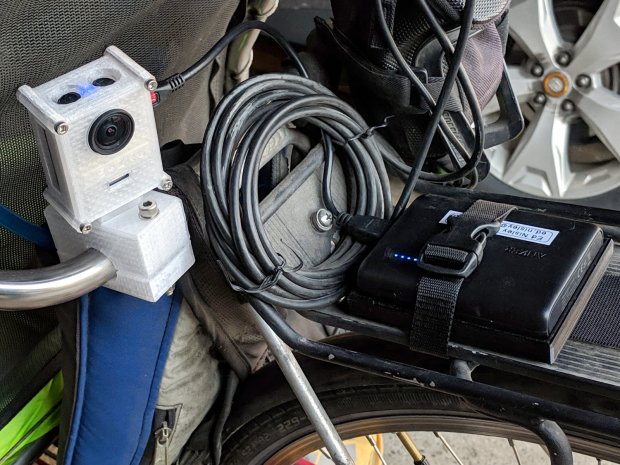
    For the usual inscrutable reasons, updating bCNC killed the USB camera on the MPCNC, although it still worked fine with VLC. Rather than argue with it, I popped a more recent camera from the heap and stuck it onto the MPCNC central assembly:

    bCNC - USB probe camera - attachment
    bCNC – USB probe camera – attachment

    This one has a nice rectangular case, although the surface might be horrible silicone that turns to snot after a few years. The fancy silver snout rotates to focus the lens from a few millimeters to infinity … and beyond!

    If you think it looks a bit off-kilter, you’re absolutely right:

    bCNC - USB probe camera - off-axis alignment
    bCNC – USB probe camera – off-axis alignment

    The lens image reflected in a mirror on the platform shows the optical axis has nothing whatsoever to do with the camera case or lens snout:

    bCNC - USB probe camera - off-axis reflection
    bCNC – USB probe camera – off-axis reflection

    Remember, the mirror reflects the lens image back to itself only when the optical axis is perpendicular to the mirror. With the mirror flat on the platform, the lens must be directly above it.

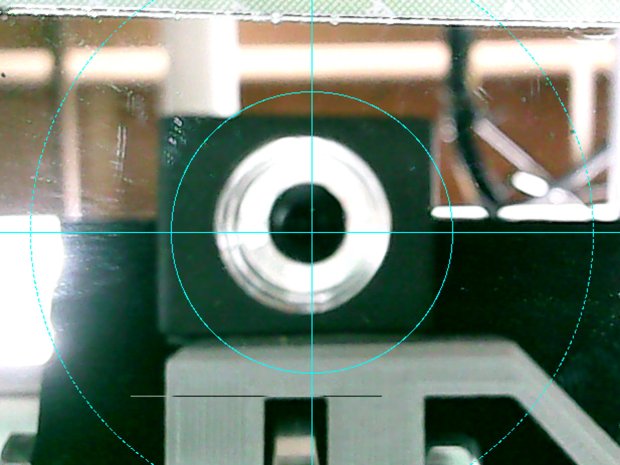
    Because the MPCNC camera rides at a constant height over the platform, the actual focus & scale depends on the material thickness, but this should be typical:

    bCNC - USB Probe Camera - scale - screenshot
    bCNC – USB Probe Camera – scale – screenshot

    It set up a Tek Circuit Computer test deck within 0.2 mm and the other two within 0.1 mm, so it’s close enough.

    The image looks a whole lot better: cheap USB cameras just keep improving …

  • Slide Rules: Real Engraving vs. Pilot V5RT Pens

    A 0.5 mm Pilot V5RT pen produces good-looking results on presentation-grade paper:

    Tek CC - V5RT black - glossy presentation paper
    Tek CC – V5RT black – glossy presentation paper

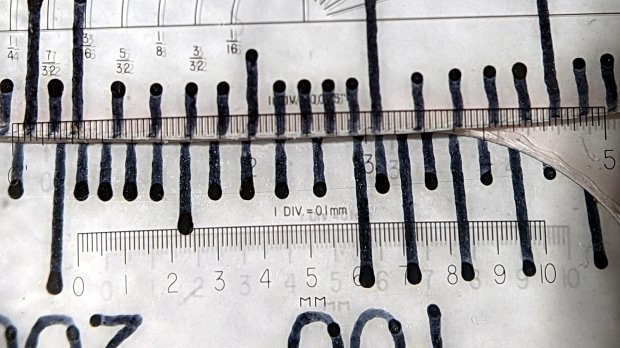
    Peering through a measuring magnifier shows a bit more tremble in the traces, but they’re still OK:

    Tek CC - V5RT pen width
    Tek CC – V5RT pen width

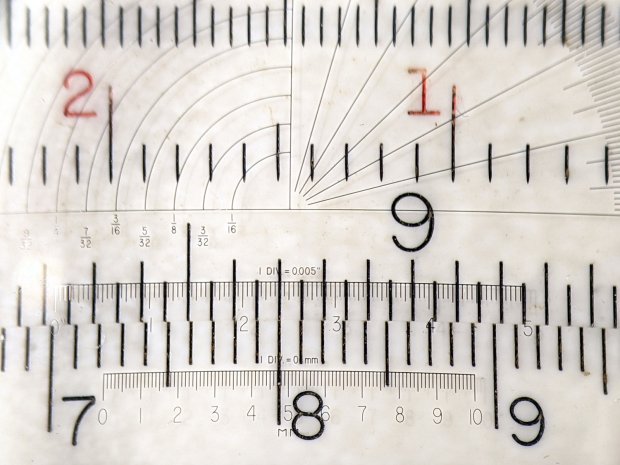
    The desk light off to the upper left casts shadows from the reticle on the three different sheets.

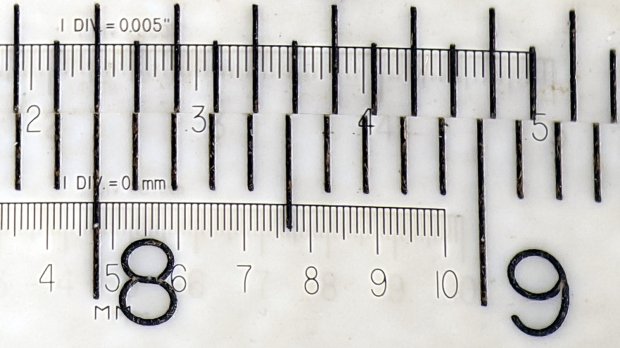
    A closer view of the linear scales:

    Tek CC - V5RT pen width - detail
    Tek CC – V5RT pen width – detail

    The pen lines seem to be 0.25 to 0.3 mm wide, with 0.4 mm dots at the end of each stroke.

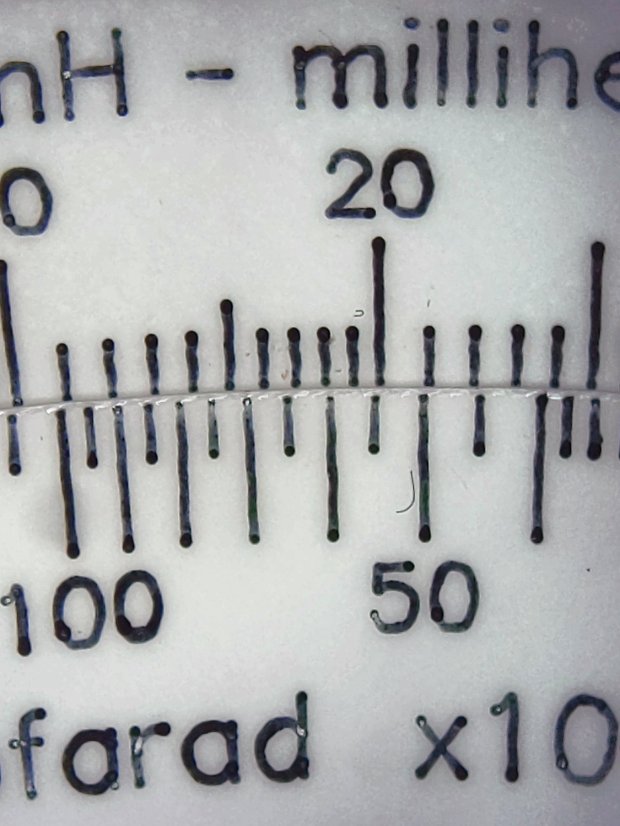
    For comparison, the engraved lines on my trusty K&E Deci-Lon slide rule are under 0.1 mm:

    KE Deci-Lon Slide Rule - scale detail
    KE Deci-Lon Slide Rule – scale detail

    The digits look like they’re embossed into the surface with shaped punches, rather than engraved like the lines. Of course, I don’t know how K&E’s production machinery worked.

    A closer view:

    KE Deci-Lon Slide Rule - scale detail - digits
    KE Deci-Lon Slide Rule – scale detail – digits

    I think 0.1 mm is an aggressively narrow trace width, even for a laser engraver.

  • Video-rated MicroSD Card Status Report

    Having just returned from the fourth ride of the season, it’s worthwhile to note how the MicroSD cards in the cameras are doing.

    The Sony HDR-AS30V helmet camera has been running a 64 GB Sandisk high-endurance video-rated card since late August 2017:

    Sandisk - 64 GB MicroSDXC cards
    Sandisk – 64 GB MicroSDXC cards

    In those 29 calendar months (maybe 20 riding months) I’ve ridden 4500-ish miles at perhaps 12 mph, so call it 375 hr = 22.5 k min. The camera fills a 4 GB file every 22.75 min, so it’s recorded 1000 files = 4 TB, which is 62× its capacity. This is better than the defunct Sandisk Extreme Pro card (3 TB & 50×) and much much better than the Sony cards (1 TB & 15×), although I have caught the camera in RCVR mode maybe twice, which means the card or camera occasionally coughs and reformats itself.

    The Cycliq Fly6 rear camera uses a Sandisk 32 GB card that’s been running flawlessly since late 2017:

    MicroSD 32 GB - Samsung EVO and SanDisk High Endurance
    MicroSD 32 GB – Samsung EVO and SanDisk High Endurance

    The new 16850 lithium cell continues to work fine, too.

    The SJCam M20 rear camera also uses a Sandisk 32 GB high-endurance card and has worked fine since early 2018. An external battery eliminated all the hassle of its feeble internal batteries, although the one that’s been in there has faded to the point of just barely keeping the clock ticking over during winter weeks without rides:

    SJCAM M20 Mount - Tour Easy side view
    SJCAM M20 Mount – Tour Easy side view

    All in all, paying the premium for video-rated MicroSD cards has been worthwhile!

  • High-Impact Driving

    We spotted this near our usual parking spot during a recent grocery trip:

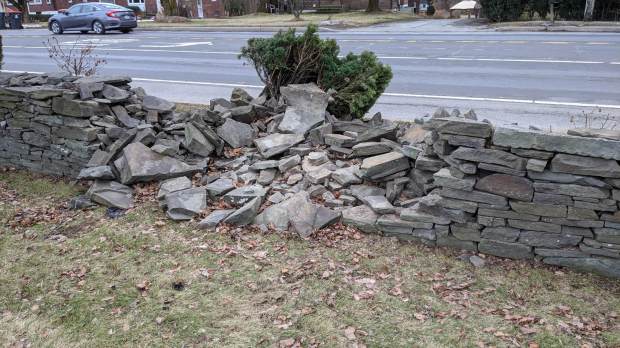
    Adams crash - stone wall
    Adams crash – stone wall

    The bush was pretty well uprooted, suggesting the vehicle stopped atop the bush after demolishing the wall.

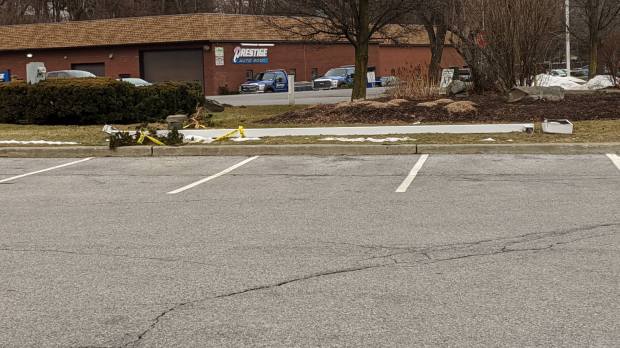
    Wondering how it got there, I looked across the parking lot:

    Adams crash - reverse view
    Adams crash – reverse view

    Yes, that’s a dead lamp post. The impact dislodged its concrete base by about four inches:

    Adams crash - lamp pole detail
    Adams crash – lamp pole detail

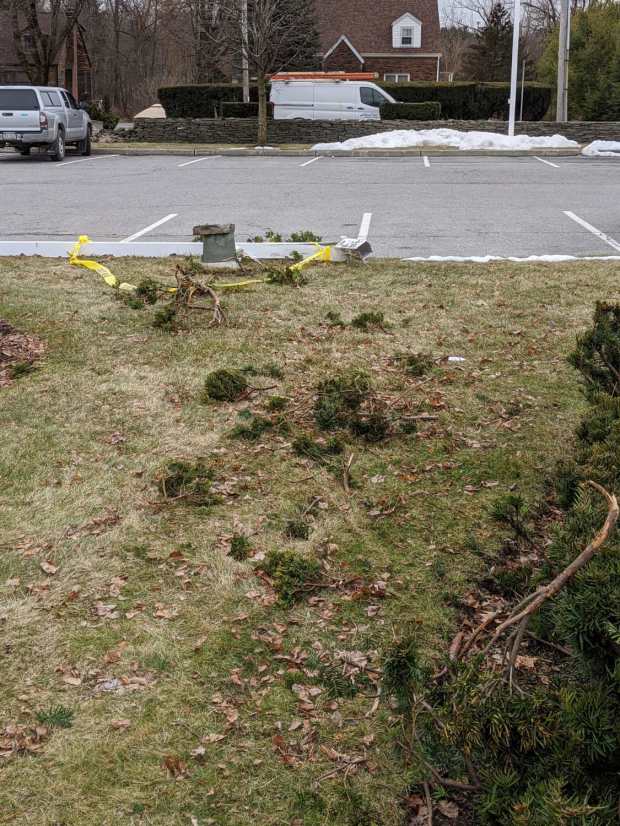
    The greenery came from another eviscerated bush:

    Adams crash - bush debris
    Adams crash – bush debris

    I expected to see tire gouges in the grass, but … nope.

    The bush got a haircut, although the right half seems undamaged:

    Adams crash - bush detail
    Adams crash – bush detail

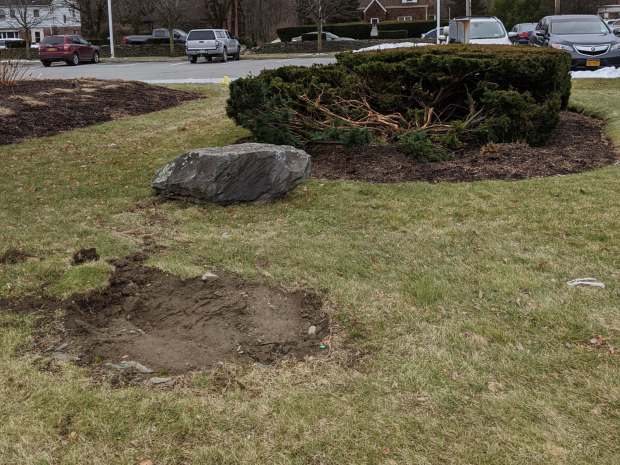
    The boulder won its disagreement with the vehicle, although there’s surprisingly little shattered plastic and other debris along the trail:

    Adams crash - boulder detail
    Adams crash – boulder detail

    The impact dislodged the boulder, which came to rest about four feet from its origin:

    Adams crash - overview
    Adams crash – overview

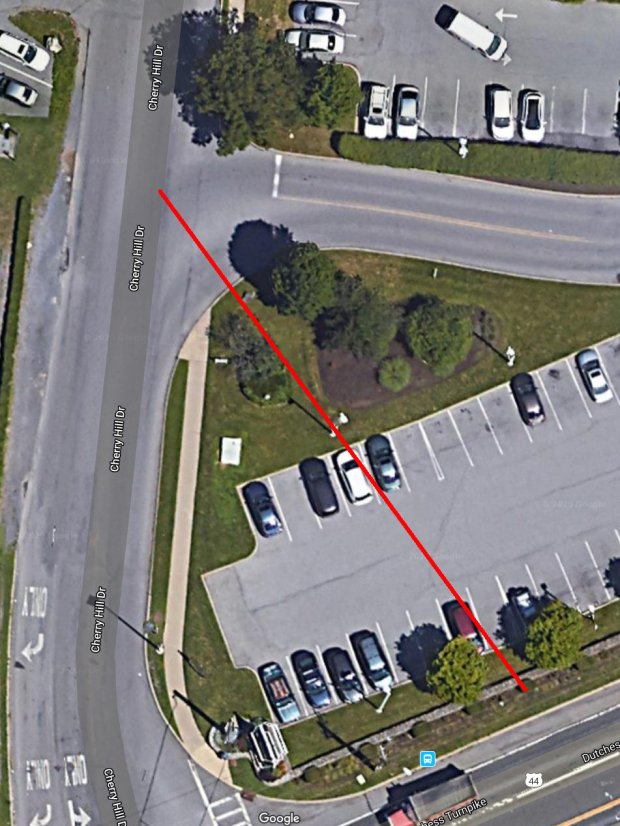
    The damage lies along a straight line from the middle of the Adams entrance intersection to the wall impact:

    Adams crash - trajectory
    Adams crash – trajectory

    There are no obvious skid marks, undercarriage scrapes, or gouges in the grass anywhere along the trajectory, suggesting the vehicle remained mostly airborne and ballistic during the whole event, and even the three (!) curbs involved have no marks.

    The nice lady at the Adams Customer Service counter didn’t know what happened and, as usual, the Poughkeepsie Journal (newspaper) has nothing to say.

    I did not check for a high-clearance pickup truck with tall tires and severe front-end damage in the body shop across the street, although one seems a likely suspect. Whatever the vehicle may have been, it was definitely traveling at the usual (tautological) “high rate of speed” …

  • Photo Lamp Mount: Moah Plastic!

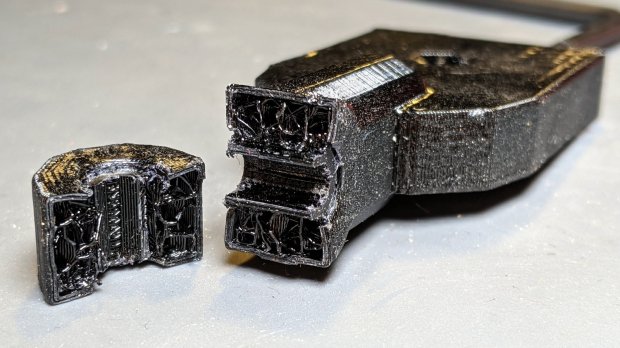
    One of the cold shoe mounts I made for the photo lamps cracked:

    Photo Lamp Mount - fractured
    Photo Lamp Mount – fractured

    It’s done in PETG with my more-or-less standard two perimeter threads and 15% 3D honeycomb infill, which is Good Enough™ for most of my parts. In this case, there’s obviously not nearly enough plastic in there!

    Redoing it with three perimeters and 50% infill should improve the situation, even though it looks identical on the outside:

    Photo Lamp Mount - reinstalled
    Photo Lamp Mount – reinstalled

    I didn’t replace the other mount. If it breaks, it’ll get the same 50% infill as this one. If this one breaks, I’ll try 75%.

    An easy fix!

  • Monthly Image: Digital Machinist 14.4 Cover

    I ain’t getting richer, but I did get mah pitcher onna cover of th’ Digital Machinist:

    Digital Machinist Cover DM14.4 - Winter 2019
    Digital Machinist Cover DM14.4 – Winter 2019

    I just caught George Bulliss in a weak moment. [grin]

    It’s the diamond drag holder on the CNC 3018-Pro, before the XL axis extension hackage., with the probe camera stuck to the left side.

    You can say you knew me before …

  • Scrap EEPROMs

    A quartet of defunct 64 KB EEPROMs (*) emerged from a box of microscope doodads, so I stuck ’em under the stereo zoom scope for final pictures.

    The oldest one, an MCM68764, came from Motorola with a 8313 date code. The next three, all TMS2764JL-25, came from TI with date codes in 84 and 85, so they have slightly different layouts.

    MCM68764C EPROM
    MCM68764C EPROM
    TMS2764JL-25 A EPROM
    TMS2764JL-25 A EPROM

    This one is rotated 90° counterclockwise:

    TMS2764JL-25 B EPROM
    TMS2764JL-25 B EPROM
    TMS2764JL-25 C EPROM
    TMS2764JL-25 C EPROM

    The hideous compression artifacts come from the original Pixel 3a images, because they’re (digitally) zoomed in all the way, plus bonus optical distortion from the quartz windows. The chips definitely look better in person, although the (optical) magnification isn’t nearly enough to show the tiniest details.

    (*) Uh, they’re just EPROMs. It’s been so long since I’ve typed it that the extra “E” just stuttered right out. That’s my story and I’m sticking with it … at least I got the image names right!