Ed Nisley's Blog: Shop notes, electronics, firmware, machinery, 3D printing, laser cuttery, and curiosities. Contents: 100% human thinking, 0% AI slop.
Even linearized, the inchworm was barely 20 mm long; it’s the thought that counts.
The stamens mature in concentric rings, each stamen topped by a pollen grain. Apparently, those grains are just about the most wonderful food ever, as the inchworm made its way around the ring eating each grain in succession:
The closest one was about 60 mm long, with plenty of growing ahead in the next few months:
Praying Mantis – 2020-07-24
A few days later, I spotted a smaller one, maybe 40 mm from eyes to cerci, hiding much deeper in the decorative grass clump. Given their overall ferocity, it was likely hiding from its larger sibs.
They have also been stilting their way across the window glass and screens in search of better hunting grounds. My affixing their oothecae to another bush may have disoriented them at first, but they definitely know where their next meal comes from!
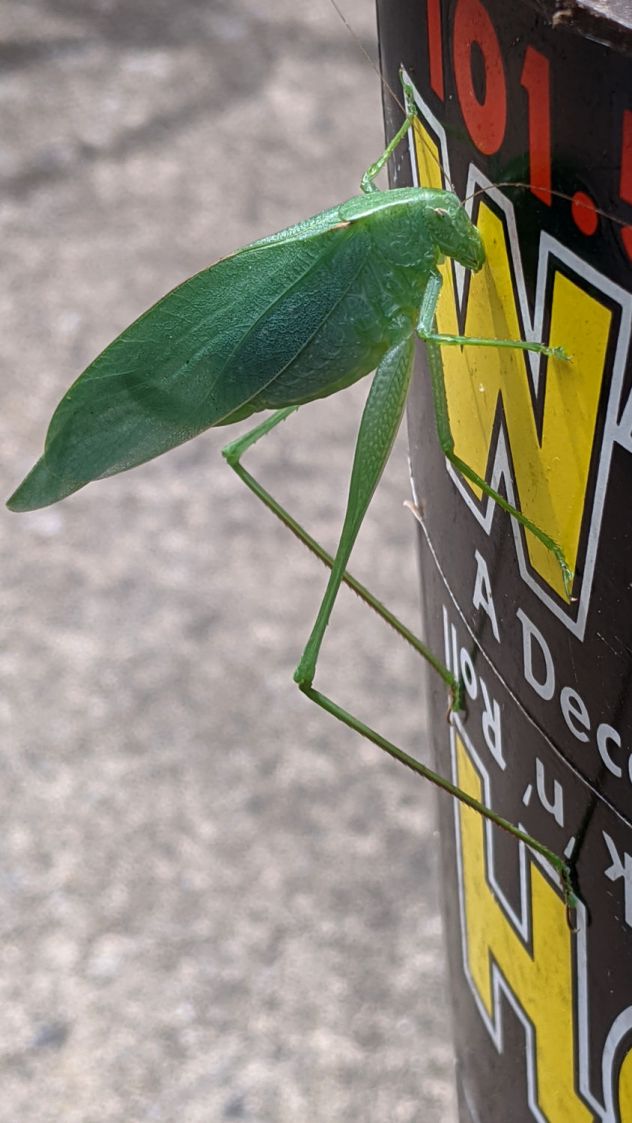
Perhaps as a bonus, a Katydid appeared inside the garage, stuck to the side of a trash can that Came With The House™ long ago:
Katydid
I deported it outside, in hopes of increasing the world’s net happiness.
The stickers covering the can say “WPDH: A Decade of Rock ‘n’ Roll”, suggesting they date back to 1986, ten years after (Wikipedia tells me) WPDH switched from country to rock. Neither genre did much for me, so I never noticed.
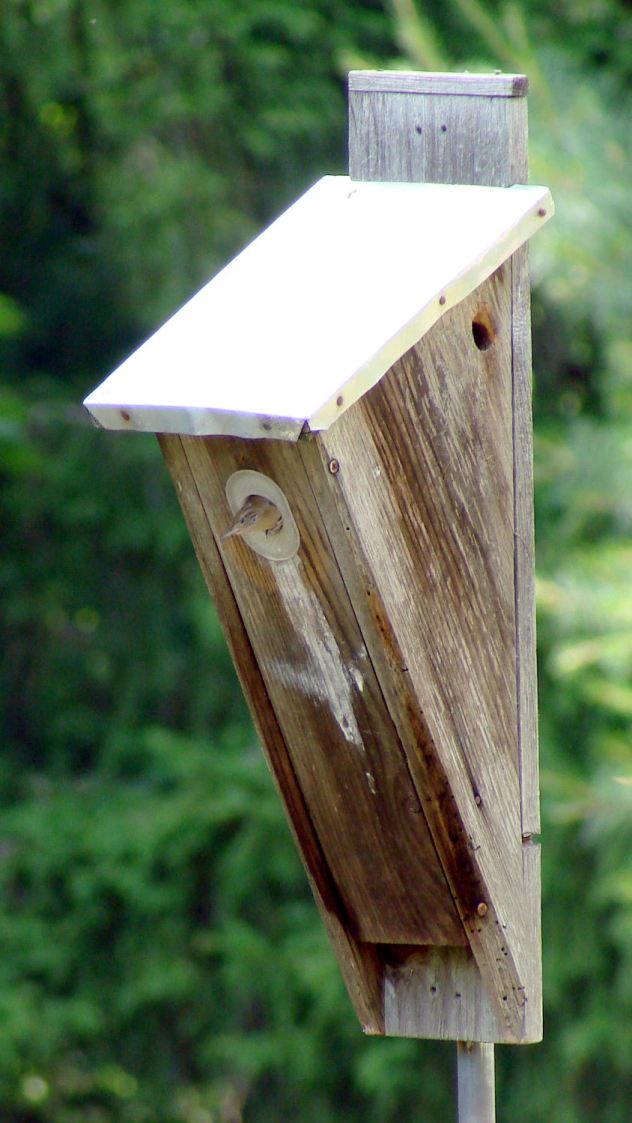
A pair of wrens, having found the new entrance reducer entirely satisfactory, set up housekeeping in the front bird box and raised their nestlings.
Somehow, they manage to fly directly into the hole without stopping:
Wren – front box – entering
Outbound trips require a security check:
Wren – front box – exit check
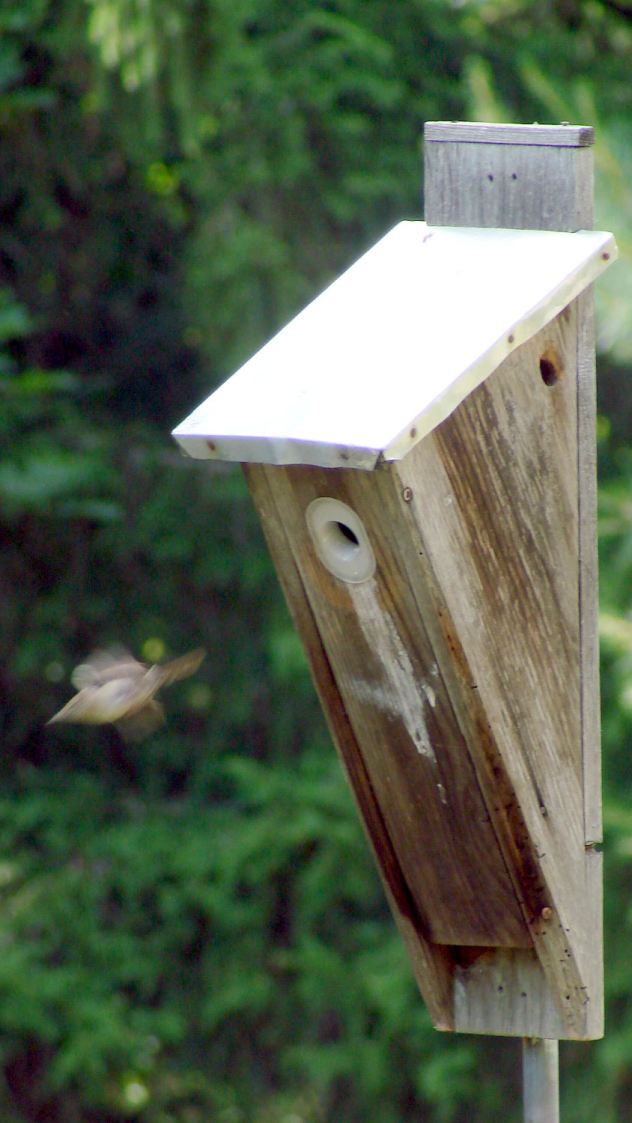
And away!
Wren – front box – fly away
After those nestlings fledged, they began building a nest in one of the garden bird boxes a few hundred feet away. In short order, we’ll be awash in wrens!
Rt 376 SB Marker 1110 – Near Miss – oncoming bicyclist and wide trailer – 2020-07-07
On the northbound side, another cyclist rides the sliver of pavement between the fog line and the gravel ridge built up from the deteriorating patches, being overtaken by a huge pickup towing a full-width quad-wheel trailer full of lawn maintenance equipment. The driver has eased about as far toward the yellow line as possible to give the cyclist barely enough clearance:
Rt 376 SB Marker 1110 – Near Miss – oncoming trailer – 2020-07-07
I am not “taking the lane”, because I’m towing a trailer of groceries and there’s always overtaking traffic coming around the blind curve behind me:
Rt 376 SB Marker 1110 – Near Miss – horn – 2020-07-07
You can’t hear the car’s horn, but it’s right in my ear.
The white patches beside and behind the trailer are the fog line paint on the original asphalt surface showing through the disintegrating scab patch. Cyclists cannot ride safely on broken pavement with half-inch discontinuities, which is why I’m to the right of the fog line, mostly off the edge of the patch. If I “took the lane” as expected by NYS DOT, I would be riding about two feet into the lane, in line with the car’s right headlight, to avoid the wheel-grabbing longitudinal fissures showing through the scab patch.
Back in the day, John Forester’s Effective Cycling defined how vehicular bicycling should be done; our now-fragile comb-bound 1980 Third Printing of the 1978 Third Edition still has a place of honor on our bookshelves. I recently discovered his analysis of how traffic signal timing should work online, which says I’ve drawn the wrong conclusions from my observations of the absurdly short green / yellow / red cycle on Burnett Blvd at Rt 55, just in front of NYS DOT’s Region 8 headquarters.
The phasing sequence that is required by current traffic law is as follows:
1. Green, which may be very short when only one vehicle is waiting
2. Yellow, of only sufficient duration to allow a stop from maximum legal speed before entering the intersection
3. Red (a 4-way red), for sufficient additional time for traffic to clear the intersection before the conflicting green appears.
With that in mind, here’s how his analysis stacks up against one of our recent trips through the intersection. The four-digit number in the picture titles gives the time in frames at 60 frame/sec.
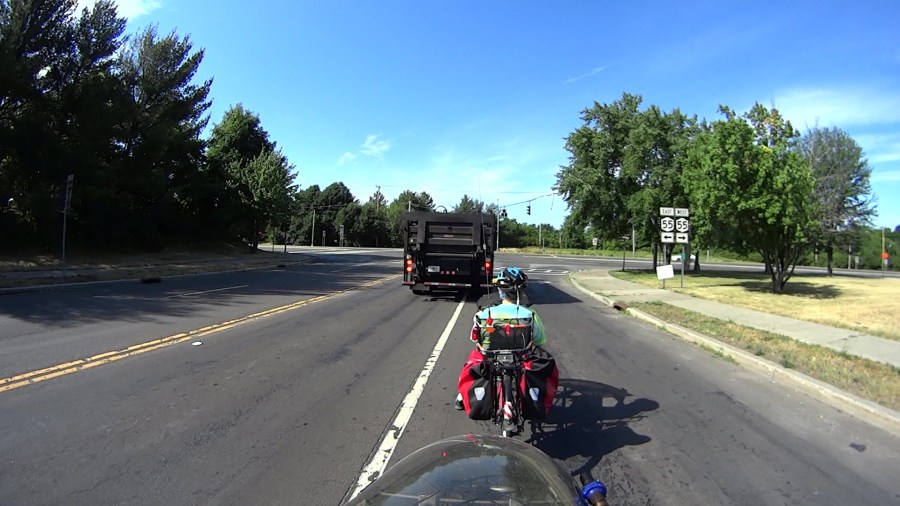
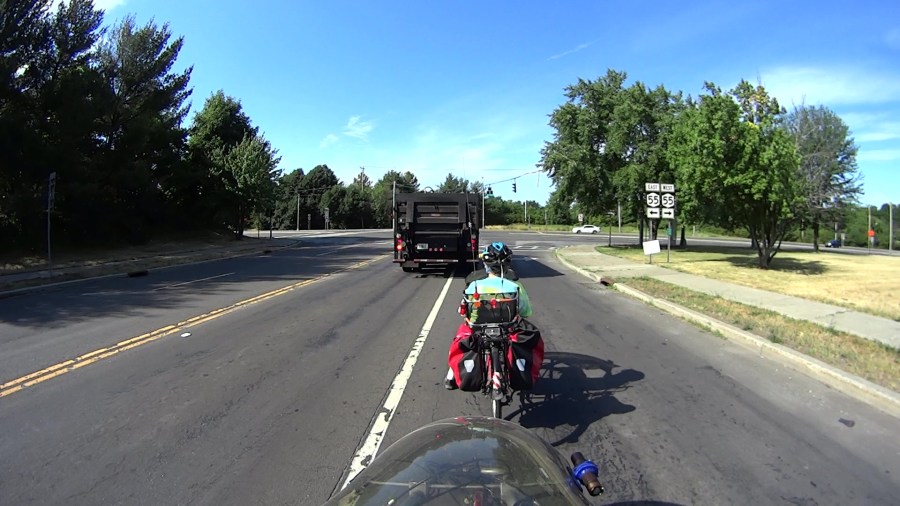
We’re stopped one car length behind a long trailer of paving equipment sporting an Iowa license plate. The driver has stopped with the trailer straddling the lane divider line, so we cannot determine which way he will turn. Because we no longer trust turn signals, despite the trailer’s blinking left signal, we will not pull up beside it in the right lane.
Frame 0127, T = 0 s, Δt = 0 s: The signal has just turned green:
Burnett Opposing Green – AS30V – 2020-06-26 – 0127
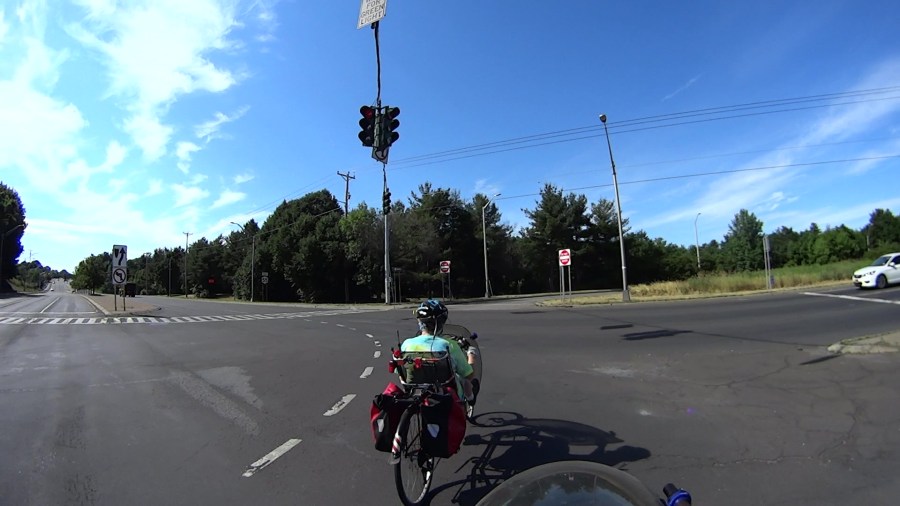
Frame 0264, T = 2.28 s, Δt = 2.28 s: The trailer has started moving and Mary is rolling behind it, with her foot just coming off the ground:
Burnett Opposing Green – AS30V – 2020-06-26 – 0264
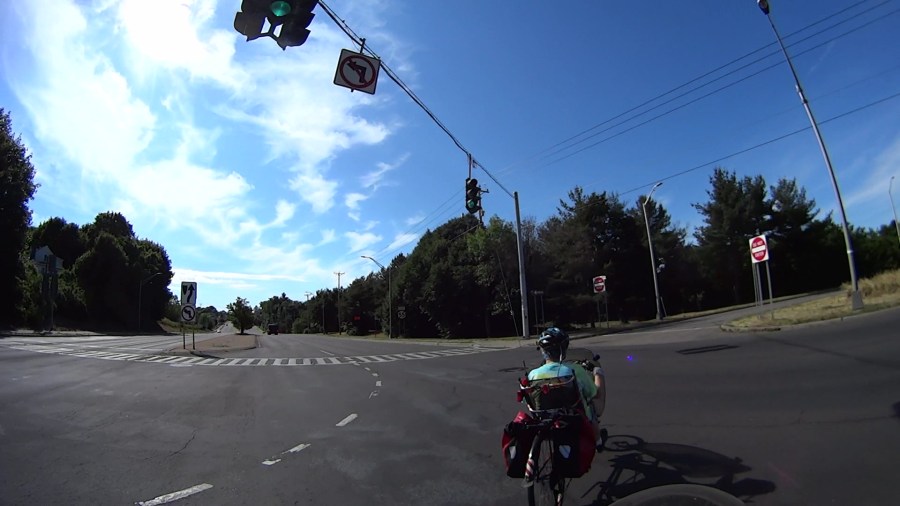
Frame 0721, T = 9.9 s, Δt = 7.6 s: The signal turns yellow, after DOT’s additional five seconds of green; previously, we had five seconds and would have been able to stop. We’re accelerating as hard as we can, but Mary has barely passed the stop line:
Burnett Opposing Green – AS30V – 2020-06-26 – 0721
Of course, entering an intersection on a stale yellow is undoubtedly unwise. It is not so unwise for someone traveling fast, because that person may well clear the intersection before the conflicting traffic starts. It is much more unwise for someone traveling slowly, but it is done and it is lawful.
Forester, ibid.
We’ve traveled about three car lengths in the seven seconds since the trailer started moving. Our bikes will sometimes trigger the signal if we’ve stopped in exactly the right spot over the unmarked sensor loops, but we have never observed our bikes retriggering the signal to lengthen the green or yellow phases as we ride through the intersection.
NYS DOT apparently expects us to stop abruptly when the signal goes yellow, wherever we may be with respect to the stop line and regardless of how fast we may be moving. In fact, given what you’re about to see, we’re expected stop on green to ensure we can start from the stop line during the next green signal.
Frame 0983, T = 14.2 s, Δt = 4.4 s: The signal turns red. The trailer is visible on the left, beyond the median signage, but we haven’t reached the middle of the intersection. I’m lined up with the rightmost lane of westbound Rt 55 and Mary is about in the center lane. The white car on our right is stopped, the black car is slowing to a stop:
Burnett Opposing Green – AS30V – 2020-06-26 – 0983
Frame 1101, T = 16.2 s, Δt = 2.0 s: The opposing signal goes green for Rt 55 traffic, while we’ve barely reached the middle of the intersection:
Burnett Opposing Green – AS30V – 2020-06-26 – 1101
Frame 1205, T = 18.0 s, Δt = 1.8 s: I’m lined up with the median, Mary’s in the center lane of eastbound Rt 55, putting us squarely in front of drivers who may be unable to see us through the stopped cars. The drivers to our left are, fortunately, waiting, unlike a previous crossing:
Burnett Opposing Green – AS30V – 2020-06-26 – 1205
Frame 1440, T = 21.9 s, Δt = 5.7 s: After 22 seconds, we’ve cleared the intersection and are proceeding eastbound on Rt 55:
Burnett Opposing Green – AS30V – 2020-06-26 – 1440
Forester observes the all-red phase must be lengthened to allow cyclists to clear the intersection. Right now, two seconds isn’t enough. Ten seconds would suffice for a pair of reasonably fit, albeit aging, cyclists.
This system fails to provide the required safety in the case of bicycles for three opposite reasons.
1. Bicycles are small and are harder to see. In particular, the most visually impressive part of the bicycle and rider is low down where it is easily shielded from view by the hoods of motor vehicles. Sometimes the only part of the cyclist that can be seen by drivers waiting at the stop line with other vehicles on their left is the head of the cyclist.
2. The cyclist crossing a typical intersection is close to the fronts of the line of cars waiting at the stop line on the cyclist’s right. This is not good judgement on the part of the cyclist, but so much emphasis has been put on staying far right that this position is typical.
3. The cyclist who is traveling slowly, or, more importantly, is starting from a minimum-duration green, is barely into a wide intersection when the conflicting green appears.
The result is a car-bike collision as one of the vehicles in the lanes nearest the curb starts up, or speeds up, and hits the cyclist who suddenly appears in front of it.
Forester, ibid.
I’ve had a DOT engineer tell me, sneeringly, that they don’t design facilities for “professional cyclists”, which commuting to work evidently made me; he was not, however, a “professional driver” even though he used a car for a similar purpose. It’s obvious DOT doesn’t design facilities for “ordinary” cyclists, either, and the evidence suggests they don’t design facilities for cyclists, period, full stop.
I still want someone from NYS DOT to explain how this “makes our highway systems safe and functional for all users“, perhaps by bicycling with us through the intersection a few times, but I’ve never gotten a response, let alone an answer, to anything I’ve ever sent their way.
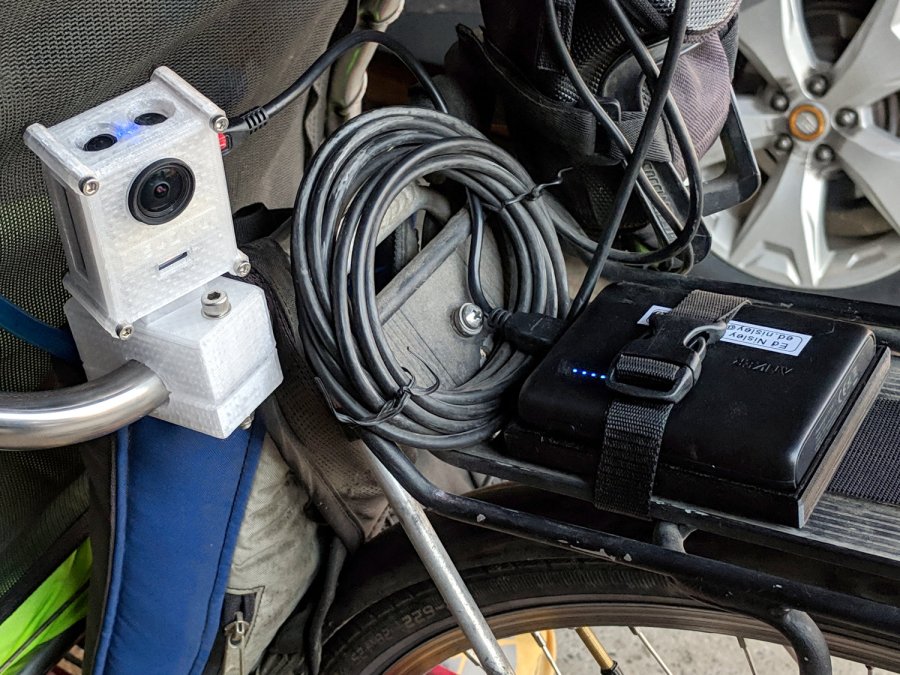
The Anker 13 A·h USB power pack on the rack provides juice for a week’s worth of rides, letting the M20’s internal battery keep its clock & settings alive between rides. I recently forgot to turn on the USB pack and discovered the camera shut down just after I cleared the end of the driveway.
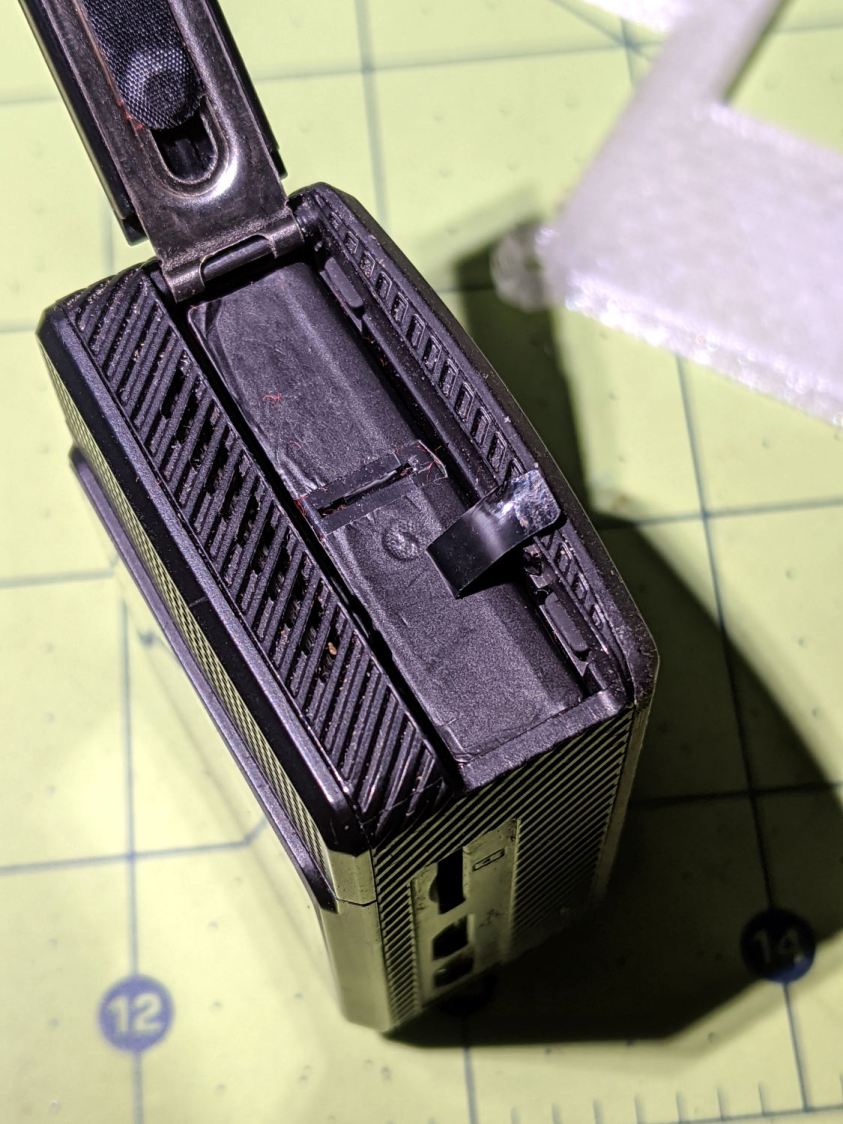
As you should expect, the battery had swollen so much its pull tab … pulled off … when I tried to extract it:
SJCAM M20 – stuck battery
So, we begin.
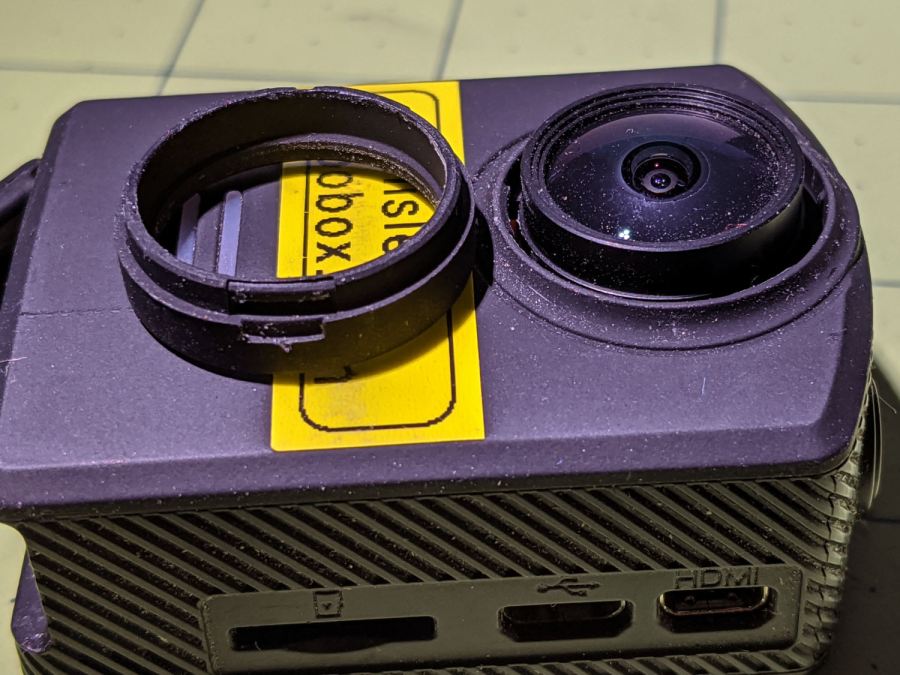
Pry off the trim ring around the lens by jamming a small screwdriver in any of the three slots:
SJCAM M20 – lens ring removed
Then pry off the entire front panel:
SJCAM M20 – camera front panel
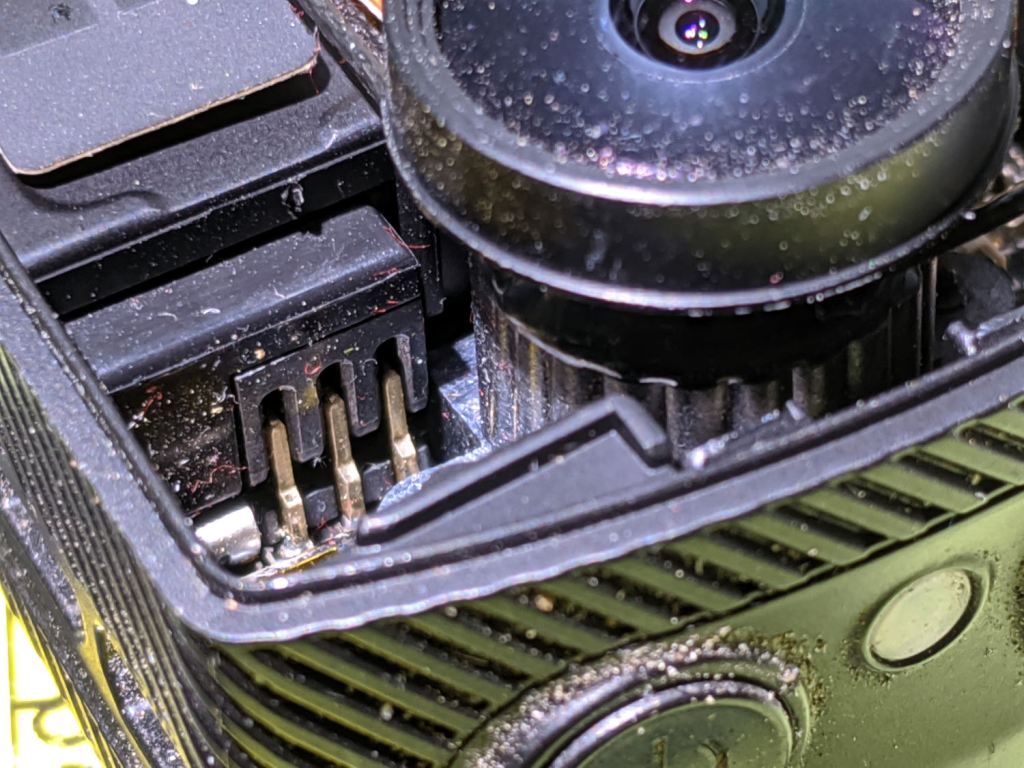
Thereby exposing the battery’s rectangular protrusion and three contacts next to the optical block:
SJCAM M20 – camera interior – battery terminals
Avoid shorting the brass terminals with, say, a small screwdriver, while shoving the battery out of the camera until you can grab it with your fingers and haul it out the rest of the way:
SJCAM M20 – swollen battery case – left
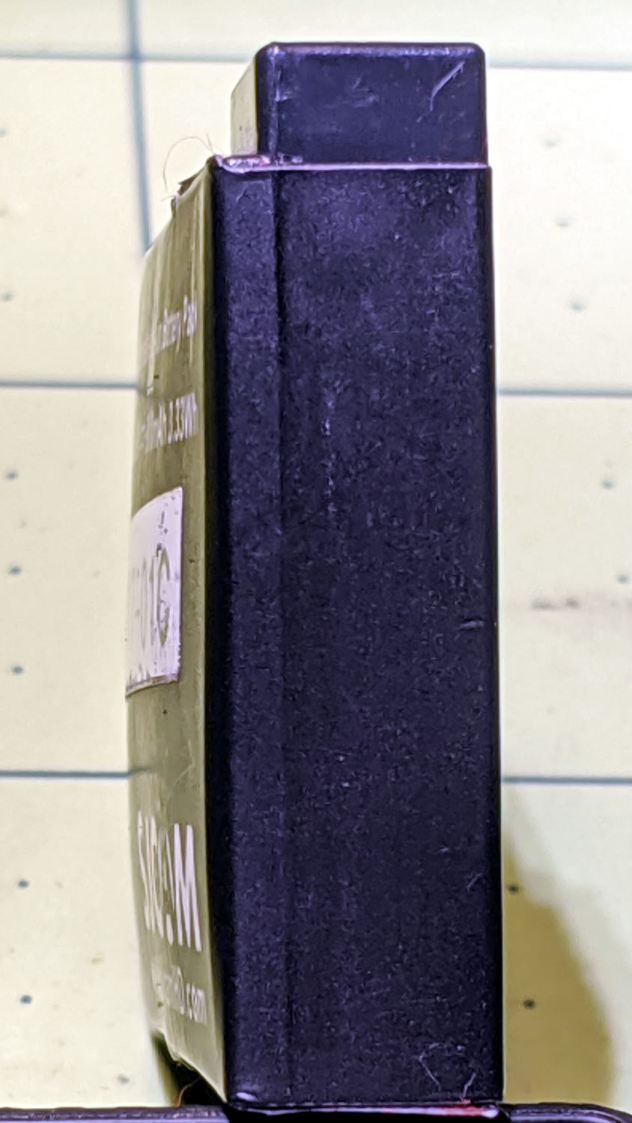
Yeah, that puppy looks all swoll up:
SJCAM M20 – swollen battery case – right
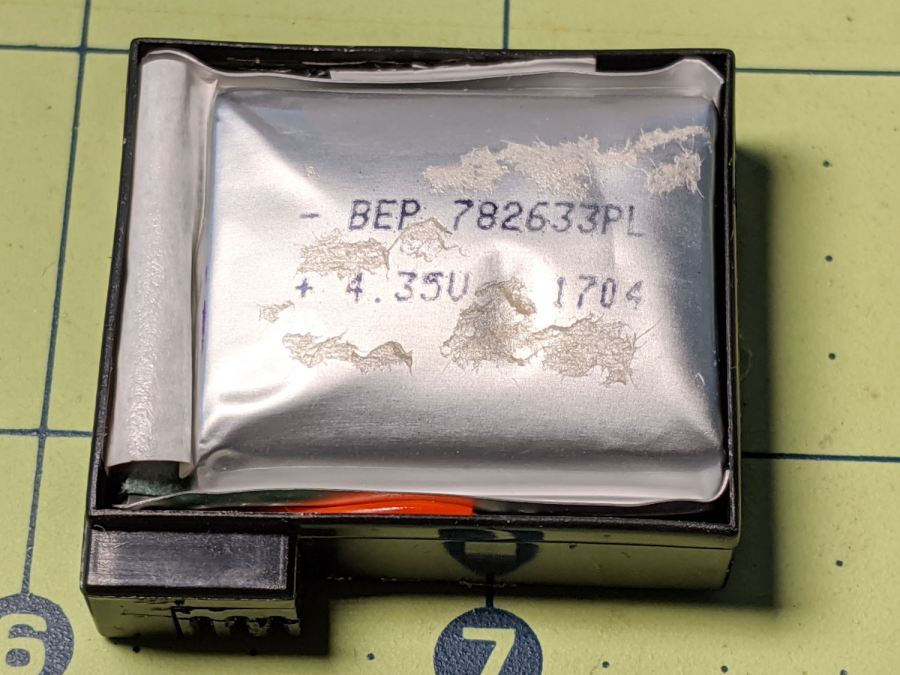
Remove the all-enclosing label to reveal the bag inside:
SJCAM M20 – swollen battery bag
Pull the bag out to reveal the protection PCB:
SJCAM M20 – battery case interior
Snip the wires and salvage the case against future need.
I bought the camera with three batteries, all three of which are now similarly swollen. I also got two official SJAM batteries with an official SJAM charger; both of those batteries seem to be in fine shape. I expect the codes on the five bags would reveal two different lots, but I’m not going to sacrifice a nominally good battery to find out.
All three swollen battery bags show the same BEP 782633PL lot code and 1704 date code. I bought everything in January 2018, so those batteries had been sitting on the shelf for the better part of a year. Maybe that’s why they offered a “deal” for two spare batteries along with the camera?
Installing one of the unswollen batteries, reconfiguring the camera’s settings & clock, and giving it a charge from the Anker USB pack put it back in operation.