Ed Nisley's Blog: Shop notes, electronics, firmware, machinery, 3D printing, laser cuttery, and curiosities. Contents: 100% human thinking, 0% AI slop.
The lump on the right is frass, not a mini-me tagging along behind.
We had no clue what it might be when it grew up, but Google Lens suggested a Striped Hairstreak Butterfly caterpillar and, later that day (and for the first time ever!), we saw an adult Hairstreak fluttering on a goldenrod in the corner of the garden.
As with all caterpillars, you’d never imagine the adult butterfly. It seems they move their hind wings to make predators aim at the south end of a northbound butterfly …
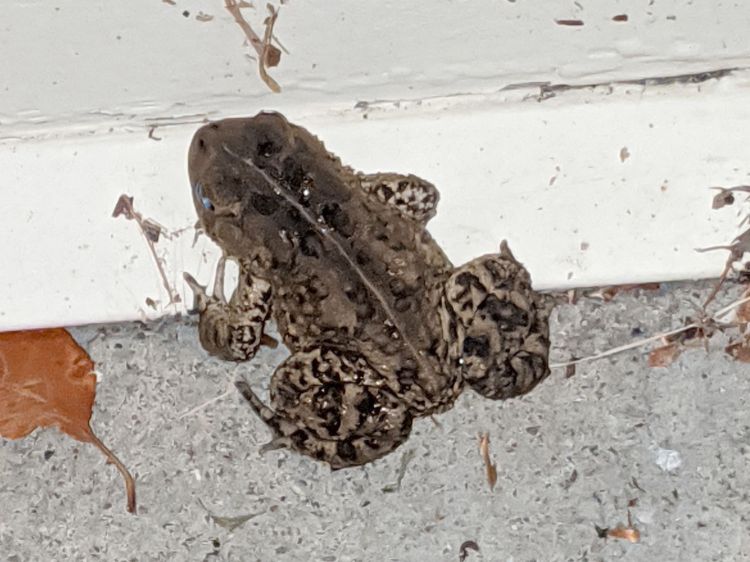
The toad population has apparently been spending more time near the Mighty Wappinger Creek, rather than around the house, during this very dry summer, so this small toad at the garage door came as a surprise:
Toad at garage door
A few days later, Mary spotted a larger toad tucked into the spice garden:
Toad in spice garden
Small tree frogs sound off in the darkness around the house, but we’ve never seen any of them.
We wish them great success in their future bug hunts!
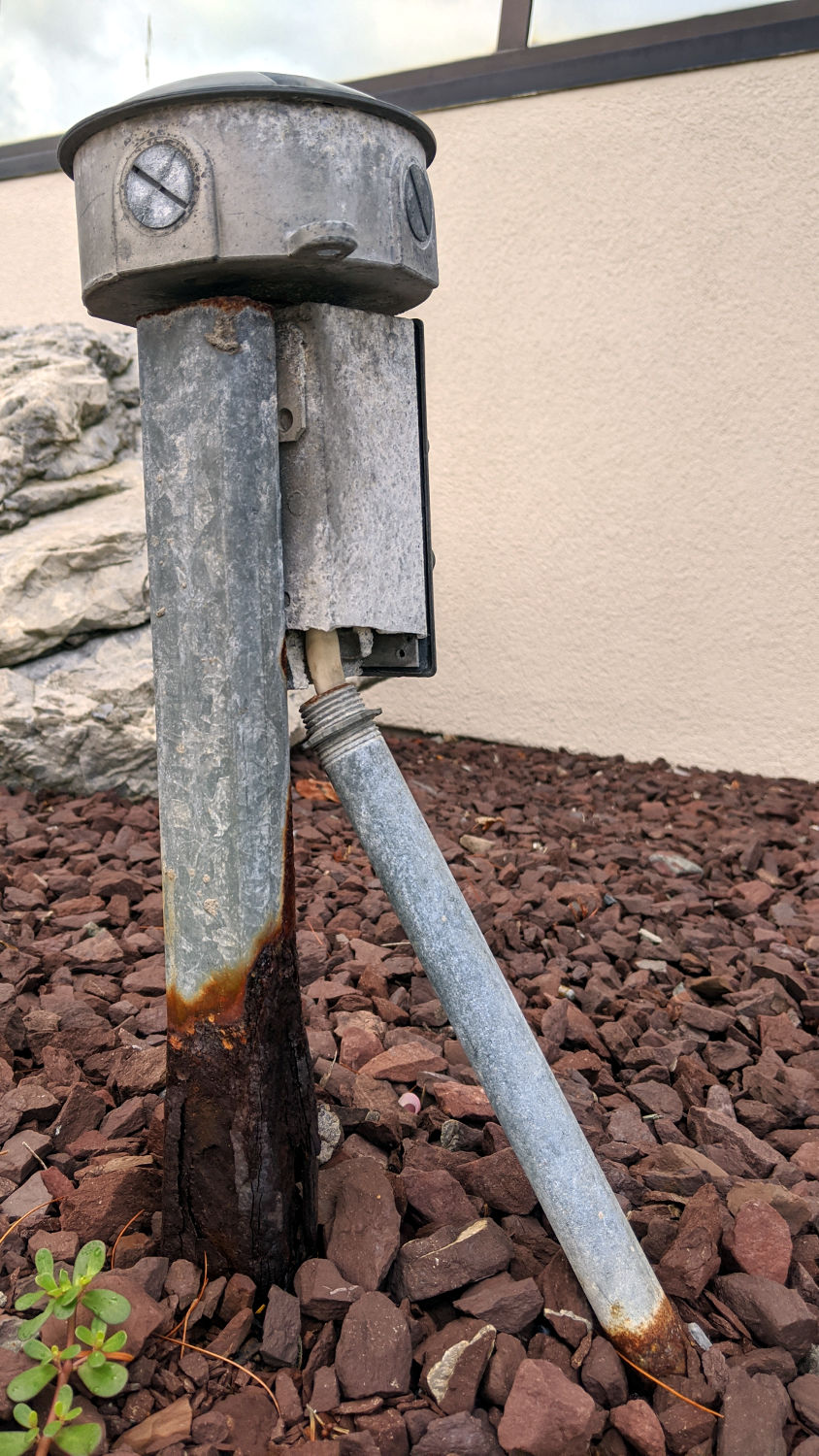
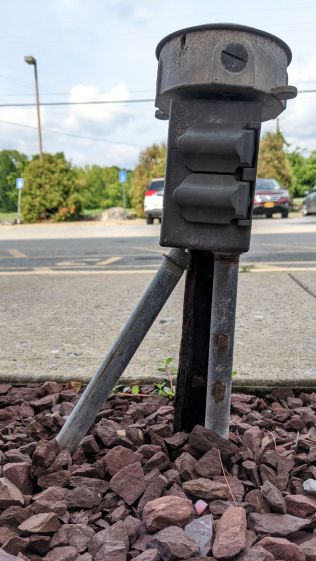
For whatever reason, a two-outlet junction box stands outside the Credit Union:
Outdoor Junction Box – angled conduit
The slanted conduit certainly looks in need of an elbow to line it up, doesn’t it?
It seems whoever installed it, many years ago, simply forced the conduit to line up, no matter the consequences:
Outdoor Junction Box – open wiring
The threaded entries on the die-cast outlet box were never intended to cope with that much misalignment; half the bottom has vanished. I think the round box on the top originally held a floodlight to wash the (uninspired) building facade at night, but those days are long gone.
If the conduit has horizontal underground runs, both are certainly full of water by now. The white(-ish) “Romex” cable insulation looks like ordinary indoor wiring, not the grayish direct-burial sheath, but it may be sun-bleached after years of exposure.
Rt 376 SB Marker 1124 Zachs Way – Near Right Hook – 2020-07-19 – 0
Although I can rarely hang with real roadies, I can put the fear in ’em for a while, so the chase is on.
About 25 seconds later, I’m southbound on Rt 376, accelerating past 20 mph = 30 feet/s. The overtaking pickup, which I haven’t noticed yet, is signaling a right turn at Zach’s Way, 350 feet ahead:
Rt 376 SB Marker 1124 Zachs Way – Near Right Hook – 2020-07-19 – 1
The pickup enters my field of view, but I can’t see the turn signals:
Rt 376 SB Marker 1124 Zachs Way – Near Right Hook – 2020-07-19 – 2
Two seconds later, the driver is braking:
Rt 376 SB Marker 1124 Zachs Way – Near Right Hook – 2020-07-19 – 3
During the next three seconds, the driver realizes I’m going much much faster than your usual cyclist and is braking hard:
Rt 376 SB Marker 1124 Zachs Way – Near Right Hook – 2020-07-19 – 4
My startled shout (“Don’t even think about it!“) may be misinterpreted, but I try to be friendly,
Rt 376 SB Marker 1124 Zachs Way – Near Right Hook – 2020-07-19 – 5
Alas, the cyclist turned into Boardman Road and all that adrenaline went to waste.
Elapsed time since the fender appeared: six seconds.
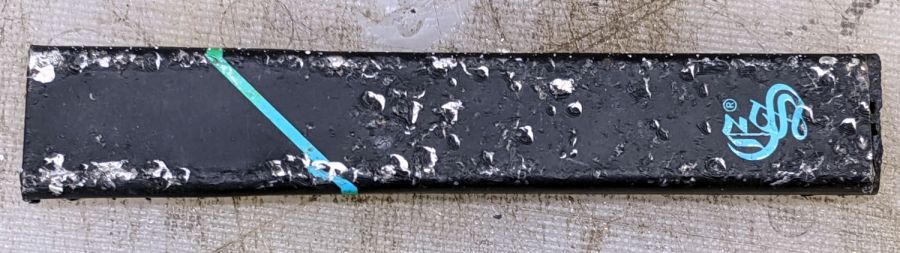
Being the type of guy who uses metal bits & pieces, I thought this might be a useful aluminum rod:
EonSmoke vape stick
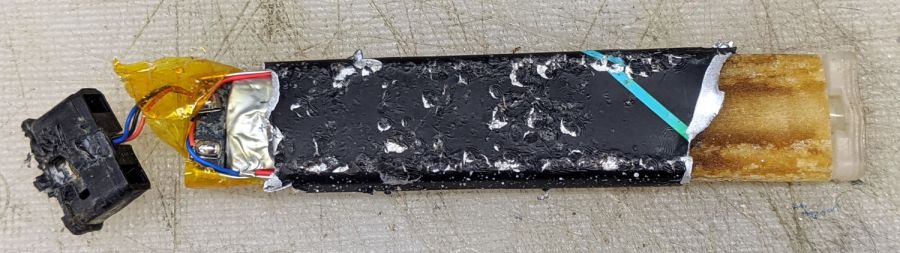
It turns out to be an aluminum tube holding a lithium cell and a reservoir of oily brown juice:
EonSmoke – peeled open
The black plastic cap read “EonSmoke”, which led to a defunct website at the obvious URL. Apparently, EonSmoke went toes-up earlier this year after ten years of poisoning their customers, most likely due to “competitor litigation”.
The black cap held what looks like a pressure switch:
EonSmoke – switch
Suck on the icky end of the tube to activate the switch, pull air past the battery (?), pick up some toxic vapor around the heater, and carry it into your lungs:
EonSmoke – reservoir heater
Maybe there’s a missing mouthpiece letting you suck on the icky end, activate the switch, pull vapor through the heater, and plate your lungs with toxic compounds. I admit certain aspects of my education have been sadly neglected.
The lithium cell was down to 1.0 V, with no overdischarge protection and no provision for charging, so it’s a single-use item. I’m sure the instructions tell you to recycle the lithium cell according to local and state regulations, not toss it out the window of your car.
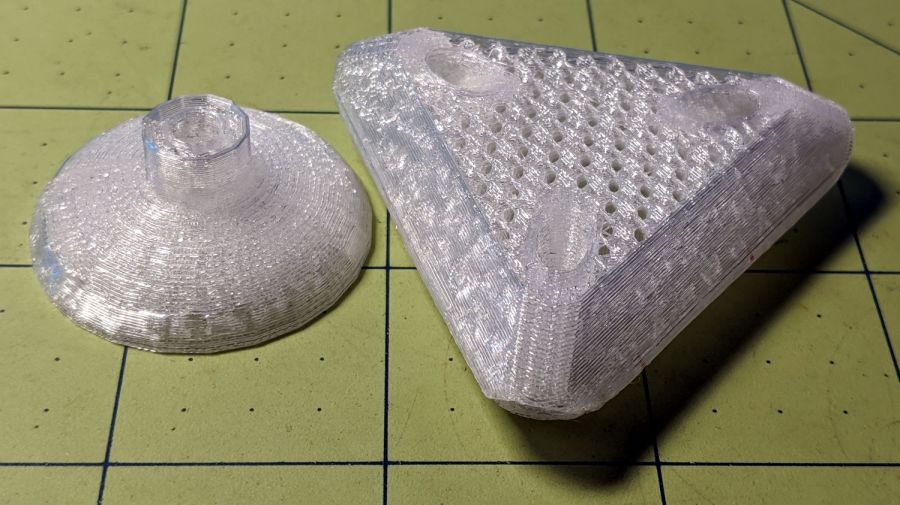
The test pieces for the Mesh Screen Frame came out a bit short:
Extruder Clog – failed print
Which turned out to be the M2’s first extruder clog in a long, long time. The printer shut down normally, with no error messages, and the objects look fine as far as they go, making the diagnosis fairly simple.
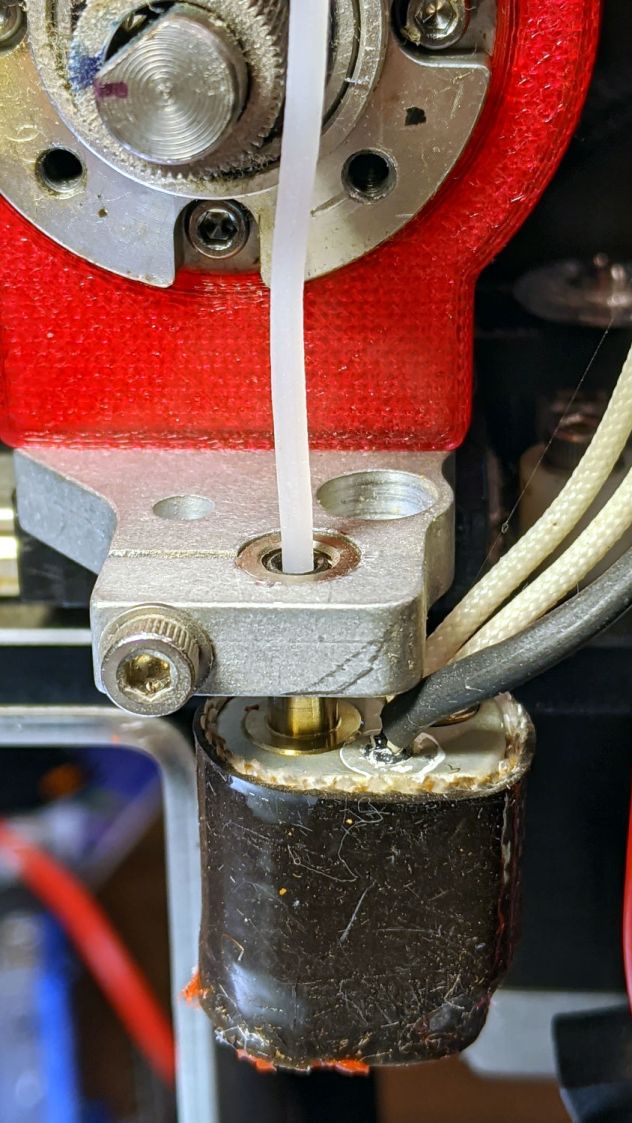
The filament still didn’t feed with the drive gear turning
It’s worth noting I use only PETG plastic from a single supplier, so Slic3r uses set-and-forget temperature and speed values, and I manually change colors only on those rare occasions when color matters. Most clogs occur after switching from a higher- to a lower-temperature plastic (PETG to PLA), where a chunk of soft-but-not-molten plastic jams in the nozzle; not the situation here.
Undo the various screws holding the block to the drive gear housing and pull it off. The drive block looked fine, with a clear round hole along the entire filament path, so that’s not the problem.
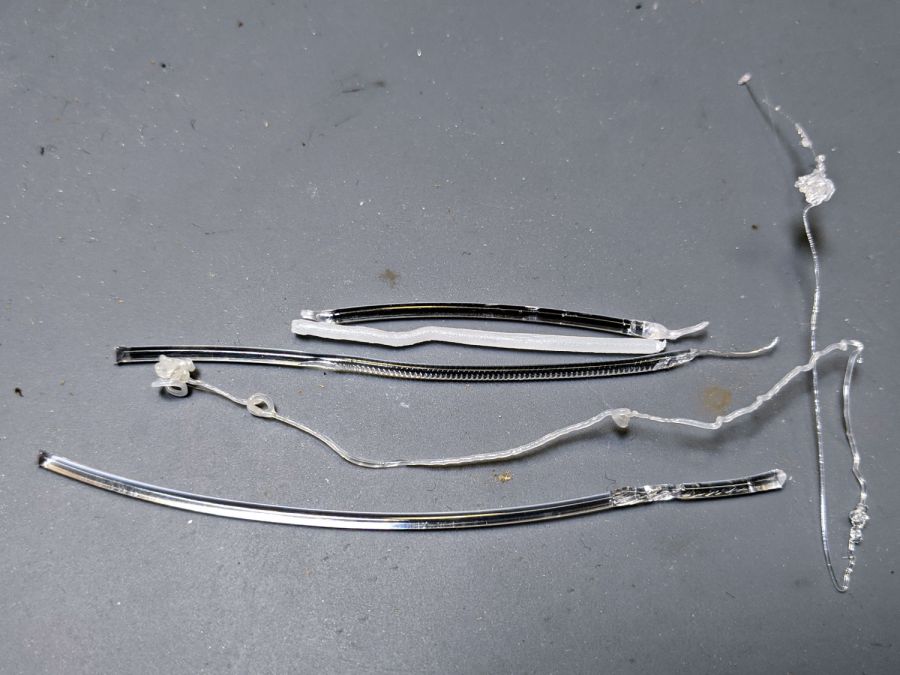
The filament snippet sticking up out of the hot end also looked fine, apart from the expected drive gear gouge, with nice serrations below that point into the hot end. It’s the third filament from the top in this group photo:
Extruder Clog – filament snippets
Although it’s called a “cold pull“, you can’t yank a solid hunk of plastic out of the hot end. Warming the PETG to around 200 °C and pulling the snippet out produced the long tapered end shown above.
I rammed another snippet into the hot end to bond with whatever was inside:
Extruder Clog – PETG pull
Which produced the top snippet above, with no particular trouble found.
Repeating the process with some nylon (?) cleaning filament:
Extruder Clog – cleaner pull
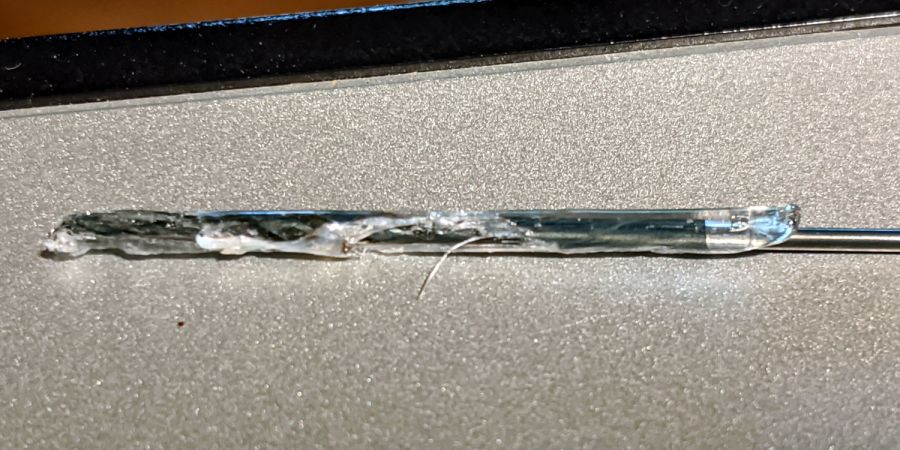
In need of more traction, I sank a #60 twist drill into the molten plastic:
Extruder Clog – drill bit insertion
Let things cool a bit, haul it out (it’s halfway in the picture above), and we’re making progress:
Extruder Clog – drill bit extraction
I warmed the PETG-encrusted bit over a butane flame, wiped it on a shop rag to get most of the plastic off, then drilled a few holes in a hardwood block.
Note that a #60 drill (40 mil = 1 mm) is much much much larger than the nozzle hole:
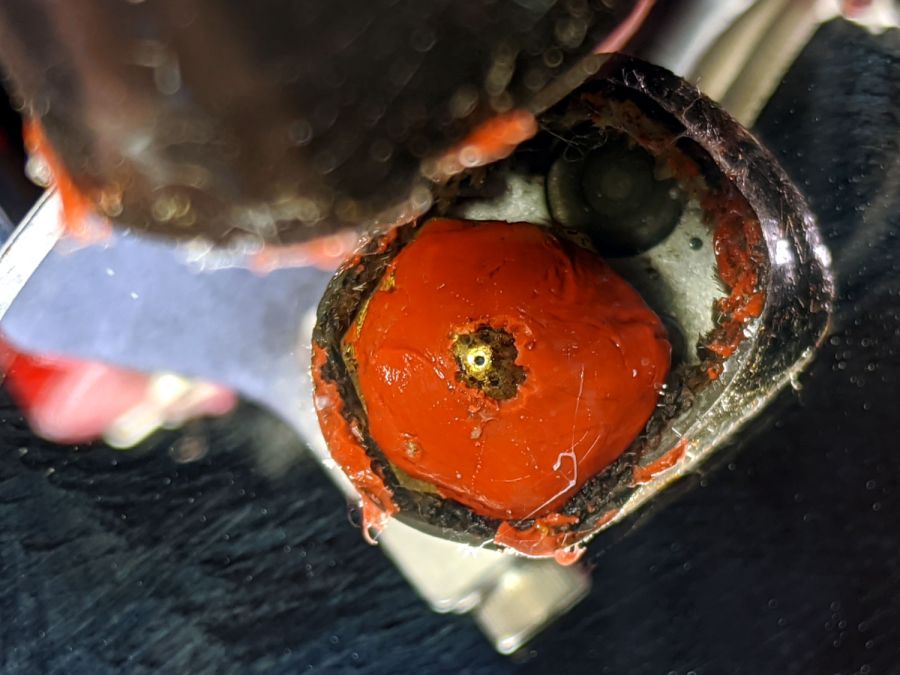
Extruder Clog – nozzle view
The vertiginous view looks downward into a small hand-held mirror.
Although some folks swear by 0.3 mm carbide drills for nozzle cleaning, I doubt I could avoid wrecking that nice round 0.35 mm hole. The new red silicone coat has chipped from around the nozzle over the last few sessions, so it’s no longer wiping the top layer.
During all this flailing, something that might have been a glass fiber emerged from the nozzle while shoving one of those PETG snippets into the hot end. Of course, when I pried it out of the goo with tweezers, it snapped away into the clutter, never to be seen again. Despite being covered in PETG, it was a rigid sliver, rather than the gooey extruded thread. Perhaps the whisker extending from the PETG surrounding the drill bit was a similar fiber, but I didn’t notice it at the time.
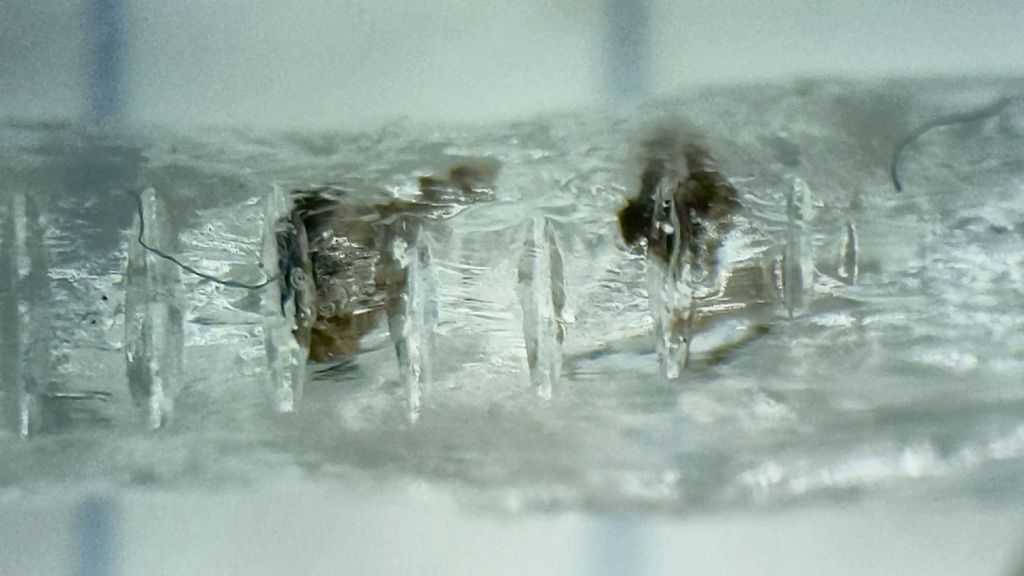
One of the PETG cold warm pulls contained two brownish lumps:
Extruder Clog – PETG inclusions
This chunk doesn’t appear in the group portrait. It’s obviously been melted, measures a bit under 1.75 mm diameter, and the drive gear tooth marks show it passed through the filament drive block under motor control, most likely retraction.
Passing the Xacto Knife of Inquiry through the leftmost lump split it neatly in two. The left section:
Extruder Clog – PETG inclusion – section L
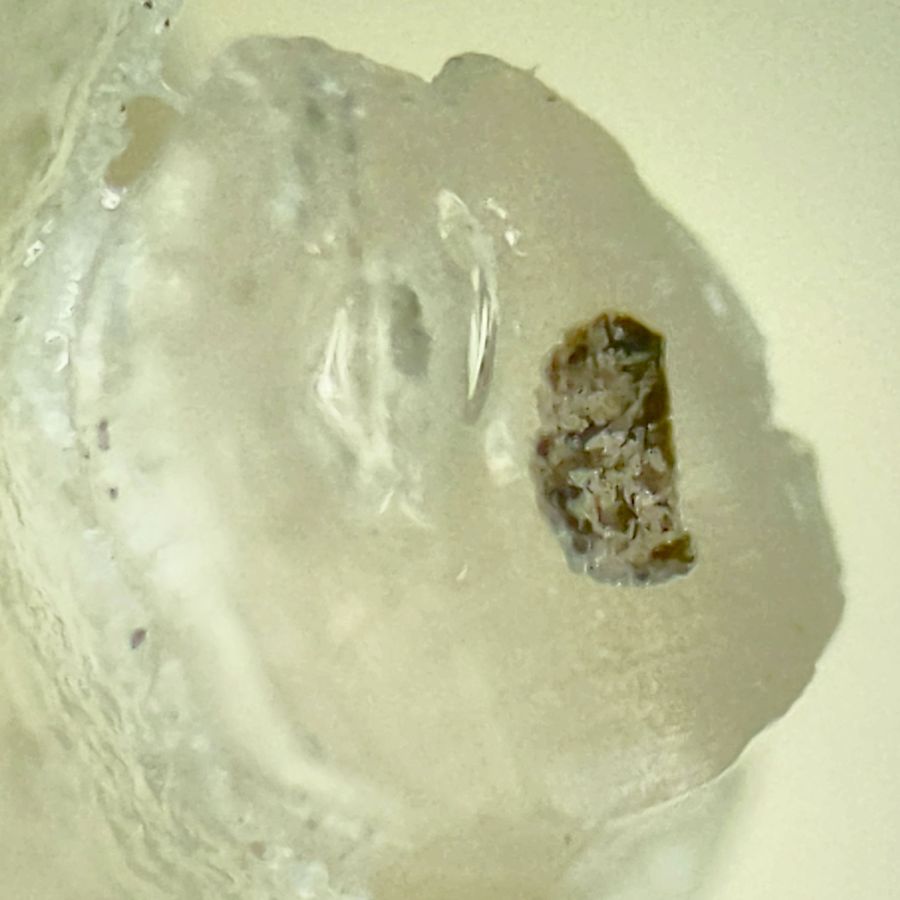
And the right section:
Extruder Clog – PETG inclusion – section R
In person, the sections look like granular / burned residue surrounded by clear PETG. I’d expect anything burned to come from inside the hot end, but I don’t know how those lumps would get surrounded by nice, clear PETG inside a reasonably cylindrical section with drive gear notches.
Anyhow, the clog has now Gone Away™ and the M2 extrudes just fine. I’ll declare victory and move on …























 The Smell of Molten Projects in the Morning