The Smell of Molten Projects in the Morning

Ed Nisley's Blog: Shop notes, electronics, firmware, machinery, 3D printing, laser cuttery, and curiosities. Contents: 100% human thinking, 0% AI slop.

Category: Machine Shop

Mechanical widgetry

  • Mailing Tube End Caps: Screw-in Version

    The mailing tube arrived with contents intact, although the USPS inlet scanning didn’t work and the tube pretty much teleported across several states without leaving any tracking data behind. The recipient suggested several modifications to the caps:

    Review of user experience of tube end:
    The ribs on the endcap are very good at holding the cap on, so much so that I had to use a prying implement to remove it, which cracked the flange.
    Would consider less depth on the cap, and possibly another layer on the flange.

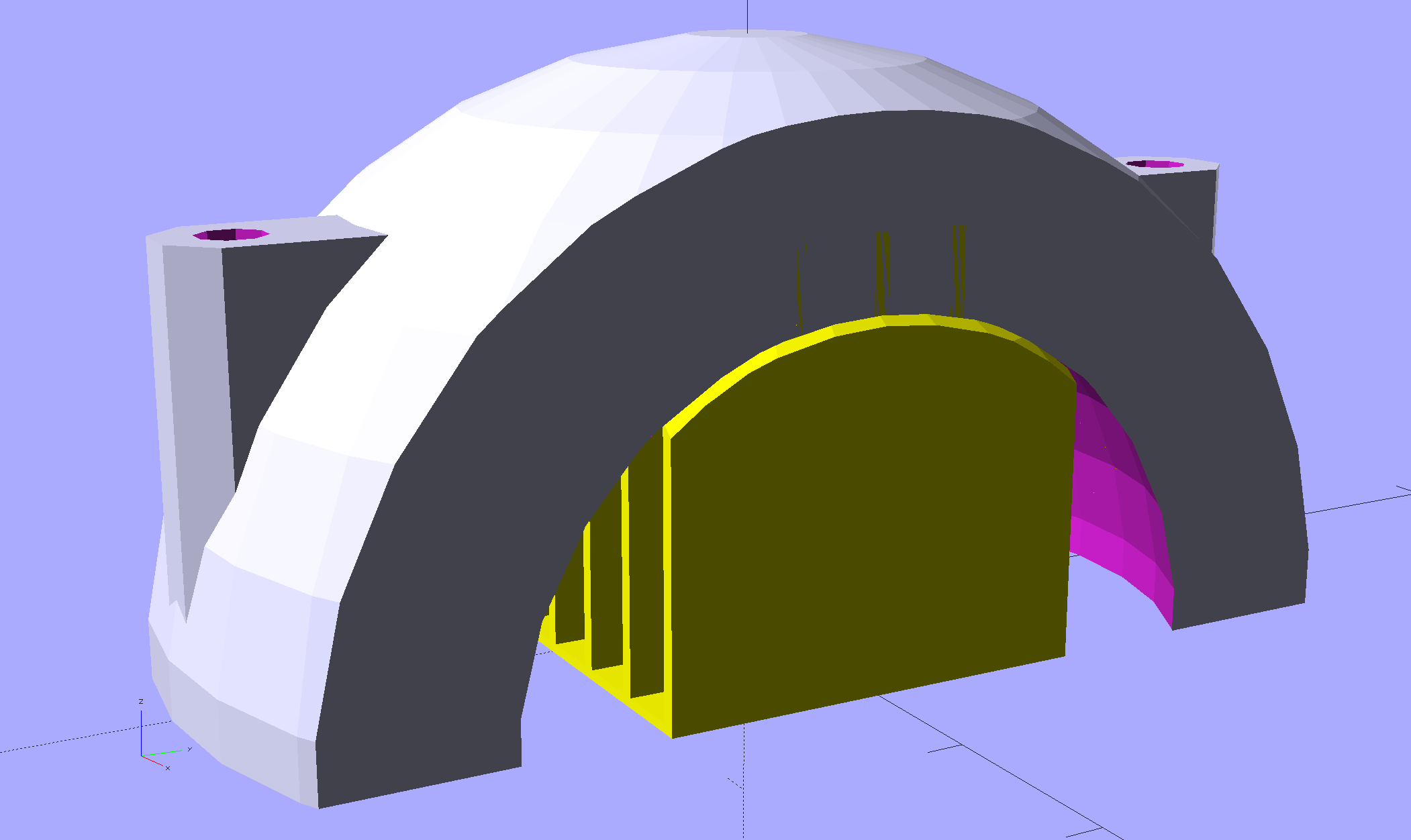
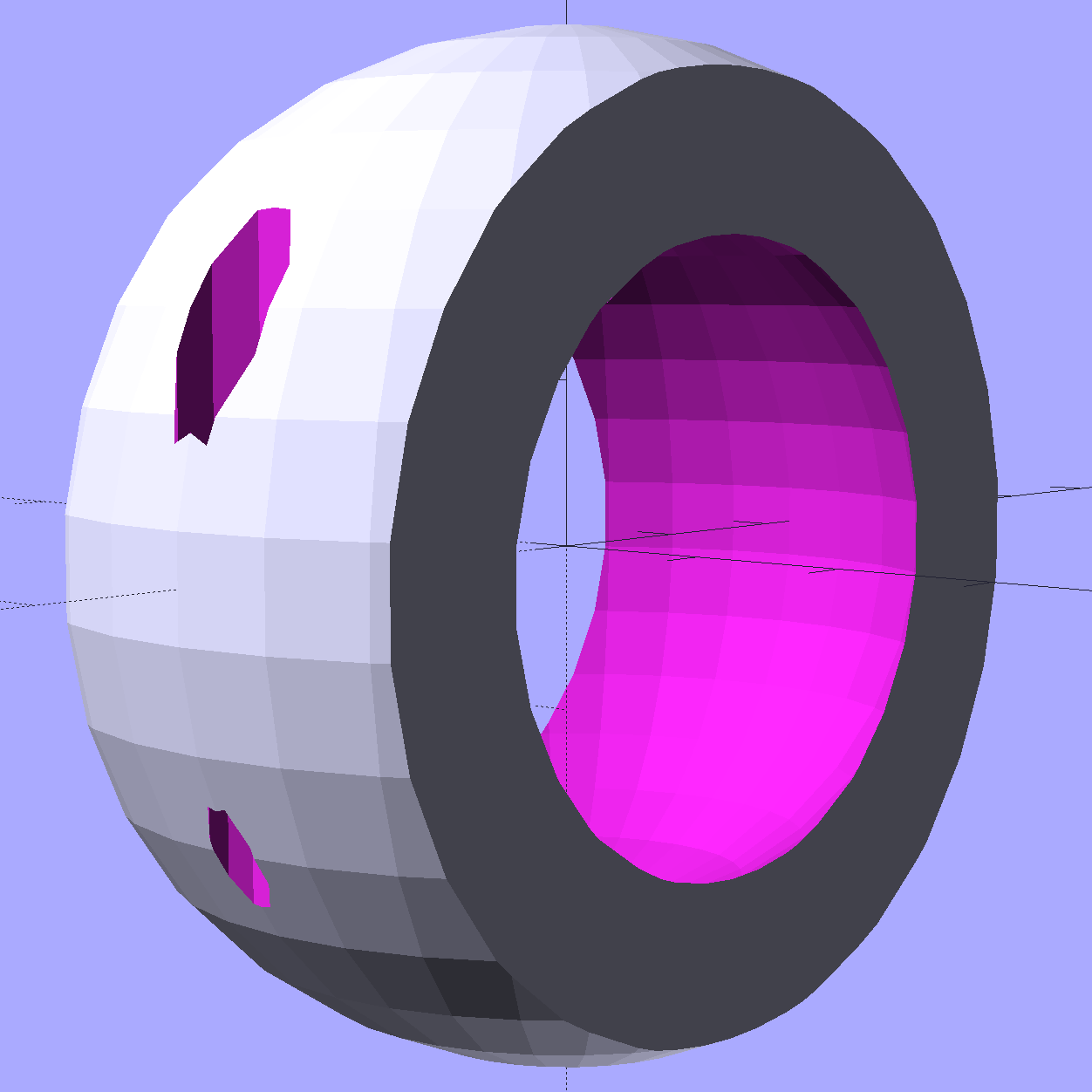
    Some continuous process improvement (a.k.a OpenSCAD hackage) produced a swoopy threaded cap with thumb-and-finger grips:

    Mailing Tube Screw Cap - top - Slic3r
    Mailing Tube Screw Cap – top – Slic3r

    The finger grips are what’s left after stepping a sphere out of the cap while rotating it around the middle:

    Mailing Tube Cap - finger grip construction
    Mailing Tube Cap – finger grip construction

    That worked out surprisingly well, with the deep end providing enough of a vertical-ish surface to push against.

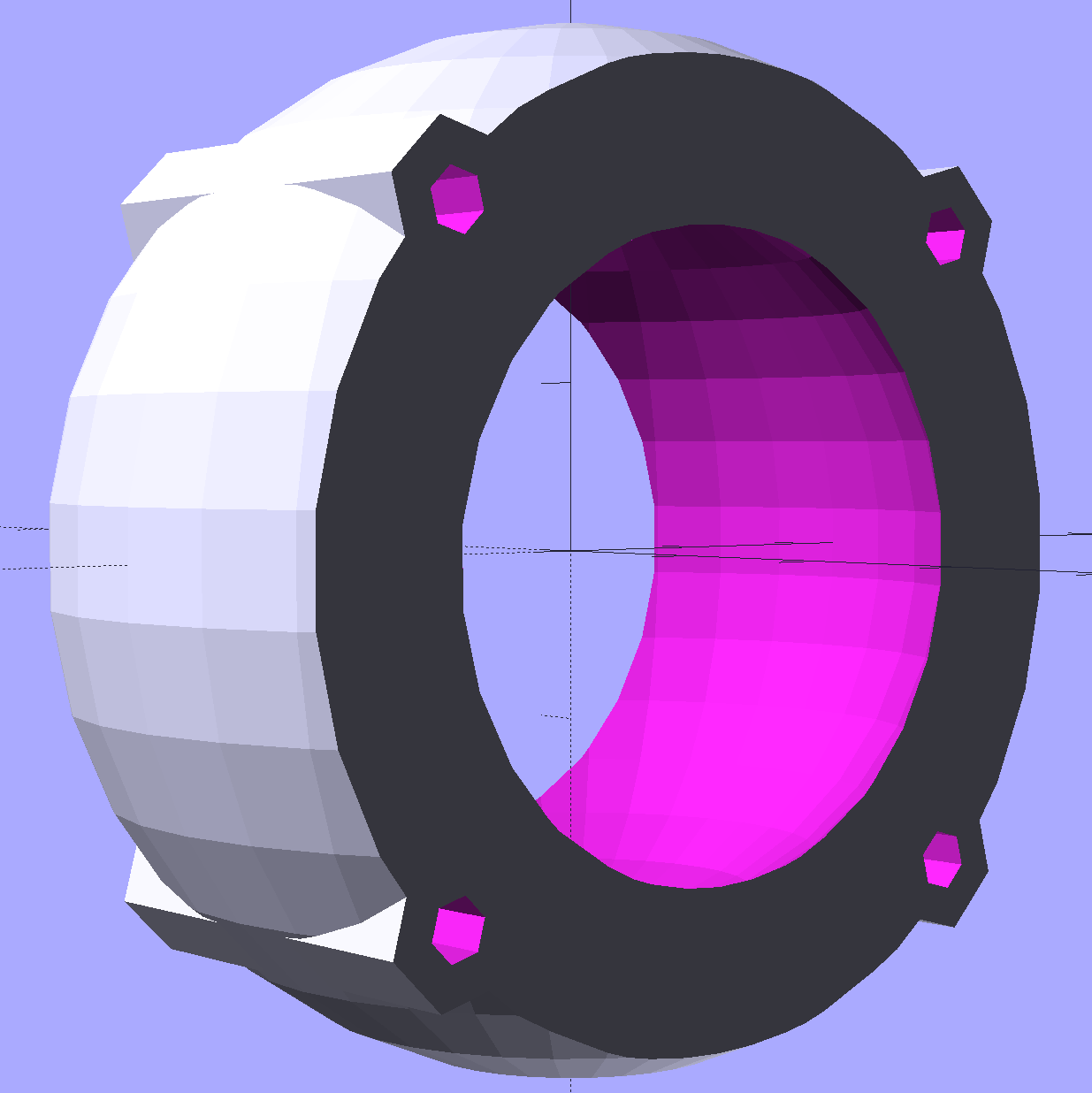
    The two hex holes fit a pin wrench, because the grips twist only one way: outward. The wrench eliminates the need for a flange, as you can now adjust the cap insertion before slathering packing tape over the ends. Man, I loves me some good late binding action!

    A three-start thread seemed like overkill, but was quick & easy. The “thread form” consists of square rods sunk into the cap perimeter, with one edge sticking out:

    Mailing Tube Cap - thread detail
    Mailing Tube Cap – thread detail

    They’re 1.05 times longer than the cap perimeter facets to make their ends overlap, although they’re not tapered like the ones in the broom handle dingus, because it didn’t (seem to) make any difference to the model’s manifoldhood.

    Not needing any endcaps right now, I built one for show-n-tell:

    Threaded mailing tube end cap - installed
    Threaded mailing tube end cap – installed

    The OpenSCAD source code as a GitHub Gist:

    // Mailing tube end cap
    // Ed Nisley KE4ZNU – June 2017
    Layout = "Build";
    Model = "Screw";
    //- Extrusion parameters – must match reality!
    ThreadThick = 0.25;
    ThreadWidth = 0.40;
    function IntegerMultiple(Size,Unit) = Unit * ceil(Size / Unit);
    Protrusion = 0.1;
    HoleWindage = 0.2;
    //- Screw sizes
    inch = 25.4;
    TubeID = 2 * inch;
    TubeWall = 0.1 * inch;
    CapInsert = 15.0;
    CapRim = 6*ThreadThick;
    CapWall = 3*ThreadWidth;
    NumFlanges = 3;
    FlangeHeight = 3*ThreadThick;
    FlangeWidth = ThreadWidth/2;
    FlangeSpace = CapInsert / (NumFlanges + 1);
    ThumbHoleOD = 20.0;
    ThumbHoleAngle = 100;
    ThumbHoleSteps = 10;
    SpannerPinOD = 5.0;
    HelixOD = 4*ThreadThick;
    HelixHeight = 0.75*CapInsert;
    HelixAngle = atan(HelixHeight/(PI*TubeID));
    HelixStarts = 3;
    OAHeight = CapInsert + CapRim;
    NumRibs = 3*4;
    NumSides = 3*NumRibs;
    //- Adjust hole diameter to make the size come out right
    module PolyCyl(Dia,Height,ForceSides=0) { // based on nophead's polyholes
    Sides = (ForceSides != 0) ? ForceSides : (ceil(Dia) + 2);
    FixDia = Dia / cos(180/Sides);
    cylinder(r=(FixDia + HoleWindage)/2,h=Height,$fn=Sides);
    }
    module ScrewCap() {
    union() {
    difference() {
    cylinder(d=TubeID,h=OAHeight,$fn=NumSides);
    for (a=[0,180])
    for (i=[0:ThumbHoleSteps-1])
    rotate(a + i*ThumbHoleAngle/ThumbHoleSteps)
    translate([TubeID/4,0,-i*ThumbHoleOD/(2*ThumbHoleSteps)])
    sphere(d=ThumbHoleOD);
    for (a=[0,180])
    rotate(a – 60)
    translate([0.75*TubeID/2,0,-Protrusion])
    rotate(0*180/6)
    PolyCyl(SpannerPinOD,0.75*CapInsert,6);
    }
    for (s=[0:HelixStarts-1])
    for (i=[0:NumSides-1])
    rotate(i*360/NumSides + 180/NumSides + s*360/HelixStarts)
    translate([TubeID/2 – 0.25*HelixOD,0,i*HelixHeight/NumSides + HelixOD])
    rotate([90 + HelixAngle,0,0])
    cylinder(d=HelixOD,h=1.05*PI*TubeID/NumSides,center=true,$fn=4);
    }
    }
    module PushCap() {
    difference() {
    cylinder(d=TubeID,h=OAHeight,$fn=NumSides);
    translate([0,0,CapWall])
    cylinder(d=TubeID – 2*CapWall,h=OAHeight,$fn=NumSides);
    }
    for (i=[1:NumFlanges])
    translate([0,0,i*FlangeSpace])
    difference() {
    cylinder(d=TubeID + 2*FlangeWidth,h=FlangeHeight,$fn=NumSides);
    translate([0,0,-Protrusion])
    cylinder(d=TubeID – 2*CapWall,h=FlangeHeight + 2*Protrusion,$fn=NumSides);
    }
    for (i=[0:NumRibs-1])
    rotate(i*360/NumRibs)
    translate([0,-ThreadWidth,CapWall + ThreadThick])
    cube([TubeID/2 – CapWall/2,2*ThreadWidth,CapInsert + CapRim – CapWall – ThreadThick],center=false);
    translate([0,0,CapInsert]) {
    difference() {
    cylinder(d=TubeID + 2*TubeWall,h=CapRim,$fn=NumSides);
    translate([0,0,-Protrusion])
    cylinder(d=TubeID – 3*2*CapWall,h=2*CapRim,$fn=NumSides);
    }
    }
    }
    //- Build things
    if (Model == "Push")
    if (Layout == "Show")
    PushCap();
    else if (Layout == "Build")
    translate([0,0,OAHeight])
    rotate([180,0,0])
    PushCap();
    if (Model == "Screw")
    if (Layout == "Show")
    ScrewCap();
    else if (Layout == "Build")
    translate([0,0,OAHeight])
    rotate([180,0,0])
    ScrewCap();
  • Handbag Strap Rivet Repair

    One of the leather strap anchors on Mary’s giant haul-everything-to-a-concert(*) handbag pulled its rivet through the canvas fabric:

    Handbag - pulled-through rivet
    Handbag – pulled-through rivet

    We knotted the strap around the zippered opening and completed the mission.

    Of course, it wouldn’t have pulled through if they’d splurged on washers, but noooo too expensive:

    Handbag - intact rivet - inside
    Handbag – intact rivet – inside

    Some rummaging produced a pan-head M3 screw of suitable length:

    Handbag - repaired - outside
    Handbag – repaired – outside

    A slightly battered acorn nut was a special treat for the inside, with another washer to keep me happy:

    Handbag - repaired - inside
    Handbag – repaired – inside

    That was easy!

    (*) At Tanglewood, where they don’t strip-search you on the way in, tow-behind coolers seemed de rigueur, and a good time was had by all.

  • Mailing Tube End Caps

    Faced with a need to send documents rolled up in a tube, rather than folded flat, I sawed off a suitable length of cardboard tube from the heap, then discovered a distinct lack of end caps.

    Well, once again, it’s 3D printing to the rescue:

    Mailing Tube Cap - top - Slic3r
    Mailing Tube Cap – top – Slic3r

    The small ribs probably don’t actually do anything, but seemed like a nice touch.

    They’re somewhat less boring from the bottom:

    Mailing Tube Cap - bottom - Slic3r
    Mailing Tube Cap – bottom – Slic3r

    The fancy spider supports that big flat top and provides some crush resistance. The flat flange should collect the edge of the packing tape wrapped around the ends.

    A firm shove installs them, so the size worked out perfectly:

    Mailing tube end cap - installed
    Mailing tube end cap – installed

    Add a wrap of tape to each end, affix the USPS label, and they went out with the next day’s mail, PETG hair and all.

    The OpenSCAD source code as a GitHub Gist:

    // Mailing tube end cap
    // Ed Nisley KE4ZNU – June 2017
    Layout = "Build";
    //- Extrusion parameters – must match reality!
    ThreadThick = 0.25;
    ThreadWidth = 0.40;
    function IntegerMultiple(Size,Unit) = Unit * ceil(Size / Unit);
    Protrusion = 0.1;
    HoleWindage = 0.2;
    //- Screw sizes
    inch = 25.4;
    TubeID = 2 * inch;
    TubeWall = 0.1 * inch;
    CapInsert = 15.0;
    CapRim = 1.0;
    CapWall = 3*ThreadWidth;
    NumFlanges = 3;
    FlangeHeight = 3*ThreadThick;
    FlangeWidth = ThreadWidth/2;
    FlangeSpace = CapInsert / (NumFlanges + 1);
    OAHeight = CapInsert + CapRim;
    NumRibs = 3*4;
    NumSides = 3*NumRibs;
    //- Adjust hole diameter to make the size come out right
    module PolyCyl(Dia,Height,ForceSides=0) { // based on nophead's polyholes
    Sides = (ForceSides != 0) ? ForceSides : (ceil(Dia) + 2);
    FixDia = Dia / cos(180/Sides);
    cylinder(r=(FixDia + HoleWindage)/2,h=Height,$fn=Sides);
    }
    module TubeCap() {
    difference() {
    cylinder(d=TubeID,h=OAHeight,$fn=NumSides);
    translate([0,0,CapWall])
    cylinder(d=TubeID – 2*CapWall,h=OAHeight,$fn=NumSides);
    }
    for (i=[1:NumFlanges])
    translate([0,0,i*FlangeSpace])
    difference() {
    cylinder(d=TubeID + 2*FlangeWidth,h=FlangeHeight,$fn=NumSides);
    translate([0,0,-Protrusion])
    cylinder(d=TubeID – 2*CapWall,h=FlangeHeight + 2*Protrusion,$fn=NumSides);
    }
    for (i=[0:NumRibs-1])
    rotate(i*360/NumRibs)
    translate([0,-ThreadWidth,CapWall + ThreadThick])
    cube([TubeID/2 – CapWall/2,2*ThreadWidth,CapInsert + CapRim – CapWall – ThreadThick],center=false);
    translate([0,0,CapInsert]) {
    difference() {
    cylinder(d=TubeID + 2*TubeWall,h=CapRim,$fn=NumSides);
    translate([0,0,-Protrusion])
    cylinder(d=TubeID – 3*2*CapWall,h=2*CapRim,$fn=NumSides);
    }
    }
    }
    //- Build things
    if (Layout == "Show")
    TubeCap();
    if (Layout == "Build")
    translate([0,0,OAHeight])
    rotate([180,0,0])
    TubeCap();
  • Proto Board Holder: Revised Screw Mounts

    Improving the crystal tester’s (nonexistent) grounding requires a band of copper tape around the inside of the proto board holder. Rather than cut the tape lengthwise to fit the holder, a new one will be just tall enough:

    Proto Board - 80x120 - revised inserts - Slic3r
    Proto Board – 80×120 – revised inserts – Slic3r

    While I was at it, I deleted the washer recesses, because those didn’t work out well, and fiddled the screw holes to put the inserts in from the bottom:

    Proto Board - 80x120 - revised inserts - detail - Slic3r
    Proto Board – 80×120 – revised inserts – detail – Slic3r

    Although the overhang inside the holes will be ugly, I’ll epoxy the inserts flush with the bottom and nobody will ever know.

    The copper tape now makes a tidy ground strap:

    Crystal Tester - ground strap - rear
    Crystal Tester – ground strap – rear

    With a gap in the front to eliminate the obvious loop:

    Crystal Tester - ground strap - front gap
    Crystal Tester – ground strap – front gap

    The OpenSCAD source code as a GitHub Gist:

    // Test support frame for proto boards
    // Ed Nisley KE4ZNU – Jan 2017
    // June 2017 – Add side-mount bracket, inserts into bottom
    Layout = "Frame";
    ClampFlange = true;
    Channel = false;
    //- Extrusion parameters – must match reality!
    ThreadThick = 0.25;
    ThreadWidth = 0.40;
    function IntegerMultiple(Size,Unit) = Unit * ceil(Size / Unit);
    Protrusion = 0.1;
    HoleWindage = 0.2;
    //- Screw sizes
    inch = 25.4;
    Tap4_40 = 0.089 * inch;
    Clear4_40 = 0.110 * inch;
    Head4_40 = 0.211 * inch;
    Head4_40Thick = 0.065 * inch;
    Nut4_40Dia = 0.228 * inch;
    Nut4_40Thick = 0.086 * inch;
    Washer4_40OD = 0.270 * inch;
    Washer4_40ID = 0.123 * inch;
    ID = 0;
    OD = 1;
    LENGTH = 2;
    Insert = [3.9,4.6,5.8];
    //- PCB sizes
    PCBSize = [80.0,120.0,1.6];
    PCBShelf = 1.0; // support rim under PCB
    Clearance = 2*[ThreadWidth,ThreadWidth,0];
    WallThick = 4.0;
    FrameHeight = IntegerMultiple(3/8 * inch,1.0);
    echo(str("Inner height: ",FrameHeight));
    ScrewOffset = 0.0 + Clear4_40/2;
    ScrewSites = [[-1,1],[-1,1]]; // -1/0/+1 = left/mid/right and bottom/mid/top
    OAHeight = FrameHeight + Clearance[2] + PCBSize[2];
    echo(str("OAH: ",OAHeight));
    FlangeExtension = 3.0;
    FlangeThick = IntegerMultiple(2.0,ThreadThick);
    Flange = PCBSize
    + 2*[ScrewOffset,ScrewOffset,0]
    + 2*[Washer4_40OD,Washer4_40OD,0]
    + [2*FlangeExtension,2*FlangeExtension,(FlangeThick – PCBSize[2])]
    ;
    echo(str("Flange: ",Flange));
    NumSides = 4*5;
    WireChannel = [Flange[0],15.0,3.0 + PCBSize[2]];
    WireChannelOffset = [Flange[0]/2,25.0,(FrameHeight + PCBSize[2] – WireChannel[2]/2)];
    //- Adjust hole diameter to make the size come out right
    module PolyCyl(Dia,Height,ForceSides=0) { // based on nophead's polyholes
    Sides = (ForceSides != 0) ? ForceSides : (ceil(Dia) + 2);
    FixDia = Dia / cos(180/Sides);
    cylinder(r=(FixDia + HoleWindage)/2,h=Height,$fn=Sides);
    }
    //- Build things
    if (Layout == "Frame")
    difference() {
    union() { // body block
    translate([0,0,OAHeight/2])
    cube(PCBSize + Clearance + [2*WallThick,2*WallThick,FrameHeight],center=true);
    for (x=[-1,1], y=[-1,1]) { // screw bosses
    translate([x*(PCBSize[0]/2 + ScrewOffset),
    y*(PCBSize[1]/2 + ScrewOffset),
    0])
    cylinder(r=Washer4_40OD,h=OAHeight,$fn=NumSides);
    }
    if (ClampFlange) // flange for work holder
    linear_extrude(height=Flange[2])
    hull()
    for (i=[-1,1], j=[-1,1]) {
    translate([i*(Flange[0]/2 – Washer4_40OD/2),j*(Flange[1]/2 – Washer4_40OD/2)])
    circle(d=Washer4_40OD,$fn=NumSides);
    }
    }
    for (x=[-1,1], y=[-1,1]) { // screw position indexes
    translate([x*(PCBSize[0]/2 + ScrewOffset),
    y*(PCBSize[1]/2 + ScrewOffset),
    -Protrusion])
    rotate(x*y*180/(2*6))
    PolyCyl(Clear4_40,(OAHeight + 2*Protrusion),6); // screw clearance holes
    translate([x*(PCBSize[0]/2 + ScrewOffset),
    y*(PCBSize[1]/2 + ScrewOffset),
    -Protrusion])
    rotate(x*y*180/(2*6))
    PolyCyl(Insert[OD],OAHeight – PCBSize[2] – 3*ThreadThick + Protrusion,6); // inserts
    if (false)
    translate([x*(PCBSize[0]/2 + ScrewOffset),
    y*(PCBSize[1]/2 + ScrewOffset),
    OAHeight – PCBSize[2]])
    PolyCyl(1.2*Washer4_40OD,(PCBSize[2] + Protrusion),NumSides); // washer recess
    }
    translate([0,0,OAHeight/2]) // through hole below PCB
    cube(PCBSize – 2*[PCBShelf,PCBShelf,0] + [0,0,2*OAHeight],center=true);
    translate([0,0,(OAHeight – (PCBSize[2] + Clearance[2])/2 + Protrusion/2)]) // PCB pocket on top
    cube(PCBSize + Clearance + [0,0,Protrusion],center=true);
    if (Channel)
    translate(WireChannelOffset) // opening for wires from bottom side
    cube(WireChannel + [0,0,Protrusion],center=true);
    }
    // Add-on bracket to hold smaller PCB upright at edge
    PCB2Insert = [3.0,4.9,4.1];
    PCB2OC = 45.0;
    if (Layout == "Bracket")
    difference() {
    hull() // frame body block
    for (x=[-1,1]) // bosses around screws
    translate([x*(PCBSize[0]/2 + ScrewOffset),0,0])
    cylinder(r=Washer4_40OD,h=OAHeight,$fn=NumSides);
    for (x=[-1,1]) // frame screw holes
    translate([x*(PCBSize[0]/2 + ScrewOffset),0,-Protrusion])
    rotate(x*180/(2*6))
    PolyCyl(Clear4_40,(OAHeight + 2*Protrusion),6);
    for (x=[-1,1]) // PCB insert holes
    translate([x*PCB2OC/2,(Washer4_40OD + Protrusion),OAHeight/2])
    rotate([90,0,0])
    cylinder(d=PCB2Insert[OD],h=2*(Washer4_40OD + Protrusion),$fn=6);
    }

  • Under-cabinet LED Strip IR Sensor: Re-aimed

    The under-cabinet LED strips work wonderfully well, except that the IR sensor seemed rather hypersensitive, so I added a small reflector made of shiny steel:

    Under-cabinet light - IR sensor mirror
    Under-cabinet light – IR sensor mirror

    Even though I rounded those corners and deburred the edges, it does look a bit threatening, doesn’t it?

    It moves the sensor’s hotspot back about half a foot, which seems Good Enough to eliminate false triggering from normal activity over the cutting board.

  • AD8310 Log Amp Module: Sidesaddle Bracket

    This little bracket attaches to a proto board holder, with holes for M3 inserts to mount the AD8310 log amp module:

    PCB Side Bracket - 80x120
    PCB Side Bracket – 80×120

    Thusly:

    AD8310 module bracket on proto board holder - component side
    AD8310 module bracket on proto board holder – component side

    The OLED display looks a bit faded, which seems to be an interaction between matrix refresh and camera shutter: looks just fine in person!

    Not much to see from the other side:

    AD8310 module bracket on proto board holder - solder side
    AD8310 module bracket on proto board holder – solder side

    I should have included an offset to slide it a bit forward; then I could mount it on the other end with clearance for the Nano’s USB port. Maybe next time.

    The OpenSCAD source code as a GitHub Gist:

    // Test support frame for proto boards
    // Ed Nisley KE4ZNU – Jan 2017
    // June 2017 – Add side-mount bracket
    Layout = "Bracket";
    ClampFlange = true;
    Channel = false;
    //- Extrusion parameters – must match reality!
    ThreadThick = 0.25;
    ThreadWidth = 0.40;
    function IntegerMultiple(Size,Unit) = Unit * ceil(Size / Unit);
    Protrusion = 0.1;
    HoleWindage = 0.2;
    //- Screw sizes
    inch = 25.4;
    Tap4_40 = 0.089 * inch;
    Clear4_40 = 0.110 * inch;
    Head4_40 = 0.211 * inch;
    Head4_40Thick = 0.065 * inch;
    Nut4_40Dia = 0.228 * inch;
    Nut4_40Thick = 0.086 * inch;
    Washer4_40OD = 0.270 * inch;
    Washer4_40ID = 0.123 * inch;
    ID = 0;
    OD = 1;
    LENGTH = 2;
    Insert = [3.9,4.6,5.8];
    //- PCB sizes
    PCBSize = [80.0,120.0,1.6];
    PCBShelf = 1.5;
    Clearance = 2*[ThreadWidth,ThreadWidth,0];
    WallThick = 4.0;
    FrameHeight = 8.0;
    ScrewOffset = 0.0 + Clear4_40/2;
    ScrewSites = [[-1,1],[-1,1]]; // -1/0/+1 = left/mid/right and bottom/mid/top
    OAHeight = FrameHeight + Clearance[2] + PCBSize[2];
    echo(str("OAH: ",OAHeight));
    FlangeExtension = 3.0;
    FlangeThick = IntegerMultiple(2.0,ThreadThick);
    Flange = PCBSize
    + 2*[ScrewOffset,ScrewOffset,0]
    + 2*[Washer4_40OD,Washer4_40OD,0]
    + [2*FlangeExtension,2*FlangeExtension,(FlangeThick – PCBSize[2])]
    ;
    echo(str("Flange: ",Flange));
    NumSides = 4*5;
    WireChannel = [Flange[0],15.0,3.0 + PCBSize[2]];
    WireChannelOffset = [Flange[0]/2,25.0,(FrameHeight + PCBSize[2] – WireChannel[2]/2)];
    //- Adjust hole diameter to make the size come out right
    module PolyCyl(Dia,Height,ForceSides=0) { // based on nophead's polyholes
    Sides = (ForceSides != 0) ? ForceSides : (ceil(Dia) + 2);
    FixDia = Dia / cos(180/Sides);
    cylinder(r=(FixDia + HoleWindage)/2,h=Height,$fn=Sides);
    }
    //- Build things
    if (Layout == "Frame")
    difference() {
    union() { // body block
    translate([0,0,OAHeight/2])
    cube(PCBSize + Clearance + [2*WallThick,2*WallThick,FrameHeight],center=true);
    for (x=[-1,1], y=[-1,1]) { // screw bosses
    translate([x*(PCBSize[0]/2 + ScrewOffset),
    y*(PCBSize[1]/2 + ScrewOffset),
    0])
    cylinder(r=Washer4_40OD,h=OAHeight,$fn=NumSides);
    }
    if (ClampFlange) // flange for work holder
    linear_extrude(height=Flange[2])
    hull()
    for (i=[-1,1], j=[-1,1]) {
    translate([i*(Flange[0]/2 – Washer4_40OD/2),j*(Flange[1]/2 – Washer4_40OD/2)])
    circle(d=Washer4_40OD,$fn=NumSides);
    }
    }
    for (x=[-1,1], y=[-1,1]) { // screw position indexes
    translate([x*(PCBSize[0]/2 + ScrewOffset),
    y*(PCBSize[1]/2 + ScrewOffset),
    -Protrusion])
    rotate(x*y*180/(2*6))
    PolyCyl(Clear4_40,(OAHeight + 2*Protrusion),6); // screw clearance holes
    translate([x*(PCBSize[0]/2 + ScrewOffset),
    y*(PCBSize[1]/2 + ScrewOffset),
    OAHeight – PCBSize[2] – Insert[LENGTH]])
    rotate(x*y*180/(2*6))
    PolyCyl(Insert[OD],Insert[LENGTH] + Protrusion,6); // inserts
    translate([x*(PCBSize[0]/2 + ScrewOffset),
    y*(PCBSize[1]/2 + ScrewOffset),
    OAHeight – PCBSize[2]])
    PolyCyl(1.2*Washer4_40OD,(PCBSize[2] + Protrusion),NumSides); // washers
    }
    translate([0,0,OAHeight/2]) // through hole below PCB
    cube(PCBSize – 2*[PCBShelf,PCBShelf,0] + [0,0,2*OAHeight],center=true);
    translate([0,0,(OAHeight – (PCBSize[2] + Clearance[2])/2 + Protrusion/2)]) // PCB pocket on top
    cube(PCBSize + Clearance + [0,0,Protrusion],center=true);
    if (Channel)
    translate(WireChannelOffset) // opening for wires from bottom side
    cube(WireChannel + [0,0,Protrusion],center=true);
    }
    // Add-on bracket to hold smaller PCB upright at edge
    PCB2Insert = [3.0,4.9,4.1];
    PCB2OC = 45.0;
    if (Layout == "Bracket")
    difference() {
    hull() // frame body block
    for (x=[-1,1]) // bosses around screws
    translate([x*(PCBSize[0]/2 + ScrewOffset),0,0])
    cylinder(r=Washer4_40OD,h=OAHeight,$fn=NumSides);
    for (x=[-1,1]) // frame screw holes
    translate([x*(PCBSize[0]/2 + ScrewOffset),0,-Protrusion])
    rotate(x*180/(2*6))
    PolyCyl(Clear4_40,(OAHeight + 2*Protrusion),6);
    for (x=[-1,1]) // PCB insert holes
    translate([x*PCB2OC/2,(Washer4_40OD + Protrusion),OAHeight/2])
    rotate([90,0,0])
    cylinder(d=PCB2Insert[OD],h=2*(Washer4_40OD + Protrusion),$fn=6);
    }

  • Monthly Science: Significant Figures vs. Accuracy vs. Precision, Marathon Edition

    The rail trail recently sprouted white mile markers:

    Rail Trail - Marathon 13 mile marker
    Rail Trail – Marathon 13 mile marker

    This one stood out:

    Rail Trail - Marathon 13.10938 mile marker
    Rail Trail – Marathon 13.10938 mile marker

    Not being a marathoner, I had the vague notion a marathon should be an even number of kilometers, because it’s not an even number of miles, but nooooo it’s just an arbitrary distance everybody agreed would be about right for a good long run.

    During the rest of the ride, I worked out that 1 micro mile = 5+ milli foot = 60+ milli inch, so the rightmost significant figure in that marker represents increments of, oh, a smidge under ¾ inch. Middle of the hash line marks the spot, perhaps?

    I’ve seen similar markers along other courses, with varying numbers of ahem significant figures, and will not say how long it took me to recognize what it represented.