Ed Nisley's Blog: Shop notes, electronics, firmware, machinery, 3D printing, laser cuttery, and curiosities. Contents: 100% human thinking, 0% AI slop.
The trend is definitely not uniformly downward, perhaps due to my increasing ability to accelerate (small) masses against the local gravity vector and, definitely, garden harvest season. My pants still fit fine, if that’s any indication.
I’ll add a skin-fold caliper dot to the weekly record after I can get repeatable measurements, perhaps by marking the test spot with a Sharpie.
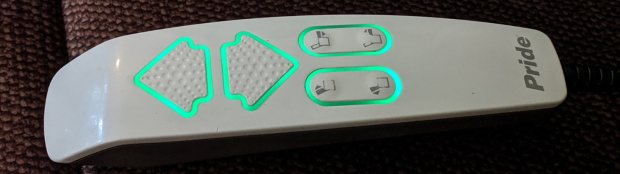
For reasons not relevant here, we recently decontaminated a second lift chair, this one in bariatric size (so it doesn’t suffer from fuzz-shaving struts) with a six-switch control pod:
Pride lift chair control – dimmed LEDs
The green LED-lit buttons were so bright I took it apart to see what could be done; the picture shows the considerably dimmed result.
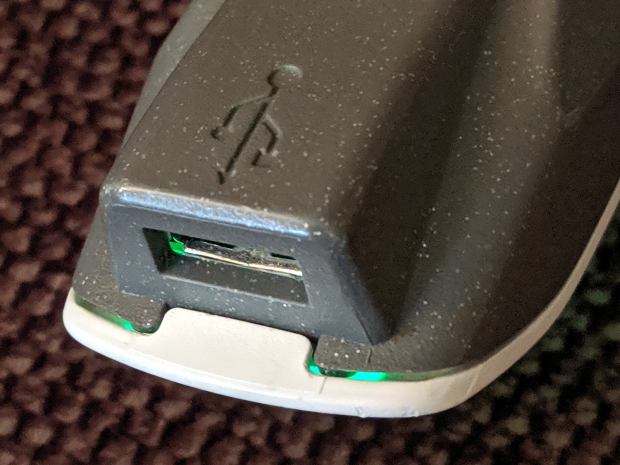
Start by prying outward on the tab at the USB charging port:
Pride lift chair control – USB port latch
Done right, you can then release the latches along the sides:
Pride lift chair control – side opened
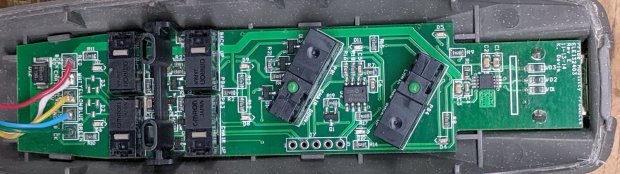
It’s impossible to photograph the PCB with the LEDs active, but here’s what it looks like without power:
Pride lift chair control – PCB overview
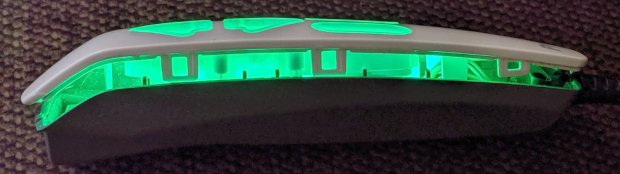
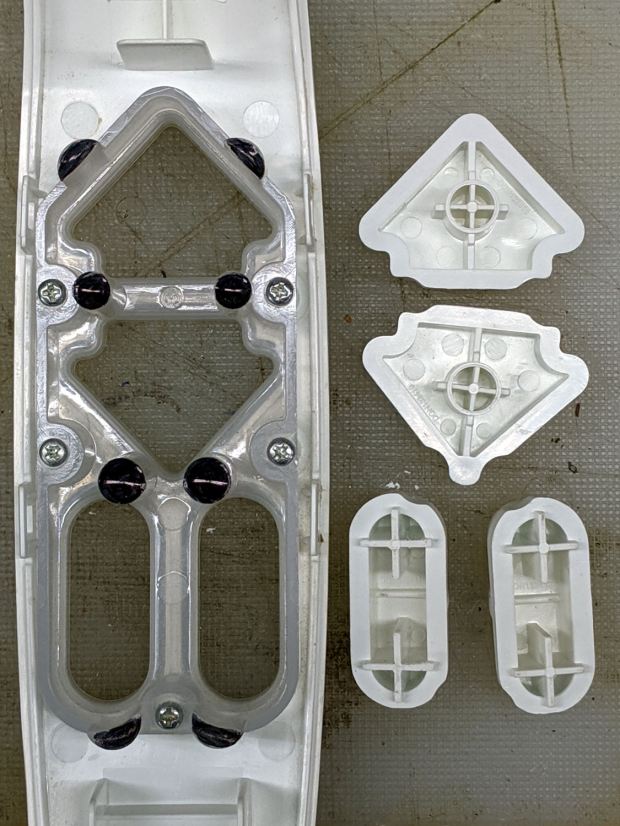
The eight (!) SMD LEDs align with light pipes around the switch openings:
Pride lift chair control – button keys
The black dots come from Sharpie ink daubed in the shallow recesses intended to nestle around the LEDs. Note that the four switch caps have unique keying, so you can’t put them back incorrectly without some effort.
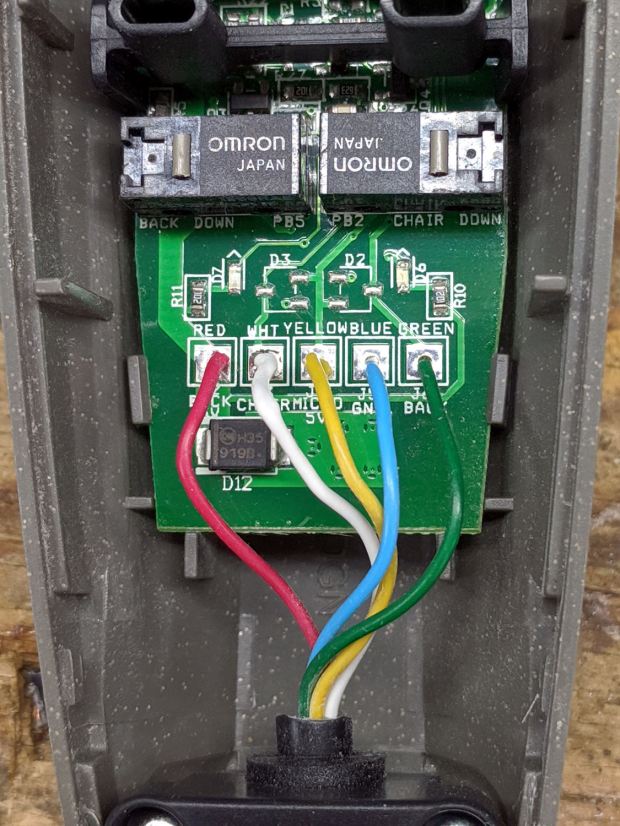
While we’re inside, here’s a closer look at the cable entry point, just in case I must replace the industrial-strength coily cord:
Pride lift chair control – cable entry
Unfortunately, it has a five-conductor cable, so a cheap phone coily cord (remember when phones had coily cords?) won’t suffice.
The PCB sports a pair of PICs, one of which seems to handle the buttons. I betcha the cable dates back to the days of hard-wired power switches, with the PIC now handling the intricate logic of deciding which motors to actuate for each function, then controlling MOSFETs as fake switch contacts.
The other PIC snuggles against the USB interface, which the manual describes as a charging-only port. It might also serve as a programming interface for the main PIC; admittedly the notion of a firmware upgrade for a lift chair seems far-fetched.
Reassembly is in reverse order with a resounding snap at the conclusion. It works fine and you (well, I) can now look at the control pod without sunglasses.
It came loose from the drain rim while I was cleaning the sink; I wasn’t doing anything particularly vigorous.
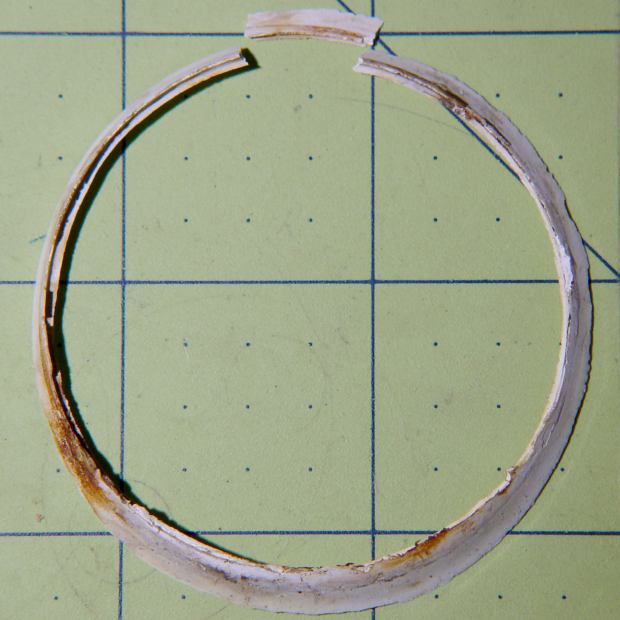
The stain in the lower right goes all the way around the epoxy:
Bathroom sink epoxy – bottom
For what should be obvious reasons, I was loathe to scuff up the sink surface to give the epoxy a better grip, so it couldn’t make a watertight seal all the way around.
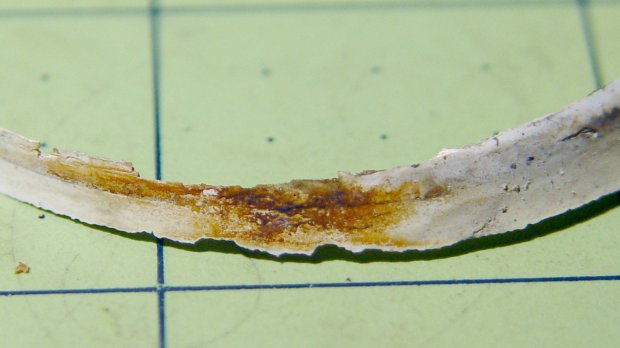
A closer look at the stain:
Bathroom sink epoxy – detail
I’m reasonably sure that’s iron bacteria colony, rather than actual rust, as there’s no iron to be found anywhere nearby.
For lack of anything smarter, I’ll apply another dose of the same epoxy, although this time I won’t be expecting a long-term fix.
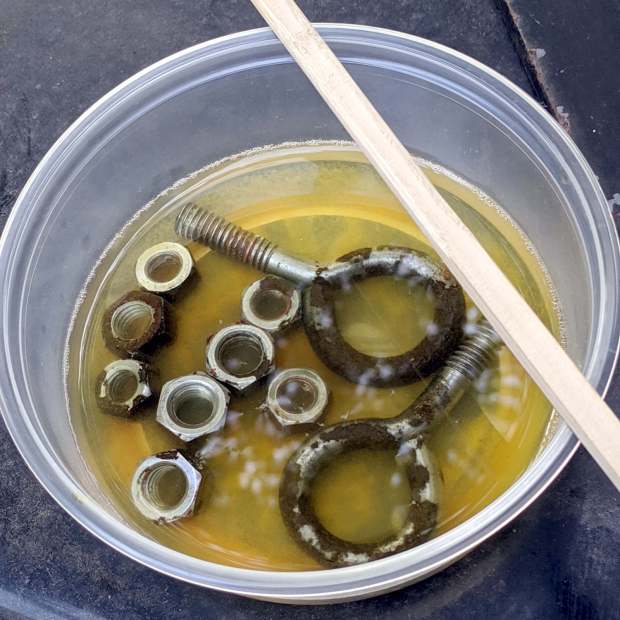
The dark areas are iron oxide being converted to loose iron sulfide, which is what Evapo-Rust does for a living.
One could, of course, simply buy new eye screws & nuts, but we’re deep into historical preservation around here.
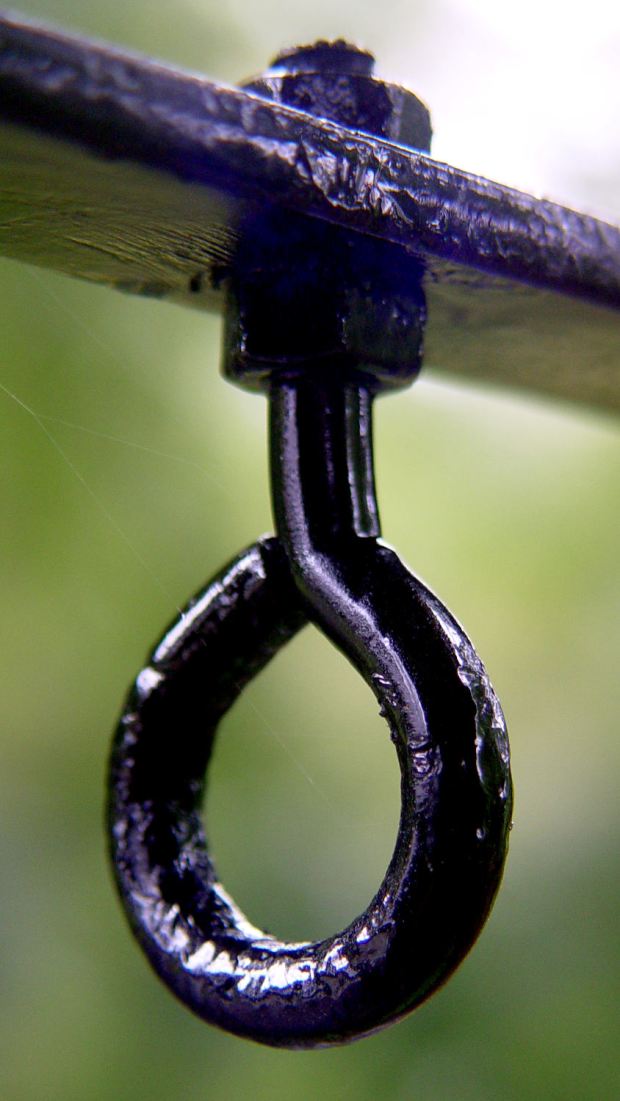
An hour of soaking and a few minutes of wire-wheeling got everything down to bare metal, ready for some rattle-can primer and black paint action:
Suet Feeder Bracket Hardware – installed
It’s a version of what Eks calls a “used car finish”: high shine over deep pits.
Discussion of why one should not paint threaded parts will be unavailing; in this case, paint serves as permanent threadlock. I re-spritzed the eyescrews & nuts after getting everything aligned, so as to produce a lovely two-coat over-all finish.
Back in the early 90s, I bought a Branson Ultrasonic Cleaner for small parts. It turned out to be ideal for eyeglasses, migrated to the bathroom, and has been used at least daily ever since. After nigh onto three decades, this happened:
Branson ultrasonic cleaner – failed switch cover
We tend to push the ON button and let it turn off by itself after a little over four minutes (exactly 255 seconds!), so the gray plastic sheet over the ON switch failed first. You can barely see the outline of the transparent film previously covering both switches, which probably helped waterproof the switches.
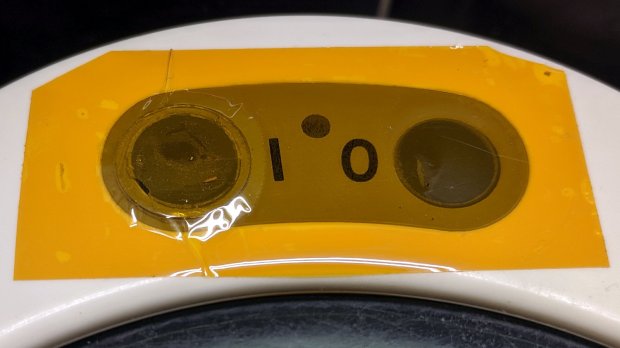
The gray plastic disk sits atop the switch actuator, so I punched a slightly larger polypropylene disk (from my stash of clamshell packages), stuck it to the disk with double-sided tape, lined it up over the hole, and covered the mess with Kapton tape:
Branson ultrasonic cleaner – expedient fix
This is in the nature of an expedient fix, as I’m not sure the polypro disk is flexible enough. The next iteration will cover the entire gray area and I’ll see about a transparent tape covering.
The flanges around the door of our giant mailbox rusted through, leaving the door to bend along the embossed (debossed? Whatever) lines across the front. Eventually, the bend got bad enough to keep the door from latching closed, but reviews of the current crop of mailboxes suggest they’re even more prone to rusting after even fewer years.
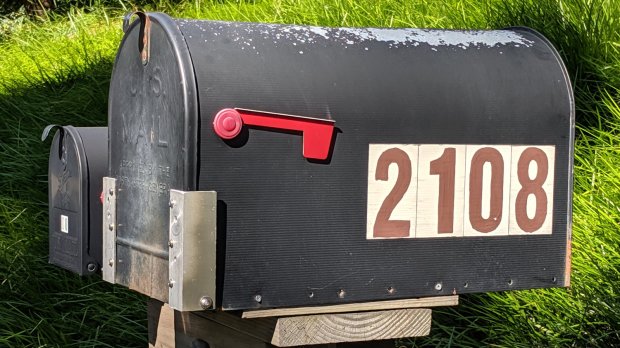
Well, I can fix that:
Mailbox door rebuild – installed
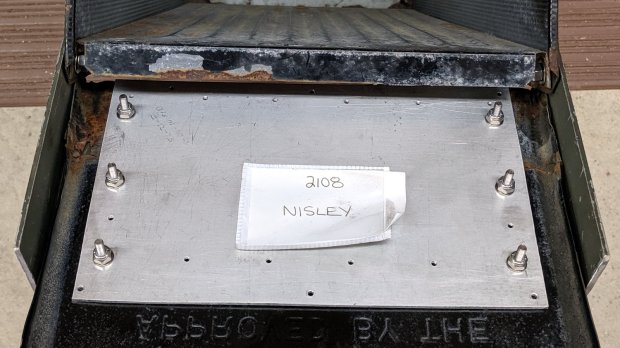
Because the bottom third of the door, basically everything around and below that horizontal ridge, had corroded, the general idea was to stiffen it with an internal plate:
Mailbox door rebuild – interior
The array of small holes suggest the plate’s rich lived experience. Some are even tapped!
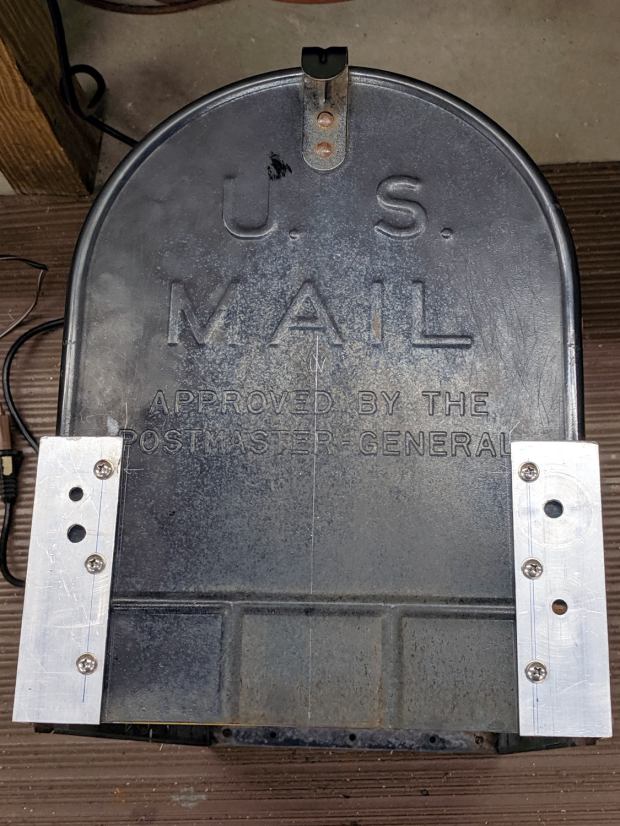
External angle brackets stiffen the sides along the corroded flanges and surround the equally corroded pivot holes:
Mailbox door rebuild – exterior
The term “brick shithouse” springs unbidden to mind, doesn’t it? Those spare holes come from previous uses; I decided this application didn’t demand cosmetic perfection and, as a result, the remaining angle stock has no holes at all.
Also, the angle brackets are as long as they are because that’s the maximum throat depth for Tiny Bandsaw™. I splurged on a Proxxon 10-14 TPI blade (for future reference: PN 28172) that cuts aluminum like butter, much better than the stock 14 TPI blade.
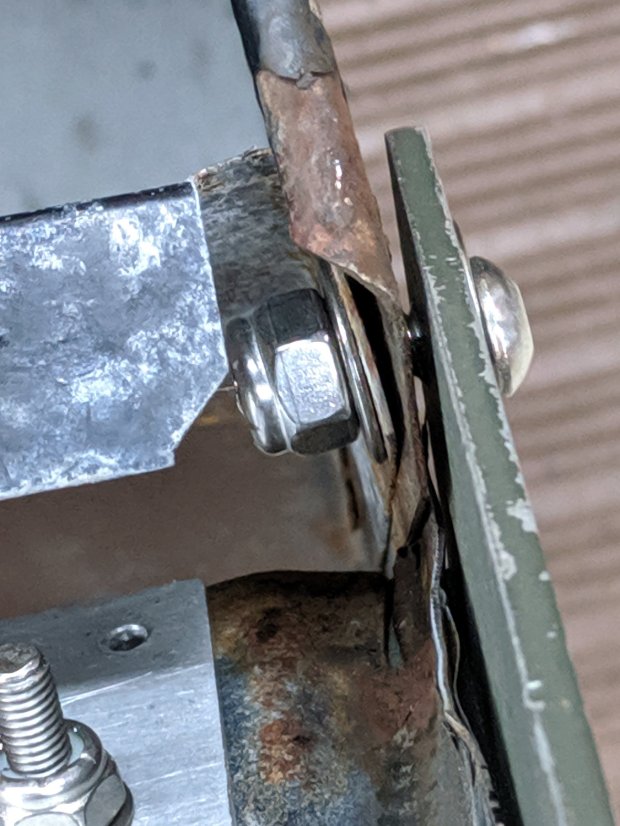
The hinge pins used to be rivets. After careful consideration, I replaced them with 1/4-20 button-head cap screws:
Mailbox door rebuild – hinge detail
Yes, the sheet metal now pivots on screw threads, rather than a nice smooth cylinder. The nyloc nut maintains the proper amount of looseness around the battered sheet metal.
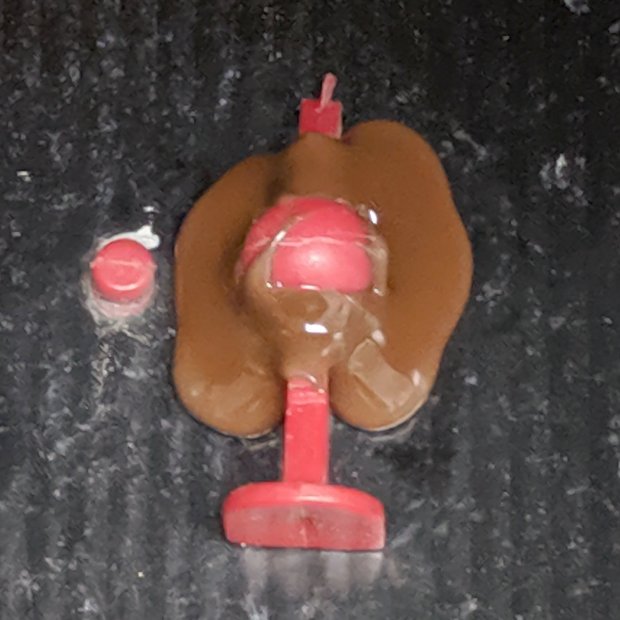
While I had the door open, I slobbered hot melt glue over the flag anchor, which should keep it from spitting the ratchet pin into the roadside debris ever again:
Mailbox door rebuild – flag anchor
A pleasant evening of Quality Shop Time, indeed!
The alert reader will note I’m securing aluminum plates with stainless steel hardware on a (nominally) galvanized steel box, thereby forming several batteries with a brine electrolyte from wintertime road salt. My engineering judgement determined this repair will last Long Enough™ and, most likely, succumb to somebody not quite making the curve while accelerating from the traffic signal.
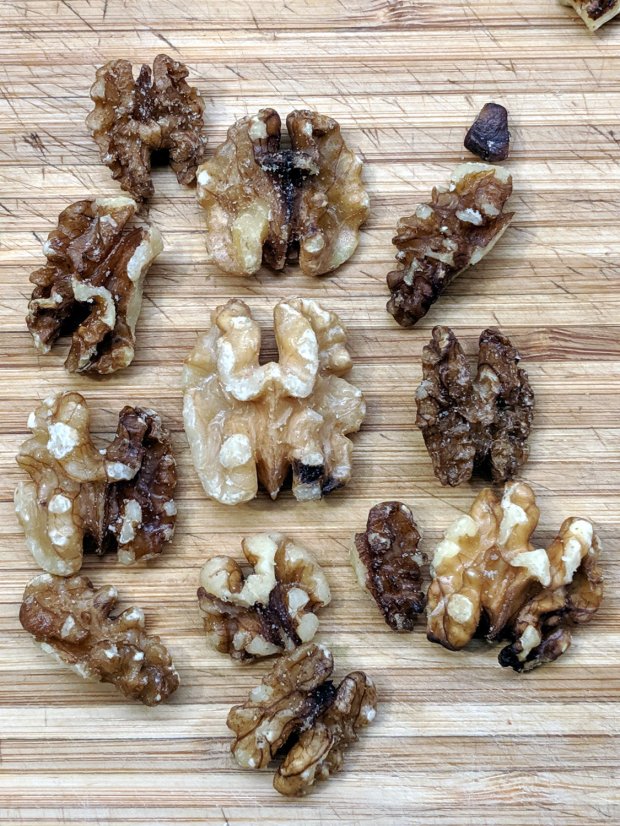
A recent Amazon purchase of three 3 lb bags of walnuts from a known-good seller arrived with many damaged nuts:
Damaged walnuts – detail
The damage matches what I read about Walnut Husk Fly infestations: shriveled kernels and terrible taste.
In round numbers, I found 8 oz of damaged nuts in each 3 lb bag, enough to ruin the entire batch. The seller immediately refunded the purchase price for all three bags, so there’s that.
It’s definitely not one of the counterfeit products plaguing Amazon, but I wonder why that lot didn’t fail incoming inspection.
I’m loathe to buy more walnuts for a while, though.
Memo to Self: Always inspect incoming purchases, even from reputable sellers!



 The Smell of Molten Projects in the Morning