The Smell of Molten Projects in the Morning

Ed Nisley's Blog: Shop notes, electronics, firmware, machinery, 3D printing, laser cuttery, and curiosities. Contents: 100% human thinking, 0% AI slop.

Category: Electronics Workbench

Electrical & Electronic gadgets

  • Astable Multivibrator: RGB LED Circuitry First Light

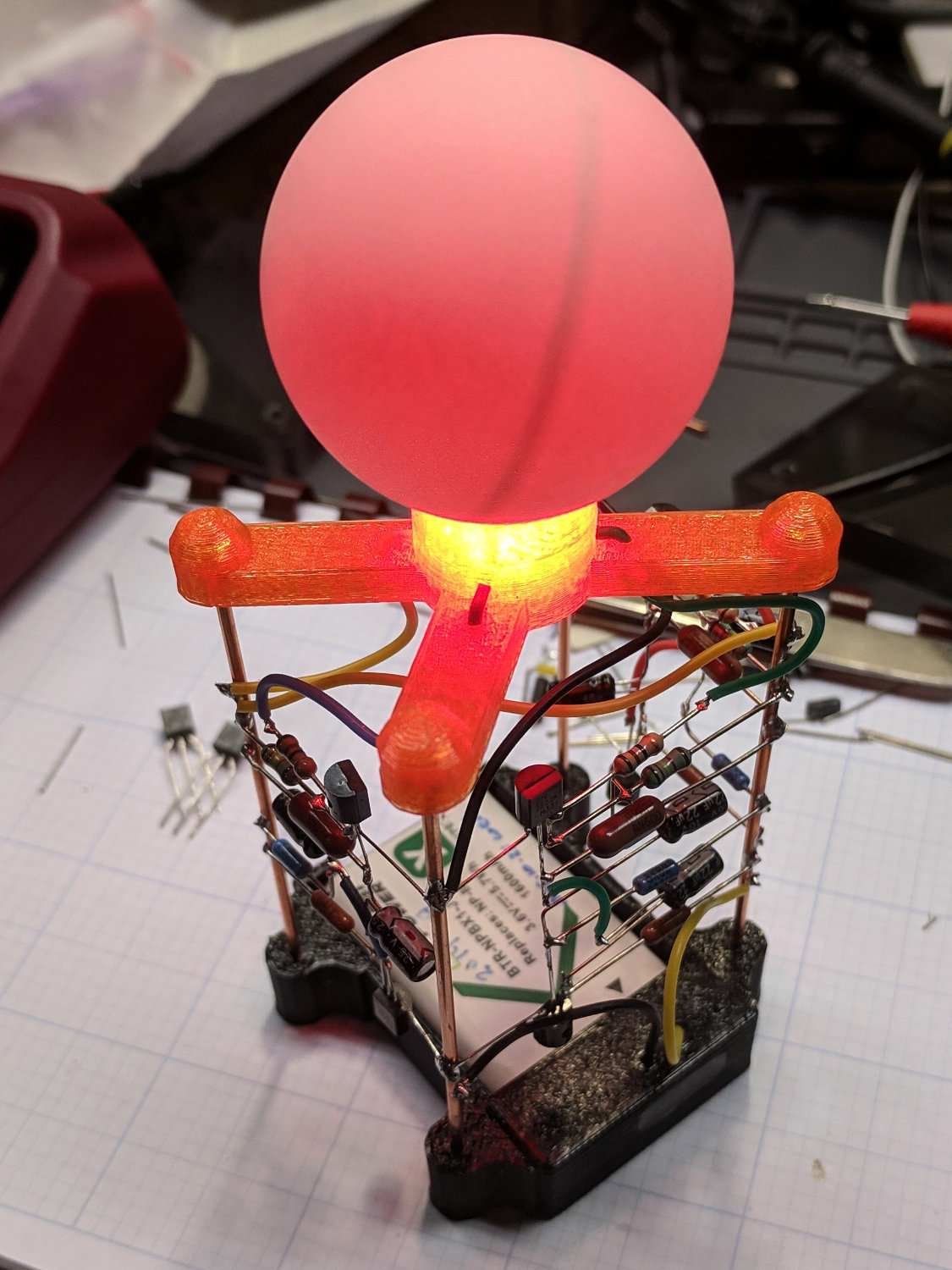
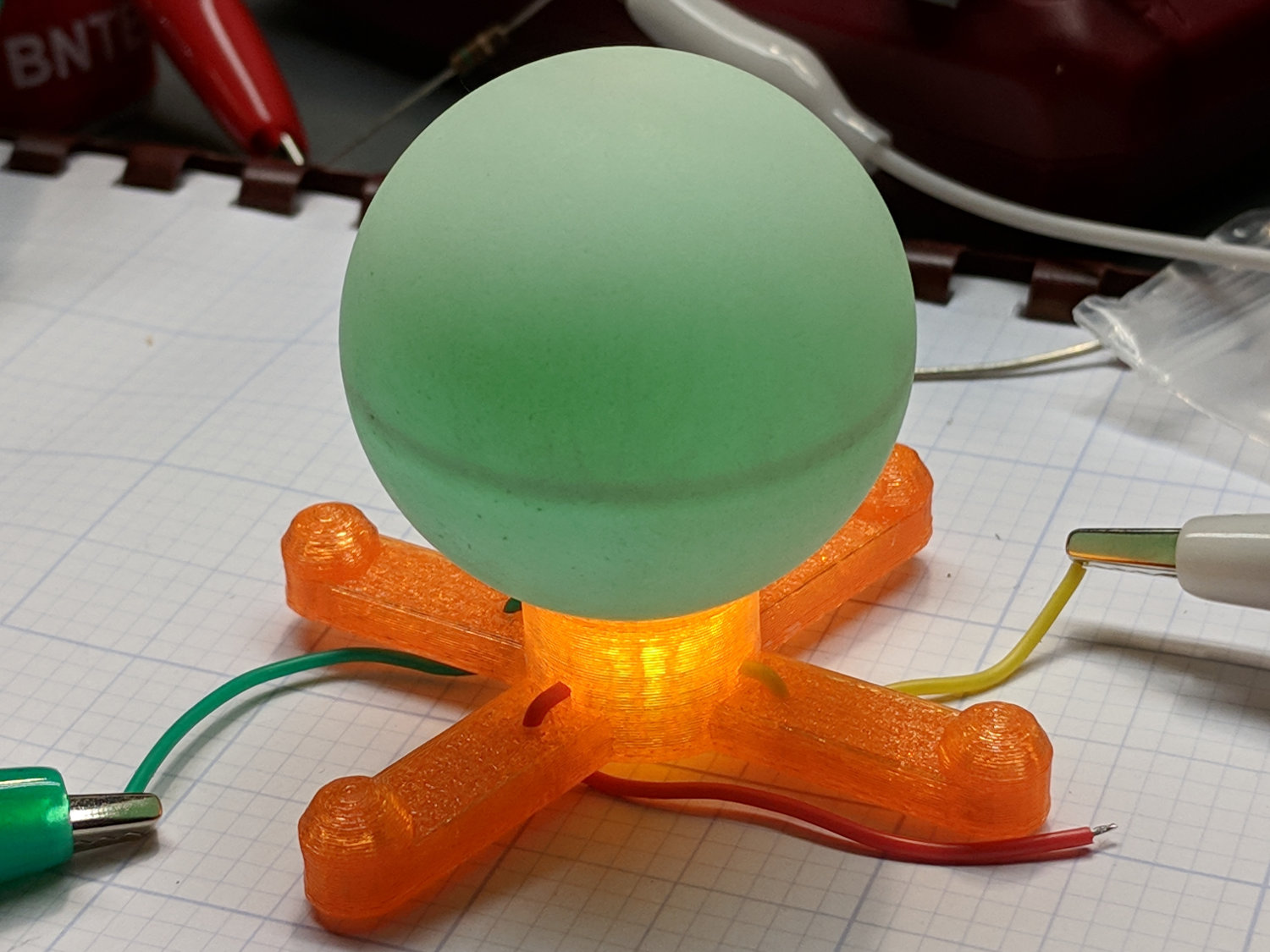
    It lights up just like it should:

    Astable RGB LED - green phase
    Astable RGB LED – green phase

    In colors:

    Astable RGB LED - red phase
    Astable RGB LED – red phase

    The blue LED works, too, but I didn’t catch any of those blinks.

    The spider should be done in black PETG, just like the battery holder, but I didn’t realize which filament was running until too late. Even the blue LED lights up the orange spider just fine!

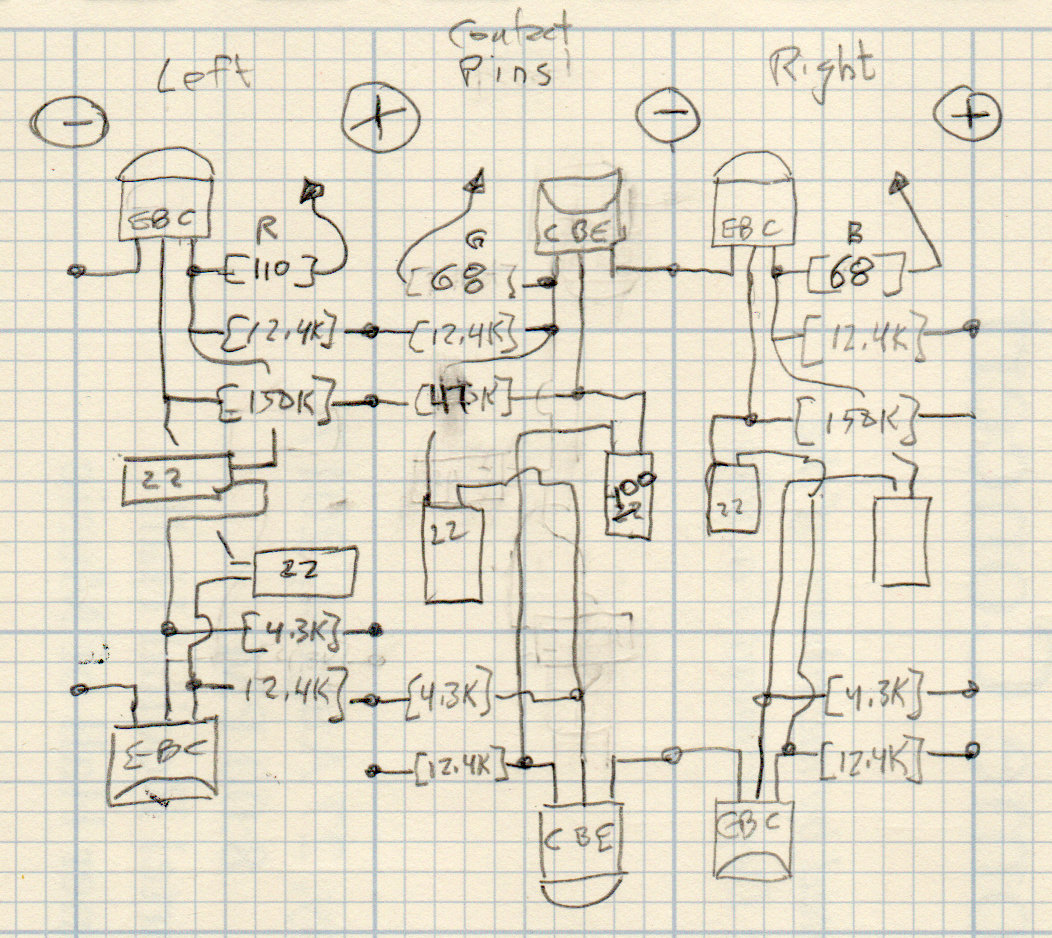
    The circuitry behind (well, below) the RGB LED Radome consists of three copies of the original multivibrator, with mirror image layouts to match the wire struts:

    RGB LED Schematic - NPN transistors
    RGB LED Schematic – NPN transistors

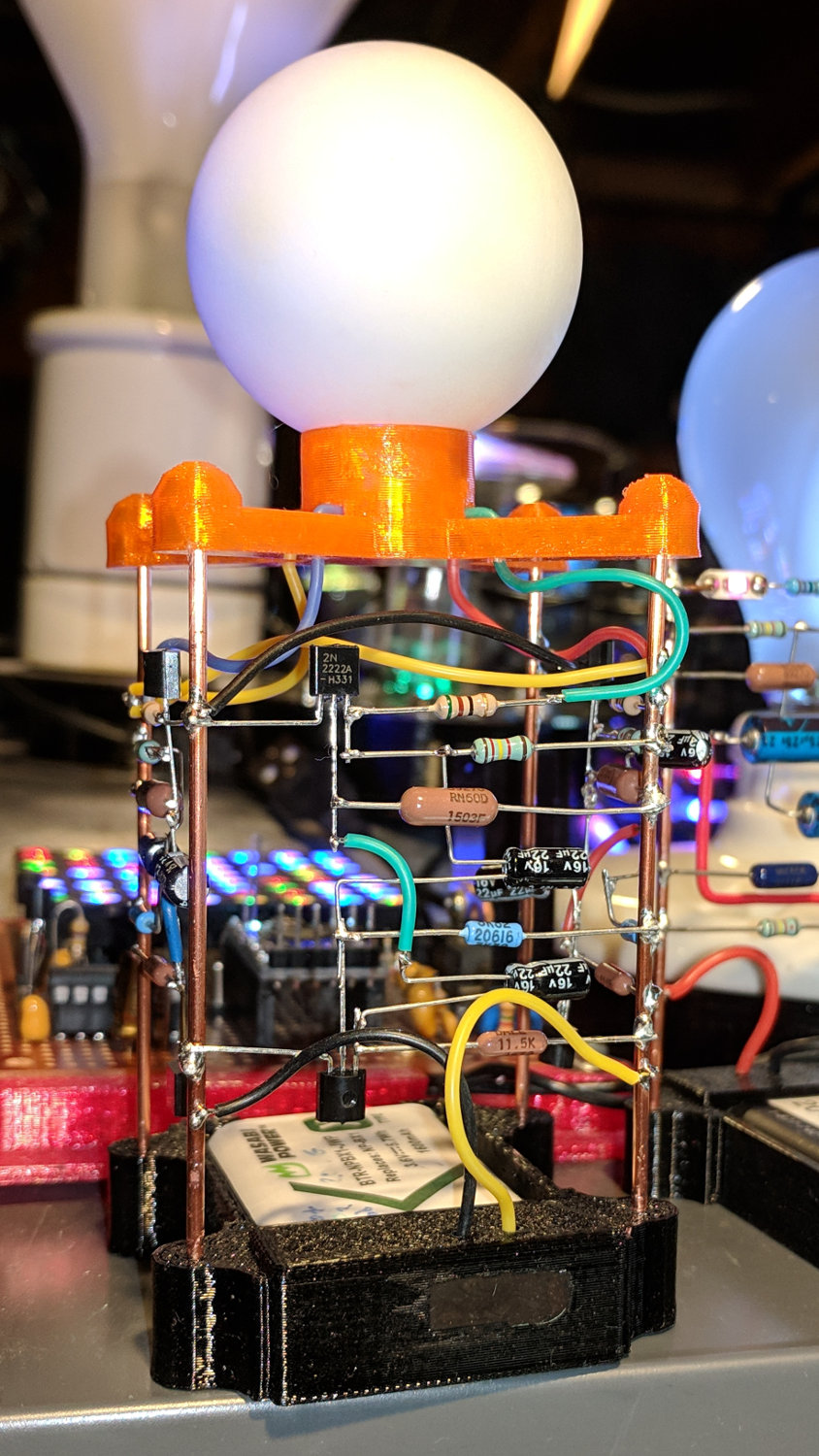
    The solder joints adhere to exactly none of the usual good practices:

    Astable RGB LED - assembled
    Astable RGB LED – assembled

    The simulation matches the actual blink times reasonably well:

    Astable - 2N2222 cap voltages
    Astable – 2N2222 cap voltages

    It’s unpleasantly frenetic in real life. The next version must have much much longer time constants.

    Unfortunately, the simulation also confirms my suspicion that I’ve been abusing the electrolytic capacitors with reverse-polarity waveforms. I suspect it doesn’t really matter too much, as the maximum voltage in either direction remains under a volt at very low currents, but it’s the principle of the thing.

    Soooo, lengthening the time constants by increasing the capacitances seems like a Bad Idea.

    Alas, increasing the resistors by an order of magnitude won’t work, either, because (despite appearances) the whole thing sits right on the hairy edge of not working. As the battery discharges toward its 2.5 V cutoff level, the currents drop and the circuitry becomes increasingly sensitive to touch. After a day or two, one of the LEDs will jam solidly on, while the others continue to blink merrily away. Removing and reinstalling the battery will sometimes resume proper operation, but it’s definitely not stable enough for production use.

    Which makes a MOSFET astable multivibrator seem like a Good Idea.

    One could achieve the same visible result with a few cents of microcontroller and a dab of software, but most of the charm comes from its analog nature and all those visible components.

  • Transistor Pricing

    You can find anything on eBay (clicky for more dots):

    ZVNL110A MOSFET - kilobuck eBay pricing
    ZVNL110A MOSFET – kilobuck eBay pricing

    The key information:

    ZVNL110A MOSFET - kilobuck eBay pricing - detail
    ZVNL110A MOSFET – kilobuck eBay pricing – detail

    For that price, I’d expect in-person hand delivery.

    Stipulated: ZVNL110A MOSFETs aren’t in production and we’re buying from diminishing inventory, but (as of late December 2018) they’re still available for under a buck apiece in small quantities.

    It could be a pricing algorithm corner case, a money laundering scheme, or just a typo that could happen to anyone. As the news sites put it, the seller did not respond in time for this posting …

  • Astable Multivibrator: RGB LED and Radome Spider

    Well, a spider with half the proper leg count:

    RGB LED - radome test
    RGB LED – radome test

    One could argue the LED spider has an unusually large abdomen, but I’m not going there.

    The solid model looks the same way:

    Astable Multivibrator Battery Holder - RGB LED Spider - radome
    Astable Multivibrator Battery Holder – RGB LED Spider – radome

    And, yes, those are eye protection caps over the four wire struts, most useful during construction while maneuvering the radome into position.

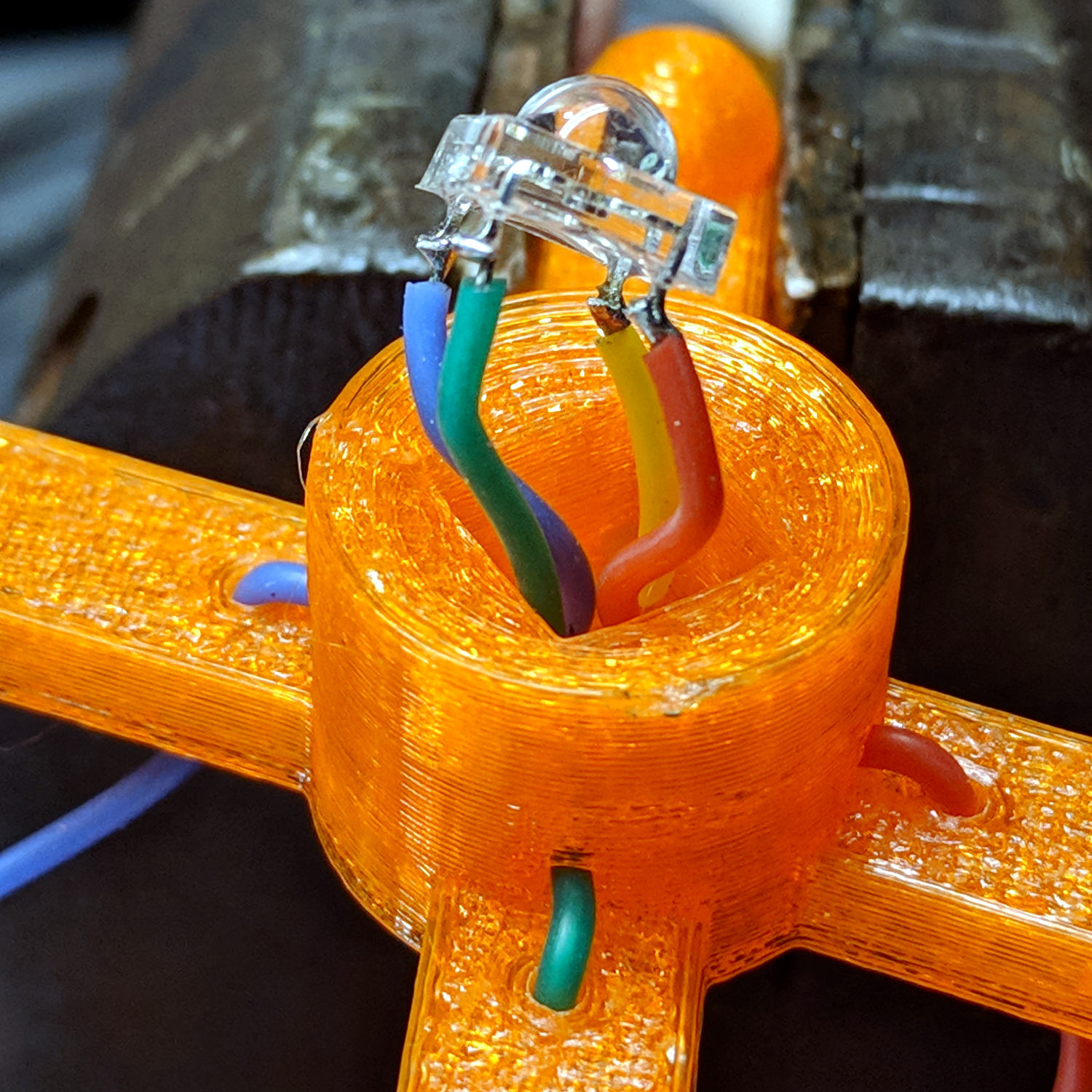
    For reasons unknown to me, they’re called “Pirhana” LEDs:

    RGB LED - wiring
    RGB LED – wiring

    I trimmed off half of each pin, soldered on 28 AWG color-coded silicone wires, threaded wires through openings, then rammed the LED package into the recess so it sits just below the radome’s curve. The dent matching the ball comes from the chord equation, as always, and looks pretty good.

    The radome is, of course, a one-star ping pong ball from the usual big box retailer’s sporting goods section. The stamped logo sits at a random position with respect to the ball’s interior structure (visible when lit, as in the top picture), so I erased it with a fine-grit sanding sponge. Hollow plastic golf balls might work just as well, with an even more interesting surface texture.

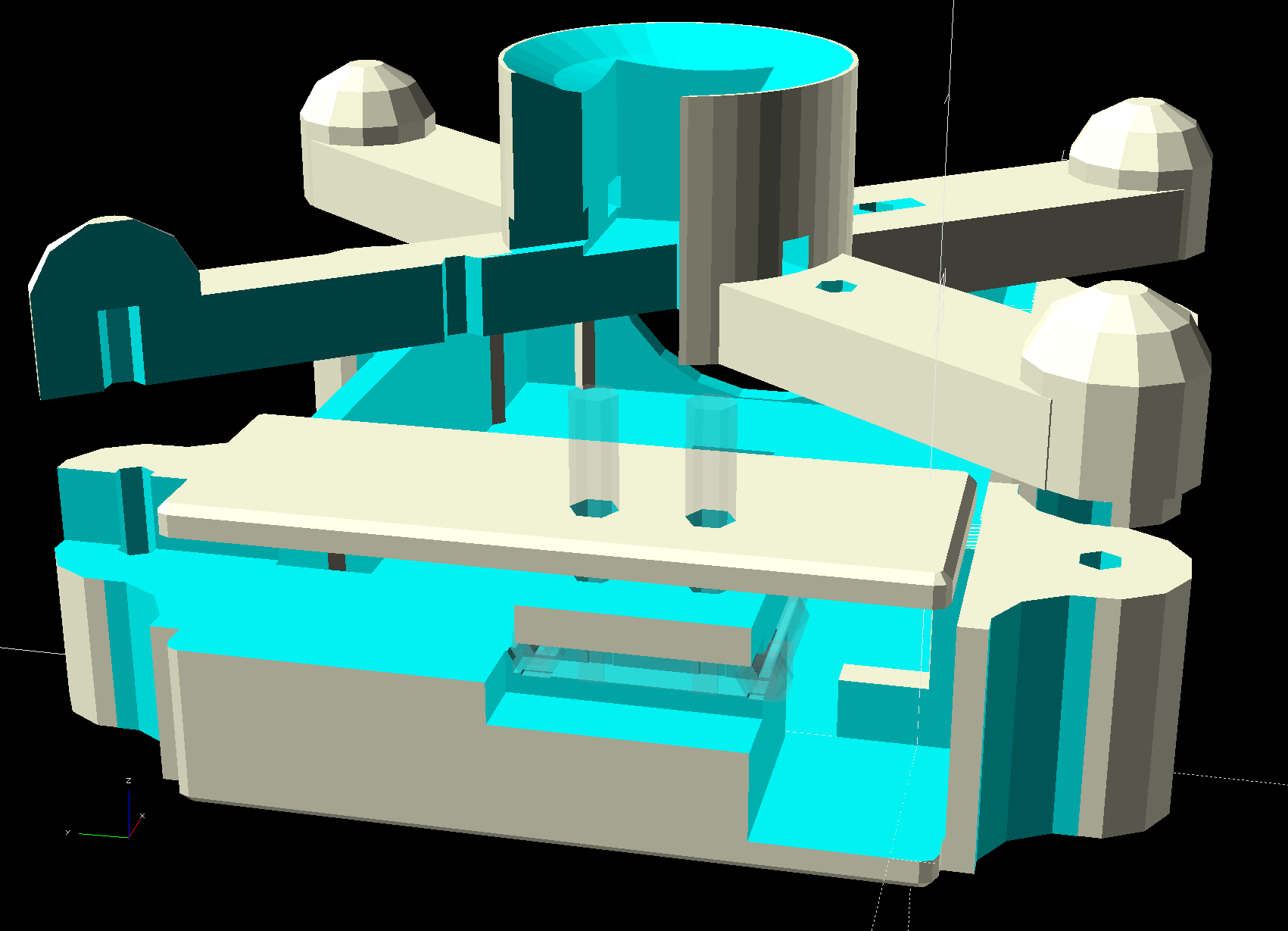
    The source code includes a cutaway look at the printed parts to verify their innards:

    Astable Multivibrator Battery Holder - RGB LED Spider - fit view
    Astable Multivibrator Battery Holder – RGB LED Spider – fit view

    The OpenSCAD source code as a GitHub Gist:

    // Holder for Li-Ion battery packs
    // Ed Nisley KE4ZNU January 2013
    // 2018-11-15 Adapted for 1.5 mm pogo pins, battery data table
    // 2018-12 RGB LED spider, general cleanups
    /* [Layout options] */
    BatteryName = "NP-BX1"; // [NP-BX1,NB-5L,NB-6L]
    RGBCircuit = true; // false = 1 strut pair, true = 2 pairs
    Layout = "Case"; // [Build,Show,Fit,Case,Lid,Pins,RGBSpider]
    /* [Extrusion parameters] – must match reality! */
    // Print with +2 shells and 3 solid layers
    ThreadThick = 0.25;
    ThreadWidth = 0.40;
    HoleWindage = 0.2;
    function IntegerMultiple(Size,Unit) = Unit * ceil(Size / Unit);
    function IntegerLessMultiple(Size,Unit) = Unit * floor(Size / Unit);
    Protrusion = 0.1; // make holes end cleanly
    /* [Hidden] */
    inch = 25.4;
    BuildOffset = 3.0; // clearance for build layout
    Gap = 2.0; // separation for Fit parts
    //- Basic dimensions
    WallThick = 4*ThreadWidth; // holder sidewalls
    BaseThick = 6*ThreadThick; // bottom of holder to bottom of battery
    TopThick = 6*ThreadThick; // top of battery to top of holder
    //- Battery dimensions – rationalized from several samples
    // Coordinate origin at battery corner with contacts, key openings downward
    T_NAME = 0; // Name must fit recess, so don't get loquacious
    T_SIZE = 1;
    T_CONTACTS = 2;
    T_KEYS = 3;
    BatteryData = [
    ["NP-BX1",[43.0,30.0,9.5],[[-0.75,6.0,6.2],[-0.75,16.0,6.2]],[[1.70,3.70,2.90],[1.70,3.60,2.90]]],
    ["NB-5L", [45.0,32.0,8.0],[[-0.82,4.5,3.5],[-0.82,11.0,3.5]],[[2.2,0.75,2.0],[2.2,2.8,2.0]]],
    ["NB-6L",[42.5,35.5,7.0],[[-0.85,5.50,3.05],[-0.85,11.90,3.05]],[[2.0,0.70,2.8],[2.0,2.00,2.8]]],
    ];
    echo(str("Battery: ",BatteryName));
    BatteryIndex = search([BatteryName],BatteryData,1,0)[0];
    echo(str(" Index: ",BatteryIndex));
    BatterySize = BatteryData[BatteryIndex][T_SIZE]; // X = length, Y = width, Z = thickness
    echo(str(" Size: ",BatterySize));
    Contacts = BatteryData[BatteryIndex][T_CONTACTS]; // relative to battery edge, front, and bottom
    echo(str(" Contacts: ",Contacts));
    ContactOC = Contacts[1].y – Contacts[0].y; // + and – terminals for pogo pin contacts
    ContactCenter = Contacts[0].y + ContactOC/2;
    KeyBlocks = BatteryData[BatteryIndex][T_KEYS]; // recesses in battery face set X position
    echo(str(" Keys: ",KeyBlocks));
    //- Pin dimensions
    ID = 0;
    OD = 1;
    LENGTH = 2;
    PinShank = [1.5,2.0,6.5]; // shank, flange, compressed length
    PinFlange = [1.5,2.0,0.5]; // flange, length included in PinShank
    PinTip = [0.9,0.9,2.5]; // extended spring-loaded tip
    WireOD = 1.7; // wiring from pins to circuitry
    PinChannel = WireOD; // cut behind flange for solder overflow
    PinRecess = 3.0; // recess behind pin flange end for epoxy fill
    echo(str("Contact tip dia: ",PinTip[OD]));
    echo(str(" .. shank dia: ",PinShank[ID]));
    OverTravel = 0.5; // space beyond battery face at X origin
    //- Holder dimensions
    GuideRadius = ThreadWidth; // friction fit ridges
    GuideOffset = 7; // from compartment corners
    LidOverhang = 2.0; // atop of battery for retention
    LidClearance = LidOverhang * (BatterySize.z/BatterySize.x); // … clearance above battery for tilting
    echo(str("Lid clearance: ",LidClearance));
    CaseSize = [BatterySize.x + PinShank[LENGTH] + OverTravel + PinRecess + GuideRadius + WallThick,
    BatterySize.y + 2*WallThick + 2*GuideRadius,
    BatterySize.z + BaseThick + TopThick + LidClearance];
    echo(str("Case size: ",CaseSize));
    CaseOffset = [-(PinShank[LENGTH] + OverTravel + PinRecess),-(WallThick + GuideRadius),0]; // position around battery
    ThumbRadius = 10.0; // thumb opening at end of battery
    CornerRadius = 3*ThreadThick; // nice corner rounding
    LidSize = [-CaseOffset.x + LidOverhang,CaseSize.y,TopThick];
    LidOffset = [0.0,CaseOffset.y,0];
    //- Wire struts
    StrutDia = 1.6; // AWG 14 = 1.6 mm
    StrutSides = 3*4;
    StrutBase = [StrutDia,StrutDia + 4*WallThick,CaseSize.z – TopThick]; // ID = wire, OD = buildable
    //StrutOC = [IntegerLessMultiple(BatterySize.x – StrutBase[OD],5.0), // set easy OC wire spacing
    // IntegerMultiple(CaseSize.y + StrutBase[OD],5.0)];
    StrutOC = [IntegerLessMultiple(CaseSize.x – 2*CornerRadius -2*StrutBase[OD],5.0),
    IntegerMultiple(CaseSize.y + StrutBase[OD],5.0)];
    StrutOffset = [CaseSize.x/2 + CaseOffset.x,BatterySize.y/2]; // from case centerlines
    StrutAngle = atan(StrutOC.y/StrutOC.x);
    echo(str("Strut OC: ",StrutOC));
    //- RGB LED
    RGBBody = [8.0,8.0,5.0]; // Z = body height
    RGBPin = 5.0; // pin length
    RGBPinsOC = [5.0,5.0]; // pin layout
    RGBRecess = RGBBody.z + RGBPin/2; // maximum LED recess depth
    BallOD = 40.0; // radome sphere
    BallSides = 4*StrutSides; // nice number of sides
    BallPillar = [norm([RGBBody.x,RGBBody.y]),
    norm([RGBBody.x,RGBBody.y]) + 4*WallThick,
    StrutBase[OD] + RGBBody.z];
    BallChordM = BallOD/2 – sqrt(pow(BallOD/2,2) – (pow(BallPillar[OD],2))/4);
    echo(str("Ball chord depth: ",BallChordM));
    //———————-
    // Useful routines
    module PolyCyl(Dia,Height,ForceSides=0) { // based on nophead's polyholes
    Sides = (ForceSides != 0) ? ForceSides : (ceil(Dia) + 2);
    FixDia = Dia / cos(180/Sides);
    cylinder(r=(FixDia + HoleWindage)/2,h=Height,$fn=Sides);
    }
    //——————-
    //– Guides for tighter friction fit
    module Guides() {
    translate([GuideOffset,-GuideRadius,0])
    PolyCyl(2*GuideRadius,(BatterySize.z – Protrusion),4);
    translate([GuideOffset,(BatterySize.y + GuideRadius),0])
    PolyCyl(2*GuideRadius,(BatterySize.z – Protrusion),4);
    translate([(BatterySize.x – GuideOffset),-GuideRadius,0])
    PolyCyl(2*GuideRadius,(BatterySize.z – Protrusion),4);
    translate([(BatterySize.x – GuideOffset),(BatterySize.y + GuideRadius),0])
    PolyCyl(2*GuideRadius,(BatterySize.z – Protrusion),4);
    translate([(BatterySize.x + GuideRadius),GuideOffset/2,0])
    PolyCyl(2*GuideRadius,(BatterySize.z – Protrusion),4);
    translate([(BatterySize.x + GuideRadius),(BatterySize.y – GuideOffset/2),0])
    PolyCyl(2*GuideRadius,(BatterySize.z – Protrusion),4);
    }
    //– Contact pins
    // Rotated to put them in their natural oriention
    // Aligned to put tip base / end of shank at Overtravel limit
    module PinShape() {
    translate([-(PinShank[LENGTH] + OverTravel),0,0])
    rotate([0,90,0])
    rotate(180/6)
    union() {
    PolyCyl(PinTip[OD],PinShank[LENGTH] + PinTip[LENGTH],6);
    PolyCyl(PinShank[ID],PinShank[LENGTH] + Protrusion,6); // slight extension for clean cuts
    PolyCyl(PinFlange[OD],PinFlange[LENGTH],6);
    }
    }
    // Position pins to put end of shank at battery face
    // Does not include recess access into case
    module PinAssembly() {
    union() {
    for (p = Contacts)
    translate([0,p.y,p.z])
    PinShape();
    translate([-(PinShank[LENGTH] + OverTravel) + PinChannel/2, // solder space
    ContactCenter,
    Contacts[0].z])
    cube([PinChannel,
    (Contacts[1].y – Contacts[0].y + PinFlange[OD]),
    PinFlange[OD]],center=true);
    for (j=[-1,1]) // wire channels
    translate([-(PinShank[LENGTH] + OverTravel – PinChannel/2),
    j*ContactOC/4 + ContactCenter,
    Contacts[0].z – PinFlange[OD]/2])
    rotate(180/6)
    PolyCyl(WireOD,CaseSize.z,6);
    }
    }
    //– Case with origin at battery corner
    module Case() {
    difference() {
    union() {
    difference() {
    union() {
    translate([(CaseSize.x/2 + CaseOffset.x), // basic case shape
    (CaseSize.y/2 + CaseOffset.y),
    (CaseSize.z/2 – BaseThick)])
    hull()
    for (i=[-1,1], j=[-1,1], k=[-1,1])
    translate([i*(CaseSize.x/2 – CornerRadius),
    j*(CaseSize.y/2 – CornerRadius),
    k*(CaseSize.z/2 – CornerRadius)])
    sphere(r=CornerRadius/cos(180/8),$fn=8); // cos() fixes undersize spheres!
    for (i= RGBCircuit ? [-1,1] : -1) { // strut bases
    hull()
    for (j=[-1,1])
    translate([i*StrutOC.x/2 + StrutOffset.x,j*StrutOC.y/2 + StrutOffset.y,-BaseThick])
    rotate(180/StrutSides)
    cylinder(d=StrutBase[OD],h=StrutBase[LENGTH],$fn=StrutSides);
    translate([i*StrutOC.x/2 + StrutOffset.x,StrutOffset.y,StrutBase[LENGTH]/2 – BaseThick])
    cube([2*StrutBase[OD],StrutOC.y,StrutBase[LENGTH]],center=true); // blocks for fairing
    for (j=[-1,1]) // hemisphere caps
    translate([i*StrutOC.x/2 + StrutOffset.x,
    j*StrutOC.y/2 + StrutOffset.y,
    StrutBase[LENGTH] – BaseThick])
    rotate(180/StrutSides)
    sphere(d=StrutBase[OD]/cos(180/StrutSides),$fn=StrutSides);
    }
    }
    translate([-OverTravel,-GuideRadius,0])
    cube([(BatterySize.x + GuideRadius + OverTravel),
    (BatterySize.y + 2*GuideRadius),
    (BatterySize.z + LidClearance + Protrusion)]); // battery space
    translate([BatterySize.x/2,BatterySize.y/2,0]) // recess around battery name
    cube([0.8*BatterySize.x,8,2*ThreadThick],center=true);
    }
    Guides(); // improve friction fit
    translate([-OverTravel,-GuideRadius,0]) // battery keying blocks
    cube(KeyBlocks[0] + [OverTravel,GuideRadius,0],center=false);
    translate([-OverTravel,(BatterySize.y – KeyBlocks[1].y),0])
    cube(KeyBlocks[1] + [OverTravel,GuideRadius,0],center=false);
    translate([BatterySize.x/2,BatterySize.y/2,-ThreadThick]) // battery name!
    linear_extrude(height=2*ThreadThick,convexity=10)
    text(text=BatteryName,size=5,spacing=1.20,font="Arial:style:Bold",halign="center",valign="center");
    }
    translate([2*CaseOffset.x, // battery top access
    (CaseOffset.y – Protrusion),
    BatterySize.z + LidClearance])
    cube([2*CaseSize.x,(CaseSize.y + 2*Protrusion),2*TopThick]);
    for (i2 = RGBCircuit ? [-1,1] : -1) { // strut wire holes and fairing
    for (j=[-1,1])
    translate([i2*StrutOC.x/2 + StrutOffset.x,j*StrutOC.y/2 + StrutOffset.y,0])
    rotate(180/StrutSides)
    PolyCyl(StrutBase[ID],2*StrutBase[LENGTH],StrutSides);
    for (i=[-1,1], j=[-1,1])
    translate([i*StrutBase[OD] + (i2*StrutOC.x/2 + StrutOffset.x),
    j*StrutOC.y/2 + StrutOffset.y,
    -(BaseThick + Protrusion)])
    rotate(180/StrutSides)
    PolyCyl(StrutBase[OD],StrutBase[LENGTH] + 2*Protrusion,StrutSides);
    }
    translate([(BatterySize.x – Protrusion), // remove thumb notch
    (CaseSize.y/2 + CaseOffset.y),
    (ThumbRadius)])
    rotate([90,0,0])
    rotate([0,90,0])
    cylinder(r=ThumbRadius,
    h=(WallThick + GuideRadius + 2*Protrusion),
    $fn=22);
    PinAssembly(); // pins and wiring
    translate([CaseOffset.x + PinRecess + Protrusion,(Contacts[1].y + Contacts[0].y)/2,Contacts[0].z])
    translate([-PinRecess,0,0])
    cube([2*PinRecess,
    (Contacts[1].y – Contacts[0].y + PinFlange[OD]/cos(180/6) + 2*HoleWindage),
    2*PinFlange[OD]],center=true); // pin insertion hole
    translate([CaseOffset.x/2 + BatterySize.x/2,BatterySize.y/2,-(BaseThick + Protrusion)])
    linear_extrude(height=2*ThreadThick + Protrusion,convexity=10)
    mirror([0,1,0])
    text(text="KE4ZNU",size=6,spacing=1.20,font="Arial:style:Bold",halign="center",valign="center");
    }
    }
    // Lid position offset to match case
    module Lid() {
    difference() {
    translate([-LidSize.x/2 + LidOffset.x + LidOverhang,LidSize.y/2 + LidOffset.y,0])
    difference() {
    hull()
    for (i=[-1,1], j=[-1,1], k=[-1,1])
    translate([i*(LidSize.x/2 – CornerRadius),
    j*(LidSize.y/2 – CornerRadius),
    k*(LidSize.z – CornerRadius)]) // double thickness for flat bottom
    sphere(r=CornerRadius,$fn=8);
    translate([0,0,-LidSize.z/2]) // remove bottom
    cube([(LidSize.x + 2*Protrusion),(LidSize.y + 2*Protrusion),LidSize.z],center=true);
    translate([LidSize.x/8,0,0])
    cube([LidSize.x/4,0.75*LidSize.y,4*ThreadThick],center=true); // epoxy recess
    }
    translate([0,0,-(Contacts[0].z + PinFlange[OD])]) // punch wire holes
    PinAssembly();
    }
    }
    // Spider for RGB LED + radome atop vertical struts
    module RGBSpider() {
    difference() {
    union() {
    for (i=[-1,1], j=[-1,1]) {
    translate([i*StrutOC.x/2,j*StrutOC.y/2,StrutBase[OD]/2])
    rotate(180/StrutSides) // doesn't quite match crosspieces; close enough
    sphere(d=StrutBase[OD]/cos(180/StrutSides),$fn=StrutSides);
    translate([i*StrutOC.x/2,j*StrutOC.y/2,0])
    rotate(180/StrutSides)
    cylinder(d=StrutBase[OD],h=StrutBase[OD]/2,$fn=StrutSides);
    }
    for (m=[-1,1]) // connecting bars
    rotate(m*StrutAngle)
    translate([0,0,StrutBase[OD]/4])
    cube([norm(StrutOC),StrutBase[OD],StrutBase[OD]/2],center=true);
    translate([0,0,0]) // pillar for RGB LED and ball
    cylinder(d=BallPillar[OD],h=BallPillar[LENGTH],$fn=BallSides);
    }
    for (i=[-1,1], j=[-1,1]) // strut wires
    translate([i*StrutOC.x/2,j*StrutOC.y/2,-Protrusion])
    rotate(0)
    PolyCyl(StrutBase[ID],StrutBase[OD]/2,6);
    for (m=[-1,1], n=[0,1]) // RGBA wires through bars
    rotate(m*StrutAngle + n*180)
    translate([StrutOC.x/3,0,-Protrusion])
    PolyCyl(StrutBase[ID],StrutBase[OD],6);
    # translate([0,0,BallOD/2 + BallPillar[LENGTH] – BallChordM]) // ball inset
    sphere(d=BallOD);
    translate([0,0,2*RGBBody.z + (BallPillar[LENGTH] – BallChordM) – RGBRecess]) // LED inset
    cube(RGBBody + [HoleWindage,HoleWindage,3*RGBBody.z],center=true); // XY clearance + huge height for E-Z cut
    for (m=[-1,1]) // RGBA wires through pillar
    rotate(m*StrutAngle)
    translate([0,0,StrutBase[OD]/2 + WireOD/2 + 0*Protrusion])
    cube([norm(StrutOC)/2,WireOD,WireOD],center=true);
    }
    }
    //——————-
    // Build it!
    if (Layout == "Case")
    Case();
    if (Layout == "Lid")
    Lid();
    if (Layout == "RGBSpider") {
    RGBSpider();
    }
    if (Layout == "Pins") {
    color("Silver",0.5)
    PinShape();
    PinAssembly();
    }
    if (Layout == "Show") { // reveal pin assembly
    difference() {
    Case();
    translate([(CaseOffset.x – Protrusion),
    Contacts[1].y,
    Contacts[1].z])
    cube([(-CaseOffset.x + Protrusion),CaseSize.y,CaseSize.z]);
    translate([(CaseOffset.x – Protrusion),
    (CaseOffset.y – Protrusion),
    0])
    cube([(-CaseOffset.x + Protrusion),
    Contacts[0].y + Protrusion – CaseOffset.y,
    CaseSize.z]);
    }
    translate([0,0,BatterySize.z + Gap])
    Lid();
    color("Silver",0.15)
    PinAssembly();
    if (RGBCircuit)
    translate([StrutOC.x/2,BatterySize.y/2,2*BatterySize.z])
    difference() {
    RGBSpider();
    rotate(180-StrutAngle)
    translate([0,0,-Protrusion])
    cube([norm(StrutOC),StrutBase[OD],2*BallPillar.z],center=false);
    }
    }
    if (Layout == "Build") {
    translate([-BatterySize.x/2,-BatterySize.y/2,BaseThick])
    Case();
    translate([-CaseSize.x + LidSize.x,-(LidSize.y/2 + LidOffset.y),0])
    Lid();
    if (RGBCircuit)
    translate([StrutOC.x + BatterySize.x/2,0,0])
    RGBSpider();
    }
    if (Layout == "Fit") {
    Case();
    translate([0,0,(BatterySize.z + Gap)])
    Lid();
    color("Silver",0.25)
    PinAssembly();
    if (RGBCircuit)
    translate([StrutOC.x/2,BatterySize.y/2,2*BatterySize.z])
    RGBSpider();
    }

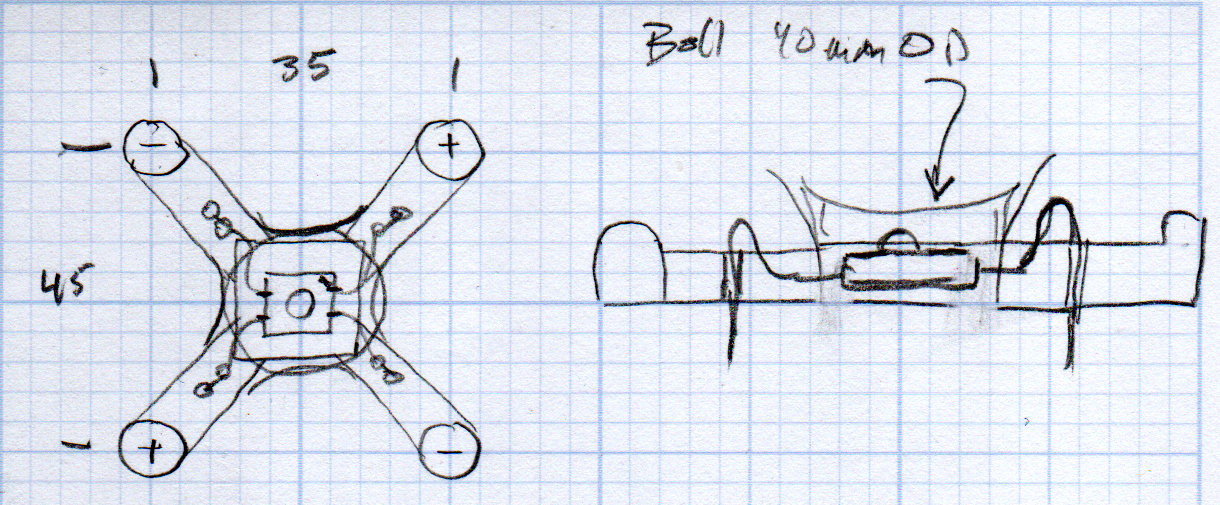
    The original doodles give useful dimensions, plus some details not withstanding the test of time:

    RGB LED Radome Spider - doodles
    RGB LED Radome Spider – doodles

    The actual center-to-center distances for the wire posts come from the battery dimensions, rounded up or down as appropriate, to the nearest multiple of 5 mm, so those are just serving suggestions.

  • Astable Multivibrator: RGB LED Strut Fixture

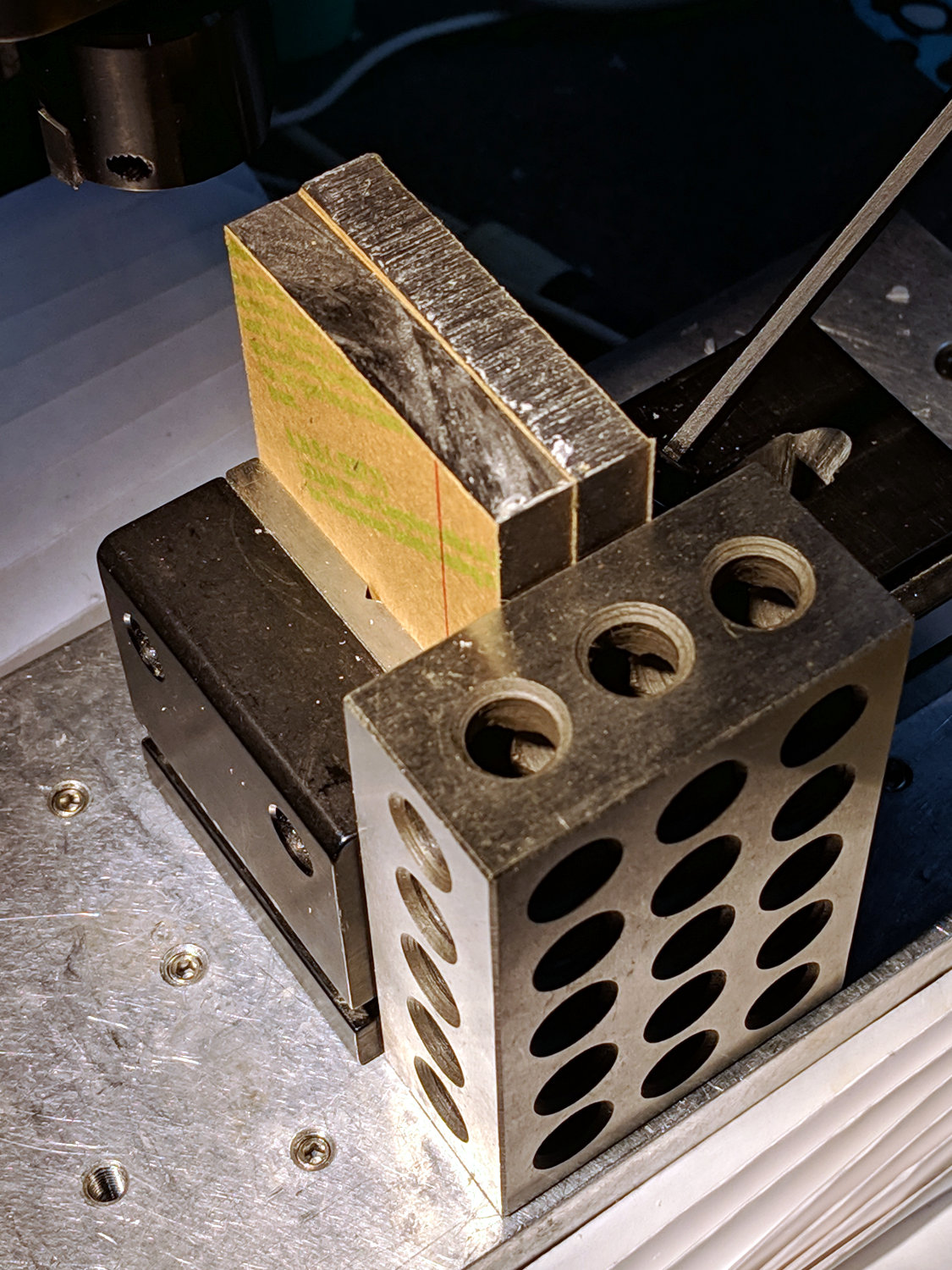
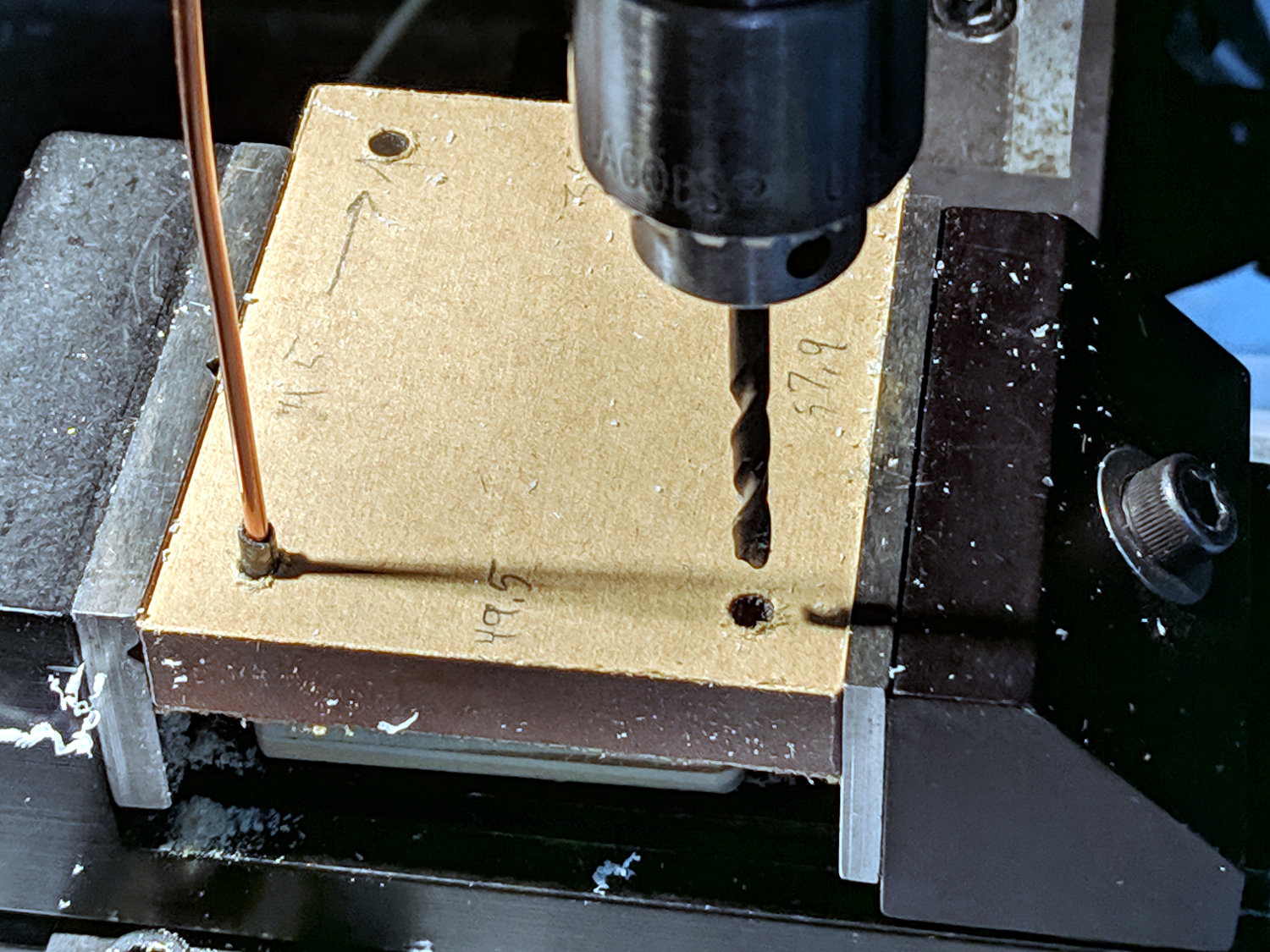
    One cannot (or, perhaps, should not attempt to) solder parts to 14 AWG wires seated in a 3D printed battery holder base, so I cleaned up the edges of two polycarbonate scraps:

    RGB LED Strut Fixture - flycutting setup
    RGB LED Strut Fixture – flycutting setup

    Then drilled holes to match the strut positions:

    RGB LED Strut Fixture - drilling
    RGB LED Strut Fixture – drilling

    The holes fit snippets of the original wire insulation, because, after all, polycarbonate is a thermoplastic, too.

    Stretch some copper wire to straighten and work-harden it, add insulation snippets, then maneuver everything in place:

    RGB LED Strut Fixture - assembled
    RGB LED Strut Fixture – assembled

    I definitely need a third (and maybe a fourth) hand to hold each part, the solder, and the iron, but at least the wires won’t walk away in the middle of the process.

  • Shoe Lace Ferrules

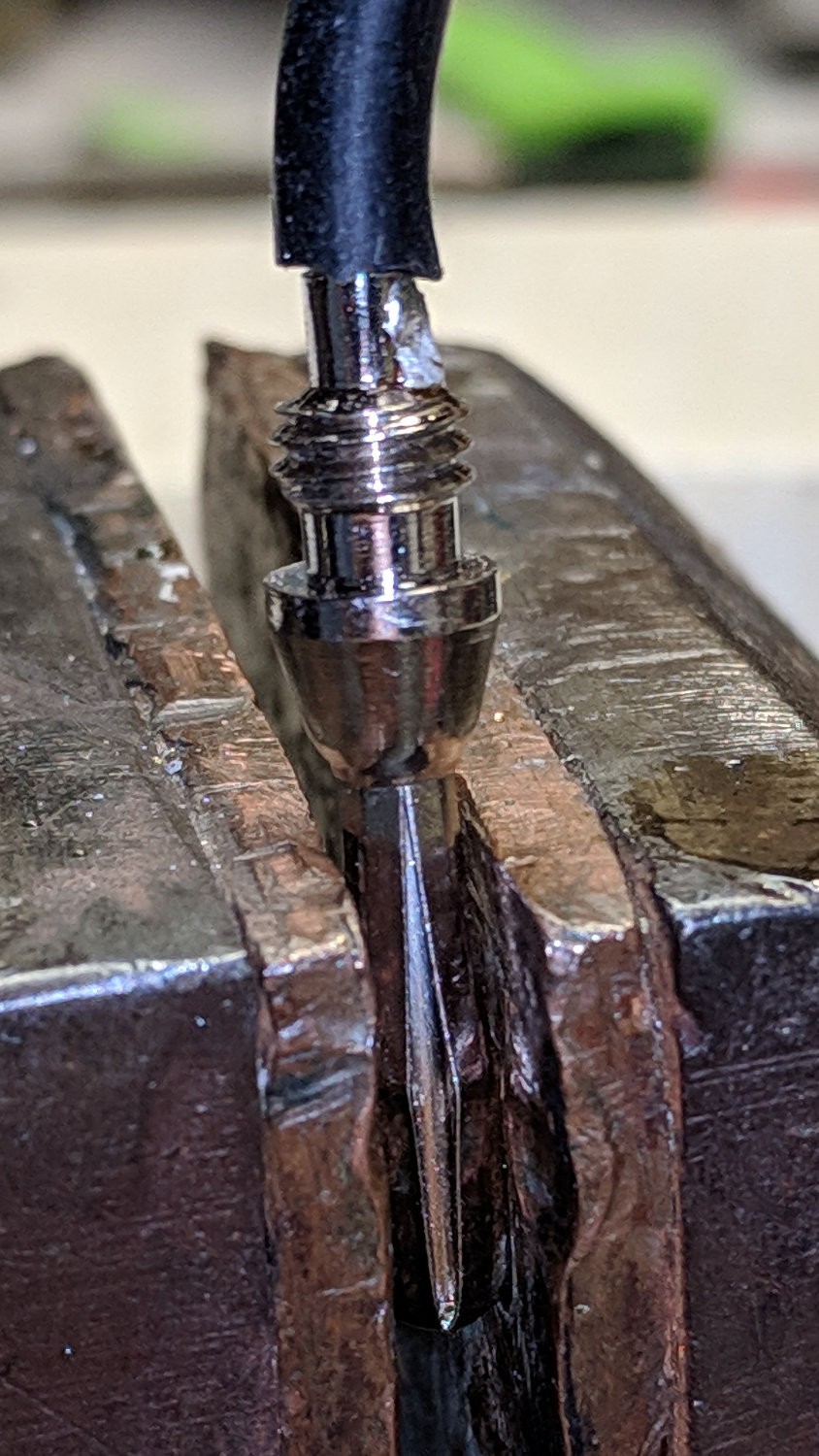
    A new pair of shoes arrived with extravagantly long laces requiring shortening. Years ago, I found heatshrink tubing completely unequal to the task, so I deployed Real Metal:

    Shoelaces with crimped ferrules
    Shoelaces with crimped ferrules

    The ferrules come from a kit of such things, minus their plastic strain relief:

    Ferrule terminals - hex crimper
    Ferrule terminals – hex crimper

    That’s a fancy hexagonal crimper for round-ish results. If you have a square terminal block, you should use the square crimper that comes with the kit.

    Worked perfectly and produced immediate customer satisfaction.

  • Astable Multivibrator: Battery Base for RGB LED

    Collecting the battery dimensions into a table should make it easier to generate new holders for astable multivibrators:

    //- Battery dimensions - rationalized from several samples
    //  Coordinate origin at battery end with contacts, key openings downward
    
    T_NAME = 0;
    T_SIZE = 1;
    T_CONTACTS = 2;
    T_KEYS = 3;
    
    BatteryData = [
      ["NP-BX1",[43.0,30.0,9.5],[[-0.75,6.0,6.2],[-0.75,16.0,6.2]],[[1.70,3.70,2.90],[1.70,3.60,2.90]]],
      ["NB-5L", [45.0,32.0,8.0],[[-0.82,4.5,3.5],[-0.82,11.0,3.5]],[[2.2,0.75,2.0],[2.2,2.8,2.0]]],
      ["NB-6L",[42.5,35.5,7.0],[[-0.85,5.50,3.05],[-0.85,11.90,3.05]],[[2.0,0.70,2.8],[2.0,2.00,2.8]]],
    ];
    
    echo(str("Battery: ",BatteryName));
    
    BatteryIndex = search([BatteryName],BatteryData,1,0)[0];
    echo(str(" Index: ",BatteryIndex));
    
    BatterySize = BatteryData[BatteryIndex][T_SIZE];          // X = length, Y = width, Z = thickness
    echo(str(" Size: ",BatterySize));
    
    Contacts = BatteryData[BatteryIndex][T_CONTACTS];         // relative to battery edge, front, and bottom
    echo(str(" Contacts: ",Contacts));
    
    ContactOC = Contacts[1].y - Contacts[0].y;                // + and - terminals for pogo pin contacts
    ContactCenter = Contacts[0].y + ContactOC/2;
    
    KeyBlocks = BatteryData[BatteryIndex][T_KEYS];            // recesses in battery face set X position
    echo(str(" Keys: ",KeyBlocks));
    

    A new boolean, RGBCircuit, adds a second pair of wire strut bases and punches holes in them:

    Astable Multivibrator Battery Holder
    Astable Multivibrator Battery Holder

    Which looks about like you’d expect in real life:

     Astable - NP-BX1 RGB holder
    Astable – NP-BX1 RGB holder

    The lettering, of course, doesn’t come through clearly, but it suffices as a hint for which battery to use.

    The four vertical struts will support three astable multivibrators, each driving one color of a common-anode RGB LED. It remains to be seen if there’s enough room for all the parts along the sides of the battery pack.

    The OpenSCAD source code as a GitHub Gist:

    // Holder for Li-Ion battery packs
    // Ed Nisley KE4ZNU January 2013
    // 2018-11-15 Adapted for 1.5 mm pogo pins, battery data table
    /* [Layout options] */
    BatteryName = "NP-BX1"; // [NP-BX1,NB-5L,NB-6L]
    RGBCircuit = true; // false = 1 strut pair, true = 2 pairs
    Layout = "Show"; // [Build,Show,Fit,Case,Lid,Pins]
    /* [Extrusion parameters] – must match reality! */
    // Print with +2 shells and 3 solid layers
    ThreadThick = 0.25;
    ThreadWidth = 0.40;
    HoleWindage = 0.2;
    function IntegerMultiple(Size,Unit) = Unit * ceil(Size / Unit);
    Protrusion = 0.1; // make holes end cleanly
    /* [Hidden] */
    inch = 25.4;
    BuildOffset = 3.0; // clearance for build layout
    Gap = 2.0; // separation for Fit parts
    //- Basic dimensions
    WallThick = 4*ThreadWidth; // holder sidewalls
    BaseThick = 6*ThreadThick; // bottom of holder to bottom of battery
    TopThick = 6*ThreadThick; // top of battery to top of holder
    //- Battery dimensions – rationalized from several samples
    // Coordinate origin at battery end with contacts, key openings downward
    T_NAME = 0;
    T_SIZE = 1;
    T_CONTACTS = 2;
    T_KEYS = 3;
    BatteryData = [
    ["NP-BX1",[43.0,30.0,9.5],[[-0.75,6.0,6.2],[-0.75,16.0,6.2]],[[1.70,3.70,2.90],[1.70,3.60,2.90]]],
    ["NB-5L", [45.0,32.0,8.0],[[-0.82,4.5,3.5],[-0.82,11.0,3.5]],[[2.2,0.75,2.0],[2.2,2.8,2.0]]],
    ["NB-6L",[42.5,35.5,7.0],[[-0.85,5.50,3.05],[-0.85,11.90,3.05]],[[2.0,0.70,2.8],[2.0,2.00,2.8]]],
    ];
    echo(str("Battery: ",BatteryName));
    BatteryIndex = search([BatteryName],BatteryData,1,0)[0];
    echo(str(" Index: ",BatteryIndex));
    BatterySize = BatteryData[BatteryIndex][T_SIZE]; // X = length, Y = width, Z = thickness
    echo(str(" Size: ",BatterySize));
    Contacts = BatteryData[BatteryIndex][T_CONTACTS]; // relative to battery edge, front, and bottom
    echo(str(" Contacts: ",Contacts));
    ContactOC = Contacts[1].y – Contacts[0].y; // + and – terminals for pogo pin contacts
    ContactCenter = Contacts[0].y + ContactOC/2;
    KeyBlocks = BatteryData[BatteryIndex][T_KEYS]; // recesses in battery face set X position
    echo(str(" Keys: ",KeyBlocks));
    //- Pin dimensions
    ID = 0;
    OD = 1;
    LENGTH = 2;
    PinShank = [1.5,2.0,6.5]; // shank, flange, compressed length
    PinFlange = [1.5,2.0,0.5]; // flange, length included in PinShank
    PinTip = [0.9,0.9,2.5]; // extended spring-loaded tip
    WireOD = 1.7; // wiring from pins to circuitry
    PinChannel = WireOD; // cut behind flange for solder overflow
    PinRecess = 3.0; // recess behind pin flange end for epoxy fill
    echo(str("Contact tip dia: ",PinTip[OD]));
    echo(str(" .. shank dia: ",PinShank[ID]));
    OverTravel = 0.5; // space beyond battery face at X origin
    //- Holder dimensions
    GuideRadius = ThreadWidth; // friction fit ridges
    GuideOffset = 7; // from compartment corners
    LidOverhang = 2.0; // atop of battery for retention
    LidClearance = LidOverhang * (BatterySize.z/BatterySize.x); // … clearance above battery for tilting
    echo(str("Lid clearance: ",LidClearance));
    CaseSize = [BatterySize.x + PinShank[LENGTH] + OverTravel + PinRecess + GuideRadius + WallThick,
    BatterySize.y + 2*WallThick + 2*GuideRadius,
    BatterySize.z + BaseThick + TopThick + LidClearance];
    echo(str("Case size: ",CaseSize));
    CaseOffset = [-(PinShank[LENGTH] + OverTravel + PinRecess),-(WallThick + GuideRadius),0]; // position around battery
    ThumbRadius = 10.0; // thumb opening at end of battery
    CornerRadius = 3*ThreadThick; // nice corner rounding
    LidSize = [-CaseOffset.x + LidOverhang,CaseSize.y,TopThick];
    LidOffset = [0.0,CaseOffset.y,0];
    //- Wire struts
    StrutDia = 1.6; // AWG 14 = 1.6 mm
    StrutSides = 3*4;
    StrutBase = [StrutDia,StrutDia + 4*WallThick,CaseSize.z – TopThick]; // ID = wire, OD = buildable
    StrutOC = IntegerMultiple(CaseSize.y + StrutBase[OD],5.0); // set easy OC wire spacing
    echo(str("Strut OC: ",StrutOC));
    //———————-
    // Useful routines
    module PolyCyl(Dia,Height,ForceSides=0) { // based on nophead's polyholes
    Sides = (ForceSides != 0) ? ForceSides : (ceil(Dia) + 2);
    FixDia = Dia / cos(180/Sides);
    cylinder(r=(FixDia + HoleWindage)/2,h=Height,$fn=Sides);
    }
    //——————-
    //– Guides for tighter friction fit
    module Guides() {
    translate([GuideOffset,-GuideRadius,0])
    PolyCyl(2*GuideRadius,(BatterySize.z – Protrusion),4);
    translate([GuideOffset,(BatterySize.y + GuideRadius),0])
    PolyCyl(2*GuideRadius,(BatterySize.z – Protrusion),4);
    translate([(BatterySize.x – GuideOffset),-GuideRadius,0])
    PolyCyl(2*GuideRadius,(BatterySize.z – Protrusion),4);
    translate([(BatterySize.x – GuideOffset),(BatterySize.y + GuideRadius),0])
    PolyCyl(2*GuideRadius,(BatterySize.z – Protrusion),4);
    translate([(BatterySize.x + GuideRadius),GuideOffset/2,0])
    PolyCyl(2*GuideRadius,(BatterySize.z – Protrusion),4);
    translate([(BatterySize.x + GuideRadius),(BatterySize.y – GuideOffset/2),0])
    PolyCyl(2*GuideRadius,(BatterySize.z – Protrusion),4);
    }
    //– Contact pins
    // Rotated to put them in their natural oriention
    // Aligned to put tip base / end of shank at Overtravel limit
    module PinShape() {
    translate([-(PinShank[LENGTH] + OverTravel),0,0])
    rotate([0,90,0])
    rotate(180/6)
    union() {
    PolyCyl(PinTip[OD],PinShank[LENGTH] + PinTip[LENGTH],6);
    PolyCyl(PinShank[ID],PinShank[LENGTH] + Protrusion,6); // slight extension for clean cuts
    PolyCyl(PinFlange[OD],PinFlange[LENGTH],6);
    }
    }
    // Position pins to put end of shank at battery face
    // Does not include recess access into case
    module PinAssembly() {
    union() {
    for (p = Contacts)
    translate([0,p.y,p.z])
    PinShape();
    translate([-(PinShank[LENGTH] + OverTravel) + PinChannel/2, // solder space
    ContactCenter,
    Contacts[0].z])
    cube([PinChannel,
    (Contacts[1].y – Contacts[0].y + PinFlange[OD]),
    PinFlange[OD]],center=true);
    for (j=[-1,1]) // wire channels
    translate([-(PinShank[LENGTH] + OverTravel – PinChannel/2),
    j*ContactOC/4 + ContactCenter,
    Contacts[0].z – PinFlange[OD]/2])
    rotate(180/6)
    PolyCyl(WireOD,CaseSize.z,6);
    }
    }
    //– Case with origin at battery corner
    module Case() {
    difference() {
    union() {
    difference() {
    union() {
    translate([(CaseSize.x/2 + CaseOffset.x), // basic case shape
    (CaseSize.y/2 + CaseOffset.y),
    (CaseSize.z/2 – BaseThick)])
    hull()
    for (i=[-1,1], j=[-1,1], k=[-1,1])
    translate([i*(CaseSize.x/2 – CornerRadius),
    j*(CaseSize.y/2 – CornerRadius),
    k*(CaseSize.z/2 – CornerRadius)])
    sphere(r=CornerRadius/cos(180/8),$fn=8); // cos() fixes undersize spheres!
    for (i=[0,RGBCircuit ? 1 : 0]) { // add strut bases
    hull()
    for (j=[-1,1])
    translate([i*(BatterySize.x – StrutBase[OD]),j*StrutOC/2 + BatterySize.y/2,-BaseThick])
    rotate(180/StrutSides)
    cylinder(d=StrutBase[OD],h=StrutBase[LENGTH],$fn=StrutSides);
    translate([i*(BatterySize.x – StrutBase[OD]),BatterySize.y/2,StrutBase[LENGTH]/2 – BaseThick])
    cube([2*StrutBase[OD],StrutOC,StrutBase[LENGTH]],center=true);
    }
    }
    translate([-OverTravel,-GuideRadius,0])
    cube([(BatterySize.x + GuideRadius + OverTravel),
    (BatterySize.y + 2*GuideRadius),
    (BatterySize.z + LidClearance + Protrusion)]); // battery space
    }
    Guides(); // improve friction fit
    translate([-OverTravel,-GuideRadius,0]) // battery keying blocks
    cube(KeyBlocks[0] + [OverTravel,GuideRadius,0],center=false);
    translate([-OverTravel,(BatterySize.y – KeyBlocks[1].y),0])
    cube(KeyBlocks[1] + [OverTravel,GuideRadius,0],center=false);
    }
    translate([2*CaseOffset.x, // battery top access
    (CaseOffset.y – Protrusion),
    BatterySize.z + LidClearance])
    cube([2*CaseSize.x,(CaseSize.y + 2*Protrusion),2*TopThick]);
    for (i2=[0,RGBCircuit ? 1 : 0]) { // strut wire holes and fairing
    for (j=[-1,1])
    translate([i2*(BatterySize.x – StrutBase[OD]),j*StrutOC/2 + BatterySize.y/2,0])
    PolyCyl(StrutBase[ID],StrutBase[LENGTH],6);
    for (i=[-1,1], j=[-1,1])
    translate([i*StrutBase[OD] + (i2*(BatterySize.x – StrutBase[OD])),
    j*StrutOC/2 + BatterySize.y/2,
    -(BaseThick + Protrusion)])
    rotate(180/StrutSides)
    PolyCyl(StrutBase[OD],StrutBase[LENGTH] + 2*Protrusion,StrutSides);
    }
    translate([(BatterySize.x – Protrusion), // remove thumb notch
    (CaseSize.y/2 + CaseOffset.y),
    (ThumbRadius)])
    rotate([90,0,0])
    rotate([0,90,0])
    cylinder(r=ThumbRadius,
    h=(WallThick + GuideRadius + 2*Protrusion),
    $fn=22);
    PinAssembly(); // pins and wiring
    translate([CaseOffset.x + PinRecess + Protrusion,(Contacts[1].y + Contacts[0].y)/2,Contacts[0].z])
    translate([-PinRecess,0,0])
    cube([2*PinRecess,
    (Contacts[1].y – Contacts[0].y + PinFlange[OD]/cos(180/6) + 2*HoleWindage),
    2*PinFlange[OD]],center=true); // pin insertion hole
    LineSpace = 7.0;
    translate([BatterySize.x/2,CaseSize.y/2,-ThreadThick])
    linear_extrude(height=2*ThreadThick,convexity=10)
    text(text=BatteryName,size=5,spacing=1.20,font="Arial:style:Bold",halign="center",valign="center");
    translate([BatterySize.x/2,CaseSize.y/2,-(BaseThick + Protrusion)])
    linear_extrude(height=ThreadThick + Protrusion,convexity=10)
    mirror([0,1,0])
    text(text="KE4ZNU",size=6,spacing=1.20,font="Arial:style:Bold",halign="center",valign="center");
    }
    }
    // Lid position offset to match case
    module Lid() {
    difference() {
    translate([-LidSize.x/2 + LidOffset.x + LidOverhang,LidSize.y/2 + LidOffset.y,0])
    difference() {
    hull()
    for (i=[-1,1], j=[-1,1], k=[-1,1])
    translate([i*(LidSize.x/2 – CornerRadius),
    j*(LidSize.y/2 – CornerRadius),
    k*(LidSize.z – CornerRadius)]) // double thickness for flat bottom
    sphere(r=CornerRadius,$fn=8);
    translate([0,0,-LidSize.z/2]) // remove bottom
    cube([(LidSize.x + 2*Protrusion),(LidSize.y + 2*Protrusion),LidSize.z],center=true);
    translate([LidSize.x/8,0,0])
    cube([LidSize.x/4,0.75*LidSize.y,4*ThreadThick],center=true); // epoxy recess
    }
    translate([0,0,-(Contacts[0].z + PinFlange[OD])]) // punch wire holes
    PinAssembly();
    }
    }
    //——————-
    // Build it!
    if (Layout == "Case")
    Case();
    if (Layout == "Lid")
    Lid();
    if (Layout == "Pins") {
    color("Silver",0.5)
    PinShape();
    PinAssembly();
    }
    if (Layout == "Show") { // reveal pin assembly
    difference() {
    Case();
    translate([(CaseOffset.x – Protrusion),
    Contacts[1].y,
    Contacts[1].z])
    cube([(-CaseOffset.x + Protrusion),
    CaseSize.y,
    (CaseSize.z – Contacts[0].z + Protrusion)]);
    translate([(CaseOffset.x – Protrusion),
    (CaseOffset.y – Protrusion),
    0])
    cube([(-CaseOffset.x + Protrusion),
    Contacts[0].y + Protrusion – CaseOffset.y,
    CaseSize.z]);
    }
    translate([0,0,BatterySize.z + Gap])
    Lid();
    color("Silver",0.15)
    PinAssembly();
    }
    if (Layout == "Build") {
    translate([-(CaseSize.x/2 + CaseOffset.x),-(CaseOffset.y – BuildOffset),BaseThick])
    Case();
    translate([CaseSize.x/2,-LidSize.x,0])
    rotate(90)
    Lid();
    }
    if (Layout == "Fit") {
    Case();
    translate([0,0,(BatterySize.z + Gap)])
    Lid();
    color("Silver",0.25)
    PinAssembly();
    }

  • Dell Laptop Battery Teardown

    The defunct 18650 lithium cell  I used for the DSO150 power supplyprompted me to crack open a battery from a long-gone Dell laptop to see if any of its cells were in better condition:

    Dell laptop battery - case cracking
    Dell laptop battery – case cracking

    Yup, gently crushing it in a vise splits the case enough to work the Designated Prydriver around the joint, a process considerably simplified by the knowledge the case isn’t going back together again.

    Prying the top off reveals the cells and their connections:

    Dell laptop battery - circuitry
    Dell laptop battery – circuitry

    One of the cells had corroded, accounting for the pack’s failure:

    Dell laptop battery - corroded cell
    Dell laptop battery – corroded cell

    The others were undamaged, but had self-discharged down to about 1.5 V over the course of several years and refused to charge.

    The moral may be to tear the pack apart as soon as it fails, a point always easier to recognize in retrospect.

    So I taped the packs to prevent shorts and tossed them into the recycle box.