The Smell of Molten Projects in the Morning

Ed Nisley's Blog: Shop notes, electronics, firmware, machinery, 3D printing, laser cuttery, and curiosities. Contents: 100% human thinking, 0% AI slop.

Category: Electronics Workbench

Electrical & Electronic gadgets

  • Shoe Lace Ferrules

    A new pair of shoes arrived with extravagantly long laces requiring shortening. Years ago, I found heatshrink tubing completely unequal to the task, so I deployed Real Metal:

    Shoelaces with crimped ferrules
    Shoelaces with crimped ferrules

    The ferrules come from a kit of such things, minus their plastic strain relief:

    Ferrule terminals - hex crimper
    Ferrule terminals – hex crimper

    That’s a fancy hexagonal crimper for round-ish results. If you have a square terminal block, you should use the square crimper that comes with the kit.

    Worked perfectly and produced immediate customer satisfaction.

  • Astable Multivibrator: Battery Base for RGB LED

    Collecting the battery dimensions into a table should make it easier to generate new holders for astable multivibrators:

    //- Battery dimensions - rationalized from several samples
    //  Coordinate origin at battery end with contacts, key openings downward
    
    T_NAME = 0;
    T_SIZE = 1;
    T_CONTACTS = 2;
    T_KEYS = 3;
    
    BatteryData = [
      ["NP-BX1",[43.0,30.0,9.5],[[-0.75,6.0,6.2],[-0.75,16.0,6.2]],[[1.70,3.70,2.90],[1.70,3.60,2.90]]],
      ["NB-5L", [45.0,32.0,8.0],[[-0.82,4.5,3.5],[-0.82,11.0,3.5]],[[2.2,0.75,2.0],[2.2,2.8,2.0]]],
      ["NB-6L",[42.5,35.5,7.0],[[-0.85,5.50,3.05],[-0.85,11.90,3.05]],[[2.0,0.70,2.8],[2.0,2.00,2.8]]],
    ];
    
    echo(str("Battery: ",BatteryName));
    
    BatteryIndex = search([BatteryName],BatteryData,1,0)[0];
    echo(str(" Index: ",BatteryIndex));
    
    BatterySize = BatteryData[BatteryIndex][T_SIZE];          // X = length, Y = width, Z = thickness
    echo(str(" Size: ",BatterySize));
    
    Contacts = BatteryData[BatteryIndex][T_CONTACTS];         // relative to battery edge, front, and bottom
    echo(str(" Contacts: ",Contacts));
    
    ContactOC = Contacts[1].y - Contacts[0].y;                // + and - terminals for pogo pin contacts
    ContactCenter = Contacts[0].y + ContactOC/2;
    
    KeyBlocks = BatteryData[BatteryIndex][T_KEYS];            // recesses in battery face set X position
    echo(str(" Keys: ",KeyBlocks));
    

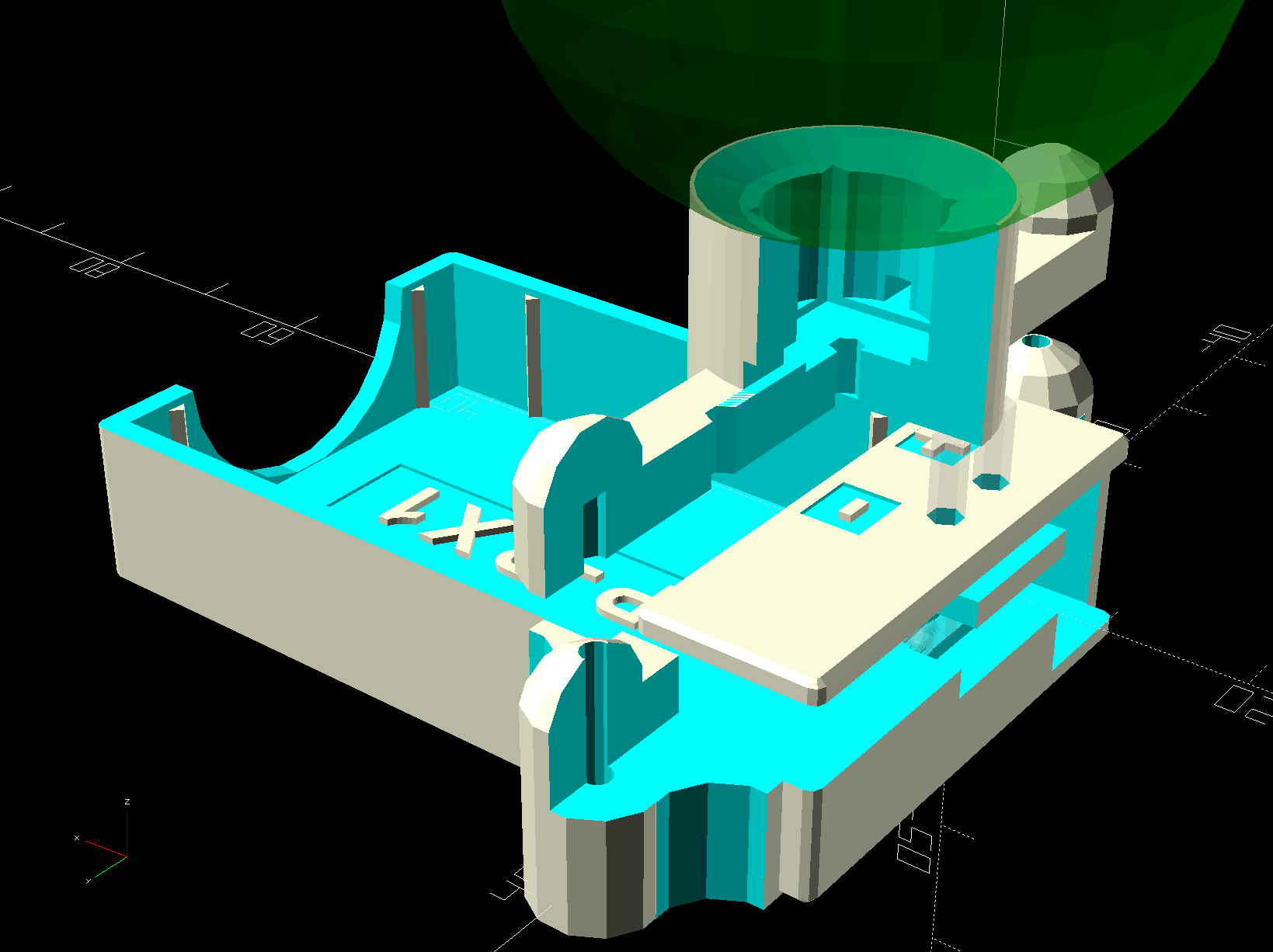
    A new boolean, RGBCircuit, adds a second pair of wire strut bases and punches holes in them:

    Astable Multivibrator Battery Holder
    Astable Multivibrator Battery Holder

    Which looks about like you’d expect in real life:

     Astable - NP-BX1 RGB holder
    Astable – NP-BX1 RGB holder

    The lettering, of course, doesn’t come through clearly, but it suffices as a hint for which battery to use.

    The four vertical struts will support three astable multivibrators, each driving one color of a common-anode RGB LED. It remains to be seen if there’s enough room for all the parts along the sides of the battery pack.

    The OpenSCAD source code as a GitHub Gist:

    // Holder for Li-Ion battery packs
    // Ed Nisley KE4ZNU January 2013
    // 2018-11-15 Adapted for 1.5 mm pogo pins, battery data table
    /* [Layout options] */
    BatteryName = "NP-BX1"; // [NP-BX1,NB-5L,NB-6L]
    RGBCircuit = true; // false = 1 strut pair, true = 2 pairs
    Layout = "Show"; // [Build,Show,Fit,Case,Lid,Pins]
    /* [Extrusion parameters] – must match reality! */
    // Print with +2 shells and 3 solid layers
    ThreadThick = 0.25;
    ThreadWidth = 0.40;
    HoleWindage = 0.2;
    function IntegerMultiple(Size,Unit) = Unit * ceil(Size / Unit);
    Protrusion = 0.1; // make holes end cleanly
    /* [Hidden] */
    inch = 25.4;
    BuildOffset = 3.0; // clearance for build layout
    Gap = 2.0; // separation for Fit parts
    //- Basic dimensions
    WallThick = 4*ThreadWidth; // holder sidewalls
    BaseThick = 6*ThreadThick; // bottom of holder to bottom of battery
    TopThick = 6*ThreadThick; // top of battery to top of holder
    //- Battery dimensions – rationalized from several samples
    // Coordinate origin at battery end with contacts, key openings downward
    T_NAME = 0;
    T_SIZE = 1;
    T_CONTACTS = 2;
    T_KEYS = 3;
    BatteryData = [
    ["NP-BX1",[43.0,30.0,9.5],[[-0.75,6.0,6.2],[-0.75,16.0,6.2]],[[1.70,3.70,2.90],[1.70,3.60,2.90]]],
    ["NB-5L", [45.0,32.0,8.0],[[-0.82,4.5,3.5],[-0.82,11.0,3.5]],[[2.2,0.75,2.0],[2.2,2.8,2.0]]],
    ["NB-6L",[42.5,35.5,7.0],[[-0.85,5.50,3.05],[-0.85,11.90,3.05]],[[2.0,0.70,2.8],[2.0,2.00,2.8]]],
    ];
    echo(str("Battery: ",BatteryName));
    BatteryIndex = search([BatteryName],BatteryData,1,0)[0];
    echo(str(" Index: ",BatteryIndex));
    BatterySize = BatteryData[BatteryIndex][T_SIZE]; // X = length, Y = width, Z = thickness
    echo(str(" Size: ",BatterySize));
    Contacts = BatteryData[BatteryIndex][T_CONTACTS]; // relative to battery edge, front, and bottom
    echo(str(" Contacts: ",Contacts));
    ContactOC = Contacts[1].y – Contacts[0].y; // + and – terminals for pogo pin contacts
    ContactCenter = Contacts[0].y + ContactOC/2;
    KeyBlocks = BatteryData[BatteryIndex][T_KEYS]; // recesses in battery face set X position
    echo(str(" Keys: ",KeyBlocks));
    //- Pin dimensions
    ID = 0;
    OD = 1;
    LENGTH = 2;
    PinShank = [1.5,2.0,6.5]; // shank, flange, compressed length
    PinFlange = [1.5,2.0,0.5]; // flange, length included in PinShank
    PinTip = [0.9,0.9,2.5]; // extended spring-loaded tip
    WireOD = 1.7; // wiring from pins to circuitry
    PinChannel = WireOD; // cut behind flange for solder overflow
    PinRecess = 3.0; // recess behind pin flange end for epoxy fill
    echo(str("Contact tip dia: ",PinTip[OD]));
    echo(str(" .. shank dia: ",PinShank[ID]));
    OverTravel = 0.5; // space beyond battery face at X origin
    //- Holder dimensions
    GuideRadius = ThreadWidth; // friction fit ridges
    GuideOffset = 7; // from compartment corners
    LidOverhang = 2.0; // atop of battery for retention
    LidClearance = LidOverhang * (BatterySize.z/BatterySize.x); // … clearance above battery for tilting
    echo(str("Lid clearance: ",LidClearance));
    CaseSize = [BatterySize.x + PinShank[LENGTH] + OverTravel + PinRecess + GuideRadius + WallThick,
    BatterySize.y + 2*WallThick + 2*GuideRadius,
    BatterySize.z + BaseThick + TopThick + LidClearance];
    echo(str("Case size: ",CaseSize));
    CaseOffset = [-(PinShank[LENGTH] + OverTravel + PinRecess),-(WallThick + GuideRadius),0]; // position around battery
    ThumbRadius = 10.0; // thumb opening at end of battery
    CornerRadius = 3*ThreadThick; // nice corner rounding
    LidSize = [-CaseOffset.x + LidOverhang,CaseSize.y,TopThick];
    LidOffset = [0.0,CaseOffset.y,0];
    //- Wire struts
    StrutDia = 1.6; // AWG 14 = 1.6 mm
    StrutSides = 3*4;
    StrutBase = [StrutDia,StrutDia + 4*WallThick,CaseSize.z – TopThick]; // ID = wire, OD = buildable
    StrutOC = IntegerMultiple(CaseSize.y + StrutBase[OD],5.0); // set easy OC wire spacing
    echo(str("Strut OC: ",StrutOC));
    //———————-
    // Useful routines
    module PolyCyl(Dia,Height,ForceSides=0) { // based on nophead's polyholes
    Sides = (ForceSides != 0) ? ForceSides : (ceil(Dia) + 2);
    FixDia = Dia / cos(180/Sides);
    cylinder(r=(FixDia + HoleWindage)/2,h=Height,$fn=Sides);
    }
    //——————-
    //– Guides for tighter friction fit
    module Guides() {
    translate([GuideOffset,-GuideRadius,0])
    PolyCyl(2*GuideRadius,(BatterySize.z – Protrusion),4);
    translate([GuideOffset,(BatterySize.y + GuideRadius),0])
    PolyCyl(2*GuideRadius,(BatterySize.z – Protrusion),4);
    translate([(BatterySize.x – GuideOffset),-GuideRadius,0])
    PolyCyl(2*GuideRadius,(BatterySize.z – Protrusion),4);
    translate([(BatterySize.x – GuideOffset),(BatterySize.y + GuideRadius),0])
    PolyCyl(2*GuideRadius,(BatterySize.z – Protrusion),4);
    translate([(BatterySize.x + GuideRadius),GuideOffset/2,0])
    PolyCyl(2*GuideRadius,(BatterySize.z – Protrusion),4);
    translate([(BatterySize.x + GuideRadius),(BatterySize.y – GuideOffset/2),0])
    PolyCyl(2*GuideRadius,(BatterySize.z – Protrusion),4);
    }
    //– Contact pins
    // Rotated to put them in their natural oriention
    // Aligned to put tip base / end of shank at Overtravel limit
    module PinShape() {
    translate([-(PinShank[LENGTH] + OverTravel),0,0])
    rotate([0,90,0])
    rotate(180/6)
    union() {
    PolyCyl(PinTip[OD],PinShank[LENGTH] + PinTip[LENGTH],6);
    PolyCyl(PinShank[ID],PinShank[LENGTH] + Protrusion,6); // slight extension for clean cuts
    PolyCyl(PinFlange[OD],PinFlange[LENGTH],6);
    }
    }
    // Position pins to put end of shank at battery face
    // Does not include recess access into case
    module PinAssembly() {
    union() {
    for (p = Contacts)
    translate([0,p.y,p.z])
    PinShape();
    translate([-(PinShank[LENGTH] + OverTravel) + PinChannel/2, // solder space
    ContactCenter,
    Contacts[0].z])
    cube([PinChannel,
    (Contacts[1].y – Contacts[0].y + PinFlange[OD]),
    PinFlange[OD]],center=true);
    for (j=[-1,1]) // wire channels
    translate([-(PinShank[LENGTH] + OverTravel – PinChannel/2),
    j*ContactOC/4 + ContactCenter,
    Contacts[0].z – PinFlange[OD]/2])
    rotate(180/6)
    PolyCyl(WireOD,CaseSize.z,6);
    }
    }
    //– Case with origin at battery corner
    module Case() {
    difference() {
    union() {
    difference() {
    union() {
    translate([(CaseSize.x/2 + CaseOffset.x), // basic case shape
    (CaseSize.y/2 + CaseOffset.y),
    (CaseSize.z/2 – BaseThick)])
    hull()
    for (i=[-1,1], j=[-1,1], k=[-1,1])
    translate([i*(CaseSize.x/2 – CornerRadius),
    j*(CaseSize.y/2 – CornerRadius),
    k*(CaseSize.z/2 – CornerRadius)])
    sphere(r=CornerRadius/cos(180/8),$fn=8); // cos() fixes undersize spheres!
    for (i=[0,RGBCircuit ? 1 : 0]) { // add strut bases
    hull()
    for (j=[-1,1])
    translate([i*(BatterySize.x – StrutBase[OD]),j*StrutOC/2 + BatterySize.y/2,-BaseThick])
    rotate(180/StrutSides)
    cylinder(d=StrutBase[OD],h=StrutBase[LENGTH],$fn=StrutSides);
    translate([i*(BatterySize.x – StrutBase[OD]),BatterySize.y/2,StrutBase[LENGTH]/2 – BaseThick])
    cube([2*StrutBase[OD],StrutOC,StrutBase[LENGTH]],center=true);
    }
    }
    translate([-OverTravel,-GuideRadius,0])
    cube([(BatterySize.x + GuideRadius + OverTravel),
    (BatterySize.y + 2*GuideRadius),
    (BatterySize.z + LidClearance + Protrusion)]); // battery space
    }
    Guides(); // improve friction fit
    translate([-OverTravel,-GuideRadius,0]) // battery keying blocks
    cube(KeyBlocks[0] + [OverTravel,GuideRadius,0],center=false);
    translate([-OverTravel,(BatterySize.y – KeyBlocks[1].y),0])
    cube(KeyBlocks[1] + [OverTravel,GuideRadius,0],center=false);
    }
    translate([2*CaseOffset.x, // battery top access
    (CaseOffset.y – Protrusion),
    BatterySize.z + LidClearance])
    cube([2*CaseSize.x,(CaseSize.y + 2*Protrusion),2*TopThick]);
    for (i2=[0,RGBCircuit ? 1 : 0]) { // strut wire holes and fairing
    for (j=[-1,1])
    translate([i2*(BatterySize.x – StrutBase[OD]),j*StrutOC/2 + BatterySize.y/2,0])
    PolyCyl(StrutBase[ID],StrutBase[LENGTH],6);
    for (i=[-1,1], j=[-1,1])
    translate([i*StrutBase[OD] + (i2*(BatterySize.x – StrutBase[OD])),
    j*StrutOC/2 + BatterySize.y/2,
    -(BaseThick + Protrusion)])
    rotate(180/StrutSides)
    PolyCyl(StrutBase[OD],StrutBase[LENGTH] + 2*Protrusion,StrutSides);
    }
    translate([(BatterySize.x – Protrusion), // remove thumb notch
    (CaseSize.y/2 + CaseOffset.y),
    (ThumbRadius)])
    rotate([90,0,0])
    rotate([0,90,0])
    cylinder(r=ThumbRadius,
    h=(WallThick + GuideRadius + 2*Protrusion),
    $fn=22);
    PinAssembly(); // pins and wiring
    translate([CaseOffset.x + PinRecess + Protrusion,(Contacts[1].y + Contacts[0].y)/2,Contacts[0].z])
    translate([-PinRecess,0,0])
    cube([2*PinRecess,
    (Contacts[1].y – Contacts[0].y + PinFlange[OD]/cos(180/6) + 2*HoleWindage),
    2*PinFlange[OD]],center=true); // pin insertion hole
    LineSpace = 7.0;
    translate([BatterySize.x/2,CaseSize.y/2,-ThreadThick])
    linear_extrude(height=2*ThreadThick,convexity=10)
    text(text=BatteryName,size=5,spacing=1.20,font="Arial:style:Bold",halign="center",valign="center");
    translate([BatterySize.x/2,CaseSize.y/2,-(BaseThick + Protrusion)])
    linear_extrude(height=ThreadThick + Protrusion,convexity=10)
    mirror([0,1,0])
    text(text="KE4ZNU",size=6,spacing=1.20,font="Arial:style:Bold",halign="center",valign="center");
    }
    }
    // Lid position offset to match case
    module Lid() {
    difference() {
    translate([-LidSize.x/2 + LidOffset.x + LidOverhang,LidSize.y/2 + LidOffset.y,0])
    difference() {
    hull()
    for (i=[-1,1], j=[-1,1], k=[-1,1])
    translate([i*(LidSize.x/2 – CornerRadius),
    j*(LidSize.y/2 – CornerRadius),
    k*(LidSize.z – CornerRadius)]) // double thickness for flat bottom
    sphere(r=CornerRadius,$fn=8);
    translate([0,0,-LidSize.z/2]) // remove bottom
    cube([(LidSize.x + 2*Protrusion),(LidSize.y + 2*Protrusion),LidSize.z],center=true);
    translate([LidSize.x/8,0,0])
    cube([LidSize.x/4,0.75*LidSize.y,4*ThreadThick],center=true); // epoxy recess
    }
    translate([0,0,-(Contacts[0].z + PinFlange[OD])]) // punch wire holes
    PinAssembly();
    }
    }
    //——————-
    // Build it!
    if (Layout == "Case")
    Case();
    if (Layout == "Lid")
    Lid();
    if (Layout == "Pins") {
    color("Silver",0.5)
    PinShape();
    PinAssembly();
    }
    if (Layout == "Show") { // reveal pin assembly
    difference() {
    Case();
    translate([(CaseOffset.x – Protrusion),
    Contacts[1].y,
    Contacts[1].z])
    cube([(-CaseOffset.x + Protrusion),
    CaseSize.y,
    (CaseSize.z – Contacts[0].z + Protrusion)]);
    translate([(CaseOffset.x – Protrusion),
    (CaseOffset.y – Protrusion),
    0])
    cube([(-CaseOffset.x + Protrusion),
    Contacts[0].y + Protrusion – CaseOffset.y,
    CaseSize.z]);
    }
    translate([0,0,BatterySize.z + Gap])
    Lid();
    color("Silver",0.15)
    PinAssembly();
    }
    if (Layout == "Build") {
    translate([-(CaseSize.x/2 + CaseOffset.x),-(CaseOffset.y – BuildOffset),BaseThick])
    Case();
    translate([CaseSize.x/2,-LidSize.x,0])
    rotate(90)
    Lid();
    }
    if (Layout == "Fit") {
    Case();
    translate([0,0,(BatterySize.z + Gap)])
    Lid();
    color("Silver",0.25)
    PinAssembly();
    }

  • Dell Laptop Battery Teardown

    The defunct 18650 lithium cell  I used for the DSO150 power supplyprompted me to crack open a battery from a long-gone Dell laptop to see if any of its cells were in better condition:

    Dell laptop battery - case cracking
    Dell laptop battery – case cracking

    Yup, gently crushing it in a vise splits the case enough to work the Designated Prydriver around the joint, a process considerably simplified by the knowledge the case isn’t going back together again.

    Prying the top off reveals the cells and their connections:

    Dell laptop battery - circuitry
    Dell laptop battery – circuitry

    One of the cells had corroded, accounting for the pack’s failure:

    Dell laptop battery - corroded cell
    Dell laptop battery – corroded cell

    The others were undamaged, but had self-discharged down to about 1.5 V over the course of several years and refused to charge.

    The moral may be to tear the pack apart as soon as it fails, a point always easier to recognize in retrospect.

    So I taped the packs to prevent shorts and tossed them into the recycle box.

  • Sonicare Essence: Final Battery Replacement

    After a bit over five years, the NiMH cells in my ancient Philips Sonicare Essence toothbrush finally gave out:

    Sonicare recharge dates - 2017-2018
    Sonicare recharge dates – 2017-2018

    Down near the end, the poor thing barely gave one brushing after an overnight charge.

    While I was dismantling the case, I charged the last two new-old-stock NiMH cells:

    Sonicare Essence - charging short cells
    Sonicare Essence – charging short cells

    They arrived the same five years ago as the deaders in the toothbrush, but haven’t been used in the interim and charged well enough. The NiteCore D4 charger arrived after they did and isn’t really intended for 2/3 AA cells, so I used short brass tubes to make up the difference. I should have used the 300 mA low-current charging option (press-and-hold the Mode button for a second), although it didn’t overcook them at 750 mA.

    The process went pretty much as before, with the new cells soldered in place atop the PCB:

    Sonicare Essence - batteries on PCB
    Sonicare Essence – batteries on PCB

    And the PCB tucked back into the case:

    Sonicare Essence - batteries installed
    Sonicare Essence – batteries installed

    I applied a solder bridge to the BLINKY pads, which seemed to disable the blinking and turn the LED on full with the toothbrush in the charger. Without waiting for a full charge cycle, I sucked the solder off the pads and restored the previous blinkiness.

    A few strips of Kapton tape and it’s back in operation:

    Sonicare Essence - retaped
    Sonicare Essence – retaped

    The first charge lasted for two weeks, so things are looking good again. When the stock of knockoff replacement brush heads wears out, it’ll be time to get a whole new toothbrush … even if the batteries aren’t completely dead yet.

  • Astable Multivibrator: SMT LED Ballast Resistor

    The original astable multivibrator ran from a dead CR123 primary lithium cell:

    CR123A Astable - front
    CR123A Astable – front

    With a terminal voltage falling from barely 3 V, the LED drew about 3 mA (1 mA/div), tops, without a ballast resistor:

    Astable - CR123A 2.8 V - 1 mA -green
    Astable – CR123A 2.8 V – 1 mA -green

    Hacking in a charged NP-BX1 secondary lithium cell boosted the supply to 4 V:

    NP-BX1 Holder - SMT pogo pins
    NP-BX1 Holder – SMT pogo pins

    Which, diodes being the way they are, raised the LED current to nearly 400 mA (100 mA/div):

    Astable - NP-BX1 4V - base V - 100mA-div
    Astable – NP-BX1 4V – base V – 100mA-div

    Somewhat to my surprise, a few weeks of abuse didn’t do any obvious damage to the LED, but I added a resistor while I was soldering up another holder:

    Astable - 51 ohm SMD ballast
    Astable – 51 ohm SMD ballast

    There’s not quite enough room for a 1/8 W axial resistor, so why not blob in a surface-mount resistor?

    Which cuts the current down to a mere 15 mA (10 mA/div) from a lithium battery at 4 V:

    Astable - NP-BX1 - 51 ohm ballast - 10ma-div
    Astable – NP-BX1 – 51 ohm ballast – 10ma-div

    It’s still blindingly bright, but now I don’t feel bad about it.


  • Astable Multivibrator: NP-BX1 Base

    Adapting the NP-BX1 battery holder to use SMT pogo pins worked well:

    NP-BX1 Holder - SMT pogo pins
    NP-BX1 Holder – SMT pogo pins

    The next step is to add sockets for those 14 AWG wires:

    NP-BX1 Battery Holder - Wire Posts - solid model
    NP-BX1 Battery Holder – Wire Posts – solid model

    Start by reaming / hand-drilling all the holes to their nominal size and cleaning out the pogo pin pocket.

    Solder wires to the pogo pins and thread them through the holder and lid:

    Astable - NP-BX1 holder - pogo pin soldering
    Astable – NP-BX1 holder – pogo pin soldering

    That’s nice, floppy silicone-insulated 24 AWG wire, which may be a bit too thick for this purpose.

    The pogo pins will, ideally, seat with the end of the body flush at the holder wall. Make it so:

    Astable - NP-BX1 holder - pogo pin protrusion
    Astable – NP-BX1 holder – pogo pin protrusion

    Dress the wires neatly into their pocket:

    Astable - NP-BX1 holder - pogo pin wiring
    Astable – NP-BX1 holder – pogo pin wiring

    Butter the bottom of the lid with epoxy, clamp in place, set it up for curing, then fill the recess:

    Astable - NP-BX1 base - curing
    Astable – NP-BX1 base – curing

    While it’s curing, make a soldering fixture for the 14 AWG wires:

    Astable - drilling strut soldering fixture
    Astable – drilling strut soldering fixture

    The holes are on 5 mm centers, in the expectation other battery holders will need different spacing.

    Solder it up and stick the wires into the base:

    Astable - NP-BX1 base - detail
    Astable – NP-BX1 base – detail

    Jam a battery in and It Just Works™:

    Astable - NP-BX1 3.8V - 20ma-div - cap V
    Astable – NP-BX1 3.8V – 20ma-div – cap V

    The traces:

    • Green = supply current at 20 mA/div
    • Yellow = LED driver transistor base voltage
    • Purple = other transistor collector voltage
    • White = base – collector voltage = capacitor voltage

    The measurement setup was a bit of a hairball:

    Astable - NP-BX1 base - current probe
    Astable – NP-BX1 base – current probe

    For completeness, here’s the schematic-and-layout diagram behind the circuitry:

    Astable - NP-BX1 base - schematic
    Astable – NP-BX1 base – schematic

    I love it when a plan comes together!

    The OpenSCAD source code as a GitHub Gist:

    // Holder for Sony NP-BX1 Li-Ion battery
    // Ed Nisley KE4ZNU January 2013
    // 2018-11-15 Adapted for wire leads from 1.5 mm test pins, added upright wire bases
    // Layout options
    Layout = "Fit"; // Show Build Fit Case Lid Pins
    //- Extrusion parameters – must match reality!
    // Print with +2 shells and 3 solid layers
    ThreadThick = 0.25;
    ThreadWidth = 0.35;
    HoleWindage = 0.2;
    function IntegerMultiple(Size,Unit) = Unit * ceil(Size / Unit);
    Protrusion = 0.1; // make holes end cleanly
    inch = 25.4;
    BuildOffset = 3.0; // clearance for build layout
    Gap = 2.0; // separation for Fit parts
    //- Basic dimensions
    WallThick = 4*ThreadWidth; // holder sidewalls
    BaseThick = 6*ThreadThick; // bottom of holder to bottom of battery
    TopThick = 6*ThreadThick; // top of battery to top of holder
    //- Battery dimensions – rationalized from several samples
    // Coordinate origin at battery contact face with key openings below contacts
    Battery = [43.0,30.0,9.5]; // X = length, Y = width, Z = thickness
    Contacts = [[-0.75,6.0,6.2],[-0.75,16.0,6.2]]; // relative to battery edge, front, and bottom
    ContactOC = Contacts[1].y – Contacts[0].y;
    ContactCenter = Contacts[0].y + ContactOC/2;
    KeyBlocks = [[1.75,3.70,2.90],[1.75,3.60,2.90]]; // recesses in battery face set X position
    //- Pin dimensions
    ID = 0;
    OD = 1;
    LENGTH = 2;
    PinShank = [1.5,2.0,6.5]; // shank, flange, compressed length
    PinFlange = [1.5,2.0,0.5]; // flange, length included in PinShank
    PinTip = [0.9,0.9,2.5]; // extended spring-loaded tip
    PinChannel = PinFlange[LENGTH] + 0.5; // cut behind flange for solder overflow
    PinRecess = 3.0; // recess behind pin flange end for epoxy fill
    echo(str("Contact tip dia: ",PinTip[OD]));
    echo(str(" .. shank dia: ",PinShank[ID]));
    OverTravel = 0.5; // space beyond battery face at X origin
    //- Holder dimensions
    GuideRadius = ThreadWidth; // friction fit ridges
    GuideOffset = 7; // from compartment corners
    ThumbRadius = 10.0; // thumb opening at end of battery
    CornerRadius = 3*ThreadThick; // nice corner rounding
    CaseSize = [Battery.x + PinShank[LENGTH] + OverTravel + PinRecess + GuideRadius + WallThick,
    Battery.y + 2*WallThick + 2*GuideRadius,
    Battery.z + BaseThick + TopThick];
    CaseOffset = [-(PinShank[LENGTH] + OverTravel + PinRecess),-(WallThick + GuideRadius),0]; // position around battery
    LidOverhang = 2.0; // over top of battery for retention
    LidSize = [-CaseOffset.x + LidOverhang,CaseSize.y,TopThick];
    LidOffset = [0.0,CaseOffset.y,0];
    //- Wire struts
    StrutDia = 1.6; // AWG 14 = 1.6 mm
    StrutOC = 45;
    StrutSides = 3*4;
    StrutBase = [StrutDia,StrutDia + 4*WallThick,CaseSize.z – TopThick]; // ID = wire, OD=buildable
    //———————-
    // Useful routines
    module PolyCyl(Dia,Height,ForceSides=0) { // based on nophead's polyholes
    Sides = (ForceSides != 0) ? ForceSides : (ceil(Dia) + 2);
    FixDia = Dia / cos(180/Sides);
    cylinder(r=(FixDia + HoleWindage)/2,h=Height,$fn=Sides);
    }
    //——————-
    //– Guides for tighter friction fit
    module Guides() {
    translate([GuideOffset,-GuideRadius,0])
    PolyCyl(2*GuideRadius,(Battery.z – Protrusion),4);
    translate([GuideOffset,(Battery.y + GuideRadius),0])
    PolyCyl(2*GuideRadius,(Battery.z – Protrusion),4);
    translate([(Battery.x – GuideOffset),-GuideRadius,0])
    PolyCyl(2*GuideRadius,(Battery.z – Protrusion),4);
    translate([(Battery.x – GuideOffset),(Battery.y + GuideRadius),0])
    PolyCyl(2*GuideRadius,(Battery.z – Protrusion),4);
    translate([(Battery.x + GuideRadius),GuideOffset/2,0])
    PolyCyl(2*GuideRadius,(Battery.z – Protrusion),4);
    translate([(Battery.x + GuideRadius),(Battery.y – GuideOffset/2),0])
    PolyCyl(2*GuideRadius,(Battery.z – Protrusion),4);
    }
    //– Contact pins
    // Rotated to put them in their natural oriention
    // Aligned to put tip base / end of shank at Overtravel limit
    module PinShape() {
    translate([-(PinShank[LENGTH] + OverTravel),0,0])
    rotate([0,90,0])
    rotate(180/6)
    union() {
    PolyCyl(PinTip[OD],PinShank[LENGTH] + PinTip[LENGTH],6);
    PolyCyl(PinShank[ID],PinShank[LENGTH] + Protrusion,6); // slight extension for clean cuts
    PolyCyl(PinFlange[OD],PinFlange[LENGTH],6);
    }
    }
    // Position pins to put end of shank at battery face
    // Does not include recess access into case
    module PinAssembly() {
    union() {
    for (p = Contacts)
    translate([0,p.y,p.z])
    PinShape();
    translate([-(PinShank[LENGTH] + OverTravel) + PinChannel/2, // solder space
    ContactCenter,
    Contacts[0].z])
    cube([PinChannel,(Contacts[1].y – Contacts[0].y),PinFlange[OD]],center=true);
    for (j=[-1,1]) // wire channels
    translate([-(PinShank[LENGTH] + OverTravel – PinChannel/2),
    j*ContactOC/4 + ContactCenter,
    Contacts[0].z – PinFlange[OD]/2])
    rotate(180/6)
    PolyCyl(PinFlange[OD],CaseSize.z,6);
    }
    }
    //– Case with origin at battery corner
    module Case() {
    difference() {
    union() {
    difference() {
    union() {
    translate([(CaseSize.x/2 + CaseOffset.x), // basic case shape
    (CaseSize.y/2 + CaseOffset.y),
    (CaseSize.z/2 – BaseThick)])
    hull()
    for (i=[-1,1], j=[-1,1], k=[-1,1])
    translate([i*(CaseSize.x/2 – CornerRadius),
    j*(CaseSize.y/2 – CornerRadius),
    k*(CaseSize.z/2 – CornerRadius)])
    sphere(r=CornerRadius/cos(180/8),$fn=8); // cos() fixes undersize spheres!
    hull() // wire strut bases
    for (j=[-1,1])
    translate([0,j*StrutOC/2 + Battery.y/2,-BaseThick])
    rotate(180/StrutSides)
    cylinder(d=StrutBase[OD],h=StrutBase[LENGTH],$fn=StrutSides);
    translate([0,Battery.y/2,StrutBase[LENGTH]/2 – BaseThick])
    cube([2*StrutBase[OD],StrutOC,StrutBase[LENGTH]],center=true);
    }
    translate([-OverTravel,-GuideRadius,0])
    cube([(Battery.x + GuideRadius + OverTravel),
    (Battery.y + 2*GuideRadius),
    (Battery.z + Protrusion)]); // battery space
    }
    Guides(); // improve friction fit
    translate([-OverTravel,-GuideRadius,0]) // battery keying blocks
    cube(KeyBlocks[0] + [OverTravel,GuideRadius,0],center=false);
    translate([-OverTravel,(Battery.y – KeyBlocks[1].y),0])
    cube(KeyBlocks[1] + [OverTravel,GuideRadius,0],center=false);
    }
    translate([2*CaseOffset.x, // battery top access
    (CaseOffset.y – Protrusion),
    Battery.z])
    cube([2*CaseSize.x,(CaseSize.y + 2*Protrusion),(TopThick + Protrusion)]);
    if (false)
    translate([(CaseOffset.x – Protrusion), // battery insertion allowance
    (CaseOffset.y – Protrusion),
    Battery.z])
    cube([(CaseSize.x + 2*Protrusion),(CaseSize.y + 2*Protrusion),(TopThick + Protrusion)]);
    for (j=[-1,1]) // strut wires
    translate([0,j*StrutOC/2 + Battery.y/2,-(BaseThick + Protrusion)])
    PolyCyl(StrutBase[ID],StrutBase[LENGTH] + 2*Protrusion,6);
    for (i=[-1,1], j=[-1,1])
    translate([i*StrutBase[OD],j*StrutOC/2 + Battery.y/2,-(BaseThick + Protrusion)])
    rotate(180/StrutSides)
    PolyCyl(StrutBase[OD],StrutBase[LENGTH] + 2*Protrusion,StrutSides);
    translate([(Battery.x – Protrusion), // remove thumb notch
    (CaseSize.y/2 + CaseOffset.y),
    (ThumbRadius)])
    rotate([90,0,0])
    rotate([0,90,0])
    cylinder(r=ThumbRadius,
    h=(WallThick + GuideRadius + 2*Protrusion),
    $fn=22);
    PinAssembly();
    translate([CaseOffset.x + PinRecess + Protrusion,(Contacts[1].y + Contacts[0].y)/2,Contacts[0].z])
    translate([-PinRecess,0,0])
    cube([2*PinRecess,
    (Contacts[1].y – Contacts[0].y + PinFlange[OD]),
    2*PinFlange[OD]],center=true);
    }
    }
    // Lid position offset to match case
    module Lid() {
    difference() {
    translate([-LidSize.x/2 + LidOffset.x + LidOverhang,LidSize.y/2 + LidOffset.y,0])
    difference() {
    hull()
    for (i=[-1,1], j=[-1,1], k=[-1,1])
    translate([i*(LidSize.x/2 – CornerRadius),
    j*(LidSize.y/2 – CornerRadius),
    k*(LidSize.z – CornerRadius)]) // double thickness for flat bottom
    sphere(r=CornerRadius,$fn=8);
    translate([0,0,-LidSize.z/2]) // remove bottom
    cube([(LidSize.x + 2*Protrusion),(LidSize.y + 2*Protrusion),LidSize.z],center=true);
    translate([LidSize.x/8,0,0])
    cube([LidSize.x/4,0.75*LidSize.y,4*ThreadThick],center=true); // epoxy recess
    }
    translate([0,0,-(Contacts[0].z + PinFlange[OD])]) // punch wire holes
    PinAssembly();
    }
    }
    //——————-
    // Build it!
    if (Layout == "Case")
    Case();
    if (Layout == "Lid")
    Lid();
    if (Layout == "Pins") {
    color("Silver",0.5)
    PinShape();
    PinAssembly();
    }
    if (Layout == "Show") { // reveal pin assembly
    difference() {
    Case();
    translate([(CaseOffset.x – Protrusion),
    Contacts[1].y,
    Contacts[1].z])
    cube([(-CaseOffset.x + Protrusion),
    CaseSize.y,
    (CaseSize.z – Contacts[0].z + Protrusion)]);
    translate([(CaseOffset.x – Protrusion),
    (CaseOffset.y – Protrusion),
    0])
    cube([(-CaseOffset.x + Protrusion),
    Contacts[0].y + Protrusion – CaseOffset.y,
    CaseSize.z]);
    }
    translate([0,0,Battery.z + Gap])
    Lid();
    color("Silver",0.15)
    PinAssembly();
    }
    if (Layout == "Build") {
    translate([-(CaseSize.x/2 + CaseOffset.x),-(CaseOffset.y – BuildOffset),BaseThick])
    Case();
    translate([CaseSize.x/2,-LidSize.x/2,0])
    rotate(90)
    Lid();
    }
    if (Layout == "Fit") {
    Case();
    translate([0,0,(Battery.z + Gap)])
    Lid();
    color("Silver",0.25)
    PinAssembly();
    }

  • Halogen Desk Lamp Conversion

    As part of converting the halogen desk lamp to LEDs, I replaced the hulking iron transformer with a flatter counterweight:

    Halogen Desk Lamp - 12 V 20 W transformer
    Halogen Desk Lamp – 12 V 20 W transformer

    Under normal circumstances, you’d use something like steel or lead sheets, but Tiny Bandsaw™ can’t cut any appreciable thickness of steel and I gave away my entire lead stockpile, so I sawed disks from a pile of non-stick pancake griddles and drilled suitable mounting holes:

    Parallel clamps in action
    Parallel clamps in action

    Another disk (from a formal aluminum sheet!) goes into the lamp head, with a trio of 3W COB LEDs epoxied in place:

    Ex-Halogen Desk Lamp - 3x3W COB LED assembly
    Ex-Halogen Desk Lamp – 3x3W COB LED assembly

    The other side of the disk sports a heatsink harvested from a PC, also epoxied in place:

    Ex-halogen Desk Lamp - heatsink fitting
    Ex-halogen Desk Lamp – heatsink fitting

    Realizing the head required only a little filing to accommodate the heatsink sealed both their fates.

    A test firing showed the heatsink needed more airflow, which didn’t come as much of a surprise, so I milled slots in the lamp head:

    Ex-halogen Desk Lamp - vent slot milling
    Ex-halogen Desk Lamp – vent slot milling

    Deburring the holes, blackening the sides with a Sharpie, and tucking a bit of black window screen behind the opening made the vents look entirely professional.

    The small dome in the base originally cleared the transformer and now holds the entire 10 W LED driver, along with all the wiring, atop the counterweight sheets:

    Ex-halogen Desk Lamp - base wiring
    Ex-halogen Desk Lamp – base wiring

    A cork pad covers the base for a bit of non-skid action:

    Ex-halogen Desk Lamp - cork pad
    Ex-halogen Desk Lamp – cork pad

    I couldn’t convince myself filling in those sectors would improve anything, so I didn’t.

    And then It Just Worked:

    Ex-halogen Desk Lamp - in use
    Ex-halogen Desk Lamp – in use

    All without a trace of solid modeling or G-Code …