|
// 60 kHz crystal tester |
|
// Ed Nisley – KE4ZNU |
|
|
|
#include <avr/pgmspace.h> |
|
#include <U8g2lib.h> |
|
#include <U8x8lib.h> |
|
#include <Adafruit_MCP4725.h> |
|
|
|
//——————— |
|
// Pin locations |
|
|
|
#define PIN_SYNC 5 |
|
|
|
#define PIN_CX_SHORT 6 |
|
|
|
#define PIN_DDS_RESET 7 |
|
#define PIN_DDS_LATCH 8 |
|
|
|
#define PIN_HEARTBEAT 9 |
|
|
|
#define PIN_LOG_AMP A0 |
|
|
|
#define PIN_JOYBUTTTON A1 |
|
#define PIN_JOY_Y A2 |
|
#define PIN_JOY_X A3 |
|
|
|
// SPI & I2C use hardware support: these pins are predetermined |
|
|
|
#define PIN_SS 10 |
|
#define PIN_MOSI 11 |
|
#define PIN_MISO 12 |
|
#define PIN_SCK 13 |
|
|
|
#define PIN_IIC_SDA A4 |
|
#define PIN_IIC_SCL A5 |
|
|
|
// IIC Hardware addresses |
|
// OLED library uses its default address |
|
|
|
#define LM75_ADDR 0x48 |
|
#define SH1106_ADDR 0x70 |
|
#define MCP4725_ADDR 0x60 |
|
|
|
// Useful constants |
|
|
|
#define GIGA 1000000000LL |
|
#define MEGA 1000000LL |
|
#define KILO 1000LL |
|
|
|
#define ONE_FX (1LL << 32) |
|
|
|
#define CALFREQ (10LL * MEGA * ONE_FX) |
|
|
|
// Structures for 64-bit fixed point numbers |
|
// Low word = fractional part |
|
// High word = integer part |
|
|
|
struct ll_fx { |
|
uint32_t low; // fractional part |
|
uint32_t high; // integer part |
|
}; |
|
|
|
union ll_u { |
|
uint64_t fx_64; |
|
struct ll_fx fx_32; |
|
}; |
|
|
|
// Define semi-constant values |
|
|
|
union ll_u CenterFreq = {(60000 – 4) * ONE_FX}; // center of scan |
|
//union ll_u CenterFreq = {(32768 – 2) * ONE_FX}; // center of scan |
|
|
|
#define NOMINAL_OSC ((125 * MEGA) * ONE_FX) |
|
union ll_u Oscillator = {NOMINAL_OSC}; // oscillator frequency |
|
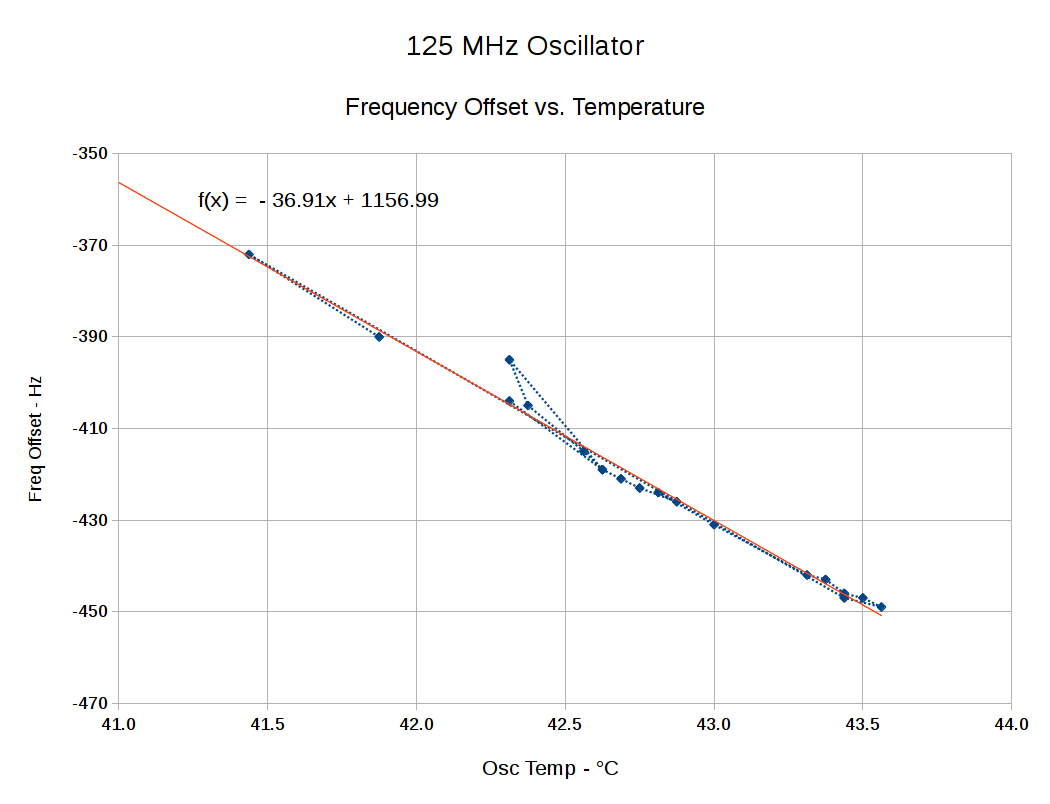
int32_t OscOffset = -414; // measured offset from NOMINAL_OSC |
|
|
|
uint16_t ScanWidth = 4*2; // width must be an even integer |
|
uint16_t ScanSettleMS = 2000; // milliseconds of settling time per measurement |
|
|
|
union ll_u ScanStepSize = {ONE_FX / 10}; // 0.1 Hz is smallest practical decimal step |
|
//union ll_u ScanStepSize = {ONE_FX / 34}; // 0.0291 is smallest possible step |
|
|
|
// Global variables of interest to everyone |
|
|
|
union ll_u ScanFrom, ScanTo; // may be larger than unsigned ints |
|
union ll_u ScanFreq; // fixed-point frequency scan settings |
|
|
|
union ll_u PeakFreq; // records maximum response point |
|
union ll_u PeakdB; // and corresponding log amp output |
|
|
|
union ll_u SeriesPeakLow,SeriesPeakHigh; // peak with CX short and CX in circuit |
|
|
|
union ll_u CtPerHz; // will be 2^32 / oscillator |
|
union ll_u HzPerCt; // will be oscillator / 2^32 |
|
|
|
char Buffer[10+1+10+1]; // string buffer for fixed point number conversions |
|
|
|
union ll_u Temperature; // read from LM75A |
|
|
|
// Hardware library variables |
|
|
|
U8X8_SH1106_128X64_NONAME_HW_I2C u8x8(U8X8_PIN_NONE); |
|
//U8X8_SH1106_128X64_NONAME_4W_HW_SPI u8x8(PIN_DISP_SEL, PIN_DISP_DC , PIN_DISP_RST); |
|
//U8X8_SH1106_128X64_NONAME_4W_SW_SPI u8x8(PIN_SCK, PIN_MOSI, PIN_DISP_SEL, PIN_DISP_DC , PIN_DISP_RST); |
|
|
|
#define DAC_WR false |
|
#define DAC_WR_EEP true |
|
#define DAC_BITS 12 |
|
#define DAC_MAX 0x0fff |
|
|
|
Adafruit_MCP4725 XAxisDAC; // I²C DAC for X axis output |
|
uint32_t XAxisValue; // DAC parameter uses 32 bits |
|
|
|
union ll_u LogAmpdB; // computed dB value |
|
|
|
#define HEARTBEAT_MS 3000 |
|
|
|
unsigned long MillisNow,MillisThen; |
|
|
|
//———– |
|
// Useful functions |
|
|
|
// Pin twiddling |
|
|
|
void TogglePin(char bitpin) { |
|
digitalWrite(bitpin,!digitalRead(bitpin)); // toggle the bit based on previous output |
|
} |
|
|
|
void PulsePin(char bitpin) { |
|
TogglePin(bitpin); |
|
TogglePin(bitpin); |
|
} |
|
|
|
void WaitButtonDown() { |
|
word ai; |
|
|
|
do { |
|
ai = analogRead(PIN_JOYBUTTTON); |
|
} while (ai > 500); |
|
} |
|
|
|
void WaitButtonUp() { |
|
word ai; |
|
|
|
do { |
|
ai = analogRead(PIN_JOYBUTTTON); |
|
} while (ai < 500); |
|
} |
|
|
|
// Hardware-assisted SPI I/O |
|
|
|
void EnableSPI(void) { |
|
digitalWrite(PIN_SS,HIGH); // set SPI into Master mode |
|
SPCR |= 1 << SPE; |
|
} |
|
|
|
void DisableSPI(void) { |
|
SPCR &= ~(1 << SPE); |
|
} |
|
|
|
void WaitSPIF(void) { |
|
while (! (SPSR & (1 << SPIF))) { |
|
// TogglePin(PIN_HEARTBEAT); |
|
// TogglePin(PIN_HEARTBEAT); |
|
continue; |
|
} |
|
} |
|
|
|
byte SendRecSPI(byte Dbyte) { // send one byte, get another in exchange |
|
SPDR = Dbyte; |
|
WaitSPIF(); |
|
|
|
return SPDR; // SPIF will be cleared |
|
} |
|
|
|
//————– |
|
// DDS module |
|
|
|
void EnableDDS(void) { |
|
|
|
digitalWrite(PIN_DDS_LATCH,LOW); // ensure proper startup |
|
|
|
digitalWrite(PIN_DDS_RESET,HIGH); // minimum reset pulse 40 ns, not a problem |
|
digitalWrite(PIN_DDS_RESET,LOW); |
|
delayMicroseconds(1); // max latency 100 ns, not a problem |
|
|
|
DisableSPI(); // allow manual control of outputs |
|
digitalWrite(PIN_SCK,LOW); // ensure clean SCK pulse |
|
PulsePin(PIN_SCK); // … to latch hardwired config bits |
|
PulsePin(PIN_DDS_LATCH); // load hardwired config bits = begin serial mode |
|
|
|
EnableSPI(); // turn on hardware SPI controls |
|
SendRecSPI(0x00); // shift in serial config bits |
|
PulsePin(PIN_DDS_LATCH); // load serial config bits |
|
|
|
} |
|
|
|
// Write delta phase count to DDS |
|
// This comes from the integer part of a 64-bit scaled value |
|
|
|
void WriteDDS(uint32_t DeltaPhase) { |
|
|
|
SendRecSPI((byte)DeltaPhase); // low-order byte first |
|
SendRecSPI((byte)(DeltaPhase >> 8)); |
|
SendRecSPI((byte)(DeltaPhase >> 16)); |
|
SendRecSPI((byte)(DeltaPhase >> 24)); |
|
|
|
SendRecSPI(0x00); // 5 MSBs = phase = 0, 3 LSBs must be zero |
|
|
|
PulsePin(PIN_DDS_LATCH); // write data to DDS |
|
} |
|
|
|
//————– |
|
// Log amp module |
|
|
|
#define LOG_AMP_SAMPLES 10 |
|
#define LOG_AMP_DELAYMS 10 |
|
|
|
uint64_t ReadLogAmp() { |
|
|
|
union ll_u LogAmpRaw; |
|
|
|
LogAmpRaw.fx_64 = 0; |
|
for (byte i=0; i<LOG_AMP_SAMPLES; i++) { |
|
LogAmpRaw.fx_32.high += analogRead(PIN_LOG_AMP); |
|
delay(LOG_AMP_DELAYMS); |
|
} |
|
|
|
LogAmpRaw.fx_64 /= LOG_AMP_SAMPLES; // figure average from totally ad-hoc number of samples |
|
|
|
LogAmpRaw.fx_64 *= 5; // convert from ADC counts to voltage |
|
LogAmpRaw.fx_64 /= 1024; |
|
|
|
LogAmpRaw.fx_64 /= 24; // convert from voltage to dBV at 24 mV/dBV |
|
LogAmpRaw.fx_64 *= 1000; |
|
|
|
return LogAmpRaw.fx_64; |
|
} |
|
|
|
//———– |
|
// Scan DDS and record response |
|
|
|
void ScanCrystal() { |
|
|
|
byte ln; |
|
union ll_u Temp, TestFreq, TestCount; |
|
|
|
XAxisValue = 0; |
|
PeakdB.fx_64 = 0; |
|
|
|
printf("CX: %s\n",digitalRead(PIN_CX_SHORT) ? "short" : "enable"); |
|
|
|
for (ScanFreq = ScanFrom; |
|
ScanFreq.fx_64 < (ScanTo.fx_64 + ScanStepSize.fx_64 / 2); |
|
ScanFreq.fx_64 += ScanStepSize.fx_64) { |
|
|
|
digitalWrite(PIN_SYNC,HIGH); |
|
|
|
TestCount.fx_64 = MultiplyFixedPt(ScanFreq,CtPerHz); // compute DDS delta phase |
|
TestCount.fx_32.low = 0; // truncate count to integer |
|
TestFreq.fx_64 = MultiplyFixedPt(TestCount,HzPerCt); // compute actual frequency |
|
|
|
Temp.fx_64 = (DAC_MAX * (ScanFreq.fx_64 – ScanFrom.fx_64)); // figure X as fraction |
|
Temp.fx_64 /= ScanWidth; |
|
XAxisValue = Temp.fx_32.high; |
|
|
|
digitalWrite(PIN_HEARTBEAT,HIGH); |
|
WriteDDS(TestCount.fx_32.high); // set DDS to new frequency |
|
XAxisDAC.setVoltage(XAxisValue,DAC_WR); // and set X axis to match |
|
digitalWrite(PIN_SYNC,LOW); |
|
|
|
if (ScanFreq.fx_64 == ScanFrom.fx_64) { |
|
delay(3*ScanSettleMS); // very long settling time |
|
} |
|
else { |
|
delay(ScanSettleMS); // small steps are faster |
|
} |
|
|
|
LogAmpdB.fx_64 = ReadLogAmp(); // fetch avg value |
|
|
|
if (LogAmpdB.fx_64 > PeakdB.fx_64) { // hit a new high? |
|
PeakFreq = TestFreq; // save actual frequency |
|
PeakdB = LogAmpdB; |
|
|
|
ln = digitalRead(PIN_CX_SHORT) ? 4 : 5; // CX selects row |
|
PrintFixedPtRounded(Buffer,TestFreq,2); // display actual peak |
|
u8x8.drawString(0,ln,Buffer); |
|
|
|
PrintFixedPtRounded(Buffer,LogAmpdB,1); // tack on response |
|
u8x8.drawString(16-strlen(Buffer),ln,Buffer); |
|
} |
|
|
|
ln = 0; |
|
PrintFixedPtRounded(Buffer,TestFreq,2); // display current frequency |
|
u8x8.draw2x2String(0,ln++,Buffer); |
|
ln++; // double-high characters |
|
printf("%9s ",Buffer); // log to serial port |
|
|
|
PrintFixedPtRounded(Buffer,LogAmpdB,1); // display response |
|
u8x8.drawString(0,ln,"dBV "); |
|
u8x8.drawString(16-strlen(Buffer),ln++,Buffer); |
|
printf(", %6s\n",Buffer); // and log it |
|
|
|
} |
|
|
|
} |
|
|
|
//———– |
|
// Round scaled fixed point to specific number of decimal places: 0 through 8 |
|
// You should display the value with only Decimals characters beyond the point |
|
// Must calculate rounding value as separate variable to avoid mystery error |
|
|
|
uint64_t RoundFixedPt(union ll_u TheNumber,unsigned Decimals) { |
|
union ll_u Rnd; |
|
|
|
Rnd.fx_64 = (ONE_FX >> 1) / (pow(10LL,Decimals)); // that's 0.5 / number of places |
|
TheNumber.fx_64 = TheNumber.fx_64 + Rnd.fx_64; |
|
|
|
return TheNumber.fx_64; |
|
} |
|
|
|
|
|
//———– |
|
// Multiply two unsigned scaled fixed point numbers without overflowing a 64 bit value |
|
// Perforce, the product of the two integer parts mut be < 2^32 |
|
|
|
uint64_t MultiplyFixedPt(union ll_u Mcand, union ll_u Mplier) { |
|
union ll_u Result; |
|
|
|
Result.fx_64 = ((uint64_t)Mcand.fx_32.high * (uint64_t)Mplier.fx_32.high) << 32; // integer parts (clear fract) |
|
Result.fx_64 += ((uint64_t)Mcand.fx_32.low * (uint64_t)Mplier.fx_32.low) >> 32; // fraction parts (always < 1) |
|
Result.fx_64 += (uint64_t)Mcand.fx_32.high * (uint64_t)Mplier.fx_32.low; // cross products |
|
Result.fx_64 += (uint64_t)Mcand.fx_32.low * (uint64_t)Mplier.fx_32.high; |
|
|
|
return Result.fx_64; |
|
} |
|
|
|
|
|
//———– |
|
// Long long print-to-buffer helpers |
|
// Assumes little-Endian layout |
|
|
|
void PrintHexLL(char *pBuffer,union ll_u FixedPt) { |
|
sprintf(pBuffer,"%08lx %08lx",FixedPt.fx_32.high,FixedPt.fx_32.low); |
|
} |
|
|
|
// converts all 9 decimal digits of fraction, which should suffice |
|
|
|
void PrintFractionLL(char *pBuffer,union ll_u FixedPt) { |
|
union ll_u Fraction; |
|
|
|
Fraction.fx_64 = FixedPt.fx_32.low; // copy 32 fraction bits, high order = 0 |
|
Fraction.fx_64 *= GIGA; // times 10^9 for conversion |
|
Fraction.fx_64 >>= 32; // align integer part in low long |
|
sprintf(pBuffer,"%09lu",Fraction.fx_32.low); // convert low long to decimal |
|
} |
|
|
|
void PrintIntegerLL(char *pBuffer,union ll_u FixedPt) { |
|
sprintf(pBuffer,"%lu",FixedPt.fx_32.high); |
|
} |
|
|
|
void PrintFixedPt(char *pBuffer,union ll_u FixedPt) { |
|
PrintIntegerLL(pBuffer,FixedPt); // do the integer part |
|
pBuffer += strlen(pBuffer); // aim pointer beyond integer |
|
*pBuffer++ = '.'; // drop in the decimal point, tick pointer |
|
PrintFractionLL(pBuffer,FixedPt); |
|
} |
|
|
|
void PrintFixedPtRounded(char *pBuffer,union ll_u FixedPt,unsigned Decimals) { |
|
char *pDecPt; |
|
|
|
FixedPt.fx_64 = RoundFixedPt(FixedPt,Decimals); |
|
|
|
PrintIntegerLL(pBuffer,FixedPt); // do the integer part |
|
pBuffer += strlen(pBuffer); // aim pointer beyond integer |
|
|
|
pDecPt = pBuffer; // save the point location |
|
*pBuffer++ = '.'; // drop in the decimal point, tick pointer |
|
|
|
PrintFractionLL(pBuffer,FixedPt); // do the fraction |
|
|
|
if (Decimals == 0) |
|
*pDecPt = 0; // 0 places means discard the decimal point |
|
else |
|
*(pDecPt + Decimals + 1) = 0; // truncate string to leave . and Decimals chars |
|
|
|
} |
|
|
|
//———– |
|
// Calculate useful "constants" from oscillator info |
|
// Offset is integer Hz, because 0.1 ppm = 1 Hz at 10 MHz is as close as we can measure |
|
|
|
void CalcOscillator(int32_t Offset) { |
|
|
|
Oscillator.fx_64 = NOMINAL_OSC + ((int64_t)Offset << 32); |
|
|
|
HzPerCt.fx_32.low = Oscillator.fx_32.high; // divide oscillator by 2^32 with simple shifting |
|
HzPerCt.fx_32.high = 0; |
|
|
|
CtPerHz.fx_64 = -1; // Compute (2^32 – 1) / oscillator |
|
CtPerHz.fx_64 /= (uint64_t)Oscillator.fx_32.high; // remove 2^32 scale factor from divisor |
|
|
|
} |
|
|
|
//– Helper routine for printf() |
|
|
|
int s_putc(char c, FILE *t) { |
|
Serial.write(c); |
|
} |
|
|
|
//———– |
|
|
|
void setup () { |
|
|
|
union ll_u TempFreq,TempCount; |
|
|
|
pinMode(PIN_HEARTBEAT,OUTPUT); |
|
digitalWrite(PIN_HEARTBEAT,LOW); // show we got here |
|
|
|
pinMode(PIN_SYNC,OUTPUT); |
|
digitalWrite(PIN_SYNC,LOW); |
|
|
|
Serial.begin (115200); |
|
fdevopen(&s_putc,0); // set up serial output for printf() |
|
|
|
Serial.println (F("60 kHz Crystal Tester")); |
|
Serial.println (F("Ed Nisley – KE4ZNU – June 2017\n")); |
|
|
|
// DDS module controls |
|
|
|
pinMode(PIN_DDS_LATCH,OUTPUT); |
|
digitalWrite(PIN_DDS_LATCH,LOW); |
|
pinMode(PIN_DDS_RESET,OUTPUT); |
|
digitalWrite(PIN_DDS_RESET,HIGH); |
|
|
|
// Light up the display |
|
|
|
Serial.println("Initialize OLED"); |
|
u8x8.begin(); |
|
u8x8.setFont(u8x8_font_artossans8_r); |
|
// u8x8.setPowerSave(0); |
|
|
|
u8x8.setFont(u8x8_font_pxplusibmcga_f); |
|
u8x8.draw2x2String(0,0,"XtalTest"); |
|
u8x8.drawString(0,3,"Ed Nisley"); |
|
u8x8.drawString(0,4," KE4ZNU"); |
|
u8x8.drawString(0,6,"June 2017"); |
|
|
|
// configure SPI hardware |
|
|
|
pinMode(PIN_SS,OUTPUT); // set up manual controls |
|
digitalWrite(PIN_SS,HIGH); |
|
pinMode(PIN_SCK,OUTPUT); |
|
digitalWrite(PIN_SCK,LOW); |
|
pinMode(PIN_MOSI,OUTPUT); |
|
digitalWrite(PIN_MOSI,LOW); |
|
|
|
pinMode(PIN_MISO,INPUT_PULLUP); |
|
|
|
SPCR = B00110000; // Auto SPI: no int, disabled, LSB first, master, + edge, leading, f/4 |
|
SPSR = B00000000; // not double data rate |
|
|
|
TogglePin(PIN_HEARTBEAT); // show we got here |
|
|
|
// Set up X axis DAC output |
|
|
|
XAxisDAC.begin(MCP4725_ADDR); // start up MCP4725 DAC at Sparkfun address |
|
// XAxisDAC.setVoltage(0,DAC_WR_EEP); // do this once per DAC to set power-on at 0 V |
|
XAxisDAC.setVoltage(0,DAC_WR); // force 0 V after a reset without a power cycle |
|
|
|
// LM75A temperature sensor requires no setup! |
|
|
|
// External capacitor in test fixture |
|
|
|
pinMode(PIN_CX_SHORT,OUTPUT); |
|
digitalWrite(PIN_CX_SHORT,HIGH); // short = remove external cap |
|
|
|
// Scan limits and suchlike |
|
|
|
ScanFrom.fx_64 = CenterFreq.fx_64 – (ONE_FX * ScanWidth/2); |
|
ScanTo.fx_64 = CenterFreq.fx_64 + (ONE_FX * ScanWidth/2); |
|
|
|
PrintFixedPtRounded(Buffer,CenterFreq,1); |
|
printf("Center freq: %s Hz\n",Buffer); |
|
printf("Settling time: %d ms\n",ScanSettleMS); |
|
|
|
// Wake up and load the DDS |
|
|
|
CalcOscillator(OscOffset); // use default oscillator frequency |
|
|
|
Serial.print("\nStarting DDS: "); |
|
TempFreq.fx_64 = CALFREQ; |
|
TempCount.fx_64 = MultiplyFixedPt(TempFreq,CtPerHz); |
|
// PrintHexLL(Buffer,TempCount); |
|
// printf(" Count: %s ",Buffer); |
|
|
|
EnableDDS(); |
|
|
|
WriteDDS(TempCount.fx_32.high); |
|
Serial.println("running\n"); |
|
|
|
// Zero-beat oscillator to 10 MHz GPS-locked reference |
|
|
|
printf("Zero beat DDS oscillator against GPS\n"); |
|
|
|
TempFreq.fx_64 = CALFREQ; |
|
|
|
u8x8.clearDisplay(); |
|
byte ln = 0; |
|
u8x8.drawString(0,ln++,"10 MHz Zero Beat"); |
|
u8x8.drawString(0,ln++,"<- Joystick ->"); |
|
u8x8.drawString(0,ln++," Button = set "); |
|
|
|
int32_t OldOffset = OscOffset; |
|
|
|
while (analogRead(PIN_JOYBUTTTON) > 500) { |
|
|
|
int ai = analogRead(PIN_JOY_Y) – 512; // totally ad-hoc axes |
|
if (ai < -100) { |
|
OscOffset += 1; |
|
} |
|
else if (ai > 100) { |
|
OscOffset -= 1; |
|
} |
|
|
|
if (OscOffset != OldOffset) { |
|
ln = 4; |
|
sprintf(Buffer,"Offset %8ld",OscOffset); |
|
u8x8.drawString(0,ln++,Buffer); |
|
|
|
CalcOscillator(OscOffset); // recalculate constants |
|
|
|
TempCount.fx_64 = MultiplyFixedPt(TempFreq,CtPerHz); // recalculate delta phase count |
|
|
|
WriteDDS(TempCount.fx_32.high); // should be 10 MHz out! |
|
|
|
OldOffset = OscOffset; |
|
} |
|
|
|
Wire.requestFrom(LM75_ADDR,2); |
|
Temperature.fx_32.high = Wire.read(); |
|
Temperature.fx_32.low = (uint32_t)Wire.read() << 24; |
|
PrintFixedPtRounded(Buffer,Temperature,3); |
|
ln = 7; |
|
u8x8.drawString(0,ln,"DDS Temp"); |
|
u8x8.drawString(16-strlen(Buffer),ln++,Buffer); |
|
|
|
delay(100); |
|
} |
|
|
|
printf("Oscillator offset: %ld\n",OscOffset); |
|
|
|
u8x8.clearDisplay(); |
|
|
|
Serial.println("\nStartup done\n"); |
|
|
|
MillisThen = millis(); |
|
} |
|
|
|
//———– |
|
|
|
void loop () { |
|
|
|
byte ln; |
|
union ll_u Temp; |
|
|
|
u8x8.setPowerSave(0); |
|
u8x8.clearDisplay(); |
|
ln = 0; |
|
u8x8.draw2x2String(0,2*ln++,"Press"); |
|
u8x8.draw2x2String(0,2*ln++,"Button"); |
|
u8x8.draw2x2String(0,2*ln++,"To Start"); |
|
u8x8.draw2x2String(0,2*ln++,"Test"); |
|
printf("Waiting for button press: "); |
|
|
|
WaitButtonDown(); |
|
|
|
printf("\n"); |
|
|
|
u8x8.clearDisplay(); |
|
// u8x8.setPowerSave(1); |
|
|
|
// Report temperature |
|
|
|
Wire.requestFrom(LM75_ADDR,2); |
|
Temperature.fx_32.high = Wire.read(); |
|
Temperature.fx_32.low = (uint32_t)Wire.read() << 24; |
|
PrintFixedPtRounded(Buffer,Temperature,3); |
|
printf("Oscillator temperature: %s C\n",Buffer); |
|
ln = 3; |
|
u8x8.drawString(0,ln,"DDS Temp"); |
|
u8x8.drawString(16-strlen(Buffer),ln,Buffer); |
|
|
|
// First scan: CX shorted |
|
|
|
digitalWrite(PIN_CX_SHORT,HIGH); |
|
delay(10); |
|
|
|
ScanCrystal(); |
|
|
|
SeriesPeakLow = PeakFreq; |
|
|
|
PrintFixedPtRounded(Buffer,PeakFreq,2); // report peak freq |
|
printf("\nPeak: %s Hz",Buffer); |
|
|
|
PrintFixedPtRounded(Buffer,PeakdB,1); // tack on response |
|
printf(" %s dbV\n",Buffer); |
|
|
|
// Second scan: CX in circuit |
|
|
|
digitalWrite(PIN_CX_SHORT,LOW); |
|
delay(10); |
|
|
|
ScanFrom.fx_64 = SeriesPeakLow.fx_64 – (2 * ONE_FX); // tighten scan limits |
|
ScanFrom.fx_32.low = 0; |
|
ScanTo.fx_64 = SeriesPeakLow.fx_64 + (4 * ONE_FX); |
|
ScanTo.fx_32.low = 0; |
|
|
|
ScanCrystal(); |
|
|
|
SeriesPeakHigh = PeakFreq; |
|
|
|
PrintFixedPtRounded(Buffer,PeakFreq,2); // report peak freq |
|
printf("\nPeak: %s Hz",Buffer); |
|
|
|
PrintFixedPtRounded(Buffer,PeakdB,1); // tack on response |
|
printf(" %s dbV\n",Buffer); |
|
|
|
ln = 0; |
|
u8x8.draw2x2String(0,ln," -Done- "); |
|
ln +=2; |
|
u8x8.clearLine(ln); |
|
|
|
ln = 6; |
|
Temp.fx_64 = SeriesPeakHigh.fx_64 – SeriesPeakLow.fx_64; |
|
PrintFixedPtRounded(Buffer,Temp,2); |
|
printf("Delta frequency: %s\n",Buffer); |
|
u8x8.drawString(0,ln,"Delta freq"); |
|
u8x8.drawString(16-strlen(Buffer),ln,Buffer); |
|
|
|
ln = 7; |
|
u8x8.drawString(0,ln,"Press button …"); |
|
|
|
u8x8.setPowerSave(0); |
|
|
|
WaitButtonDown(); |
|
|
|
WaitButtonUp(); |
|
|
|
|
|
} |
|
|
|
|


 The Smell of Molten Projects in the Morning