The Smell of Molten Projects in the Morning

Ed Nisley's Blog: Shop notes, electronics, firmware, machinery, 3D printing, laser cuttery, and curiosities. Contents: 100% human thinking, 0% AI slop.

Tag: Repairs

If it used to work, it can work again

  • Tour Easy Front Fender Clip: Longer and Stronger

    We negotiated the Belmar Bridge connection stairway from the Allegheny River Trail to the Sandy Creek trail:
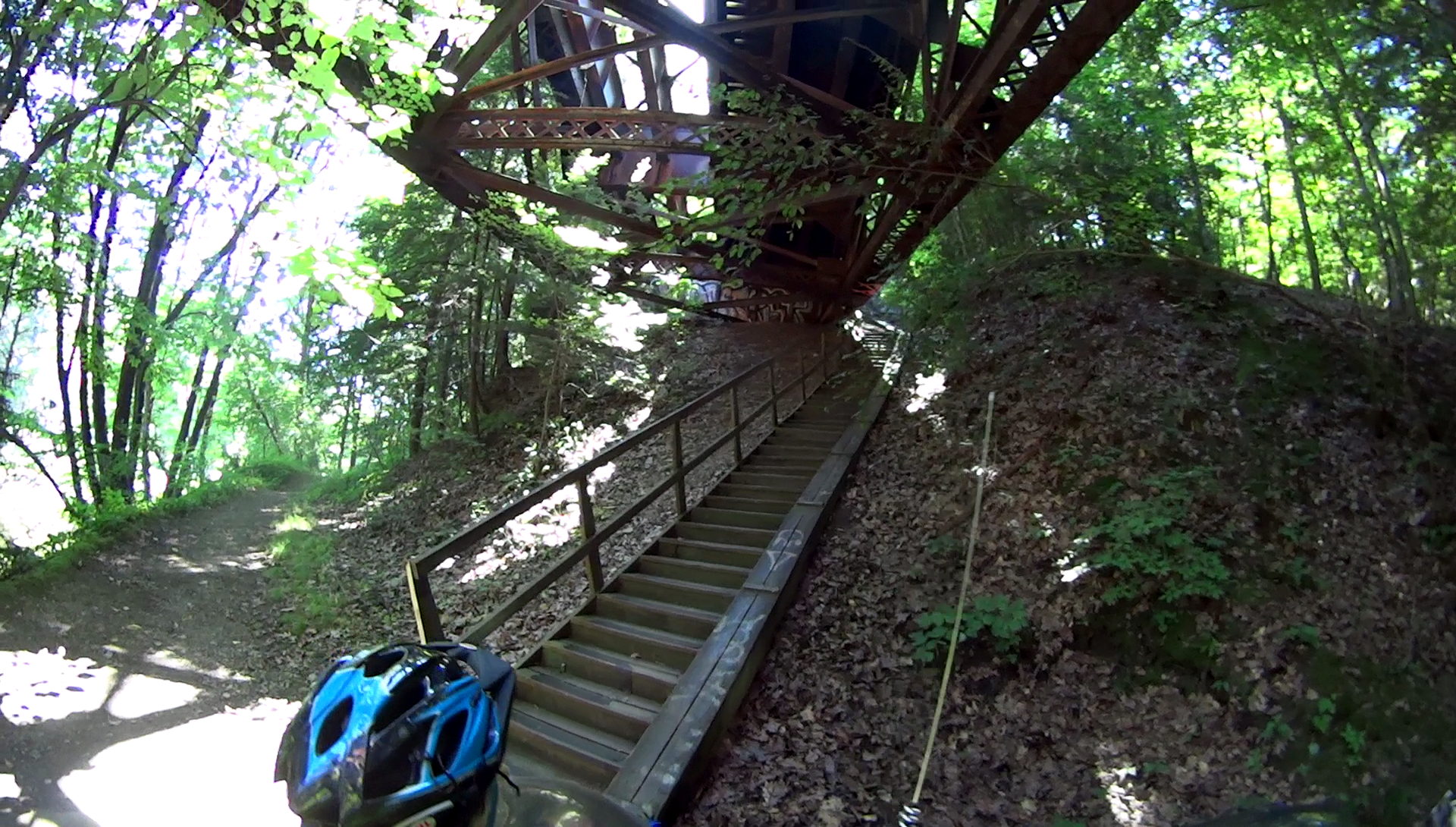
    Belmar Bridge Stairs - Overview
    Belmar Bridge Stairs – Overview

    We’re maneuvering Mary’s bike, but you get the general idea. Our bikes aren’t built for stairways, particularly ones with low overheads:
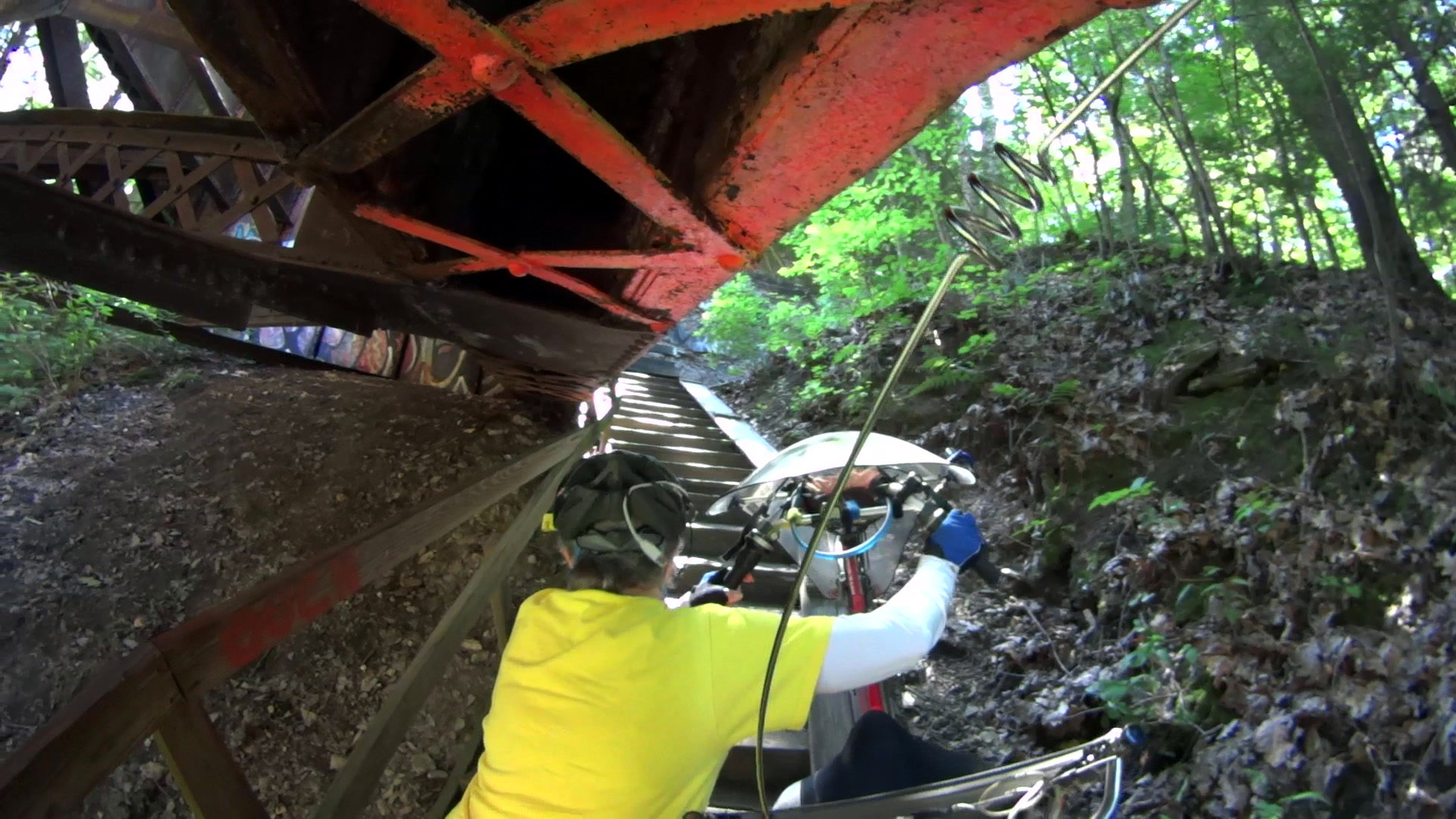
    Belmar Bridge Stairs - Low Overhead
    Belmar Bridge Stairs – Low Overhead

    The front fender clip on my Tour Easy snapped (at the expected spots) when the mudflap snagged on one of the angles:
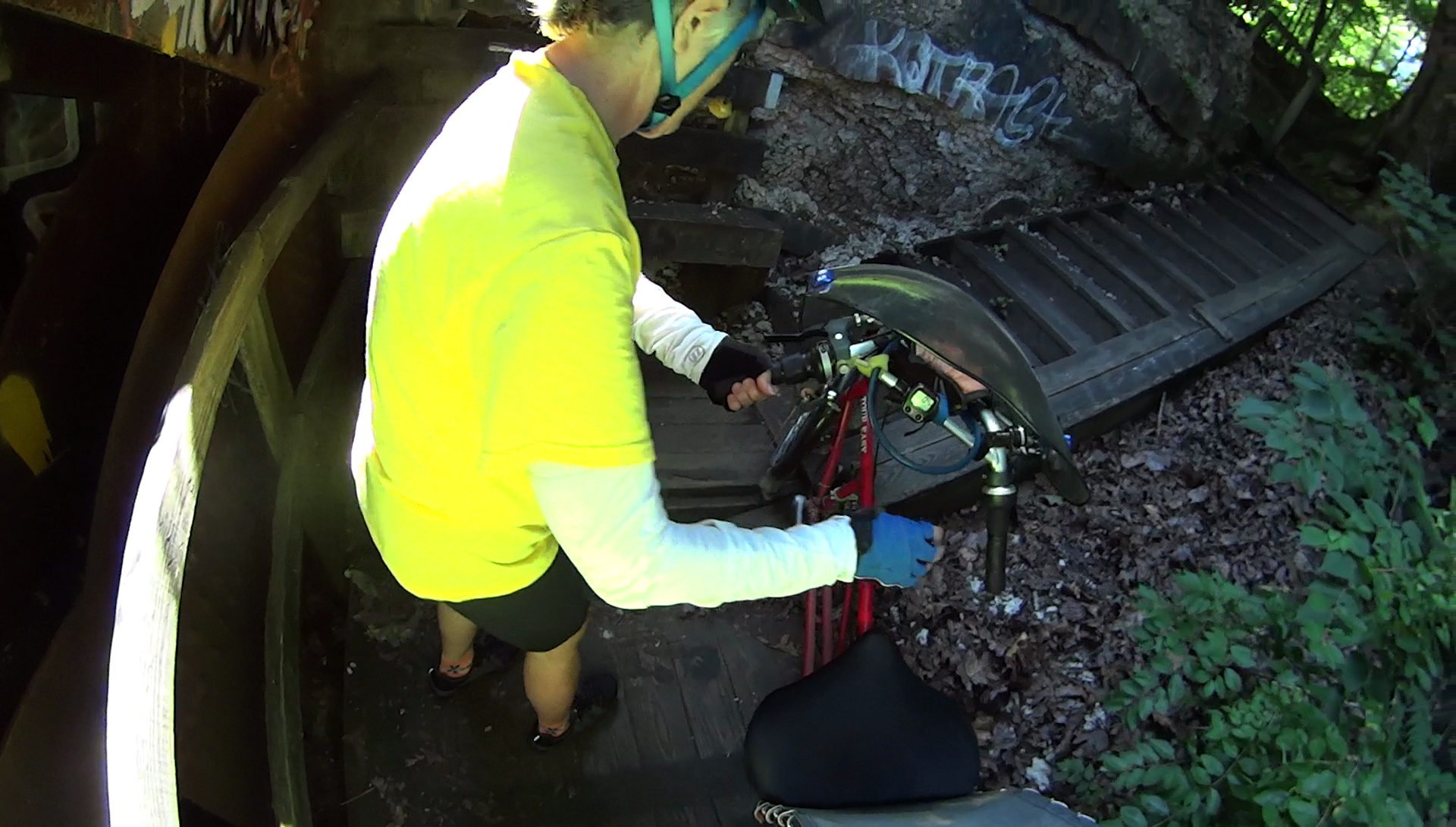
    Belmar Bridge Stairs - First Turn
    Belmar Bridge Stairs – First Turn

    For some inexplicable reason, I didn’t have a roll of duct tape in my packs, so the temporary repair required a strip of tape from a battery pack, two snippets of hook-and-loop tape, and considerable muttering:
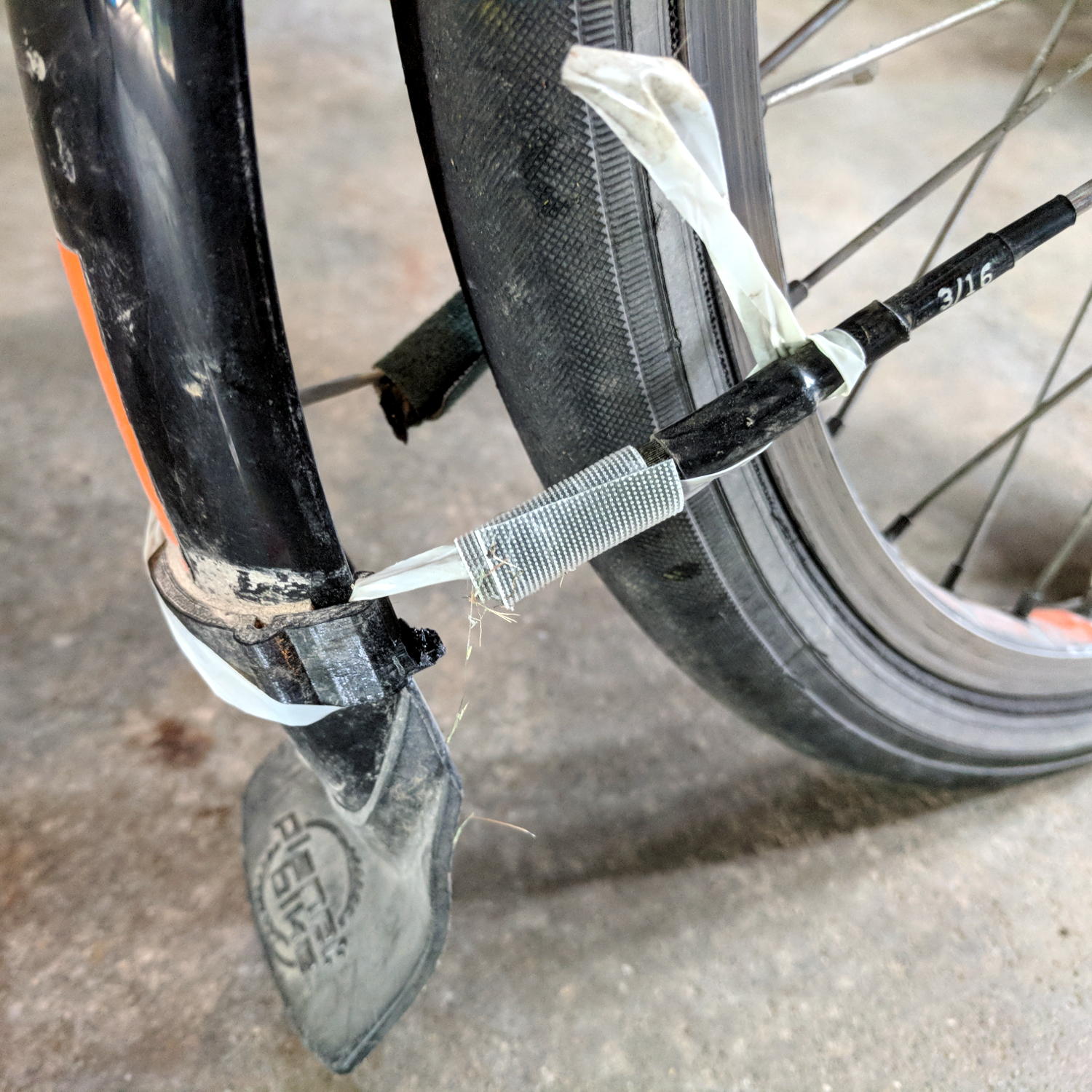
    Tour Easy front fender clip - expedient repair
    Tour Easy front fender clip – expedient repair

    It was good for two dozen more miles to the end of our vacation, so I’d say that was Good Enough.

    The new version has holes in the ferrules ten stay diameters deep, instead of six, which might eliminate the need for heatstink tubing. I added a small hole at the joint between the curved hooks and the ferrules to force more plastic into those spots:
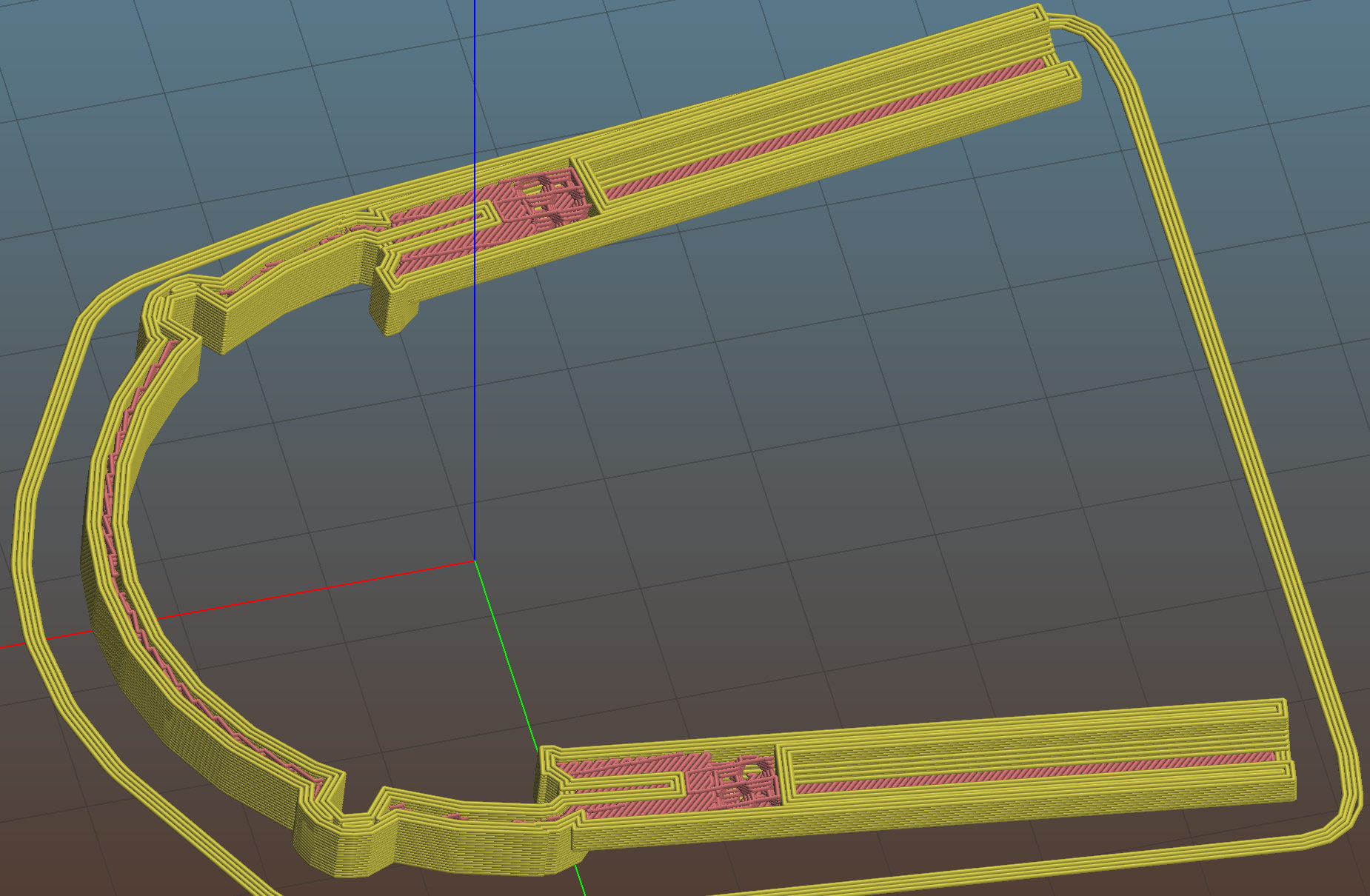
    Front Fender Clip - Slic3r
    Front Fender Clip – Slic3r

    I also bent the hanger extension to put the fender’s neutral position closer to the wheel.

    We’ll see how long this one lasts. By now, I now have black double-sticky foam tape!

    The OpenSCAD source code as a GitHub Gist:

    // Tour Easy front fender clip
    // Ed Nisley KE4ZNU July 2017
    Layout = "Build"; // Build Profile Ferrule Clip
    //- Extrusion parameters must match reality!
    ThreadThick = 0.25;
    ThreadWidth = 0.40;
    HoleWindage = 0.2;
    Protrusion = 0.1; // make holes end cleanly
    inch = 25.4;
    function IntegerMultiple(Size,Unit) = Unit * ceil(Size / Unit);
    //———————-
    // Dimensions
    // special case: fender is exactly half a circle!
    FenderC = 51.0; // fender outside width = chord
    FenderM = 21.0; // height of chord
    FenderR = (pow(FenderM,2) + pow(FenderC,2)/4) / (2 * FenderM); // radius
    echo(str("Fender radius: ", FenderR));
    FenderD = 2*FenderR;
    FenderA = 2 * asin(FenderC / (2*FenderR));
    echo(str(" … Arc: ",FenderA," deg"));
    FenderThick = 2.5; // fender thickness, assume dia of edge
    ClipHeight = 15.0; // top to bottom, ignoring rakish tilt
    ClipThick = IntegerMultiple(2.5,ThreadWidth); // thickness of clip around fender
    ClipD = FenderD; // ID of clip against fender
    ClipSides = 4 * 8; // polygon sides around clip circle
    BendReliefD = 2.5; // bend arch diameter
    BendReliefA = 2/3 * FenderA/2; // … angle from dead ahead
    BendReliefCut = 1.5; // factor to thin outside of bend
    ID = 0;
    OD = 1;
    LENGTH = 2;
    StayDia = 3.3; // fender stay rod diameter
    StayOffset = 15.0; // stay-to-fender distance
    StayPitch = -5; // angle from stay to fender arch
    DropoutSpace = 120; // stay spacing at wheel hub
    StayLength = 235; // stay length: hub to fender
    StaySplay = asin((DropoutSpace – FenderC)/(2*StayLength)); // outward angle to hub
    echo(str(" … Pitch: ",StayPitch," deg"));
    echo(str(" … Splay: ",StaySplay," deg"));
    FerruleSides = 2*4;
    Ferrule = [StayDia,3*FenderThick/cos(180/FerruleSides),10*StayDia + StayOffset]; // ID = stay rod OD
    FerruleHoleD = 0.1; // small hole to create solid plastic at ferrule joint
    //———————-
    // Useful routines
    module PolyCyl(Dia,Height,ForceSides=0) { // based on nophead's polyholes
    Sides = (ForceSides != 0) ? ForceSides : (ceil(Dia) + 2);
    FixDia = Dia / cos(180/Sides);
    cylinder(r=(FixDia + HoleWindage)/2,
    h=Height,
    $fn=Sides);
    }
    //———————-
    // Clip profile around fender
    // Centered on fender arc
    module Profile(HeightScale = 1) {
    linear_extrude(height=HeightScale*ClipHeight,convexity=5) {
    difference() {
    offset(r=ClipThick) // outside of clip
    union() {
    circle(d=ClipD,$fn=ClipSides);
    for (i=[-1,1])
    rotate(i*BendReliefA) {
    translate([ClipD/2 + BendReliefD/2,0,0])
    circle(d=BendReliefD,$fn=6);
    }
    }
    union() { // inside of clip
    circle(d=ClipD,$fn=ClipSides);
    for (i=[-1,1])
    rotate(i*BendReliefA) {
    translate([ClipD/2 + BendReliefCut*BendReliefD/2,0,0])
    circle(d=BendReliefD/cos(180/6),$fn=6);
    translate([ClipD/2,0,0])
    square([BendReliefCut*BendReliefD,BendReliefD],center=true);
    }
    }
    translate([(FenderR – FenderM – FenderD/2),0]) // trim ends
    square([FenderD,2*FenderD],center=true);
    }
    for (a=[-1,1]) // hooks around fender
    rotate(a*(FenderA/2))
    translate([FenderR – FenderThick/2,0]) {
    difference() {
    rotate(1*180/12)
    circle(d=FenderThick + 2*ClipThick,$fn=12);
    rotate(1*180/8)
    circle(d=FenderThick,$fn=8);
    rotate(a * -90)
    translate([0,-2*FenderThick,0])
    square(4*FenderThick,center=false);
    }
    }
    }
    }
    //———————-
    // Ferrule body
    module FerruleBody() {
    translate([0,0,Ferrule[OD]/2 * cos(180/FerruleSides)])
    rotate([0,-90,0]) rotate(180/FerruleSides)
    difference() {
    cylinder(d=Ferrule[OD],h=Ferrule[LENGTH],$fn=FerruleSides,center=false);
    translate([0,0,StayOffset + Protrusion])
    PolyCyl(Ferrule[ID],Ferrule[LENGTH] – StayOffset + Protrusion,FerruleSides);
    }
    }
    //———————-
    // Generate entire clip at mounting angle
    module FenderClip() {
    difference() {
    union() {
    translate([FenderR,0,0])
    difference() { // angle and trim clip
    rotate([0,StayPitch,0])
    translate([-(FenderR + ClipThick),0,0])
    Profile(2); // scale upward for trimming
    translate([0,0,-ClipHeight]) // trim bottom
    cube(2*[FenderD,FenderD,ClipHeight],center=true);
    translate([0,0,ClipHeight*cos(StayPitch)+ClipHeight]) // trim top
    cube(2*[FenderD,FenderD,ClipHeight],center=true);
    }
    for (j = [-1,1]) // place ferrules
    translate([Ferrule[OD]*sin(StayPitch) + (Ferrule[OD]/2)*sin(StaySplay),j*(FenderR – FenderThick/2),0])
    rotate(-j*StaySplay)
    FerruleBody();
    }
    for (i=[-1,1]) // punch stiffening holes
    translate([FenderThick/2,-i*(FenderR – FenderThick/2),Ferrule[OD]/2])
    rotate([0,-90,i*StaySplay])
    PolyCyl(FerruleHoleD,Ferrule[OD],FerruleSides);
    }
    }
    //———————-
    // Build it
    if (Layout == "Profile") {
    Profile();
    }
    if (Layout == "Ferrule") {
    FerruleBody();
    }
    if (Layout == "Clip") {
    FenderClip();
    }
    if (Layout == "Build") {
    FenderClip();
    }

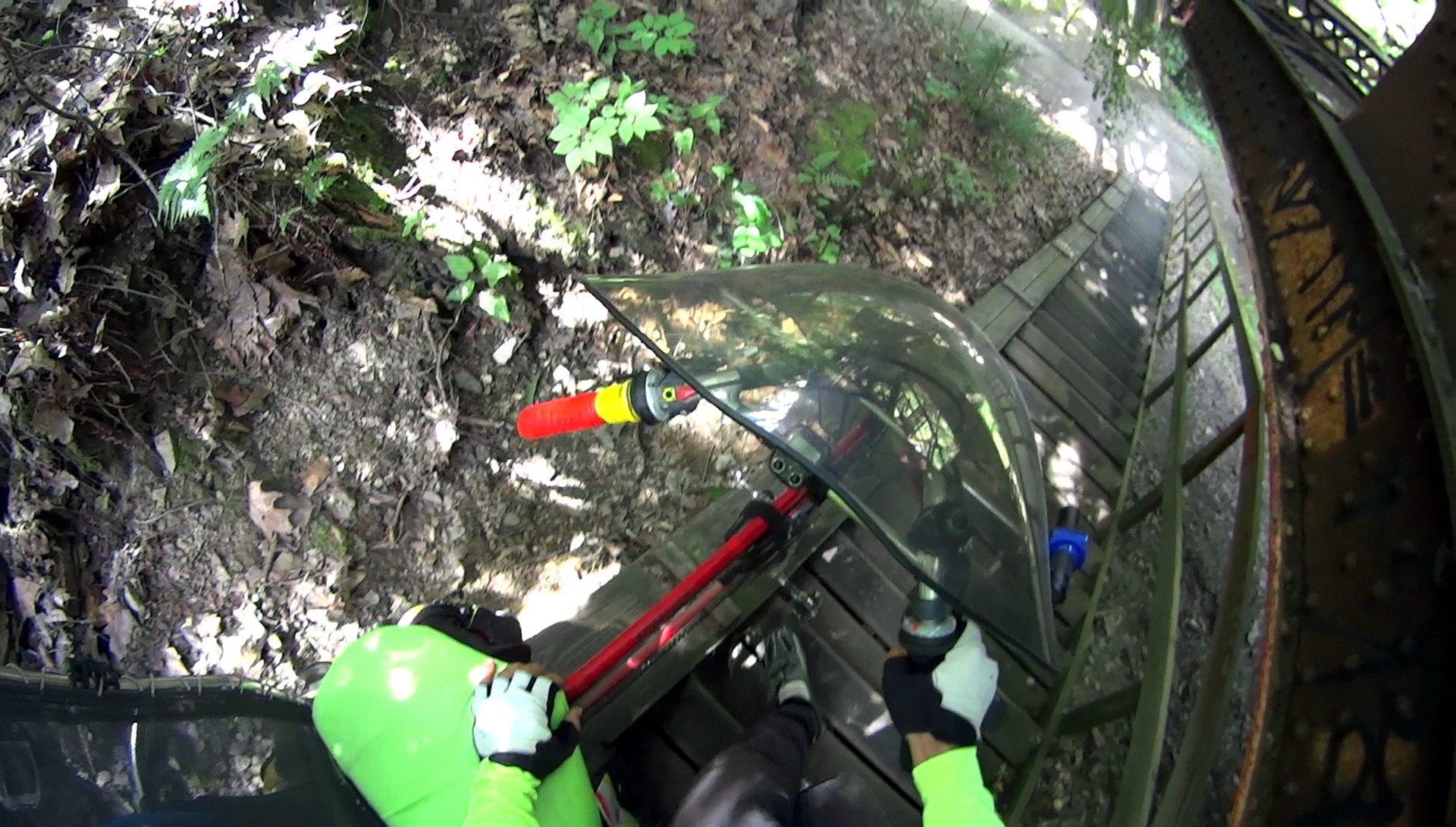
    As a bonus for paging all the way to the end, here’s the descent on the same stairway:
    Belmar Bridge Stairs - Descent
    Belmar Bridge Stairs – Descent

    No, I wasn’t even tempted …
  • Tek A6302 Current Probe: Offset Resistor Tweakage

    A package deal of two Tektronix A6302 current probes arrived from eBay, with one probe having a small crack across its case (shown in the description and bought accordingly).

    The other probe worked fine and was quite clean inside:

    A6302 B055461 - major sections
    A6302 B055461 – major sections

    The cracked one couldn’t be balanced, with the twiddlepot on the AM503 amp unable to bring the signal down to 0 V from a positive offset on any of the ranges.

    The current transformer might have suffered some stress on the upper-left corner of the main part (in the probe body), but it doesn’t have any obvious damage:

    A6302 B032444 - ball - current transformer in place
    A6302 B032444 – ball – current transformer in place

    The small ball to the left of the transfomer lid provides the slide detent; it’s an ordinary 3/32 = 0.094 inch bearing. Which, as it happens, is a Good Thing, because there’s another one exactly like it somewhere in the litter under the Electronics Workbench.

    Protip: follow the disassembly procedure in the instruction manual and do it over a towel or, at least, a shallow dish. You have been warned.

    Extracting the transformer from the body revealed a numeric value I didn’t recognize at the time:

    A6302 B032444 - current transformer
    A6302 B032444 – current transformer

    The top slide contacts looked awful, but they’re actually covered in semi-dried contact grease and cleaned up easily:

    A6302 B032444 - slide contacts
    A6302 B032444 – slide contacts

    Swapping the “bad” transformer into the P6302 probe I got a while ago showed it wouldn’t balance, either, but the offset was far off into negative voltages. Putting the “good” transformer into the “bad” probe produced a similar too-positive offset. Conclusion: the transformer was probably good and Something Else was wrong.

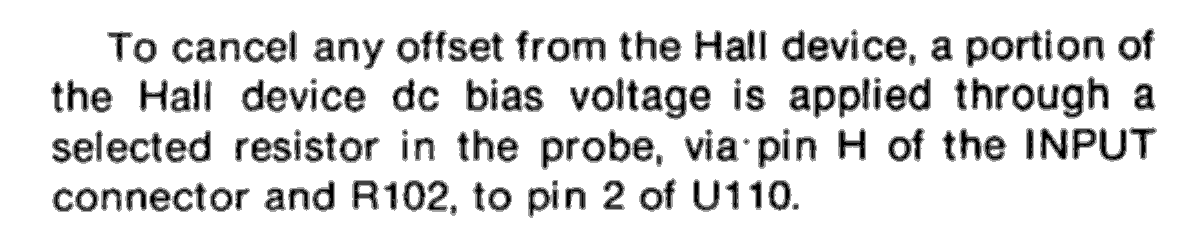
    Spending more time with the manuals produced this hint in the AM503 Amplifier circuit description:

    AM503 manual - Hall offset - probe resistor selection
    AM503 manual – Hall offset – probe resistor selection

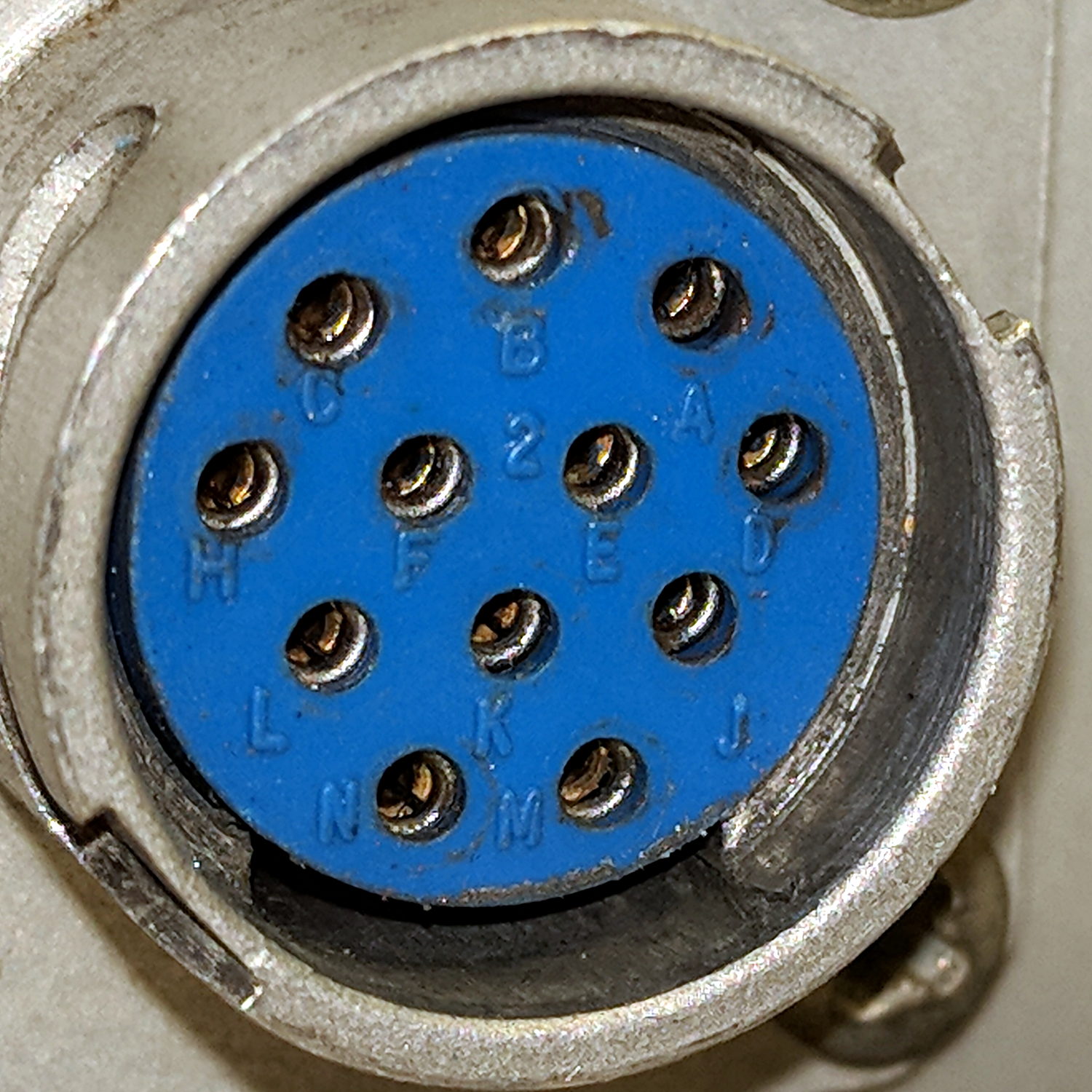
    Fortunately, the AM503 probe connector has pin labels:

    Tek AM503 Amplifier - Probe Connector - pin ID
    Tek AM503 Amplifier – Probe Connector – pin ID

    Note the absence of pins G and I, probably to eliminate any confusion with “ground” and “one”, respectively.

    Continuity checking reveals the left end of the 34.8 kΩ resistor connects to pin H:

    A6302 B032444 - PCB 34.8k offset R
    A6302 B032444 – PCB 34.8k offset R

    Huh. Even a blind pig occasionally finds a truffle: where have we seen that value before? Apparently Tek measured each transformer / Hall sensor and wrote the appropriate offset resistor value exactly where it’d do the most good.

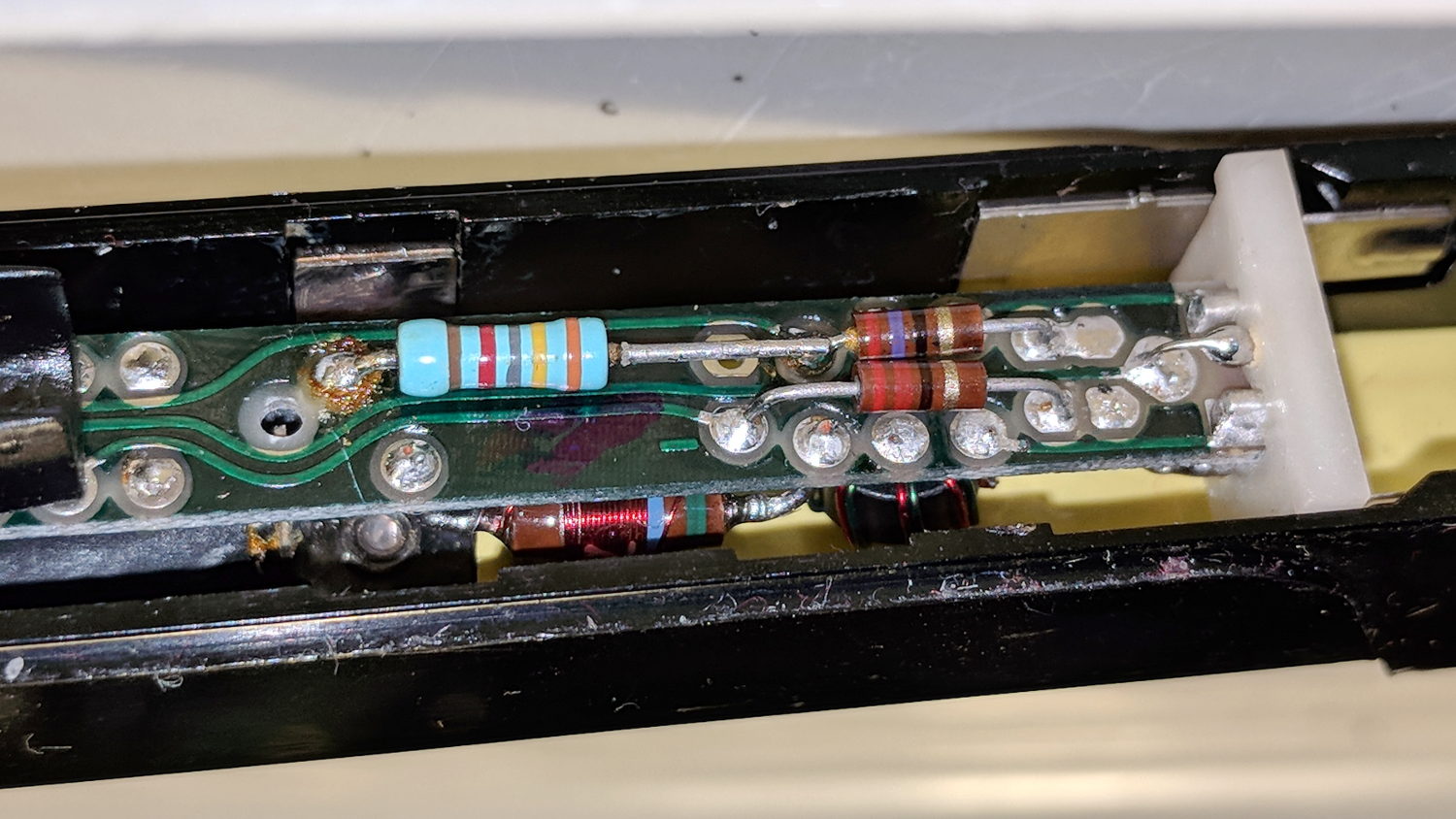
    Although I don’t pretend to know why the transformer offset has changed, if Tek can select a resistor to correct the offset, so can I:

    A6302 B032444 - PCB - tweaked 82k offset R
    A6302 B032444 – PCB – tweaked 82k offset R

    The 82 kΩ value roughly centers the offset twiddlepot span around 0 V; it’s the result of a binary search through the resistor drawers, rather than a complex calculation.

    With the resistor in place and the probe reassembled in reverse order, everything works the way it should:

    Tek A6302 - 82k ohm offset - 50 mA
    Tek A6302 – 82k ohm offset – 50 mA

    The lower trace is a square wave from the scope’s arb waveform generator into a (likely counterfeit) Fotek DC-DC solid-state relay, with the bench supply dialed to 5.7 V to put 5 V across a hulking 100 Ω power resistor, thus 50 mA through the probe. The purple trace comes from the repaired probe, with the other one turned off for pedagogic purposes:

    Tek A6302 Calibration Setup
    Tek A6302 Calibration Setup

    That wasn’t easy, but seems to solve the problem.

    Dang, I loves me some good Tek current probe action …


  • Rt 376 at Red Oaks Mill: Re-repaving

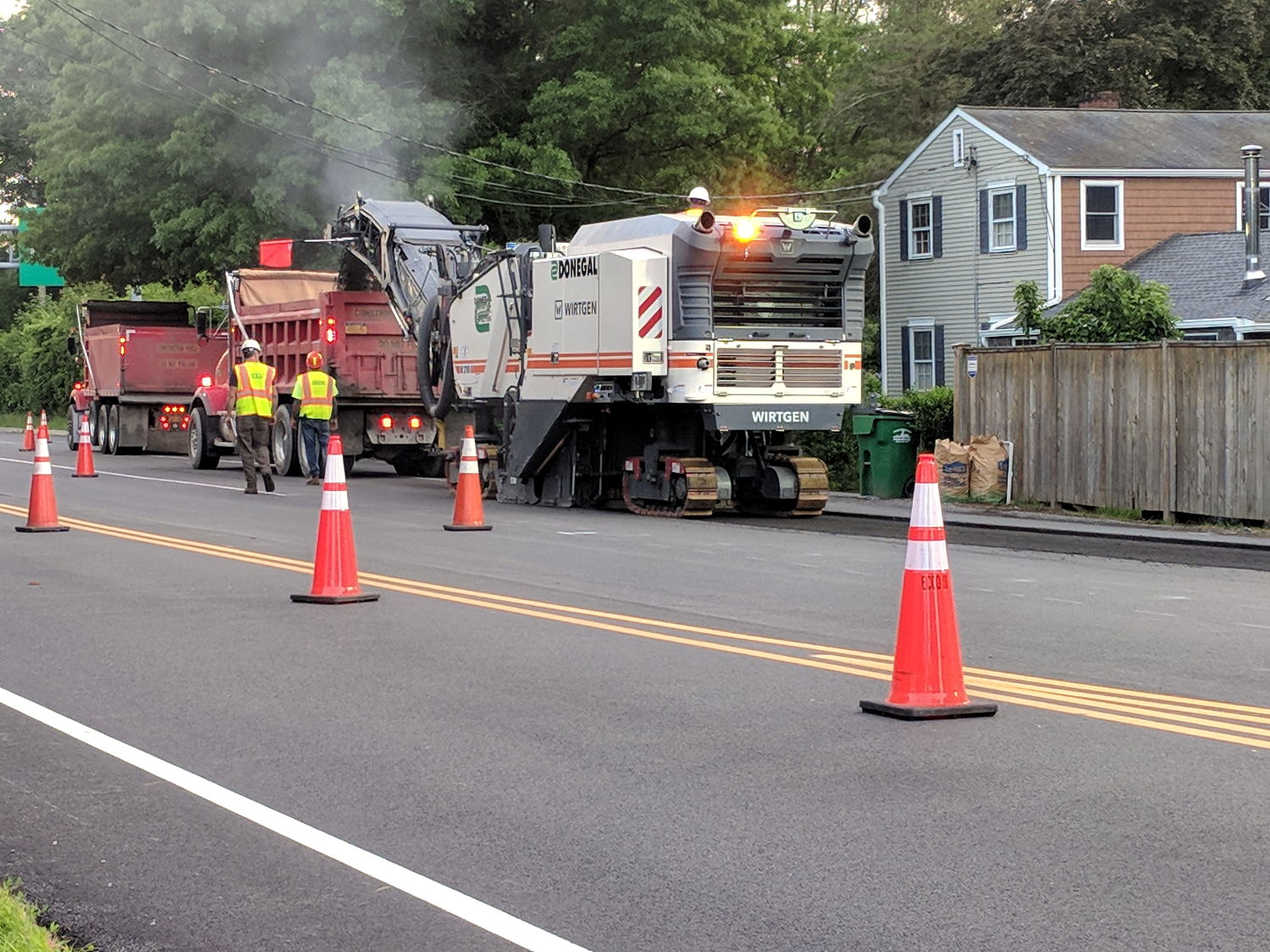
    For unknown reasons, NYS DOT milled away some of the newly laid asphalt north of Red Oaks Mill:

    Rt 376 Red Oaks Mill - New Pavement Milling
    Rt 376 Red Oaks Mill – New Pavement Milling

    Then laid it down again:

    Rt 376 Red Oaks Mill - New Pavement - 2018-06-14
    Rt 376 Red Oaks Mill – New Pavement – 2018-06-14

    As far as we can tell, there’s absolutely no difference, other than the opportunity for a huge longitudinal crack between the shoulder and the travel lane.

    My guess: the contractor shorted them an inch of asphalt, got caught, and had to do it over again.

    It’s only NYS Bike Route 9, so you can’t expect much in the way of bicycle-friendly design or build quality.

  • Tour Easy Rack: Front Mount Screw

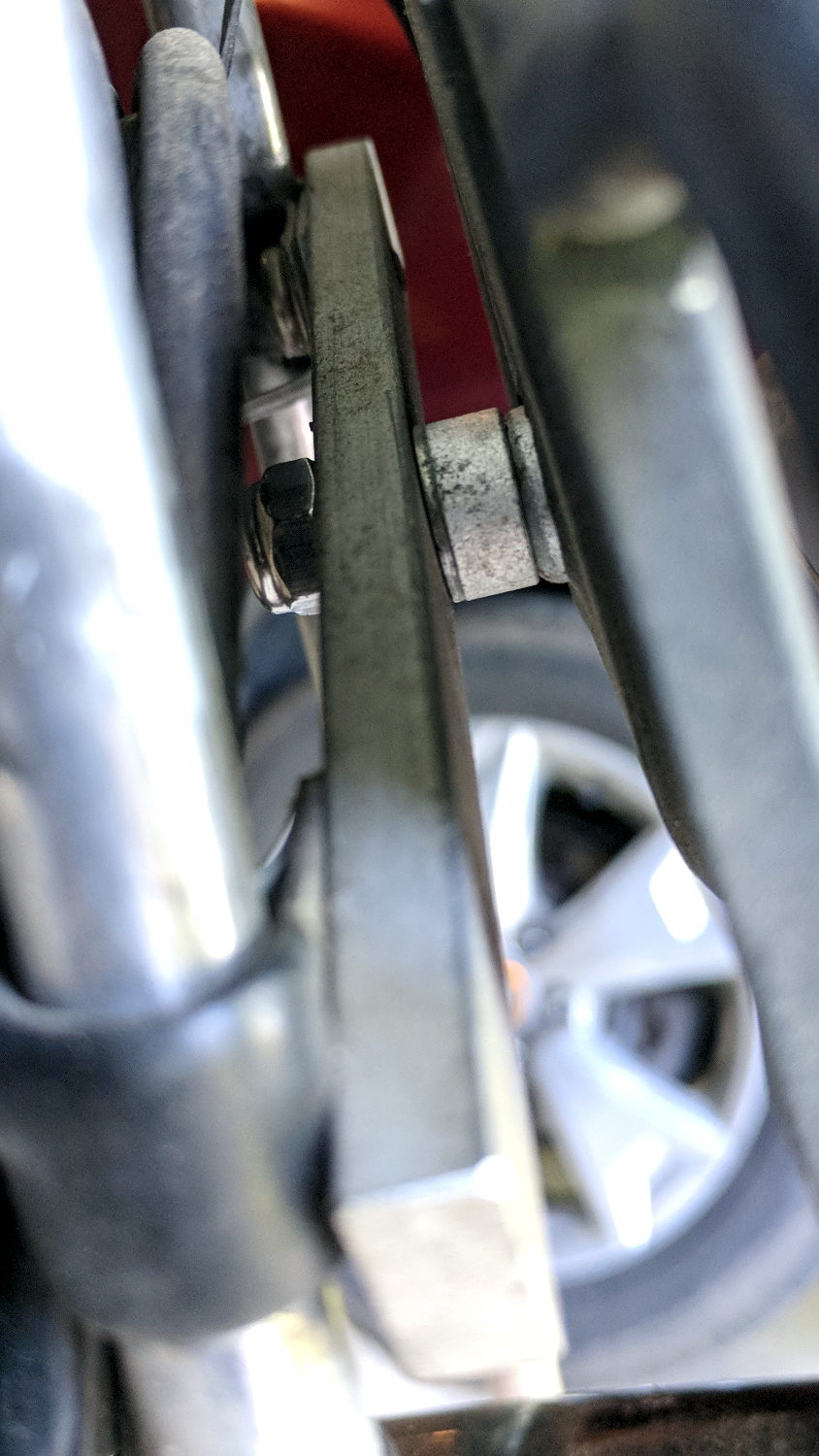
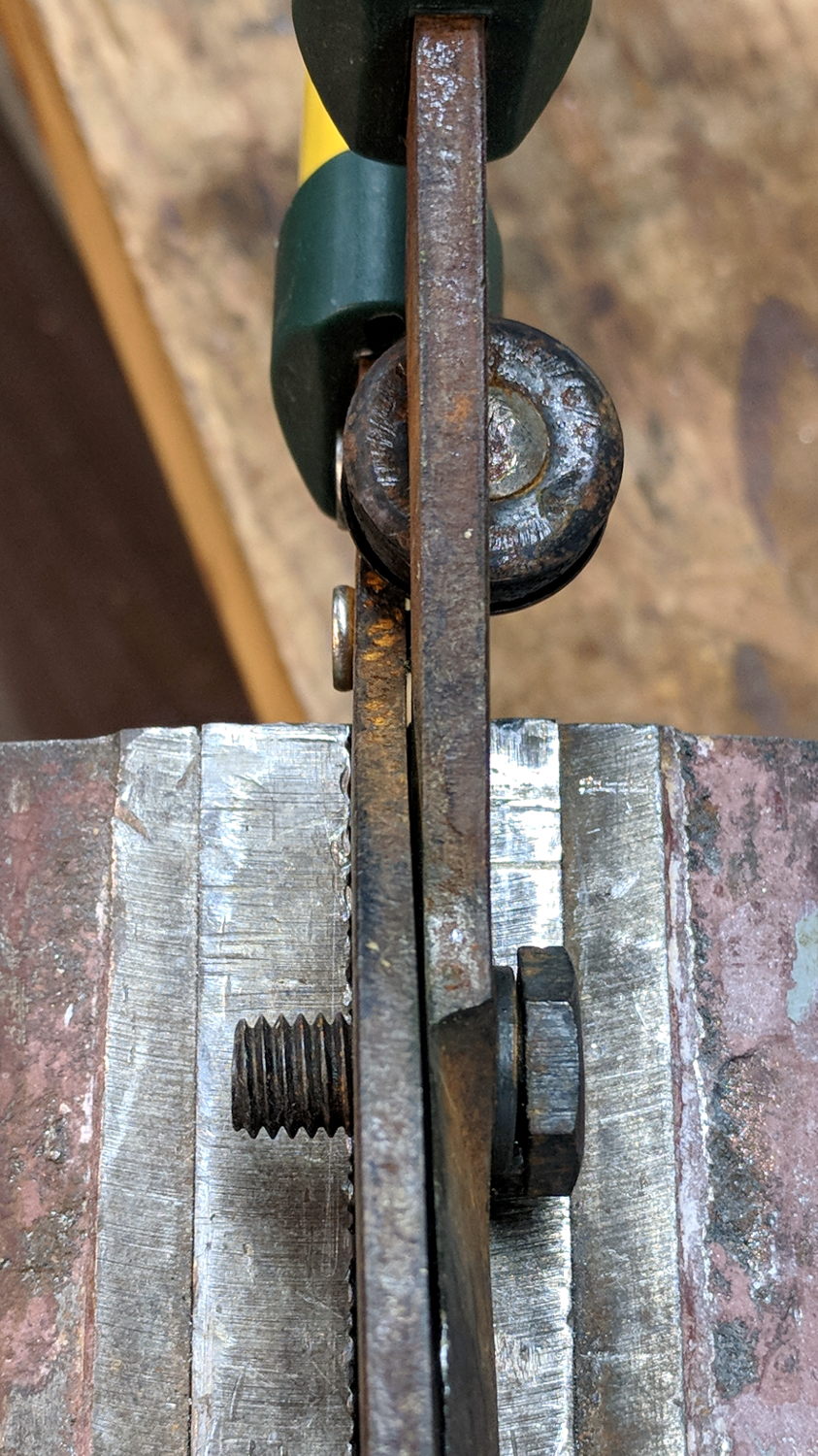
    Long ago, I conjured a front rack mount from an aluminum bar across the seat struts on our Tour Easy recumbents, with a spherical washer soaking up the angular misalignment. The rack on Mary’s bike developed a serious wobble due to a missing screw, which was easy enough to replace:

    Rack mount screw - rear
    Rack mount screw – rear

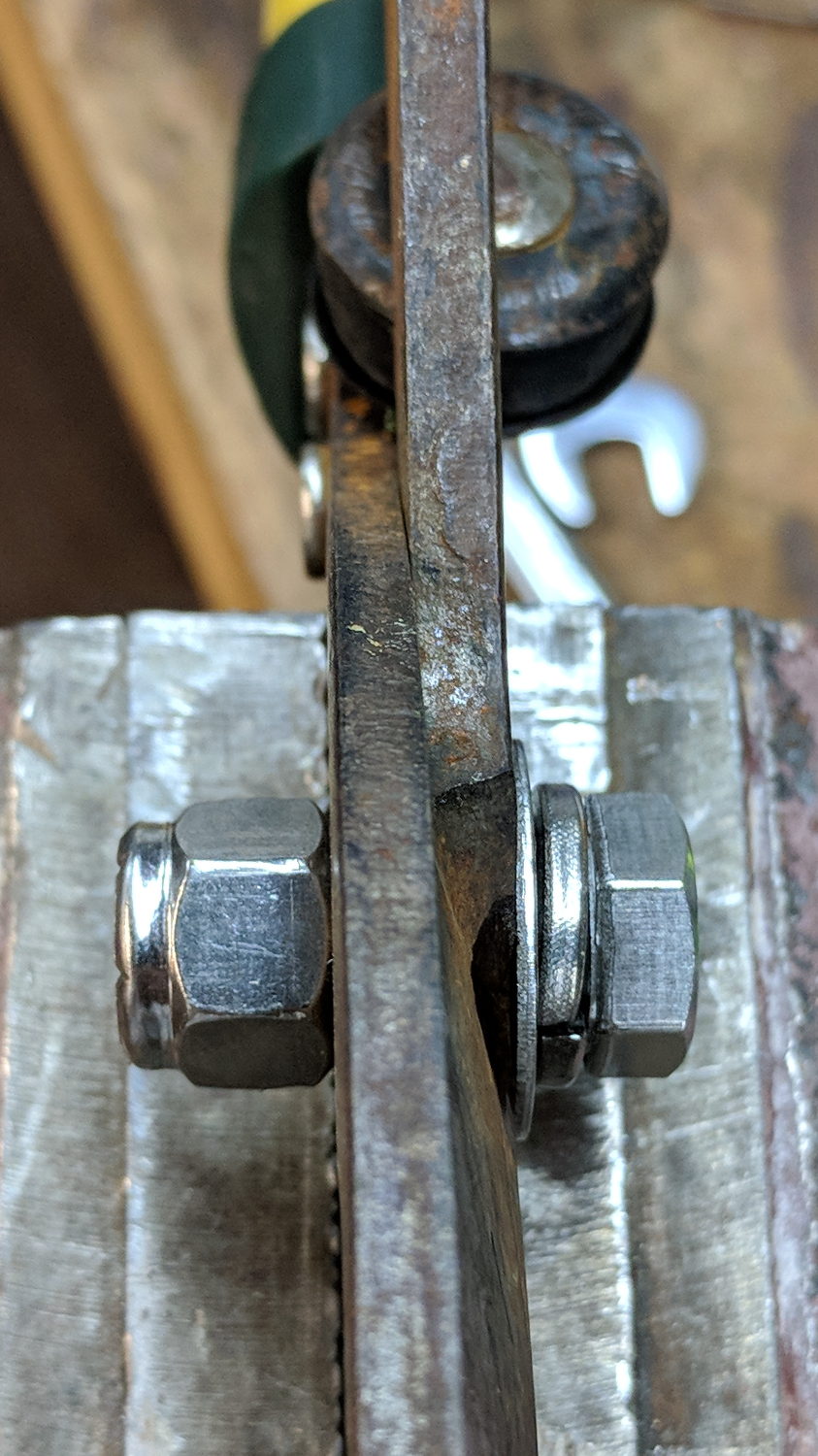
    From the side:

    Rack mount screw - side
    Rack mount screw – side

    It’s a 2 inch screw sawed down to 1.5 inch, ground to shape, then run through a die to clean up the threads.

    The nylon lock nut over on the left should keep the screw from working its way out of the tapped aluminum bar. On the other paw, a dab of Loctite survived nearly a decade of heavy loads and vibration.

  • Bypass Lopper

    Some surreptitious brush clearing called for a tool larger than our wonderful Fiskars PowerGear pruner, so I unearthed a long-disused bypass lopper in the garage (it may have Come With The House). Alas, the pivot bolt lost its jam nut long ago:

    Bypass loppers - OEM 10 mm bolt
    Bypass loppers – OEM 10 mm bolt

    That’s an M10x1.5 bolt, for which I lack a corresponding nut.

    But 3/8-16 is approximately M10x1.5, for small values of thread engagement, and I do have an assortment of inch-sized stainless steel fasteners:

    Bypass loppers - 0.375 inch bolt
    Bypass loppers – 0.375 inch bolt

    The nylon lock nut jams the bolt against the left blade, with the split washer applying pressure to the tapered blade. Slobbering oil in the sliding joints restored it to perfect working order.

    The weird round dingus on the far side of the pivot, up against the handles, is a bumper cushioning the fully closed position. It’s a nice touch and might work better if its rubber pad hadn’t aged out over the decades spent in the garage waiting for this very day.

    It’s my kind of yard work: “What do you need killed next?”

  • Bike Brake Pad Wear

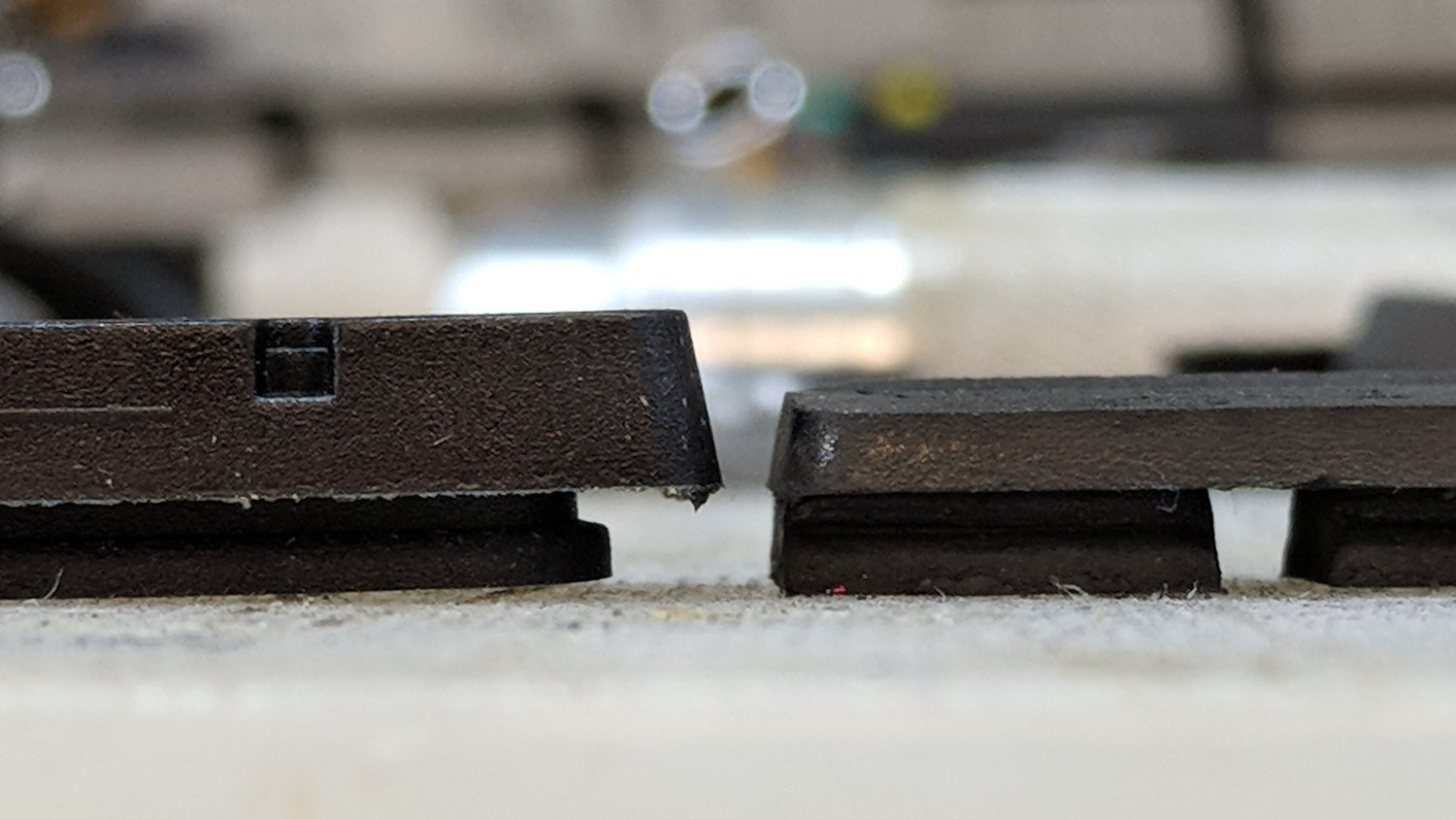
    The rear brake on my bike wasn’t stopping nearly as well as it should, even after cleaning the rim and pads with brake cleaner, so I pulled the shoes and replaced the pads:

    Bike brake pad wear
    Bike brake pad wear

    It’s down a bit beyond the --WEAR--LINE-- indicator, of course.

    New brake shoes on clean rims work exactly like they should!

  • Xubuntu 18.04 vs. VNC

    For unknown reasons, the Gnome-ish vino-server package for Xubuntu 18.04 no longer installs vino-preferences, so it’s not obvious how to configure the server.

    After considerable flailing, I installed good old x11vnc, set up a password, then started it in .xprofile:

    x11vnc -forever -find -no6 -avahi -usepw
    

    I don’t mind having programs change, but it’d be nice if features like, say, configuration wouldn’t just vanish.