The Smell of Molten Projects in the Morning

Ed Nisley's Blog: Shop notes, electronics, firmware, machinery, 3D printing, laser cuttery, and curiosities. Contents: 100% human thinking, 0% AI slop.

Tag: Repairs

If it used to work, it can work again

  • Wood Board Cheese Slicer Rebolting

    Long ago, a wood-base countertop cheese slicer arrived with a tenuous connection between its screw-on knob / handle and the bolt securing the cutting wire. The problem seemed to be boogered bolt threads:

    Cheese slicer - original bolt
    Cheese slicer – original bolt

    The knob screwed firmly onto a known-good 10-24 screw, not the M5 bolt I expected, so the slicer may be old enough to be Made In America. Ya never know around here.

    However, the hex head is essential, because you must hold it while tightening the nut capturing the slicing wire. Not having a 10-24 or even 10-32 bolt in hand, I went full-frontal metric with an M5 bolt.

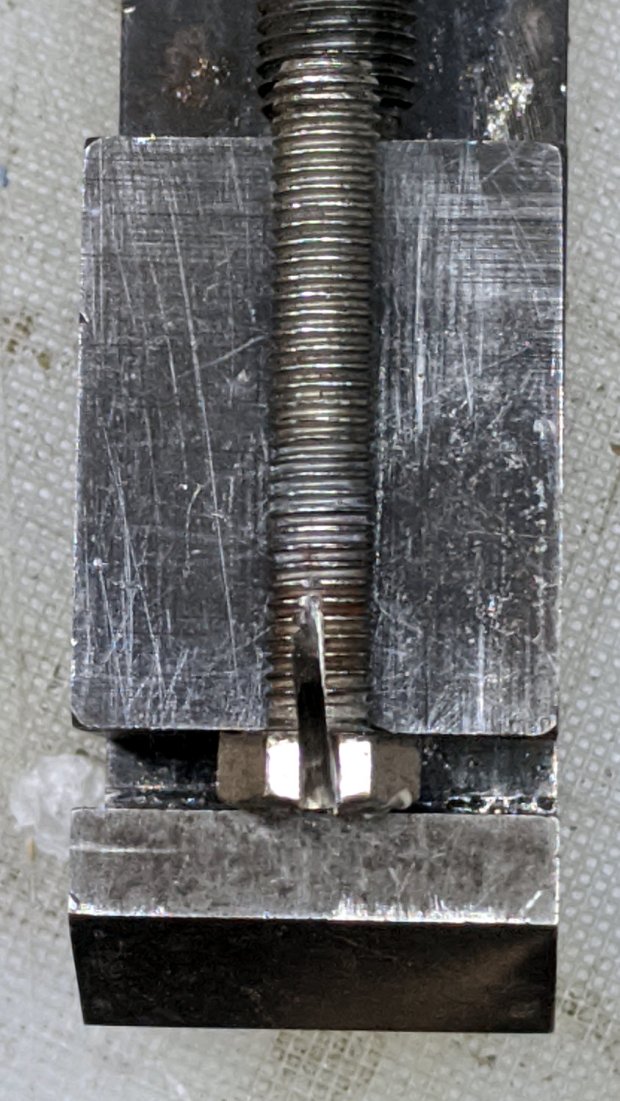
    Even with a full face shield, I don’t like standing in the plane of an abrasive cutting tool, even a piddly Dremel disk, so the slot through the head isn’t the best work I’ve ever presented:
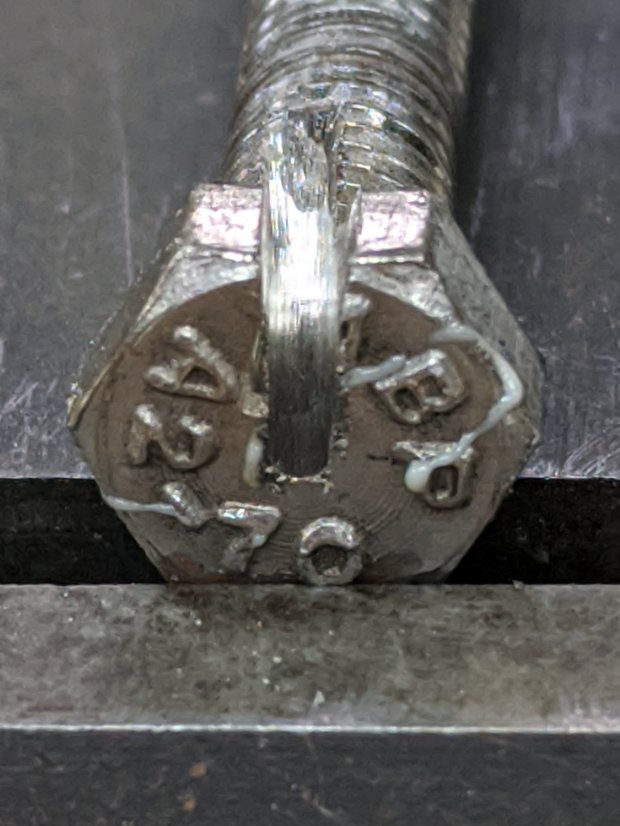
    Cheese slicer - slotted bolt head
    Cheese slicer – slotted bolt head

    Indeed:

    Cheese slicer - skewed slot
    Cheese slicer – skewed slot

    But it’s hereby defined to be Good Enough™ for the purpose.

    As you might expect, I ran an M5×0.8 tap into the existing 10-24 knob thread, hand-turning the lathe chuck and lining up the tap wrench with the tailstock.

    Drill out the slicer’s frame hole to clear the bolt, re-string wire through slot, tighten jam nut, add a locking nut on the other side, screw on the knob, and it’s All Good:

    Cheese slicer - repaired
    Cheese slicer – repaired

    Ugly, but good.

    I expect the re-wrapped wire will break in short order, because you just can’t re-bend steel wire with impunity. So far, so good.
  • Always Bring Duct Tape

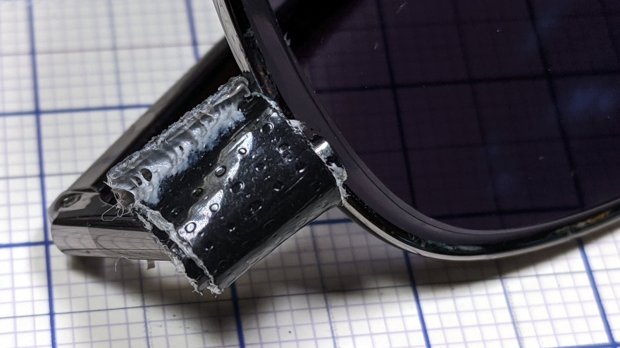
    My pre-trip checklist now includes “Duct Tape”, so, when the tiny screw holding my sunglasses together went spung and dropped the lens on the parking lot gravel, I was prepared:

    Sunglasses - duct tape FTW
    Sunglasses – duct tape FTW

    I continued the mission in full-frontal Harry Potter mode.

    Fortunately, it’s a captive screw and returned home with us. Back in the Basement Laboratory, with a Philips 00 screwdriver and threadlocker at hand, the repair was no big deal:

    Sunglasses - loose lens screw
    Sunglasses – loose lens screw

    You’re looking at the screw head, believe it or not.

    And, no, I’m not packing a Philips 00 screwdriver on our next trip.

  • Wasabi NP-BX1: End-of-Life

    As a followup to the DOT-01 battery status, I found the last of the Wasabi NP-BX1 batteries in a drawer where they’d sat unused for eight months.

    Recharge and test to get the blue lines, with the red lines from the DOT-01 batteries:

    Wasabi DOT-01 NP-BX1 - 2019-11
    Wasabi DOT-01 NP-BX1 – 2019-11

    The double blue line came from a second recharge of that battery, just to see if more electrons would help. Nope, it’s still dead.

    The Wasabi battery with the highest capacity also has the weirdly rippled voltage trace and, when I extracted it from the test holder, came out disturbingly warm and all swoll up. This is A Bad Sign™, so it spent the next few hours chillin’ on the patio and now resides in the recycle box.

  • Wireless Keypad Cap Swap

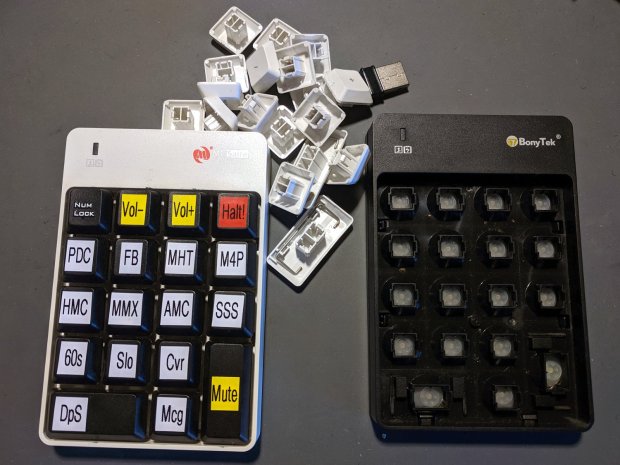
    One of the wireless numeric keypads I’ve been using with the streaming radio players developed some intermittent key switch failures resisting all the usual blandishments. Eventually it hard-failed, but I was unwilling to scrap the tediously printed keycap labels:

    Wireless keypads - swapped caps
    Wireless keypads – swapped caps

    Hard to believe, but I’ve been using the white keypad for plain old numeric entry with the keypad-less Kinesis Freestyle 2 keyboard.

    I swapped the Frankenpad + receiver to the least-conspicuous streamer and, someday, I’ll update all the labels on all the keypads to match the current streams. Until then, the white keycaps shall remain in the same bag as the defunct black keypad, tucked into the Big Box o’ USB mice & suchlike.

  • Crock Pot Base Screw

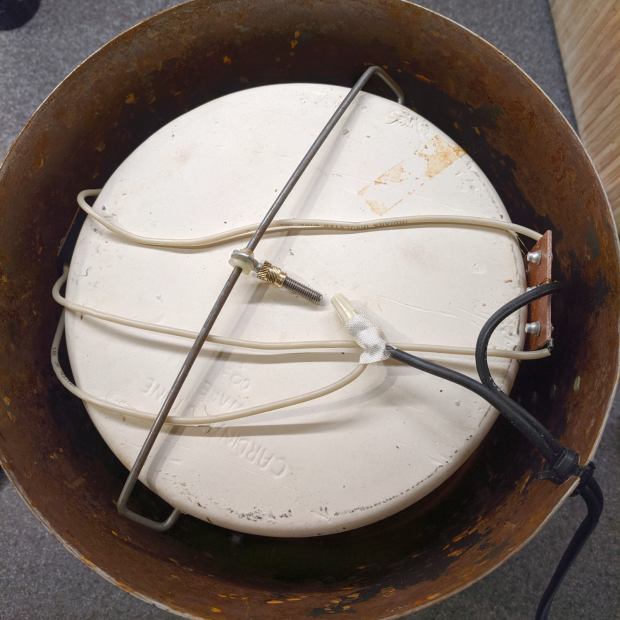
    While washing our ancient electric crock pot (“slow cooker”), I wondered how corroded the inside of the steel shell had become. A simple nut secured the base plate and unscrewed easily enough, whereupon what I thought was a stud vanished inside the shell.

    The shell wasn’t rusty enough to worry about, but the stud turned out to be a crudely chopped-off thumbscrew on a springy rod pulling the base toward the ceramic pot:

    Crock Pot Base - OEM thumbscrew
    Crock Pot Base – OEM thumbscrew

    Evidently, they pulled the thumbscrew through the base, tightened the nut, then cut off the thumbscrew flush with the nut.

    I desperately wanted to drill a hole in a new thumbscrew and repeat the process, but I no longer have a small drawer full of assorted thumbscrews. So I must either lengthen the existing thread just enough to complete the mission or build a screw from scratch.

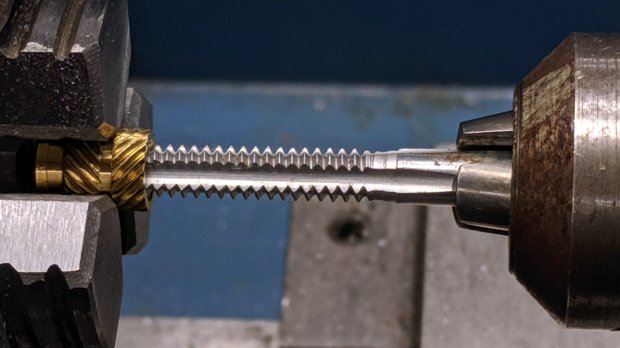
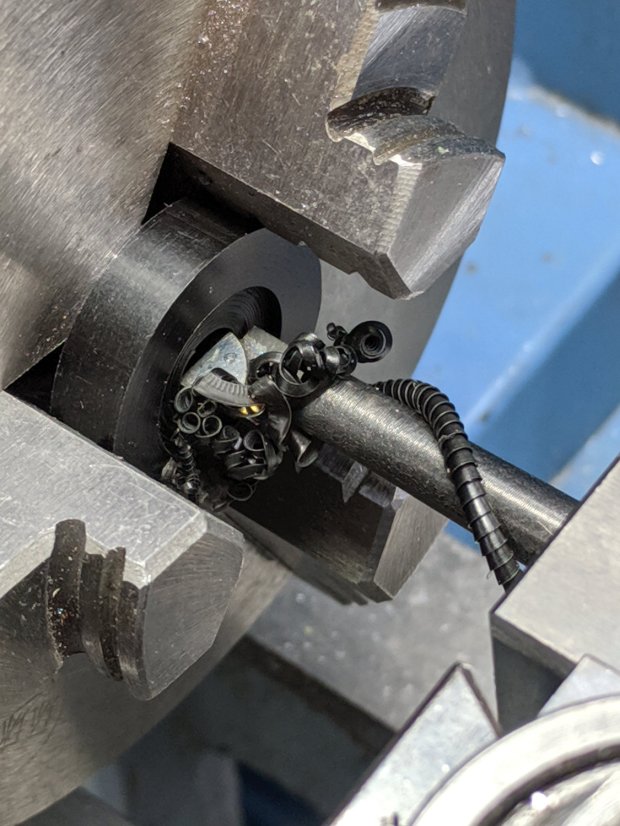
    The thumbscrew is threaded 10-24, I have a bunch of 10-32 threaded inserts, so pretend they have the same thread diameter and tap one end to 10-24:

    Crock Pot Base - tapping insert
    Crock Pot Base – tapping insert

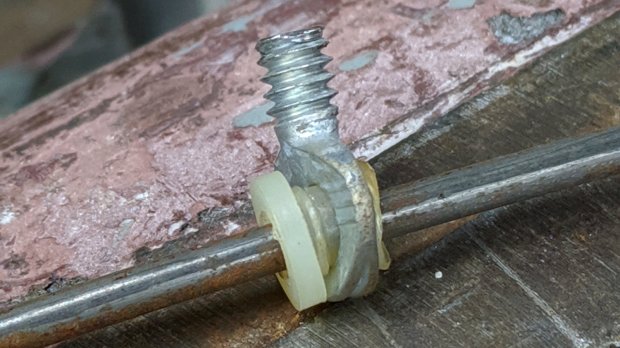
    Jam the new threads on the thumbscrew and jam a 10-32 setscrew into the un-wrecked end:

    Crock Pot Base - thumbscrew extender
    Crock Pot Base – thumbscrew extender

    You can see the surface rust in there, right?

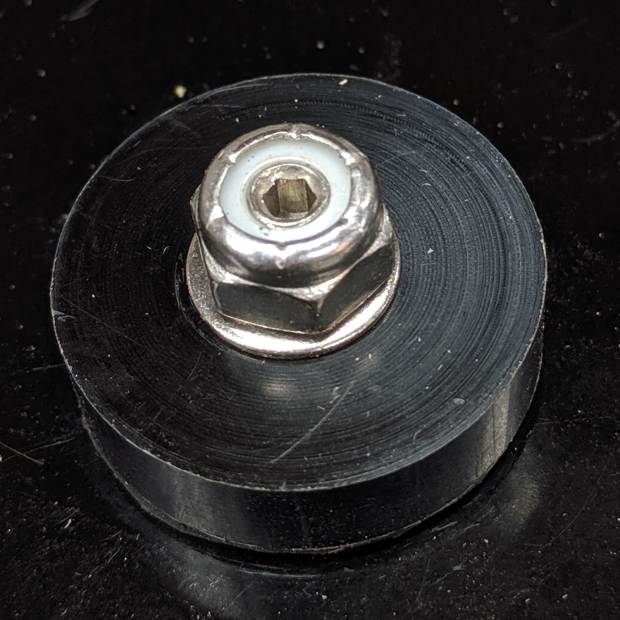
    Make a Delrin bushing to fit around the insert poking through the base:

    Crock Pot Base - drilling Delrin button
    Crock Pot Base – drilling Delrin button

    Reassemble the internal bits with permanent Loctite, top with a nyloc nut, and it’s only a little taller than the original nut:

    Crock Pot Base - assembled
    Crock Pot Base – assembled

    The setscrew let me hold the new “stud” in place while torquing the nut, plus it looks spiffy.

    Memo to Self: If it ain’t broke, don’t look inside. Hah!

    Surprisingly, both Amazon and eBay lack useful thumbscrew assortments …

  • Kenmore Gas Stove Oven Temperature Control Encoder

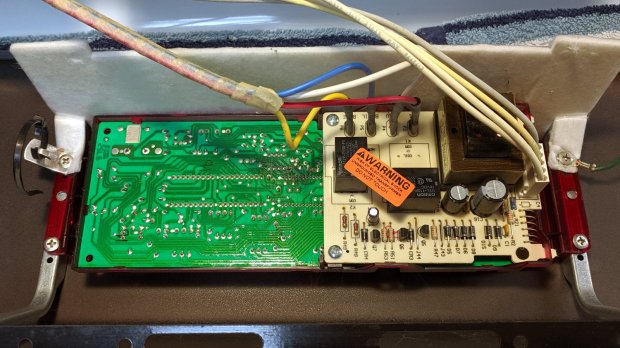
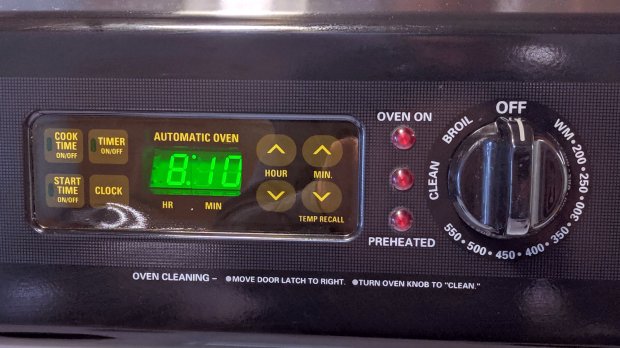
    For the last year or so, the oven temperature control on our Kenmore gas stove has been decreasingly stable, sometimes varying by 100 °F from the setpoint before settling down somewhere close to what it should be. Spotting a replacement control board for a bit over $100, I decided the board used an absolute rotary encoder of the open-frame variety, so I took the thing apart:

    Kenmore oven control - PCB overview
    Kenmore oven control – PCB overview

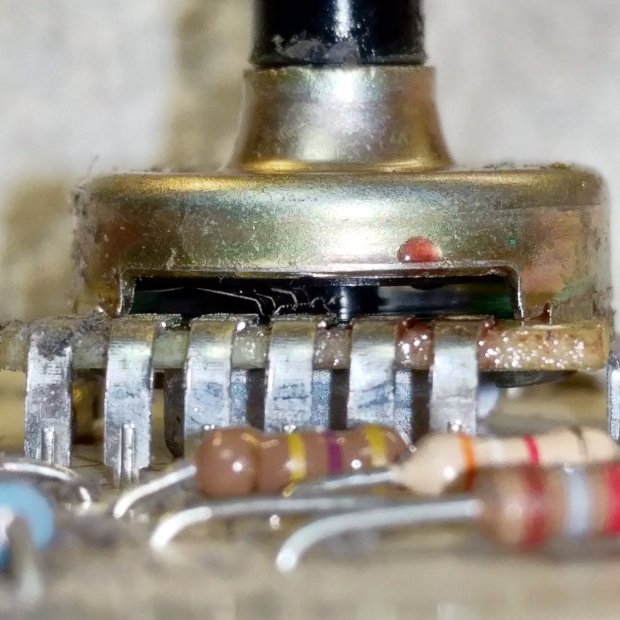
    The encoder was, indeed, an open frame:

    Kenmore oven control - rotary encoder
    Kenmore oven control – rotary encoder

    The red droplet is DeoxIT, the rest of which went inside, just ahead of the contact fingers, and got vigorously massaged across the switch contacts on the wafer by spinning the shaft.

    Some time ago, the membrane over the TIMER ON/OFF switch cracked and I applied a small square of Kapton tape. Having the entire controller in hand, I replaced the square with a strip of 2 inch Kapton, carefully aligned with the bezel marks embossed on the membrane, and now it’s smooth all over:

    Kenmore oven control - Kapton tape cover
    Kenmore oven control – Kapton tape cover

    The MIN(ute) ^ switch required a much firmer than usual push, so I tucked a shim cut from a polypropylene clamshell between the membrane and the pin actuating the switch.

    Reassembled, it works perfectly once more.

    Gotta love a zero-dollar appliance repair!

  • Tire FOD

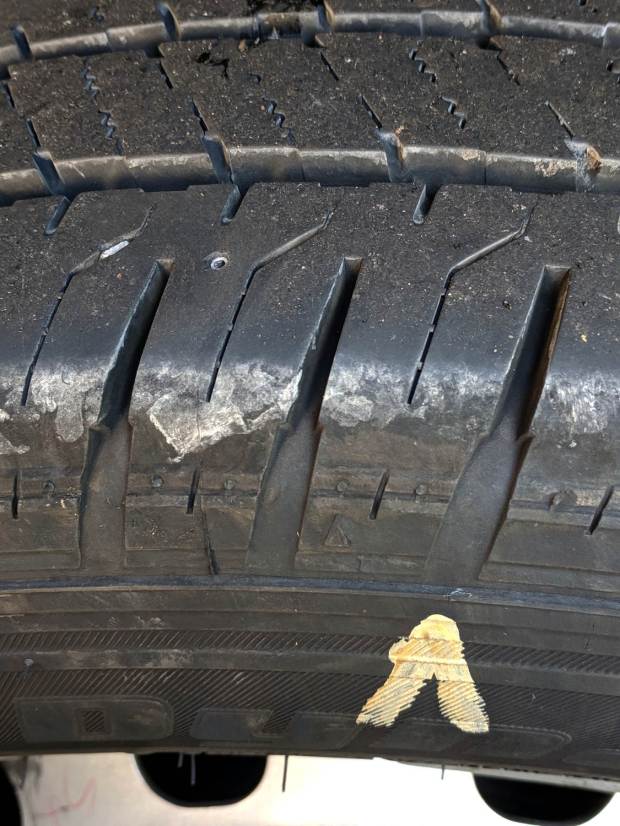
    We rented a van to haul our bikes on a vacation trip, but the tire pressure warning alarm sounded when I turned into the driveway. Measuring the tire pressures showed the left rear tire was at 51 psi, far below the 72 psi shown on the doorframe sticker, and a quick check showed a possible problem:

    Tire FOD - in place
    Tire FOD – in place

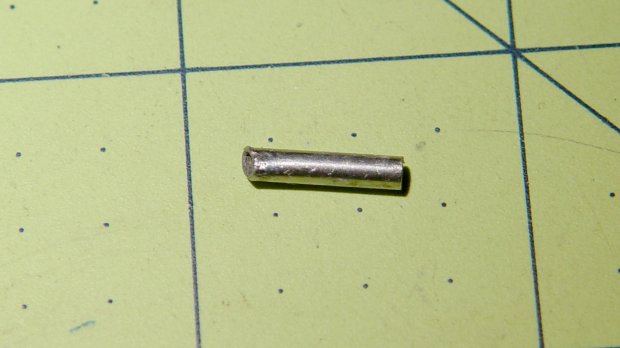
    The small circle in the tread to the left of that mark turned out to be a metal tube:

    Tire FOD object
    Tire FOD object

    Their tire contractor determined the tire wasn’t leaking, the metal tube hadn’t punctured the carcass, and all was right with the world. After, of course, two hours when we expected to be loading the van.

    The rental company was good about it, perhaps because I reported they sent the van out with the other rear tire grossly overinflated to 86 psi (!); obviously, their prep didn’t include checking the tires. Somewhat to my surprise, the space under the passenger seat for a jack was empty.

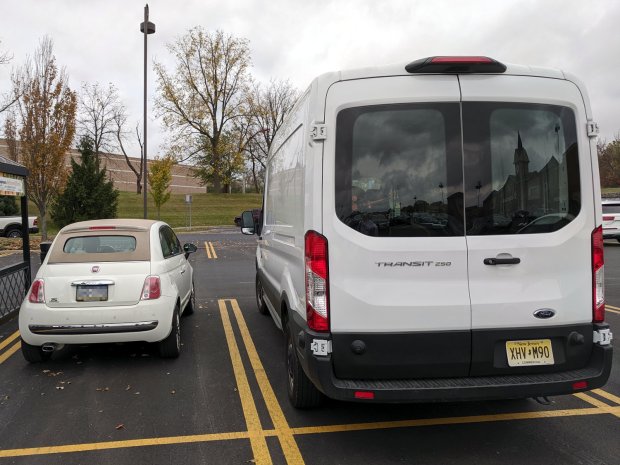
    During the trip, the van laid an egg:

    Transit Van with Egg
    Transit Van with Egg

    A good time was had by all, but our next bicycling vacation will definitely have much more bicycling and much less driving!