The Smell of Molten Projects in the Morning

Ed Nisley's Blog: Shop notes, electronics, firmware, machinery, 3D printing, laser cuttery, and curiosities. Contents: 100% human thinking, 0% AI slop.

Tag: M2

Using and tweaking a Makergear M2 3D printer

  • Improved Alignment Pin Hole for Split 3D Prints

    I’ve been working on an object (more on this later) that requires precise alignment of two parts that capture a nut deep inside. This calls for alignment pins, similar to the ones I used for, say, the Triple-Cylinder Thing:
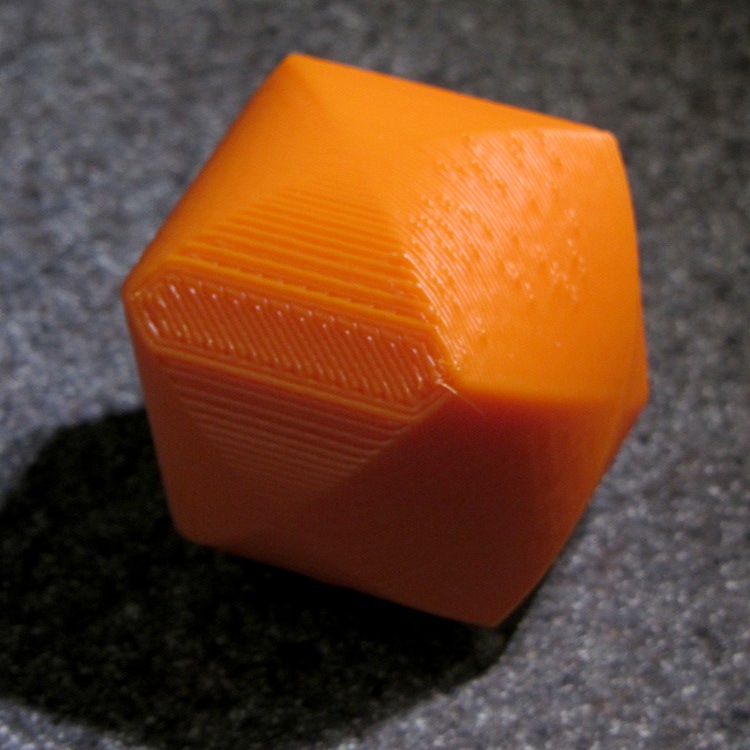
    Cylinder Thing - rotated
    Cylinder Thing – rotated

    The general idea is to design holes that fit the pins, then locate them at the parting line of the model, where they’re subtracted from the solid and appear in exactly the proper places when the model splits for printing:

    Cylinder Thing - alignment pegs
    Cylinder Thing – alignment pegs

    You slather solvent glue on both halves, jam pins into the holes, slap the parts together, and clamp until cured. Works fine, I use pins all over the place.

    The gotcha of using just a (polygonal) cylinder as the hole: if you glue one end of the pin at a time, a small rim of dissolved plastic may form around the pin at the surface. That can bond the two halves together or prevent them from joining properly after being disassembled.

    Sooo, here’s a new alignment pin hole with a gutter around the pin on both surfaces to capture the glop:
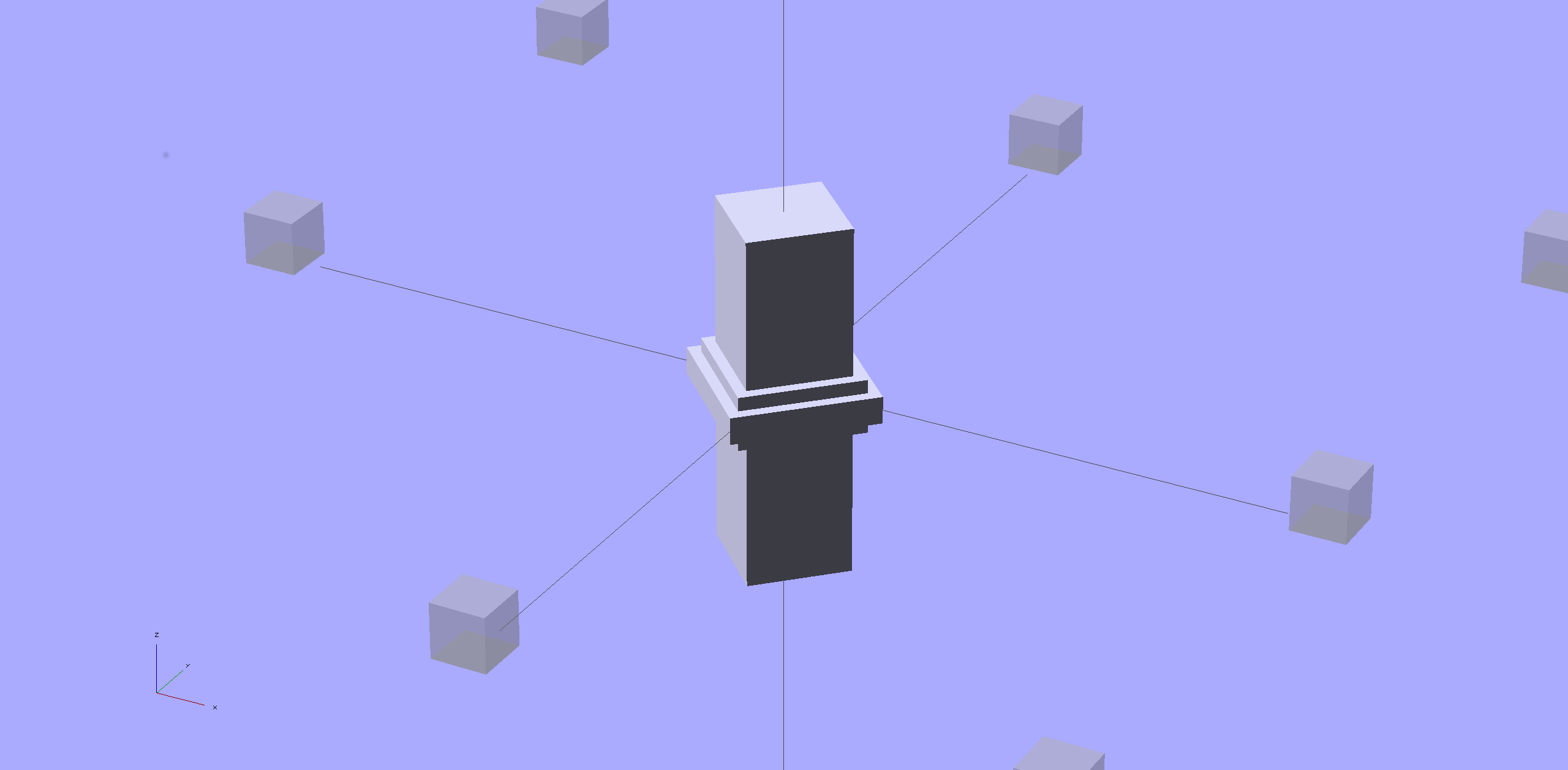
    Alignment pin hole - overview
    Alignment pin hole – overview

    Remember, that’s the negative volume that will hold the pin, not the pin itself!

    Here’s how it works in real plastic, with a 1.75 mm peg glued into one hole with a bit of crud in the gutter:

    Alignment Hole and Pin
    Alignment Hole and Pin

    The secret to making the gutter work: offset the second layer by half the thread width, so that it’s reasonably well supported on the first layer. If you don’t do that, the inner layers simply drop down through the hole and fill the gutter. Even doing that, notice the distortion of the first few layers inside the hole.

    The OpenSCAD source code looks about like you’d expect:

    //-- Locating pin hole with glue recess
    
    module LocatingPin(Dia=PinOD,Len=5.00) {
    
    	translate([0,0,-ThreadThick])
    		PolyCyl((Dia + 2*ThreadWidth),2*ThreadThick,4);
    
    	translate([0,0,-2*ThreadThick])
    		PolyCyl((Dia + 1*ThreadWidth),4*ThreadThick,4);
    
    	translate([0,0,-(Len/2 + ThreadThick)])
    		PolyCyl(Dia,(Len + 2*ThreadThick),4);
    }
    

    Ideally, the pin length should extend at least two diameters into each side of the object, but you can feed in whatever you need to make it come out right.

    The PolyCyl() routine produces a low-vertex-count polygon that circumscribes the nominal diameter, which is what you need for vertical holes in 3D printed objects:

    module PolyCyl(Dia,Height,ForceSides=0) {			// based on nophead's polyholes
    
      Sides = (ForceSides != 0) ? ForceSides : (ceil(Dia) + 2);
    
      FixDia = Dia / cos(180/Sides);
    
      cylinder(r=(FixDia + HoleWindage)/2,
               h=Height,
    	   $fn=Sides);
    }
    

    Tip o’ the cycling helmet to nophead for figuring out the polyhole idea and explaining why they’re needed…
  • Broom Handle Screw With Dedendum: Effect of Printing Orientation

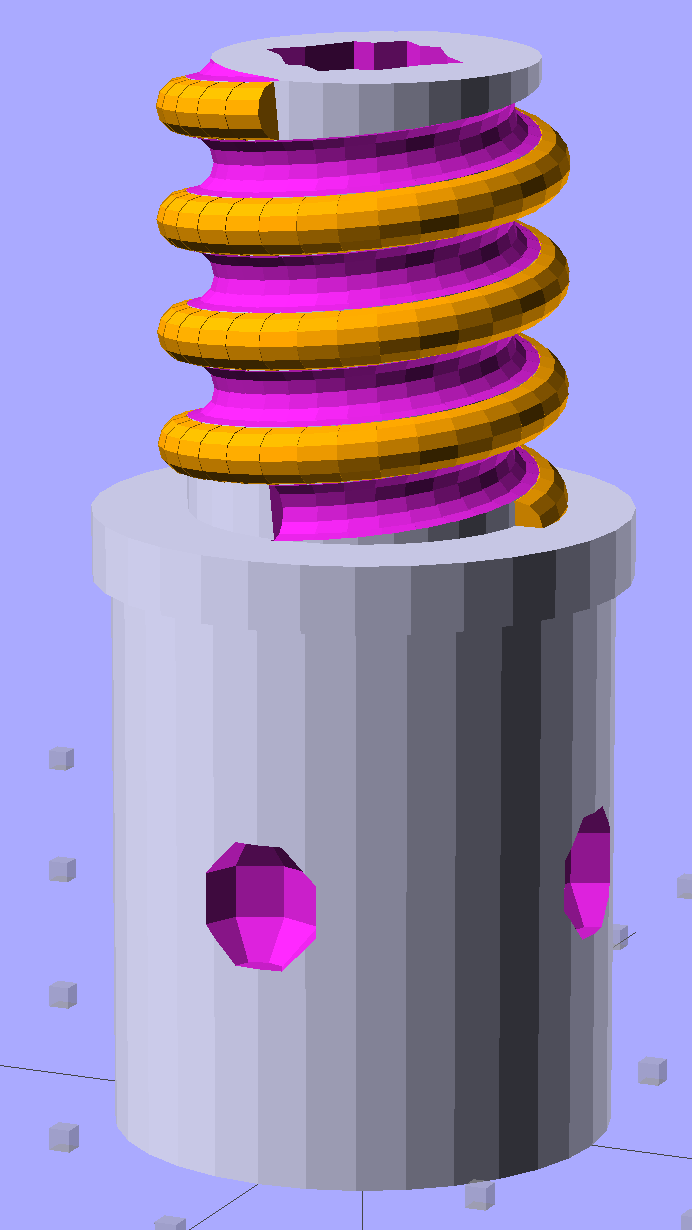
    Although the current OpenSCAD could produce a solid model with the screw thread’s dedendum, I’d never actually printed one of them:

    Broom Handle Screw - full thread - solid model
    Broom Handle Screw – full thread – solid model

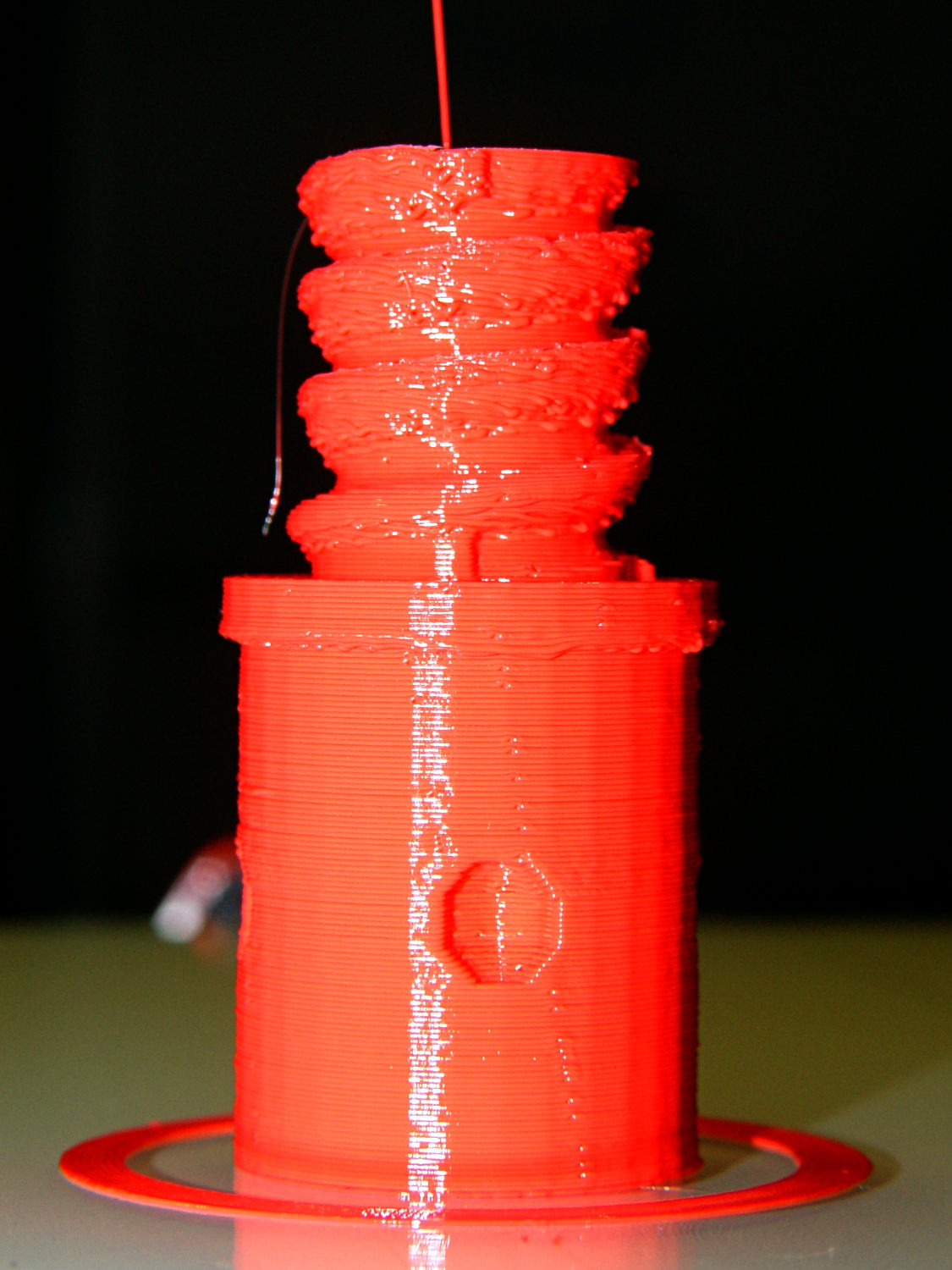
    I need some fondlestuff illustrating how to handle overhangs, so I ran one standing vertically, which (pretty much as I expected) didn’t work well at all:

    Broom Handle Screw - dedendum - vertical
    Broom Handle Screw – dedendum – vertical

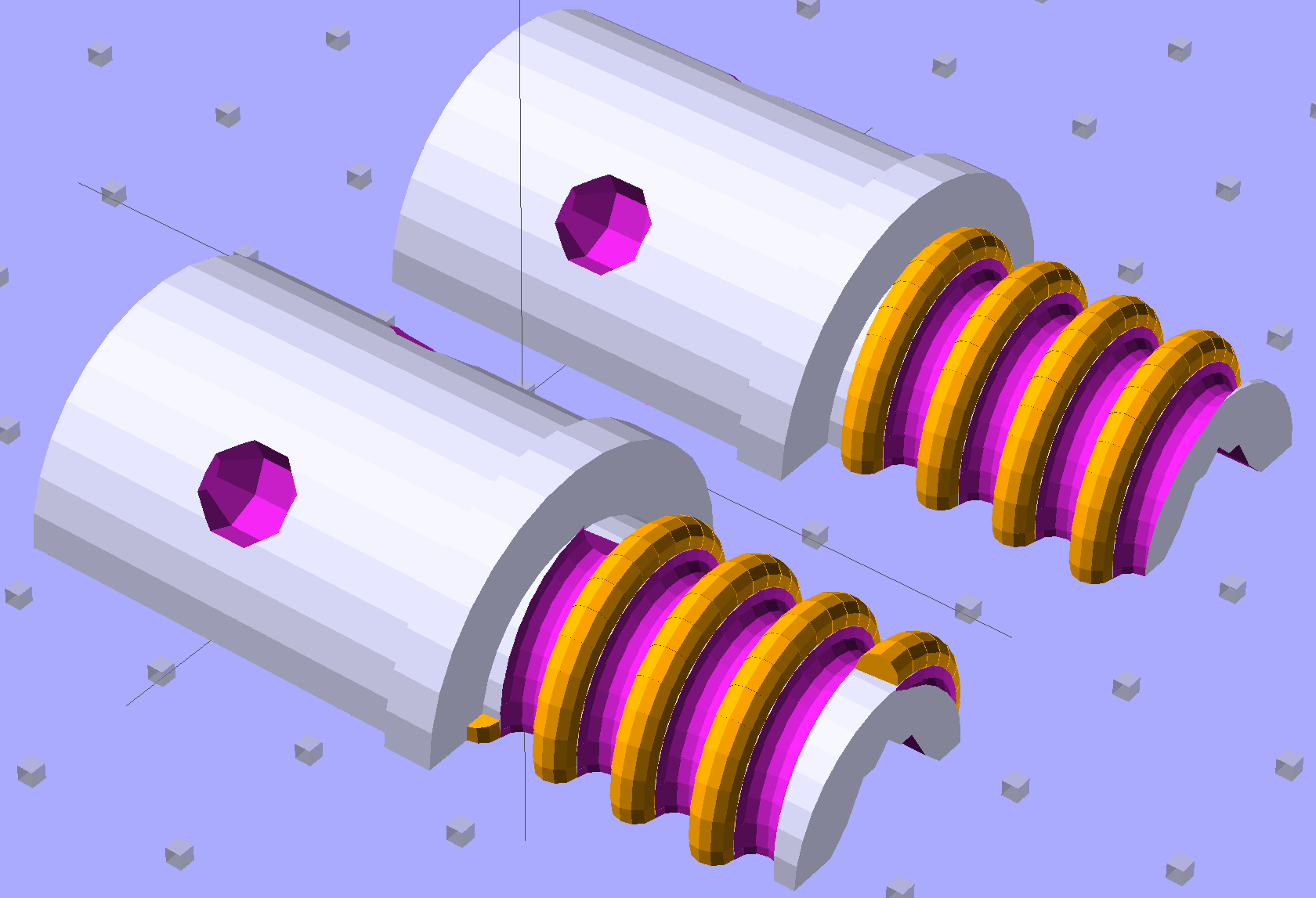
    The trick is to split the model down the middle:

    Broom Handle Screw - horizontal top
    Broom Handle Screw – horizontal top

    And put holes in each half for alignment pins:

    Broom Handle Screw - horizontal bottom
    Broom Handle Screw – horizontal bottom

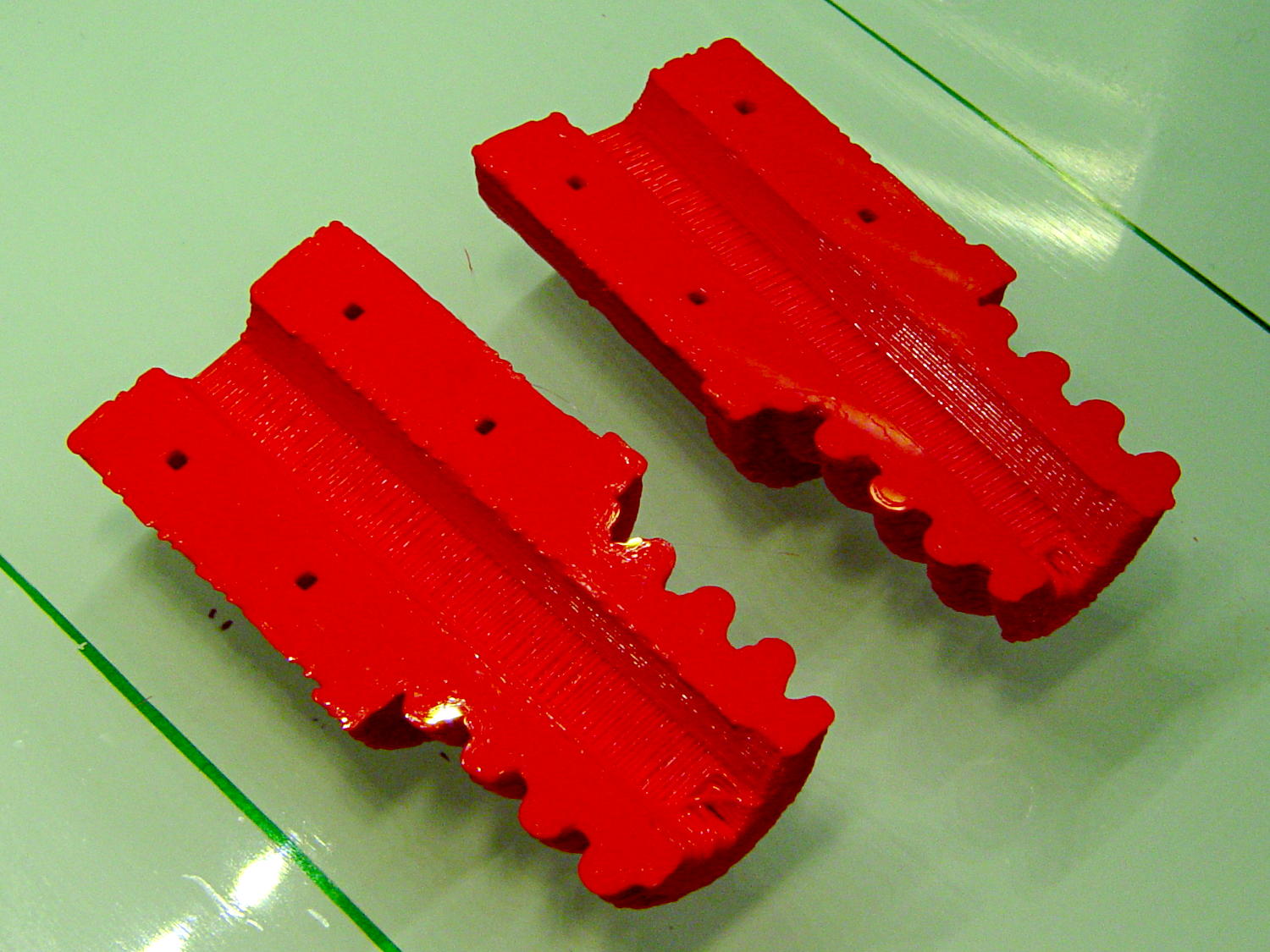
    Then you can print it lying down:

    Broom Handle Screw - horizontal - as-printed top
    Broom Handle Screw – horizontal – as-printed top

    The internal overhang would probably call for some support material, particularly in the square recess at the end, but in this case it’s a lesson:

    Broom Handle Screw - horizontal - as-printed bottom
    Broom Handle Screw – horizontal – as-printed bottom

    Glue some filament snippets into the holes, snap it together, and it looks just fine over there on the right:

    Broom Handle Screw - orientation comparison
    Broom Handle Screw – orientation comparison

    Doesn’t matter how many I print, it still doesn’t make any economic sense as a broom repair…

    The OpenSCAD source code now has a Layout variable to control the orientation and, not as shown in the model, the alignment pins have glue gutters in the first layer:

    // Broom Handle Screw End Plug
    // Ed Nisley KE4ZNU October 2013
    
    Layout = "Horizontal";		// Vertical Horizontal Pin
    
    UseDedendum = true;			// true to create full thread form
    
    //- Extrusion parameters must match reality!
    
    ThreadThick = 0.25;
    ThreadWidth = 0.40;
    
    HoleWindage = 0.2;
    
    Protrusion = 0.1;			// make holes end cleanly
    
    //----------------------
    // Dimensions
    
    PostOD = 22.3;				// post inside metal handle
    PostLength = 25.0;
    
    FlangeOD = 24.0;			// stop flange
    FlangeLength = 3.0;
    
    PitchDia = 15.5;			// thread center diameter
    ScrewLength = 20.0;
    
    ThreadFormOD = 2.5;			// diameter of thread form
    ThreadPitch = 5.0;
    NumSegments = 32;			//  .. number of cylinder approximations per turn
    
    BoltOD = 7.0;				// clears 1/4-20 bolt
    BoltSquare = 6.5;			// across flats
    BoltHeadThick = 3.0;
    
    RecessDia = 6.0;			// recesss to secure post in handle
    
    OALength = PostLength + FlangeLength + ScrewLength;
    
    SplitOC = 1.25*FlangeOD;	// separation in Horizontal layout
    PinOD = 1.75;				// alignment pin diameter = filament stub
    PinLength = 7.0;			//  ... length
    
    $fn=8*4;					// default cylinder sides
    
    echo("Pitch dia: ",PitchDia);
    echo("Root dia: ",PitchDia - ThreadFormOD);
    echo("Crest dia: ",PitchDia + ThreadFormOD);
    
    Pi = 3.14159265358979;
    
    //----------------------
    // Useful routines
    
    // Wrap cylindrical thread segments around larger plug cylinder
    
    module CylinderThread(Pitch,Length,PitchDia,ThreadOD,PerTurn) {
    
    CylFudge = 1.02;				// force overlap
    
        RotIncr = 1/PerTurn;
        PitchRad = PitchDia/2;
    
        Turns = Length/Pitch;
        NumCyls = Turns*PerTurn;
    
        ZStep = Pitch / PerTurn;
    
        HelixAngle = atan(Pitch/(Pi*PitchDia));
        CylLength = CylFudge * (Pi*(PitchDia + ThreadOD) / PerTurn) / cos(HelixAngle);
    
    	for (i = [0:NumCyls-1]) {
    		assign(Angle = 360*i/PerTurn)
    			translate([PitchRad*cos(Angle),PitchRad*sin(Angle),i*ZStep])
    				rotate([90+HelixAngle,0,Angle])
    					cylinder(r1=ThreadOD/2,
    							r2=ThreadOD/(2*CylFudge),
    							h=CylLength,
    							center=true,$fn=12);
    	}
    }
    
    // Build complete plug
    
    module ScrewPlug() {
    	difference() {
    		union() {
    			cylinder(r=PostOD/2,h=PostLength);
    			cylinder(r=PitchDia/2,h=OALength);
    			translate([0,0,PostLength])
    				cylinder(r=FlangeOD/2,h=FlangeLength);
    			color("Orange")
    			translate([0,0,(PostLength + FlangeLength)])
    				CylinderThread(ThreadPitch,(ScrewLength - ThreadFormOD/2),PitchDia,ThreadFormOD,NumSegments);
    		}
    
    		translate([0,0,-Protrusion])
    			PolyCyl(BoltOD,(OALength + 2*Protrusion),6);
    
    		translate([0,0,(OALength - BoltHeadThick)])
    			PolyCyl(BoltSquare,(BoltHeadThick + Protrusion),4);
    
    		if (UseDedendum)
    			translate([0,0,(PostLength + FlangeLength + ThreadFormOD/2 - ThreadPitch/(2*NumSegments))])
    				rotate(-90 - 360/(2*NumSegments))
    				CylinderThread(ThreadPitch,ScrewLength,PitchDia,ThreadFormOD,NumSegments);
    
    		for (i = [0:90:270]) {
    			rotate(45 + i)					// 45 works better with Horizontal layout
    				translate([PostOD/2,0,PostLength/2])
    					sphere(r=RecessDia/2,$fn=8);
    		}
    	}
    }
    
    // Locating pin hole with glue recess
    
    module LocatingPin() {
    
    	translate([0,0,-ThreadThick])
    		PolyCyl((PinOD + 2*ThreadWidth),2*ThreadThick,4);
    	translate([0,0,-(PinLength/2 + ThreadThick)])
    		PolyCyl(PinOD,(PinLength + 2*ThreadThick),4);
    
    }
    
    module PolyCyl(Dia,Height,ForceSides=0) {			// based on nophead's polyholes
    
      Sides = (ForceSides != 0) ? ForceSides : (ceil(Dia) + 2);
    
      FixDia = Dia / cos(180/Sides);
    
      cylinder(r=(FixDia + HoleWindage)/2,
               h=Height,
    	   $fn=Sides);
    }
    
    module ShowPegGrid(Space = 10.0,Size = 1.0) {
    
      Range = floor(50 / Space);
    
    	for (x=[-Range:Range])
    	  for (y=[-Range:Range])
    		translate([x*Space,y*Space,Size/2])
    		  %cube(Size,center=true);
    
    }
    
    //-------------------
    // Build it...
    
    ShowPegGrid();
    
    if (Layout == "Vertical")
    	ScrewPlug();
    
    if (Layout == "Pin")
    	LocatingPin();
    
    if (Layout == "Horizontal")
    	for (i=[-1,1])
    		difference() {
    			translate([i*SplitOC/2,PostLength/2,0])
    				rotate([90,180*(i + 1)/2,0])
    					ScrewPlug();
    
    			translate([0,0,-FlangeOD/2])
    				cube([2*OALength,2*OALength,FlangeOD],center=true);
    
    			for (j=[-1,1], pin=[-1,1])
    				assign(PinX = i*SplitOC/2 + pin*(PostOD + BoltOD)/4,
    					   PinY = j*PostLength/4) {
    					translate([PinX,PinY,0])
    						rotate(45)
    							LocatingPin();
    					echo("i j pin: ",i,j,pin);
    					echo("X Y: ",PinX,PinY);
    				}
    		}
    
  • Plant Stand Feet

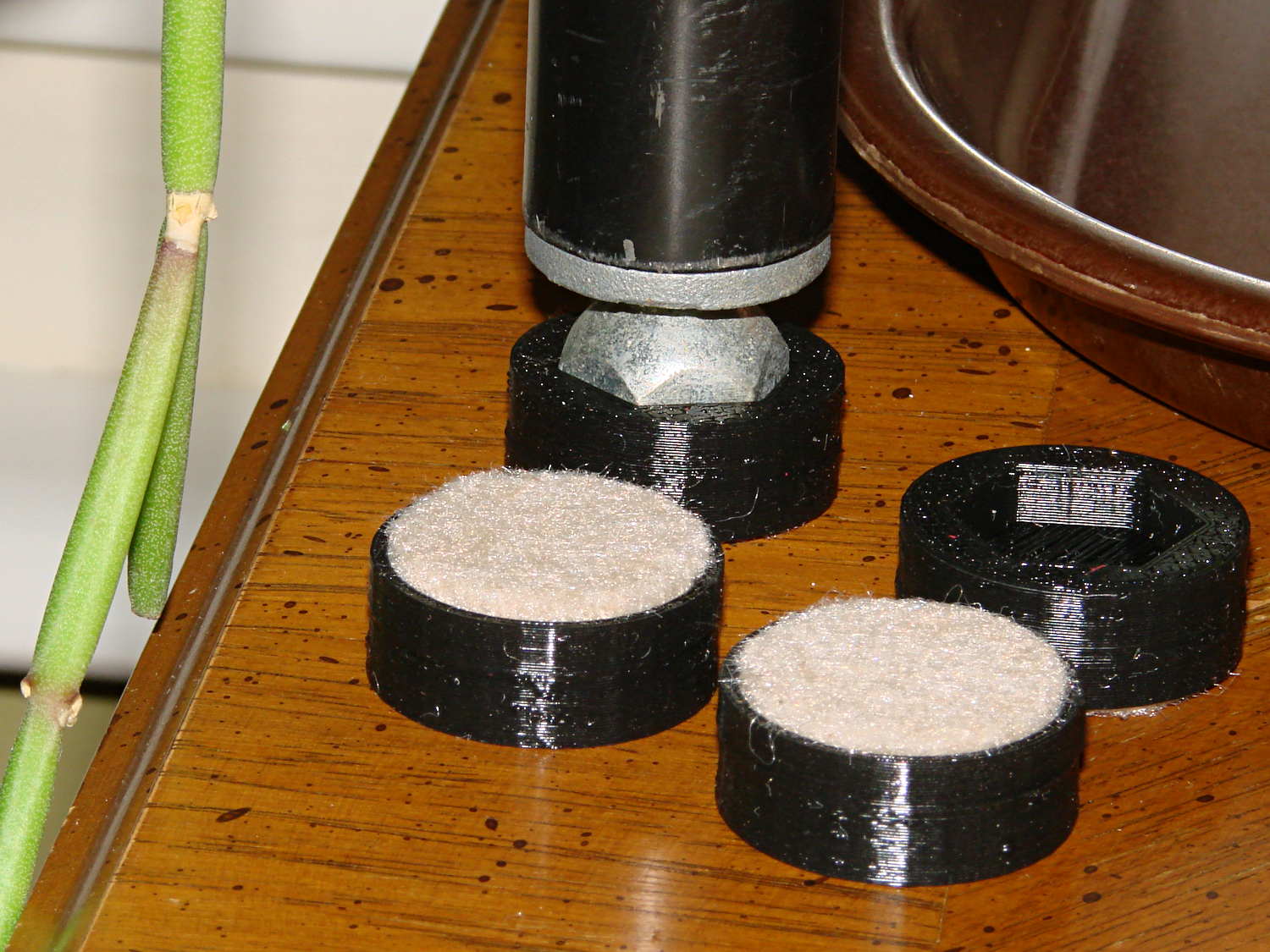
    The houseplants have migrated indoors after spending a summer charging up in the sun on the patio, which means it’s time to replace the silicone rubber feet on the bottom of the plant shelves. This year, I printed a set of feet to fit the hex-head adjustable feet:

    Plant Stand Foot - installed
    Plant Stand Foot – installed

    The pencil-stem plant on the left, for whatever it’s worth, is a perfectly healthy Rhipsalis that greatly enjoyed the summer sun.

    The feet print upside-down to give the surface around the hex a smooth finish. I used Slic3r’s Hilbert Curve for pattern a bit more interesting than the usual parallel lines:

    Plant Shelf Foot - as built
    Plant Shelf Foot – as built

    The Hilbert curve doesn’t fit neatly into a non-rectangular shape, but it’s close enough.

    The solid model includes the support structure:

    Plant Shelf Foot - solid model - bottom
    Plant Shelf Foot – solid model – bottom

    Which pops out cleanly:

    Plant Shelf Foot - support material detail
    Plant Shelf Foot – support material detail

    Yes, that’s a shred of red filament embedded on the left side. Cleanliness is next to impossible…

    The fuzzy felt feet come from a 6 mm thick slab of the stuff:

    Plant Shelf Foot - cutting felt plugs
    Plant Shelf Foot – cutting felt plugs

    The round socket wall leaves about 2 mm of felt showing at the bottom; it’s not very compressible and that should suffice to keep the plastic off the table.

    The OpenSCAD source code:

    // Feet for a wire-shelf plant stand
    // Ed Nisley KE4ZNU October 2013
    
    Layout = "Build";			// Show Build
    
    Support = true;
    
    //- Extrusion parameters must match reality!
    //  Print with 2 shells and 3 solid layers
    
    ThreadThick = 0.25;
    ThreadWidth = 0.40;
    
    HoleWindage = 0.2;
    
    Protrusion = 0.1;			// make holes end cleanly
    
    //----------------------
    // Dimensions
    
    StandFootOD = 18.0;			// hex across flats
    StandFootDepth = 5.0;		//  ... socket depth
    
    FeltPadOD = 25.0;			// felt foot diameter
    FeltPadDepth = 4.0;			//  ... depth
    
    FootBaseThick = 6*ThreadThick;	// between foot and pad
    FootWall = 4*ThreadWidth;		// around exterior
    
    FootOD = 2*FootWall + max(StandFootOD,FeltPadOD);
    echo(str("Foot OD: ",FootOD));
    
    FootTall = StandFootDepth + FootBaseThick + FeltPadDepth;
    echo(str(" ... height: "),FootTall);
    
    NumSides = 8*4;
    
    //----------------------
    // Useful routines
    
    module FootPad() {
    
    	difference() {
    
    		cylinder(r=FootOD/2,h=FootTall,$fn=NumSides);
    
    		translate([0,0,FeltPadDepth + FootBaseThick])
    			PolyCyl(StandFootOD,2*StandFootDepth,6);
    
    		translate([0,0,-Protrusion])
    			PolyCyl(FeltPadOD,(FeltPadDepth + Protrusion),NumSides);
    
    	}
    }
    
    // Locating pin hole with glue recess
    
    module LocatingPin() {
    
    	translate([0,0,-ThreadThick])
    		PolyCyl((PinOD + 2*ThreadWidth),2*ThreadThick,4);
    	translate([0,0,-(PinLength/2 + ThreadThick)])
    		PolyCyl(PinOD,(PinLength + 2*ThreadThick),4);
    
    }
    
    module PolyCyl(Dia,Height,ForceSides=0) {			// based on nophead's polyholes
    
      Sides = (ForceSides != 0) ? ForceSides : (ceil(Dia) + 2);
    
      FixDia = Dia / cos(180/Sides);
    
      cylinder(r=(FixDia + HoleWindage)/2,
               h=Height,
    	   $fn=Sides);
    }
    
    module ShowPegGrid(Space = 10.0,Size = 1.0) {
    
      Range = floor(50 / Space);
    
    	for (x=[-Range:Range])
    	  for (y=[-Range:Range])
    		translate([x*Space,y*Space,Size/2])
    		  %cube(Size,center=true);
    
    }
    
    //-------------------
    // Build it...
    
    ShowPegGrid();
    
    if (Layout == "Show")
    	FootPad();
    
    if (Layout == "Build") {
    	translate([0,0,FootTall])
    		rotate([180,0,0])
    			FootPad();
    	if (Support)
    		color("Yellow")
    			for (Seg=[0:5]) {
    				rotate(30 + 360*Seg/6)
    				translate([0,0,(StandFootDepth - ThreadThick)/2])
    					cube([(StandFootOD - 3*ThreadWidth),
    						  2*ThreadWidth,
    						  (StandFootDepth - ThreadThick)],
    						  center=true);
    				}
    }
    
  • Makergear M2: Re-Relocated Z-min Platform Height Switch

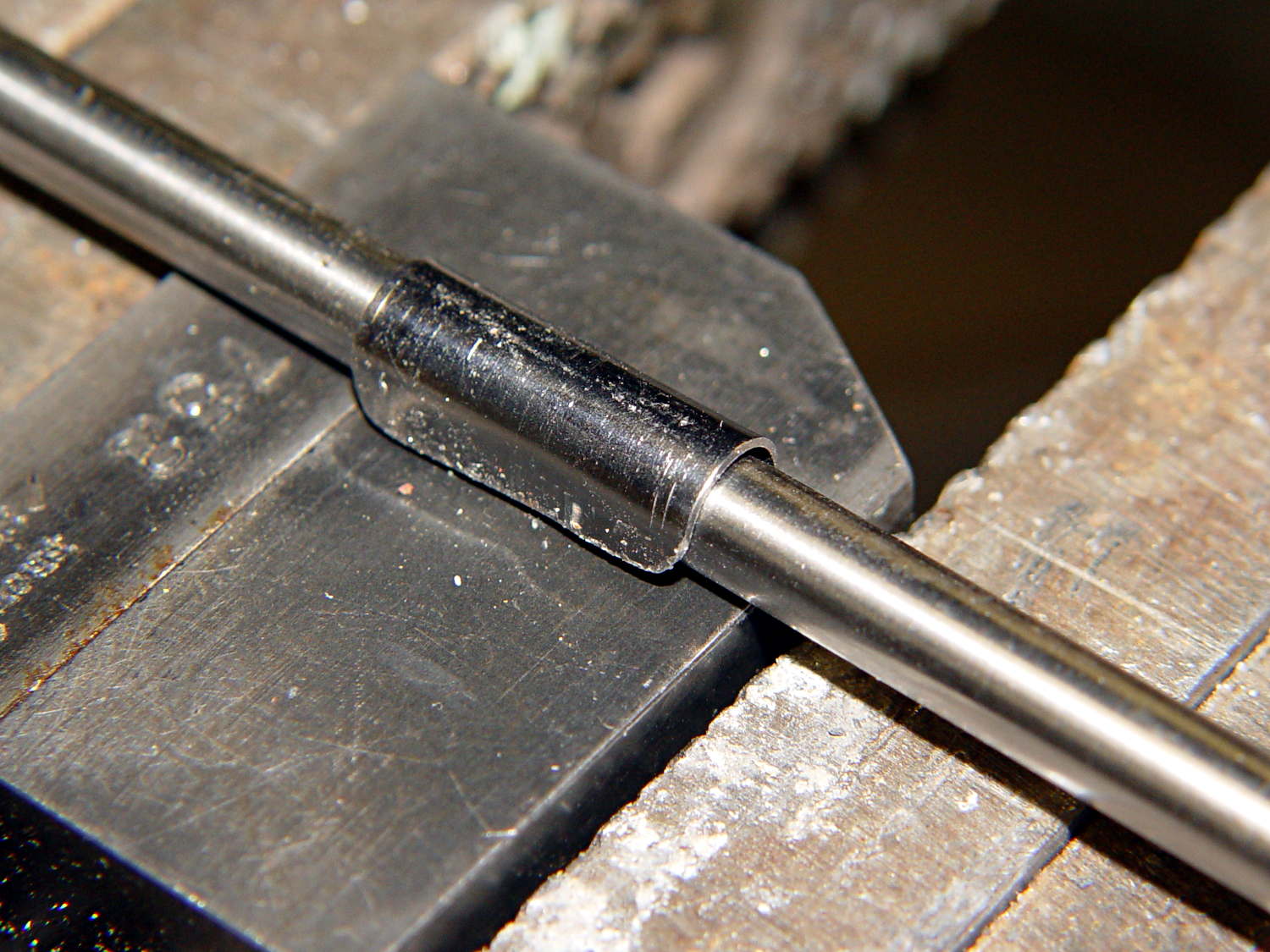
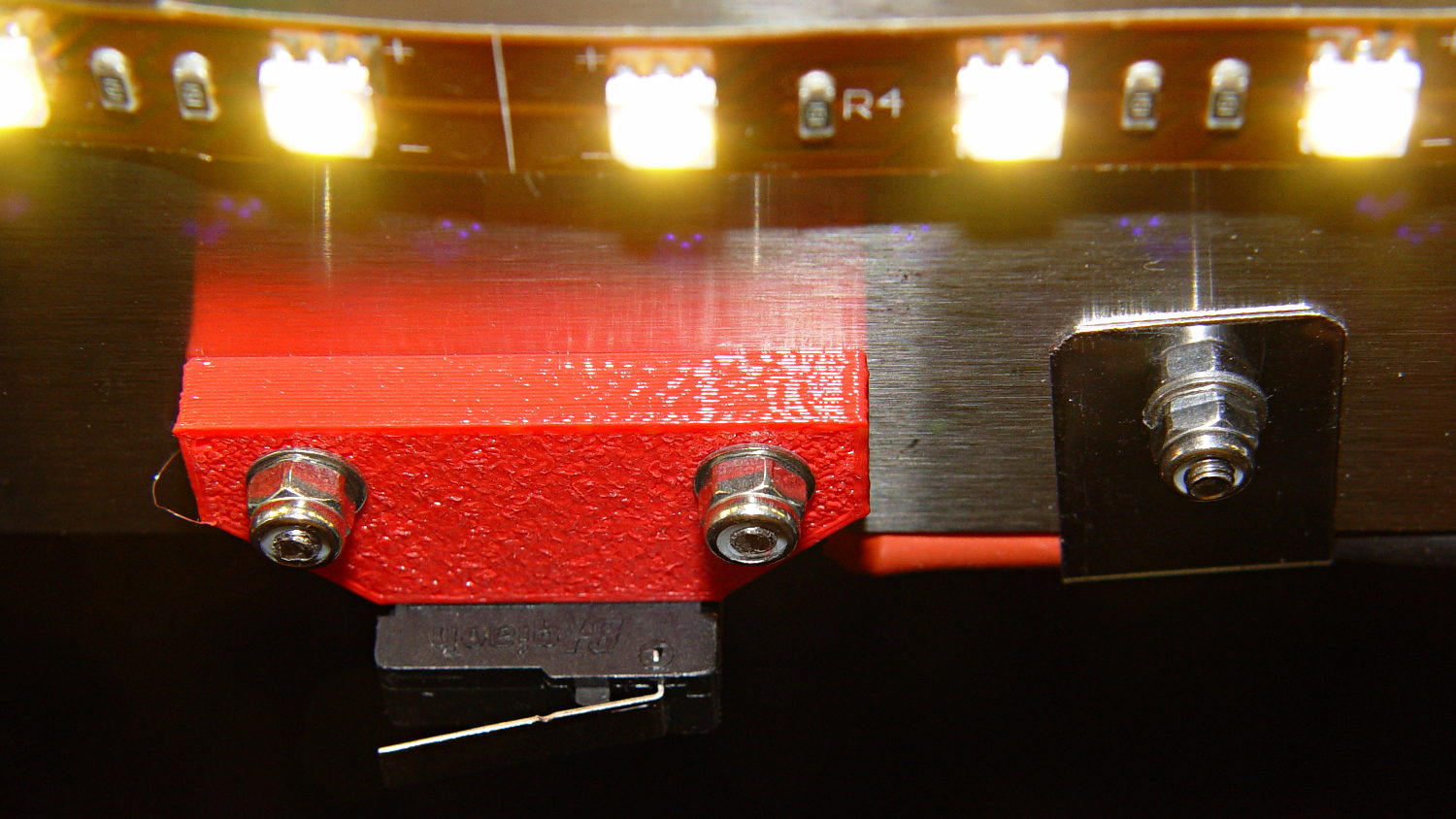
    A few trips with the M2 convinced me that the cable to the relocated Z-min switch along the front of the X gantry needed a clip on each end and should not run under the gantry. This time I used the full width of the steel strap and bashed a neater curve around a length of drill rod:

    M2 Z-min Cable Clip - forming
    M2 Z-min Cable Clip – forming

    The new clips look a bit better with straight edges:

    M2 Z-min Cable Clips - old vs new
    M2 Z-min Cable Clips – old vs new

    The top view shows the new clips and cable location:

    M2 Z-min Switch - top view
    M2 Z-min Switch – top view

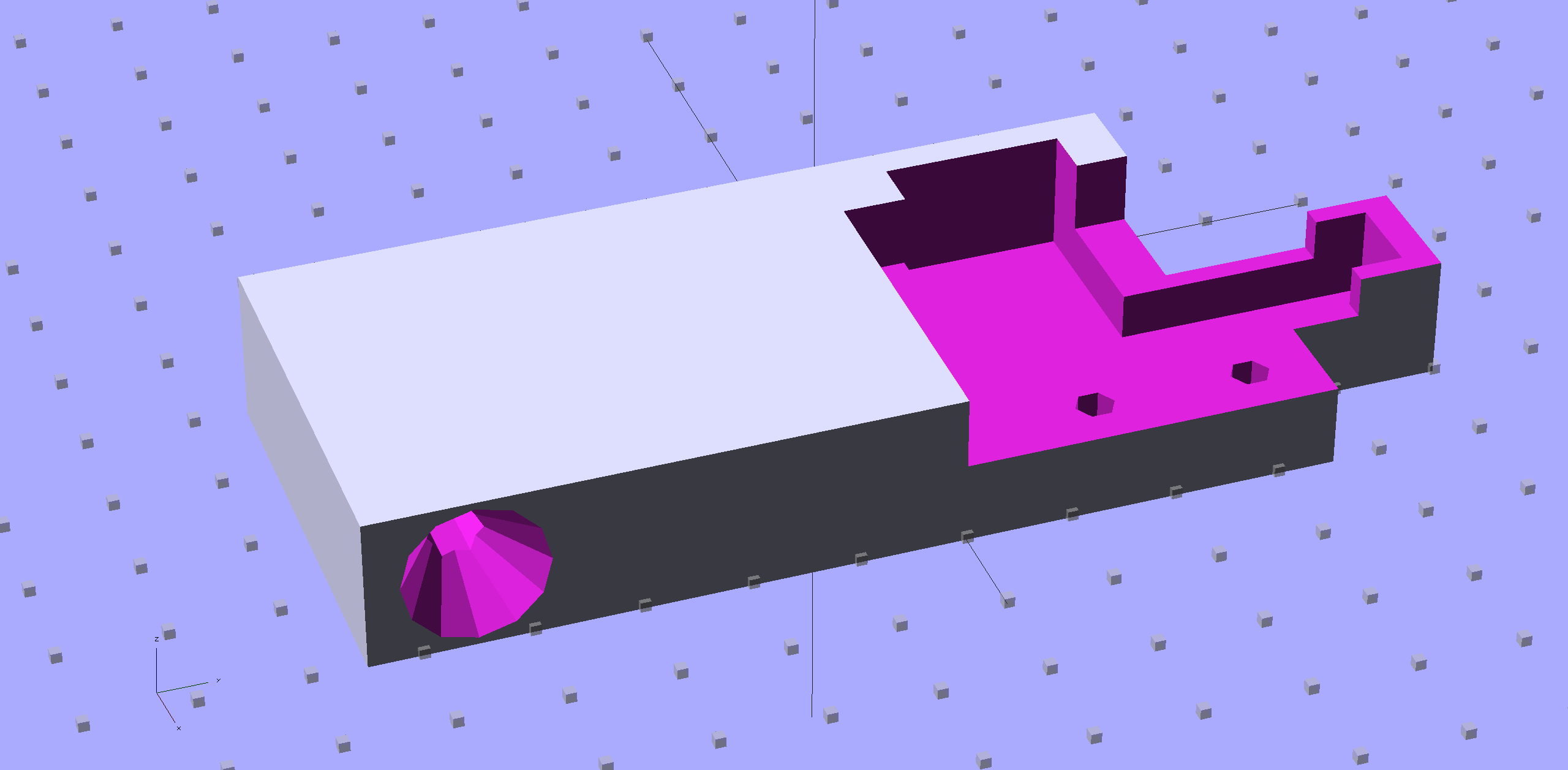
    While I was at it, I trimmed the edges off the switch mounting block. Rather than figure out the trig required to hack off the corners, I applied linear_extrude() to a polygon() defined by some obvious points, then poked the same holes in the block:

    Z-min Front Mount Switch Block - chamfer - solid model
    Z-min Front Mount Switch Block – chamfer – solid model

    It pretty much vanishes in the top view, but here’s a view from the +Y end of the platform:

    M2 Z-min Switch - bottom view
    M2 Z-min Switch – bottom view

    Despite all that maneuvering, the G92 Z-4.55 touchoff value remained the same!

    If you’ve forgotten why all this makes sense, it’s a first pass at detecting the actual build platform position. The stock M2 uses that switch to detect the top of a screw attached to the Z-axis stage, which means it can’t sense the actual platform. The Z-min switch I added to the Thing-O-Matic convinced me that was the only way to fly; given the TOM’s plywood-and-acrylic frame, it was essentially mandatory.

    Mounting the switch on the extruder would allow probing the entire platform, which would allow on-the-fly correction for both average height and (non-)flatness, but that’s a whole ‘nother project.

    The OpenSCAD source code:

    // Block to mount M2 Z-min switch on X gantry
    // Ed Nisley KE4ZNU - Oct 2013
    
    //- Extrusion parameters - must match reality!
    
    ThreadThick = 0.25;
    ThreadWidth = 0.40;
    
    function IntegerMultiple(Size,Unit) = Unit * ceil(Size / Unit);
    
    Protrusion = 0.1;
    
    HoleWindage = 0.2;
    
    //- Sizes
    
    SwitchLength = 20.0;					// switch size across front of block
    
    SwitchScrewOD = 2.05;					// microswitch screw tapping
    SwitchScrewOC = 9.5;					//  ... on-center spacing
    
    GantryScrewOD = 3.0;					// X rail screw clearance
    GantryScrewOC = 25.0;					//  ... on-center spacing along X
    GantryScrewOffset = 12.0;				//  ... Y offset from gantry front
    
    BlockSize = [1.5*GantryScrewOC,17.0,5.0];			// XYZ dimensions as mounted
    HalfBlock = BlockSize/2;
    
    SwitchScrewLength = BlockSize[1] - 5*ThreadWidth;	// net length of switch screws
    echo("Max switch screw length: ",SwitchScrewLength + 5.0);		// ... allow switch thickness
    
    ChamferAngle = atan((BlockSize[0] - SwitchLength)/(BlockSize[1]/2));
    echo("Chamfer Angle: ",ChamferAngle);
    
    //- Adjust hole diameter to make the size come out right
    
    module PolyCyl(Dia,Height,ForceSides=0) {			// based on nophead's polyholes
    
      Sides = (ForceSides != 0) ? ForceSides : (ceil(Dia) + 2);
    
      FixDia = Dia / cos(180/Sides);
    
      cylinder(r=(FixDia + HoleWindage)/2,h=Height,$fn=Sides);
    }
    
    //- Put peg grid on build surface
    
    module ShowPegGrid(Space = 10.0,Size = 1.0) {
    
      RangeX = floor(100 / Space);
      RangeY = floor(125 / Space);
    
    	for (x=[-RangeX:RangeX])
    	  for (y=[-RangeY:RangeY])
    		translate([x*Space,y*Space,Size/2])
    		  %cube(Size,center=true);
    
    }
    
    //- Define basic block shape
    
    module BaseBlock() {
    	translate([0,-GantryScrewOffset,0])
    		linear_extrude(height=BlockSize[2])
    		polygon(points=[[-HalfBlock[0],BlockSize[1]],
    						[HalfBlock[0],BlockSize[1]],
    						[HalfBlock[0],HalfBlock[1]],
    						[SwitchLength/2,0],
    						[-SwitchLength/2,0],
    						[-HalfBlock[0],HalfBlock[1]]
    						]);
    }
    
    //- Build it
    
    ShowPegGrid();
    
    difference() {
    	BaseBlock();
    	for (i=[-1,1]) {
    		translate([i*GantryScrewOC/2,0,-Protrusion])
    			rotate(-90)
    				PolyCyl(GantryScrewOD,(BlockSize[2] + 2*Protrusion));
    		translate([i*SwitchScrewOC/2,-(GantryScrewOffset + Protrusion),BlockSize[2]/2])
    			rotate([-90,0,0])
    				rotate(90)
    					PolyCyl(SwitchScrewOD,(SwitchScrewLength + Protrusion));
    	}
    }
    
  • Makergear M2 Filament Guide Tube: Bigger Is Better

    The whole point of the new guide tube block is to see if a larger ID tube will reduce the force required to pull the filament through it; long after Dan suggested simply using a larger tube, I got around to picking up a lifetime supply of 1/4 inch OD polyethylene tubing: 25 feet for $3. The ID is about 0.17 inch = 4.3 mm, large enough to let the 1.75 mm filament move smoothly, and the inside clearance provides a few millimeters of free motion so that retraction moves don’t require pushing the guide tube around.

    The new filament guide + wire cover anchors the spool end of the tube:

    M2 Larger Filament Guide - overview
    M2 Larger Filament Guide – overview

    On the other end, I blobbed a piece of 1/4 inch ID tubing to anchor the guide tube. It’s nicer than the twist of cardboard I used before, but nothing to get excited about:

    M2 Extruder - nested filament guide tubes
    M2 Extruder – nested filament guide tubes

    There exists a printed tubing anchor that attaches to the bolt that adjusts the force pressing the filament against the drive gear, but:

    • It’s just an STL model
    • That fits the original guide tube
    • So I’d have to reverse engineer it
    • And I don’t want to fiddle with the extruder

    This will suffice for a while.

    As I hoped, the larger guide tube reduces the force required to pull the filament into the extruder under 1 pound. Most of that force comes from persuading the filament spool to drag-rotate around the plastic support arm, so some simple improvements should help there, as well. I foresee some bearings in its future.

    Fine tuning of the tubing length is also in order, but that’ll require more printing sessions.

  • Makergear M2: Improved X-Min Wire Cover and Filament Guide Anchor

    With the reverse-engineered wire cover model in hand, a bit of tinkering extends one side into a relentlessly rectangular block with a hole for the filament guide tube:

    M2 Wire Cover Filament Guide - overview
    M2 Wire Cover Filament Guide – overview

    Because the block sits somewhat to the rear of the spool, I added a conical entrance to help ease the filament around the corner into the tube. The hole fits the larger 1/4 inch tube that I’m trying out, with a stop equal to the tube’s 0.17 inch ID just before the conical section, as shown in this cross-section view:

    M2 Wire Cover Filament Guide - guide tube section
    M2 Wire Cover Filament Guide – guide tube section

    It fits just about the way you’d expect:

    M2 Larger Filament Guide - rear view
    M2 Larger Filament Guide – rear view

    The perspective makes the guide tube look more angled than it really is; most of that curve is toward the front, so it’s considerably foreshortened in this view.

    The metal bar with the cross pin sticking up in front is a bar clamp that holds an oak strip across the back of the bench to keep the M2 from walking away.

    The OpenSCAD source code:

    // Improved M2 filament guide and X-min switch wire guide
    // Ed Nisley KE4ZNU - Oct 2013
    
    Layout = "Build";				// Build Section
    
    //- Useful Stuff
    
    function IntegerMultiple(Size,Unit) = Unit * ceil(Size / Unit);
    
    Protrusion = 0.1;
    
    HoleWindage = 0.2;
    
    //- Sizes
    
    PlateMinThick = 8.0;				// basic thickness excluding wire guides
    PlateLength = 55.0;					// from side of frame beyond top wire guide
    
    TopGuideLength = 7.0;				// protrusion from plate
    
    PlateThick = PlateMinThick + TopGuideLength;
    
    echo(str("Total thickness: ",PlateThick));
    
    GuideTubeOD = 6.3;					// max diameter!
    GuideTubeID = 4.3;					// max diameter!
    GuideTubeOffset = 45.0;				// centerline from edge of frame
    
    //- Adjust hole diameter to make the size come out right
    
    module PolyCyl(Dia,Height,ForceSides=0) {			// based on nophead's polyholes
    
      Sides = (ForceSides != 0) ? ForceSides : (ceil(Dia) + 2);
    
      FixDia = Dia / cos(180/Sides);
    
      cylinder(r=(FixDia + HoleWindage)/2,h=Height,$fn=Sides);
    }
    
    //- Put peg grid on build surface
    
    module ShowPegGrid(Space = 10.0,Size = 1.0) {
    
      RangeX = floor(100 / Space);
      RangeY = floor(125 / Space);
    
    	for (x=[-RangeX:RangeX])
    	  for (y=[-RangeY:RangeY])
    		translate([x*Space,y*Space,Size/2])
    		  %cube(Size,center=true);
    
    }
    
    //- Define basic block shape
    //  Mostly reverse engineered from
    //    https://github.com/MakerGear/M2/blob/master/Printed%20Parts/STL/M2%20X%20Endstop%20Wire%20Cover%20with%20Filament%20Guide.stl
    //	Hence all the magic numbers...
    
    module BaseBlock() {
    
    SideGuideLength = 4.0;				// protrusion = even with frame interior
    ChannelDepth = 4.5;					// wiring channel
    FrameOffset = 28;
    
    	translate([18,28,0]) {			// align neatly for later processing
    
    		if (true)
    			color("Green",0.2)
    				translate([-18,22,15])
    					rotate([-90,0,-90])
    						import("file:///mnt/bulkdata/Project%20Files/Thing-O-Matic/M2%20Parts/Filament%20Guide/M2+X+Endstop+Wire+Cover+with+Filament+Guide.stl",
    								convexity=10);
    
    		difference() {
    			linear_extrude(height=PlateThick,convexity=5)		// main block
    				polygon(points=[[0,0],[0,22],[12,22],[12,7.5],[22,7.5],
    								[22,-(PlateLength + FrameOffset)],[-18,-(PlateLength + FrameOffset)],
    								[-18,0]
    						]);
    
    			for (i=[-1,0])
    				translate([17,((i*15.0)+ 1.05),-Protrusion])
    					rotate(180/6) {
    						PolyCyl(3.1,(PlateMinThick + 2*Protrusion),6);		// screw holes
    						PolyCyl(5.7,(3.0 + Protrusion),6);					//  ... countersink
    					}
    
    			translate([0,0,(PlateMinThick - ChannelDepth)])		// wire channel
    				linear_extrude(height=15,convexity=5)
    					polygon(points=[[2,-5],[2,19],[10,19],[10,-22],[-15,-22],[-15,-5]
    							]);
    
    			translate([-10,14,PlateMinThick])				// M2 frame
    				rotate(-90)
    					cube([42,35,10],center=false);
    
    			translate([-5,5,(PlateMinThick + SideGuideLength)])	// shorten side guide
    				cube([20,20,10],center="false");
    		}
    	}
    }
    
    //- Complete object
    
    module GuideCover() {
    
    	difference() {
    		BaseBlock();
    
    		translate([50,-GuideTubeOffset,PlateThick/2])
    			rotate([0,-90,0])
    				rotate(180/6)
    					PolyCyl(GuideTubeID,60,6);
    
    		translate([25,-GuideTubeOffset,PlateThick/2])
    			rotate([0,-90,0])
    				rotate(180/6)
    					PolyCyl(GuideTubeOD,60,6);
    
    		translate([41,-GuideTubeOffset,PlateThick/2])
    			rotate([0,-90,0])
    				rotate(180/6)
    					cylinder(r1= 0.5*PlateThick,r2=GuideTubeID/2,h=8,$fn=12);
    	}
    }
    
    //- Build it
    
    ShowPegGrid();
    
    if (Layout == "Section")
    	difference() {
    		GuideCover();
    		translate([2*100/3,-GuideTubeOffset,-PlateThick])
    			rotate(180)
    				cube([100,PlateLength,3*PlateThick]);
    	}
    
    if (Layout == "Build")
    	GuideCover();
    
  • Makergear M2: Reverse-engineering the X-min Wire Cover

    The Makergear M2 comes with a plastic block that covers the X-min switch wiring and anchors the end of the filament guide. Because the guide wasn’t anchored to the block, bumping the guide tended to bend the filament where it exited the block. To prevent that, I hot-melt-glued the guide to the block, which really wasn’t particularly elegant. This picture shows the X-min switch relocated to contact the platform, with the slightly out of focus blob anchoring the guide off to the right:

    M2 - Z-min switch at rear X gantry
    M2 – Z-min switch at rear X gantry

    Makergear provides STL files of the M2’s printable bits, including several versions of the wire cover block. This corresponds to the one on my M2, although the rounded edges don’t come through in the plastic very welll:

    Stock M2 Wire Cover Filament Guide - solid model
    Stock M2 Wire Cover Filament Guide – solid model

    Because STL files aren’t editable, I reverse-engineered the dimensions into an OpenSCAD model that I could use as the basis for a different guide. This is just the basic wire cover, minus the filament guide extension, plus a flat end that wraps around the edge of the chassis:

    M2 Wire Cover - reverse engineered
    M2 Wire Cover – reverse engineered

    The trick is to import the STL into OpenSCAD, then build a model that matches the key dimensions. Fortunately, Makergear used hard metric sizes for everything, so most of the numbers came out as integers or single-place decimals:

    M2 Wire Cover Filament Guide - overlay reverse engineered
    M2 Wire Cover Filament Guide – overlay reverse engineered

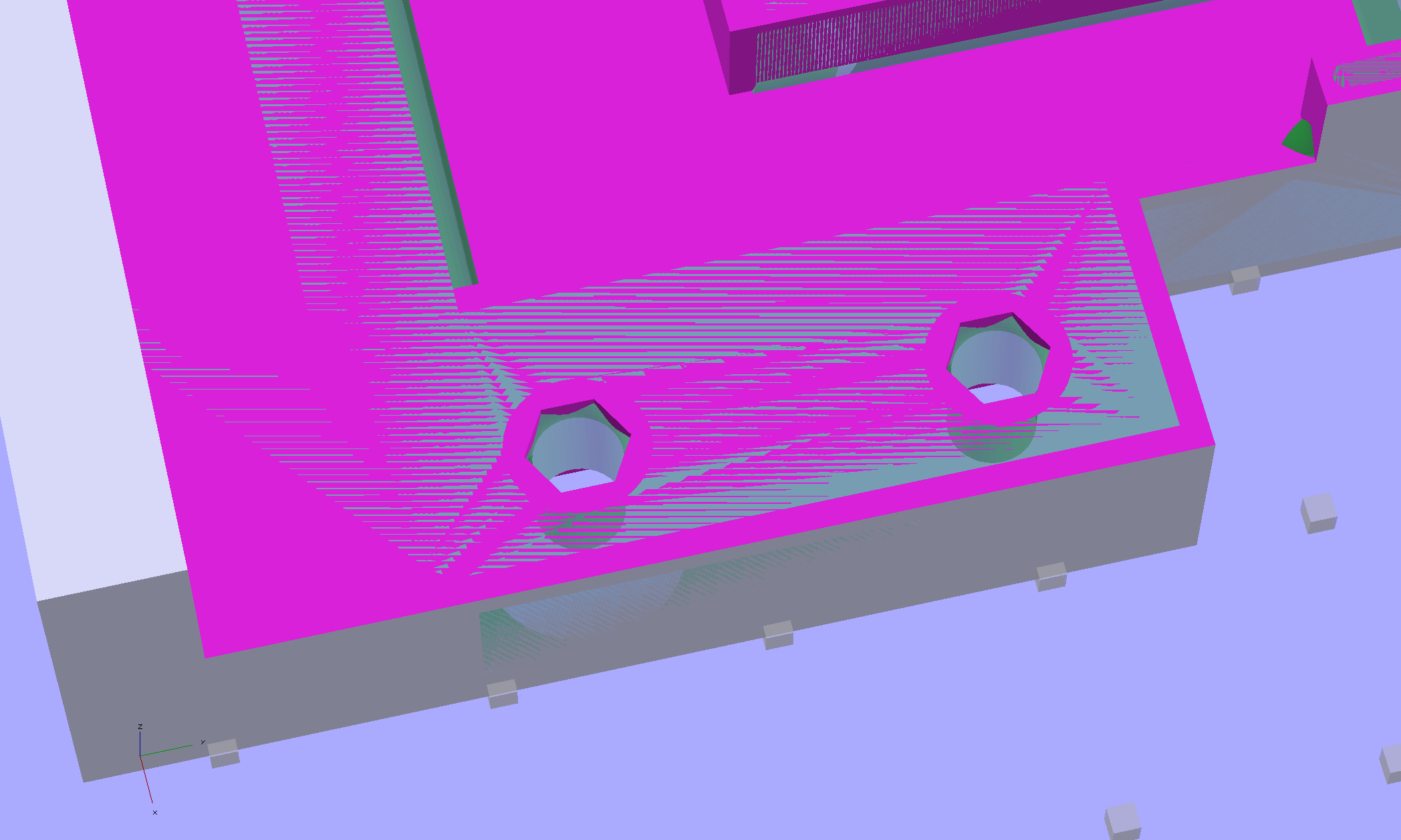
    The shimmer indicates coincident surfaces; that’s ordinarily a Very Bad Thing, but in this case it shows that the dimensions match. The top of the holes have neat hexagonal patterns where my straight-sided PolyHoles extend through their chamfered circular holes:

    M2 Wire Cover Filament Guide - overlay - hole detail
    M2 Wire Cover Filament Guide – overlay – hole detail

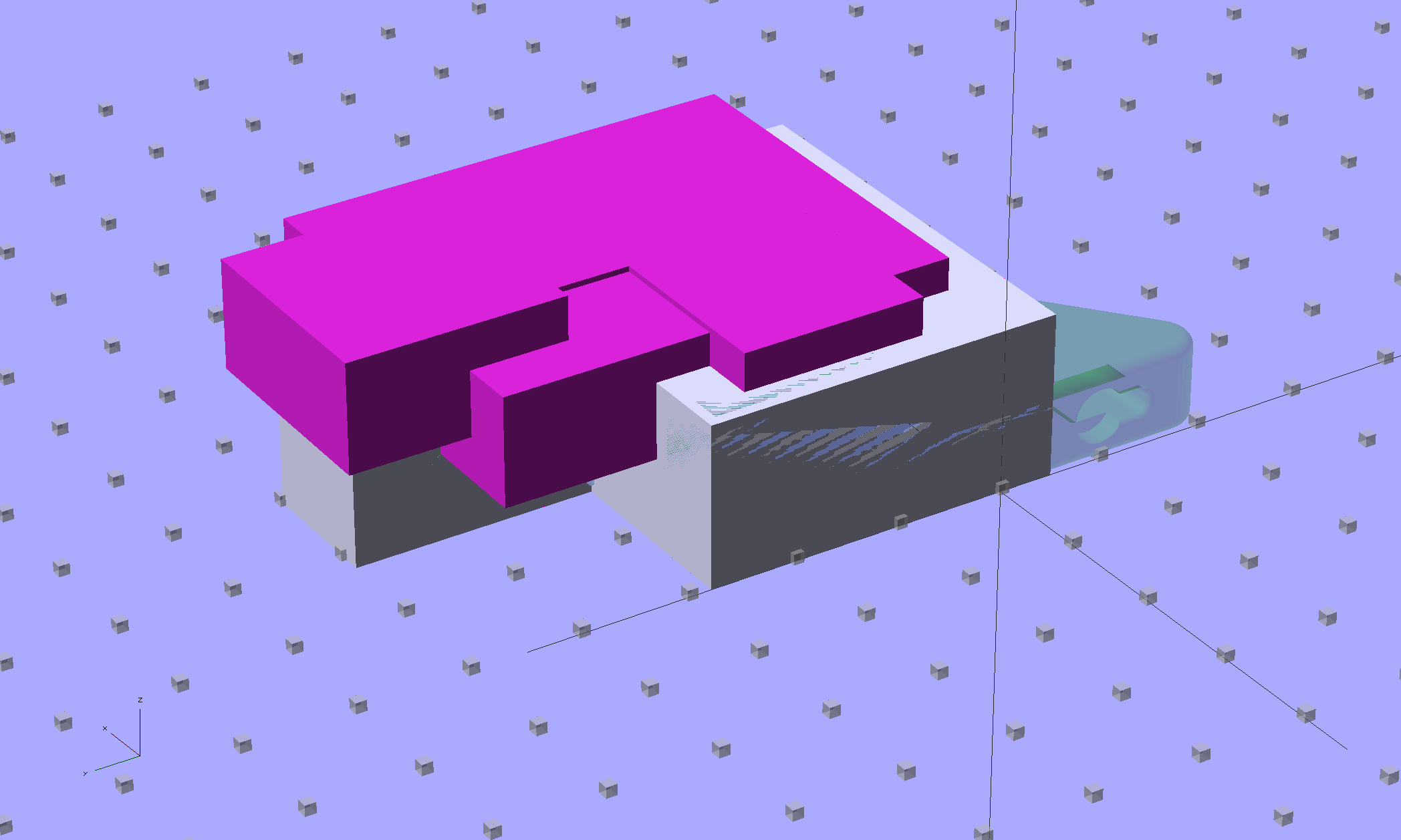
    Unlike my from-scratch OpenSCAD models, this one bristles with magic numbers that describe the dimensions of the M2 STL model. The basic shape comes from an extruded polygon matching the outside walls, another extruded polygon knocking out the wire channel, then cubes lopping off the top surfaces:

    M2 Wire Cover Filament Guide - overlay - F12 view
    M2 Wire Cover Filament Guide – overlay – F12 view

    The end result of all that thrashing around has a certain Soviet Concrete look to it:

    M2 Wire Cover - OpenSCAD solid model
    M2 Wire Cover – OpenSCAD solid model

    This version lacks the filament guide; I wanted to make sure all the protrusions and channels fit, which they sort of did:

    M2 reverse engineered wire cover - installed
    M2 reverse engineered wire cover – installed

    The next version will have slightly more clearance on the side and slightly less on the top; that’s easy to do now that I have an editable OpenSCAD model.

    The OpenSCAD source code:

    // Improved M2 filament guide and X-min switch wire guide
    // Ed Nisley KE4ZNU - Oct 2013
    
    function IntegerMultiple(Size,Unit) = Unit * ceil(Size / Unit);
    
    Protrusion = 0.1;
    
    HoleWindage = 0.2;
    
    //- Sizes
    
    PlateMinThick = 8.0;				// basic thickness excluding wire guides
    PlateLength = 5.0;					// from side of frame beyond top wire guide
    
    TopGuideLength = 7.0;				// protrusion from plate
    
    PlateThick = PlateMinThick + TopGuideLength;
    
    echo(str("Total thickness: ",PlateThick));
    
    //- Adjust hole diameter to make the size come out right
    
    module PolyCyl(Dia,Height,ForceSides=0) {			// based on nophead's polyholes
    
      Sides = (ForceSides != 0) ? ForceSides : (ceil(Dia) + 2);
    
      FixDia = Dia / cos(180/Sides);
    
      cylinder(r=(FixDia + HoleWindage)/2,h=Height,$fn=Sides);
    }
    
    //- Put peg grid on build surface
    
    module ShowPegGrid(Space = 10.0,Size = 1.0) {
    
      RangeX = floor(100 / Space);
      RangeY = floor(125 / Space);
    
    	for (x=[-RangeX:RangeX])
    	  for (y=[-RangeY:RangeY])
    		translate([x*Space,y*Space,Size/2])
    		  %cube(Size,center=true);
    
    }
    
    //- Define basic block shape
    //  Mostly reverse engineered from
    //    https://github.com/MakerGear/M2/blob/master/Printed%20Parts/STL/M2%20X%20Endstop%20Wire%20Cover%20with%20Filament%20Guide.stl
    //	Hence all the magic numbers...
    
    module BaseBlock() {
    
    SideGuideLength = 4.0;				// protrusion = even with frame interior
    ChannelDepth = 4.5;					// wiring channel
    FrameOffset = 28;
    
    	translate([18,FrameOffset,0]) {			// align neatly for later processing
    
    		if (true)
    			color("Green",0.3)
    				translate([-18,22,15])
    					rotate([-90,0,-90])
    						import("/mnt/bulkdata/Project Files/Thing-O-Matic/M2 Parts/Filament Guide/M2+X+Endstop+Wire+Cover+with+Filament+Guide.stl",
    								convexity=10);
    
    		difference() {
    			linear_extrude(height=PlateThick,convexity=5)		// main block
    				polygon(points=[[0,0],[0,22],[12,22],[12,7.5],[22,7.5],
    								[22,-(PlateLength + FrameOffset)],[-18,-(PlateLength + FrameOffset)],
    								[-18,0]
    						]);
    
    			for (i=[-1,0])
    				translate([17,((i*15.0)+ 1.05),-Protrusion])
    					rotate(180/6) {
    						PolyCyl(3.1,(PlateMinThick + 2*Protrusion),6);		// screw holes
    						PolyCyl(5.7,(3.0 + Protrusion),6);					//  ... countersink
    					}
    
    			translate([0,0,(PlateMinThick - ChannelDepth)])		// wire channel
    				linear_extrude(height=15,convexity=5)
    					polygon(points=[[2,-5],[2,19],[10,19],[10,-22],[-15,-22],[-15,-5]
    							]);
    
    			translate([-10,14,PlateMinThick])				// M2 frame
    				rotate(-90)
    					cube([42,35,10],center=false);
    
    			translate([-5,5,(PlateMinThick + SideGuideLength)])	// shorten side guide
    				cube([20,20,10],center="false");
    
    		}
    	}
    
    }
    
    //- Build it
    
    ShowPegGrid();
    
    BaseBlock();