The Smell of Molten Projects in the Morning

Ed Nisley's Blog: Shop notes, electronics, firmware, machinery, 3D printing, laser cuttery, and curiosities. Contents: 100% human thinking, 0% AI slop.

Tag: Improvements

Making the world a better place, one piece at a time

  • Under-cabinet LED Strip IR Sensor: Re-aimed

    The under-cabinet LED strips work wonderfully well, except that the IR sensor seemed rather hypersensitive, so I added a small reflector made of shiny steel:

    Under-cabinet light - IR sensor mirror
    Under-cabinet light – IR sensor mirror

    Even though I rounded those corners and deburred the edges, it does look a bit threatening, doesn’t it?

    It moves the sensor’s hotspot back about half a foot, which seems Good Enough to eliminate false triggering from normal activity over the cutting board.

  • AD8310 Log Amp Module: Sidesaddle Bracket

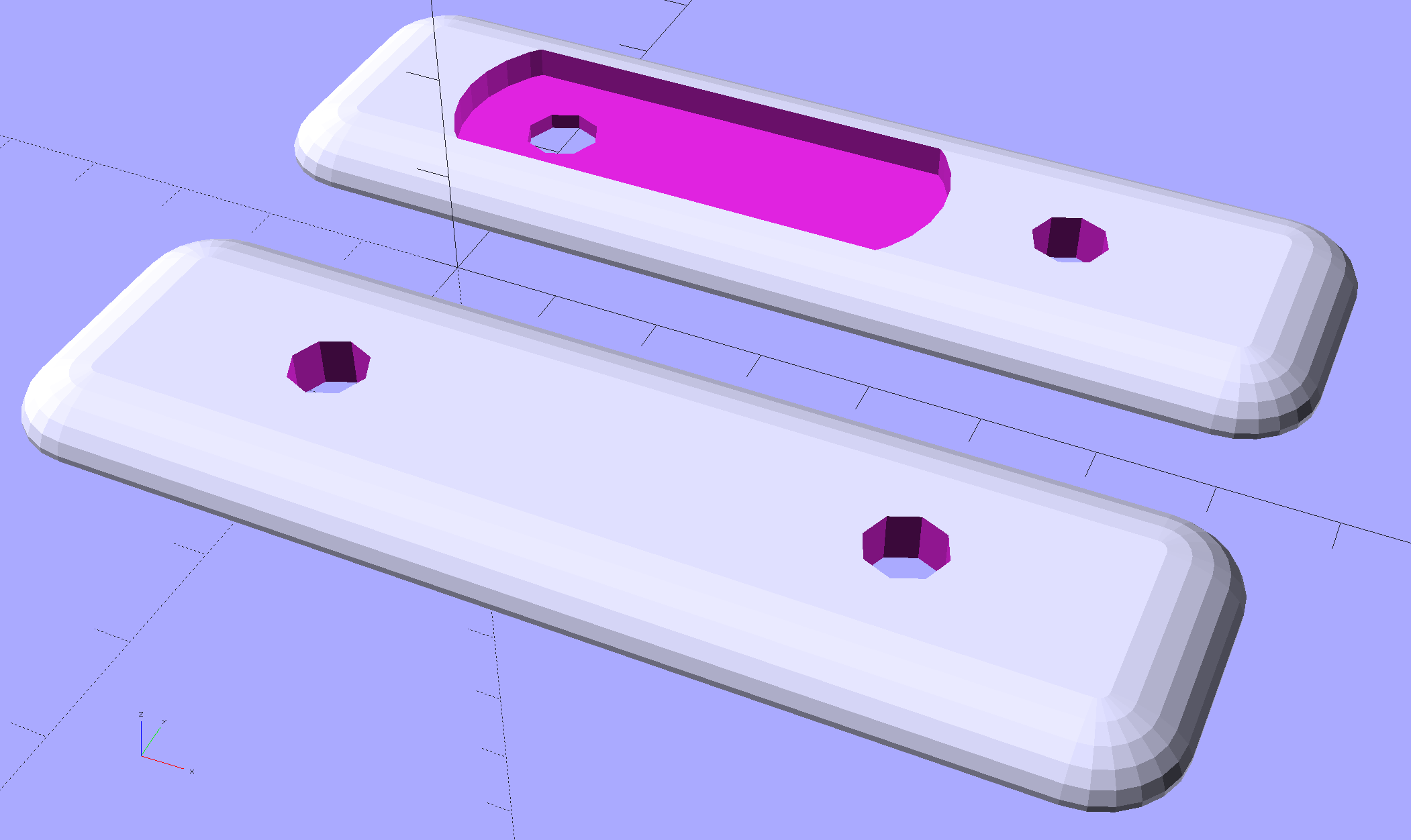
    This little bracket attaches to a proto board holder, with holes for M3 inserts to mount the AD8310 log amp module:

    PCB Side Bracket - 80x120
    PCB Side Bracket – 80×120

    Thusly:

    AD8310 module bracket on proto board holder - component side
    AD8310 module bracket on proto board holder – component side

    The OLED display looks a bit faded, which seems to be an interaction between matrix refresh and camera shutter: looks just fine in person!

    Not much to see from the other side:

    AD8310 module bracket on proto board holder - solder side
    AD8310 module bracket on proto board holder – solder side

    I should have included an offset to slide it a bit forward; then I could mount it on the other end with clearance for the Nano’s USB port. Maybe next time.

    The OpenSCAD source code as a GitHub Gist:

    // Test support frame for proto boards
    // Ed Nisley KE4ZNU – Jan 2017
    // June 2017 – Add side-mount bracket
    Layout = "Bracket";
    ClampFlange = true;
    Channel = false;
    //- Extrusion parameters – must match reality!
    ThreadThick = 0.25;
    ThreadWidth = 0.40;
    function IntegerMultiple(Size,Unit) = Unit * ceil(Size / Unit);
    Protrusion = 0.1;
    HoleWindage = 0.2;
    //- Screw sizes
    inch = 25.4;
    Tap4_40 = 0.089 * inch;
    Clear4_40 = 0.110 * inch;
    Head4_40 = 0.211 * inch;
    Head4_40Thick = 0.065 * inch;
    Nut4_40Dia = 0.228 * inch;
    Nut4_40Thick = 0.086 * inch;
    Washer4_40OD = 0.270 * inch;
    Washer4_40ID = 0.123 * inch;
    ID = 0;
    OD = 1;
    LENGTH = 2;
    Insert = [3.9,4.6,5.8];
    //- PCB sizes
    PCBSize = [80.0,120.0,1.6];
    PCBShelf = 1.5;
    Clearance = 2*[ThreadWidth,ThreadWidth,0];
    WallThick = 4.0;
    FrameHeight = 8.0;
    ScrewOffset = 0.0 + Clear4_40/2;
    ScrewSites = [[-1,1],[-1,1]]; // -1/0/+1 = left/mid/right and bottom/mid/top
    OAHeight = FrameHeight + Clearance[2] + PCBSize[2];
    echo(str("OAH: ",OAHeight));
    FlangeExtension = 3.0;
    FlangeThick = IntegerMultiple(2.0,ThreadThick);
    Flange = PCBSize
    + 2*[ScrewOffset,ScrewOffset,0]
    + 2*[Washer4_40OD,Washer4_40OD,0]
    + [2*FlangeExtension,2*FlangeExtension,(FlangeThick – PCBSize[2])]
    ;
    echo(str("Flange: ",Flange));
    NumSides = 4*5;
    WireChannel = [Flange[0],15.0,3.0 + PCBSize[2]];
    WireChannelOffset = [Flange[0]/2,25.0,(FrameHeight + PCBSize[2] – WireChannel[2]/2)];
    //- Adjust hole diameter to make the size come out right
    module PolyCyl(Dia,Height,ForceSides=0) { // based on nophead's polyholes
    Sides = (ForceSides != 0) ? ForceSides : (ceil(Dia) + 2);
    FixDia = Dia / cos(180/Sides);
    cylinder(r=(FixDia + HoleWindage)/2,h=Height,$fn=Sides);
    }
    //- Build things
    if (Layout == "Frame")
    difference() {
    union() { // body block
    translate([0,0,OAHeight/2])
    cube(PCBSize + Clearance + [2*WallThick,2*WallThick,FrameHeight],center=true);
    for (x=[-1,1], y=[-1,1]) { // screw bosses
    translate([x*(PCBSize[0]/2 + ScrewOffset),
    y*(PCBSize[1]/2 + ScrewOffset),
    0])
    cylinder(r=Washer4_40OD,h=OAHeight,$fn=NumSides);
    }
    if (ClampFlange) // flange for work holder
    linear_extrude(height=Flange[2])
    hull()
    for (i=[-1,1], j=[-1,1]) {
    translate([i*(Flange[0]/2 – Washer4_40OD/2),j*(Flange[1]/2 – Washer4_40OD/2)])
    circle(d=Washer4_40OD,$fn=NumSides);
    }
    }
    for (x=[-1,1], y=[-1,1]) { // screw position indexes
    translate([x*(PCBSize[0]/2 + ScrewOffset),
    y*(PCBSize[1]/2 + ScrewOffset),
    -Protrusion])
    rotate(x*y*180/(2*6))
    PolyCyl(Clear4_40,(OAHeight + 2*Protrusion),6); // screw clearance holes
    translate([x*(PCBSize[0]/2 + ScrewOffset),
    y*(PCBSize[1]/2 + ScrewOffset),
    OAHeight – PCBSize[2] – Insert[LENGTH]])
    rotate(x*y*180/(2*6))
    PolyCyl(Insert[OD],Insert[LENGTH] + Protrusion,6); // inserts
    translate([x*(PCBSize[0]/2 + ScrewOffset),
    y*(PCBSize[1]/2 + ScrewOffset),
    OAHeight – PCBSize[2]])
    PolyCyl(1.2*Washer4_40OD,(PCBSize[2] + Protrusion),NumSides); // washers
    }
    translate([0,0,OAHeight/2]) // through hole below PCB
    cube(PCBSize – 2*[PCBShelf,PCBShelf,0] + [0,0,2*OAHeight],center=true);
    translate([0,0,(OAHeight – (PCBSize[2] + Clearance[2])/2 + Protrusion/2)]) // PCB pocket on top
    cube(PCBSize + Clearance + [0,0,Protrusion],center=true);
    if (Channel)
    translate(WireChannelOffset) // opening for wires from bottom side
    cube(WireChannel + [0,0,Protrusion],center=true);
    }
    // Add-on bracket to hold smaller PCB upright at edge
    PCB2Insert = [3.0,4.9,4.1];
    PCB2OC = 45.0;
    if (Layout == "Bracket")
    difference() {
    hull() // frame body block
    for (x=[-1,1]) // bosses around screws
    translate([x*(PCBSize[0]/2 + ScrewOffset),0,0])
    cylinder(r=Washer4_40OD,h=OAHeight,$fn=NumSides);
    for (x=[-1,1]) // frame screw holes
    translate([x*(PCBSize[0]/2 + ScrewOffset),0,-Protrusion])
    rotate(x*180/(2*6))
    PolyCyl(Clear4_40,(OAHeight + 2*Protrusion),6);
    for (x=[-1,1]) // PCB insert holes
    translate([x*PCB2OC/2,(Washer4_40OD + Protrusion),OAHeight/2])
    rotate([90,0,0])
    cylinder(d=PCB2Insert[OD],h=2*(Washer4_40OD + Protrusion),$fn=6);
    }
  • AD9850 DDS Module: 1.3 inch I²C OLED FTW

    A white 1.3 inch I²C OLED turns out to be much more readable than the yellow-blue 0.96 inch version:

    Arduino with OLED - white 1.3 inch
    Arduino with OLED – white 1.3 inch

    Of course, after you make it readable, you immediately make room to cram more data on it:

    White 1.3 inch OLED on crystal tester
    White 1.3 inch OLED on crystal tester

    That’s on the proto board with the Arduino and AD9850 DDS ticking away on the left; the bright red MCP4725 DAC will eventually drive the scope’s X axis. Shifting the display to the I²C interface and cleaning up my SPI initialization code worked wonders: the DDS now steps a sine wave at 0.1 Hz (pretty nearly) intervals from 57.0 to 60.3 Hz.

  • AD9850 DDS Module: OLED Display

    Those little OLED displays might just work:

    Arduino with OLED - simulated DDS
    Arduino with OLED – simulated DDS

    The U8X8 driver produces those double-size bitmap characters; the default 8×8 matrix seem pretty much unreadable on a 0.96 inch OLED at any practical distance from a benchtop instrument. They might be workable on a 1.3 inch white OLED, minus the attractive yellow highlight for the frequency in the top line.

    The OLED uses an SPI interface, although the U8X8 library clobbers my (simpleminded) SPI configuration for the AD9850 DDS and I’ve dummied out the DDS outputs. A soon-to-arrive I²C OLED should resolve that problem; changing the interface from SPI to I²C involves changing the single line of code constructing the driver object, so It Should Just Work.

    The U8X8 driver writes directly to the display, thus eliminating the need for a backing buffer in the Arduino’s painfully limited RAM. I think the library hauls in all possible fonts to support font selection at runtime, even though I need at most two fonts, so it may be worthwhile to hack the unneeded ones from the library (or figure out if I misunderstand the situation and the Flash image includes only the fonts actually used). Each font occupies anywhere from 200 to 2000 bytes, which I’d rather have available for program code. Chopping out unused functions would certainly be less useful.

    The display formatting is a crude hack just to see what the numbers look like:

        int ln = 0;
        u8x8.draw2x2String(0,ln,Buffer);
        ln += 2;
    
        TestFreq.fx_64 = ScanTo.fx_64 - ScanFrom.fx_64;
        PrintFixedPtRounded(Buffer,TestFreq,1);
        u8x8.draw2x2String(0,ln,"W       ");
        u8x8.draw2x2String(2*(8-strlen(Buffer)),ln,Buffer);
        ln += 2;
    
        PrintFixedPtRounded(Buffer,ScanStep,3);
        u8x8.draw2x2String(0,ln,"S       ");
        u8x8.draw2x2String(2*(8-strlen(Buffer)),ln,Buffer);
        ln += 2;
    
        TestFreq.fx_32.high = SCAN_SETTLE;                    // milliseconds
        TestFreq.fx_32.low = 0;
        TestFreq.fx_64 /= KILO;                               // to seconds
        PrintFixedPtRounded(Buffer,TestFreq,3);
        u8x8.draw2x2String(0,ln,"T       ");
        u8x8.draw2x2String(2*(8-strlen(Buffer)),ln,Buffer);
        ln += 2;
    

    Updating the display produces a noticeable and annoying flicker, which isn’t too surprising, so each value should have an “update me” flag to avoid gratuitous writes. Abstracting the display formatting into a table-driven routine might be appropriate, when I need more than one layout, but sheesh.

    I calculate the actual frequency from the 32 bit integer delta phase word written to the DDS, rather than use the achingly precise fixed point value, so a tidy 0.100 Hz frequency step doesn’t produce neat results. Instead, the displayed value will be within ±0.0291 Hz (the frequency resolution) of the desired frequency, which probably makes more sense for the very narrow bandwidths involved in a quartz crystal test gadget.

    Computing the frequency step size makes heavy use of 64 bit integers:

    //  ScanStep.fx_64 = One.fx_64 / 4;                       // 0.25 Hz = 8 or 9 tuning register steps
      ScanStep.fx_64 = One.fx_64 / 10;                    // 0.1 Hz = 3 or 4 tuning register steps
    //  ScanStep.fx_64 = One.fx_64 / 20;                    // 0.05 Hz = 2 or 3 tuning register steps
    //  ScanStep = HzPerCt;                                   // smallest possible frequency step
    

    The fixed point numbers resulting from those divisions will be accurate to nine decimal places; good enough for what I need.

    The sensible way of handling discrete scan width / step size / settling time options is through menus showing the allowed choices, with joystick / joyswitch navigation & selection, rather than keyboard entry. An analog joystick has the distinct advantage of using two analog inputs, not four digital pins, although the U8X8 driver includes a switch-driven menu handler.

    There’s a definite need to log all the values through the serial output for data collection without hand transcription.

    The Arduino source code as a GitHub Gist:

    // OLED display test for 60 kHz crystal tester
    #include <avr/pgmspace.h>
    //#include <SPI.h>
    #include <U8g2lib.h>
    #include <U8x8lib.h>
    // Turn off DDS SPI for display checkout
    #define DOSPI 0
    //———————
    // Pin locations
    // SPI uses hardware support: those pins are predetermined
    #define PIN_HEARTBEAT 9
    #define PIN_DDS_RESET 7
    #define PIN_DDS_LATCH 8
    #define PIN_DISP_SEL 4
    #define PIN_DISP_DC 5
    #define PIN_DISP_RST 6
    #define PIN_SCK 13
    #define PIN_MISO 12
    #define PIN_MOSI 11
    #define PIN_SS 10
    char Buffer[10+1+10+1]; // string buffer for long long conversions
    #define GIGA 1000000000LL
    #define MEGA 1000000LL
    #define KILO 1000LL
    struct ll_fx {
    uint32_t low; // fractional part
    uint32_t high; // integer part
    };
    union ll_u {
    uint64_t fx_64;
    struct ll_fx fx_32;
    };
    union ll_u CtPerHz; // will be 2^32 / 125 MHz
    union ll_u HzPerCt; // will be 125 MHz / 2^32
    union ll_u One; // 1.0 as fixed point
    union ll_u Tenth; // 0.1 as fixed point
    union ll_u TenthHzCt; // 0.1 Hz in counts
    // All nominal values are integers for simplicity
    #define OSC_NOMINAL (125 * MEGA)
    #define OSC_OFFSET_NOMINAL (-344LL)
    union ll_u OscillatorNominal; // nominal oscillator frequency
    union ll_u OscOffset; // … and offset, which will be signed 64-bit value
    union ll_u Oscillator; // true oscillator frequency with offset
    union ll_u CenterFreq; // center of scan width
    #define SCAN_WIDTH 6
    #define SCAN_SETTLE 2000
    union ll_u ScanFrom, ScanTo, ScanFreq, ScanStep; // frequency scan settings
    uint8_t ScanStepCounter;
    union ll_u TestFreq,TestCount; // useful variables
    //U8X8_SH1106_128X64_NONAME_4W_HW_SPI u8x8(PIN_DISP_SEL, PIN_DISP_DC , PIN_DISP_RST);
    U8X8_SH1106_128X64_NONAME_4W_SW_SPI u8x8(PIN_SCK, PIN_MOSI, PIN_DISP_SEL, PIN_DISP_DC , PIN_DISP_RST);
    //U8X8_SH1106_128X64_NONAME_HW_I2C u8x8(U8X8_PIN_NONE);
    #define HEARTBEAT_MS 3000
    unsigned long MillisNow,MillisThen;
    //———–
    // Useful functions
    // Pin twiddling
    void TogglePin(char bitpin) {
    digitalWrite(bitpin,!digitalRead(bitpin)); // toggle the bit based on previous output
    }
    void PulsePin(char bitpin) {
    TogglePin(bitpin);
    TogglePin(bitpin);
    }
    // SPI I/O
    void EnableSPI(void) {
    digitalWrite(PIN_SS,HIGH); // set SPI into Master mode
    SPCR |= 1 << SPE;
    }
    void DisableSPI(void) {
    SPCR &= ~(1 << SPE);
    }
    void WaitSPIF(void) {
    while (! (SPSR & (1 << SPIF))) {
    TogglePin(PIN_HEARTBEAT);
    TogglePin(PIN_HEARTBEAT);
    continue;
    }
    }
    byte SendRecSPI(byte Dbyte) { // send one byte, get another in exchange
    SPDR = Dbyte;
    WaitSPIF();
    return SPDR; // SPIF will be cleared
    }
    // DDS module
    void EnableDDS(void) {
    digitalWrite(PIN_DDS_LATCH,LOW); // ensure proper startup
    digitalWrite(PIN_DDS_RESET,HIGH); // minimum reset pulse 40 ns, not a problem
    digitalWrite(PIN_DDS_RESET,LOW);
    delayMicroseconds(1); // max latency 100 ns, not a problem
    DisableSPI(); // allow manual control of outputs
    digitalWrite(PIN_SCK,LOW); // ensure clean SCK pulse
    PulsePin(PIN_SCK); // … to latch hardwired config bits
    PulsePin(PIN_DDS_LATCH); // load hardwired config bits = begin serial mode
    EnableSPI(); // turn on hardware SPI controls
    SendRecSPI(0x00); // shift in serial config bits
    PulsePin(PIN_DDS_LATCH); // load serial config bits
    }
    // Write delta phase count to DDS
    // This comes from the integer part of a 64-bit scaled value
    void WriteDDS(uint32_t DeltaPhase) {
    SendRecSPI((byte)DeltaPhase); // low-order byte first
    SendRecSPI((byte)(DeltaPhase >> 8));
    SendRecSPI((byte)(DeltaPhase >> 16));
    SendRecSPI((byte)(DeltaPhase >> 24));
    SendRecSPI(0x00); // 5 MSBs = phase = 0, 3 LSBs must be zero
    PulsePin(PIN_DDS_LATCH); // write data to DDS
    }
    //———–
    // Round scaled fixed point to specific number of decimal places: 0 through 8
    // You should display the value with only Decimals characters beyond the point
    // Must calculate rounding value as separate variable to avoid mystery error
    uint64_t RoundFixedPt(union ll_u TheNumber,unsigned Decimals) {
    union ll_u Rnd;
    Rnd.fx_64 = (One.fx_64 / 2) / (pow(10LL,Decimals));
    TheNumber.fx_64 = TheNumber.fx_64 + Rnd.fx_64;
    return TheNumber.fx_64;
    }
    //———–
    // Multiply two unsigned scaled fixed point numbers without overflowing a 64 bit value
    // The product of the two integer parts mut be < 2^32
    uint64_t MultiplyFixedPt(union ll_u Mcand, union ll_u Mplier) {
    union ll_u Result;
    Result.fx_64 = ((uint64_t)Mcand.fx_32.high * (uint64_t)Mplier.fx_32.high) << 32; // integer parts (clear fract)
    Result.fx_64 += ((uint64_t)Mcand.fx_32.low * (uint64_t)Mplier.fx_32.low) >> 32; // fraction parts (always < 1)
    Result.fx_64 += (uint64_t)Mcand.fx_32.high * (uint64_t)Mplier.fx_32.low; // cross products
    Result.fx_64 += (uint64_t)Mcand.fx_32.low * (uint64_t)Mplier.fx_32.high;
    return Result.fx_64;
    }
    //———–
    // Long long print-to-buffer helpers
    // Assumes little-Endian layout
    void PrintHexLL(char *pBuffer,union ll_u FixedPt) {
    sprintf(pBuffer,"%08lx %08lx",FixedPt.fx_32.high,FixedPt.fx_32.low);
    }
    // converts all 9 decimal digits of fraction, which should suffice
    void PrintFractionLL(char *pBuffer,union ll_u FixedPt) {
    union ll_u Fraction;
    Fraction.fx_64 = FixedPt.fx_32.low; // copy 32 fraction bits, high order = 0
    Fraction.fx_64 *= GIGA; // times 10^9 for conversion
    Fraction.fx_64 >>= 32; // align integer part in low long
    sprintf(pBuffer,"%09lu",Fraction.fx_32.low); // convert low long to decimal
    }
    void PrintIntegerLL(char *pBuffer,union ll_u FixedPt) {
    sprintf(pBuffer,"%lu",FixedPt.fx_32.high);
    }
    void PrintFixedPt(char *pBuffer,union ll_u FixedPt) {
    PrintIntegerLL(pBuffer,FixedPt); // do the integer part
    pBuffer += strlen(pBuffer); // aim pointer beyond integer
    *pBuffer++ = '.'; // drop in the decimal point, tick pointer
    PrintFractionLL(pBuffer,FixedPt);
    }
    void PrintFixedPtRounded(char *pBuffer,union ll_u FixedPt,unsigned Decimals) {
    char *pDecPt;
    FixedPt.fx_64 = RoundFixedPt(FixedPt,Decimals);
    PrintIntegerLL(pBuffer,FixedPt); // do the integer part
    pBuffer += strlen(pBuffer); // aim pointer beyond integer
    pDecPt = pBuffer; // save the point location
    *pBuffer++ = '.'; // drop in the decimal point, tick pointer
    PrintFractionLL(pBuffer,FixedPt); // do the fraction
    if (Decimals == 0)
    *pDecPt = 0; // 0 places means discard the decimal point
    else
    *(pDecPt + Decimals + 1) = 0; // truncate string to leave . and Decimals chars
    }
    //———–
    // Calculate useful "constants" from oscillator info
    // Args are integer constants in Hz
    void CalcOscillator(uint32_t Base,uint32_t Offset) {
    union ll_u Temp;
    Oscillator.fx_32.high = Base + Offset; // get true osc frequency from integers
    Oscillator.fx_32.low = 0;
    HzPerCt.fx_32.low = Oscillator.fx_32.high; // divide oscillator by 2^32 with simple shifting
    HzPerCt.fx_32.high = 0;
    CtPerHz.fx_64 = -1; // Compute (2^32 – 1) / oscillator
    CtPerHz.fx_64 /= (uint64_t)Oscillator.fx_32.high; // remove 2^32 scale factor from divisor
    TenthHzCt.fx_64 = MultiplyFixedPt(Tenth,CtPerHz); // 0.1 Hz as delta-phase count
    #if 0
    printf("Inputs: %ld = %ld%+ld\n",Base+Offset,Base,Offset);
    PrintFixedPt(Buffer,Oscillator);
    printf("Osc freq: %s\n",Buffer);
    PrintFixedPt(Buffer,HzPerCt);
    printf("Hz/Ct: %s\n",Buffer);
    PrintFixedPt(Buffer,CtPerHz);
    printf("Ct/Hz: %s\n",Buffer);
    PrintFixedPt(Buffer,TenthHzCt);
    printf("0.1 Hz Ct: %s",Buffer);
    #endif
    }
    //– Helper routine for printf()
    int s_putc(char c, FILE *t) {
    Serial.write(c);
    }
    //———–
    void setup ()
    {
    pinMode(PIN_HEARTBEAT,OUTPUT);
    digitalWrite(PIN_HEARTBEAT,HIGH); // show we got here
    Serial.begin (115200);
    fdevopen(&s_putc,0); // set up serial output for printf()
    Serial.println (F("DDS OLED exercise"));
    Serial.println (F("Ed Nisley – KE4ZNU – May 2017\n"));
    // DDS module controls
    pinMode(PIN_DDS_LATCH,OUTPUT);
    digitalWrite(PIN_DDS_LATCH,LOW);
    pinMode(PIN_DDS_RESET,OUTPUT);
    digitalWrite(PIN_DDS_RESET,HIGH);
    // Light up the display
    Serial.println("Initialize OLED");
    u8x8.begin();
    u8x8.setPowerSave(0);
    u8x8.setFont(u8x8_font_pxplusibmcga_f);
    u8x8.draw2x2String(0,0,"OLEDTest");
    u8x8.drawString(0,2,"Ed Nisley");
    u8x8.drawString(0,3," KE4ZNU");
    u8x8.drawString(0,4,"May 2017");
    // configure SPI hardware
    #if DOSPI
    SPCR = B01110001; // Auto SPI: no int, enable, LSB first, master, + edge, leading, f/16
    SPSR = B00000000; // not double data rate
    pinMode(PIN_SS,OUTPUT);
    digitalWrite(PIN_SCK,HIGH);
    pinMode(PIN_SCK,OUTPUT);
    digitalWrite(PIN_SCK,LOW);
    pinMode(PIN_MOSI,OUTPUT);
    digitalWrite(PIN_MOSI,LOW);
    pinMode(PIN_MISO,INPUT_PULLUP);
    #endif
    TogglePin(PIN_HEARTBEAT); // show we got here
    // Calculate useful constants
    One.fx_64 = 1LL << 32; // Set up 1.0, a very useful constant
    Tenth.fx_64 = One.fx_64 / 10; // Likewise, 0.1
    // Set oscillator "constants"
    CalcOscillator(OSC_NOMINAL,OSC_OFFSET_NOMINAL);
    TogglePin(PIN_HEARTBEAT); // show we got here
    // Set the crystal-under-test nominal frequency
    CenterFreq.fx_64 = One.fx_64 * (60 * KILO);
    #if 1
    PrintFixedPtRounded(Buffer,CenterFreq,1);
    printf("Center: %s\n",Buffer);
    #endif
    // Set up scan limits based on center frequency
    ScanFrom.fx_64 = CenterFreq.fx_64 – SCAN_WIDTH * (One.fx_64 >> 1);
    ScanTo.fx_64 = CenterFreq.fx_64 + SCAN_WIDTH * (One.fx_64 >> 1);
    ScanFreq = ScanFrom; // start scan at lower limit
    // ScanStep.fx_64 = One.fx_64 / 4; // 0.25 Hz = 8 or 9 tuning register steps
    ScanStep.fx_64 = One.fx_64 / 10; // 0.1 Hz = 3 or 4 tuning register steps
    // ScanStep.fx_64 = One.fx_64 / 20; // 0.05 Hz = 2 or 3 tuning register steps
    // ScanStep = HzPerCt; // smallest possible frequency step
    #if 1
    Serial.println("\nScan limits");
    PrintFixedPtRounded(Buffer,ScanFrom,1);
    printf(" from: %11s\n",Buffer);
    PrintFixedPtRounded(Buffer,ScanFreq,1);
    printf(" at: %11s\n",Buffer);
    PrintFixedPtRounded(Buffer,ScanTo,1);
    printf(" to: %11s\n",Buffer);
    PrintFixedPtRounded(Buffer,ScanStep,3);
    printf(" step: %s\n",Buffer);
    #endif
    // Wake up and load the DDS
    #if DOSPI
    TestCount.fx_64 = MultiplyFixedPt(ScanFreq,CtPerHz);
    EnableDDS();
    WriteDDS(TestCount.fx_32.high);
    #endif
    delay(2000);
    u8x8.clearDisplay();
    u8x8.setFont(u8x8_font_artossans8_r);
    Serial.println("\nStartup done!");
    MillisThen = millis();
    }
    //———–
    void loop () {
    MillisNow = millis();
    if ((MillisNow – MillisThen) >= SCAN_SETTLE) {
    TogglePin(PIN_HEARTBEAT);
    MillisThen = MillisNow;
    PrintFixedPtRounded(Buffer,ScanFreq,2);
    TestCount.fx_64 = MultiplyFixedPt(ScanFreq,CtPerHz);
    // printf("%12s -> %9ld\n",Buffer,TestCount.fx_32.high);
    #if DOSPI
    WriteDDS(TestCount.fx_32.high);
    #endif
    TestCount.fx_32.low = 0; // truncate to integer
    TestFreq.fx_64 = MultiplyFixedPt(TestCount,HzPerCt); // recompute frequency
    PrintFixedPtRounded(Buffer,TestFreq,2);
    int ln = 0;
    u8x8.draw2x2String(0,ln,Buffer);
    ln += 2;
    TestFreq.fx_64 = ScanTo.fx_64 – ScanFrom.fx_64;
    PrintFixedPtRounded(Buffer,TestFreq,1);
    u8x8.draw2x2String(0,ln,"W ");
    u8x8.draw2x2String(2*(8-strlen(Buffer)),ln,Buffer);
    ln += 2;
    PrintFixedPtRounded(Buffer,ScanStep,3);
    u8x8.draw2x2String(0,ln,"S ");
    u8x8.draw2x2String(2*(8-strlen(Buffer)),ln,Buffer);
    ln += 2;
    TestFreq.fx_32.high = SCAN_SETTLE; // milliseconds
    TestFreq.fx_32.low = 0;
    TestFreq.fx_64 /= KILO; // to seconds
    PrintFixedPtRounded(Buffer,TestFreq,3);
    u8x8.draw2x2String(0,ln,"T ");
    u8x8.draw2x2String(2*(8-strlen(Buffer)),ln,Buffer);
    ln += 2;
    ScanFreq.fx_64 += ScanStep.fx_64;
    if (ScanFreq.fx_64 > (ScanTo.fx_64 + ScanStep.fx_64 / 2)) {
    ScanFreq = ScanFrom;
    }
    }
    }
    view raw DDSOLEDTest.ino hosted with ❤ by GitHub
  • Bathroom Door Retainer

    The weather got warm enough to open the windows before pollen season started, which led to the front bathroom door slamming closed in the middle of the night when a gusty rainstorm blew through town. After far too many years, I decided this was an annoyance up with which I need no longer put.

    A few minutes with OpenSCAD and Slic3r produces the shape:

    Bathroom Door Retainer - Slic3r
    Bathroom Door Retainer – Slic3r

    It’s basically an extrusion of a 2D shape with a rectangular recess for the door chewed out.

    An hour later, it’s in full effect:

    Bathroom Door Retainer - installed
    Bathroom Door Retainer – installed

    The model now sports a little ball to secure the retainer against the towel bar:

    Bathroom Door Retainer - bump
    Bathroom Door Retainer – bump

    Maybe someday I’ll reprint it.

    That was easy …

    The cast-iron pig sometimes standing guard as a doorstop in the relatively narrow doorway poses a bit of a foot hazard, so he moves into a closet during the off season. He can now remain there, snug and comfy, until a need for ballast arises.

    The OpenSCAD source code as a GitHub Gist:

    // Bathroom Door Retainer
    // Ed Nisley KE4ZNU – May 2017
    Layout = "Show"; // Show Build
    //——-
    //- Extrusion parameters must match reality!
    ThreadThick = 0.20;
    ThreadWidth = 0.40;
    HoleWindage = 0.2;
    Protrusion = 0.1; // make holes end cleanly
    function IntegerMultiple(Size,Unit) = Unit * ceil(Size / Unit);
    //——-
    // Dimensions
    TowelBarSide = 20.5; // towel bar across flat side
    TowelBarAngle = 45; // rotation of top flat from horizontal
    DoorOffset = 16.0; // from towel bar to door
    DoorThick = 36.5;
    WallThick = 4.0; // minimum wall thickness
    RetainerDepth = 10.0; // thickness of retaining notch
    NumSides = 6*4;
    CornerRad = WallThick;
    BarClipOD = TowelBarSide*sqrt(2) + 2*WallThick;
    BarClipRad = BarClipOD/2;
    OAH = RetainerDepth + WallThick;
    module LatchPlan() {
    union() {
    linear_extrude(height=OAH,convexity=4)
    difference() {
    union() {
    circle(d=BarClipOD,$fn=NumSides);
    hull()
    for (i=[0,1], j=[0,1])
    translate([i*(BarClipRad + DoorOffset + DoorThick + WallThick – CornerRad),j*(BarClipRad – CornerRad)])
    circle(r=CornerRad,$fn=4*4);
    }
    rotate(TowelBarAngle) // towel bar shape
    square(size=TowelBarSide,center=true);
    translate([0,-TowelBarSide/sqrt(2)]) // make access slot
    rotate(-TowelBarAngle)
    square(size=[2*TowelBarSide,TowelBarSide],center=false);
    }
    translate([0,-TowelBarSide/sqrt(2),OAH/2])
    rotate([90,0,45])
    sphere(r=TowelBarSide/25,$fn=4*3);
    }
    }
    module Latch() {
    difference() {
    LatchPlan();
    translate([BarClipRad + DoorOffset,-BarClipRad/2,-Protrusion])
    cube([DoorThick,BarClipOD,RetainerDepth + Protrusion],center=false);
    }
    }
    //——-
    // Build it!
    if (Layout == "Show") {
    Latch();
    }
    if (Layout == "Build") {
    translate([0,0,OAH])
    rotate([180,0,0])
    Latch();
    }
  • Arduino vs. Significant Figures: Useful 64-bit Fixed Point

    Devoting eight bytes to every fixed point number may be excessive, but having nine significant figures apiece for the integer and fraction parts pushes the frequency calculations well beyond the limits of the DDS hardware, without involving any floating point library routines. This chunk of code performs a few more calculations using the format laid out earlier and explores a few idioms that may come in handy later.

    Rounding the numbers to a specific number of decimal places gets rid of the repeating-digit problem that turns 0.10 into 0.099999:

    uint64_t RoundFixedPt(union ll_u TheNumber,unsigned Decimals) {
    union ll_u Rnd;
    
      Rnd.fx_64 = (One.fx_64 / 2) / (pow(10LL,Decimals));
      TheNumber.fx_64 = TheNumber.fx_64 + Rnd.fx_64;
      return TheNumber.fx_64;
    }
    

    That pretty well trashes the digits beyond the rounded place, so you shouldn’t display any more of them:

    void PrintFixedPtRounded(char *pBuffer,union ll_u FixedPt,unsigned Decimals) {
    char *pDecPt;
    
      FixedPt.fx_64 = RoundFixedPt(FixedPt,Decimals);
    
      PrintIntegerLL(pBuffer,FixedPt);  // do the integer part
    
      pBuffer += strlen(pBuffer);       // aim pointer beyond integer
    
      pDecPt = pBuffer;                 // save the point location
      *pBuffer++ = '.';                 // drop in the decimal point, tick pointer
    
      PrintFractionLL(pBuffer,FixedPt);
    
      if (Decimals == 0)
        *pDecPt = 0;                    // 0 places means discard the decimal point
      else
        *(pDecPt + Decimals + 1) = 0;   // truncate string to leave . and Decimals chars
    }
    

    Which definitely makes the numbers look prettier:

      Tenth.fx_64 = One.fx_64 / 10;             // Likewise, 0.1
      PrintFixedPt(Buffer,Tenth);
      printf("\n0.1: %s\n",Buffer);
      PrintFixedPtRounded(Buffer,Tenth,9);                    // show rounded value
      printf("0.1 to 9 dec: %s\n",Buffer);
    
      TestFreq.fx_64 = RoundFixedPt(Tenth,3);                 // show full string after rounding
      PrintFixedPt(Buffer,TestFreq);
      printf("0.1 to 3 dec: %s (full string)\n",Buffer);
    
      PrintFixedPtRounded(Buffer,Tenth,3);                    // show truncated string with rounded value
      printf("0.1 to 3 dec: %s (truncated string)\n",Buffer);
    
    0.1: 0.099999999
    0.1 to 9 dec: 0.100000000
    0.1 to 3 dec: 0.100499999 (full string)
    0.1 to 3 dec: 0.100 (truncated string)
    
      CtPerHz.fx_64 = -1;                       // Set up 2^32 - 1, which is close enough
      CtPerHz.fx_64 /= 125 * MEGA;              // divide by nominal oscillator
      PrintFixedPt(Buffer,CtPerHz);
      printf("\nCt/Hz = %s\n",Buffer);
    
      printf("Rounding: \n");
      for (int d = 9; d >= 0; d--) {
        PrintFixedPtRounded(Buffer,CtPerHz,d);
        printf("     %d: %s\n",d,Buffer);
      }
    
    Ct/Hz = 34.359738367
    Rounding:
         9: 34.359738368
         8: 34.35973837
         7: 34.3597384
         6: 34.359738
         5: 34.35974
         4: 34.3597
         3: 34.360
         2: 34.36
         1: 34.4
         0: 34
    

    Multiplying two scaled 64-bit fixed-point numbers should produce a 128-bit result. For all the values we (well, I) care about, the product will fit into a 64-bit result, because the integer parts will always multiply out to less than 232 and we don’t care about more than 32 bits of fraction. This function multiplies two fixed point numbers of the form a.b × c.d by adding up the partial products thusly: ac + bd + ad + bc. The product of the integers ac won’t overflow 32 bits, the cross products ad and bc will always be slightly less than their integer factors, and the fractional product bd will always be less than 1.0.

    Soooo, just multiply ’em out as 64-bit integers, shift the products around to align the appropriate parts, and add up the pieces:

    
    uint64_t MultiplyFixedPt(union ll_u Mcand, union ll_u Mplier) {
    union ll_u Result;
    
      Result.fx_64  = ((uint64_t)Mcand.fx_32.high * (uint64_t)Mplier.fx_32.high) << 32; // integer parts (clear fract) 
      Result.fx_64 += ((uint64_t)Mcand.fx_32.low * (uint64_t)Mplier.fx_32.low) >> 32;   // fraction parts (always < 1)
      Result.fx_64 += (uint64_t)Mcand.fx_32.high * (uint64_t)Mplier.fx_32.low;          // cross products
      Result.fx_64 += (uint64_t)Mcand.fx_32.low * (uint64_t)Mplier.fx_32.high;
    
      return Result.fx_64;
    }
    

    This may be a useful way to set magic numbers with a few decimal places, although it does require keeping the decimal point in mind:

      TestFreq.fx_64 = (599999LL * One.fx_64) / 10;           // set 59999.9 kHz differently
      PrintFixedPt(Buffer,TestFreq);
      printf("\nTest frequency: %s\n",Buffer);
      PrintFixedPtRounded(Buffer,TestFreq,1);
      printf("         round: %s\n",Buffer);
    
    Test frequency: 59999.899999999
             round: 59999.9
    

    Contrary to what I thought, computing the CtPerHz coefficient doesn’t require pre-dividing both 232 and the oscillator by 2, thus preventing the former from overflowing a 32 bit integer. All you do is knock the numerator down by one little itty bitty count you’ll never notice:

      CtPerHz.fx_64 = -1;                       // Set up 2^32 - 1, which is close enough
      CtPerHz.fx_64 /= 125 * MEGA;              // divide by nominal oscillator
      PrintFixedPt(Buffer,CtPerHz);
      printf("\nCt/Hz = %s\n",Buffer);
    
    Ct/Hz = 34.359738367
    

    That’s also the largest possible fixed-point number, because unsigned:

      TempFX.fx_64 = -1;
      PrintFixedPt(Buffer,TempFX);
      printf("Max fixed point: %s\n",Buffer);
    
    Max fixed point: 4294967295.999999999
    

    With nine.nine significant figures in the mix, tweaking the 125 MHz oscillator to within 2 Hz will work:

    Oscillator tune: CtPerHz
     Oscillator: 125000000.00
     -10 -> 34.359741116
      -9 -> 34.359741116
      -8 -> 34.359740566
      -7 -> 34.359740566
      -6 -> 34.359740017
      -5 -> 34.359740017
      -4 -> 34.359739467
      -3 -> 34.359739467
      -2 -> 34.359738917
      -1 -> 34.359738917
      +0 -> 34.359738367
      +1 -> 34.359738367
      +2 -> 34.359737818
      +3 -> 34.359737818
      +4 -> 34.359737268
      +5 -> 34.359737268
      +6 -> 34.359736718
      +7 -> 34.359736718
      +8 -> 34.359736168
      +9 -> 34.359736168
     +10 -> 34.359735619
    

    So, all in all, this looks good. The vast number of strings in the test program bulk it up beyond reason, but in actual practice I think the code will be smaller than the equivalent floating point version, with more significant figures. Speed isn’t an issue either way, because the delays waiting for the crystal tester to settle down at each frequency step should be larger than any possible computation.

    The results were all verified with my trusty HP 50g and HP-15C calculators, both of which wipe the floor with any other way of handling mixed binary / hex / decimal arithmetic. If you do bit-wise calculations, even on an irregular basis, get yourself a SwissMicro DM16L; you can thank me later.

    The Arduino source code as a GitHub Gist:

    // Fixed point exercise for 60 kHz crystal tester
    #include <avr/pgmspace.h>
    char Buffer[10+1+10+1]; // string buffer for long long conversions
    #define GIGA 1000000000LL
    #define MEGA 1000000LL
    #define KILO 1000LL
    struct ll_fx {
    uint32_t low;
    uint32_t high;
    };
    union ll_u {
    uint64_t fx_64;
    struct ll_fx fx_32;
    };
    union ll_u CtPerHz; // will be 2^32 / 125 MHz
    union ll_u HzPerCt; // will be 125 MHz / 2^32
    union ll_u One; // 1.0 as fixed point
    union ll_u Tenth; // 0.1 as fixed point
    union ll_u TenthHzCt; // 0.1 Hz in counts
    union ll_u Oscillator; // nominal oscillator frequency
    union ll_u OscOffset; // oscillator calibration offset
    union ll_u TestFreq,TestCount; // useful variables
    union ll_u TempFX;
    //———–
    // Round scaled fixed point to specific number of decimal places: 0 through 8
    // You should display the value with only Decimals characters beyond the point
    // Must calculate rounding value as separate variable to avoid mystery error
    uint64_t RoundFixedPt(union ll_u TheNumber,unsigned Decimals) {
    union ll_u Rnd;
    // printf(" round before: %08lx %08lx\n",TheNumber.fx_32.high,TheNumber.fx_32.low);
    Rnd.fx_64 = (One.fx_64 / 2) / (pow(10LL,Decimals));
    // printf(" incr: %08lx %08lx\n",Rnd.fx_32.high,Rnd.fx_32.low);
    TheNumber.fx_64 = TheNumber.fx_64 + Rnd.fx_64;
    // printf(" after: %08lx %08lx\n",TheNumber.fx_32.high,TheNumber.fx_32.low);
    return TheNumber.fx_64;
    }
    //———–
    // Multiply two unsigned scaled fixed point numbers without overflowing a 64 bit value
    // The product of the two integer parts mut be < 2^32
    uint64_t MultiplyFixedPt(union ll_u Mcand, union ll_u Mplier) {
    union ll_u Result;
    Result.fx_64 = ((uint64_t)Mcand.fx_32.high * (uint64_t)Mplier.fx_32.high) << 32; // integer parts (clear fract)
    Result.fx_64 += ((uint64_t)Mcand.fx_32.low * (uint64_t)Mplier.fx_32.low) >> 32; // fraction parts (always < 1)
    Result.fx_64 += (uint64_t)Mcand.fx_32.high * (uint64_t)Mplier.fx_32.low; // cross products
    Result.fx_64 += (uint64_t)Mcand.fx_32.low * (uint64_t)Mplier.fx_32.high;
    return Result.fx_64;
    }
    //———–
    // Long long print-to-buffer helpers
    // Assumes little-Endian layout
    void PrintHexLL(char *pBuffer,union ll_u FixedPt) {
    sprintf(pBuffer,"%08lx %08lx",FixedPt.fx_32.high,FixedPt.fx_32.low);
    }
    // converts all 9 decimal digits of fraction, which should suffice
    void PrintFractionLL(char *pBuffer,union ll_u FixedPt) {
    union ll_u Fraction;
    Fraction.fx_64 = FixedPt.fx_32.low; // copy 32 fraction bits, high order = 0
    Fraction.fx_64 *= GIGA; // times 10^9 for conversion
    Fraction.fx_64 >>= 32; // align integer part in low long
    sprintf(pBuffer,"%09lu",Fraction.fx_32.low); // convert low long to decimal
    }
    void PrintIntegerLL(char *pBuffer,union ll_u FixedPt) {
    sprintf(pBuffer,"%lu",FixedPt.fx_32.high);
    }
    void PrintFixedPt(char *pBuffer,union ll_u FixedPt) {
    PrintIntegerLL(pBuffer,FixedPt); // do the integer part
    pBuffer += strlen(pBuffer); // aim pointer beyond integer
    *pBuffer++ = '.'; // drop in the decimal point, tick pointer
    PrintFractionLL(pBuffer,FixedPt);
    }
    void PrintFixedPtRounded(char *pBuffer,union ll_u FixedPt,unsigned Decimals) {
    char *pDecPt;
    //char *pBase;
    // pBase = pBuffer;
    FixedPt.fx_64 = RoundFixedPt(FixedPt,Decimals);
    PrintIntegerLL(pBuffer,FixedPt); // do the integer part
    // printf(" Buffer int: [%s]\n",pBase);
    pBuffer += strlen(pBuffer); // aim pointer beyond integer
    pDecPt = pBuffer; // save the point location
    *pBuffer++ = '.'; // drop in the decimal point, tick pointer
    PrintFractionLL(pBuffer,FixedPt);
    // printf(" Buffer all: [%s]\n",pBase);
    if (Decimals == 0)
    *pDecPt = 0; // 0 places means discard the decimal point
    else
    *(pDecPt + Decimals + 1) = 0; // truncate string to leave . and Decimals chars
    // printf(" Buffer end: [%s]\n",pBase);
    }
    //– Helper routine for printf()
    int s_putc(char c, FILE *t) {
    Serial.write(c);
    }
    //———–
    void setup ()
    {
    Serial.begin (115200);
    fdevopen(&s_putc,0); // set up serial output for printf()
    Serial.println (F("DDS calculation exercise"));
    Serial.println (F("Ed Nisley – KE4ZNU – May 2017\n"));
    // set up useful constants
    TempFX.fx_64 = -1;
    PrintFixedPt(Buffer,TempFX);
    printf("Max fixed point: %s\n",Buffer);
    One.fx_32.high = 1; // Set up 1.0, a very useful constant
    PrintFixedPt(Buffer,One);
    printf("\n1.0: %s\n",Buffer);
    Tenth.fx_64 = One.fx_64 / 10; // Likewise, 0.1
    PrintFixedPt(Buffer,Tenth);
    printf("\n0.1: %s\n",Buffer);
    PrintFixedPtRounded(Buffer,Tenth,9); // show rounded value
    printf("0.1 to 9 dec: %s\n",Buffer);
    TestFreq.fx_64 = RoundFixedPt(Tenth,3); // show full string after rounding
    PrintFixedPt(Buffer,TestFreq);
    printf("0.1 to 3 dec: %s (full string)\n",Buffer);
    PrintFixedPtRounded(Buffer,Tenth,3); // show truncated string with rounded value
    printf("0.1 to 3 dec: %s (truncated string)\n",Buffer);
    CtPerHz.fx_64 = -1; // Set up 2^32 – 1, which is close enough
    CtPerHz.fx_64 /= 125 * MEGA; // divide by nominal oscillator
    PrintFixedPt(Buffer,CtPerHz);
    printf("\nCt/Hz = %s\n",Buffer);
    printf("Rounding: \n");
    for (int d = 9; d >= 0; d–) {
    PrintFixedPtRounded(Buffer,CtPerHz,d);
    printf(" %d: %s\n",d,Buffer);
    }
    HzPerCt.fx_64 = 125 * MEGA; // 125 MHz / 2^32, without actually shifting!
    PrintFixedPt(Buffer,HzPerCt);
    printf("\nHz/Ct: %s\n",Buffer);
    TenthHzCt.fx_64 = MultiplyFixedPt(Tenth,CtPerHz); // 0.1 Hz as delta-phase count
    PrintFixedPt(Buffer,TenthHzCt);
    printf("\n0.1 Hz as ct: %s\n",Buffer);
    printf("Rounding: \n");
    for (int d = 9; d >= 0; d–) {
    PrintFixedPtRounded(Buffer,TenthHzCt,d);
    printf(" %d: %s\n",d,Buffer);
    }
    // Try out various DDS computations
    TestFreq.fx_64 = One.fx_64 * (60 * KILO); // set 60 kHz
    PrintFixedPt(Buffer,TestFreq);
    printf("\nTest frequency: %s\n",Buffer);
    PrintFixedPtRounded(Buffer,TestFreq,1);
    printf(" round: %s\n",Buffer);
    TestCount.fx_64 = MultiplyFixedPt(TestFreq,CtPerHz); // convert to counts
    PrintFixedPt(Buffer,TestCount);
    printf("Delta phase ct: %s\n",Buffer);
    PrintFixedPtRounded(Buffer,TestCount,0);
    printf(" round to int: %s\n",Buffer);
    TestFreq.fx_64 += Tenth.fx_64; // set 60000.1 kHz
    PrintFixedPt(Buffer,TestFreq);
    printf("\nTest frequency: %s\n",Buffer);
    PrintFixedPtRounded(Buffer,TestFreq,1);
    printf(" round: %s\n",Buffer);
    TestCount.fx_64 = MultiplyFixedPt(TestFreq,CtPerHz); // convert to counts
    PrintFixedPt(Buffer,TestCount);
    printf("Delta phase ct: %s\n",Buffer);
    PrintFixedPtRounded(Buffer,TestCount,0);
    printf(" round to int: %s\n",Buffer);
    TestFreq.fx_64 -= Tenth.fx_64 * 2; // set 59999.9 kHz
    PrintFixedPt(Buffer,TestFreq);
    printf("\nTest frequency: %s\n",Buffer);
    PrintFixedPtRounded(Buffer,TestFreq,1);
    printf(" round: %s\n",Buffer);
    TestCount.fx_64 = MultiplyFixedPt(TestFreq,CtPerHz); // convert to counts
    PrintFixedPt(Buffer,TestCount);
    printf("Delta phase ct: %s\n",Buffer);
    PrintFixedPtRounded(Buffer,TestCount,0);
    printf(" round to int: %s\n",Buffer);
    TestFreq.fx_64 = (599999LL * One.fx_64) / 10; // set 59999.9 kHz differently
    PrintFixedPt(Buffer,TestFreq);
    printf("\nTest frequency: %s\n",Buffer);
    PrintFixedPtRounded(Buffer,TestFreq,1);
    printf(" round: %s\n",Buffer);
    TestCount.fx_64 = MultiplyFixedPt(TestFreq,CtPerHz); // convert to counts
    PrintFixedPt(Buffer,TestCount);
    printf("Delta phase ct: %s\n",Buffer);
    PrintFixedPtRounded(Buffer,TestCount,0);
    printf(" round to int: %s\n",Buffer);
    TempFX.fx_64 = RoundFixedPt(TestCount,0); // compute frequency from integer count
    TestFreq.fx_64 = MultiplyFixedPt(TempFX,HzPerCt);
    PrintFixedPt(Buffer,TestFreq);
    printf("Int ct -> freq: %s\n",Buffer);
    PrintFixedPtRounded(Buffer,TestFreq,1);
    printf(" round: %s\n",Buffer);
    TestFreq.fx_64 = One.fx_64 * (10 * MEGA); // set 10 MHz
    PrintFixedPt(Buffer,TestFreq);
    printf("\nTest frequency: %s\n",Buffer);
    PrintFixedPtRounded(Buffer,TestFreq,1);
    printf(" round: %s\n",Buffer);
    TestCount.fx_64 = MultiplyFixedPt(TestFreq,CtPerHz); // convert to counts
    PrintFixedPt(Buffer,TestCount);
    printf("Delta phase ct: %s\n",Buffer);
    PrintFixedPtRounded(Buffer,TestCount,0);
    printf(" round to int: %s\n",Buffer);
    TempFX.fx_64 = RoundFixedPt(TestCount,0); // compute frequency from integer count
    TestFreq.fx_64 = MultiplyFixedPt(TempFX,HzPerCt);
    PrintFixedPt(Buffer,TestFreq);
    printf("Int ct -> freq: %s\n",Buffer);
    PrintFixedPtRounded(Buffer,TestFreq,1);
    printf(" round: %s\n",Buffer);
    TestFreq.fx_64 = One.fx_64 * (10 * MEGA); // set 10 MHz + 0.1 Hz
    TestFreq.fx_64 += Tenth.fx_64;
    PrintFixedPt(Buffer,TestFreq);
    printf("\nTest frequency: %s\n",Buffer);
    PrintFixedPtRounded(Buffer,TestFreq,1);
    printf(" round: %s\n",Buffer);
    TestCount.fx_64 = MultiplyFixedPt(TestFreq,CtPerHz); // convert to counts
    PrintFixedPt(Buffer,TestCount);
    printf("Delta phase ct: %s\n",Buffer);
    PrintFixedPtRounded(Buffer,TestCount,0);
    printf(" round to int: %s\n",Buffer);
    TempFX.fx_64 = RoundFixedPt(TestCount,0); // compute frequency from integer count
    TestFreq.fx_64 = MultiplyFixedPt(TempFX,HzPerCt);
    PrintFixedPt(Buffer,TestFreq);
    printf("Int ct -> freq: %s\n",Buffer);
    PrintFixedPtRounded(Buffer,TestFreq,1);
    printf(" round: %s\n",Buffer);
    TestFreq.fx_64 = One.fx_64 * (10 * MEGA); // set 10 MHz – 0.1 Hz
    TestFreq.fx_64 -= Tenth.fx_64;
    PrintFixedPt(Buffer,TestFreq);
    printf("\nTest frequency: %s\n",Buffer);
    PrintFixedPtRounded(Buffer,TestFreq,1);
    printf(" round: %s\n",Buffer);
    TestCount.fx_64 = MultiplyFixedPt(TestFreq,CtPerHz); // convert to counts
    PrintFixedPt(Buffer,TestCount);
    printf("Delta phase ct: %s\n",Buffer);
    PrintFixedPtRounded(Buffer,TestCount,0);
    printf(" round to int: %s\n",Buffer);
    TempFX.fx_64 = RoundFixedPt(TestCount,0); // compute frequency from integer count
    TestFreq.fx_64 = MultiplyFixedPt(TempFX,HzPerCt);
    PrintFixedPt(Buffer,TestFreq);
    printf("Int ct -> freq: %s\n",Buffer);
    PrintFixedPtRounded(Buffer,TestFreq,1);
    printf(" round: %s\n",Buffer);
    Oscillator.fx_64 = One.fx_64 * (125 * MEGA);
    Serial.println("Oscillator tune: CtPerHz");
    PrintFixedPtRounded(Buffer,Oscillator,2);
    printf(" Oscillator: %s\n",Buffer);
    for (int i=-10; i<=10; i++) {
    OscOffset.fx_64 = i * One.fx_64;
    CtPerHz.fx_64 = 1LL << 63;
    CtPerHz.fx_64 /= (Oscillator.fx_64 + OscOffset.fx_64) >> 33;
    PrintFixedPt(Buffer,CtPerHz);
    printf(" %+3d -> %s\n",i,Buffer);
    }
    }
    //———–
    void loop () {
    }
    view raw DDSCalcTest.ino hosted with ❤ by GitHub
    DDS calculation exercise
    Ed Nisley – KE4ZNU – May 2017
    Max fixed point: 4294967295.999999999
    1.0: 1.000000000
    0.1: 0.099999999
    0.1 to 9 dec: 0.100000000
    0.1 to 3 dec: 0.100499999 (full string)
    0.1 to 3 dec: 0.100 (truncated string)
    Ct/Hz = 34.359738367
    Rounding:
    9: 34.359738368
    8: 34.35973837
    7: 34.3597384
    6: 34.359738
    5: 34.35974
    4: 34.3597
    3: 34.360
    2: 34.36
    1: 34.4
    0: 34
    Hz/Ct: 0.029103830
    0.1 Hz as ct: 3.435973831
    Rounding:
    9: 3.435973832
    8: 3.43597383
    7: 3.4359738
    6: 3.435974
    5: 3.43597
    4: 3.4360
    3: 3.436
    2: 3.44
    1: 3.4
    0: 3
    Test frequency: 60000.000000000
    round: 60000.0
    Delta phase ct: 2061584.302070550
    round to int: 2061584
    Test frequency: 60000.099999999
    round: 60000.1
    Delta phase ct: 2061587.738044382
    round to int: 2061588
    Test frequency: 59999.900000000
    round: 59999.9
    Delta phase ct: 2061580.866096718
    round to int: 2061581
    Test frequency: 59999.899999999
    round: 59999.9
    Delta phase ct: 2061580.866096710
    round to int: 2061581
    Int ct -> freq: 59999.914551639
    round: 59999.9
    Test frequency: 10000000.000000000
    round: 10000000.0
    Delta phase ct: 343597383.678425103
    round to int: 343597384
    Int ct -> freq: 10000000.014506079
    round: 10000000.0
    Test frequency: 10000000.099999999
    round: 10000000.1
    Delta phase ct: 343597387.114398935
    round to int: 343597387
    Int ct -> freq: 10000000.114506079
    round: 10000000.1
    Test frequency: 9999999.900000000
    round: 9999999.9
    Delta phase ct: 343597380.242451271
    round to int: 343597380
    Int ct -> freq: 9999999.914506079
    round: 9999999.9
    Oscillator tune: CtPerHz
    Oscillator: 125000000.00
    -10 -> 34.359741116
    -9 -> 34.359741116
    -8 -> 34.359740566
    -7 -> 34.359740566
    -6 -> 34.359740017
    -5 -> 34.359740017
    -4 -> 34.359739467
    -3 -> 34.359739467
    -2 -> 34.359738917
    -1 -> 34.359738917
    +0 -> 34.359738367
    +1 -> 34.359738367
    +2 -> 34.359737818
    +3 -> 34.359737818
    +4 -> 34.359737268
    +5 -> 34.359737268
    +6 -> 34.359736718
    +7 -> 34.359736718
    +8 -> 34.359736168
    +9 -> 34.359736168
    +10 -> 34.359735619
    view raw DDSCalcTest.txt hosted with ❤ by GitHub
  • Copying Video Files From Action Cameras to a NAS Drive

    For unknown reasons, a recent VLC update caused it to ignore uppercase file extensions: MP4 and AVI files no longer appear in its directory listings, while mp4 and avi files do. The least-awful solution involved renaming the files after copying them:

    find /mnt/video -name \*AVI -print0 | xargs -0 rename -v -f 's/AVI/avi/'
    find /mnt/video -name \*MP4 -print0 | xargs -0 rename -v -f 's/MP4/mp4/'
    find /mnt/video -name \*THM -print0 | xargs -0 rename -v -f 's/THM/thm/'
    

    Yup, that scans the whole drive every time, which takes care of stray files, manual tweaks, and suchlike. The THM files are useless thumbnails; I should just delete them.

    While I had the hood up, I listed the remaining space on the NAS drive and cleaned up a few misfeatures. I manually delete old video files / directories as needed, usually immediately after the script crashes for lack of room.

    The Sony HDR-AS30V can act as a USB memory device, but it dependably segfaults the ExFAT driver; I now transfer its MicroSD card to an adapter and jam it into the media slot on the monitor, where it works fine.

    Protip: always turn the AS30V on to verify the MicroSD card has seated correctly in its socket. Unfortunately, the socket can also hold Sony’s proprietary Memory Stick Micro cards (32 GB maximum capacity = roadkill), but the dual-use / dual-direction socket isn’t a snug fit around MicroSD cards. You (well, I) can insert a card so it looks fine, while sitting slightly canted and not making proper contact. The camera will kvetch about that and it’s easier to fix with the camera in hand.

    I’ve disabled USB device automounting, as I vastly prefer to handle them manually, so the script asks for permission in order to mount the drives. The transfer requires about an hour, so I’ve extended the time the sudo password remains active.

    The script lets both cards transfer data simultaneously; the Fly6 generally finishes first because it produces less data. That produces a jumbled progress display and the script waits for both drives to finish before continuing.

    The Bash source code as a GitHub Gist:

    #!/bin/sh
    thisdate=$(date –rfc-3339=date)
    echo Date is $thisdate
    date
    # MicroSD cards not automounted
    as30v=/mnt/AS30V
    fly6=/mnt/Fly6
    sudo mount -o uid=ed /dev/sdb1 /mnt/AS30V/
    sudo mount -o uid=ed /dev/sdc1 /mnt/Fly6/
    # IOmega NAS defined as /mnt/video in fstab
    sudo mount /mnt/video
    mkdir /mnt/video/$thisdate
    rsync -ahu –progress $as30v/MP_ROOT/100ANV01/ /mnt/video/$thisdate &
    pid1=$!
    rsync -ahu –progress $fly6 /mnt/video
    date
    rc2=$?
    echo Fly6 RC is $rc2
    echo Waiting for $as30v
    wait $pid1
    rc=$(( $rc2 + $? ))
    date
    echo Overall RC: $rc
    if [ $rc -eq 0 ] ; then
    echo Fix capitalized extensions
    find /mnt/video -name \*AVI -print0 | xargs -0 rename -v -f 's/AVI/avi/'
    find /mnt/video -name \*MP4 -print0 | xargs -0 rename -v -f 's/MP4/mp4/'
    find /mnt/video -name \*THM -print0 | xargs -0 rename -v -f 's/THM/thm/'
    echo Space remaining on NAS drive:
    df -h /mnt/video
    echo Remove files on AS30V
    rm $as30v/MP_ROOT/100ANV01/*
    echo Unmount cards and NAS
    sudo umount $as30v
    sudo umount $fly6
    sudo umount /mnt/video
    else
    echo Whoopsie: $rc
    fi
    view raw savevideo.sh hosted with ❤ by GitHub