The Smell of Molten Projects in the Morning

Ed Nisley's Blog: Shop notes, electronics, firmware, machinery, 3D printing, laser cuttery, and curiosities. Contents: 100% human thinking, 0% AI slop.

Category: Home Ec

Things around the home & hearth

  • Quilting Hexagon Template Generator

    Quilting Hexagon Template Generator

    Mary took on the task of finishing a hexagonal quilt from pieced strips, only to discover she’ll need several more strips and the myriad triangles required to turn hexagons into strips. The as-built strips do not match any of the standard pattern sizes, which meant ordinary templates were unavailing. I offered to build a template matching the (average) as-built hexagons, plus a triangle template based on those dimensions.

    Wikipedia has useful summaries of hexagon and equilateral triangle geometry and equations.

    Quilters measure hexes based on their finished side length, so a “1 inch hex” has sides measuring 1 inch, with the seam allowance extending ¼ inch beyond the sides. It’s difficult to measure finished sides with sufficient accuracy, so we averaged the side-to-side distance across several hexes.

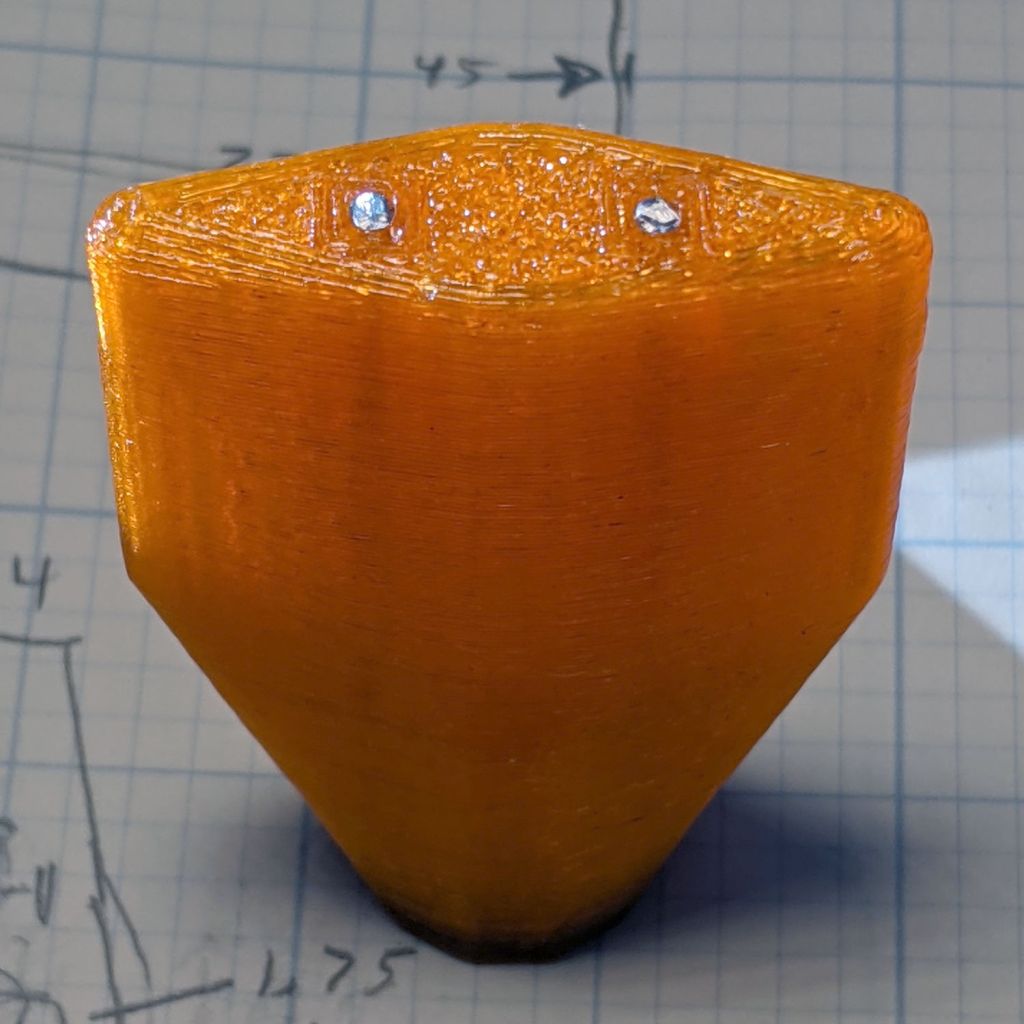
    Some thrashing around produced a quick-and-dirty check piece that matched (most of) the stack of un-sewn hexes:

    Quilting Hexagon Cutting Template
    Quilting Hexagon Cutting Template

    That one came from a knockoff of the circle template, after some cleanup & tweakage, but failed user testing for not withstanding the side force from the rotary cutter blade. The inside and outside dimensions were correct, however, so I could proceed with some confidence I understood the geometry.

    Both the pattern width (the side-to-side distance across the inside of the hex) and the seam allowance appearing in the Customizer appear in inches, because that’s how things get measured outside the Basement Laboratory & Fabrication Facility:

    FinishedWidthInch = 2.75;
    FinishedWidth = FinishedWidthInch * inch;
    
    SeamAllowanceInch = 0.25;
    SeamAllowance = SeamAllowanceInch * inch;

    You feed in one side-to-side measurement and all other hex dimensions get calculated from that number; quilters default to a ¼ inch seam allowance. Remember, standard quilt hexes are measured by their side length, so just buy some standard templates.

    This is one of the few times I’ve needed triangle graph paper:

    Hex Quilting Template - geometry doodles
    Hex Quilting Template – geometry doodles

    After I gave up trying to get it right on square-grid paper, of course.

    Solidifying those relations:

    Quilting Hex Template - build layout
    Quilting Hex Template – build layout

    Then math got real:

    Hex Quilting Templates - on strips
    Hex Quilting Templates – on strips

    Both templates have non-skid strips to keep the fabric in place while cutting:

    Hex Quilting Template - grip strips
    Hex Quilting Template – grip strips

    I should have embossed the size on each template, but this feels like a one-off project and YAGNI. Of course, that’s how I felt about the circle templates, so maybe next time I’ll get it right.

    As it turned out, Mary realized she needed a template for the two half-triangles at the end of each row:

    Quilting Hex Template - half-triangle
    Quilting Hex Template – half-triangle

    It’s half of the finished size of the equilateral triangle on the right, with seam allowance added all around. The test scrap of fabric on the left shows the stitching along the hypotenuse of the half-triangle, where it joins to the end-of-row hexagon. Ideally, you need two half-triangle templates, but Mary says it’s easier to cut the fabric from the back side than to keep track of two templates.

    The family portrait now has three members:

    Quilting Hex Template - family
    Quilting Hex Template – family

    The OpenSCAD source code as a GitHub Gist:

    // Quilting – Hexagon Templates
    // Ed Nisley KE4ZNU – July 2020
    // Reverse-engineered to repair a not-quite-standard hexagon quilt
    // Useful geometry:
    // https://en.wikipedia.org/wiki/Hexagon
    /* [Layout Options] */
    Layout = "Build"; // [Build, HexBuild, HexPlate, TriBuild, TriPlate, EndBuild, EndPlate]
    //——-
    //- Extrusion parameters must match reality!
    // Print with 2 shells
    /* [Hidden] */
    ThreadThick = 0.25;
    ThreadWidth = 0.40;
    HoleFinagle = 0.2;
    HoleFudge = 1.00;
    function HoleAdjust(Diameter) = HoleFudge*Diameter + HoleFinagle;
    Protrusion = 0.1; // make holes end cleanly
    function IntegerMultiple(Size,Unit) = Unit * ceil(Size / Unit);
    inch = 25.4;
    //——-
    // Dimensions
    /* [Layout Options] */
    FinishedWidthInch = 2.75;
    FinishedWidth = FinishedWidthInch * inch;
    SeamAllowanceInch = 0.25;
    SeamAllowance = SeamAllowanceInch * inch;
    TemplateThick = 3.0;
    TriKnob = true;
    EndKnob = false;
    /* [Hidden] */
    FinishedSideInch = FinishedWidthInch/sqrt(3);
    FinishedSide = FinishedSideInch * inch;
    echo(str("Finished side: ",FinishedSideInch," inch"));
    CutWidth = FinishedWidth + 2*SeamAllowance;
    CutSide = CutWidth/sqrt(3);
    echo(str("Cut side: ",CutSide / inch," inch"));
    // Make polygon-circles circumscribe the target widths
    TemplateID = FinishedWidth / cos(180/6);
    TemplateOD = CutWidth / cos(180/6);
    /* [Hidden] */
    TriRadius = FinishedSide/sqrt(3);
    TriPoints = [[TriRadius,0],
    [TriRadius*cos(120),TriRadius*sin(120)],
    [TriRadius*cos(240),TriRadius*sin(240)]
    ];
    echo(str("TriPoints: ",TriPoints));
    EndPoints = [[TriRadius,0],
    [TriRadius*cos(120),TriRadius*sin(120)],
    [TriRadius*cos(120),0]
    ];
    echo(str("EndPoints: ",EndPoints));
    TipCutRadius = 2*(TriRadius + SeamAllowance); // circumscribing radius of tip cutter
    TipPoints = [[TipCutRadius,0],
    [TipCutRadius*cos(120),TipCutRadius*sin(120)],
    [TipCutRadius*cos(240),TipCutRadius*sin(240)]
    ];
    HandleHeight = 1 * inch;
    HandleLength = (TemplateID + TemplateOD)/2;
    HandleThick = IntegerMultiple(3.0,ThreadWidth);
    HandleSides = 12*4;
    StringDia = 4.0;
    StringHeight = 0.6*HandleHeight;
    DentDepth = HandleThick/4;
    DentDia = 15 * DentDepth;
    DentSphereRadius = (pow(DentDepth,2) + pow(DentDia,2)/4)/(2*DentDepth);
    KnobOD = 15.0; // Triangle handle
    KnobHeight = 20.0;
    //——-
    module PolyCyl(Dia,Height,ForceSides=0) { // based on nophead's polyholes
    Sides = (ForceSides != 0) ? ForceSides : (ceil(Dia) + 2);
    FixDia = Dia / cos(180/Sides);
    cylinder(r=HoleAdjust(FixDia)/2,h=Height,$fn=Sides);
    }
    //——-
    // Hex template
    module HexPlate() {
    difference() {
    cylinder(r=TemplateOD/2,h=TemplateThick,$fn=6);
    translate([0,0,-Protrusion])
    cylinder(r=TemplateID/2,h=(TemplateThick + 2*Protrusion),$fn=6);
    }
    for (i=[1:6/2])
    rotate(i*60)
    translate([0,0,TemplateThick/2])
    cube([HandleLength,HandleThick,TemplateThick],center=true);
    }
    module HexHandle() {
    difference() {
    rotate([90,0,0])
    scale([1,HandleHeight/(TemplateOD/2),1])
    rotate(180/HandleSides)
    cylinder(d=HandleLength,h=HandleThick,center=true,$fn=HandleSides);
    translate([0,0,-HandleHeight])
    cube([2*TemplateOD,2*TemplateOD,2*HandleHeight],center=true);
    translate([0,HandleThick,StringHeight])
    rotate([90,090,0])
    rotate(180/8)
    PolyCyl(StringDia,2*HandleThick,8);
    for (j=[-1,1]) {
    translate([0,j*(DentSphereRadius + HandleThick/2 – DentDepth),StringHeight])
    rotate(180/48)
    sphere(r=DentSphereRadius,$fn=48);
    }
    }
    }
    module HexTemplate() {
    HexPlate();
    HexHandle();
    }
    //——-
    // Triangle template
    module TriPlate() {
    linear_extrude(height=TemplateThick)
    intersection() {
    offset(delta=SeamAllowance) // basic cutting outline
    polygon(points=TriPoints);
    rotate(180)
    polygon(points=TipPoints);
    }
    }
    module TriTemplate() {
    union() {
    if (TriKnob)
    cylinder(d=KnobOD,h=KnobHeight,$fn=HandleSides);
    TriPlate();
    }
    }
    //——-
    // End piece template
    module EndPlate() {
    linear_extrude(height=TemplateThick)
    intersection() {
    offset(delta=SeamAllowance) // basic cutting outline
    polygon(points=EndPoints);
    rotate(180)
    polygon(points=TipPoints);
    }
    }
    module EndTemplate() {
    union() {
    if (EndKnob)
    translate([0,(TriRadius/2)*sin(30),0])
    cylinder(d=KnobOD,h=KnobHeight,$fn=HandleSides);
    EndPlate();
    }
    }
    //——-
    // Build it!
    if (Layout == "HexPlate")
    HexPlate();
    if (Layout == "HexBuild")
    HexTemplate();
    if (Layout == "TriPlate")
    TriPlate();
    if (Layout == "TriBuild")
    TriTemplate();
    if (Layout == "EndPlate")
    EndPlate();
    if (Layout == "EndBuild")
    EndTemplate();
    if (Layout == "Build") {
    translate([1.5*TriRadius,-TriRadius,0])
    rotate(180/6)
    TriTemplate();
    translate([-1.5*TriRadius,-TriRadius,0])
    rotate(180/6)
    EndTemplate();
    translate([0,TemplateOD/2,0])
    HexTemplate();
    }

  • Pan Lid Handle Quieting

    Pan Lid Handle Quieting

    A surprisingly heavy stainless steel pan lid from the local ReStore has only one fault: when placed upside-down on the counter while we’re tending the pan contents, it will rock back and forth for nearly a minute. The lid has a rubberized insert for finger protection:

    Pan lid - original handle
    Pan lid – original handle

    However, the inserts cover only the side of the handle, so the metal arch rests on the counter. Setting it up in the shop let me scuff up the handle contact points:

    Pan lid - contact point
    Pan lid – contact point

    Then some Dremel grinding wheel work recessed the handle just barely below the inserts and changed the arch enough to keep it off the counter:

    Pan lid - recessed handle crest
    Pan lid – recessed handle crest

    The lid now stops rocking after a few seconds and is much quieter while doing so. It may require a bit more grinding, but it’s much better after this small intervention.

  • Miniblind Cord Caps: White PETG

    Miniblind Cord Caps: White PETG

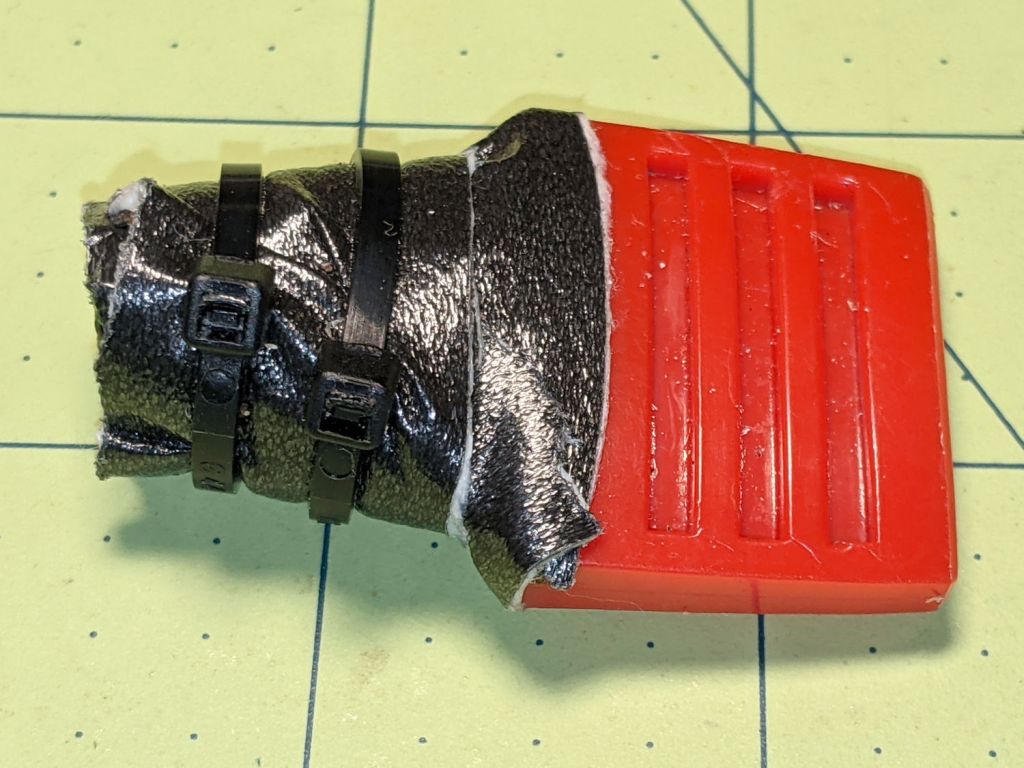
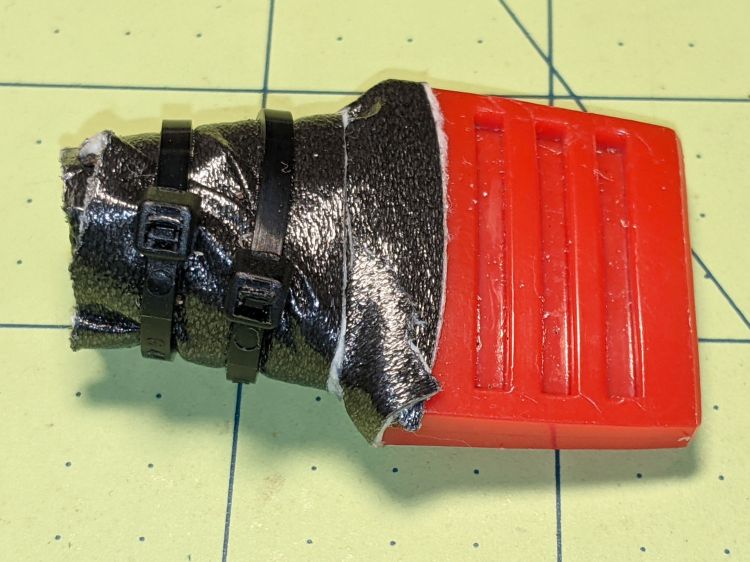
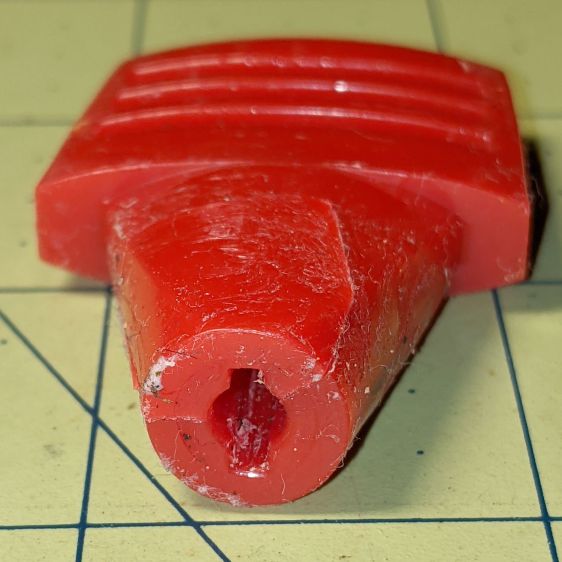
    I managed to smash another miniblind cord cap and used white PETG this time around:

    Miniblind cord caps - white PETG
    Miniblind cord caps – white PETG

    It’s the same solid model as before, sliced with whatever improvements have transpired during the last four years.

    Made four of ’em, preemptively replaced the cap on the adjacent window, and tucked the last two away against future need.

  • Can Opener Re-Gearing

    Can Opener Re-Gearing

    Six years on, I just deployed the last of the aluminum spares from the original CNC project:

    Can opener - new gear installed
    Can opener – new gear installed

    I swear the cutter gear on the left does not show that rust in person!

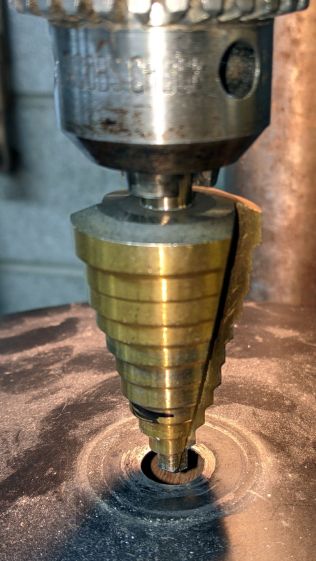
    This can opener has a slightly larger bolt than the previous ones, so I embiggened the hole with a step drill:

    Can opener - redrilling new gear
    Can opener – redrilling new gear

    Having run out of aluminum gears, I’ll be forced to make a hob to make a steel gear. Drat!

  • Lending a Hand

    Lending a Hand

    This being repotting season, Mary trimmed a pair of leaves from a bay tree and wanted to dry them for cooking, so I offered to lend a hand:

    Bay leaves drying in helping hand fixture
    Bay leaves drying in helping hand fixture

    Two hands, in fact.

    The whole affair now sits on a kitchen windowsill, shriveling by the day, and the leaves should be ready in a month or two. Yum!

  • Motor Starting vs. Long Wires

    A recent email conversation may prove relevant to someone else …

    I have a pole barn which has approximately 100′ run of 10 gauge copper supplying power to the building. I … did not care to pay … $12,000 for a new 200′ line from the road … [with] only lights and 2 door openers for demand.

    I … put a 30 gallon air compressor in […]. When I first put it in, it struggled to start @<40 F. They called it a 1.6 running h.p. (whatever that means) motor. Nameplate shows 15/7.5 F.L.A. I switched it to 240v and the problem went away.

    Aren’t I likely to get the same problem as I had before or do 240 volt motors start easier?

    I screwed up when they buried the wire – in retrospect I would have buried 6ga to the barn to lessen the voltage drop.

    After running a few numbers, here’s what I came up with …

    do 240 volt motors start easier?

    The trouble with motors is they draw far more current while starting than they do while running. A factor of ten more is a good rule of thumb.

    So a “1.6 running HP” motor draws 1.2 kW while running at full load:
     – 10 A at 120 V
     –  5 A at 240 V

    The “full load amps” will be higher than that, because the motor isn’t 100% efficient. You can plug the FLA values into the calculation for an even more depressing result.

    During the fraction of a second when it’s starting, however, it will (try to!) draw 100 A or 50 A, depending on which line voltage you’ve wired it for.

    100′ run of 10 gauge copper

    That’s 200 feet of wire out-and-back.

    Look up the resistance per foot in a wire table, finding 10 AWG wire has a (convenient!) resistance of 1 mΩ/ft, so a 200 ft length has 0.2 Ω of resistance:

     – A 10 A load drops 2 V
     – A  5 A load drops 1 V

    Both of which are survivable in normal operation at their respective line voltages.

    However, the motor starting currents will be completely different. A 100 A current will (try to!) drop 20 V, reducing the line voltage to 100 V and stalling the motor. Running the motor from 240 V means the 50 A starting current drops only 10 V and the remaining 230 V can get the motor up to speed.

    Now, 240 V service isn’t a complete solution. The new compressor draws 15 “full load amps”, so it’ll drop 3 V while it’s running and 30 V while starting. It’ll probably start at 210 V, but it may grunt for a bit longer than you like as the speed comes up and the current goes down.

    in retrospect I would have buried 6ga to the barn

    There’s a Pennsylvania Dutch saying: “We grow too soon old and too late smart.” [grin]

  • Monthly Image: Wren Traffic

    Monthly Image: Wren Traffic

    A pair of wrens, having found the new entrance reducer entirely satisfactory, set up housekeeping in the front bird box and raised their nestlings.

    Somehow, they manage to fly directly into the hole without stopping:

    Wren - front box - entering
    Wren – front box – entering

    Outbound trips require a security check:

    Wren - front box - exit check
    Wren – front box – exit check

    And away!

    Wren - front box - fly away
    Wren – front box – fly away

    After those nestlings fledged, they began building a nest in one of the garden bird boxes a few hundred feet away. In short order, we’ll be awash in wrens!