Ed Nisley's Blog: Shop notes, electronics, firmware, machinery, 3D printing, laser cuttery, and curiosities. Contents: 100% human thinking, 0% AI slop.
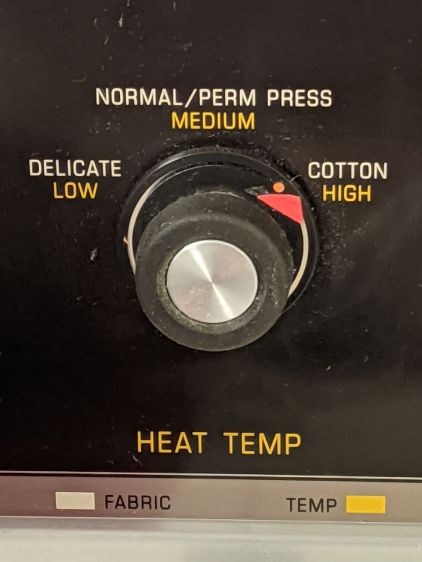
On rare occasions, our longsuffering and much-repaired Kenmoreclothesdryer will sometimes not fully dry a load, as if the heater didn’t turn on. Setting the temperature selector to High:
Kenmore dryer temperature selector – front panel
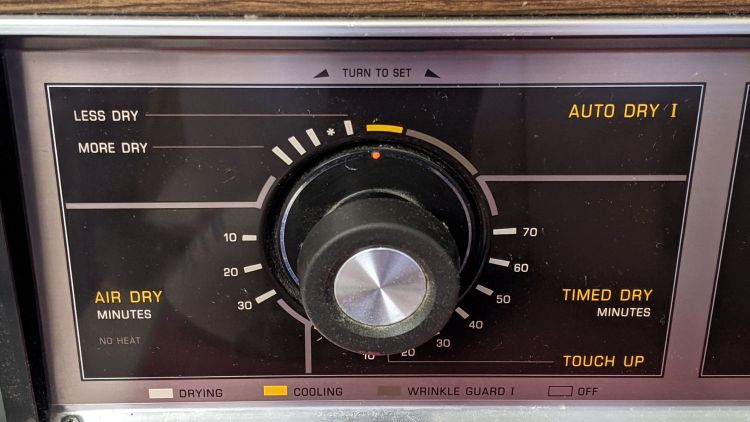
Then resetting the cycle timer to the spot marked with the otherwise unlabeled asterisk to activate the humidity sensor gets the job done:
Kenmore dryer cycle select dial
We normally crank the knob to the asterisk, leave the temperature set to Normal, and mostly it works.
I thought perhaps the temperature selector had become intermittent, along the lines of the temperature control knob on the oven, so I turned off the breaker, verified the dryer was disconnected, and popped the top:
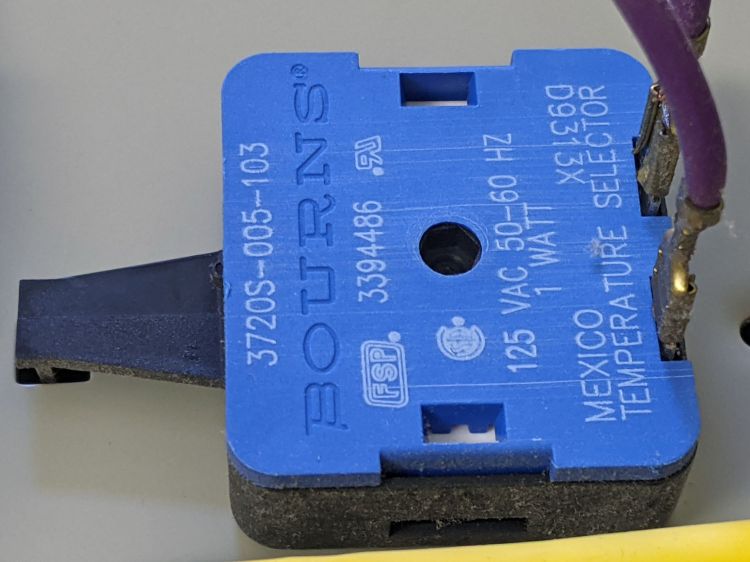
Kenmore dryer temperature selector – part detail
It turns out that part is no longer available from any of the usual sources; one describes their inventory as both “used” and “out of stock”; if it’s dead, a resurrection will be in order.
The selector knob has three positions:
Low = 0 Ω, as in a closed switch
Medium = 5.8 kΩ, most likely a fixed resistor
High = open circuit, as in an open switch
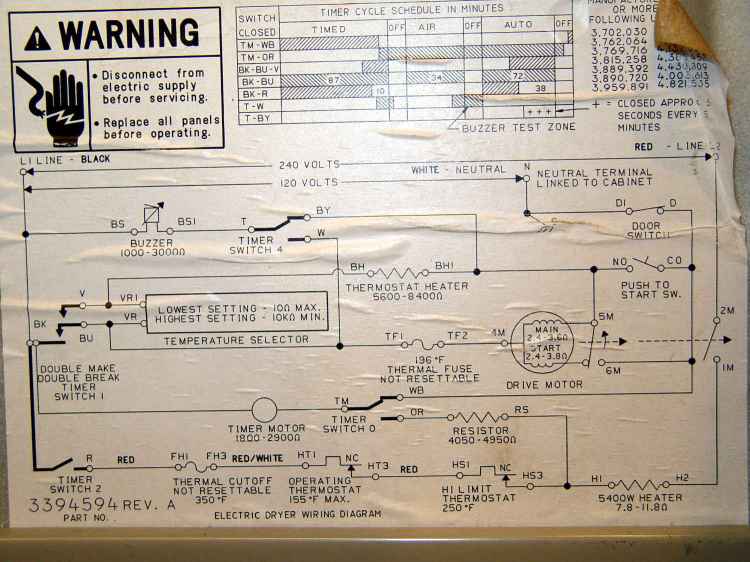
The Low and High positions meet the limits shown in the diagram and Medium falls in between, so it seems to be working as designed. If it intermittently fails as a short, then the clothes would get Low heat and (I think) would emerge somewhat more dry than we notice.
I put it all back together, but we won’t know for a while if my laying-on-of-hands non-repair had any effect.
One terrifying possibility, which we reject out of hand, is that we occasionally forget to crank the cycle knob around to the asterisk before punching the Start button. That would explain all the observed facts and contradict none, but is inconceivable.
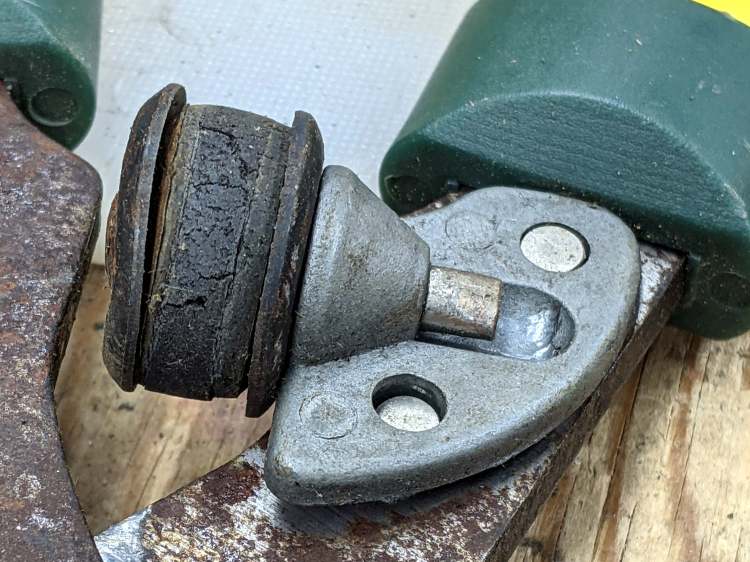
Contrary to what you might think, those rivets never had a head on this side and the bumper seems to be held in place by an interference fit with the plastic handle cover.
A bit of cutoff wheel work removed the crimped end on the 5 mm stud holding the bumper to the pot-metal dingus:
Bypass Lopper – shaft cut
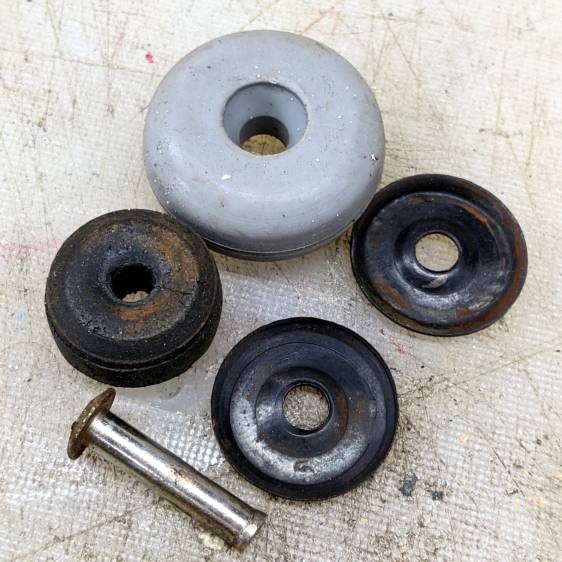
Whacking it with a punch separated all the parts:
Bypass Lopper – bumper parts
The gray thing is a silicone rubber vibration isolator that’s a bit too large in all dimensions, but surely Close Enough™ for present purposes.
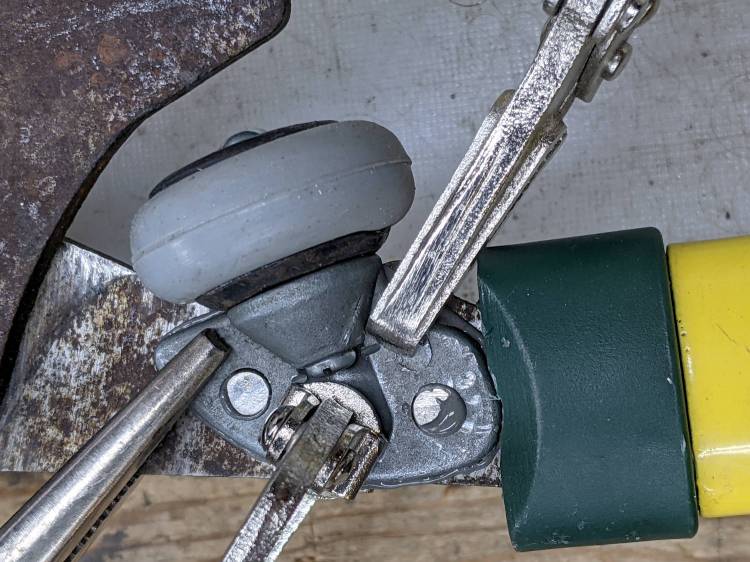
A length of 5 mm shaft became the new stud, with M3×0.5 threads tapped into both ends and a pair of random screws held in place with red Loctite:
Bypass Lopper – epoxy curing
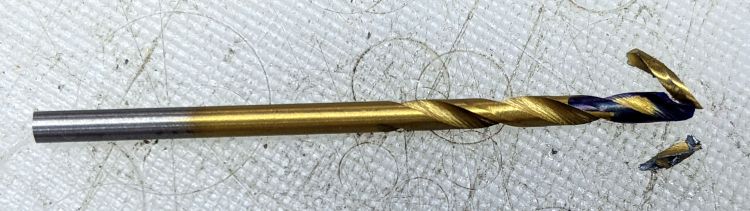
There are no pix of the drilling and threading, as it was accomplished after a shiny-new 2.7 mm “titanium” metric drill from a not-dirt-cheap set shattered in the shaft:
Shattered metric drill
The blue color on the flutes is Sharpie to remind me it’s defunct. I completed the mission using a #36 drill with no further excitement.
The dingus is now held to the lopper with JB Weld and, should that fail, I’ll drill-n-tap the rivets and be done with it.
My AmazonBasics laminator wrapped a small card around one of its rollers and jammed solid:
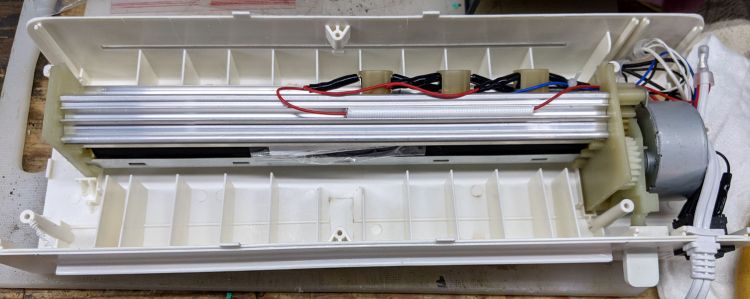
AmazonBasics laminator – interior bottom
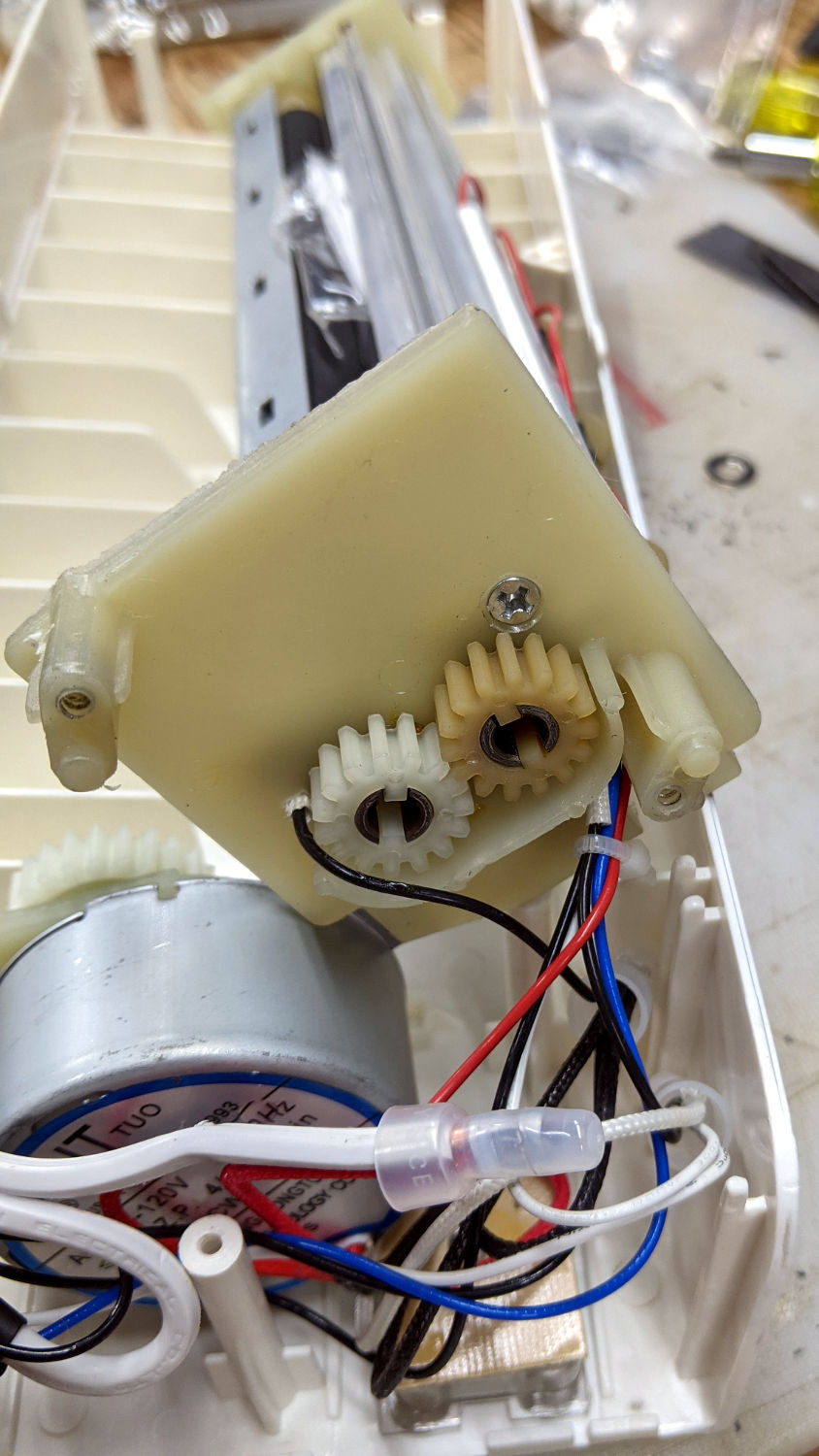
The lever sticking out on the lower right (above) drives the rollers in reverse by moving the motor from one gear to the other:
AmazonBasics laminator – roller gears
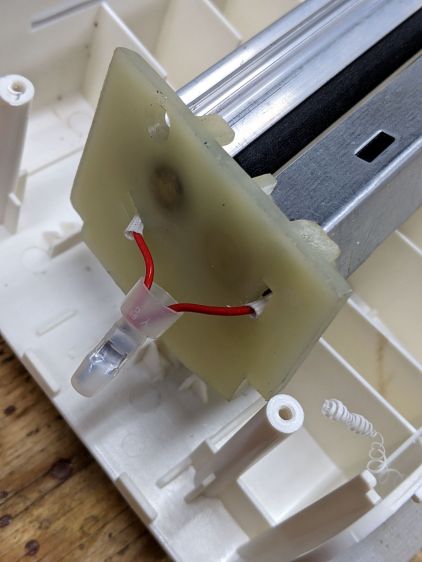
Obviously, reverse gear wouldn’t get me anywhere, but dismantling the rollers required cutting the junction between the heating elements running through the aluminum extrusions:
AmazonBasics laminator – heater junction
I spliced a few inches of wire onto those leads. If there’s a next time, I can cut the splice in the middle and use a wire nut.
The white plastic curl in the lower right showed they ran a deburring tool around the exit slot and called it Good Enough™.
The gears slide off the roller shafts and the rollers out of the extrusions, after which removing the tightly wrapped and completely useless card posed no problem.
One lone, short, and eagerly self-tapping screw holds each plastic end plate to the extrusion, so be careful about cross-threading.
All in all, this was easy enough, although I’m sure I was supposed to just throw the laminator away and buy a new one.
This year was my turn to take an online Defensive Driving Course to knock a few percent off our automobile insurance premium. It’s admittedly difficult to make traffic law interesting, but this was the worst-written, poorest-edited, and most factually incorrect course I have ever had the misfortune to waste eight hours of my life taking.
For example:
Emergency signals, also called emergency flashers or hazard warning devices, are flashing red lights found on the front and rear of the vehicle
No, they’re amber on both ends of the vehicle. Flashing red on the front is reserved for vehicles with police and firefighters inside.
… material used to block the sun from coming into a vehicle through the windshield and windows must have a luminous transmittance of less than 70%. That means the material must allow at least 30% of the light to pass through it
No, lower transmittance means less light passing through the glass.
I think the author and editors live in a part of the world once colonized by the British Empire:
Driving class – mirror-image roadway crossing
Here in New York State, we drive on the right.
Update:scruss recalls the image in an old UK driving manual. It describes a type of pedestrian crossing unknown in the US.
The sign recognition lesson claimed this sign marks a section of road with two-lane traffic:
Driving class – 2-lane traffic
NYS DMV says it actually indicates two-way traffic on an undivided road.
The course says this sign marks the point where the two-lane section ends:
Driving class – lane reductIon
It really means a divided highway ends and two-way traffic begins.
The course definitely offered amusing incorrect answers:
Driving class – slippery area
The sign really means slippery when wet, but I suppose that’s in the nature of fine tuning.
The closing page of the course told me I could take a survey, but, somehow, the survey never appeared.
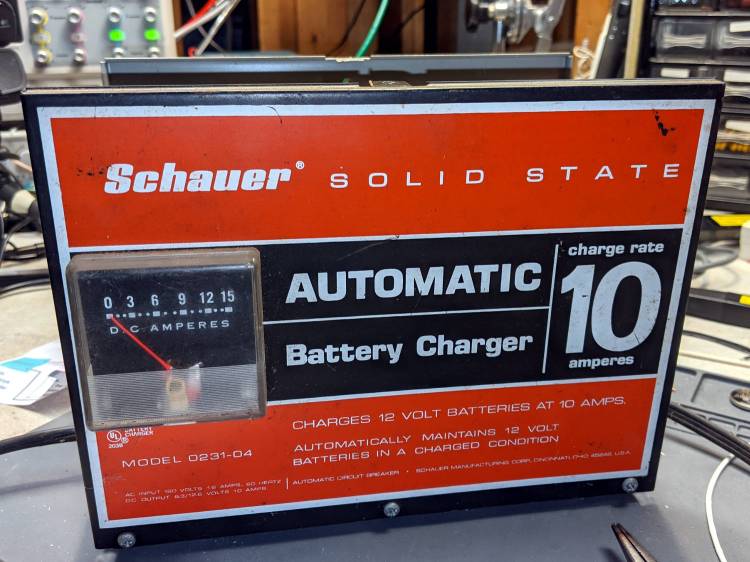
The Forester’s battery has been on life support from an ancient Schauer “Solid State” charger (which may have Come With The House™) for the last year:
Schauer battery charger – analog ammeter
A remote Squidwrench session provided an opportunity to replace its OEM ammeter with a cheap volt-amp meter:
Schauer battery charger – digital meter
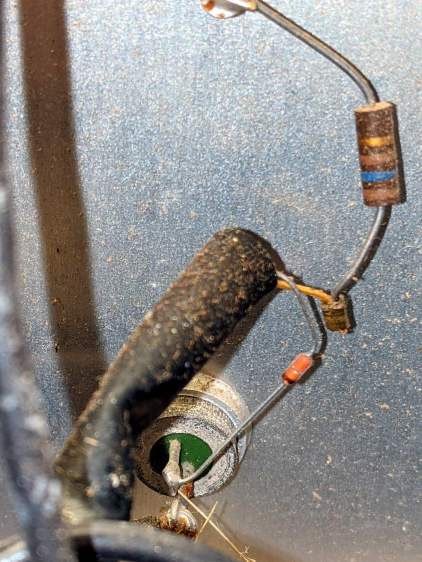
The charger is “solid state” because it contains silicon electronics:
Schauer battery charger – solid state components
That’s an SCR implanted in the aluminum heatsink. The other side has a Motorola 18356 house number, a date code that might be 523, and the word MEXICO. The company now known as NXP says Motorola opened its Guadalajara plant in 1969, so they could have built the SCR in either 1973 or 1975; it’s not clear who manufactures what these days.
The black tubing contains at least one part with enough value to justify the (presumably) Kovar lead; nowadays, it would be a “gold tone” finish. It’s probably a Zener diode setting the trickle-charging voltage, joined to the resistor lead in the crimped block. I don’t know if the glass diode is soldered to the Zener, but I’m reasonably sure if the third lead came from a transistor tucked inside the sleeve, we’d read about it on the charger’s front cover.
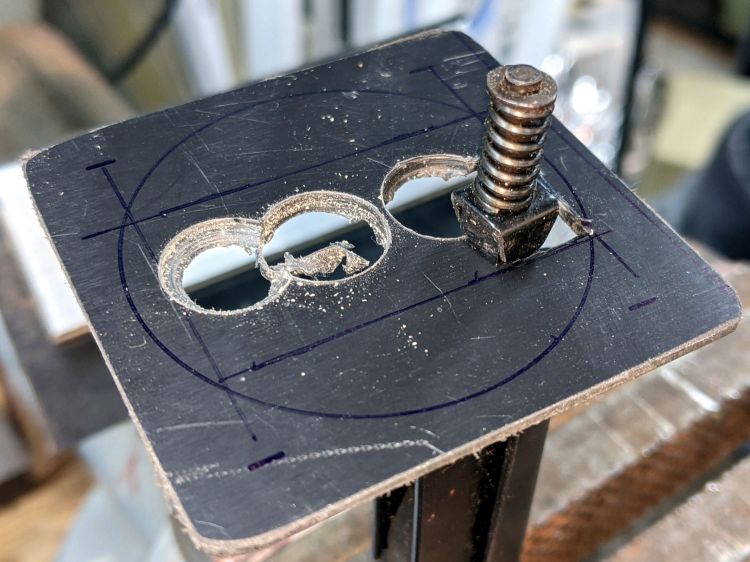
In an ideal world, a digital meter would fit into a matching rectangular hole in the front panel, but that’s not the world we live in. After wrestling my gotta-make-a-solid-model jones to the floor, I got primal on a random slab of soft-ish plastic sheet:
Schauer battery charger – bezel nibbling
There’s nothing like some bandsaw / belt sander / nibbler action to jam a square peg into a round hole:
Schauer battery charger – bezel test fit
It’s actually a firm press fit; whenever something like that happens, you know the project will end well.
Hot melt glue FTW:
Schauer battery charger – digital meter wiring
The new meter’s (heavy) red-black leads go to the same terminals as the old meter’s wires, paying attention to the polarity. I splurged with insulated QD terminals on the old wires where a joint was needed.
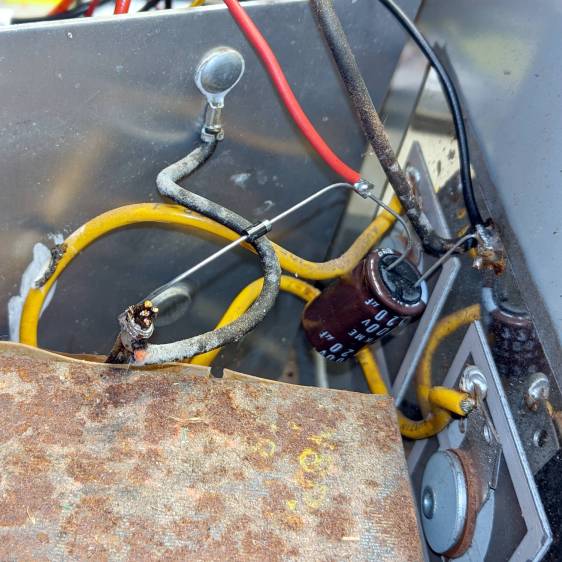
The meter’s thin red lead expects to see a power supply under 50 V with no particular regulation requirements, so I used the same flying-component design as the rest of the charger:
Schauer battery charger – meter power supply
The meter draws basically no current, at least on the scale of an automotive battery charger, so the 220 µf cap holds pretty nearly the peak 18 V half-wave rectified from the center tap by a 1N5819 Schottky diode.
Those two squares riveted to the back panel are genuine selenium rectifiers, from back in the day when silicon power diodes weren’t cheap and readily available. They also limit the charger’s peak current and have yet to emit their incredibly foul stench upon failure; you always know exactly what died when that happens.
Selenium rectifiers were pretty much obsolete by the early 1970s, agreeing with a 1973 date code. Schauer might have been working through their stockpile of obsolete rectifiers, which would have been sunk-cost-cheap compared to silicon diodes.
The meter’s thin black lead goes to the power supply common point, which turns out to be where those rectifiers meet. The larger black wire goes off to the meter’s fat black lead on the other side of the aluminum heatsink, joining it in a new insulated QD terminal.
The meter’s thin yellow wire is its voltage sense input, which gets soldered directly to the hot lead of the SCR.
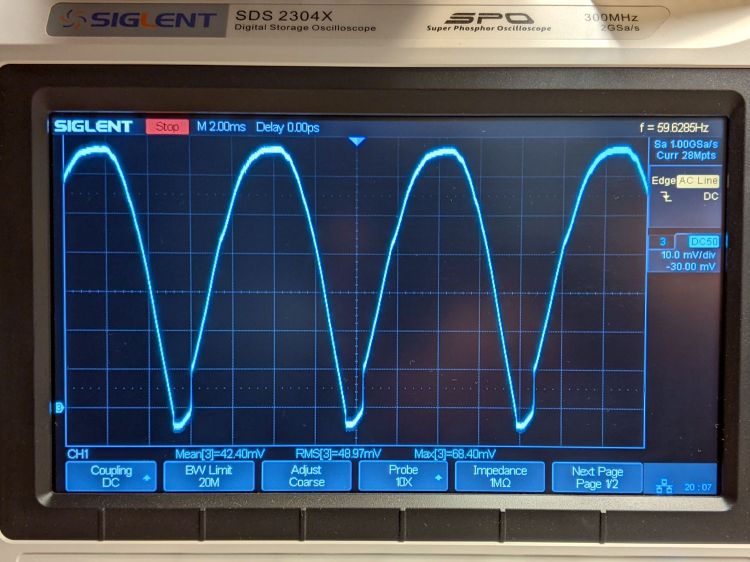
The meter indicates DC voltages and currents, which definitely isn’t the situation in the 100 Ω power resistor shown in the second picture.
The voltage:
Schauer battery charger – voltage waveform
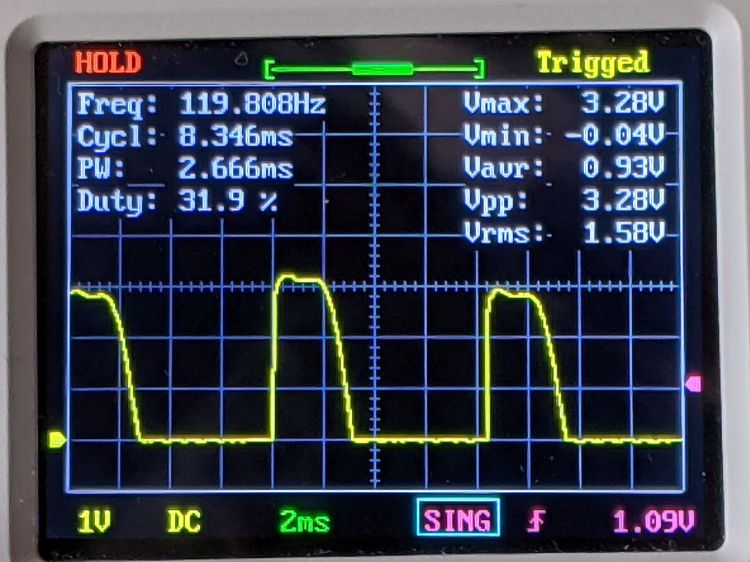
And the current at 20 mA/div, showing why silicon replaced selenium:
Schauer battery charger – current waveform
Yes, the current does go negative while the rectifiers figure out what to do next.
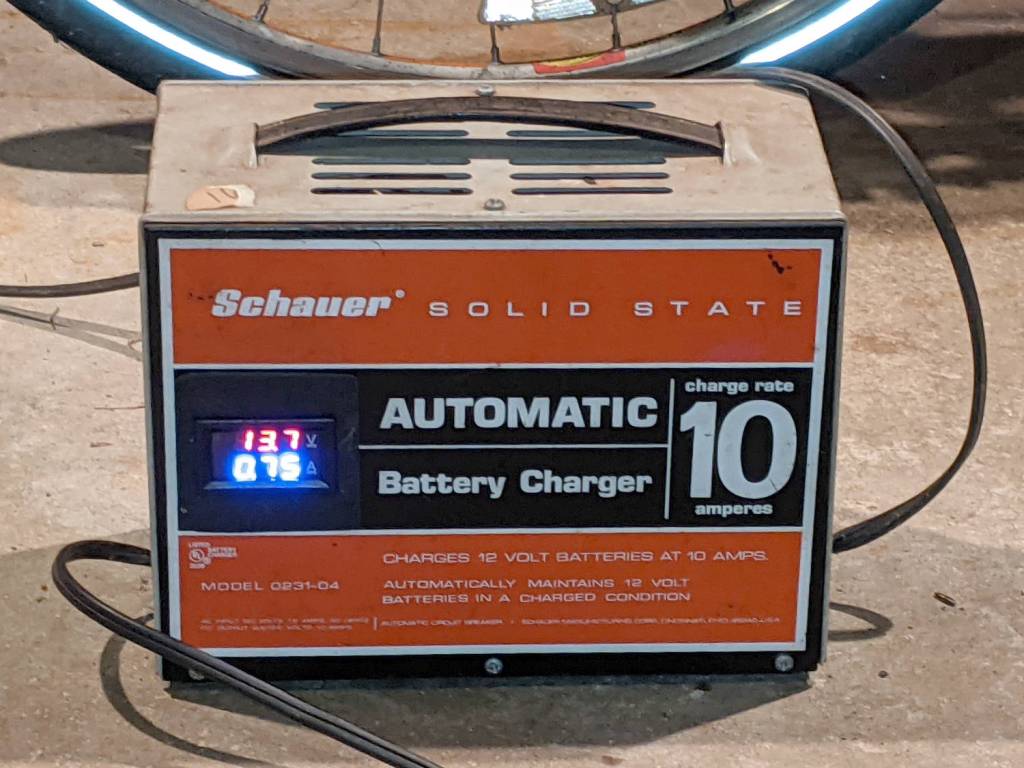
The charger seems a little happier out in the garage:
Schauer battery charger – in use
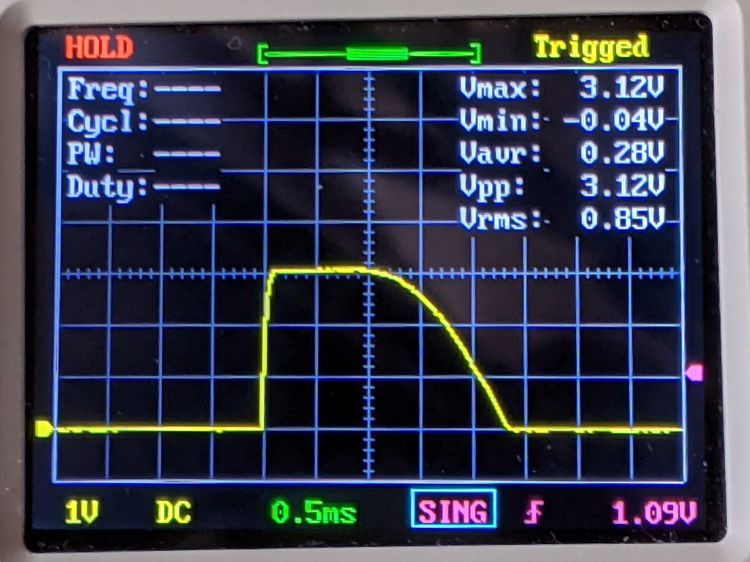
The battery holds the voltage steady at 13.7 V, with the charger producing 85 mV blips every second or so:
Schauer battery charger – float V pulse
Those blips correspond to 3 A pulses rammed into the battery:
Schauer battery charger – float A pulse – 1 A-div
They’re measured across a 1 Ω series resistor that’s surely limiting the maximum current: 18 V from the transformer minus 13.7 V on the battery minus other IR losses doesn’t leave room for anything more than 3 V across the resistor. I wasn’t going to haul the Tek current probes out to the garage just for the occasion.
Opening the Forester’s door to turn on all its LED interior lights bumps the meter to about 1 A, although the truth is more complicated:
Schauer battery charger – loaded A pulse – 1 A-div
The average current is, indeed, just under 1 A, but in this situation the meter’s cool blue number seems more like a comfort indicator than anything particularly reliable.
All I really wanted from the meter was an indication that the trickle charger was trickling, so I disconnected Tiny Scope, declared victory, and closed the garage door.
Reddit’s New Hotness has a half-life well under a day, although a steady trickle of incoming traffic will continue forever: The Internet Never Forgets.
Protip: forcing Reddit URLs to old.reddit.com eliminates the user-hostile site layout. Manual tweaking suffices for my very few visits; you can find browser extensions for on-the-fly rewriting.
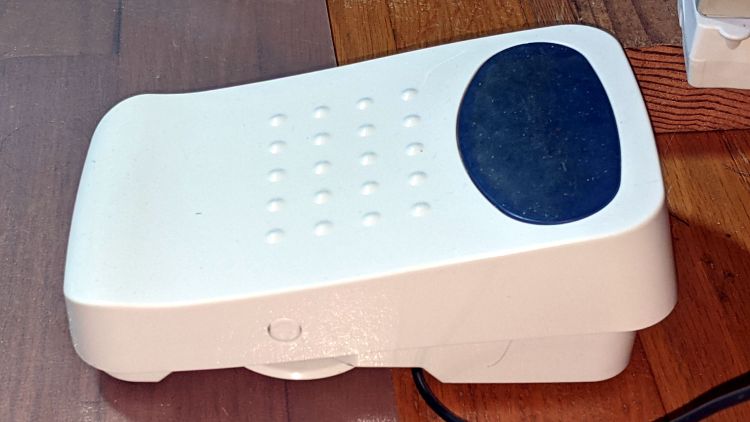
Her Juki TL-2010Q sewing machine has a built-in thread cutter activated by pressing down on the heel end (to the left) of the foot control:
Juki JC-001 Foot Control – overview
The machine had previously performed “uncommanded” thread cuts on other projects, but the many short segments in this pattern triggered far too many cuts. I aimed a camera at her foot on the pedal and she was definitely not pressing down with her heel when the cutter fired.
In point of fact, the thread cutter fired when she was just starting a new segment, where she was gently pressing down on the toe end (to the right) of the pedal to start at the slowest possible speed.
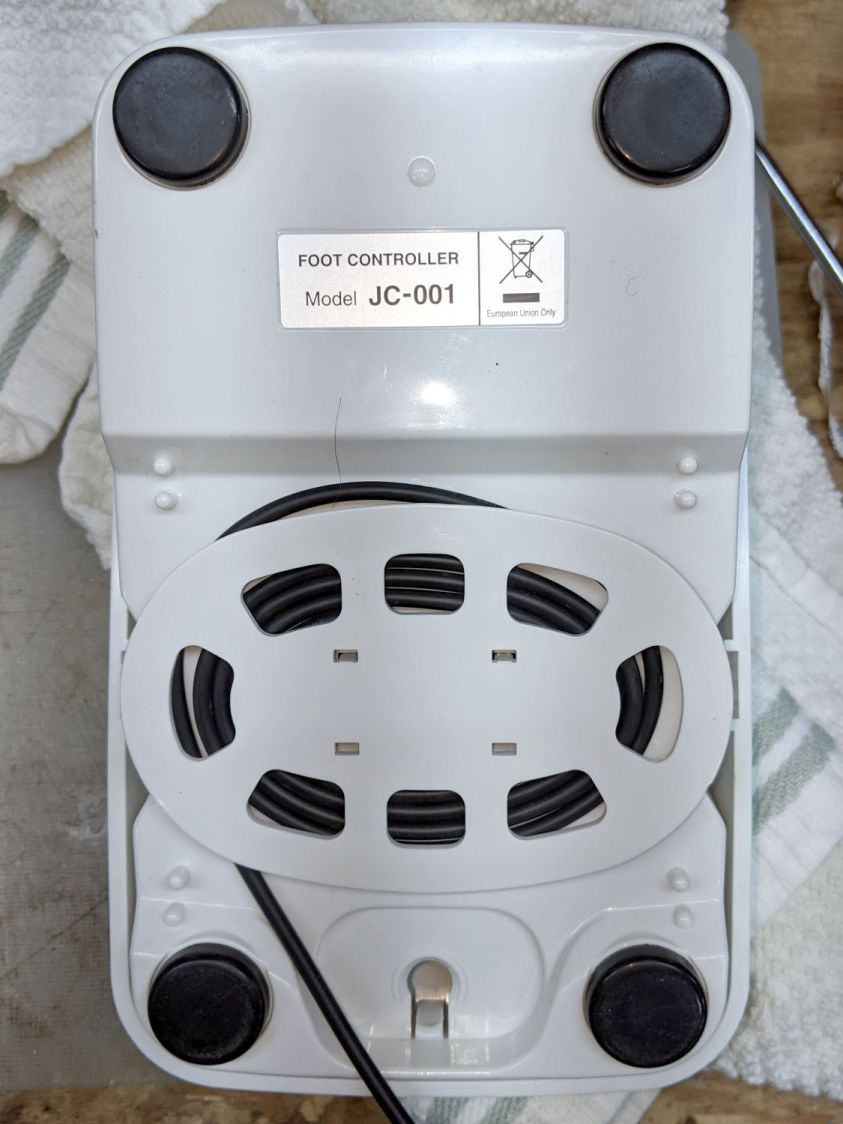
For completeness, the underside of the pedal:
Juki JC-001 Foot Control – bottom
There are no screws holding it together. The top cover pivots on a pair of plastic pegs sticking out from the base near the middle of the cable spool. Disassembly requires jamming a pair of husky Prydrivers in there and applying enough brute force to pry both sides outward farther than you (well, I) think they should bend. This will scar the bottom of the case, but nobody will ever notice.
The foot control cable plugs into the machine through what looks like an ordinary two-conductor coax plug, just like the ones on wall warts delivering power to gadgets around the house. In this day and age, the communications protocol could be anything from a simple resistor to a full-frontal 1-Wire encrypted data exchange.
Based on the old Kenmore foot pedals, I expected a resistive control and, indeed, a simple test gave these results:
Idle = 140 kΩ
Heel pressed (cut) = 46 kΩ
Toe slight press (slow running) = 20 kΩ
Toe full press (fast running) = 0.2 kΩ
We can all see where this is going, but just to be sure I pried the top off the control to reveal the insides:
Juki JJC-001 Foot Control – interior
The two cylindrical features capture the ends of a pair of stiff compression springs pressing the top of the pedal upward.
The small, slightly stretched, extension spring in the middle pulls the slider to the left (heelward), with a ramp in the top cover forcing it to the right (toeward) as the speed increases.
The top cover includes a surprisingly large hunk of metal which may provide enough mass to make the pedal feel good:
Juki JC-001 Foot Control – top underside
The ramp is plastic and the slider has a pair of nylon (-ish) rollers, so there’s not much friction involved in the speed control part of motion. Yes, this is oriented the other way, with the heel end over on the right.
The metal insert pivots in the serrated plastic section near the middle, with the two husky extension springs visible on the left holding it against the plastic cover. The two rectangular features on the left rest under the plastic flanges on the right of the base to prevent the metal insert from moving upward, so pressing the heel end down pulls the cover away from the insert to let the slider rollers move toward the right end of the ramp, into roughly the position shown in the interior view.
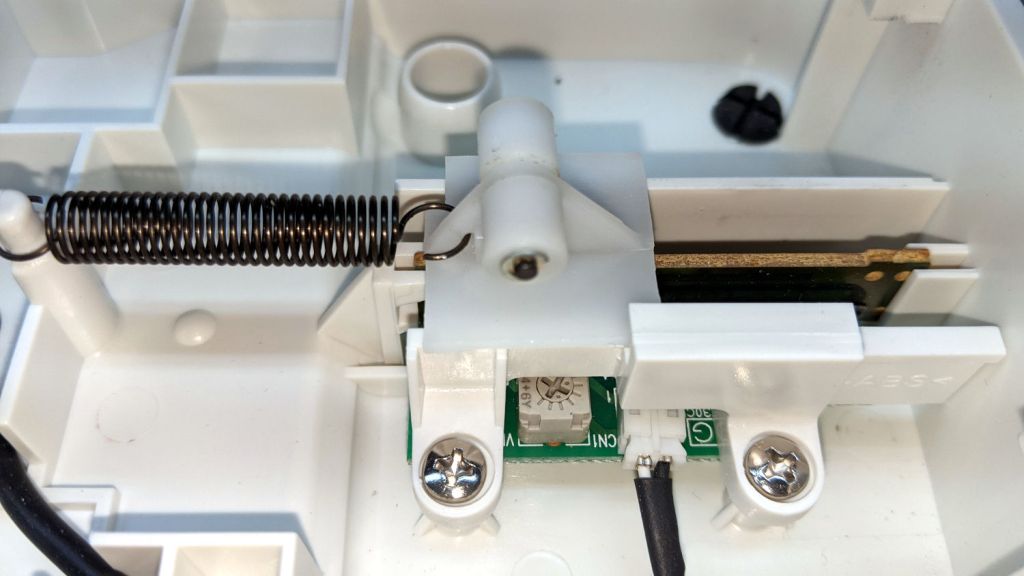
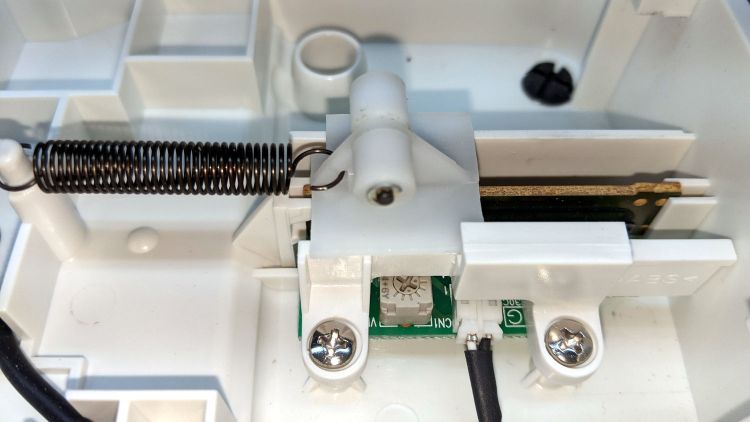
A closeup look at the slider shows the rollers and the PCB holding all of the active ingredients:
Juki JC-001 Foot Control – Resistor Slider
I think the trimpot adjusts the starting resistance for the slider’s speed control travel. It is, comfortingly, roughly in the middle of its range.
A top view shows the fixed 140 kΩ resistor (brown yellow black orange, reading from the right) setting the idle resistance:
Juki JC-001 Foot Control – PCB top view
Measuring the resistance while gently teasing the slider showed that it’s possible to produce a resistance higher than 20 kΩ and lower than 140 kΩ, although it requires an exceedingly finicky touch and is completely unstable.
Before looking inside the pedal, we thought the cutter was triggered by an actual switch closure with the heel end most of the way downward against those stiff springs, which meant the failure came from a switch glitch. Now, we think the earlier and infrequent uncommanded thread cuts trained Mary to start very carefully to be very sure she wasn’t glitching the cutter’s hypothetical switch. Of course, her gradually increasing toe pressure moved the slider veryslowly through its idle-to-running transition: she was optimizing her behavior to produce exactly the resistance required to trigger the cutter.
She now sets the machine’s speed control midway between Turtle and Hare to limit its top speed, presses the pedal with more confidence to minimize the time spent passing through the danger zone, and has had far few uncommanded thread cuts. We think it’s now a matter of retraining her foot to stomp with conviction; there’s no hardware or software fix.
I’m sure Juki had a good reason to select the resistances they did, but I would have gone for a non-zero minimum resistance at the fast end of travel and a zero-resistance switch to trigger the cutter.