Ed Nisley's Blog: Shop notes, electronics, firmware, machinery, 3D printing, laser cuttery, and curiosities. Contents: 100% human thinking, 0% AI slop.
Baofeng UV-5 radios can (mostly) eliminate the loud hiss heard at the end of a transmission before the squelch kicks in after the received carrier drops: Menu → 34 STE → ON. A detailed description of the option suggests it’s a 55 Hz subaudible tone sent for 250 milliseconds after the sender releases the PTT and before the transmitter stops sending, with the receiver muting its audio during the tone. Obviously, this requires a Baofend radio at each end of the conversation, which applies to our bikes.
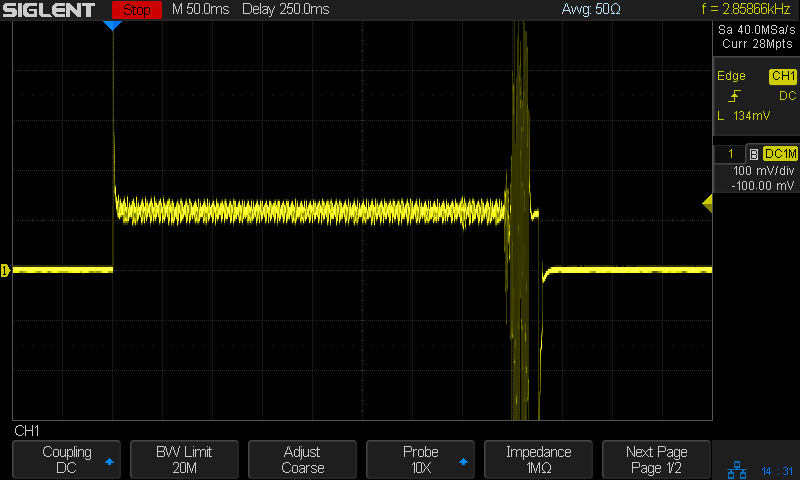
Saying “laaaa” while kerchunking (into a smaller dummy load than the hulk) with STE OFF:
Baofeng – STE OFF – laaaa
Compared to the received audio, the squelch tail hiss is really really loud.
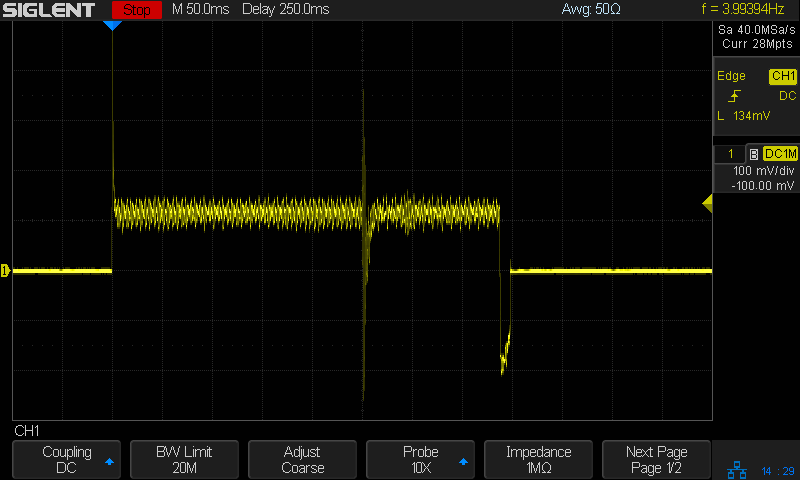
Then with STE ON:
Baofeng – STE ON – laaaa
You can see the STE tone reception start about 250 ms before the audio cuts off, although it’s not at all clear the audio is muted on either end. In any event, there’s no squelch tail worth mentioning, even if there’s an audible tick when the STE tone starts.
Saying nothing with STE ON:
Baofeng – STE ON – silent
It’s unlikely the audio output would include the subaudible tone, but you might convince yourself something happens in the 250 ms between the STE blip near midscreen and the final pop (now clipped) as the audio drops.
Perhaps because we’re using better quality earbuds, the Baofeng UV-5 radios on our bikes produce extremely loud audio, even with the volume knob just above its power-on click. Reducing the volume requires a series resistor downstream of the diodes clipping the pops:
Because we have different earbuds and different hearing, my radio has a 140 Ω resistor and Mary’s has a 430 Ω resistor. Getting the right value requires a few iterations of on-road testing, but it’s not particularly critical; the volume knob should end up roughly in the middle of its range.
For now, all the “circuitry” lives among layers of Kapton tape:
Baofeng headset wire plate – detail
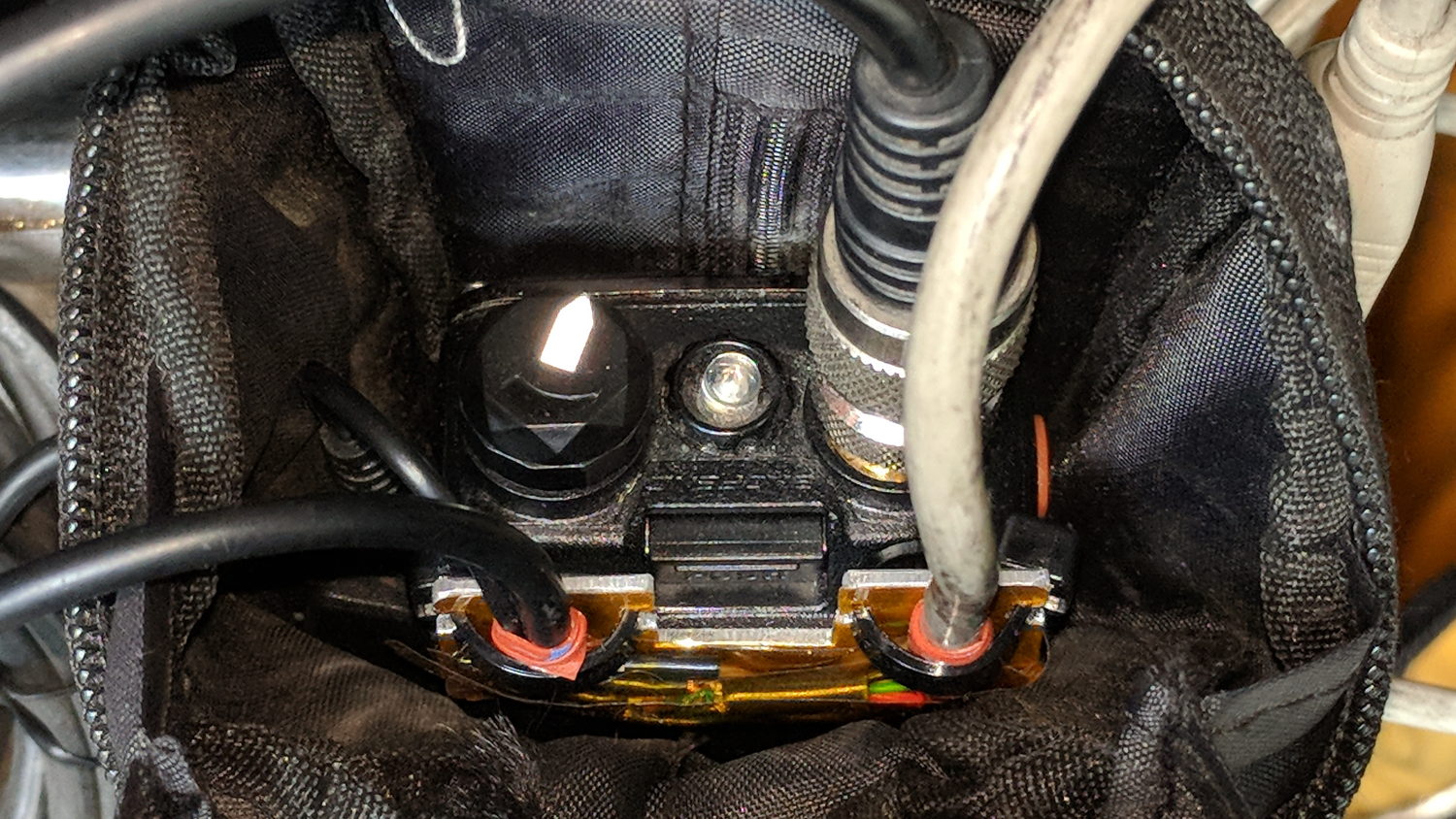
Speaking of volume knobs, Baofeng radios have large flat-top cylindrical knobs (unlike Wouxun’s fluted knobs), so I added a pointed snippet of reflective tape to make the position visible:
Baofeng volume knob – reflective pointer
The flash lights it up, but there’s enough backlighting behind your (well, my) head to make it easily visible under normal conditions. Once you figure out the proper volume, it’s easy to set the pointer in that direction before every ride.
Our first ride with the Baofeng UV-5 radios subjected us to loud pops around each transmission. Back on the bench, this is the signal applied to the earbud during a no-audio simplex kerchunk:
Baofeng – squelch pops
The small noise burst to the right of the center, just before the downward pulse, happens after the carrier drops and before the squelch closes; it’s familiar to all HT users.
The huge pulses, upward at the start and downward at the end, cause the pops. They’re nearly 3 V tall, compared with the 300-ish mV squelch noise, and absolutely deafening through an earbud jammed in my ear. Mary refused to listen, so we finished the first ride in companionable silence.
I think the radio switches the audio amp power supply on and off to reduce battery drain. It’s obviously a single-supply design, so we’re looking at a hefty DC blocking capacitor charging and discharging through the earbud resistance. I suppose that’s to be expected in a $25 radio.
The obvious solution: clamp the audio signal to something reasonable, perhaps with a pair of nose-to-tail Schottky diodes across the earbud. Rather than using axial diodes, along the lines of the 1N5819 diodes in the WWVB preamp, I used a BAT54S dual SMD diode as a tiny clamp:
BAT54S dual-Shottky diode – SMD package
No pix of the final result, but it’s basically two wires soldered alongside the SMD package, surrounded by a snippet of heatstink tubing to stabilize the wires and protect the SMD leads. It might actually survive for a while, even without the obligatory epoxy blob.
The BAT54S clamps the pops to 200-ish mV, as you’d expect:
Baofeng – squelch pops – clamped – 500mV-div
That’s a kerchunk at twice the vertical scale. The very thin spike at the start of each pop isn’t audible, as nearly as we can tell, and I’ve cranked up the audio gain to make the squelch noise more prominent. Your ears will determine your knob setting.
With the audio amp applying 3 V to the diodes at the start of each pop, you’re looking at an absurdly high pulse current. I’m sure the radio exceeds the BAT54 datasheet’s 600 mA surge current limit by a considerable margin, but I’m hoping the short duration compensates for some serious silicon abuse.
Tamping those pops down made the radios listenable.
I’ve often observed that Baofeng radios are the worst HTs you’d be willing to use.
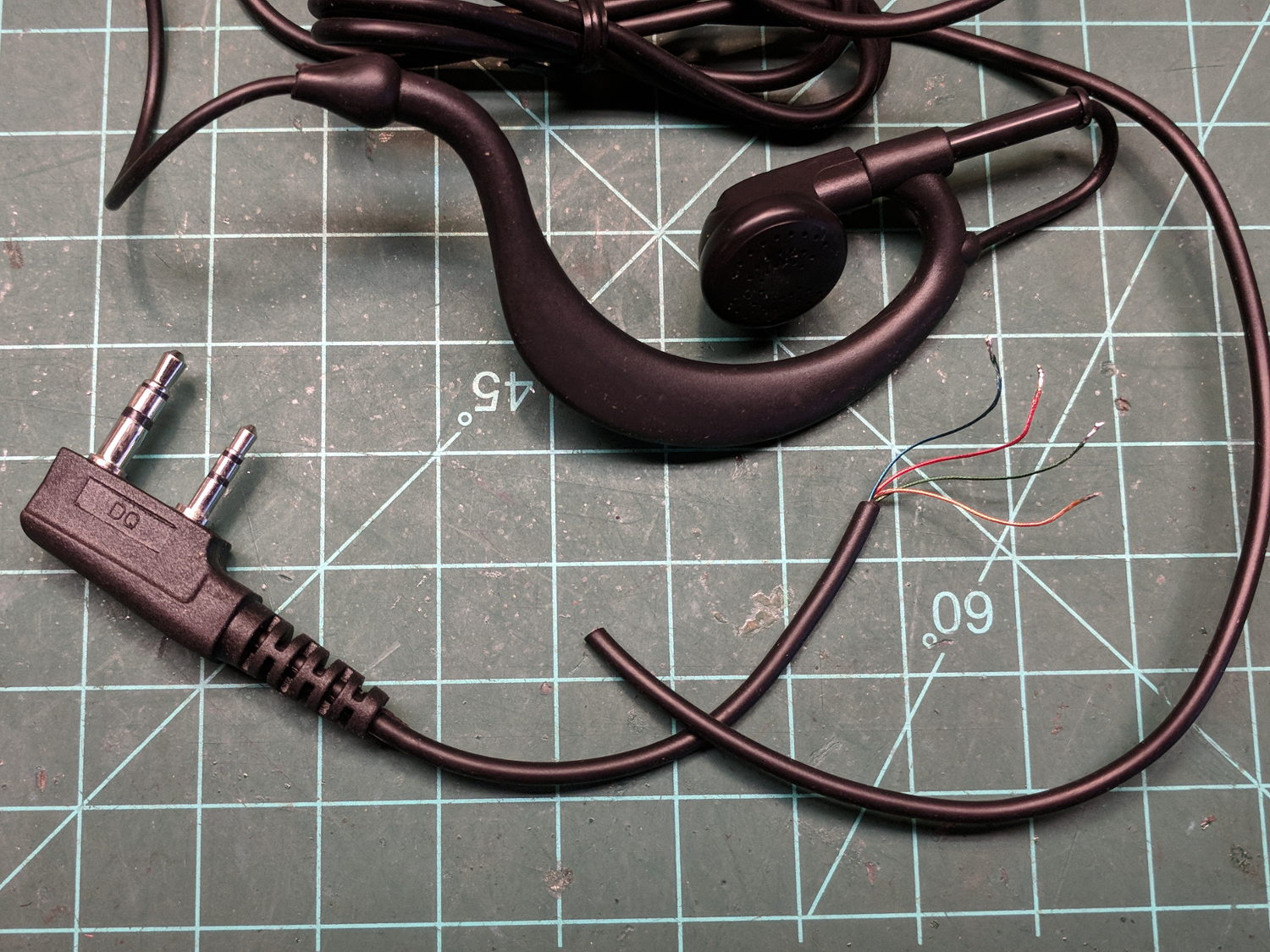
Un-wearably bad Baofeng headsets now cost just over a buck apiece in lots of five, delivered halfway around the planet, and provide:
A compatible molded mic+speaker plug
A decent length of four-conductor cable with solder-meltable insulation
An unlistenably bad earbud on a stick
A lump with an electret mic and PTT switch
Various junk I’ll never use
The “hook earpiece” seems to have been designed by someone who had read the specs for a human head, but had never actually met a human being.
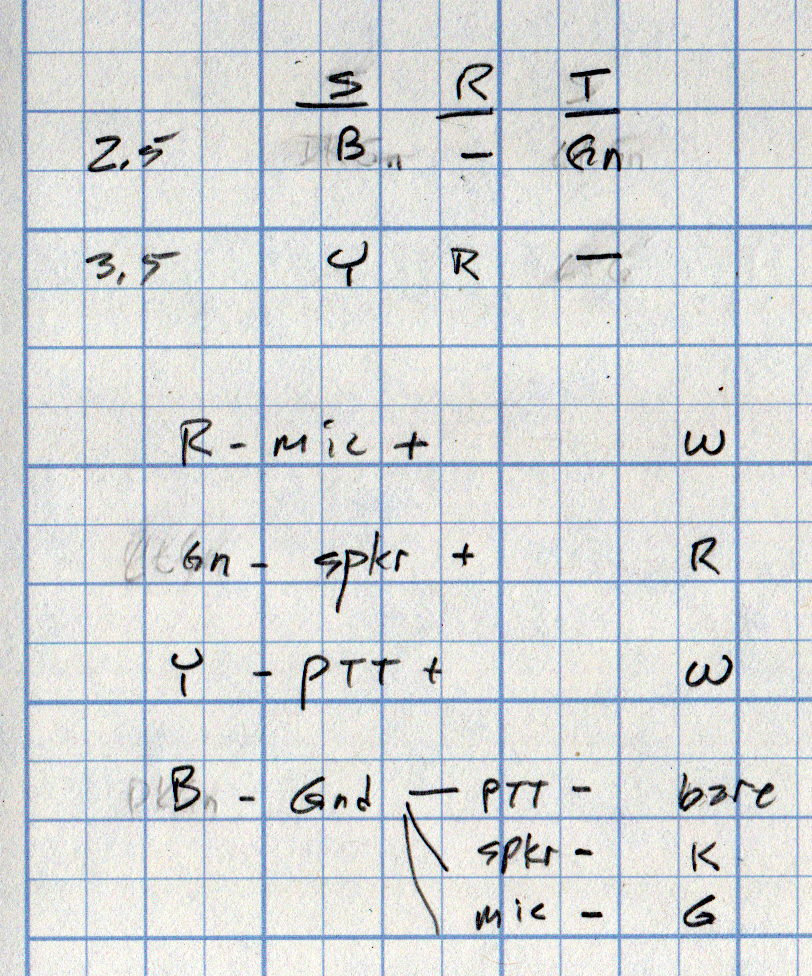
The wire colors from the dual plug, along with the wire colors for the repurposed USB cable to the headset, and the PTT connection:
Baofeng headset cable vs helmet cable – wire colors
Then wire it up accordingly:
Baofeng headset wire plate – first wiring
The small heatstink tubing surrounding each connection isn’t easily visible, which, in the case of the ground / common lump, is a Good Thing. I chivied a strip of Kapton under the whole mess, folded it over on top, squished it together, then secured it with 1/4 inch tape extending over the plate edges. The cable ties stick out far enough to keep the joints from rubbing on anything; it’s not built to last for a thousand years, but should let us hear how this lashup works.
Now, to the bikes:
Baofeng headset wire plate – in use
I’m convincing myself a little supporting ring under the SMA-to-UHF adapter won’t actually stabilize the precarious-looking joint.
My venerable amateur radio HT APRS-voice interfaces have recently begun failing and, given poor APRS coverage in Poughkeepsie due to having two iGates shut down (due to the aging radio geek population), I decided it’s time to simplify the radio interface. Given that HTs are designed to run with an external electret mic and earbud, the “interface” becomes basically some wires between the radio’s jacks, a repurposed USB plug on the bike helmet, and the PTT switch on the handlebar.
I expected to add a resistive attenuator to the earbud, but it wasn’t clear whether the mic would need an amplifier similar to the one in the APRS interface, so I decided to start as simply as possible.
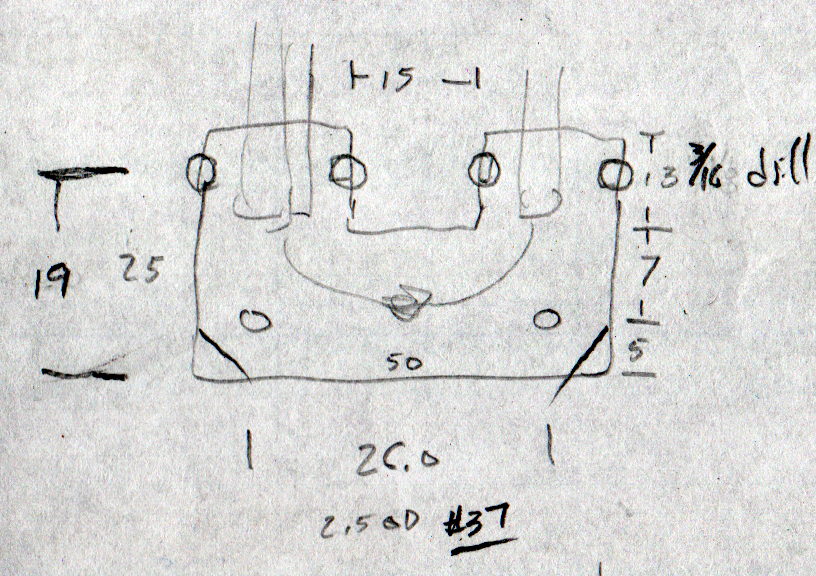
The general idea is to anchor all the cables to a plate on the back of the radio, interconnect as needed, then “protect” everything with tape. The pocket clip has M2.5 screws on 26 mm (not 25.4, honest) centers, so that’s how it started:
Baofeng headset wire plate – dimensions
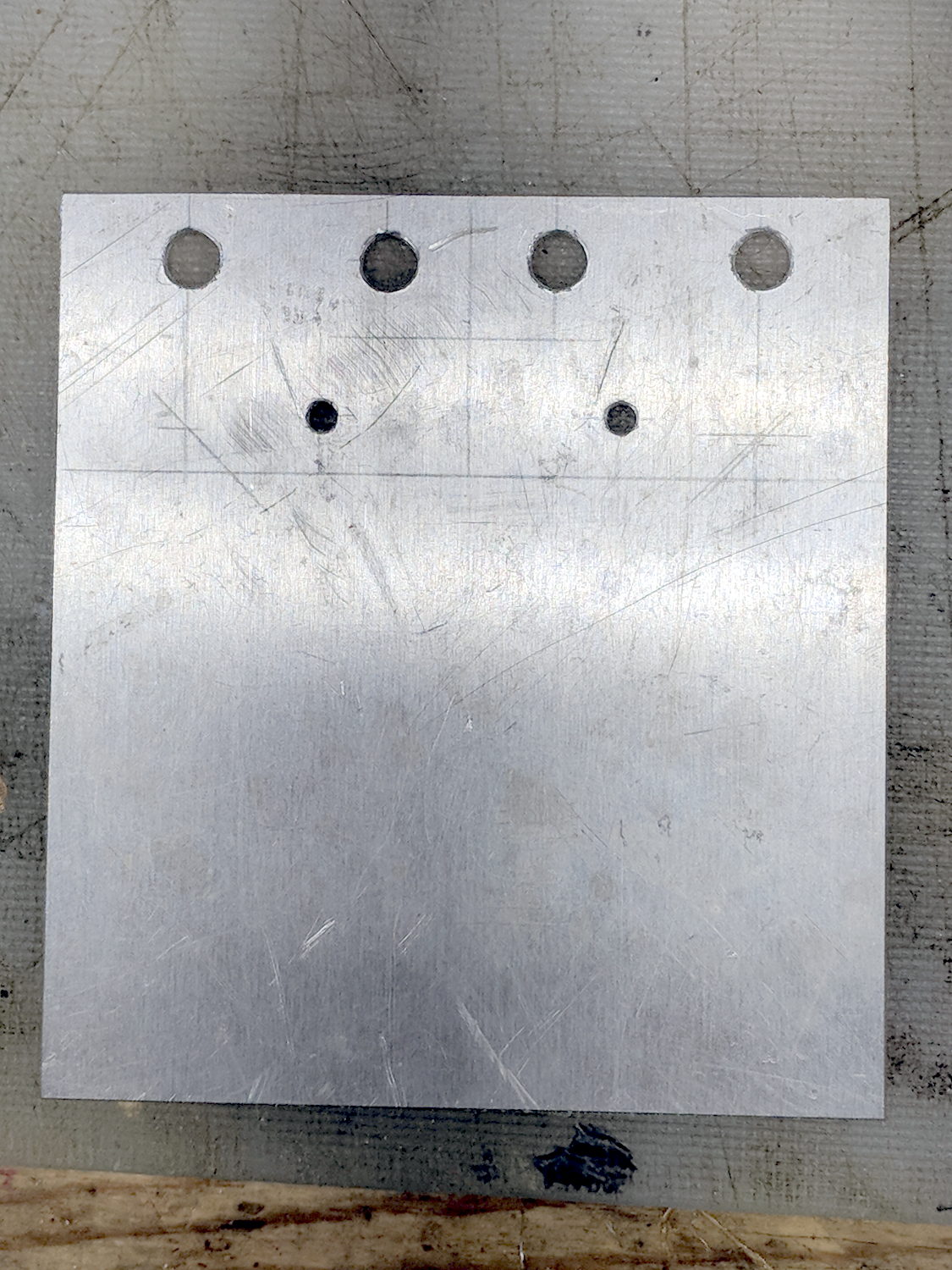
The four holes beside the tabs will serve as starting points for rectangular notches holding cable ties lashing the wires to the plate:
Baofeng headset wire plate – drilled
Like this:
Baofeng headset wire plate – sawed
That’s hot and nasty, straight from the bandsaw.
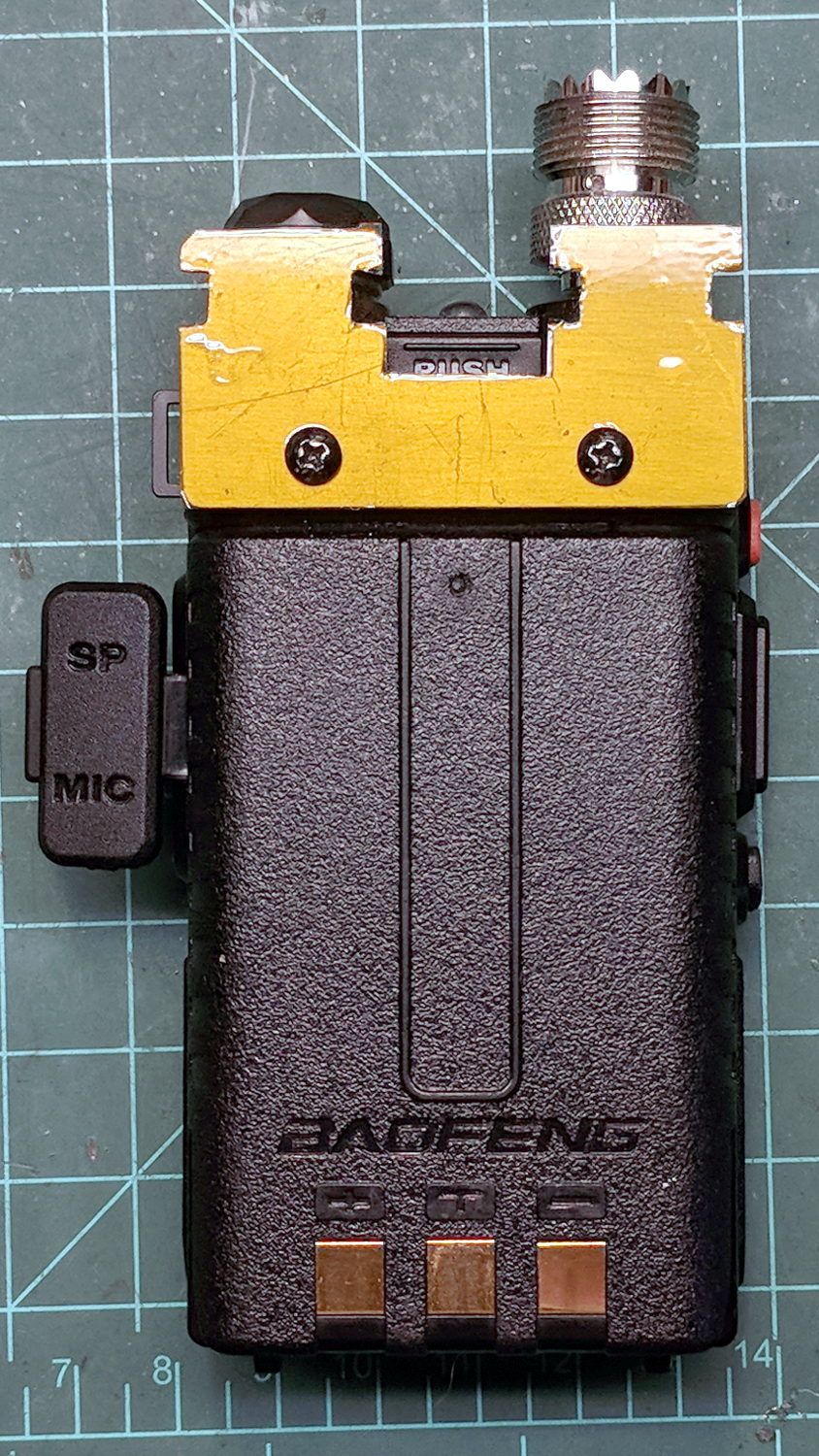
After some edge cleanup, add obligatory Kapton tape to insulate stray wires from the aluminum:
Baofeng headset wire plate – installed
The alert reader will note beveled corners on one plate and square corners on the other; think “continuous product improvement”.
The big rectangular gap in the middle of the plate provides (barely enough) finger clearance to push the battery release latch.
Now, to wire it up …
The dimensions of the recess surrounding the jacks on the Baofeng UV-5, just to have them around:
Baofeng headset jack socket – dimension doodle
Which came from measurements of both the Wouxun and Baofeng radios:
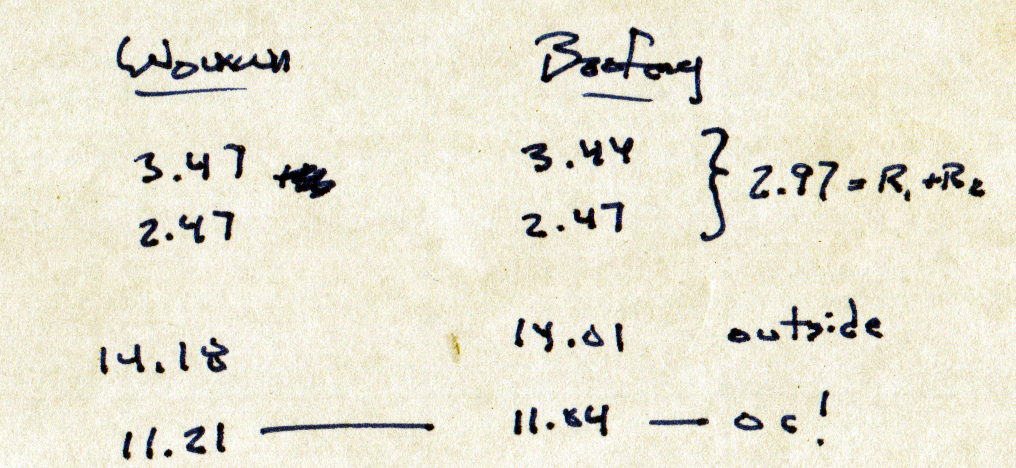
Baofeng Wouxun headset jack sockets – measurements
A long time ago, a pair of white LED + red laser flashlights powered by an AA cell diverged: one flashlight worked fine, the other always had a dead battery. The latter ended up on my “one of these days” pile, from which it recently emerged and accompanied me to a Squidwrench Tuesday session:
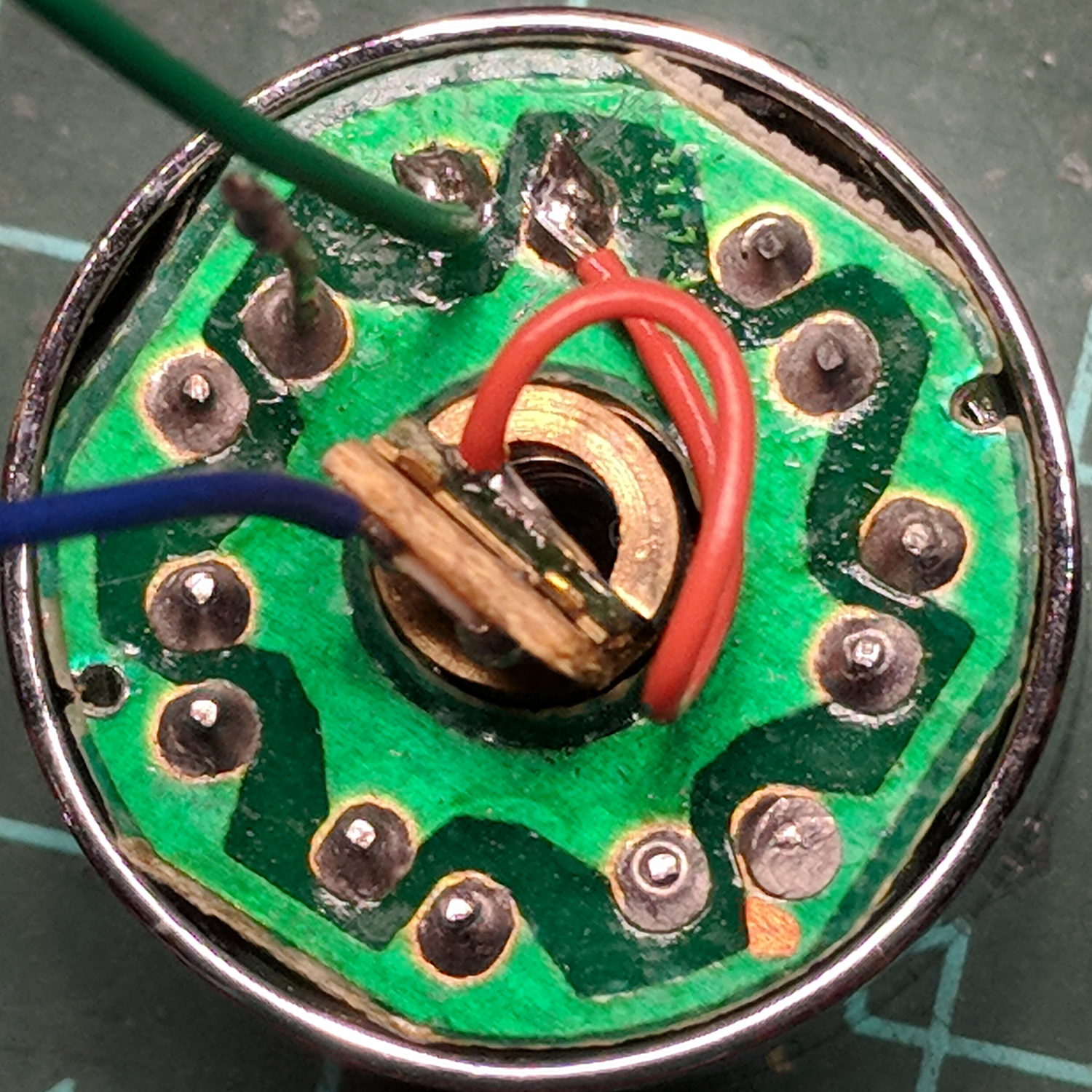
Small Sun flashlight – original wiring
The black wire trailing from the innards goes to the battery negative terminal, with the aluminum body providing the positive terminal connection to the wavy-washer spring contact visible atop the rear PCB inside the front shell.
The switch connects each red wire to the battery negative terminal, so there’s a color code issue in full effect. The two red wires burrow through holes in the rear PCB (shown above) and connect to the negative terminal of the laser module (the brass cylinder near the top) and the negative terminal ring on the front PCB holding the seven white LEDs:
Small Sun flashlight – original wiring – LED laser board
Continuing the color code issue, the black wire from the laser is its positive terminal. The out-of-focus wire (an LED pin) sticking up near the top of the picture carries the positive connection to the LED ring. The red wires from the switch are the negative connections for the LEDs and laser.
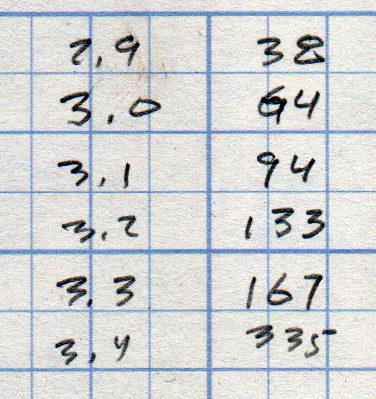
Voltages applied to the LED ring and the currents flowing therein:
Small Sun flashlight – 7x white LED current vs voltage
Seven LEDs at 20 mA each = 140 mA, so the voltage booster must crank out slightly more than 3.2 V. They’re not the brightest white LEDs I’ve ever seen, but suffice for a small flashlight.
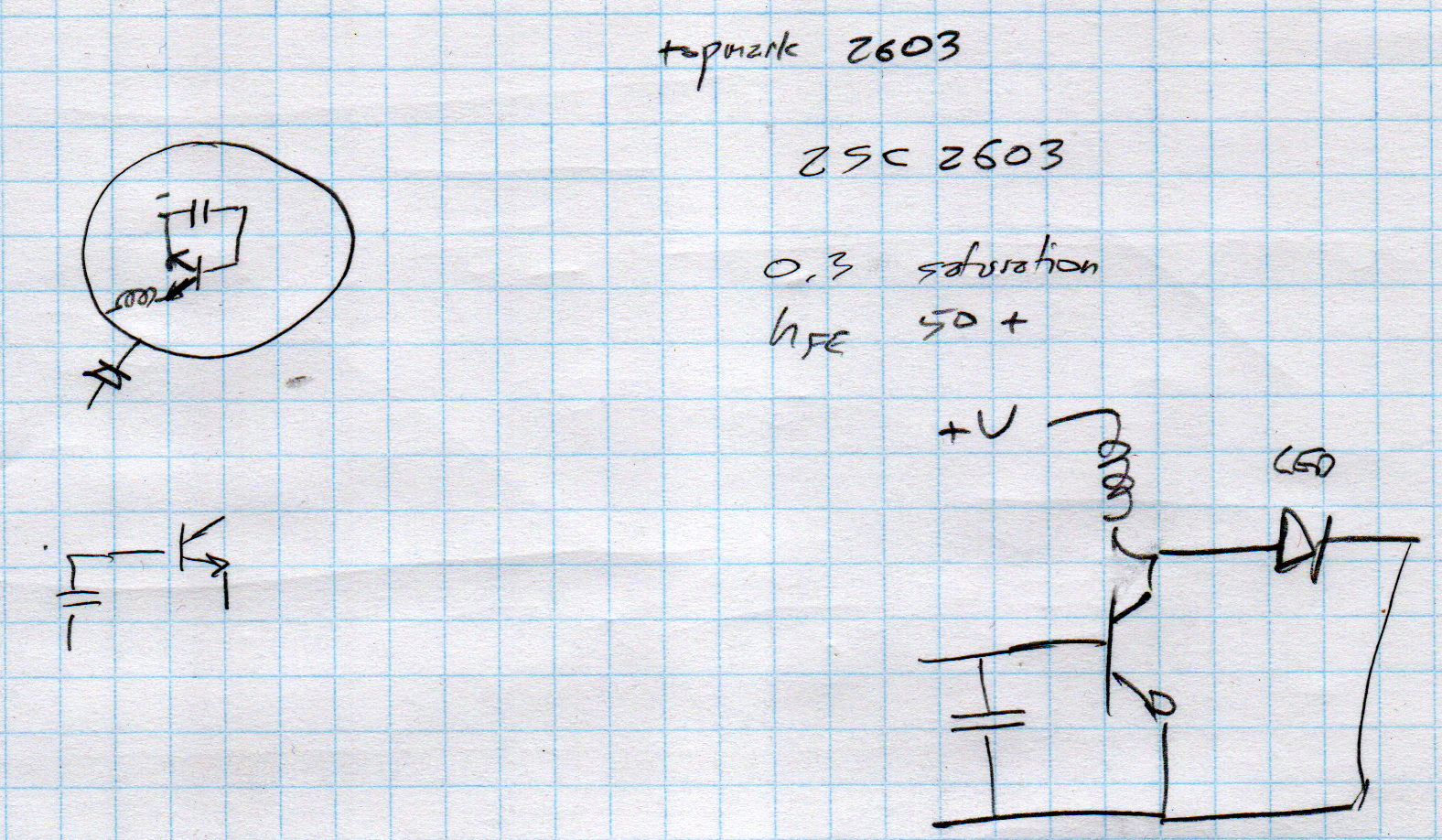
A crude sketch of the PCB layout, with a completely incorrect schematic based on the mistaken assumption the SOT23-3 package was an NPN transistor:
Small Sun flashlight – schematic doodle
Obviously, that’s just not ever going to oscillate, even if the 2603 topmark meant a 2SC2603 transistor, which it doesn’t.
A bit more searching suggests it’s a stripped-down Semtech SC2603A boost converter, normally presented in a SOT23-6 package. If you order a few million of ’em, you can strip off three unused pins, do some internal rebonding, and (presumably) come out with an SOT23-3:
Small Sun flashlight – correct schematic doodle
That topology makes more sense!
Before going further, I had to rationalize the colors:
Small Sun flashlight – rewired LED laser board
Soldering longer leads to the PCB allows current & voltage measurements:
Small Sun flashlight – LED current test
With the LEDs and laser disconnected, the converter seems to be struggling to keep the capacitor charged:
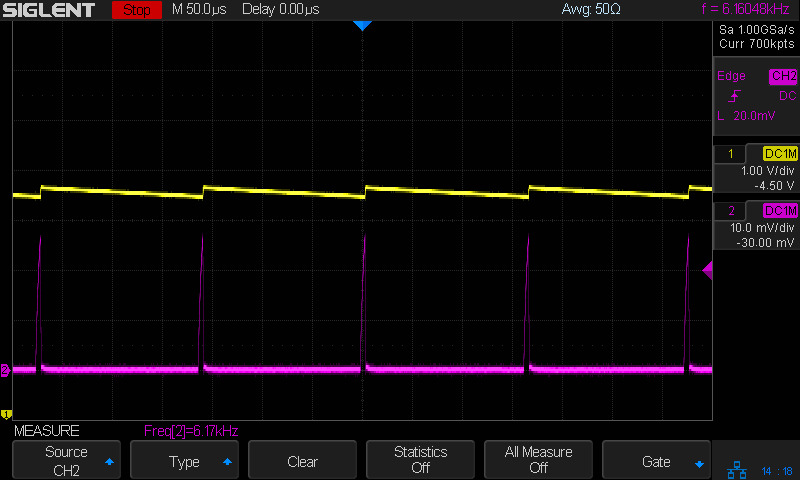
Small Sun flashlight – V boost I 200mA-div – idle
Those purple spikes come from the current probe at 200 mA/div: maybe half an amp in 5 μs pulses at 6 kHz works out to a 15 mA average current, which is pretty close to the 11 mA I measured; it’s not obvious the Siglent SDM3045 meter was intended to handle such a tiny duty cycle.
Obviously, the output capacitor is junk and, after removing it, the AADE L/C meter says NOT A CAPACITOR. Perhaps it never was one?
Measuring the cap in the good (well, the other flashlight) suggests something around 100 nF, so I installed a random 110 nF cap from the stash. The current peaks are about the same size:
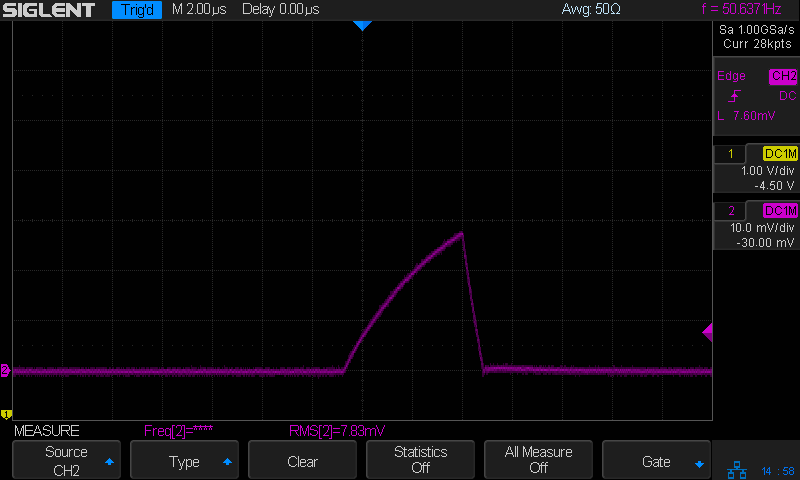
Small Sun flashlight – I 200mA-div – 110nF cap
The cap voltage (not shown) is now nearly constant and the 50 Hz PWM rate reduces the average battery current to 100-ish μA:
Small Sun flashlight – I 200mA-div – color-grade – 110nF cap
Not great, but tolerable; a 1000 mA·h battery will go flat in a few months.
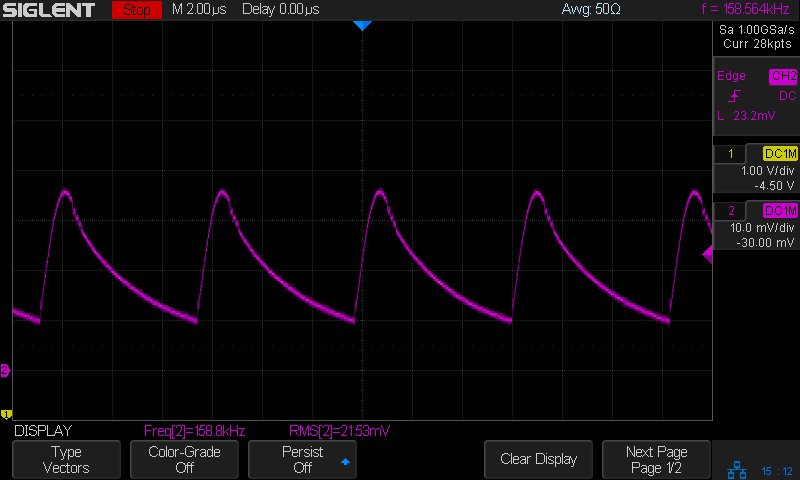
The LED current runs a bit hotter than I expected:
Small Sun flashlight – I 200mA-div – LED current – 110nF cap
The bottom is about 200 mA and the average might be 350 to 400 mA.
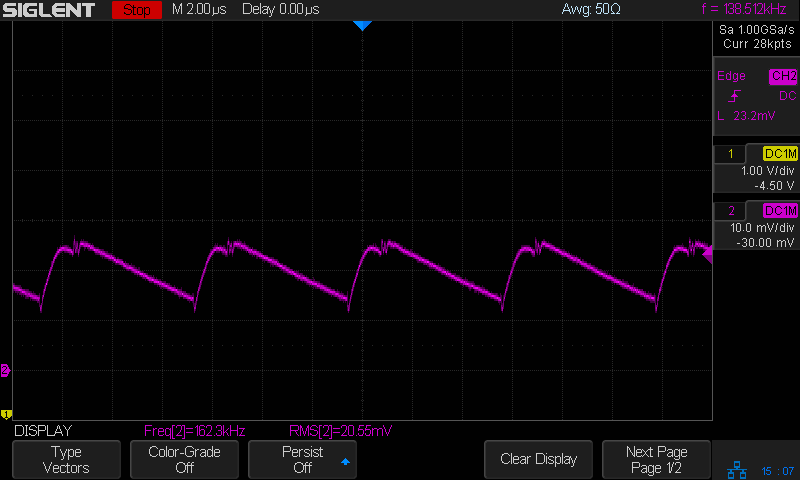
Compared with the other flashlight:
Small Sun flashlight other – I 200mA-div – LED current
So the cap is maybe a bit too small, but it likely doesn’t matter.
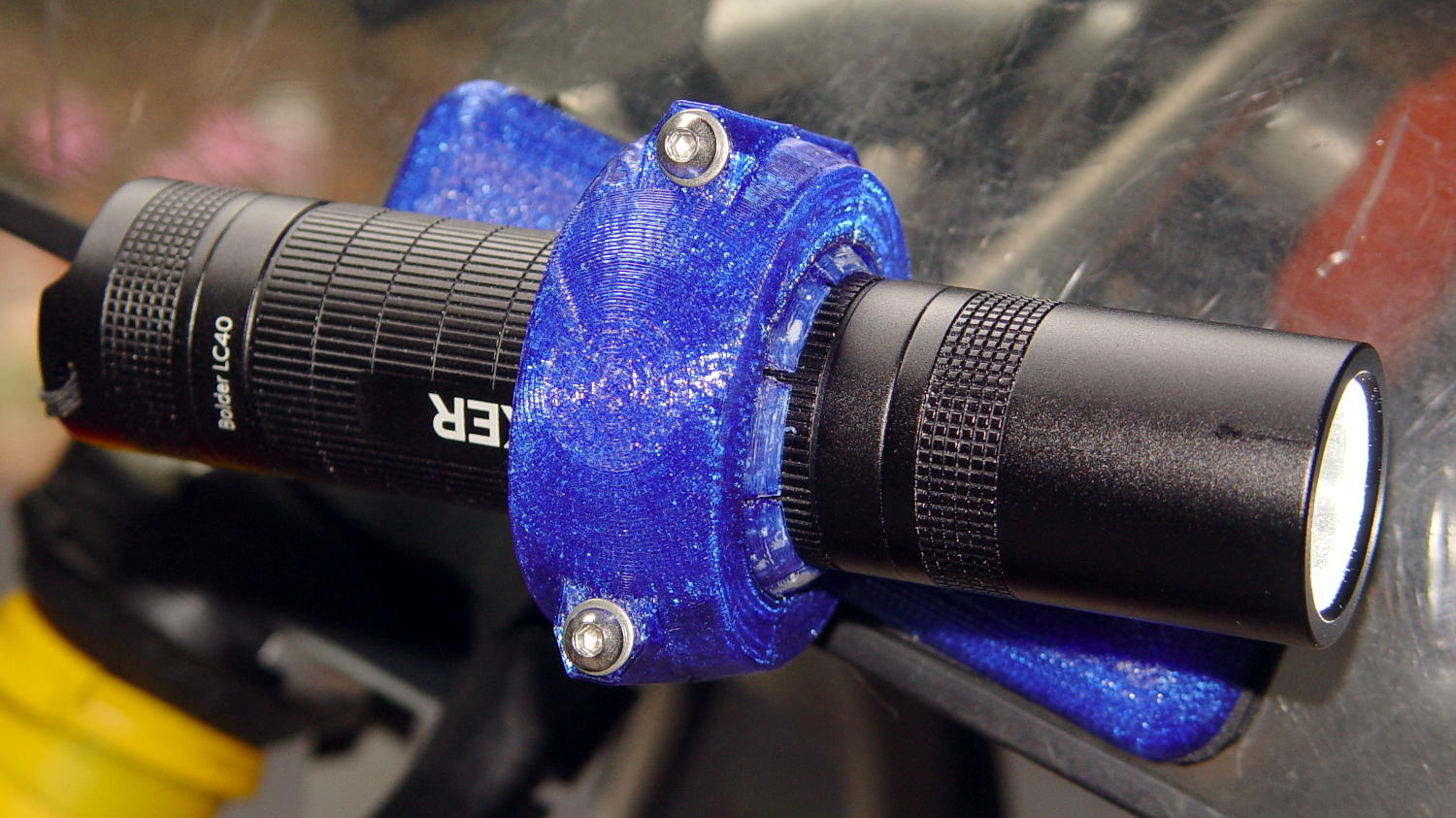
And, because they’re firmly attached to the fairing mount, there’s no way to tilt them to extract the 18650 cell.
This took entirely too long to figure out:
Lithium 18650 Cell Extractor Tab
The LC40 end caps have a recess exactly where it’ll do the most good: capturing the tab inside the cap means it can’t interfere with the rear contact spring: