Looks like a trend to me:
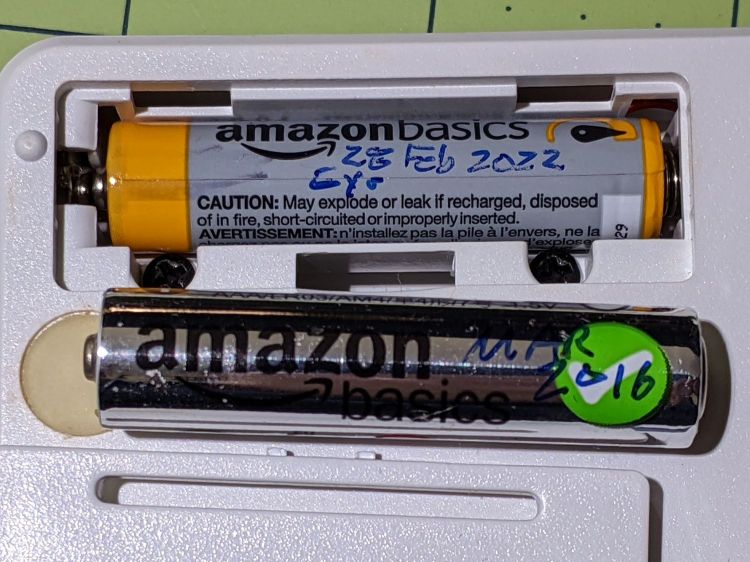
Of course, past performance does not guarantee future results, because Amazon surely has gone through more white-label suppliers in the last half-dozen years than I can count.
The Smell of Molten Projects in the Morning
Ed Nisley's Blog: Shop notes, electronics, firmware, machinery, 3D printing, laser cuttery, and curiosities. Contents: 100% human thinking, 0% AI slop.
Electrical & Electronic gadgets

Looks like a trend to me:
Of course, past performance does not guarantee future results, because Amazon surely has gone through more white-label suppliers in the last half-dozen years than I can count.

Having worn my work glove collection to exhaustion, the fanciest two pairs in a new selection came with elaborate security tags:

Finding a standard tag inside inside the fancy shell shouldn’t come as any surprise, but I’m surprised the retail loss ratio for a pair of $20 gloves can support that much hardware.
I went through the self-checkout area and didn’t do anything special, so either those lanes don’t have tag scanners or the tags are security theater.

It never ceases to amaze me that these capacitors appear in the AC power line circuits inside old-school fluorescent shop lights:

It really is a capacitor:

Its sibling from the other end of the fixture had more ESR:

Both were likely within spec, whatever that means.
I have no idea what’s lurking inside the tidy LED tubes now living in that same fixture, of course.

Found inside a fluorescent desk lamp being salvaged for possible use as an LED task lamp:

It’s one of the few Underwriter’s Knots I’ve ever seen in the wild. Many recent (i.e., built in the last half-century) lamps pass the cords through a plastic clamp or depend on simple bushings, with some just ignoring the problem.
This anonymous lamp sports the usual Made in China sticker, but also features a genuine-looking UL sticker complete with elaborate holograms, so it may well have been sold by a reputable company. IIRC, it came from a trash can in a Vassar College hallway, back when in-person meetings were a thing; perhaps Vassar required known-good electrical hardware.
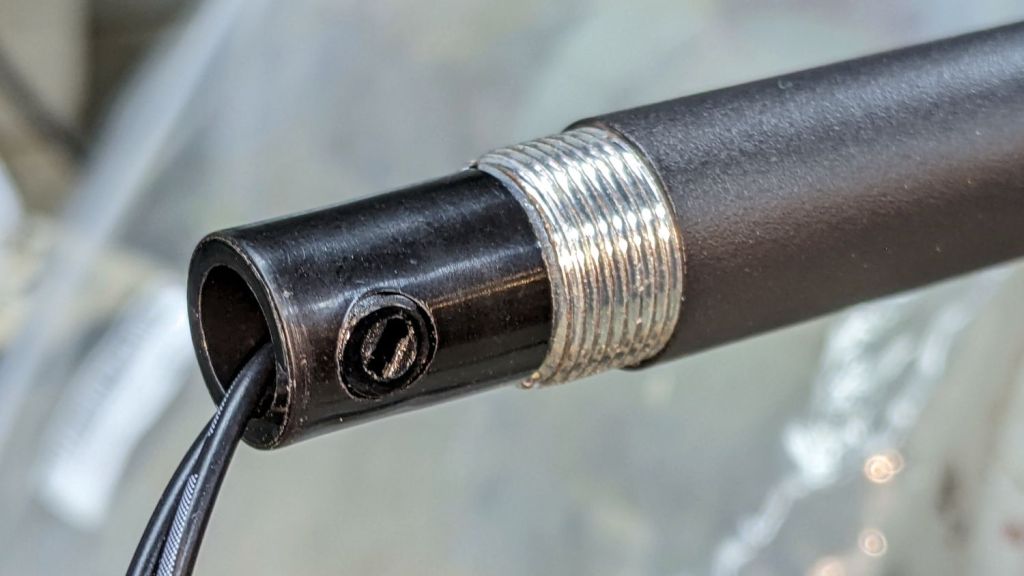
A new floor lamp similar to the one I adjusted to suit my chair appeared next to Mary’s chair. It was, as I expected, much too tall, but shortening it required just removing one of the vertical tube sections (exactly one foot long!), as Mary was content with the flexy arm’s reach. Perhaps as a nod to the current chip shortage, this version of the lamp has a control consisting of a mechanical knob in a lump just under the flexy arm: push to turn on, rotate for intensity, tap for color, push-and-hold for off. This is much more usable than the finicky proximity pads on my lamp (and the slightly more expensive version of this one), which is why I picked it.
Because the coaxial power connector doesn’t fit through the bushing in the base of the vertical tubes and didn’t have a connector at the control lump, I had to dismantle the lump to disconnect the power cable to remove the pipe section, an operation deep in warranty violation territory.
So, we begin.
Loosen the screw clamping the power cord to the tube just below the control lump:
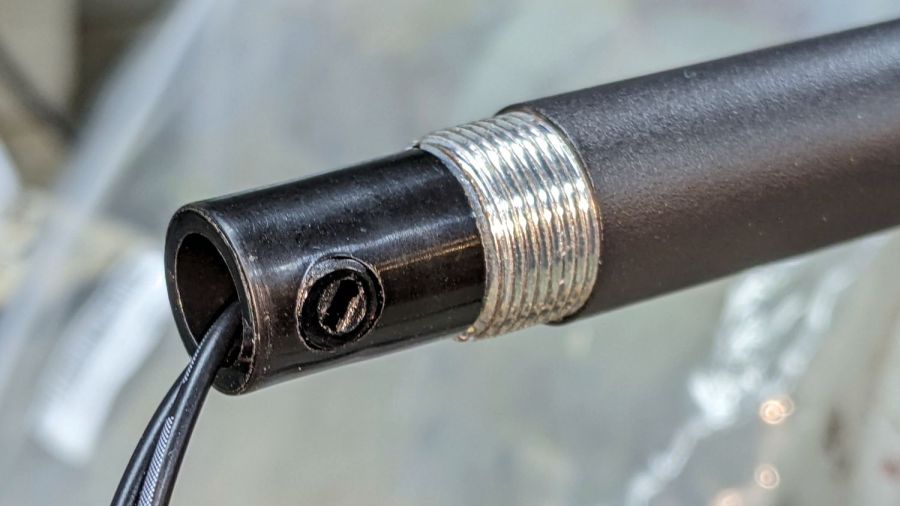
Remove the two screws holding the control lump together:

Pull the front of the lump off the tube and peel off a protective foam sheet to expose the circuitry:
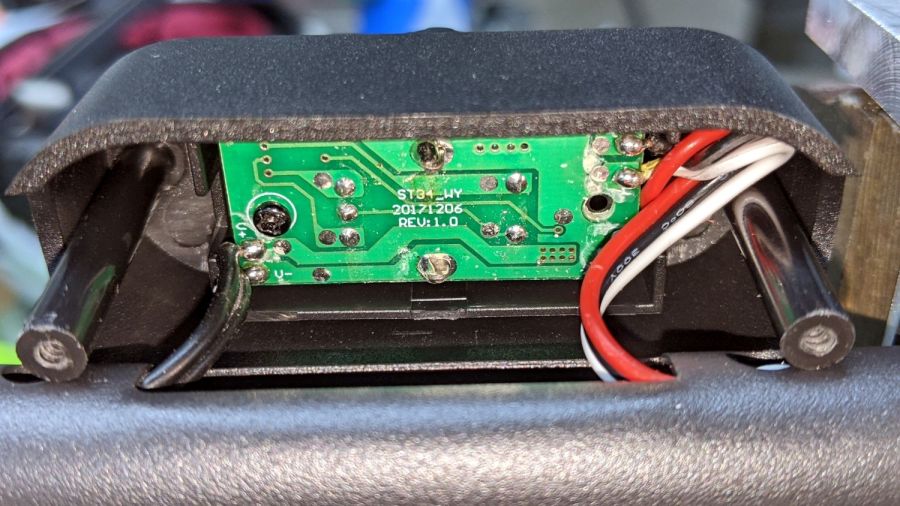
Power comes from a 12 VDC 400 mA wall wart, so note the wire markings:
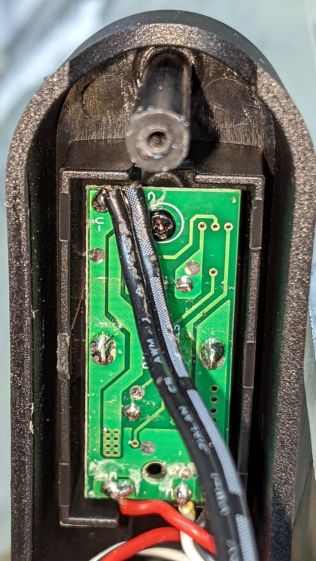
In this case, the marked wire (with the dashed lines) is the positive conductor:

Unsolder the cable and pull it out of the entire collection of tubing. The topmost section has two inner threads, so remove one of the other sections (with inner and outer threads) and reassemble the rest. Poke the cable through the tubes, solder to PCB, tighten clamp screw, reassemble lump in reverse order, then declare victory:

The business end now hovers 39 inches (a neat 1 m) over the floor, just below her eye level, where it belongs.
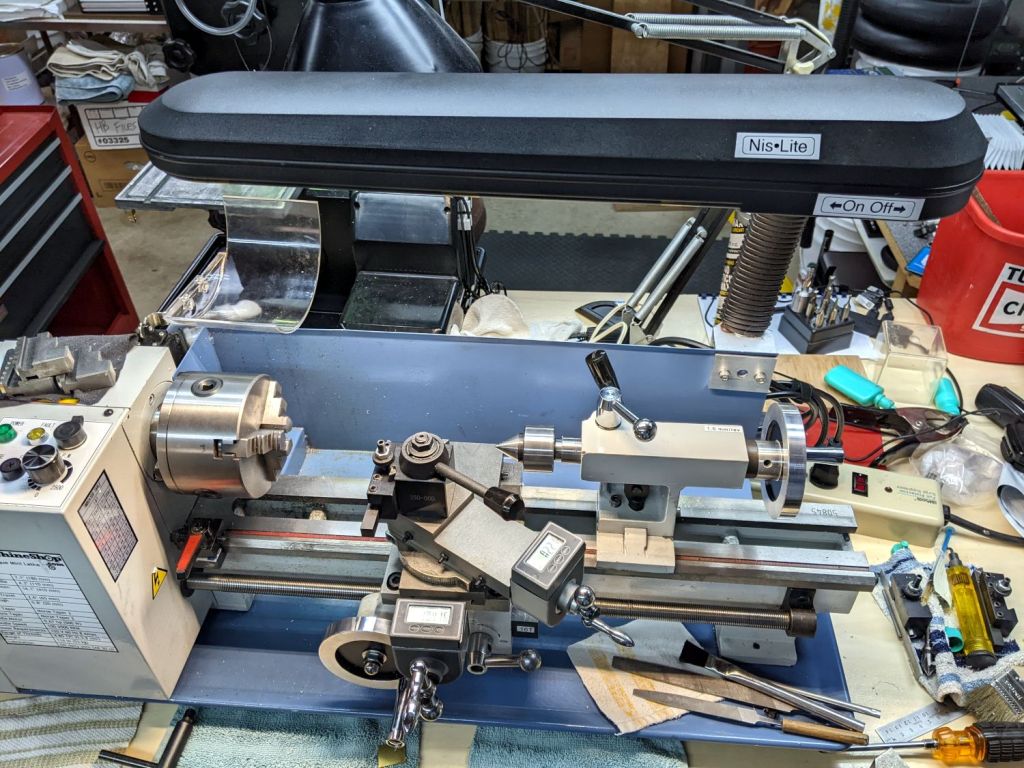
An ancient Ottlite fluorescent floor lamp (one of a pair bought during a closeout sale at a minute fraction of their absurd sticker price) finally aged out. Pondering what to do with the carcass led to this discovery:
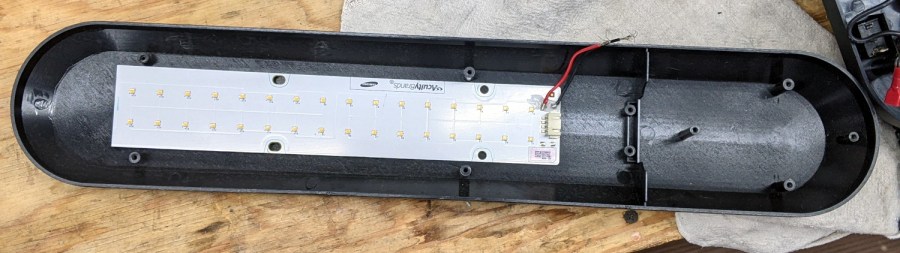
Half of a Samsung (!) LED panel (presumably sheared by the surplus supplier) fit so perfectly in place of the fluorescent tube that I just had to make it happen.
The original fluorescent ballast mounted in the smaller compartment:
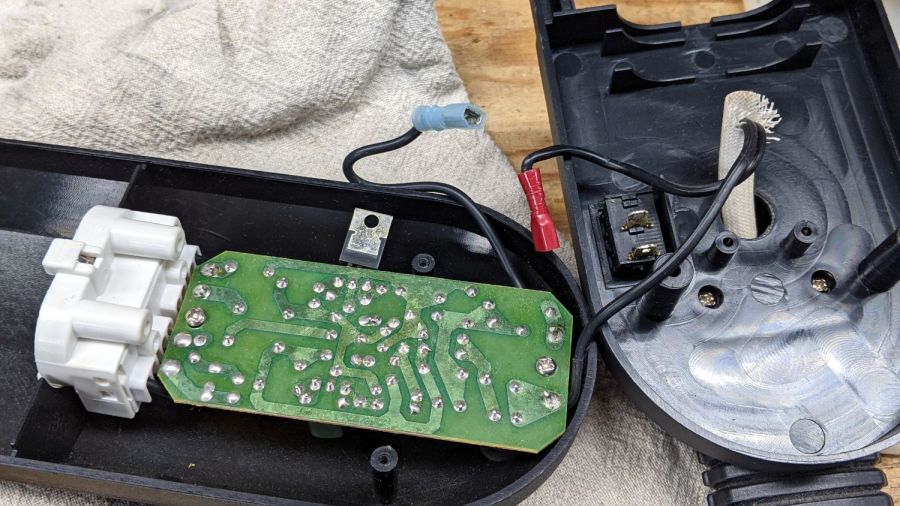
I like the air-cooled triac sticking off the side of the PCB.
The lamp originally mounted parallel to the flex arm, but I wanted it at a right angle, so the molded bracket had to go:
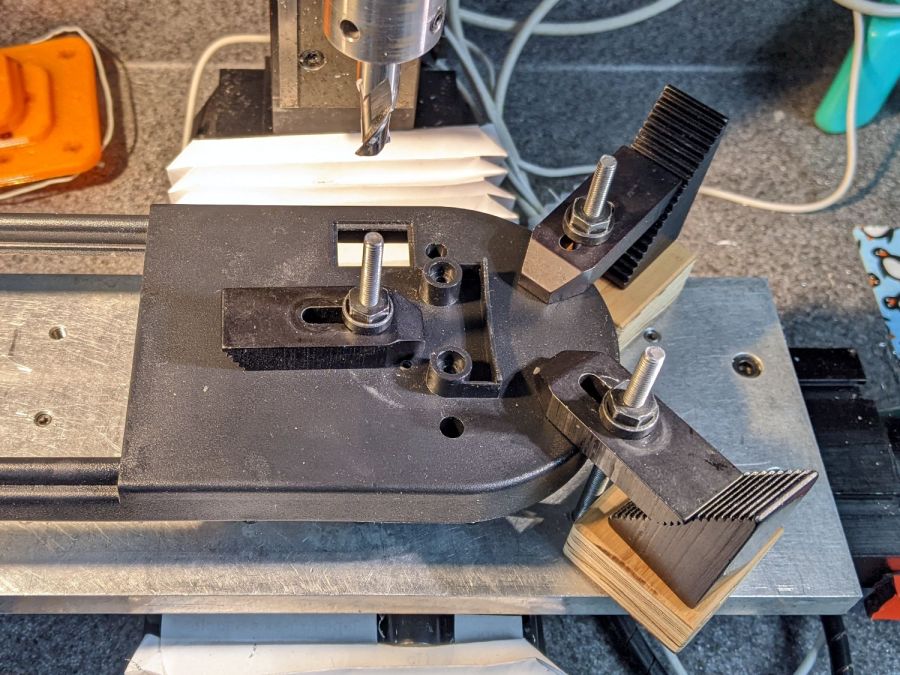
Which required a few minutes of manual jogging:
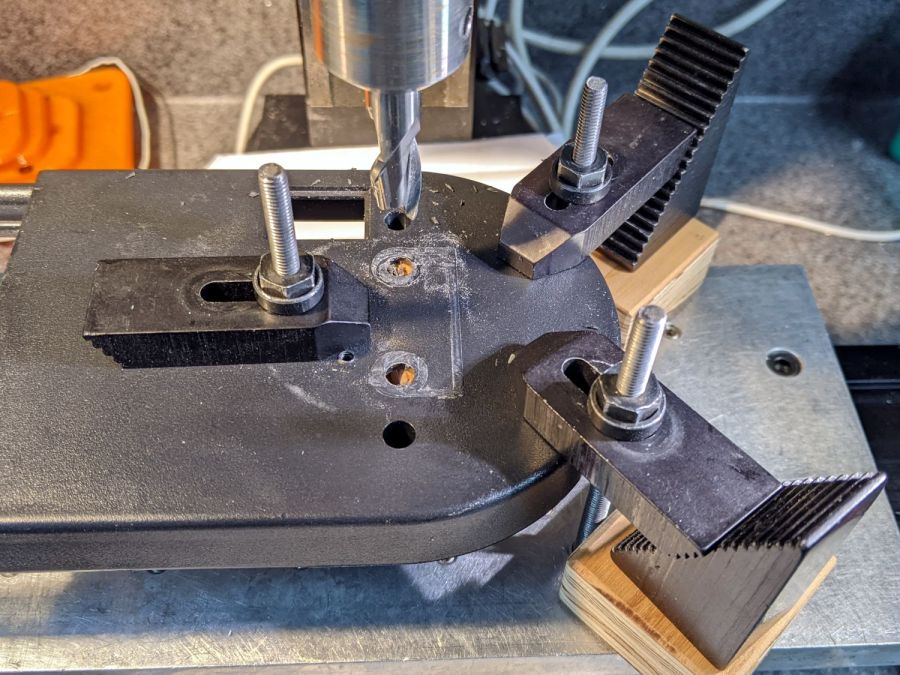
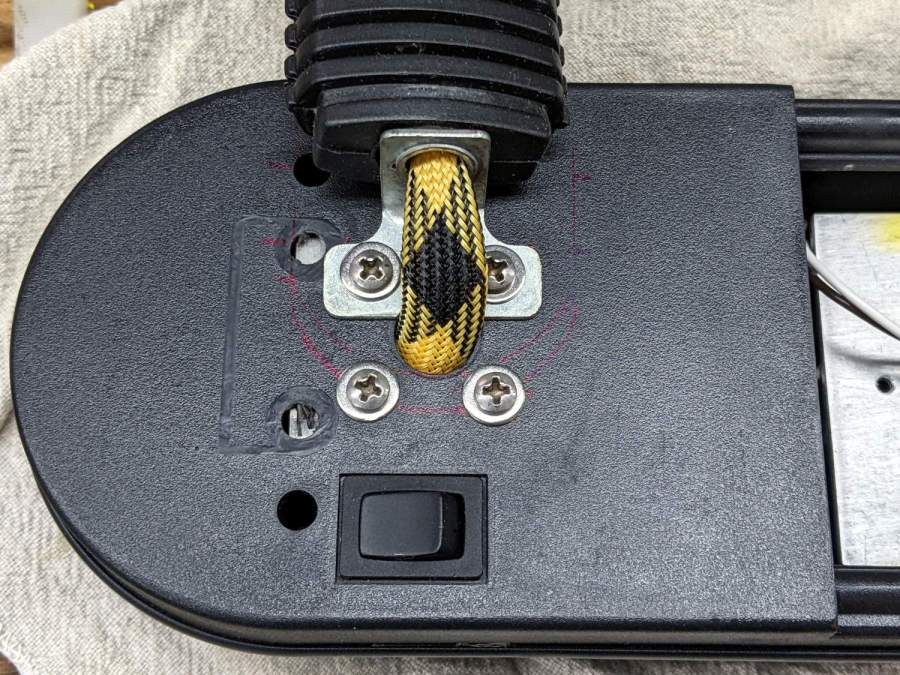
Some coordinate drilling on the Sherline converted a rectangle of aluminum sheet into a backing plate inside the base (visible through the original holes) to spread the stress over a larger area:
The new 24 V 1 A power supply mounts pretty much where the OEM ballast came from, although I had to hack out the molded screw bosses and perch the PCB atop four aluminum standoffs anchored in globs of high-temperature hot-melt glue:
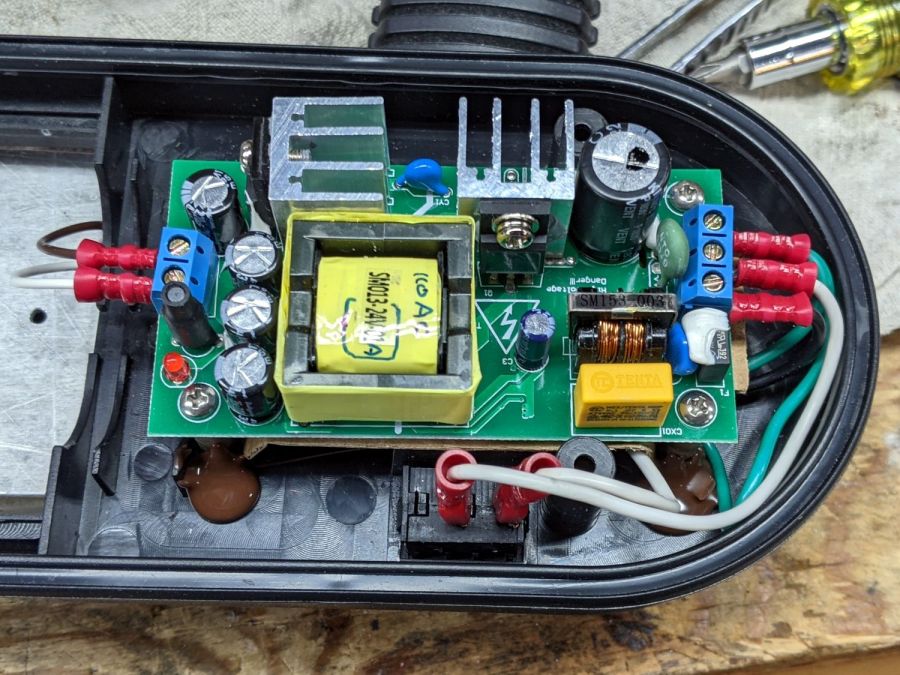
You might think the white and black wires on the right are interchanged, because you’re not supposed to switch the neutral, but only if you also insist anybody cares about the colors of wires inside a molded cord. This one came from a nominally good-quality cord with an IEC connector now in the e-waste box: trust yet always always verify.
The LED panel sticks to the aluminum sheet with thermal tape and is clamped in place with a quartet of M2.5 standoffs:
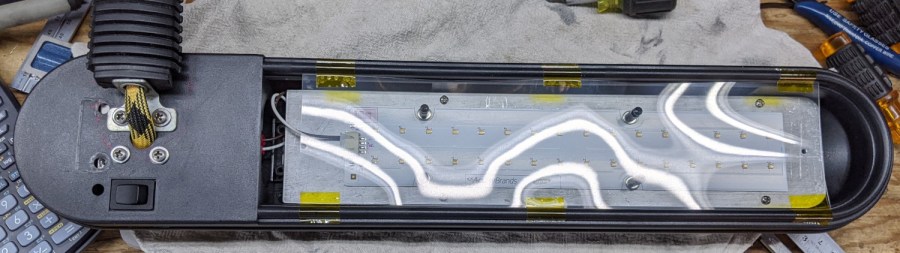
I’ll eventually make a better cover than a strip of overhead projector film (remember overhead projectors?), as spattering the LEDs with cutting oil and random conductive swarf is Bad Practice™.
A little more cutting and drilling produced an angle bracket for the lathe backsplash panel:
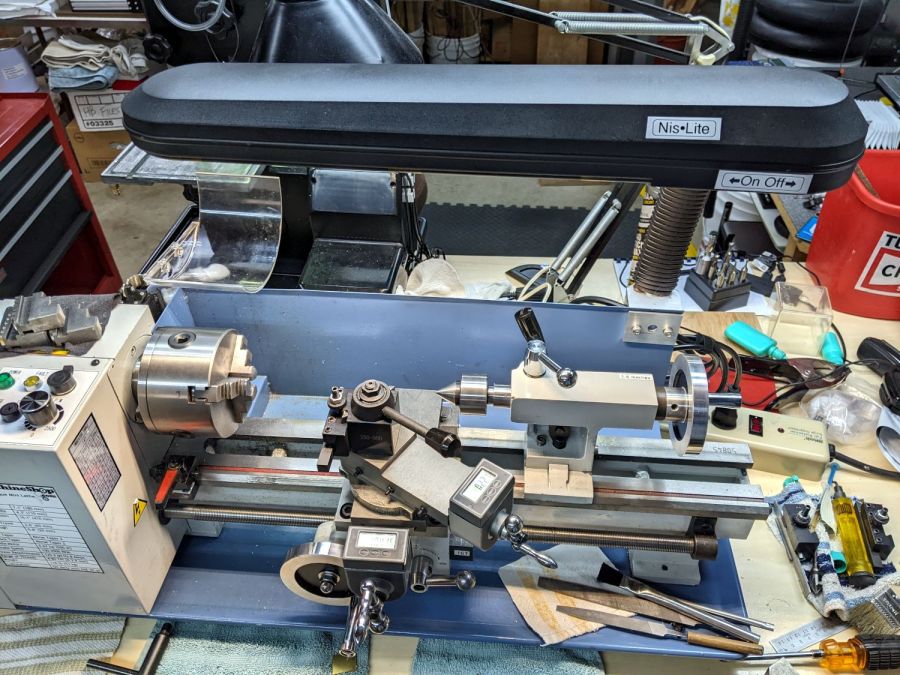
Thing looks like it grew there, doesn’t it?
The end of the backsplash might need a 3D printed bracket to stabilize its right-angle bends and prevent wobbulation, although I’ll wait until that becomes a real problem before solving it.
The top of that stylin’ lamp shade tapers along its length and, unfortunately, appears directly in front of the MPCNC bench across the basement (out of sight at the top) as I stand at the lathe. Having the shade not align exactly parallel to the bench is more annoying than it really should be; perhaps I can get used to it after spending more time at the lathe.
I loves me some good LED lighting …

Harvesting a line cord for a widowmaker test setup revealed its inner secret:

The conductors are as thin as I’ve ever seen in an AC line cord, with 0.5 mm² = just under 20 AWG. The color code doesn’t match USA-ian standards, but neither does the labeling, so I’m not surprised.
If the individual strands seem unnaturally straight, they are, because they’re made of (presumably) copper plated on a (presumably) metallic core. Here’s what they look like after bending them sharply around my fingernail:

Wonderfully springy, utterly non-magnetic, and surprisingly durable.
Scraping the 0.02 mm strands with a sharp blade reveals a silvery interior, so it’s (presumably) not copper-coated plastic. Aluminum springs (ahem) to mind, but I’d expect tiny aluminum strands would snap (or at least deform) when bent and erode quickly when scraped.
Each wire measures about 1 Ω / m from the plug (a convenient 40 inch = 1 m away), which is the resistance you’d get from a single hair-fine 5 mil = 0.13 mm strand of 35 AWG solid copper. An 18 AWG aluminum wire would have the same resistance as a 20 AWG copper wire, both of which should be 32 mΩ / m: a factor of 30 less than this crap.
I have no idea what low-end Chinese factories use in place of copper, but it’s gotta be really cheap.
A hank of the wire goes into the Box o’ Springs, in the event I ever need a tiny straight spring rod; you definitely can’t wind this stuff into a coil! It might be fine enough for a crosshair / reticle, at least for crude optics.
 The Smell of Molten Projects in the Morning