Ed Nisley's Blog: Shop notes, electronics, firmware, machinery, 3D printing, laser cuttery, and curiosities. Contents: 100% human thinking, 0% AI slop.
Danger Zone Earrings – GITD and PSA vinyl – UV light
And UV powers up GITD tape something fierce:
Danger Zone Earrings – GITD radiation
Cutting the central pattern out of the GITD earring might make it look even better, but I like the subtle presentation.
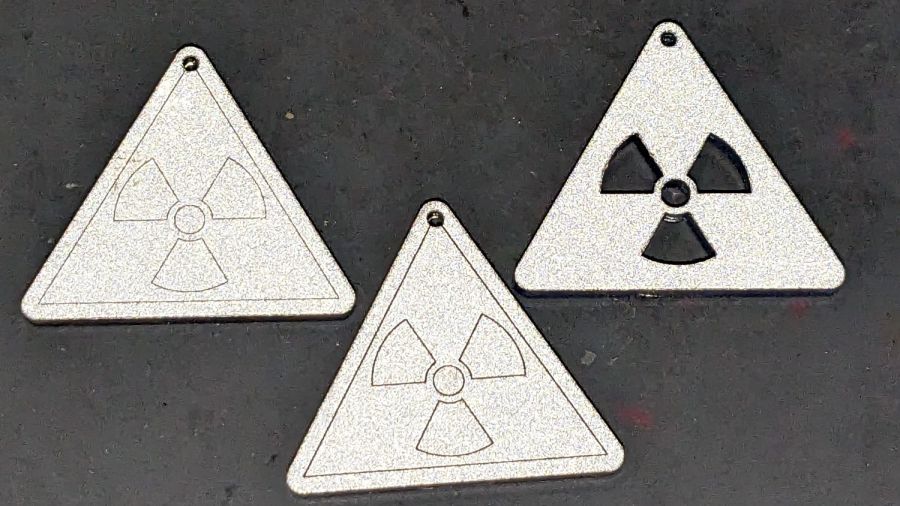
If it’s flash you want, then retroreflective tape is your fashion friend:
Danger Zone Earrings – retroreflective
The bolder kiss-cut lines in the middle earring might suffice, but the cutouts on the right definitely look more distinctive. Perhaps the kiss-cut perimeter line would set the pattern off a little better.
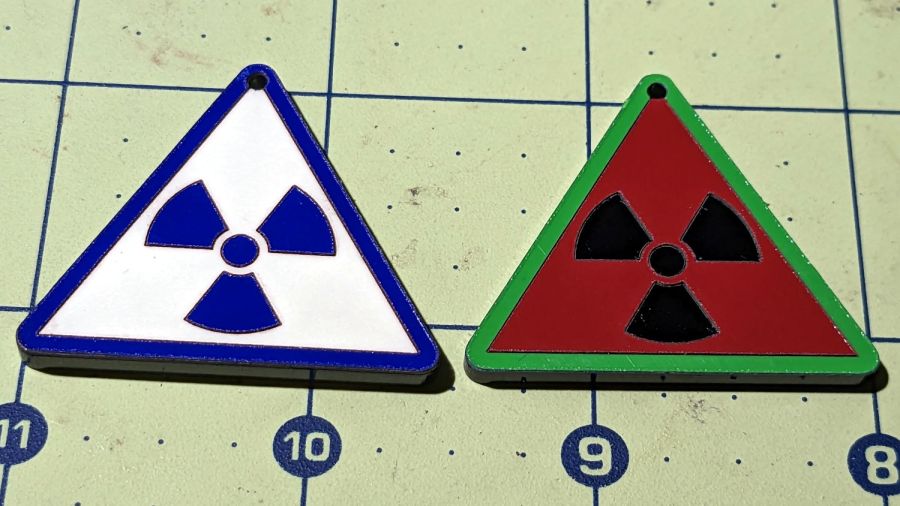
Assuming PSA vinyl sticks to itself and GITD tape well enough to survive normal handling, that would make multicolor earrings an option:
Danger Zone Earrings – multilayer PSA vinyl
On the left: blue PSA vinyl on GITD tape. On the right: green PSA vinyl on red PSA vinyl on black acrylic. Peeling the PSA vinyl is tedious and I’m still not good enough to avoid small nicks in the underlying layer.
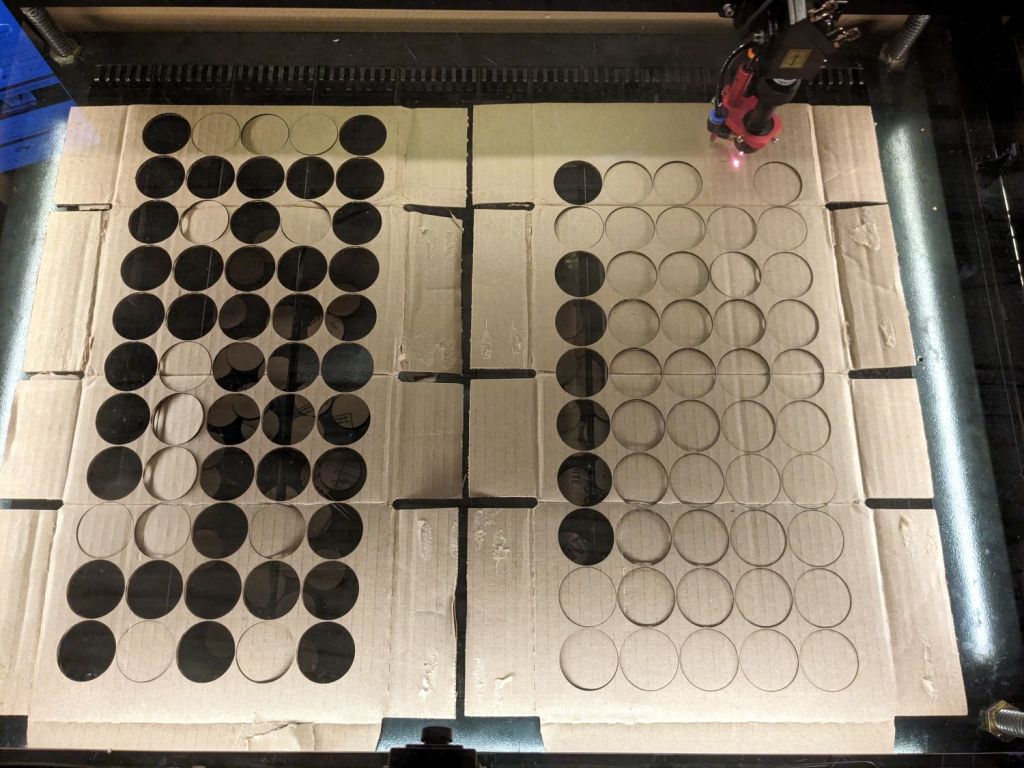
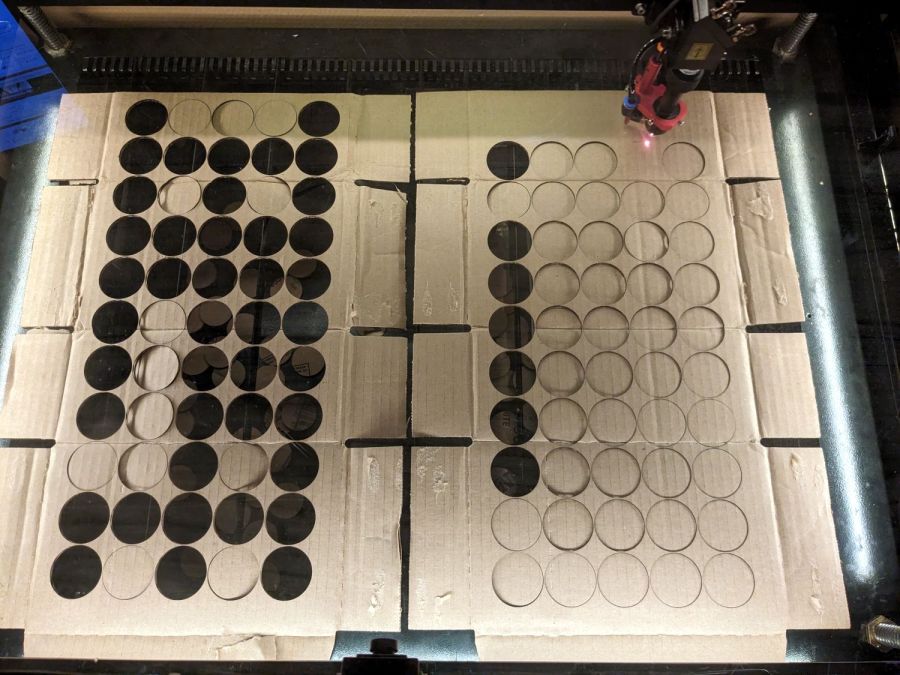
Draw a 42 mm circle, set the layer to cut corrugated cardboard, turn the circle into suitable arrays, flatten some boxes from the heap, and Fire the Laser:
Seedling starter pot bottoms
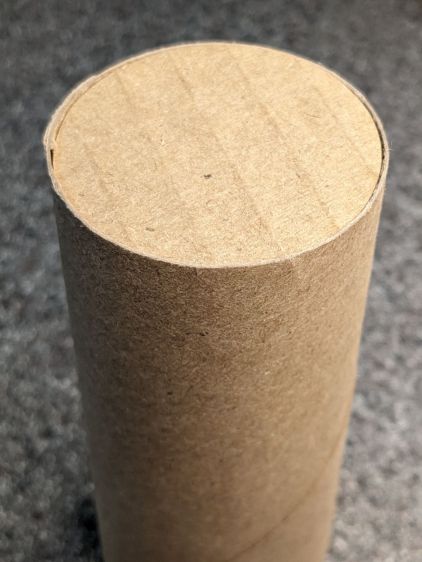
Collect the fallen disks from the chip tray and jam one in place as a serving suggestion, where it fits like it was custom-made:
TP roll seedling starter pot bottom
You’d still want to fold some flaps over the disk to keep it in place, but now your pot has a real bottom.
I have no idea if 42 mm is a Galactic Constant, but it worked for the pile of tubes we had on hand.
Some geometry review and a bit of fiddling with LightBurn produced regularized patterns suitable for laser cuttery:
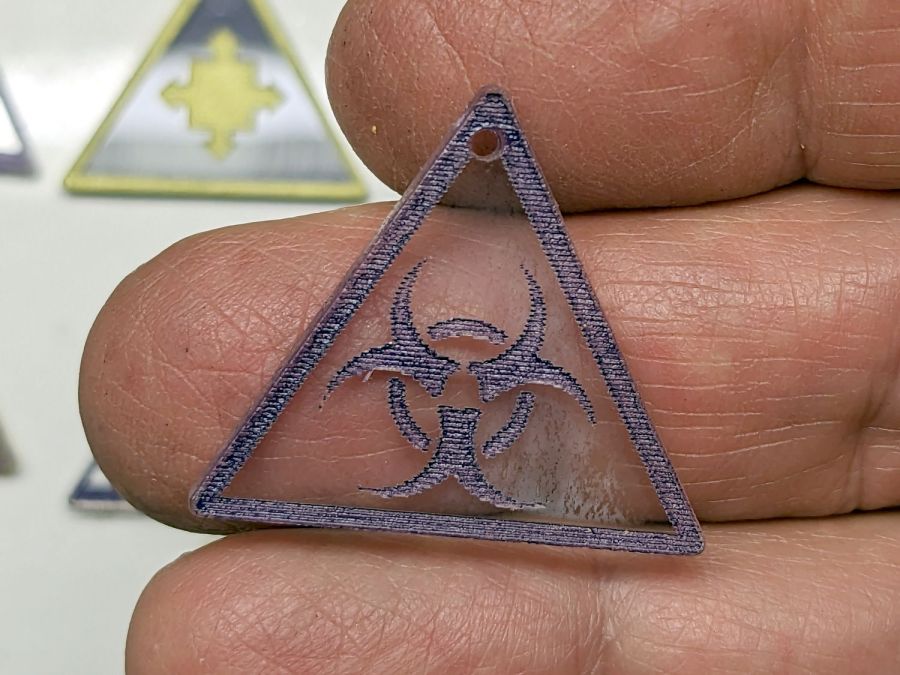
Danger Zone Earrings – radioactive – handful
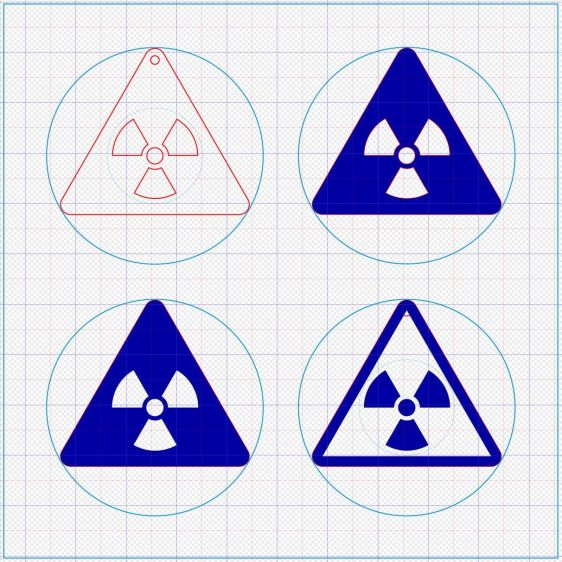
A key trick: circumscribe the figure with a circle on a tool layer, then group the whole mess together, so that the center of the circle coincides with the desired center of the figure. In particular, the geometric center of an equilateral triangle is not at the center of its vertical extent:
Danger Zone Earrings – radioactive – LB layout
The dark blue layer engraves the surface, the red layer cuts through 3 mm acrylic, and the light blue layer is the tooling.
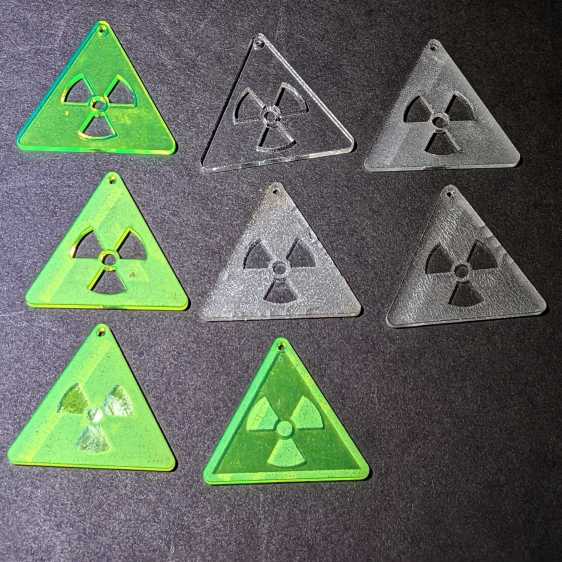
I like the edge-lit ones, although the simplicity of laser-cut clear acrylic is hard to beat:
Danger Zone Earrings – radioactive – white light
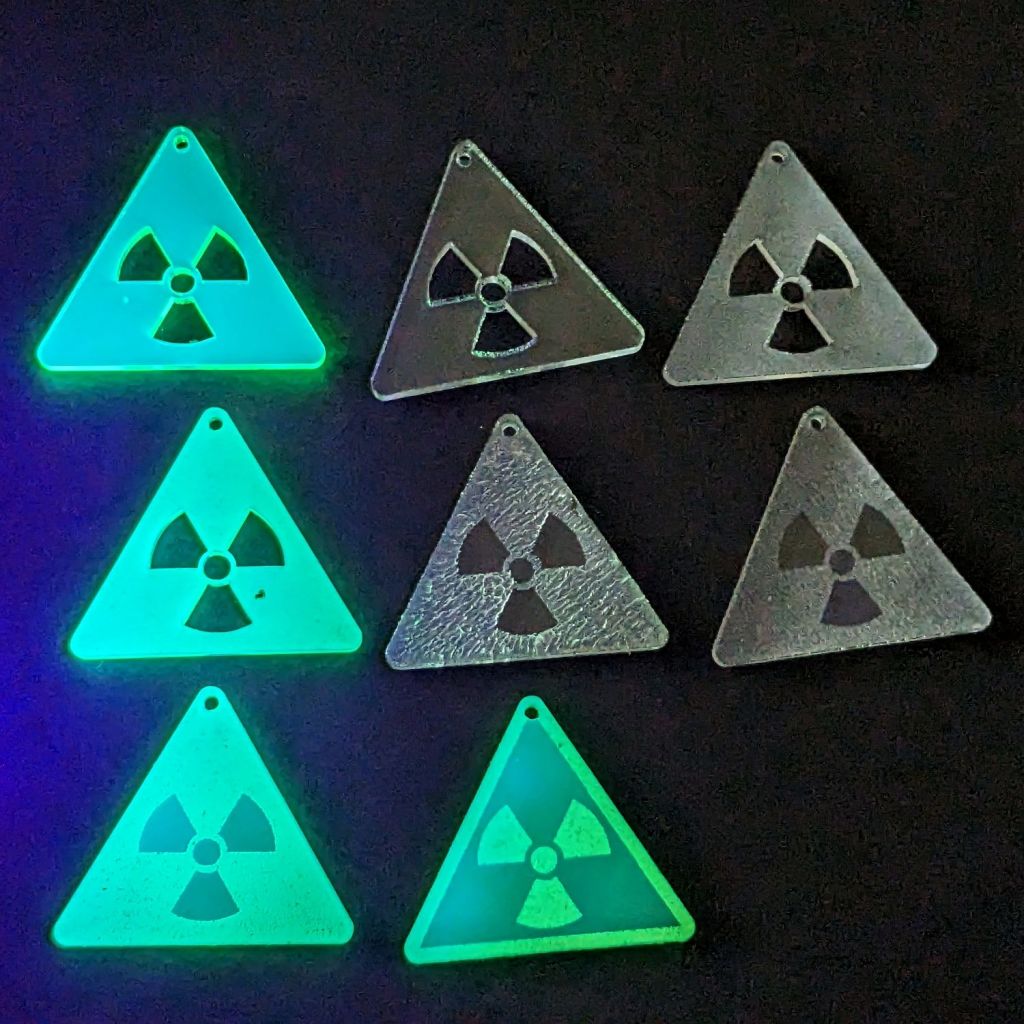
Wearing them in a place flooded with UV radiation would set you apart:
Danger Zone Earrings – radioactive – GITD UV
The careful observer will note stress cracking in the two clear earrings in the middle row. Those came from the vintage paper-covered acrylic sheet and I used alcohol to clean off the not-quite-vaporized glue just to see if isopropyl alcohol would behave differently than denatured alcohol. Nope, the cracks appear instantly.
Peeling the paper and engraving the bare surface produced the clear-frosted earring in the upper right, with the radiation symbol cut out of the sheet. Engraving without surface protection tends to deposit vaporized acrylic dust everywhere, so it would require hand cleaning without the cutouts.
The cutouts get 0.1 mm inward offsets to slightly increase the wall thickness around that central circle.
One combination I didn’t try: engrave the triangle perimeter for emphasis and cut out the symbol for contrast with edge-lit acrylic.
Dropping other symbols into place should be straightforward, with the center of the circumcircle as the snap target.
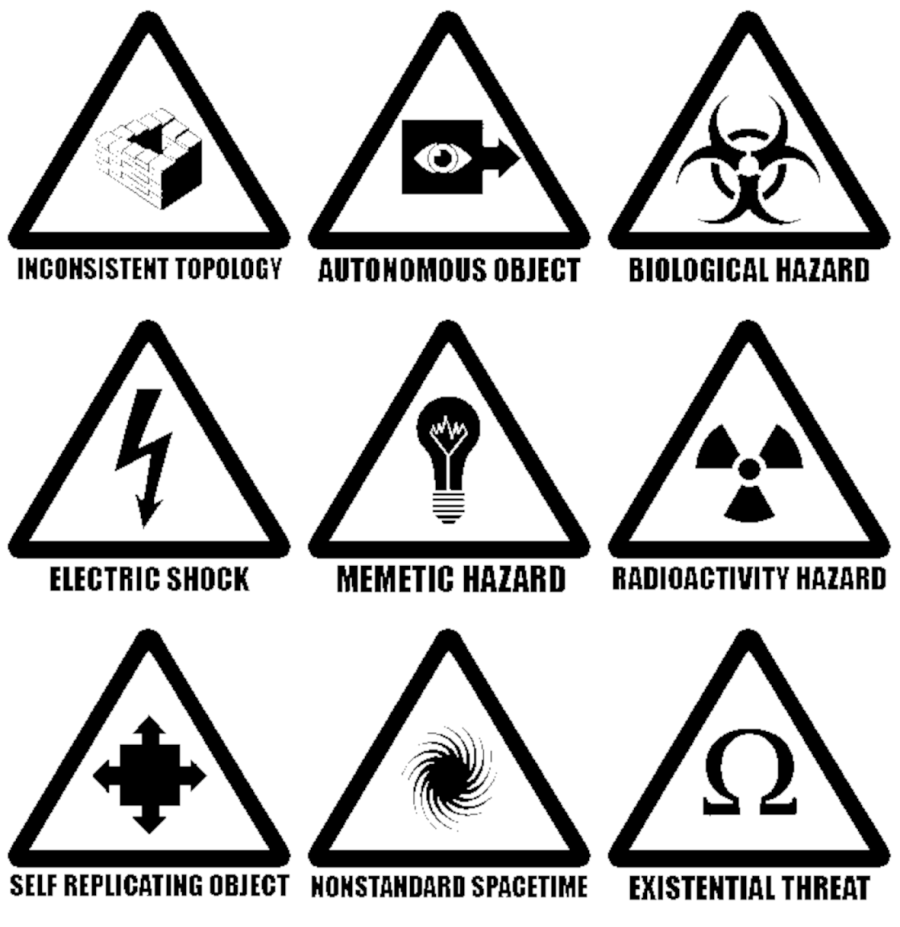
Then I traced them into LightBurn vectors suitable for engraving, added hanging holes, and fit a perimeter cutout. This being a test, I took a number of shortcuts resulting in slightly off-center engravings and ignored a number of image botches (most notably in the Inconsistent Topology figure.
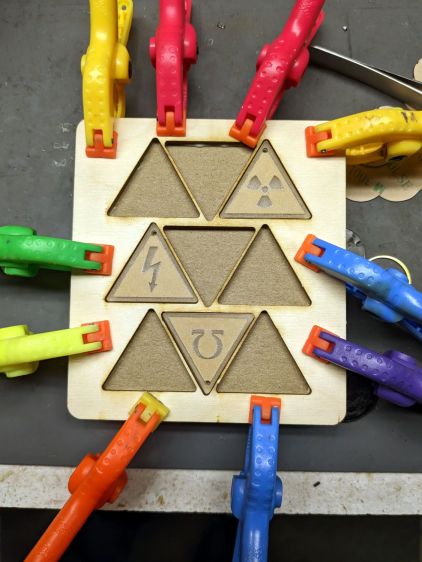
A quick painting fixture kept (most of) the rattlecan paint off the edges:
SCP Warning Labels – fixture clamping
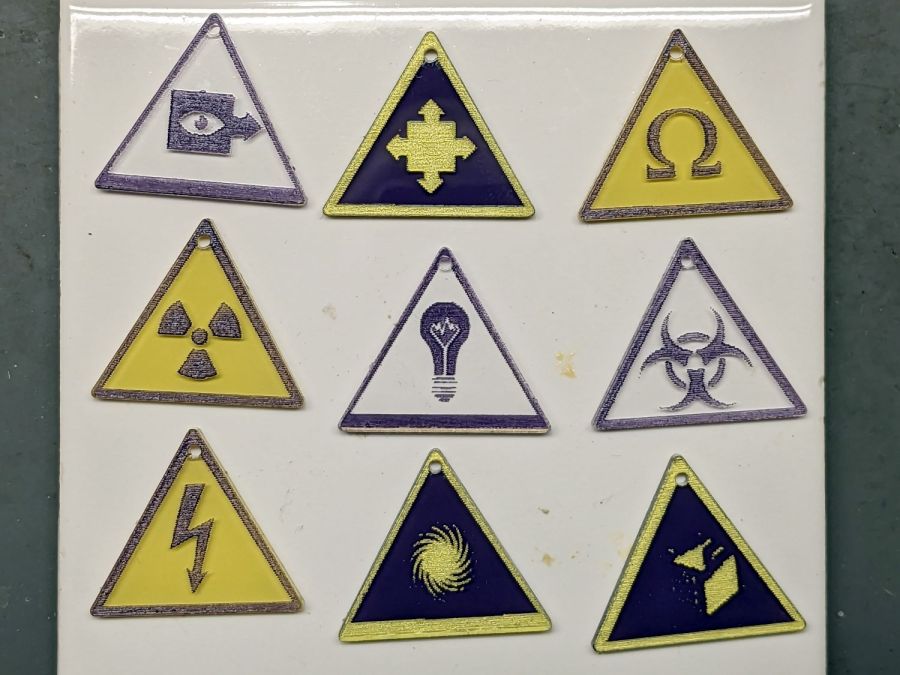
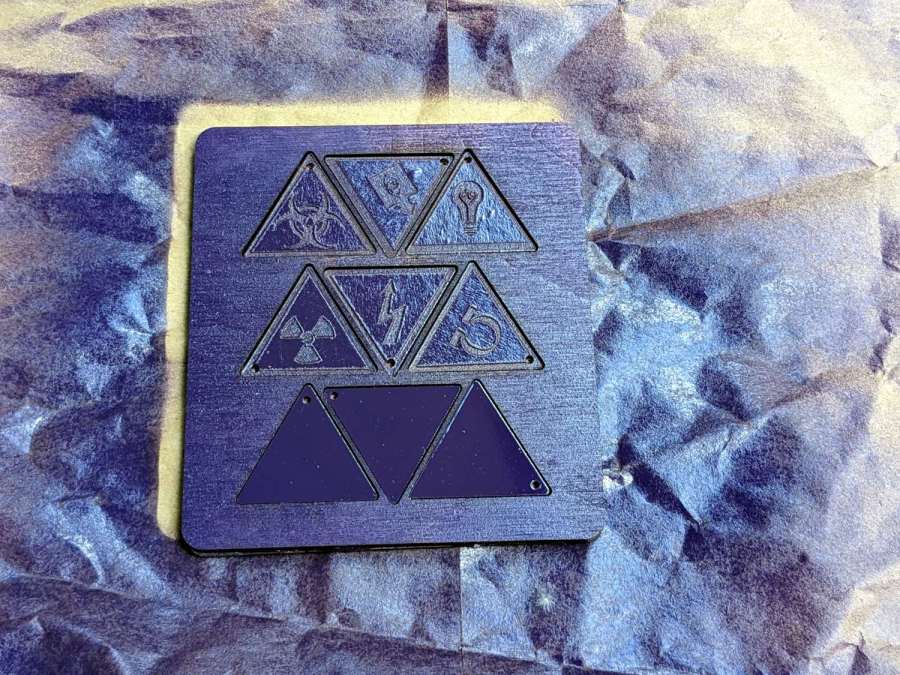
The acrylic is old enough to have brown paper protective layers, rather than fancy plastic sheets. I peeled various combinations and shot various sides with purple:
SCP Warning Labels – purple coat
Remove some, flip others over, and hit ’em with yellow:
SCP Warning Labels – yellow coat
I expected purple markings over a yellow background to look best:
SCP Warning Labels – purple over yellow
But the inverse version seems more contrasty (ignore the off-center cutout):
SCP Warning Labels – yellow over purple
I think the purple-on-clear version would look better with edge-lit acrylic:
SCP Warning Labels – purple over clear
The 0.15 mm line spacing seems too coarse, but trying to get a perfectly flat engraved bottom seems futile.
A second coat of paint on the engraving would definitely boost the contrast.
If you were going to do this for real, you’d definitely recreate the images with vectors right from the start, using the original images as inspiration.
All in all, I like ’em, but there’s some improvement required before anybody else does!
Using Bash arrays is an exercise in masochism, but I got to recycle most of the oddities from the previous script, so it wasn’t a dead loss.
The cameras use individually unique / screwy / different filesystem layouts, so the script must have individual code to both copy the file and decapitalize the file extensions. This prevents using a single tidy function, although laying out the code in case statements keyed by the camera name helps identify what’s going on.
My previous approach identified the MicroSD cards by their UUIDs, which worked perfectly right up until the camera reformats the card while recovering from a filesystem crash and installs a randomly generated UUID. Because there’s no practical way to modify an existing UUID on a VFAT drive, I’m switching to the volume label as needed:
In particular, note the two UUIDs for the M20 camera: there’s a crash and reformat in between those two lines. The two C100 cameras started out with labels because the M20 taught me the error of my ways.
The script simply iterates through a list array of the cameras and tries to mount the corresponding MicroSD card for each one: the mount points are cleverly chosen to match the camera names in the array. Should the mount succeeds, an asynchronous rsync then slurps the files onto the bulk video drive.
With all the rsync operations running, the script waits for all of them to complete before continuing. I don’t see much point in trying to identify which rsync just finished and fix up its files while the others continue to run, so the script simply stalls in a loop until everything is finished.
All in all, the script scratches my itch and, if naught else, can serve as a Bad Example™ of how to get the job done.
A picture to keep WordPress from reminding me that readers respond positively to illustrated posts:
This file contains hidden or bidirectional Unicode text that may be interpreted or compiled differently than what appears below. To review, open the file in an editor that reveals hidden Unicode characters.
Learn more about bidirectional Unicode characters
Cutting or engraving patterns on earrings should go more smoothly with a fixture:
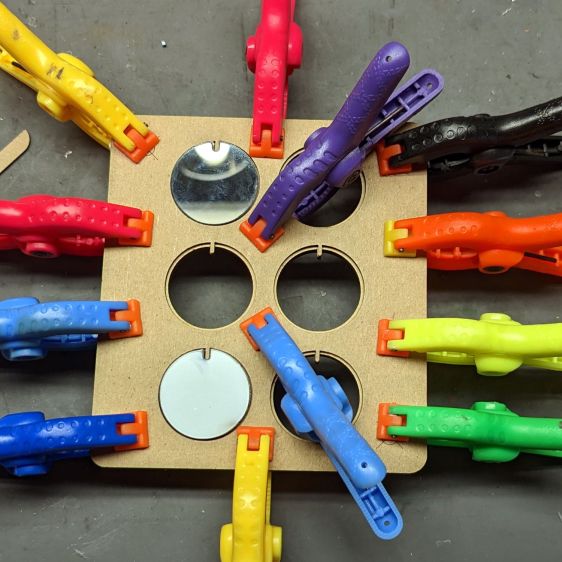
Earring fixture – demo install
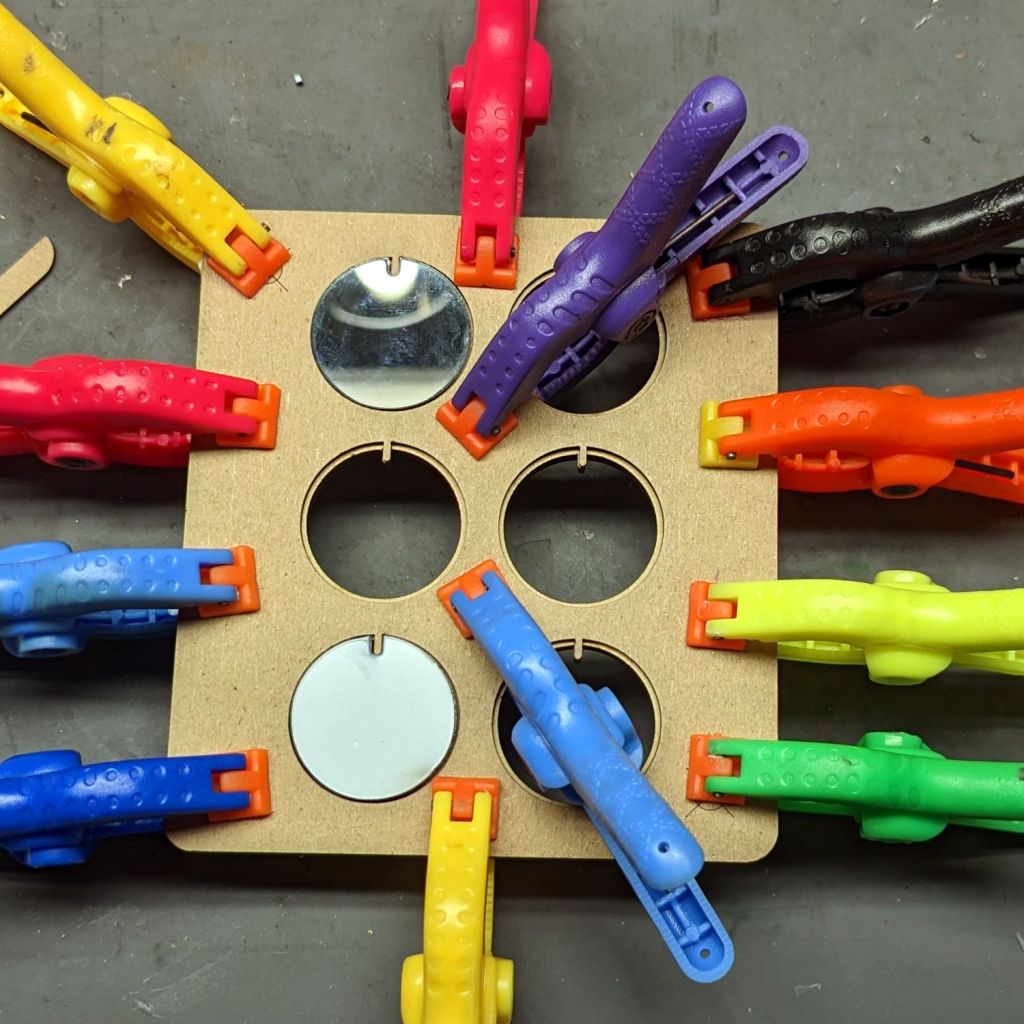
That’s a serving suggestion, using the Biohazard test pieces, which also helped align the top and bottom layers while gluing:
Earring fixture – clamping
That used all my little clamps: obviously I need more!
The bottom layer (red) is MDF for strength and the top layer (orange) is chipboard because that’s all it needs:
Earring fixture – LB layout
The little tab along the top ensures alignment using the jump ring cutout. The central hole will let me cut through the earring, should that be necessary.
The two strips over on the left get glued on the bottom, spaced to align along one of the aluminum knife blade rails, as with the craft stick fixture. With that lined up, any two of the four targets will serve to align the template with the fixture using LightBurn’s Print-and-Cut tool, as with the craft stick template.
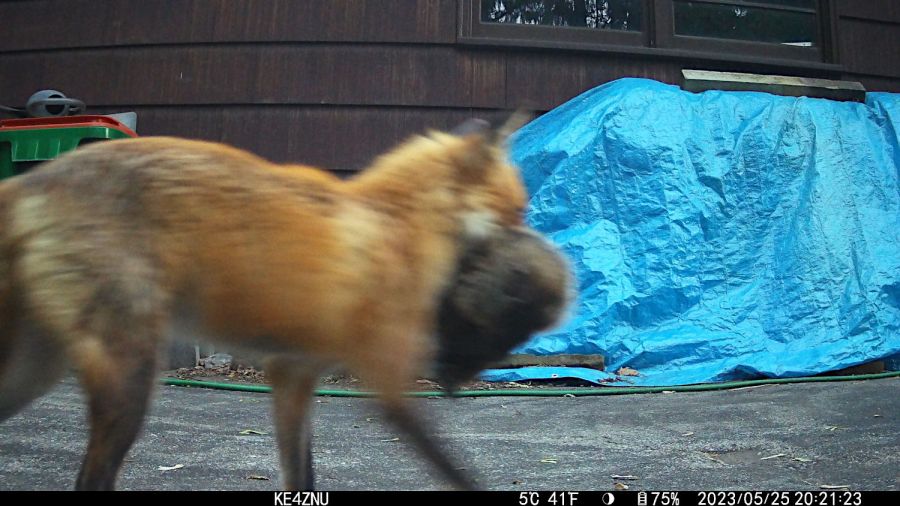
The fox caught what looks like a small groundhog for supper:
IM_00307 – Fox with supper – 2023-05-25
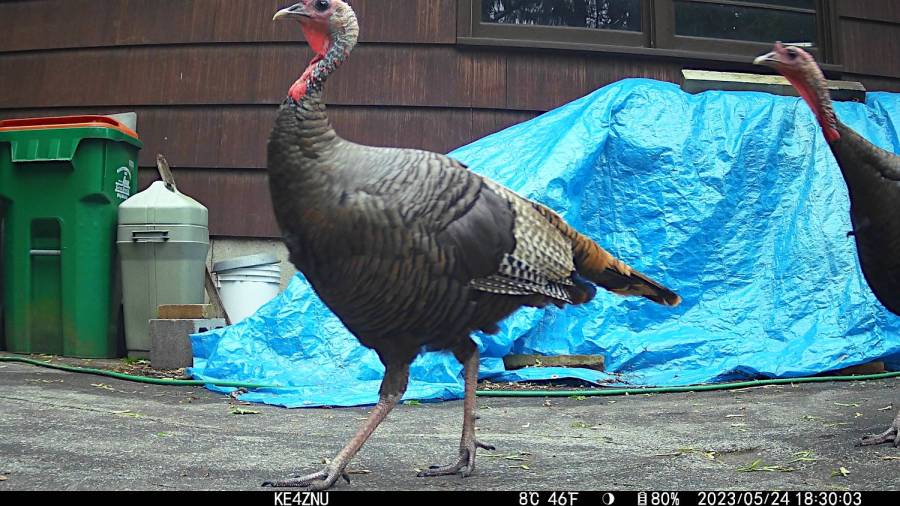
The tom turkeys have been forming and re-forming their groups:
IM_00178 – Turkey parade – 2023-05-24
The gray cat may have spotted breakfast out there in the yard:
IM_00112 – Gray Cat – 2023-05-23
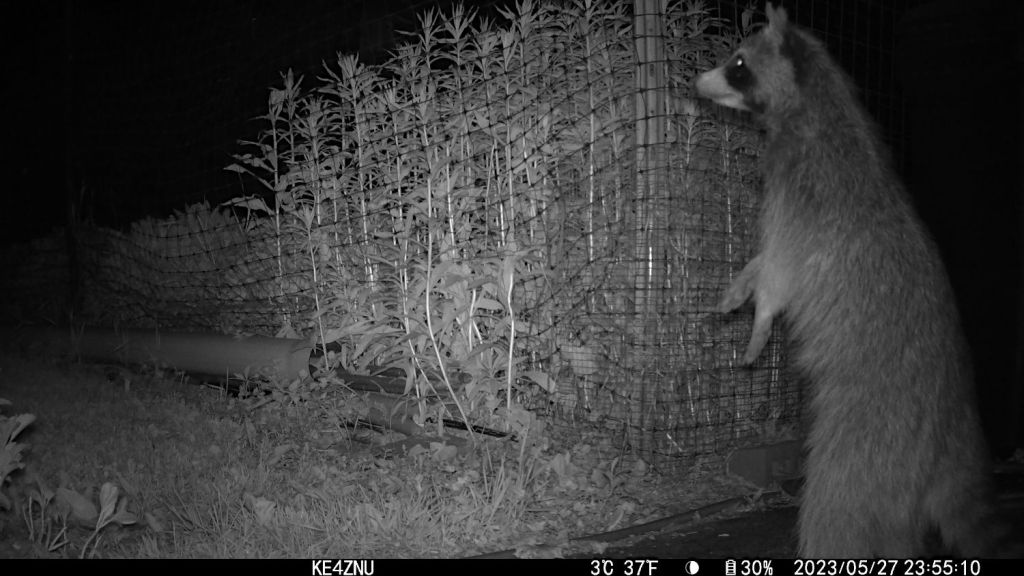
We haven’t seen a raccoon stand up like this before, so something must be very interesting out there:
IM_00089 – Standing raccoon – 2023-05-27
Off to its far right, Mary had fertilized a new pepper planting, which evidently smelled good enough to motivate vigorous digging. None of the plants sustained damage, despite being tossed around, but dexterous paws were surely involved!












 The Smell of Molten Projects in the Morning

