The Smell of Molten Projects in the Morning

Ed Nisley's Blog: Shop notes, electronics, firmware, machinery, 3D printing, laser cuttery, and curiosities. Contents: 100% human thinking, 0% AI slop.

Author: Ed

  • Traffic Signal Timing: Burnett Blvd. at Rt 55, Redux

    Just in case you think reporting a problem to NYSDOT will actually produce any action:

    Burnett at Rt 55 2015-11-08 - Yellow 5 s after green
    Burnett at Rt 55 2015-11-08 – Yellow 5 s after green

    Apparently, NYSDOT’s bicycle safety criteria allow greenlighting opposing vehicles onto bicyclists in the middle of intersections, so there’s no particular urgency to fix this non-problem.

    They’ve been “studying” that situation, without contacting me for any further information, since July, so you can decide how much they’ve accomplished thus far. I know NYSDOT employees get offended when you call them liars to their face, but they have never, ever produced any evidence showing that I’m wrong.

    Yeah, call me a cynic.

  • Neopixel Current vs. Arduino Power Supply Voltage

    Just to show why powering Neopixels directly from an Arduino is a Bad Idea, I wired up an Adafruit Jewel thusly (and, BTW, exactly like their lead illustration shows):

    dsc00925 - Adafruit Neopixel Jewel with Tek current probe

    Makes your skin crawl just to look at it, right?

    With all seven Neopixels set to a gray PWM (64,64,64), the average current should be around 90 mA: 21 * 18 mA * 64/255, with another 6% knocked off because the WS2812B controller imposes that much mandatory dark time at PWM 255.

    Eyeballometrically, this looks pretty close at 100 mA/div:

    Neopixel current 100 mA - 64-64-64 0-7 200 mA peak
    Neopixel current 100 mA – 64-64-64 0-7 200 mA peak

    But those seven asynchronous PWM oscillators guarantee this will happen every now & again:

    Neopixel current 100 mA - 64-64-64 0-7 400 mA peak
    Neopixel current 100 mA – 64-64-64 0-7 400 mA peak

    The 400 mA peaks happen when all seven Neopixels turn on at once. The broad flat floor means they’re off most of the time and the power supply sees a hefty 400 Hz pulsating load.

    The bottom trace shows the effect of those peaks in the top trace (at 200 mA/div) on the Arduino’s VCC pin:

    Neopixel current 200 mA - 64-64-64 0-7 400 mA pk w VCC
    Neopixel current 200 mA – 64-64-64 0-7 400 mA pk w VCC

    That’s at 200 mV/div and AC coupled to remove the 5 VDC supply. Because the board runs from USB power, the on-board regulator doesn’t contribute to the problem, but there’s plenty of problem to go around.

    Always use an external power supply and a 5 VDC regulator with Neopixels!

  • Hard Drive Platter Thicknesses

    It should come as no surprise that hard drive platters have different thicknesses:

    Hard Drive Platter Thickness
    Hard Drive Platter Thickness

    The thicker ones measure 1.25 mm, which is near enough to 50 mils to suggest they date back to the Good Old Days. The three thinner ones in the middle are 0.77 mm = 30 mil and could be slightly younger than dirt. There’s more where these came from and I expect more variation on the theme.

    The beveled edges make the platters look thinner than they really are; they’re firmly clamped together with no space between them.

    As nearly as I can tell, the IBM 350 Disk Storage Unit on the IBM 350 RAMAC had platters about 25 mil thick. Those were two feet in diameter, so they definitely don’t make ’em like they used to!

    The thickness wouldn’t matter, except that the OpenSCAD program producing the hub & spacer tabs for the Mood Lights needs to know.

  • Hard Drive Platter Mood Light: Improved Trigonometry

    The original Mood Light firmware used the current time in milliseconds as a factor in the sin() argument, assuming that the Arduino runtime would Do The Right Thing. Having been gently disabused of that notion, here’s another pass that resets the argument after every full cycle to keep the trig from going crazy. Thanks to all of you for helping out… [grin]

    The hardware still looks like this, though:

    Hard Drive Mood Light - high angle
    Hard Drive Mood Light – high angle

    Define a structure to hold everything needed to calculate each color, then make an array holding one structure per color:

    struct pixcolor_t {
    	byte Prime;
    	unsigned int NumSteps;
    	unsigned int Step;
    	float StepSize;
    	byte MaxPWM;
    	byte Value;
    };
    
    enum pixcolors {RED, GREEN, BLUE, PIXELSIZE};
    
    #define RESOLUTION 1000
    
    struct pixcolor_t Pixels[PIXELSIZE];
    

    The general idea is to increment the integer Step from 0 through NumSteps - 1 to create the sine wave, with the total number of steps per cycle being Prime times the RESOLUTION.

    The angular argument is Step * StepSize, with the size of each step equal to 2π / NumSteps. Because Step gets reset to zero after reaching NumSteps - 1, the argument never exceeds 2π and the trig never falls off the rails.

    Soooo, calculating the PWM value for each color goes like this:

    byte StepColor(byte Color) {
    
        Pixels[Color].Value = (Pixels[Color].MaxPWM / 2.0) * (1.0 + sin(Pixels[Color].Step * Pixels[Color].StepSize));
    	
    	Pixels[Color].Step = (Pixels[Color].Step >= Pixels[Color].NumSteps) ? 0 : Pixels[Color].Step + 1;
    	
    	if (0 == Pixels[Color].Step) {
    		printf("Color %d cycle end at %d\r\n",Color,Pixels[Color].NumSteps);
    	}
    
        return Pixels[Color].Value;
    }
    

    The MaxPWM parameter limits the perceived brightness, although not the peak current. Each Neopixel dissipates 300-ish mW at full throttle, they’re mounted on a plastic structure, and there’s not a lot of air flowing between those platters; running at half power makes a lot of sense.

    Initializing the structure values happens in the setup() function, because it’s easier than filling in all the array structure entries by hand:

    	Pixels[RED].Prime = 5;
    	Pixels[GREEN].Prime = 7;
    	Pixels[BLUE].Prime = 11;
    	
    	for (byte c=0; c < PIXELSIZE; c++) {
    		Pixels[c].NumSteps = RESOLUTION * Pixels[c].Prime;
    		Pixels[c].Step = random(Pixels[c].NumSteps);
    		Pixels[c].StepSize = TWO_PI / Pixels[c].NumSteps;
    		Pixels[c].MaxPWM = 128;
    		StepColor(c);
    	}
    

    The Phase value has Gone Away, because it really didn’t add anything to the proceedings. Instead, I randomize the starting Step, although there’s not a lot of randomness to be had early on in an Arduino program; that needs a bit more work. Adding a little PCB with a random noise source doesn’t seem cost-effective, although a photodetector peering out the side and adjusting the MaxPWM values might be a Good Thing.

    Come to think of it, limiting the sum of the PWM values might be more useful than limiting their individual maximum values. That’s a simple matter of software…

    The main() loop doesn’t have a lot to do. Every 25 ms it updates the three color PWM values, sets the new values into all 12 LED buffer locations, and sends the whole mess to the Neopixels. The RESOLUTION value acts as a gearshift between the 25 ms update rate and the speed at which complete cycles zip past. Absent the Prime factor, each cycle would require 25 ms * RESOLUTION ms to complete: call it 25 seconds.

    The Prime factors slow that down proportionally and push the repetition interval out to the product of all the factors. For the (5, 7, 11) factors shown below, that’s 5x7x11x253 s = 6×10⁶ s = 70 days,

    Now it doesn’t matter how often the millis() value wraps. Every now & again, MillisThen will be just under 232 and MillisNow will be just over 0, but their (unsigned) difference will be some huge number, the conditional will trip, and nobody will notice the timing glitch…

    The Arduino source code:

    // Neopixel mood lighting for hard drive platter sculpture
    // Ed Nisley - KE4ANU - November 2015
    
    #include <Adafruit_NeoPixel.h>
    
    //----------
    // Pin assignments
    
    const byte PIN_NEO = 6;				// DO - data out to first Neopixel
    
    const byte PIN_HEARTBEAT = 13;		// DO - Arduino LED
    
    //----------
    // Constants
    
    const unsigned long UpdateMS = 25ul - 4ul;		// update LEDs only this many ms apart minus loop() overhead
    
    //----------
    // Globals
    
    unsigned long MillisNow;
    unsigned long MillisThen;
    
    Adafruit_NeoPixel strip = Adafruit_NeoPixel(12, PIN_NEO, NEO_GRB + NEO_KHZ800);
    
    uint32_t FullWhite = strip.Color(255,255,255);
    uint32_t FullOff = strip.Color(0,0,0);
    
    struct pixcolor_t {
    	byte Prime;
    	unsigned int NumSteps;
    	unsigned int Step;
    	float StepSize;
    	byte MaxPWM;
    	byte Value;
    };
    
    enum pixcolors {RED, GREEN, BLUE, PIXELSIZE};
    
    #define RESOLUTION 1000
    
    struct pixcolor_t Pixels[PIXELSIZE];								// everything that calculates the pixel colors
    
    byte Map[] = {0,5,6,11, 1,4,7,10, 2,3,8,9};							// pixel numbers around platter, bottom to top.
    
    //-- Figure PWM based on current state
    
    byte StepColor(byte Color) {
    
        Pixels[Color].Value = (Pixels[Color].MaxPWM / 2.0) * (1.0 + sin(Pixels[Color].Step * Pixels[Color].StepSize));
    	
    	Pixels[Color].Step = (Pixels[Color].Step >= Pixels[Color].NumSteps) ? 0 : Pixels[Color].Step + 1;
    	
    	if (0 == Pixels[Color].Step) {
    		printf("Color %d cycle end at %d\r\n",Color,Pixels[Color].NumSteps);
    	}
    	
    //	printf("Step: %d Color: %d Value: %d\r\n",Pixels[Color].Step,(word)Color,(word)Pixels[Color].Value);
    	
        return Pixels[Color].Value;
    }
    
    
    //-- Helper routine for printf()
    
    int s_putc(char c, FILE *t) {
      Serial.write(c);
    }
    
    //------------------
    // Set the mood
    
    void setup() {
    	
    	pinMode(PIN_HEARTBEAT,OUTPUT);
    	digitalWrite(PIN_HEARTBEAT,LOW);	// show we arrived
    
    	Serial.begin(57600);
    	fdevopen(&s_putc,0);				// set up serial output for printf()
    
    	printf("Mood Light with Neopixels\r\nEd Nisley - KE4ZNU - November 2015\r\n");
    	
    /// set up Neopixels
    	
    	strip.begin();
    	strip.show();
    	
    // lamp test: run a brilliant white dot along the length of the strip
    	
    	printf("Lamp test: walking white\r\n");
    	
    	strip.setPixelColor(0,FullWhite);
    	strip.show();
    	delay(500);
    	
    	for (int i=1; i<strip.numPixels(); i++) {
    		digitalWrite(PIN_HEARTBEAT,HIGH);
    		strip.setPixelColor(i-1,FullOff);
    		strip.setPixelColor(i,FullWhite);
    		strip.show();
    		digitalWrite(PIN_HEARTBEAT,LOW);
    		delay(500);
    	}
    	
    	strip.setPixelColor(strip.numPixels() - 1,FullOff);
    	strip.show();
    	delay(500);
    	
    // and around the disks
    	
    	printf(" ... using Map array\r\n");
    	
    	strip.setPixelColor(Map[0],FullWhite);
    	strip.show();
    	delay(250);
    	
    	for (int i=1; i<strip.numPixels(); i++) {
    		digitalWrite(PIN_HEARTBEAT,HIGH);
    		strip.setPixelColor(Map[i-1],FullOff);
    		strip.setPixelColor(Map[i],FullWhite);
    		strip.show();
    		digitalWrite(PIN_HEARTBEAT,LOW);
    		delay(250);
    	}
    	
    	strip.setPixelColor(Map[strip.numPixels() - 1],FullOff);
    	strip.show();
    	delay(250);
    	
    	MillisNow = MillisThen = millis();
    	randomSeed(MillisNow + analogRead(7));
    	printf("First random number: %ld\r\n",random(10));
    	
    	Pixels[RED].Prime = 5;
    	Pixels[GREEN].Prime = 7;
    	Pixels[BLUE].Prime = 11;
    	
    	for (byte c=0; c < PIXELSIZE; c++) {
    		Pixels[c].NumSteps = RESOLUTION * Pixels[c].Prime;
    		Pixels[c].Step = random(Pixels[c].NumSteps);
    		Pixels[c].StepSize = TWO_PI / Pixels[c].NumSteps;
    		Pixels[c].MaxPWM = 128;
    		StepColor(c);
    	}
    	printf("Prime scales: (%d,%d,%d)\r\n",Pixels[RED].Prime,Pixels[GREEN].Prime,Pixels[BLUE].Prime);
    	printf("Initial step: (%d,%d,%d)\r\n",Pixels[RED].Step,Pixels[GREEN].Step,Pixels[BLUE].Step);
    	printf("  ...  color: (%d,%d,%d)\r\n",Pixels[RED].Value,Pixels[GREEN].Value,Pixels[BLUE].Value);
    	
    	for (int i=0; i<strip.numPixels(); i++) { strip.setPixelColor(Map[i],strip.Color(Pixels[RED].Value,Pixels[GREEN].Value,Pixels[BLUE].Value)); } strip.show(); } //------------------ // Run the mood void loop() { // printf("Loop! %ld %ld\r\n",MillisNow,MillisThen); MillisNow = millis(); if ((MillisNow - MillisThen) > UpdateMS) {
    		digitalWrite(PIN_HEARTBEAT,HIGH);
    
    		for (byte c=0; c < PIXELSIZE; c++) {
    			StepColor(c);
    		}
    		
    		for (int i=0; i < strip.numPixels(); i++) {
    			strip.setPixelColor(i,strip.Color(Pixels[RED].Value,Pixels[GREEN].Value,Pixels[BLUE].Value));
    		}
    		strip.show();
    
    		MillisThen = MillisNow;
    		digitalWrite(PIN_HEARTBEAT,LOW);
    	}
    	
    }
    
  • Sony HDR-AS30V Camera vs. STK NP-BX1 Batteries

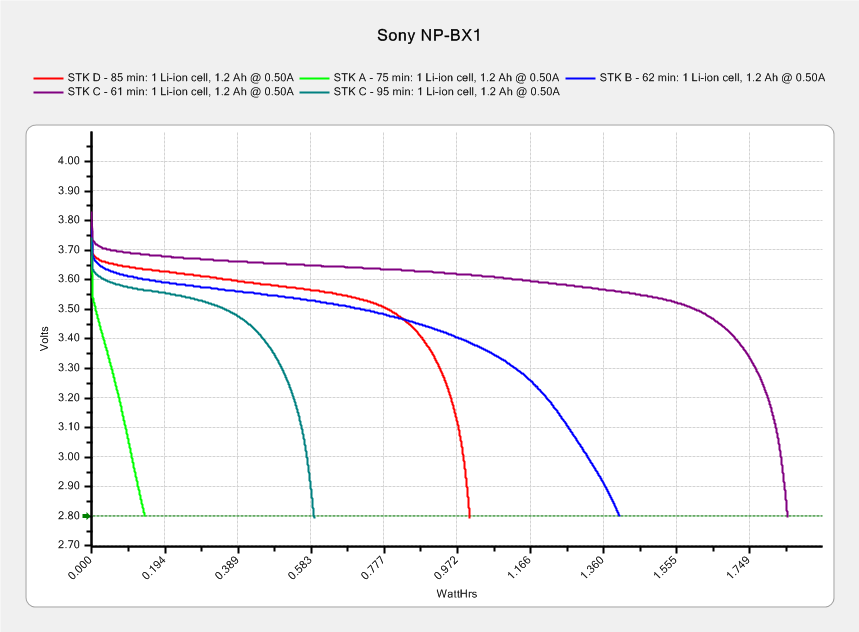
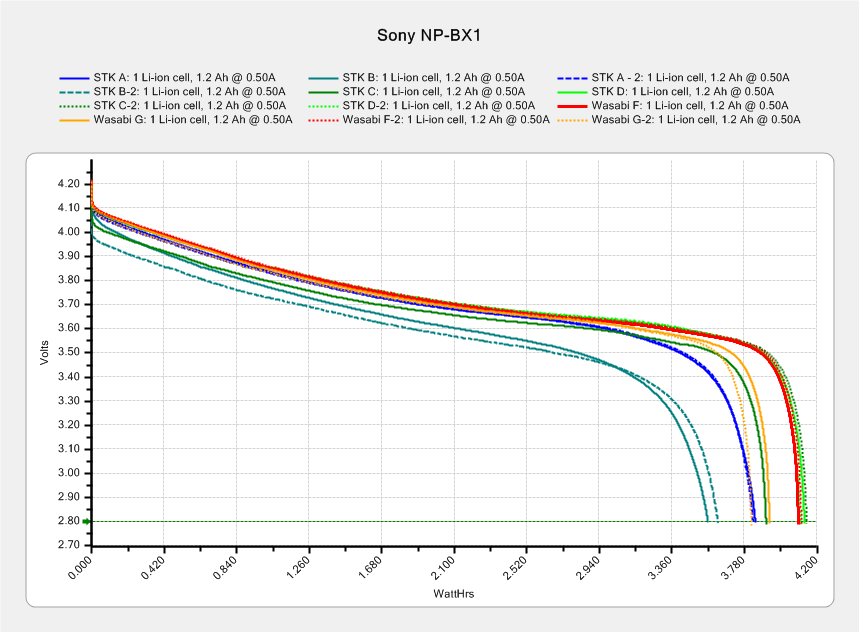
    This sheaf of tests shows three of the four STK NP-BX1 batteries deliver about 4 W·h during a constant 500 mA discharge, with battery B trailing behind:

    Sony NP-BX1 - Wasabi FG - STK ABCD - Wh scale - 2015-11-03
    Sony NP-BX1 – Wasabi FG – STK ABCD – Wh scale – 2015-11-03

    After the three most recent bike rides, I popped the partially discharged battery into the tester and used the same test current:

    Sony NP-BX1 - STK ABD - charged vs used - Wh scale - 2015-11-22
    Sony NP-BX1 – STK ABD – charged vs used – Wh scale – 2015-11-22

    The longer curves come from the top chart (with different colors), the shorter ones from the partially discharged batteries. In an ideal world, the shorter curves should give the energy left in the battery after the ride, so subtracting that from the before-ride capacity gives the energy used during the ride.

    The results for battery A may not be typical, as the camera turned off before I rolled into the garage. The camera may run with a battery voltage below the 2.8 V cutoff in those tests, so it can extract more energy than the tests. The slope of the curve toward the end suggests it won’t get much, but that will still bias the results.

    In round numbers, the bike rides required:

    • A: 3.8 – 0.1 = 3.7 W·h
    • B: 3.6 – 1.4 = 2.2 W·h
    • D: 4.2 – 1.0 = 3.2 W·h

    I generally turn the camera off during the mid-ride pause (Protip: never wear a helmet camera into a Port-a-Loo), so at least two of the rides have discontinuous usage. I figured the total run time from the video file sizes at the rate of 22.75 min/4.0 GB, blithely ignoring issues like the battery recovering during the pauses, the effect of ambient temperature vs. camera heating on battery temperature, and so forth and so on.

    In an ideal world, dividing the total energy by the run time (converted from minutes to hours and not venturing into pirate·ninja territory) should produce a nearly constant value equal to the camera’s power dissipation:

    • A: 3.7 W·h / 1.25 h = 2.96 W
    • B: 2.2 W·h / 1.0 h = 2.1 W
    • D: 3.2 W·h / 1.4 h = 2.25

    Ignoring the suspiciously high result for battery A, it looks like the HDR-AS30V really does dissipate a bit over 2 W while recording 1920×1080@60fps video. That’s with GPS, WiFi, and NFC turned off, of course.

    Which turns out to be pretty close to the test conditions: 3.7 V x 500 mA = 1.85 W. I could goose the test current to 600 mA = 2.2 W/3.7 V for the next tests, but maybe long-term consistency is a virtue.

  • Kenmore Vacuum Cleaner Tool Adapters

    After donating the neversufficiently-to-be-damned Samsung vacuum cleaner (and all its remaining bags & doodads) to a nonprofit’s tag sale, we picked up a Sears Kenmore Progressive vacuum cleaner that seemed to be the least awful of the current offerings. Unlike all previous vacuum cleaners, its tools & doodads have complex plastic fittings with latches and keyways and all manner of gimcrackery. The designers seem to have hands and legs of far-above-average size, but that’s another rant.

    All this came to a head when I attempted to vacuum the fuzz out of the refrigerator’s evaporator coils, because the long snout that reaches the back of the refrigerator doesn’t fit the aperture in the giant handle.

    Well, at least I can fix that

    The first step involved modeling the plastic fitting that snaps into the handle:

    Kenmore Male Fitting - Solid model
    Kenmore Male Fitting – Solid model

    The latch on the handle snaps into an opening that took some tinkering to reproduce. Stand back, I’m going to use trigonometry:

                translate([0,-11.5/2,23.0 - 5.0])                                    // latch opening
                    cube(Latch);
                    
                translate([OEMTube[ID1]/2 + EntryHeight/tan(90-EntryAngle),0,0])    // latch ramp
                    translate([(Latch[1]/cos(180/EntrySides))*cos(EntryAngle)/2,0,(Latch[1]/cos(180/EntrySides))*sin(EntryAngle)/2])
                        rotate([0,-EntryAngle,0])
                            intersection() {
                                rotate(180/EntrySides)
                                    PolyCyl(Latch[1],Latch[0],EntrySides);
                                translate([-(2*Latch[0])/2,0,-Protrusion])
                                    cube(2*Latch[0],center=true);
                            }
    

    Which spits out two suitable shapes with the proper positions and alignments:

    Kenmore Male Fitting - Latch detail - Solid model
    Kenmore Male Fitting – Latch detail – Solid model

    The magic wand for the refrigerator originally slid into the Samsung’s metal pipe, so I put a slightly tapered cylinder inside a somewhat more tapered exterior (which seems chunky enough to withstand my flailing around under the refrigerator), then topped it off with the male fitting:

    Refrigerator Coil Wand Adapter
    Refrigerator Coil Wand Adapter

    The Kenmore crevice tool snaps under the gargantuan plastic handle, which limits it to being 6.5 inches long, totally unable to reach into any of the nontrivial crevices around here, and in the way when it’s not being used. Some rummaging turned up a longer crevice tool from the Electrolux That Came With The House™, an old-school tool that slipped over its pipe. Modeling a straight cylinder inside a tapered cylinder that fits the tool didn’t take long:

    Crevice Tool Adapter
    Crevice Tool Adapter

    Flushed with success, I found a smaller floor brush than the new Kenmore, with dimensions similar to the Electrolux snout, so another module appeared:

    Floor Brush Adapter
    Floor Brush Adapter

    All of them build with the latch end upward to avoid needing support structure, with a 5 mm brim for good platform adhesion:

    Floor Brush Adapter - Slic3r preview
    Floor Brush Adapter – Slic3r preview

    I printed them during the PDS Mini Maker Faire as examples of Useful Things You Can Do With a 3D Printer:

    Kenmore Vacuum Cleaner - Tool Adapters
    Kenmore Vacuum Cleaner – Tool Adapters

    As I pointed out to nearly everybody, the Big Lie about 3D printing is that you’ll just download somebody else’s model to solve your problem. In general, that won’t work, because nobody else has your problem; if you can’t do solid modeling, there’s no point in you having a 3D printer. There’s also no point in going to Kinko’s to get a standardized 3D printed doodad, because you can just order a better-looking injection-molded part directly from Sears (or an aftermarket source) and be done with it.

    I loves me some good OpenSCAD action on my Makergear M2, though…

    The OpenSCAD source code:

    // Kenmore vacuum cleaner nozzle adapters
    // Ed Nisley KE4ZNU November 2015
    
    // Layout options
    
    Layout = "CreviceTool";        // MaleFitting CoilWand FloorBrush CreviceTool
    
    //- Extrusion parameters must match reality!
    //  Print with +1 shells and 3 solid layers
    
    ThreadThick = 0.25;
    ThreadWidth = 0.40;
    
    HoleWindage = 0.2;
    
    function IntegerMultiple(Size,Unit) = Unit * ceil(Size / Unit);
    
    Protrusion = 0.1;           // make holes end cleanly
    
    //----------------------
    // Dimensions
    
    ID1 = 0;                                                // for tapered tubes
    ID2 = 1;
    OD1 = 2;
    OD2 = 3;
    LENGTH = 4;
    
    OEMTube = [35.0,35.0,41.7,40.5,30.0];                    // main fitting tube
    EndStop = [OEMTube[ID1],OEMTube[ID2],47.5,47.5,6.5];    // flange at end of main tube
    
    FittingOAL = OEMTube[LENGTH] + EndStop[LENGTH];
    
    $fn = 12*4;
    
    //----------------------
    // Useful routines
    
    module PolyCyl(Dia,Height,ForceSides=0) {           // based on nophead's polyholes
    
    Sides = (ForceSides != 0) ? ForceSides : (ceil(Dia) + 2);
    
    FixDia = Dia / cos(180/Sides);
    
    cylinder(r=(FixDia + HoleWindage)/2,
             h=Height,
             $fn=Sides);
    }
    
    
    //-------------------
    // Male fitting on end of Kenmore tools
    // This slides into the end of the handle or wand and latches firmly in place
    
    module MaleFitting() {
        
    Latch = [40,11.5,5.0];                    // rectangle latch opening
    EntryAngle = 45;                        // latch entry ramp
    EntrySides = 16;
    EntryHeight = 15.0;                        // lower edge on *inside* of fitting
    
    KeyRadius = 1.0;
            
        translate([0,0,6.5])
            difference() {
                union() {
                    cylinder(d1=OEMTube[OD1],d2=OEMTube[OD2],h=OEMTube[LENGTH]);            // main tube
                    
                    hull()                                                                    // insertion guide
                        for (i=[-(6.0/2 - KeyRadius),(6.0/2 - KeyRadius)], 
                            j=[-(28.0/2 - KeyRadius),(28.0/2 - KeyRadius)], 
                            k=[-(26.0/2 - KeyRadius),(26.0/2 - KeyRadius)])
                            translate([(i - (OEMTube[ID1]/2 + OEMTube[OD1]/2)/2 + 6.0/2),j,(k + 26.0/2 - 1.0)])
                                sphere(r=KeyRadius,$fn=8);
                    
                    translate([0,0,-EndStop[LENGTH]])                                // wand tube butts against this
                        cylinder(d=EndStop[OD1],h=EndStop[LENGTH] + Protrusion);
                }
                
                translate([0,0,-OEMTube[LENGTH]])                                    // main bore
                    cylinder(d=OEMTube[ID1],h=2*OEMTube[LENGTH] + 2*Protrusion);
                    
                translate([0,-11.5/2,23.0 - 5.0])                                    // latch opening
                    cube(Latch);
                    
                translate([OEMTube[ID1]/2 + EntryHeight/tan(90-EntryAngle),0,0])    // latch ramp
                    translate([(Latch[1]/cos(180/EntrySides))*cos(EntryAngle)/2,0,(Latch[1]/cos(180/EntrySides))*sin(EntryAngle)/2])
                        rotate([0,-EntryAngle,0])
                            intersection() {
                                rotate(180/EntrySides)
                                    PolyCyl(Latch[1],Latch[0],EntrySides);
                                translate([-(2*Latch[0])/2,0,-Protrusion])
                                    cube(2*Latch[0],center=true);
                            }
            }
    }
    
    //-------------------
    // Refrigerator evaporator coil wand
    
    module CoilWand() {
        
        union() {
            translate([0,0,50.0])
                rotate([180,0,0])
                    difference() {
                        cylinder(d1=EndStop[OD1],d2=42.0,h=50.0);
                        translate([0,0,-Protrusion])
                            cylinder(d1=35.0,d2=35.8,h=100);
                    }
            translate([0,0,50.0 - Protrusion])
                MaleFitting();
        }
    }
    
    
    //-------------------
    // Refrigerator evaporator coil wand
    
    module FloorBrush() {
        
        union() {
            translate([0,0,60.0])
                rotate([180,0,0])
                    difference() {
                        union() {
                            cylinder(d1=EndStop[OD1],d2=32.4,h=10.0);
                            translate([0,0,10.0 - Protrusion])
                                cylinder(d1=32.4,d2=30.7,h=50.0 + Protrusion);
                        }
                        translate([0,0,-Protrusion])
                            cylinder(d1=28.0,d2=24.0,h=100);
                    }
            translate([0,0,60.0 - Protrusion])
                MaleFitting();
        }
    }
    
    
    //-------------------
    // Crevice tool
    
    module CreviceTool() {
        
        union() {
            translate([0,0,60.0])
                rotate([180,0,0])
                    difference() {
                        union() {
                            cylinder(d1=EndStop[OD1],d2=32.0,h=10.0);
                            translate([0,0,10.0 - Protrusion])
                                cylinder(d1=32.0,d2=30.4,h=50.0 + Protrusion);
                        }
                        translate([0,0,-Protrusion])
                            cylinder(d1=28.0,d2=24.0,h=100);
                    }
            translate([0,0,60.0 - Protrusion])
                MaleFitting();
        }
    }


    //----------------------
    // Build it!
    
    if (Layout == "MaleFitting")
        MaleFitting();
    
    if (Layout == "CoilWand")
        CoilWand();
    
    if (Layout == "FloorBrush")
        FloorBrush();
    
    if (Layout == "CreviceTool")
        CreviceTool();
    
    
  • Provincetown Pilgrim Memorial: Lighting Ticky-tacky

    This imposing memorial plaque stands in a small park in Provincetown MA, at the foot of the hill from which the Pilgrim Monument emerges:

    Provincetown Pilgrim Memorial
    Provincetown Pilgrim Memorial

    It’s one of those 1920-ish things with the impeccable stonework and bronze casting that you couldn’t possibly duplicate nowadays. But, at least twice between then and now, somebody thought it’d be a Good Idea to decorate it with what look to be Genuine Christmas Tree Lights:

    Provincetown Pilgrim Memorial - detail
    Provincetown Pilgrim Memorial – detail

    The most recent lamps and wires seem to be restrained by plastic clips glued onto the face of the stone:

    Provincetown Pilgrim Memorial - lamp detail
    Provincetown Pilgrim Memorial – lamp detail

    A previous generation drilled small holes and inserted metal pins that didn’t survive in a salt-spray environment, so I guess plastic seemed like the right answer.

    Words fail me…