Once again, maple sap rises from the ground and falls from damaged branches:

Sapcicle – 1 
Sapcicle – 2 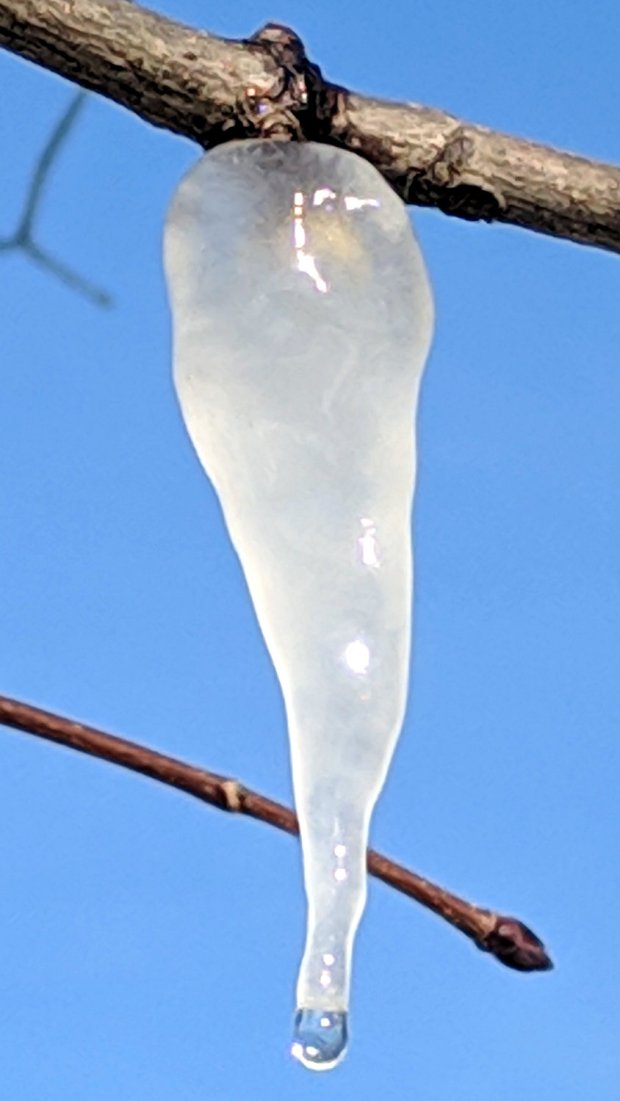
Sapcicle – 3 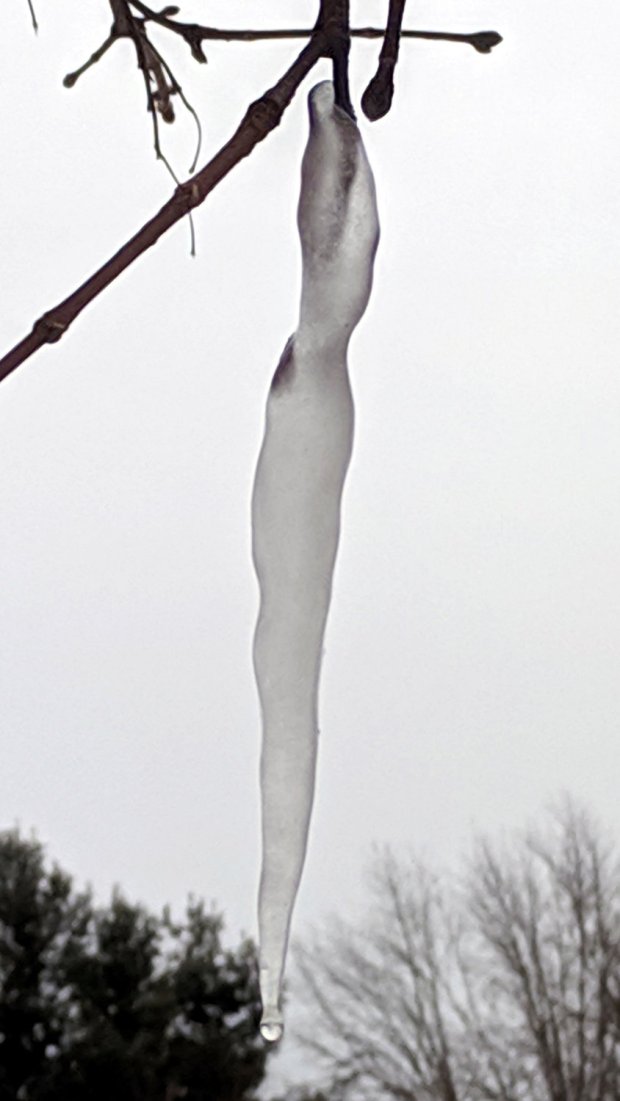
Sapcicle – 4 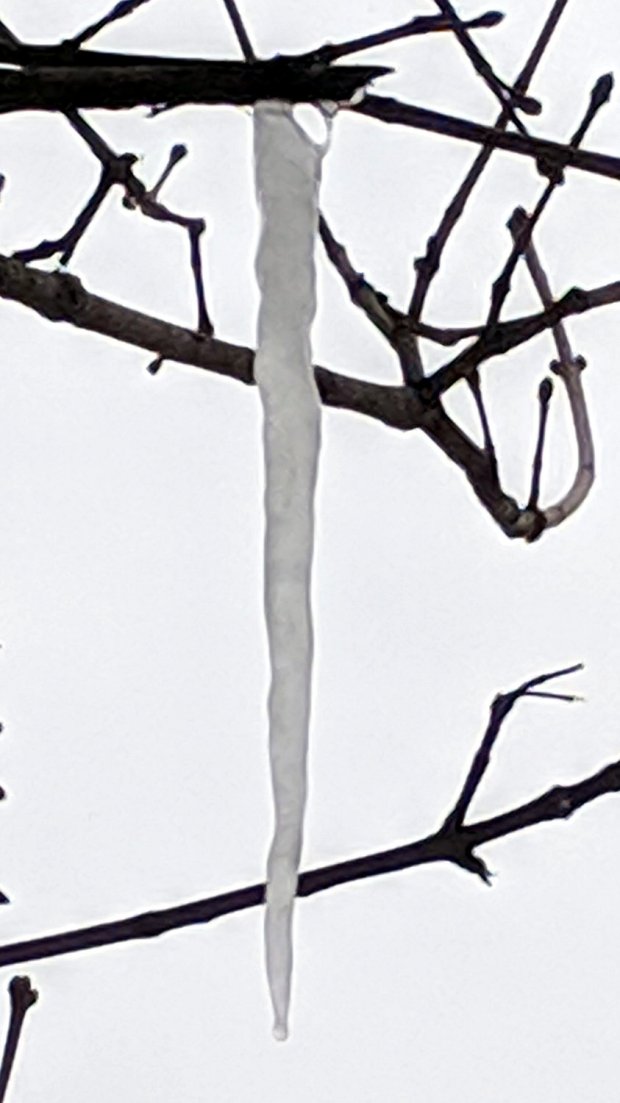
Sapcicle – 5
And, sometimes, a tiny sweet treat during our walks …
The Smell of Molten Projects in the Morning
Ed Nisley's Blog: Shop notes, electronics, firmware, machinery, 3D printing, laser cuttery, and curiosities. Contents: 100% human thinking, 0% AI slop.
Once again, maple sap rises from the ground and falls from damaged branches:
And, sometimes, a tiny sweet treat during our walks …
Three years on, it’s time to rebuild some NP-FS11 lithium battery packs for the ancient Sony F505V camera, starting with packs I’ve rebuilt several times before and the last four cells from 2016.
The final test shows the 2011-F pack may power an LED blinky, but not much else:

Although the total capacity is still about 1.3 A·h for the two best batteries, the camera says the weakest two are dead after a few photos.
For reference while resoldering, the joints at the negative terminals:

And the protection PCB on the positive end:

Unsolder the strap in the middle and the B+ positive connection on the right side to remove the cells.
If cameras used bare cells, rather than glued-shut “proprietary” packs with super-secret unique ID ROMs, they’d be easier to keep running. My Sony DSC-H5 has other problems, but NiMH AA cells are easy to find.
After more use and brightness tweaking, the COB light bars on the Juki TL-2010Q and Kenmore 158 now have 2.2 Ω ballast resistors setting the LED current to 370 mA and 300 mA, respectively:
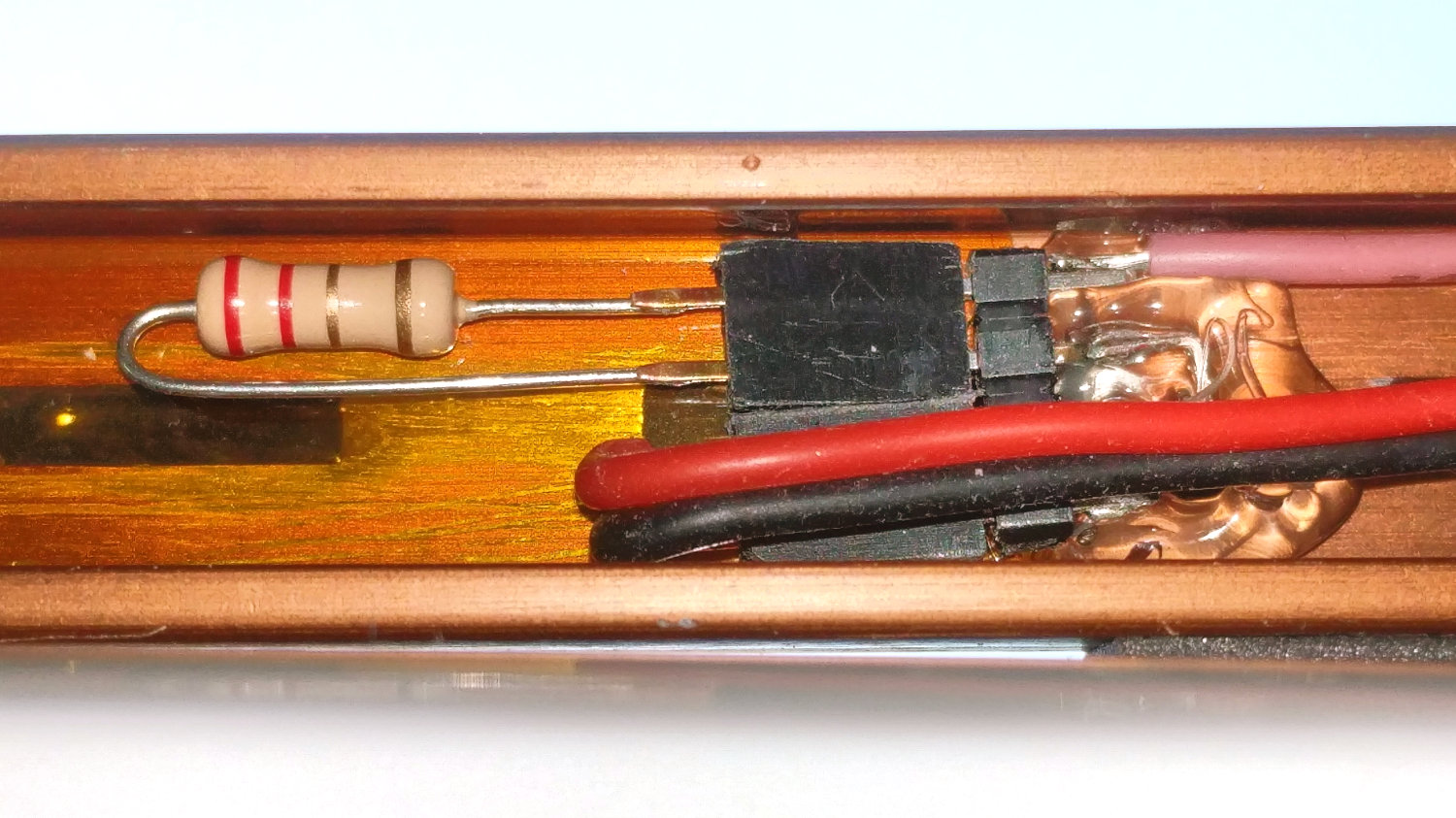
Changing from 2.0 Ω to 2.2 Ω produces a noticeable decrease in light, so 10% steps around 2 Ω seem to be about the right increment. The COB LED strips claim 6 W at 12 V = 500 mA nominal, so they’re running well under the spec.
Given that cheap 1% metal film resistor assortments use E6 or E12 value steps, at best, we may need two resistors in parallel for the next adjustments.
The general idea is to replace this:
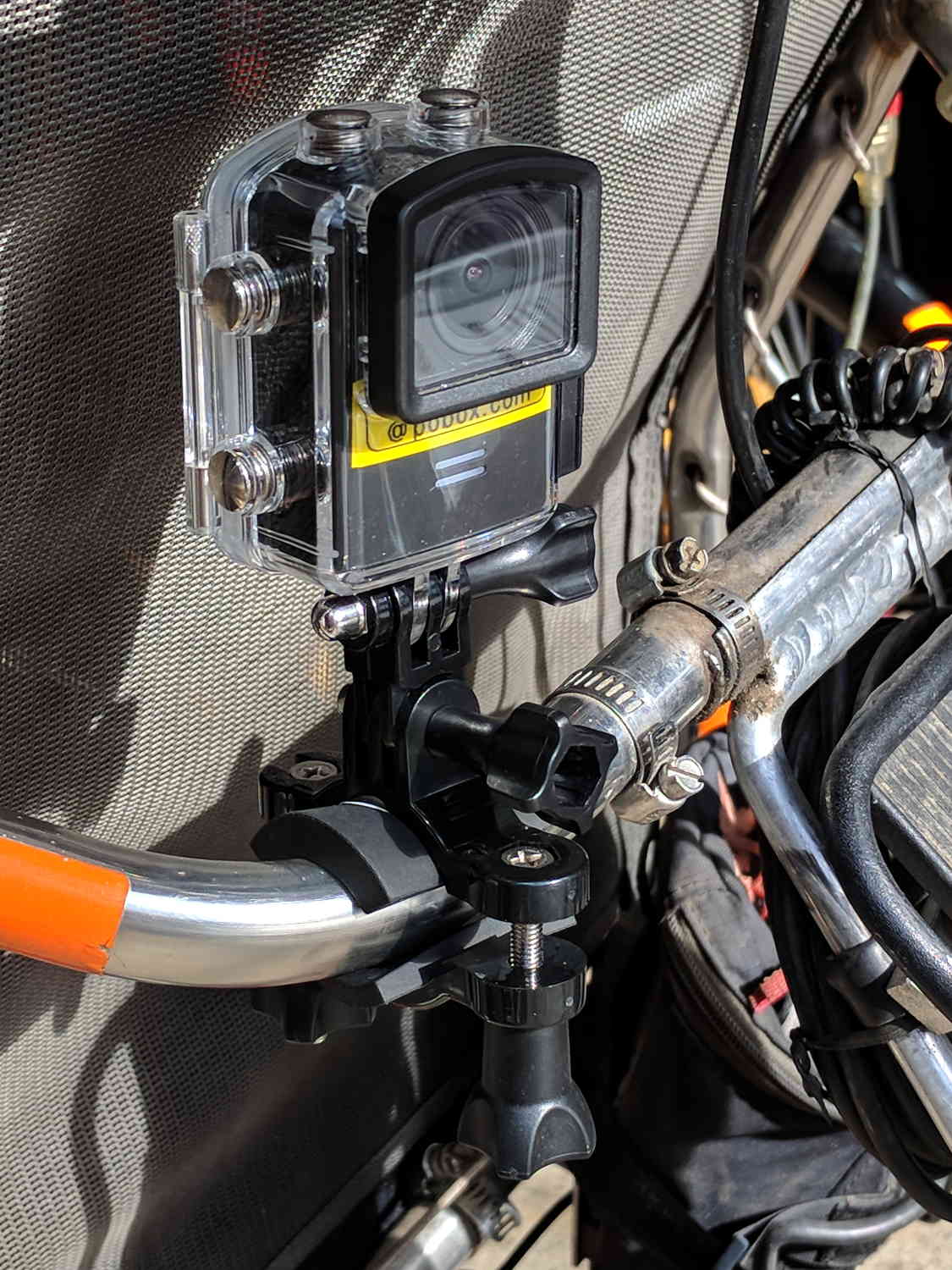
With this:

Thereby solving two problems:
The battery is an Anker PowerCore 13000 Power Bank plugged into the M20’s USB port. Given that SJCAM’s 1 A·h batteries barely lasted for a typical hour of riding, the 13 A·h PowerCore will definitely outlast my legs. The four blue dots just ahead of the strap around the battery show it’s fully charged and the blue light glowing through the case around the M20 indicates it’s turned on.
The solid model has four parts:

Which, as always, incorporates improvements based on the actual hardware on the bike.
A strap-and-buckle belt harvested from a defunct water pack holds the battery into the cradle and the cradle onto the rack, with a fuzzy velcro strip stuck to the bottom to prevent sliding:

The shell around the camera is basically a box minus the camera:
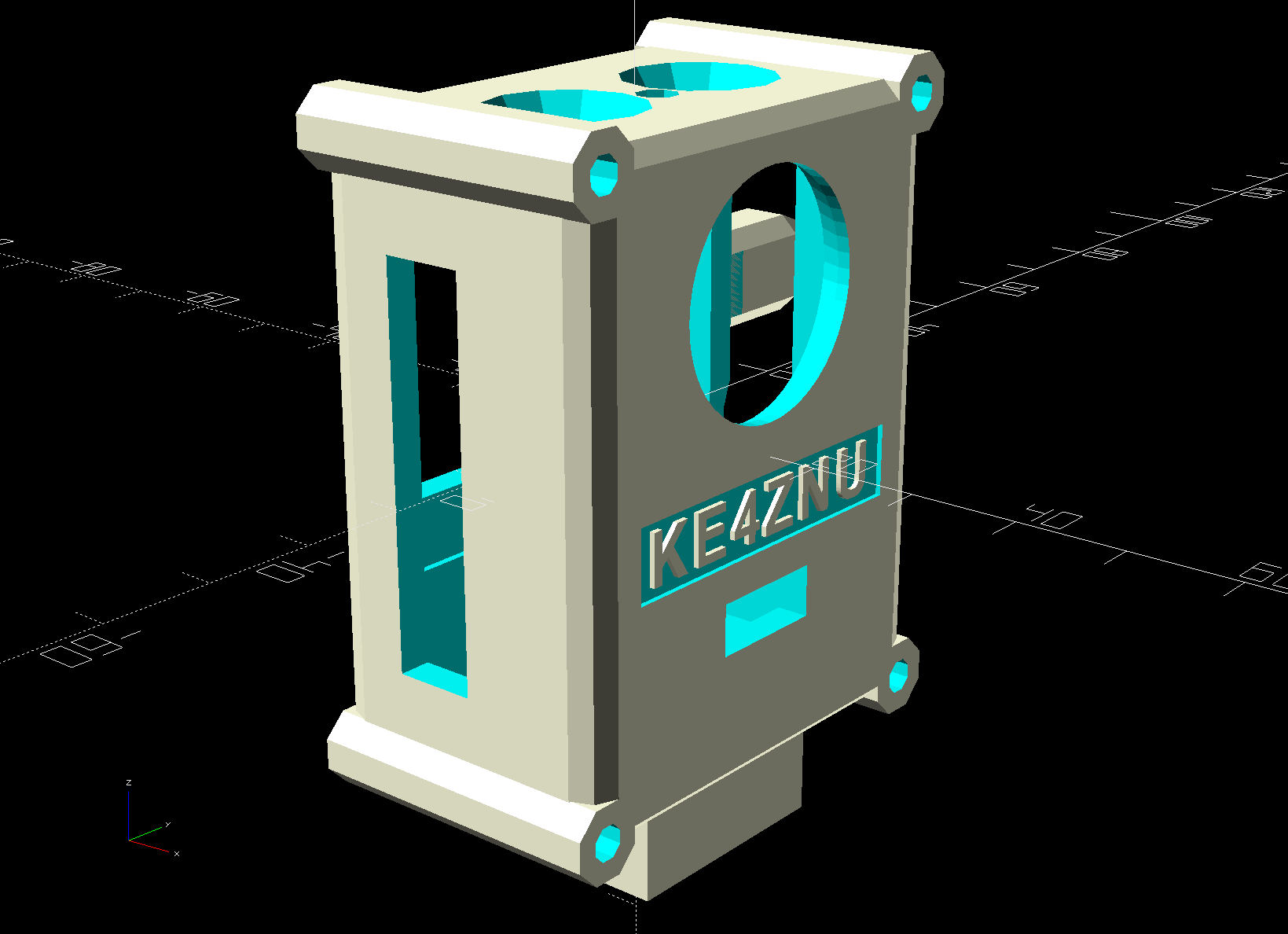
The shell builds as three separate slabs, with the center section having cutouts ahead of the camera’s projections to let it slide into place:
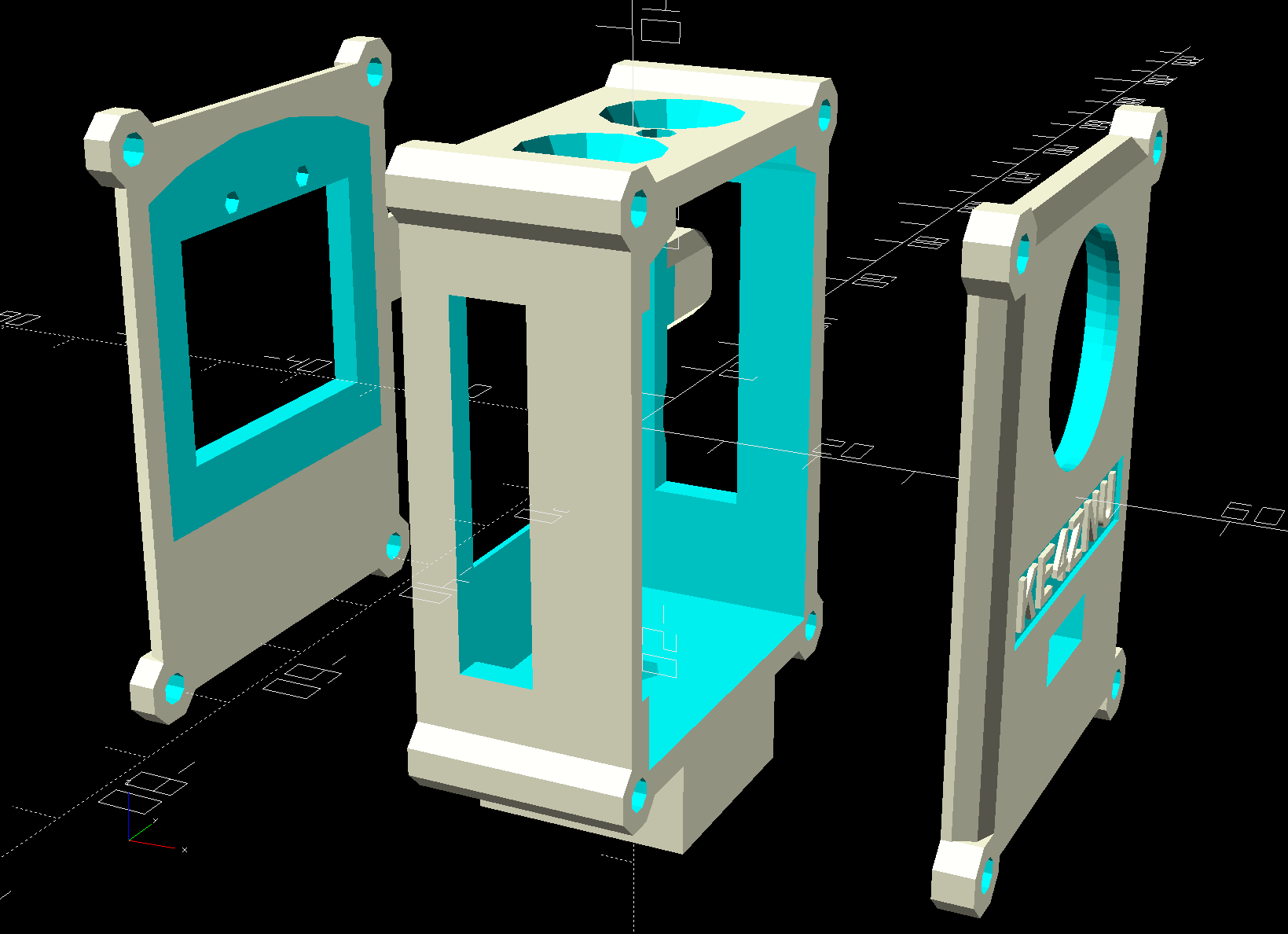
The new shell version is 30.5 mm thick, so a 40 mm screw will stick out maybe 5 mm beyond the nylon locknut. I trust the screws will get lost in the visual noise of the bike.
A peg sticking out behind the USB jack anchors the cable in place:

The front slab and center top have curves matching the M20 case:

The camera model has a tidy presentation option:
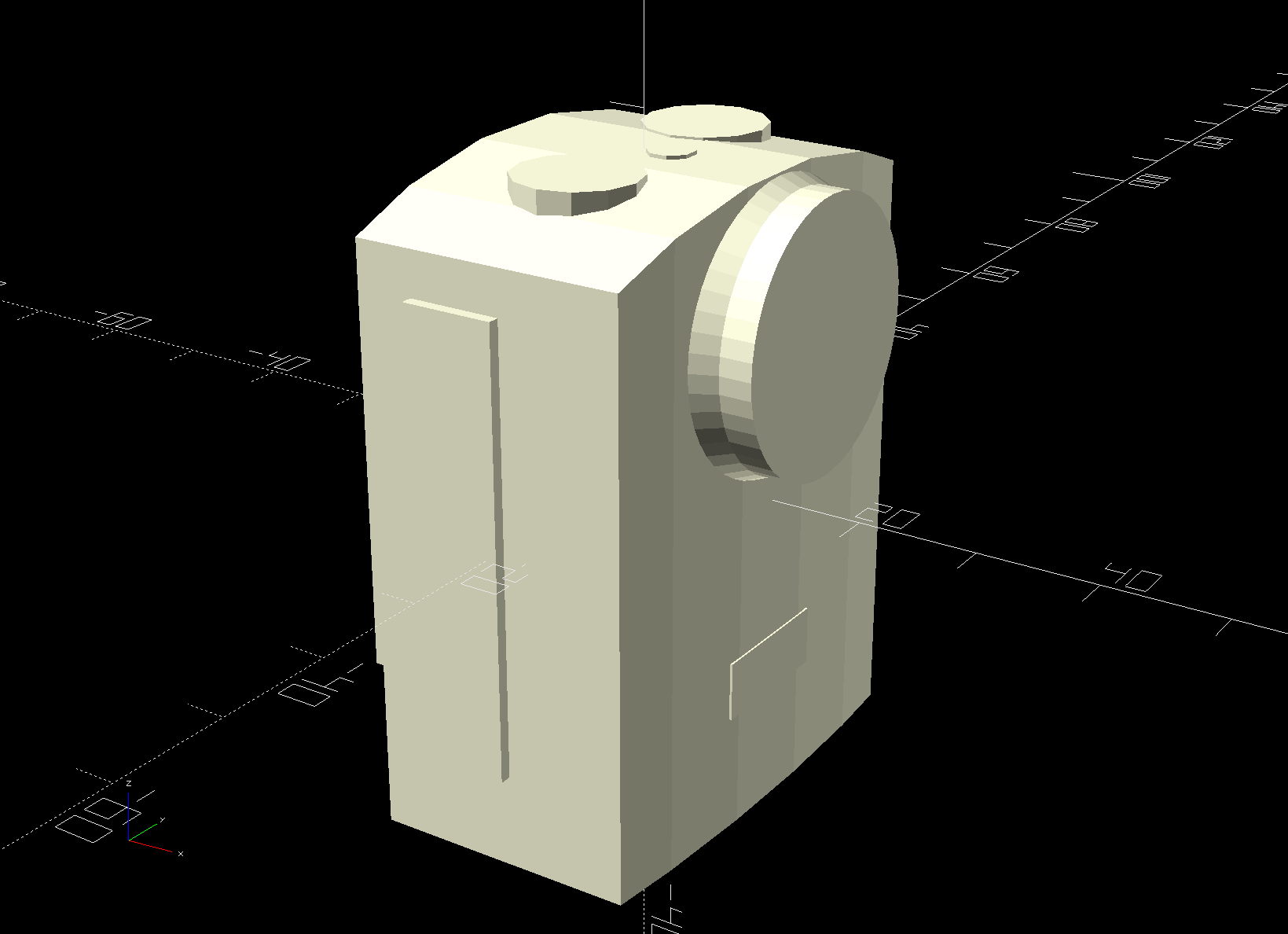
And an ugly option to knock the protruberances out of the shell:

The square-ish post on the base fits into an angled socket in the clamp around the seat rail:
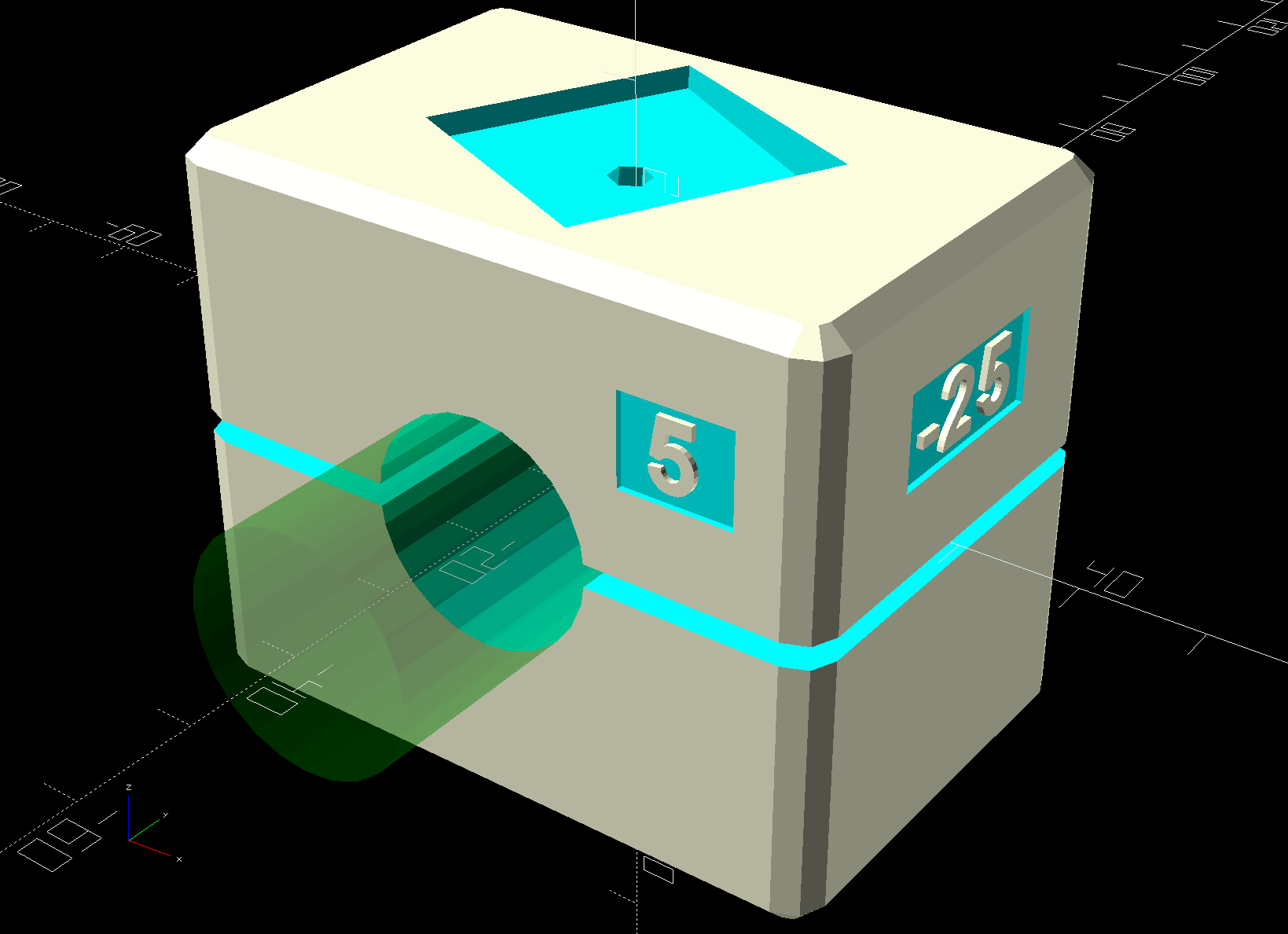
The numbers correspond to the “Look Angle” of the socket pointing the camera toward overtaking traffic. The -20° in the first clamp shows a bit too much rack:

It may not matter, though, as sometimes you want to remember what’s on the right:
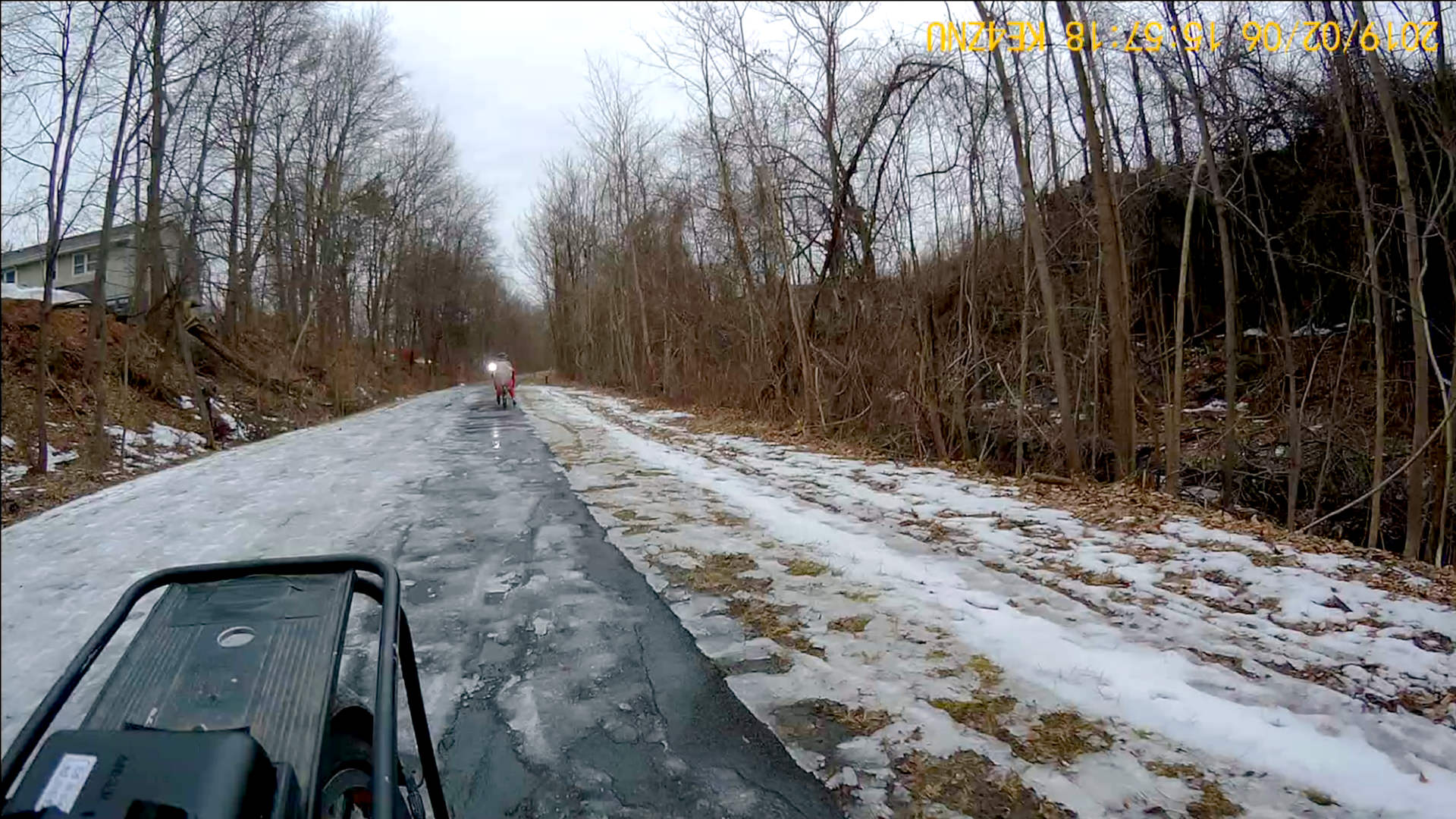
FWIW, the track veering off onto the grass came from a fat-tire bike a few days earlier. Most of the rail trail had cleared by the time we tried it, with some ice and snow in rock cuts and shaded areas.
Contrary to the first picture, I later remounted the camera under the seat rail with its top side downward. The M20 has a “rotate video” mode for exactly that situation, which I forgot to turn off in the fancy new mount, so I rotated the pix afterward.
A 3 mm screw extends upward through the hole in the socket to meet a threaded brass insert epoxied into the shell base, as shown in the uglified M20 model. Despite appearances, the hole is perpendicular to both the socket and the shell, so you can tweak the Look Angle without reprinting the shell.
All in all, the mount works well. We await better riding weather …
The OpenSCAD source code as a GitHub Gist:
| // SJCAM M20 Camera Mount for Tour Easy seat back rail | |
| // Ed Nisley – KE4ZNU | |
| // 2019-02 | |
| /* [Layout Options] */ | |
| Layout = "Fit"; // [Show,Fit,Build] | |
| Part = "Shell"; // [Cradle,Shell,Clamp,ShellSections,M20,Interposer,Battery,Buttons] | |
| LookAngle = [0,5,-25]; // camera angle, looking backwards | |
| /* [Extrusion Parameters] */ | |
| ThreadWidth = 0.40; | |
| ThreadThick = 0.25; | |
| HoleWindage = 0.2; | |
| Protrusion = 0.1; | |
| //—– | |
| // Dimensions | |
| /* [Hidden] */ | |
| ID = 0; | |
| OD = 1; | |
| LENGTH = 2; | |
| ClampScrew = [5.0,10.0,50.0]; // ID=thread OD=washer LENGTH=total | |
| ClampInsert = [5.0,7.5,10.5]; // brass insert | |
| MountScrew = [3.0,7.0,23]; // ID=thread OD=washer LENGTH=tune to fit clamp arch | |
| MountInsert = [3.0,4.95,8.0]; // ID=screw OD, OD=knurl dia | |
| EmbossDepth = 2*ThreadThick + Protrusion; // recess depth + Protrusion beyond surface | |
| DebossHeight = EmbossDepth; // text height + Protrusion into part | |
| Projection = 10; // stick-out to punch through shell sides & suchlike | |
| SupportColor = "Yellow"; | |
| FadeColor = "Green"; | |
| FadeAlpha = 0.25; | |
| //—– | |
| // Useful routines | |
| function IntegerMultiple(Size,Unit) = Unit * ceil(Size / Unit); | |
| module PolyCyl(Dia,Height,ForceSides=0) { // based on nophead's polyholes | |
| Sides = (ForceSides != 0) ? ForceSides : (ceil(Dia) + 2); | |
| FixDia = Dia / cos(180/Sides); | |
| cylinder(r=(FixDia + HoleWindage)/2, | |
| h=Height, | |
| $fn=Sides); | |
| } | |
| //—– | |
| // M20 Camera | |
| // Looks backwards from seat = usual right-hand coordinates work fine | |
| // X parallel to bike frame, Y parallel to seat strut, Z true vertical | |
| M20 = [24.5,40.5,54.0]; | |
| M20tm = 4.0; // chord height at top of case | |
| M20tr = (pow(M20tm,2) + pow(M20.y,2)/4) / (2*M20tm); // … radius | |
| echo(str("Top radius: ",M20tr)); | |
| M20TopSides = 3*3*4; | |
| echo(str(" … sides: ",M20TopSides)); | |
| M20fm = 1.0; // chord height at front of case | |
| M20fr = (pow(M20fm,2) + pow(M20.y,2)/4) / (2*M20fm); // … radius | |
| echo(str("Front radius: ",M20fr)); | |
| M20FrontSides = ceil(M20fr / M20tr * M20TopSides); // make arc sides match up | |
| echo(str(" … sides: ",M20FrontSides)); | |
| Lens = [19.0,22.5,5.5]; // ID=optical element, OD=tube | |
| LensBezel = [23.0,24.5,2.5]; // ID=lens tube, OD=bezel | |
| LensOffset = [-M20fm,0,41.5]; // bottom of case to lens centerline | |
| LensCap = [Lens[OD],24.5,4.5]; // silicone lens cap | |
| Spkr = [0.75,M20.y,14.3]; // speaker recess below LCD | |
| Switch = [8.0,1.0,38.0]; // selection switches | |
| SwitchOffset = [9.0,0,0]; // from rear to center of switches | |
| Jack = [10.0,0.1,36.0]; // jack and MicroSD card access, slightly enlarged | |
| JackOffset = [10.0,0,30.0]; // rear, bottom to center of jack block | |
| USB = [JackOffset.x – Jack.x/2,20.0,10.0]; // strut under USB plug | |
| USBOffset = [0,0,33.5]; // bottom to center of jack | |
| SDCard = [2.0,0.1,12.0]; // SD Card slot | |
| SDOffset = [9.0,0,20.0]; // bottom, rear to center of slot | |
| Button = [8.5,10.5,M20tm]; // ID = button, OD = bezel | |
| ButtonOC = 18.0; // on-center Y separation, assume X centered | |
| Screen = [0.1,31,24]; // LCD on rear face | |
| ScreenOffset = [0,0,33]; | |
| BarLEDs = [0.1 + M20fm,12.0,5.0]; // Bar LEDs on front face | |
| BarLEDsOffset = [-M20fm,0,12.5]; | |
| PwrLED = [3.5,3.5,0.1 + M20tm]; // power LED on top | |
| PwrLEDOffset = [2.5,0,0]; | |
| RearLEDs = [1.0,2.0,0.1]; // charge and power LED openings above LCD | |
| RearLEDsOffset = [0,13.0/2,M20tm + 3.0]; // .. from top center of case | |
| module Buttons(KO) { | |
| for (j = [-1,1]) | |
| translate([0,j*ButtonOC/2,0]) { | |
| cylinder(d=Button[OD],h=Button[LENGTH],$fn=12); | |
| if (KO) | |
| translate([0,0,M20tm]) | |
| cylinder(d1=Button[OD],d2=1.5*Button[OD],h=Button.z,$fn=12); | |
| } | |
| } | |
| module M20Shape(Knockout = false) { | |
| difference() { | |
| intersection() { | |
| translate([0,0,M20.z/2 – M20tr]) // top curve | |
| rotate([0,90,0]) rotate(180/M20TopSides) | |
| cylinder(r=M20tr,h=2*(M20.x + Protrusion),$fn=M20TopSides,center=true); | |
| translate([M20.x/2 – M20fr,0,0]) | |
| rotate(180/M20FrontSides) | |
| cylinder(r=M20fr,h=2*M20.z,$fn=M20FrontSides,center=true); | |
| cube(M20,center=true); | |
| } | |
| translate([Spkr.x/2 – M20.x/2 – Protrusion,0,Spkr.z/2 – Protrusion/2 – M20.z/2]) | |
| cube(Spkr + [Protrusion,2*Protrusion,Protrusion],center=true); | |
| } | |
| translate([M20.x/2,0,-M20.z/2] + LensOffset) | |
| rotate([0,90,0]) | |
| cylinder(d=Lens[OD] + HoleWindage,h=(Knockout ? Projection : Lens[LENGTH]),$fn=4*4*3,center=false); | |
| translate([M20.x/2 + M20fm/2,0,-M20.z/2] + LensOffset) // lens bezel | |
| rotate([0,90,0]) | |
| cylinder(d1=LensBezel[OD],d2=Lens[OD],h=LensBezel[LENGTH],$fn=4*4*3,center=false); | |
| translate([-M20.x/2 + SwitchOffset.x, // side switches | |
| -(Switch.y + M20.y – Protrusion)/2, | |
| 0]) | |
| cube(Switch + [0,Protrusion,0] + (Knockout ? [0,Projection,0] : [0,0,0]),center=true); | |
| if (Knockout) | |
| translate([(M20.x/2 – M20fm)/2,-M20.y/2,0]) // side switch slide-in clearance | |
| cube([M20.x/2 – M20fm,2*Switch.y,Switch.z],center=true); | |
| translate([-M20.x/2 + JackOffset.x, | |
| (Jack.y + M20.y – Protrusion)/2, | |
| JackOffset.z – M20.z/2]) | |
| cube(Jack + [0,Protrusion,0] + (Knockout ? [0,Projection,0] : [0,0,0]),center=true); | |
| translate([0,0,M20.z/2 – M20tm]) // top control buttons | |
| Buttons(Knockout); | |
| if (Knockout) | |
| translate([(M20.x – M20fm)/4,0,M20.z/2 – M20tm + Button[LENGTH]/2]) // slide-in button clearance | |
| cube([(M20.x – M20fm)/2,ButtonOC + Button[OD],Button[LENGTH]],center=true); | |
| translate([-(M20.x + Screen.x – Protrusion)/2,0,-M20.z/2] + ScreenOffset) | |
| cube(Screen + [Protrusion,0,0] + (Knockout ? [Projection,0,0] : [0,0,0]),center=true); | |
| for (j = [-1,1]) | |
| translate([-M20.x/2 + Protrusion,j*RearLEDsOffset.y,M20.z/2 – RearLEDsOffset.z]) | |
| rotate([0,-90,0]) rotate(180/6) | |
| PolyCyl(RearLEDs[OD],Knockout ? Projection : RearLEDs[LENGTH],6); | |
| translate([M20.x/2 + BarLEDs.x/2,0,-M20.z/2] + BarLEDsOffset) | |
| cube(BarLEDs + (Knockout ? [Projection,0,0] : [0,0,0]),center=true); | |
| translate([0,0,M20.z/2 – M20tm] + PwrLEDOffset) | |
| rotate(180/8) | |
| PolyCyl(PwrLED[OD],(Knockout ? Projection : PwrLED[LENGTH]),8); | |
| if (Knockout) { | |
| translate([0,0,-M20.z/2]) | |
| rotate([180,0,0]) { // mounting screw | |
| PolyCyl(MountScrew[ID],MountScrew[LENGTH],6); | |
| translate([0,0,MountScrew[LENGTH] – Protrusion]) | |
| PolyCyl(MountScrew[OD],MountScrew[ID] + 4*ThreadThick,6); // SHCS head is about 1 ID long | |
| } | |
| translate([0,0,-(M20.z/2 + MountInsert[LENGTH] + 4*ThreadWidth – Protrusion)]) | |
| PolyCyl(MountInsert[OD],MountInsert[LENGTH] + 4*ThreadWidth,6); // insert inside Interposer | |
| } | |
| } | |
| //—– | |
| // Shell | |
| // Wraps around camera | |
| NomWall = 3.0; | |
| ShellWall = [IntegerMultiple(NomWall,ThreadThick), | |
| IntegerMultiple(NomWall,ThreadWidth), | |
| IntegerMultiple(NomWall,ThreadWidth)]; | |
| ShellRadius = ShellWall.x; | |
| ShellSides = 8; | |
| ShellOA = M20 + 2*ShellWall; | |
| echo(str("Shell OA: ",ShellOA)); | |
| Interposer = [M20.x – M20fm,M20.x – M20fm,10.0]; // if you can't be smart, be square | |
| module Shell() { | |
| Screw = [3.0,6.75,30]; // ID=thread OD=washer LENGTH | |
| ScrewClear = 1.0; // additional washer clearance | |
| ScrewSides = 8; | |
| ScrewOC = M20 + [0,Screw[ID]/cos(180/ScrewSides),Screw[ID]/cos(180/ScrewSides)]; // use PolyCyl hole dia, ignore .x value | |
| difference() { | |
| union() { | |
| hull() | |
| for (i=[-1,1], j=[-1,1], k=[-1,1]) | |
| translate([i*(ShellOA.x – 2*ShellRadius)/2, | |
| j*(ShellOA.y – 2*ShellRadius)/2, | |
| k*(ShellOA.z – 2*ShellRadius)/2]) | |
| sphere(r=ShellRadius/cos(180/ShellSides),$fn=ShellSides); // fix low-poly approx radius | |
| for (j=[-1,1], k=[-1,1]) // screw bosses, full length | |
| translate([0,j*ScrewOC.y/2,k*ScrewOC.z/2]) | |
| rotate([0,90,0]) rotate(180/ScrewSides) | |
| cylinder(d=Screw[OD] + ScrewClear,h=ShellOA.x,center=true,$fn=ScrewSides); | |
| translate([-(ShellOA.x – USB.x – ShellWall.x)/2, // USB plug support strut | |
| (M20.y + USB.y)/2 – ShellRadius, | |
| -M20.z/2] + USBOffset) | |
| hull() | |
| for (i=[-1,1], j=[-1,1], k=[-1,1]) | |
| translate([i*(USB.x + ShellWall.x – 2*ShellRadius)/2, | |
| j*(USB.y – 2*ShellRadius)/2, | |
| k*(USB.z – 2*ShellRadius)/2]) | |
| rotate(0*180/ShellSides) rotate([90,0,90]) | |
| sphere(r=ShellRadius/cos(180/ShellSides),$fn=ShellSides); | |
| translate([-M20fm/2,0,-ShellOA.z/2 – Interposer.z + Protrusion/2]) | |
| InterposerShape(Embiggen = false); | |
| } | |
| render(convexity=4) // remove camera shape from interior | |
| M20Shape(Knockout = true); | |
| for (j=[-1,1], k=[-1,1]) // screw bores | |
| translate([-ShellOA.x,j*ScrewOC.y/2,k*ScrewOC.z/2]) | |
| rotate([0,90,0]) rotate(180/ScrewSides) | |
| PolyCyl(Screw[ID],2*ShellOA.x,ScrewSides); | |
| translate([ShellOA.x/2 – ThreadThick + Protrusion/2,0,-5]) // recess for legend | |
| cube([EmbossDepth,ShellOA.y – 12,7],center=true); | |
| translate([0,(M20.y + 1.5*SDCard.z)/2 + ThreadWidth,-M20.z/2 + SDOffset.z]) | |
| resize([M20.x,0,0]) | |
| sphere(d=1.5*SDCard.z,$fn=24); | |
| } | |
| translate([ShellOA.x/2 – DebossHeight,0,-5]) | |
| rotate([90,0,90]) | |
| linear_extrude(height=DebossHeight,convexity=20) | |
| text(text="KE4ZNU",size=5,spacing=1.20,font="Arial:style:Bold",halign="center",valign="center"); | |
| // Totally ad-hoc support structures | |
| if (false) | |
| color(SupportColor) { | |
| for (j=[-1,1], k=[0,1]) | |
| translate([-ShellOA.x/2 + Screw[LENGTH],j*ShellOA.y/2,k*ShellOA.z]) | |
| rotate([0,90,0]) | |
| SupportScrew(Dia=Screw[OD] + ScrewClear,Length=ShellOA.x – Screw[LENGTH],Num=ScrewSides); | |
| } | |
| } | |
| // Generate support structure for screw boss | |
| module SupportScrew(Dia,Length,Num = 6) { | |
| for (a=[0 : 360/Num : 360/2]) | |
| rotate(a) | |
| translate([0,0,(Length + ThreadThick)/2]) | |
| cube([Dia – 2*ThreadWidth,2*ThreadWidth,Length – ThreadThick],center=true); | |
| } | |
| // Generate interposer block | |
| // Origin at center bottom surface for E-Z rotation | |
| module InterposerShape(Embiggen = false) { | |
| translate([0,0,Interposer.z/2]) | |
| if (Embiggen) { | |
| minkowski() { | |
| cube(Interposer,center=true); | |
| cube(HoleWindage,center=true); | |
| } | |
| } | |
| else | |
| cube(Interposer + [-Protrusion,0,Protrusion],center=true); // avoid slivers, merge with shell | |
| } | |
| // Cut shell sections for printing | |
| // "Front" = lens end, toward +X direction | |
| // origin centered on M20.xyz and ShellOA.xyz | |
| module ShellSection(Section="Front") { | |
| if (Section == "Front") // include front curve | |
| intersection() { | |
| Shell(); | |
| translate([ShellOA.x – (M20fm + ShellWall.x),0,0]) | |
| cube([ShellOA.x,2*ShellOA.y,2*ShellOA.z],center=true); | |
| } | |
| else if (Section == "Center") // exclude front curve for E-Z printing | |
| intersection() { | |
| Shell(); | |
| translate([-M20fm/2,0,0]) | |
| cube([M20.x – M20fm,2*ShellOA.y,2*ShellOA.z],center=true); | |
| } | |
| else if (Section == "Back") // flush with LCD on rear face | |
| intersection() { | |
| Shell(); | |
| translate([-ShellOA.x + (ShellWall.x),0,0]) | |
| cube([ShellOA.x,2*ShellOA.y,2*ShellOA.z],center=true); | |
| } | |
| } | |
| //—– | |
| // Clamp | |
| // Grips seat frame rail | |
| // Uses shell rounding values for tidiness | |
| // Adjust MountScrew[LENGTH] to put head more-or-less flush with clamp arch | |
| RailOD = 20.0; // slightly elliptical in bent section | |
| RailSides = 2*3*4; | |
| ClampOA = [60.0,40.0,ClampScrew[LENGTH]]; // set clamp size to avoid weird screw spacing | |
| echo(str("Clamp OA: ",ClampOA)); | |
| ClampOffset = 0.0; // raise clamp to allow more room for mount | |
| ClampTop = ClampOA.z/2 + ClampOffset; | |
| InsertCap = 6*ThreadThick; // fill layers atop inserts | |
| Kerf = 2.0; | |
| module Clamp(Support = false) { | |
| RibThick = 2*ThreadWidth; | |
| NumRibs = IntegerMultiple(ceil(ClampOA.y / 4.0),2); // space ribs roughly 4 mm apart | |
| RibSpace = ClampOA.y / NumRibs; | |
| echo(str("Ribs: ",NumRibs," spaced: ",RibSpace)); | |
| ClampScrewOC = IntegerMultiple(ClampOA.x – ClampScrew[OD] – 10*ThreadWidth,1.0); | |
| echo(str("ClampScrew OC: ",ClampScrewOC)); | |
| difference() { | |
| hull() | |
| for (i=[-1,1], j=[-1,1], k=[-1,1]) | |
| translate([i*(ClampOA.x – 2*ShellRadius)/2, | |
| j*(ClampOA.y – 2*ShellRadius)/2, | |
| k*(ClampOA.z – 2*ShellRadius)/2 + ClampOffset]) | |
| sphere(r=ShellRadius/cos(180/ShellSides),$fn=ShellSides); | |
| cube([2*ClampOA.x,2*ClampOA.y,Kerf],center=true); // split across middle | |
| rotate([90,0,0]) // seat rail | |
| cylinder(d=RailOD,h=2*ClampOA.y,$fn=RailSides,center=true); | |
| for (i=[-1,1]) // clamp inserts | |
| translate([i*ClampScrewOC/2,0,0]) | |
| rotate(180/6) | |
| PolyCyl(ClampInsert[OD],ClampTop – InsertCap,6); | |
| for (i=[-1,1]) // clamp screw clearance | |
| translate([i*ClampScrewOC/2,0,-(ClampOA.z/2 – ClampOffset) – InsertCap]) | |
| rotate(180/6) | |
| PolyCyl(ClampScrew[ID],ClampOA.z,6); | |
| translate([0,0,ClampTop + 0.7*Interposer.z]) // mounting bolt hole | |
| rotate(LookAngle) | |
| translate([0,0,ShellOA.z/2]) { | |
| M20Shape(Knockout = true); | |
| translate([0,0,-ShellOA.z/2 – Interposer.z]) | |
| InterposerShape(Embiggen = true); | |
| } | |
| translate([ClampOA.x/2 – (EmbossDepth – Protrusion)/2, // recess for LookAngle.z | |
| 0, | |
| ClampOA.z/4 + ClampOffset]) | |
| cube([EmbossDepth,17,8],center=true); | |
| translate([0.3*ClampOA.x, // recess for LookAngle.z | |
| -(ClampOA.y/2 – (EmbossDepth – Protrusion)/2), | |
| ClampOA.z/4 + ClampOffset]) | |
| cube([10,EmbossDepth,8],center=true); | |
| translate([0,0,-ClampOA.z/2 + (EmbossDepth – Protrusion)/2]) // recess bottom legend | |
| cube([35,10,EmbossDepth],center=true); | |
| } | |
| translate([ClampOA.x/2 – DebossHeight,0,ClampOA.z/4 + ClampOffset]) // LookAngle.z legend | |
| rotate([90,0,90]) | |
| linear_extrude(height=DebossHeight,convexity=20) | |
| text(text=str(LookAngle.z),size=6,spacing=1.20, | |
| font="Arial:style:Bold",halign="center",valign="center"); | |
| translate([0.3*ClampOA.x,-ClampOA.y/2 + DebossHeight + Protrusion/2,ClampOA.z/4 + ClampOffset]) // LookAngle.y legend | |
| rotate([90,0,00]) | |
| linear_extrude(height=DebossHeight,convexity=20) | |
| text(text=str(LookAngle.y),size=6,spacing=1.20, | |
| font="Arial:style:Bold",halign="center",valign="center"); | |
| translate([0,0,-ClampOA.z/2]) | |
| linear_extrude(height=DebossHeight,convexity=20) | |
| mirror([0,1,0]) | |
| text(text="KE4ZNU",size=5,spacing=1.20, | |
| font="Arial:style:Bold",halign="center",valign="center"); | |
| if (Support) { | |
| difference() { | |
| color(SupportColor) | |
| union() { | |
| for (j=[-NumRibs/2:NumRibs/2]) | |
| translate([0,j*RibSpace,0]) | |
| rotate([90,0,0]) | |
| cylinder(d=RailOD – 2*ThreadThick,h=RibThick,$fn=2*3*4,center=true); | |
| cube([RailOD – 4*ThreadWidth,NumRibs*RibSpace,Kerf + 2*ThreadThick],center=true); | |
| } | |
| cube([2*ClampOA.x,2*ClampOA.y,Kerf],center=true); // split across middle | |
| } | |
| } | |
| } | |
| //—– | |
| // Battery | |
| // Based on Anker PowerCore, simplified shapes | |
| // Includes port & button punchouts | |
| Battery = [97.5,80.0,22.5]; // X=length, Y includes rounded edges, Z = Y dia | |
| module BatteryShape() { | |
| USB = [Projection,38,10]; // clearance around USB output ports | |
| USBOffset = [0,25.5,0]; // from -Y edge to center of USB block | |
| ChargeBtn = [11.0 + 5.0,10,5.0 + 5.0]; // charge level check button, enlarged | |
| Btnc = ChargeBtn.z; // figure button recess into battery curve | |
| Btnr = Battery.z/2; | |
| Btnm = Btnr – sqrt(pow(Btnr,2) – pow(Btnc,2)/4); | |
| ChargeBtnOffset = [17.0,0,0]; // from +X edge to center, centered on Z | |
| BatterySides = 2*3*4; | |
| hull() | |
| for (j=[-1,1]) | |
| translate([0,j*(Battery.y – Battery.z)/2,0]) | |
| rotate([0,90,0]) | |
| cylinder(d=Battery.z,h=Battery.x,$fn=BatterySides,center=true); | |
| translate([(Battery.x + USB.x)/2 – Protrusion,-Battery.y/2 + USBOffset.y,0]) | |
| cube(USB,center=true); | |
| translate([Battery.x/2 – ChargeBtnOffset.x,Battery.y/2 + ChargeBtn.y/2 – 2*Btnm,0]) | |
| cube(ChargeBtn,center=true); | |
| } | |
| //—– | |
| // Battery cradle | |
| RackWidth = 89.0; // flat width between rack rails | |
| CradleWall = [4.0,4.0,3.0]; // wall thickness | |
| CradleRadius = 2.0; // corner rounding | |
| CradlePad = 0.5; // cushion around battery | |
| BatteryBase = CradleWall.z + CradlePad; // actual bottom surface of battery | |
| CradleOA = [Battery.x + 2*CradleWall.x, | |
| min((Battery.y + 2*CradleWall.y),RackWidth), | |
| BatteryBase + Battery.z/3]; | |
| echo(str("Cradle OA: ",CradleOA)); | |
| module Cradle() { | |
| difference() { | |
| hull() | |
| for (i=[-1,1], j=[-1,1]) { // box with tidy rounded corners | |
| translate([i*(CradleOA.x/2 – CradleRadius), | |
| j*(CradleOA.y/2 – CradleRadius), | |
| 1*(CradleOA.z – CradleRadius)]) | |
| sphere(r=CradleRadius,$fn=6); | |
| translate([i*(CradleOA.x/2 – CradleRadius), | |
| j*(CradleOA.y/2 – CradleRadius), | |
| 0*(CradleOA.z/2 – CradleRadius)]) | |
| cylinder(r=CradleRadius,h=CradleOA.z/2,$fn=6); | |
| } | |
| translate([0,0,Battery.z/2 + BatteryBase]) // minus the battery | |
| minkowski(convexity=3) { // … slightly embiggened | |
| BatteryShape(); | |
| cube(2*CradlePad,center=true); | |
| } | |
| if (false) // reveal insets for debug | |
| translate([0,0,-Protrusion]) | |
| cube(CradleOA + [0,0,CradleOA.z],center=false); | |
| translate([0,0,CradleWall.z – ThreadThick + Protrusion/2]) // recess top legend | |
| cube([55,20,EmbossDepth],center=true); | |
| translate([0,0,(EmbossDepth – Protrusion)/2]) // recess bottom legend | |
| cube([70,15,EmbossDepth],center=true); | |
| } | |
| translate([0,4.0,CradleWall.z – DebossHeight – Protrusion]) | |
| linear_extrude(height=DebossHeight,convexity=20) | |
| text(text="PowerCore",size=6,spacing=1.20, | |
| font="Arial:style:Bold",halign="center",valign="center"); | |
| translate([0,-4.0,CradleWall.z – DebossHeight – Protrusion]) | |
| linear_extrude(height=DebossHeight,convexity=20) | |
| text(text="13000",size=6,spacing=1.20, | |
| font="Arial:style:Bold",halign="center",valign="center"); | |
| linear_extrude(height=DebossHeight,convexity=20) | |
| mirror([0,1,0]) | |
| text(text="KE4ZNU",size=10,spacing=1.20, | |
| font="Arial:style:Bold",halign="center",valign="center"); | |
| } | |
| //—– | |
| // Build things | |
| // Layouts for design & tweaking | |
| if (Layout == "Show") | |
| if (Part == "Battery") | |
| BatteryShape(); | |
| else if (Part == "Buttons") | |
| Buttons(); | |
| else if (Part == "Interposer") | |
| InterposerShape(Embiggen = false); | |
| else if (Part == "Shell") | |
| Shell(); | |
| else if (Part == "M20") | |
| M20Shape(Knockout = false); | |
| else if (Part == "ShellSections") { | |
| translate([ShellOA.x,0,0]) | |
| ShellSection(Section="Front"); | |
| translate([0,0,0]) | |
| ShellSection(Section="Center"); | |
| translate([-ShellOA.x,0,0]) | |
| ShellSection(Section="Back"); | |
| } | |
| else if (Part == "Clamp") { | |
| Clamp(Support = false); | |
| color(FadeColor,FadeAlpha) | |
| rotate([90,0,0]) | |
| cylinder(d=RailOD,h=2*ClampOA.y,$fn=RailSides,center=true); | |
| } | |
| else if (Part == "Cradle") { | |
| Cradle(); | |
| translate([0,0,Battery.z/2 + CradleWall.z]) | |
| color(FadeColor,FadeAlpha) | |
| BatteryShape(); | |
| } | |
| // Build layouts for top-level parts | |
| if (Layout == "Build") | |
| if (Part == "Cradle") | |
| Cradle(); | |
| else if (Part == "Clamp") { | |
| translate([0,0.7*ClampOA.y,0]) | |
| difference() { | |
| translate([0,0,-Kerf/2]) | |
| Clamp(Support = true); | |
| translate([0,0,-ClampOA.z]) | |
| cube(2*ClampOA,center=true); | |
| } | |
| translate([0,-0.7*ClampOA.y,-0]) | |
| difference() { | |
| translate([0,0,-Kerf/2]) | |
| rotate([0,180,0]) | |
| Clamp(Support = true); | |
| translate([0,0,-ClampOA.z]) | |
| cube(2*ClampOA,center=true); | |
| } | |
| } | |
| else if (Part == "Shell") { | |
| translate([0,-1.2*ShellOA.y,ShellOA.x/2]) | |
| rotate([0,90,180]) | |
| ShellSection(Section="Front"); | |
| translate([0,0,M20.x/2]) | |
| rotate([0,-90,0]) | |
| ShellSection(Section="Center"); | |
| translate([0,1.4*ShellOA.y,ShellOA.x/2]) | |
| rotate([0,-90,180]) | |
| ShellSection(Section="Back"); | |
| } | |
| // Ad-hoc arrangement to see how it all goes together | |
| if (Layout == "Fit") { | |
| rotate(180) { | |
| Cradle(); | |
| translate([0,0,Battery.z/2 + CradleWall.z]) | |
| color(FadeColor,FadeAlpha) | |
| BatteryShape(); | |
| } | |
| translate([0,-100,0]) { | |
| Clamp(); | |
| color(FadeColor,FadeAlpha) | |
| rotate([90,0,0]) | |
| cylinder(d=RailOD,h=2*ClampOA.y,$fn=RailSides,center=true); | |
| } | |
| translate([0,-100,(ClampOA.z + ShellOA.z)/2 + Interposer.z]) | |
| translate([0,0,-ShellOA.z/2 + Interposer.z]) | |
| rotate(LookAngle) | |
| translate([0,0,ShellOA.z/2]) { | |
| Shell(); | |
| color(FadeColor,FadeAlpha) | |
| M20Shape(Knockout = false); | |
| } | |
| } | |
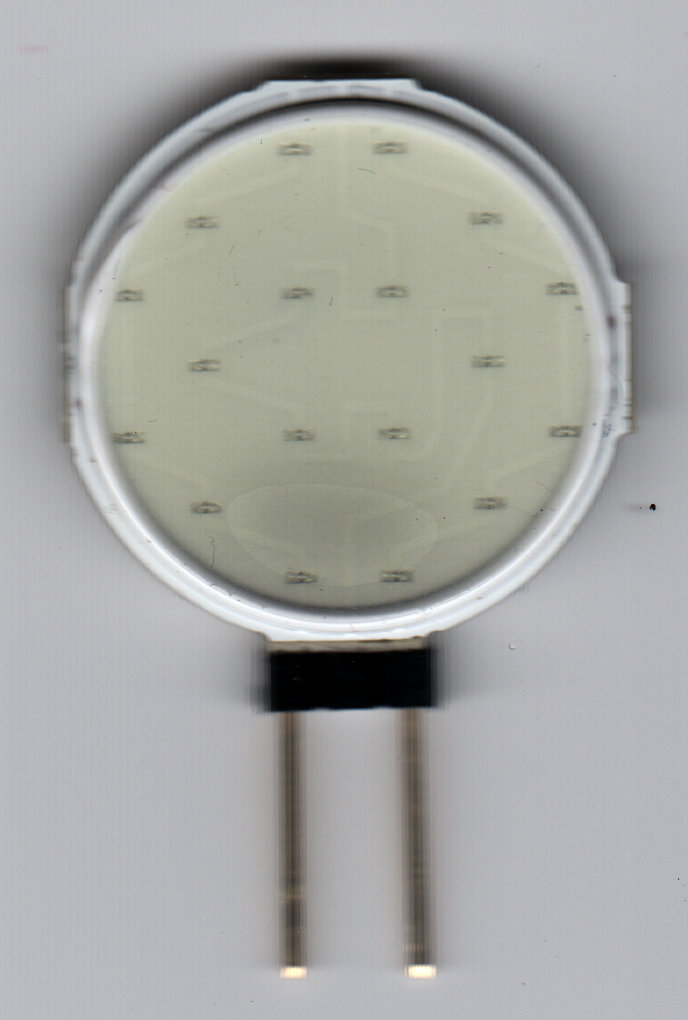
A bag of G4 COB LEDs arrived from halfway around the planet:

Those are “5 W” and “4 W” cool white modules, respectively, with another set of 4 W warm white looking pretty much the same. There’s no provision for heatsinking, which makes the wattage seem suspect; halogen G4 bulbs run around 20 W, for whatever that’s worth.
The silicone overlay becomes nearly transparent when seen through an ordinary desktop document scanner:
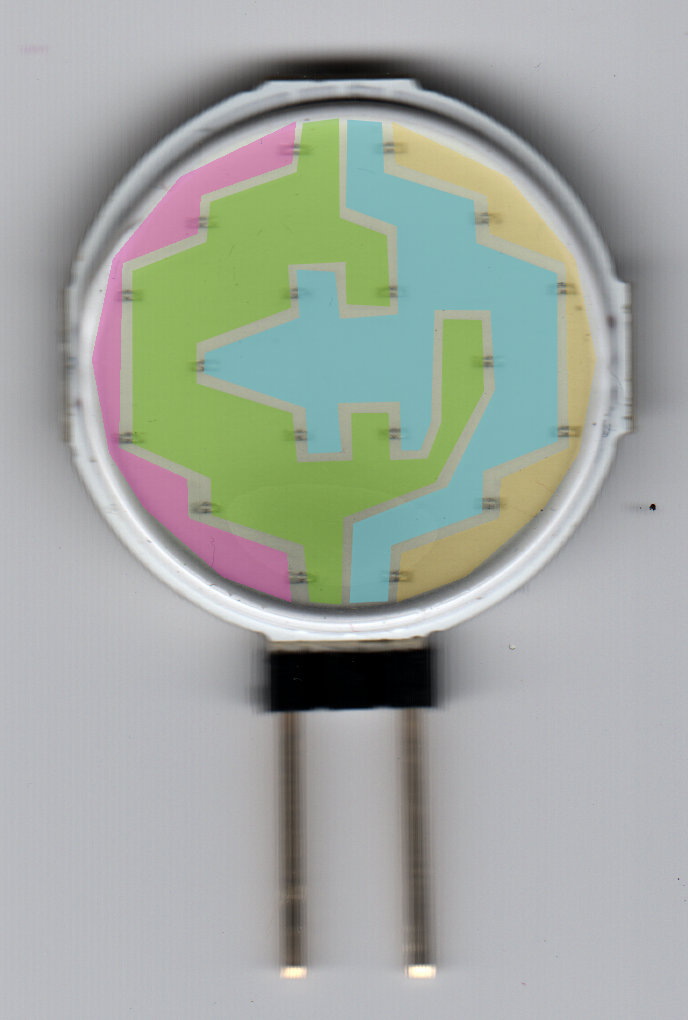
Highlighting the PCB copper pours shows 18 LEDs arranged in three series groups of six LEDs in parallel:
The “smart IC” touted in the writeup turns out to be a bridge rectifier for AC or DC power:

The SMD resistors on all 15 modules measure 27.6 Ω, more or less, and seem randomly oriented face-up or face-down. I assume that one is face-down; maybe it’s just unlabeled on both sides.
Back of the envelope: there’s no way it will dissipate 5 W. The bridge drops 1.4 V = 2×0.7, the LEDs drop maybe 9 V, leaving the resistor with 1.6 V to pass all of 60 mA, so call it 700 mW.
Some measurements:
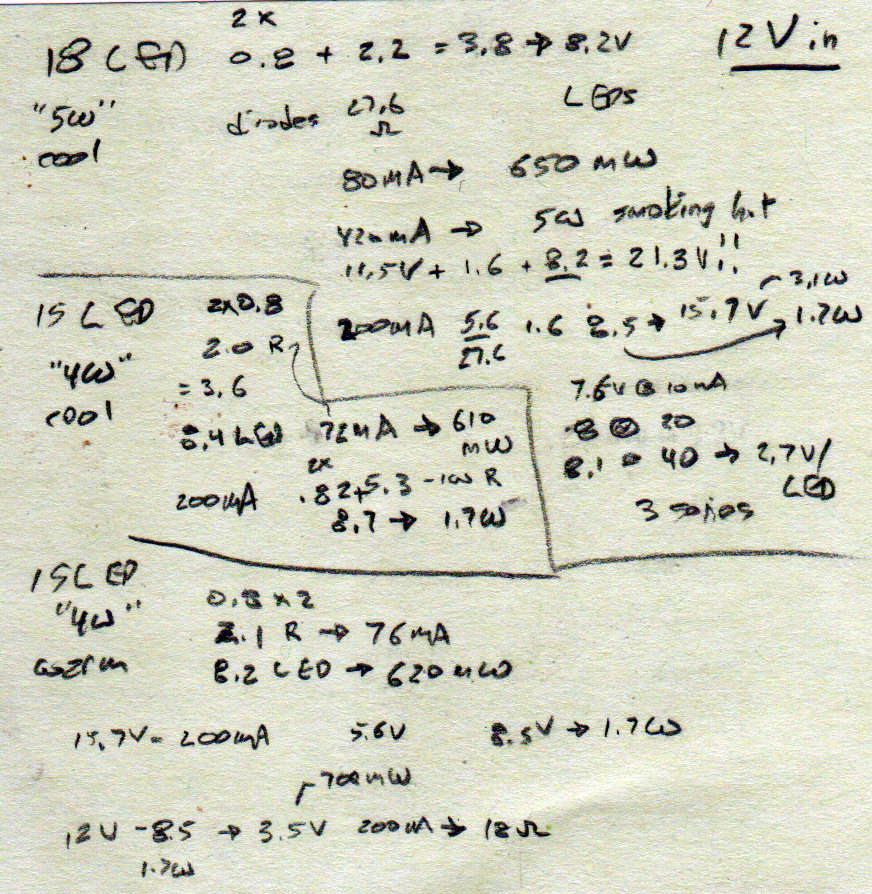
With 12 VDC applied to the pins, the bridge drops 1.6 V, the LEDs 8.2 V, and the resistor 2.2 V, with 80 mA through the whole affair dissipating just under 1 W.
Huh.
Cranking the supply until the current hits 200 mA puts 15.7 V across the pins for a total dissipation of 3.1 W, burning 1.7 W in the LEDs and 1.1 W in the resistor.
Cranking the supply to 21.3 V drives 410 mA, dissipates just under 9 W total, produces a curl of rosin smoke from the PCB, and maybe delaminates the silicone around some of the LEDs.
OK, now I have a crash test dummy.
Given complete control over the application, I’ll strip everything off the PCB and bond it to a heatsink of some sort. With 6 LEDs in parallel, 120 mA (6 × 20 mA) total current might be reasonable and 200 mA (6 × 30 mA) probably won’t kill the things outright. Plus, I have spares.
An external 18 Ω resistor should suffice. Perhaps a pair of 6 Ω SMD resistors on the PCB, with fine-tuning through an external resistor. Call it 250 mW apiece: don’t use little bitty SMD resistors.
A quartet of DOT01 NP-BX1 batteries arrived:

The dotted lines show the results from late 2015 for a pair of then-new Wasabi NP-BX1 batteries, so the DOT-01 batteries look about the same. The F battery barely lasted to the halfway point of our most recent bike ride and the G battery now resides in the blinky-and-glowy pile.
I’d be unsurprised to discover all the myraid “different” NP-BX1 batteries all come from the same factory. Unlike the Wasabi batteries, these lack date codes, which seems like an extra-cost option you don’t get on the low end.
With the intent of being able to find a picture of the battery in our 2015 Subaru Forester when I need it:
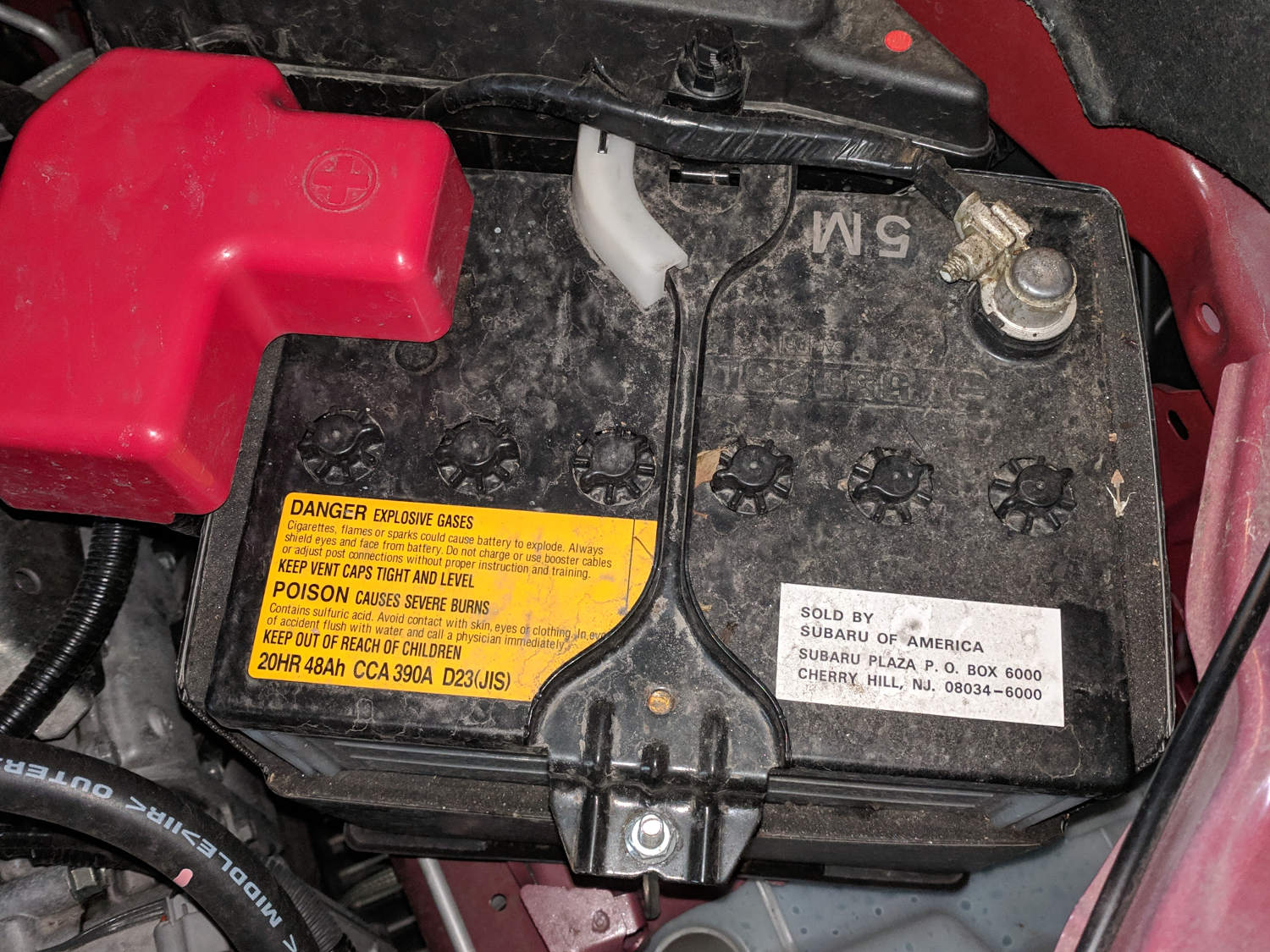
The manual says the “battery type” is 55D23L, with a 48 A·h capacity.
Here in the US, we measure a battery’s physical size with “Group Size” numbers which have no relation with JIS numbers, despite some overlapping or similar numeric values. The money quote:
Definition of Group Size: The Battery Council International (BCI) assigns numbers and letters to common battery types. These numbers and letters are standards for maximum container size, location and type of terminal and special container features.
So, it’s random. Choose a retailer, feed in the automobile year / make / model, and discover I need a Group 35 battery.
The label includes “390 CCA”, which is the Cold Cranking Amps rating:
The rating refers to the number of amps a 12-volt battery can deliver at 0°F for 30 seconds while maintaining a voltage of at least 7.2 volts
So, if you’re building an automotive gadget and expect the battery to deliver something like 12 V, you’re wrong. Bonus protip: look up “load dump” to get an idea of the highest voltage.
The “20 HR 48 Ah” specifies the Reserve Capacity:
Amp Hour or C20 is an indicator of how much energy is stored in a battery. It is the energy a battery can deliver continuously for 20 hours at 80°F without falling below 10.5 volts.
So a constant load of 2.4 A would do the trick, should you leave a few lights on overnight during the summer. In wintertime, you’re on your own.
Because hell hath no fury like that of an unjustified assumption, the terminals are on the top surface toward the rear, with the positive lug on the left when you’re standing at the front bumper. That may be the “L” in “D23L”.
Long ago, I ran afoul of an automotive battery which required knowing the terminal chirality and, of course, I bought the wrong one. Now I have a picture!
 The Smell of Molten Projects in the Morning