The Smell of Molten Projects in the Morning

Ed Nisley's Blog: Shop notes, electronics, firmware, machinery, 3D printing, laser cuttery, and curiosities. Contents: 100% human thinking, 0% AI slop.

Author: Ed

  • ShopVac Repairs

    A stainless steel 10 gallon (*) 5 Peak HP (**) ShopVac followed me home from the side of the road. It seemed to be in easily repairable condition and looks like a definite improvement for my collection.

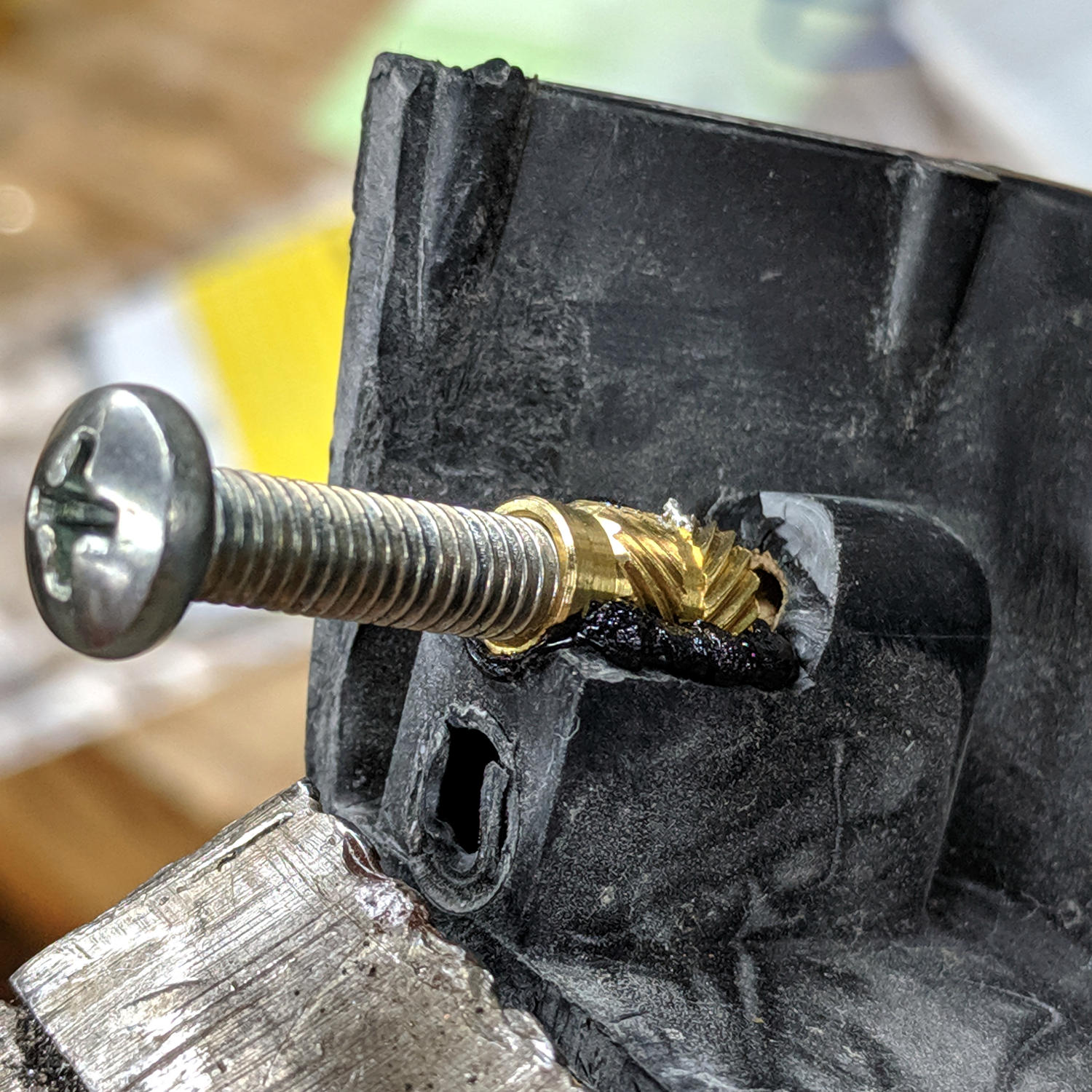
    One handle had a broken screw boss, probably from the same event producing the crack across the top, over on the right:

    ShopVac - broken screw boss
    ShopVac – broken screw boss

    The self-tapping screw (taken from the other end of the handle) looked to be about #10, so I melted a 10-32 brass insert into roughly the right position with a soldering gun:

    ShopVac - brass insert in handle boss
    ShopVac – brass insert in handle boss

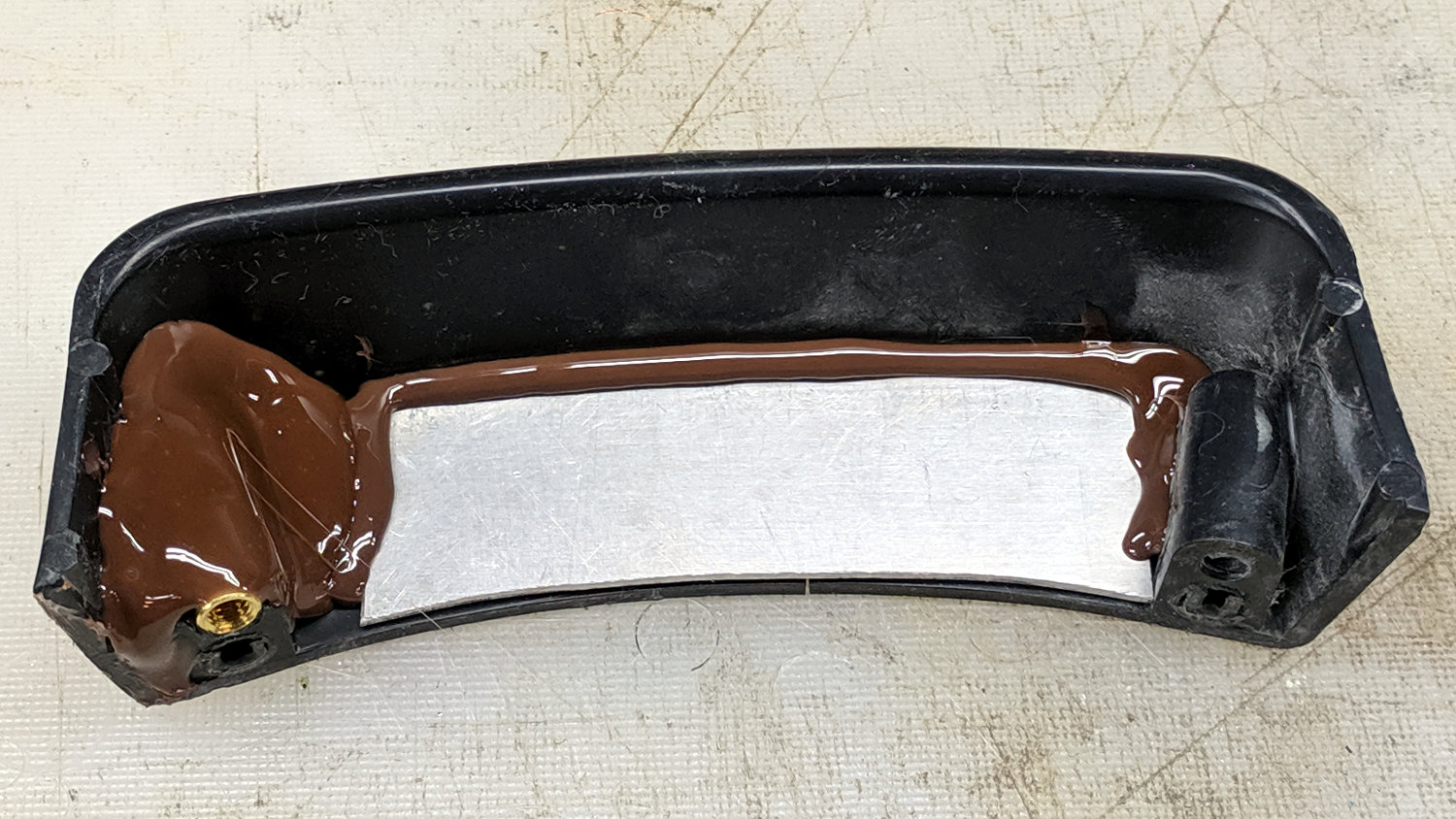
    An aluminum sheet bandsawed into shape will reinforce the crack, with a generous dollop of hot melt glue holding everything in place:

    ShopVac - repaired handle - bottom view
    ShopVac – repaired handle – bottom view

    I don’t plan to carry it around by the handle, so perhaps it’ll outlast your expectations.

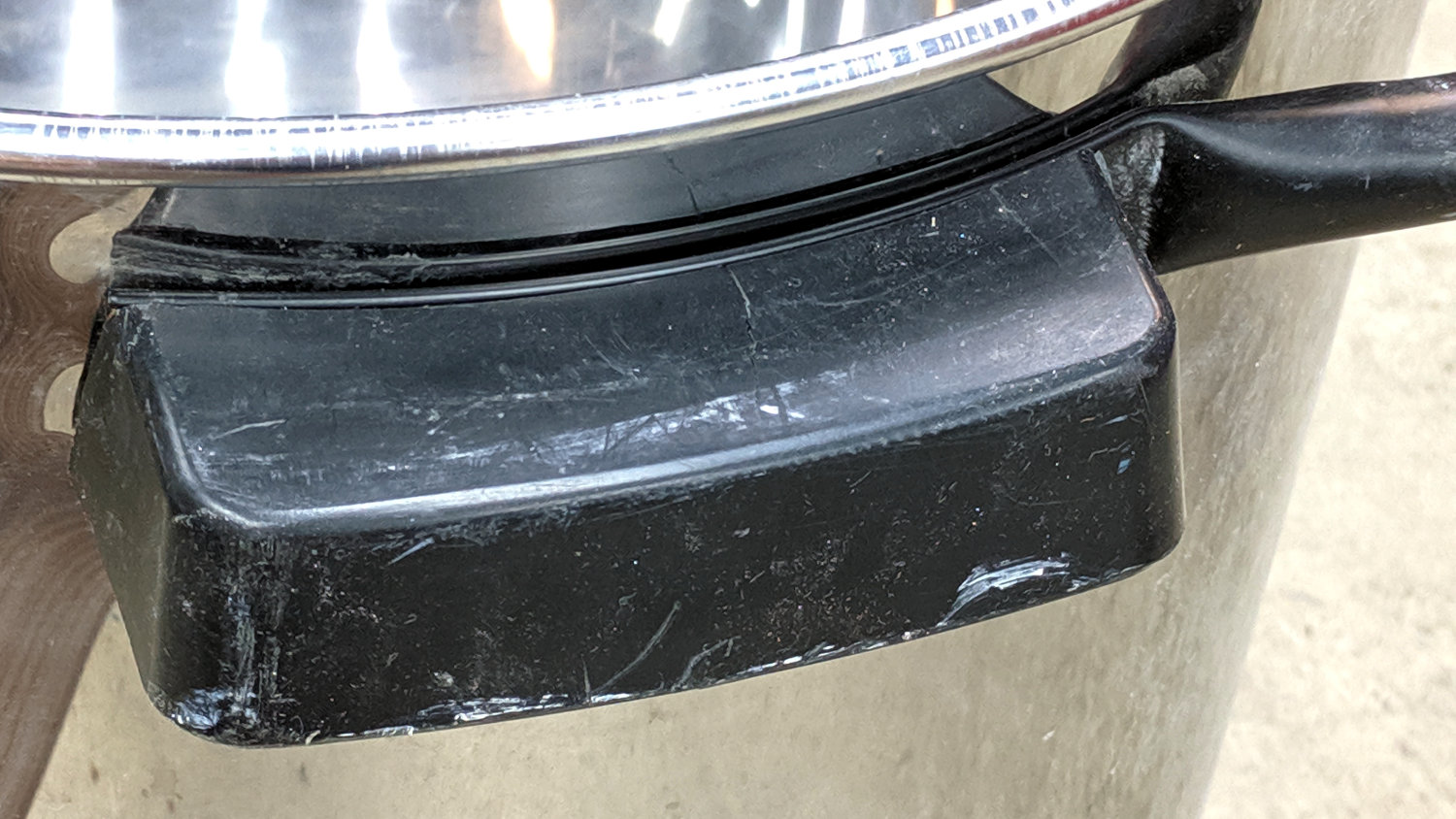
    From the top, it looks pretty much the way it should:

    ShopVac - repaired handle - installed
    ShopVac – repaired handle – installed

    The front caster mount lost both of the 1/4-20 bolts previously holding it to the canister, so I installed a pair of nice stainless steel bolts and nyloc nuts:

    ShopVac - new front foot bolts
    ShopVac – new front foot bolts

    The motor runs fine, a new bag & filter arrived the next day, and it’s all good.

    Disclaimers from ShopVac’s Fine Print section:

    * Tank capacity refers to actual tank volume, and does not reflect capacity available during operation.

    ** “Peak Horsepower” (PHP) is a term used in the wet-dry vacuum industry for consumer comparison purposes. It does not denote the operational horsepower of a wet-dry vacuum but rather the horsepower output of a motor, including the motor’s inertial contribution, achieved in laboratory testing. In actual use, Shop-Vac® motors do not operate at the peak horsepower shown.

    https://www.shopvac.com/

    Translation: they lie.

  • Weatherproof Outlet Cover Re-Chaining

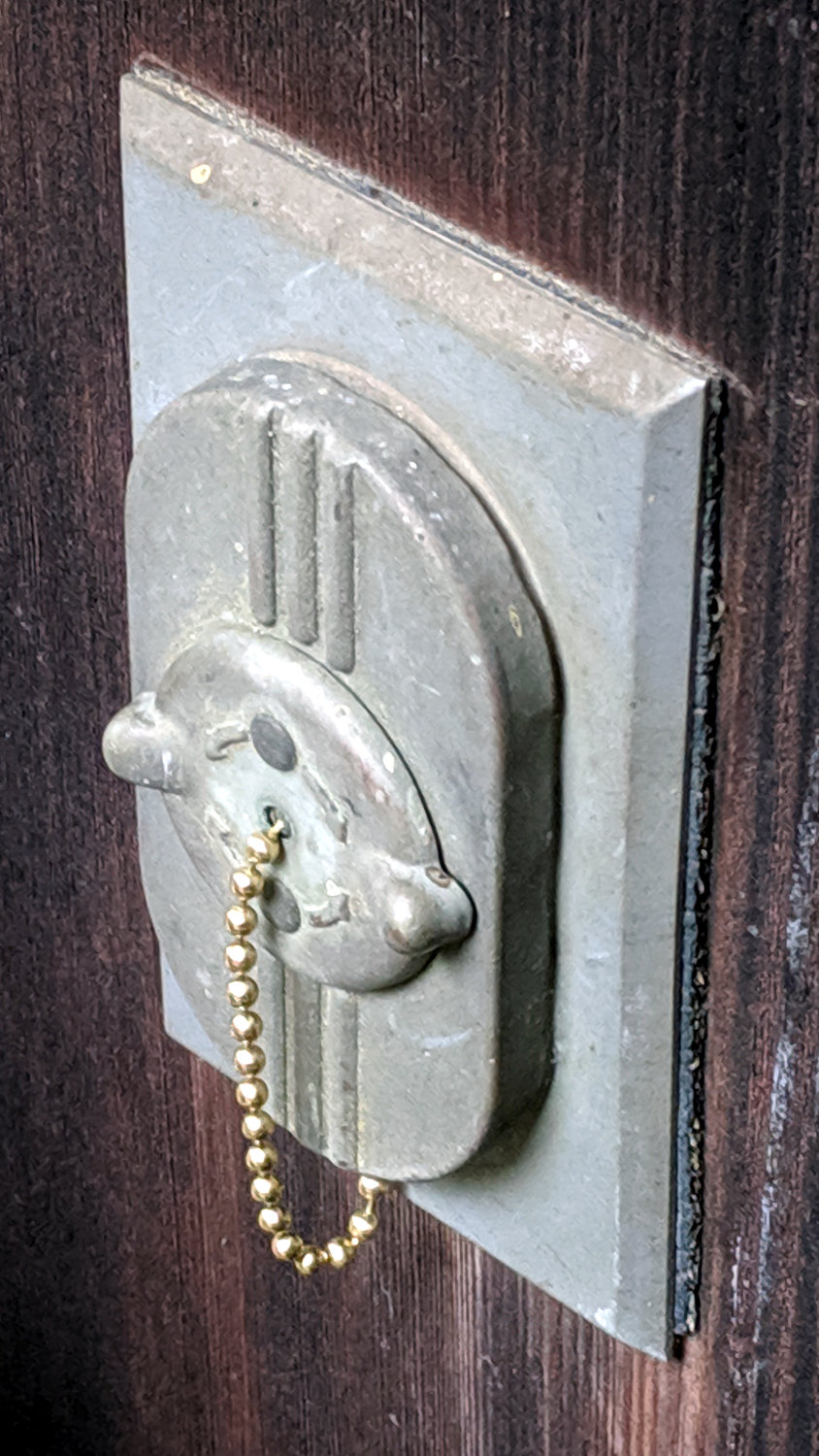
    The yard camera now resides outdoors and plugs into one of three outlets on the patio, all of which have weatherproof covers attached by a bead chain to the trim plate:

    Patio Outlet - new chain installed
    Patio Outlet – new chain installed

    That’s the after-repair condition, as two of the three chains were broken when we bought the house.

    Stipulated: the covers needed scrubbing, but sometimes ya gotta stay focused on the Main Goal.

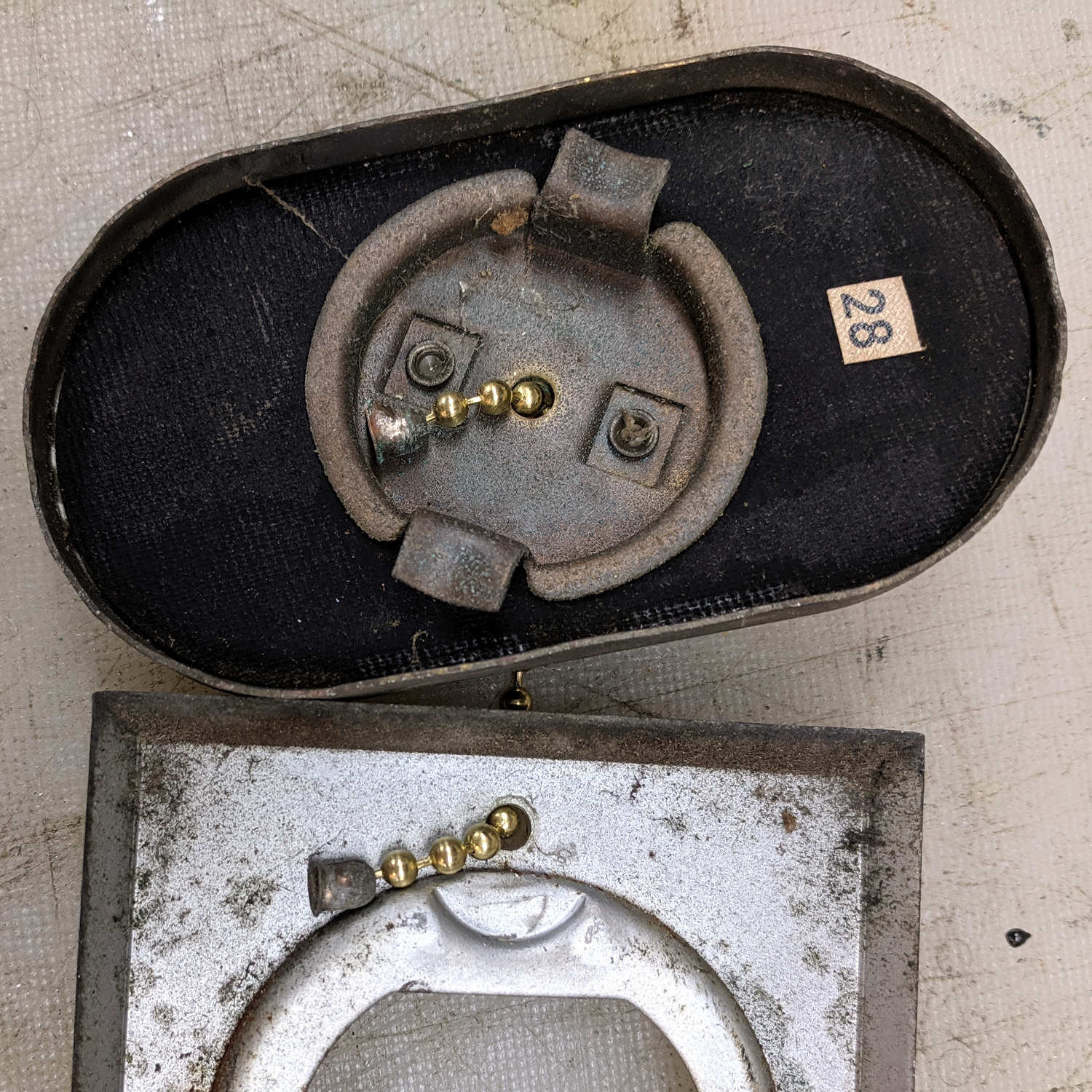
    Two feet of 3.4 mm brass bead chain (because spares: ya gotta have stuff) arrived from eBay, I dismounted all three covers, and discovered the bell-shaped brass caps on the old chains were perfectly serviceable after six decades:

    Patio Outlet - chain retainers
    Patio Outlet – chain retainers

    The outlets are wired to circuit breaker 28, of course.

    Having enough chain to go around, each cover now sports a slightly longer leash than before:

    Patio Outlet - chain assembly
    Patio Outlet – chain assembly

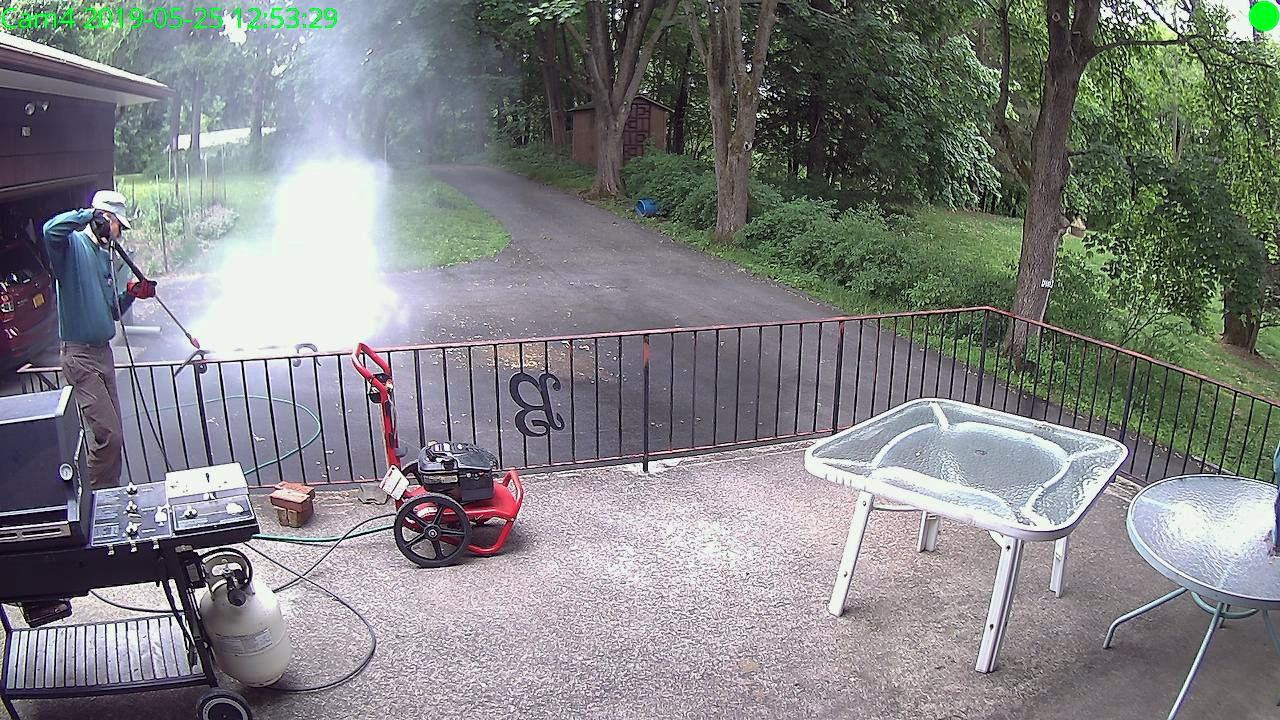
    Reinstall in reverse order, the camera rebooted as it should, and it’s all good out there:

    Pressure-washing Patio Railing
    Pressure-washing Patio Railing

    That was easy …

  • Arlington Fire Department Practice Session

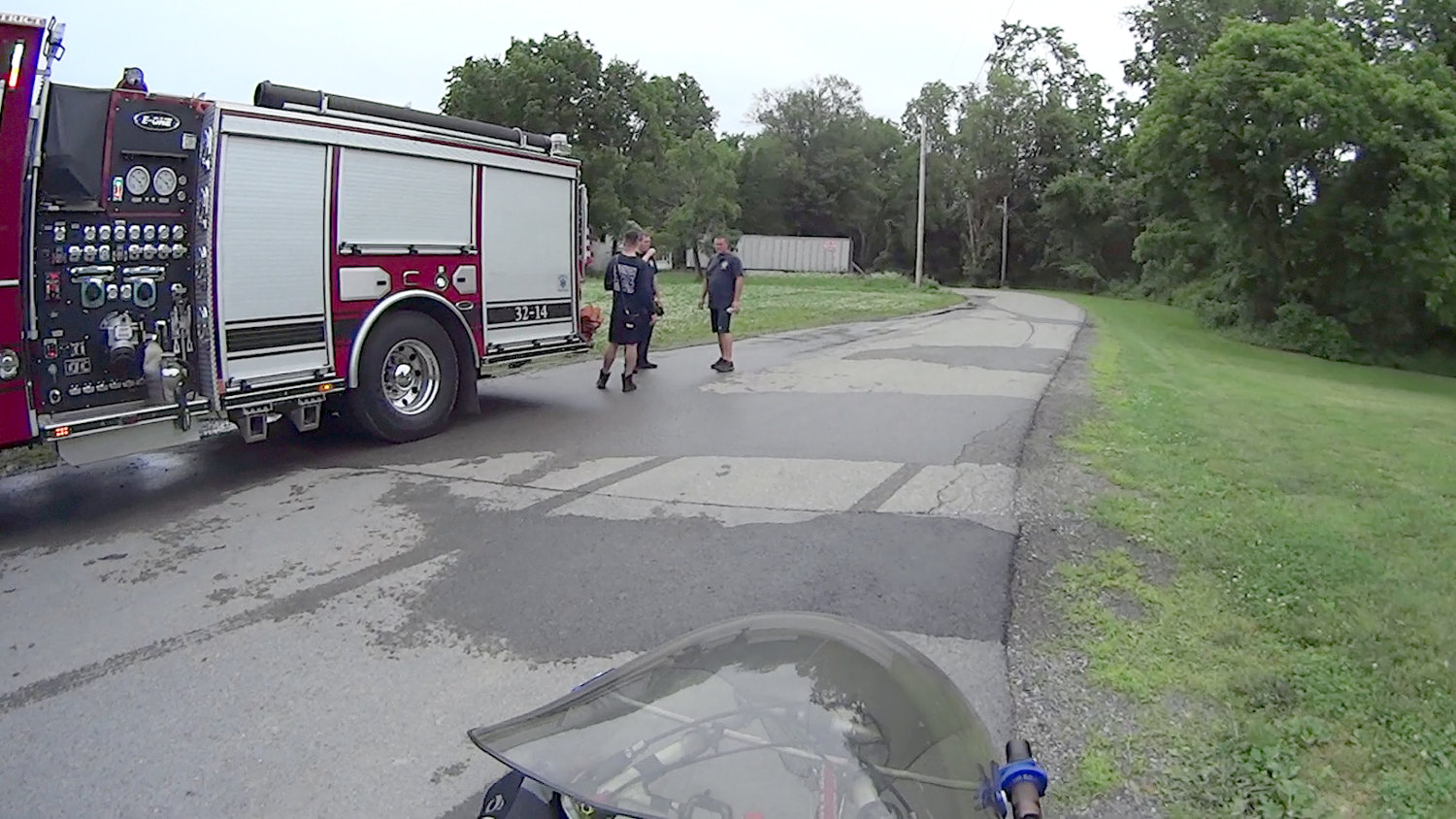
    The normal Vassar Farm exit was blocked by Arlington Fire District equipment, but the scene was calm and nobody objected when I asked to ride through:

    Fire Department Practice - Hose Engine
    Fire Department Practice – Hose Engine

    They were practicing hose deployment and structure entry in a soon-to-be-demolished building:

    Fire Department Practice - Theatrical Smoke
    Fire Department Practice – Theatrical Smoke

    That’s theatrical smoke, not a real fire; the folks off the right of the picture told me it’s impossible to burn down old structures for practice nowadays, what with all the environmental regulations.

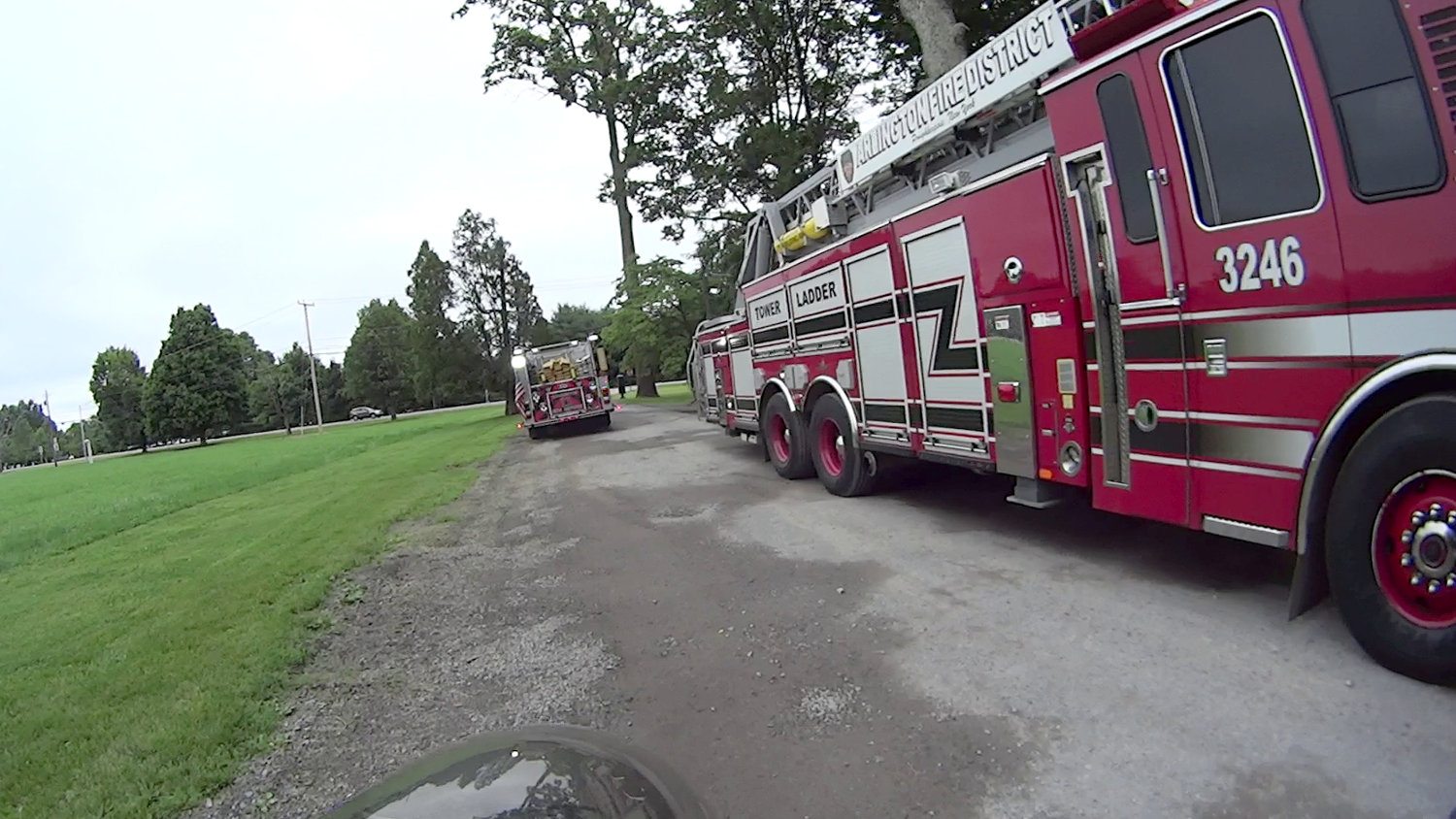
    The Tower Truck obviously has more reach than they’ll need for the second floor:

    Fire Department Practice - Ladder Truck
    Fire Department Practice – Ladder Truck

    A few days later, we spotted Fairview Fire District folks scoping out the house.

    We think this might be Vassar’s way of contributing back to the various emergency departments, as the College is mostly tax-exempt.

  • Runtime Error!

    Spotted high on the wall of the local USPS office:

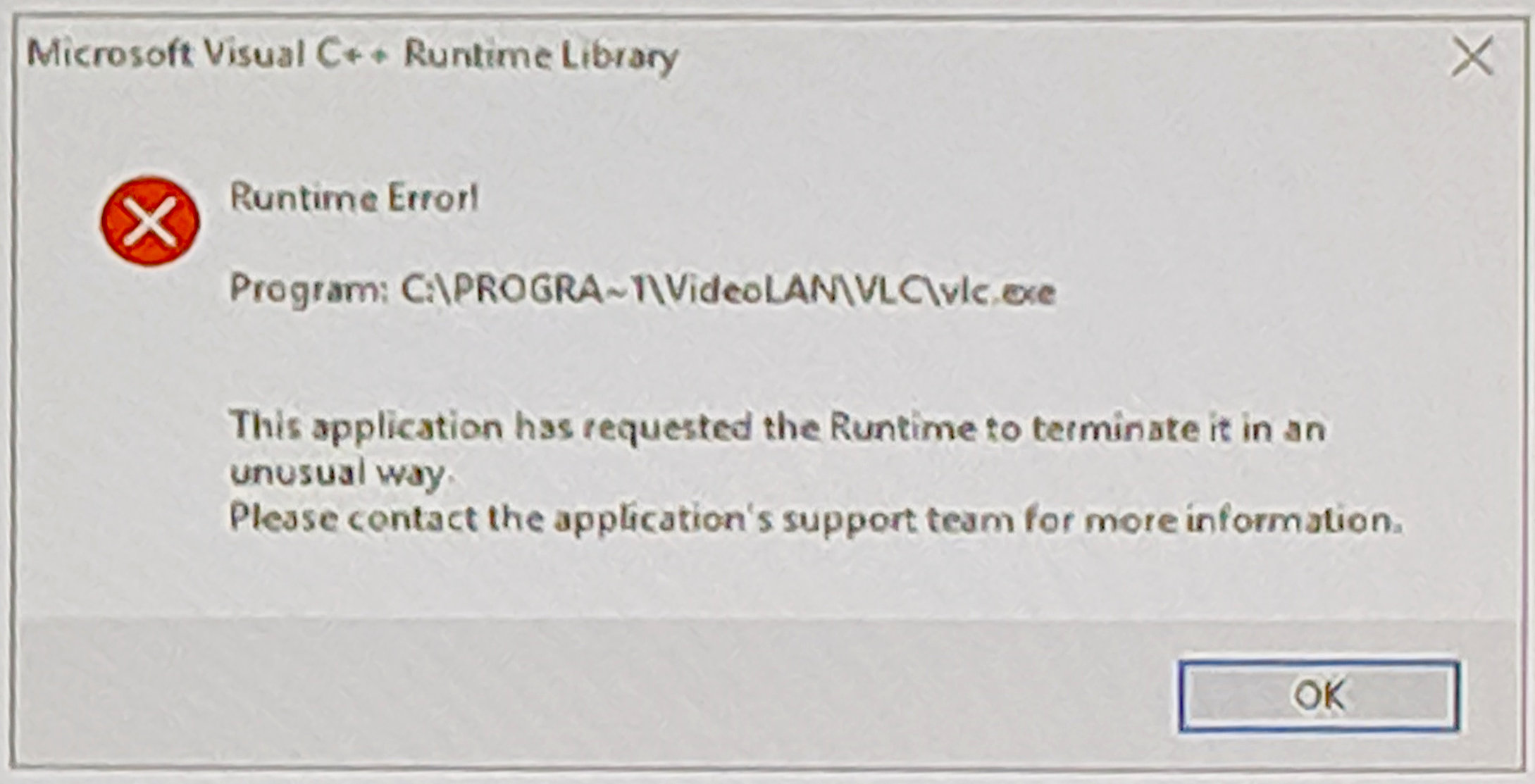
    Windows Runtime Error - VLC - monitor
    Windows Runtime Error – VLC – monitor

    A closer look:

    Windows Runtime Error - VLC
    Windows Runtime Error – VLC

    Huh.

    The USPS uses VLC. Who knew?

    I darken their doorway so infrequently I have no idea what’s normally displayed up there. Surely it shows advertisements for USPS products, which begs the question: why VLC?

  • Wrapping GCMC Text Around Arcs

    GCMC includes a typeset function converting a more-or-less ASCII string into the coordinate points (a “vectorlist” containing a “path”) defining its character strokes and pen motions. The coordinates are relative to an origin at the lower-left corner of the line, with the font’s capital-X height set to 1.0, so you apply a scale function to make them whatever size you want and hand them to the engrave library routine, which squirts the corresponding G-Code into the output file.

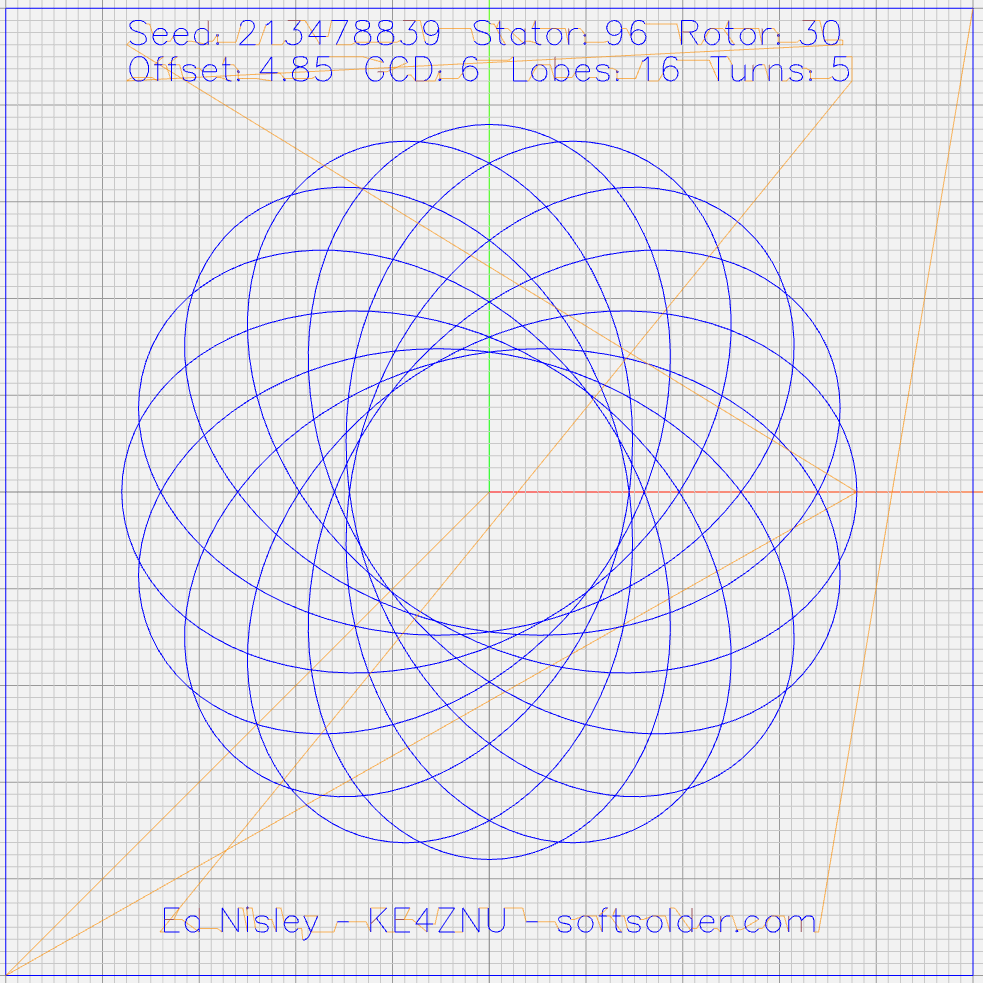
    Such G-Code can annotate plots:

    Guilloche 213478839
    Guilloche 213478839

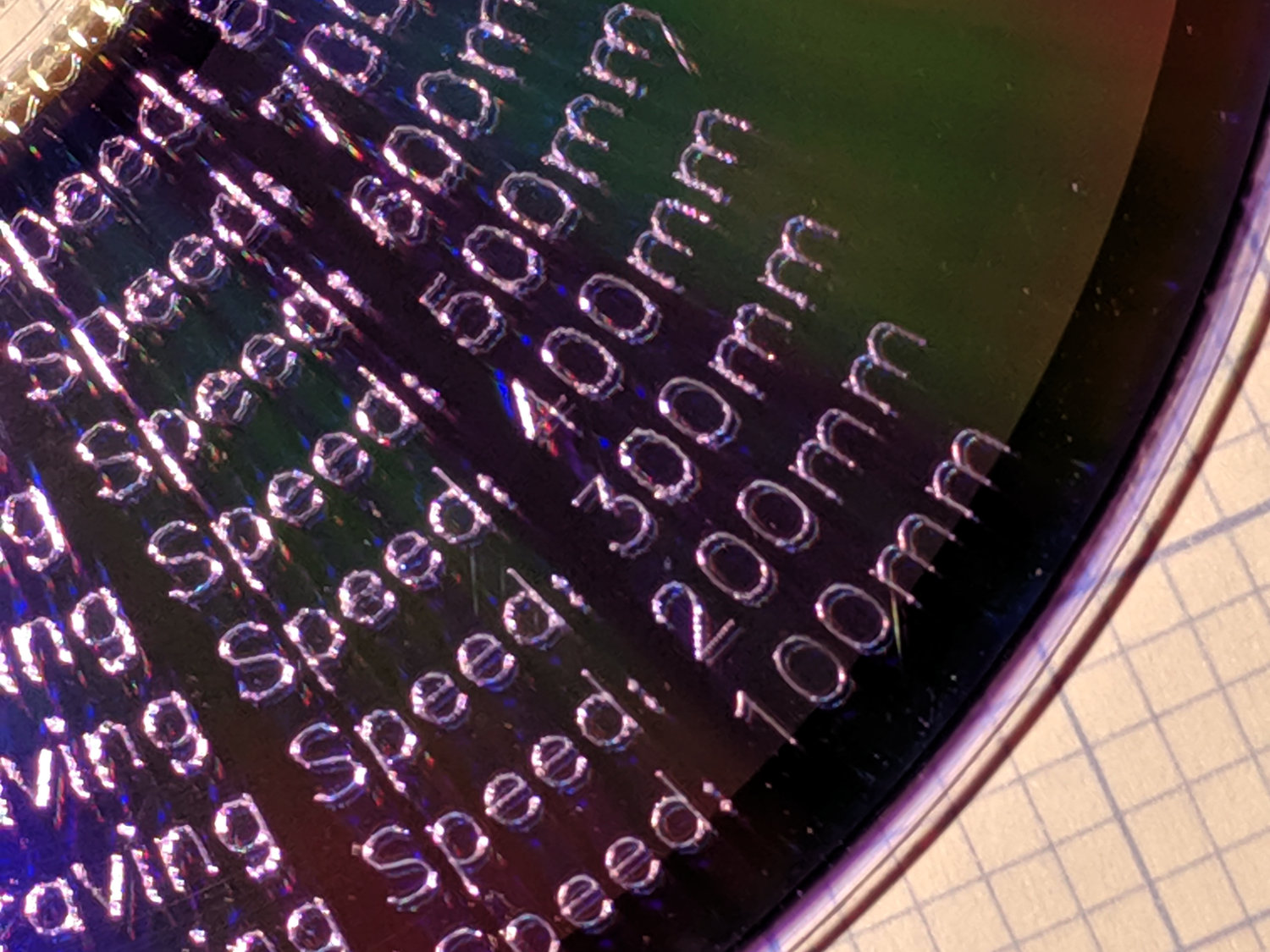
    Given that the plots appear on relentlessly circular CDs and hard drive platters, It Would Be Nice to wrap text around a circular arc, thusly:

    Diamond Scribe - LM3UU - arc text - first light
    Diamond Scribe – LM3UU – arc text – first light

    The scaled coordinates cover a distance L along a straight line, so putting them on an arc will cover the same distance. The arc is part of a circle with radius R and a circumference 2πR, so … polar coordinates to the rescue!

    The total text length L corresponds to the total angle A along the arc:

    A = 360° L / 2πR

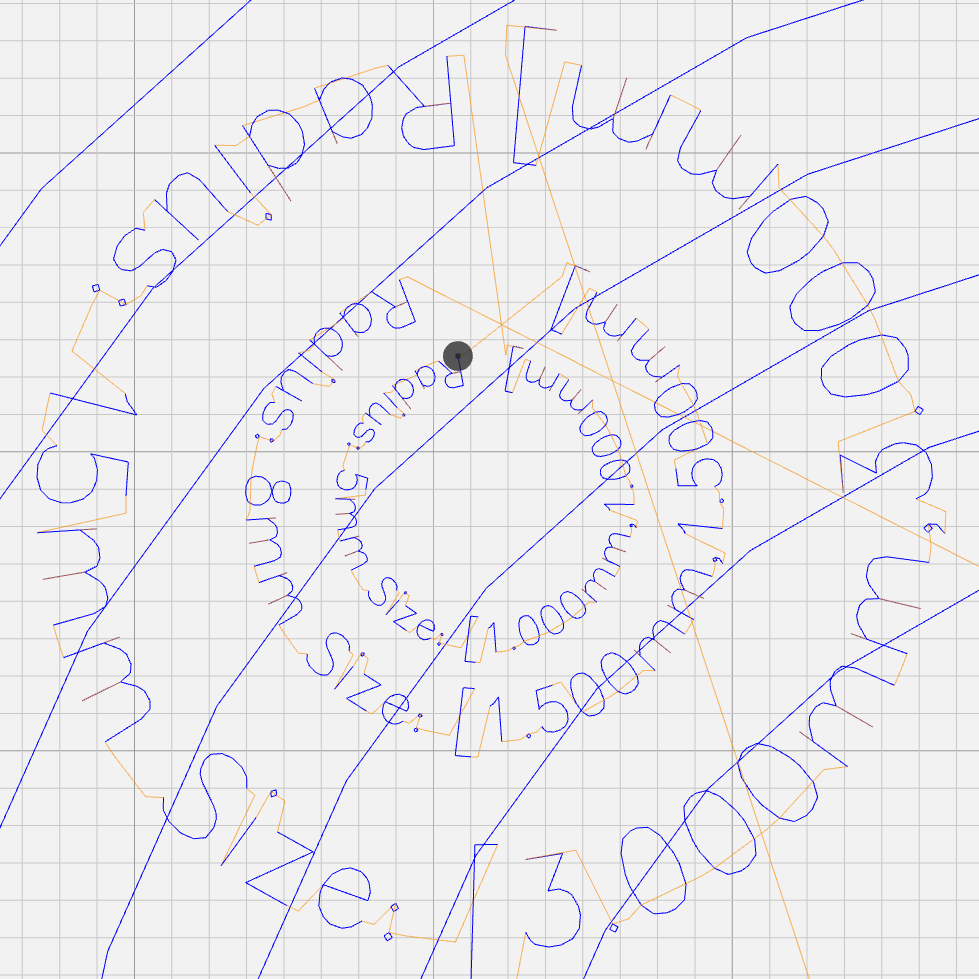
    It’s entirely possible to have a text line longer than the entire circumference of the circle, whereupon the right end overlaps the left. Smaller characters fit better on smaller circles:

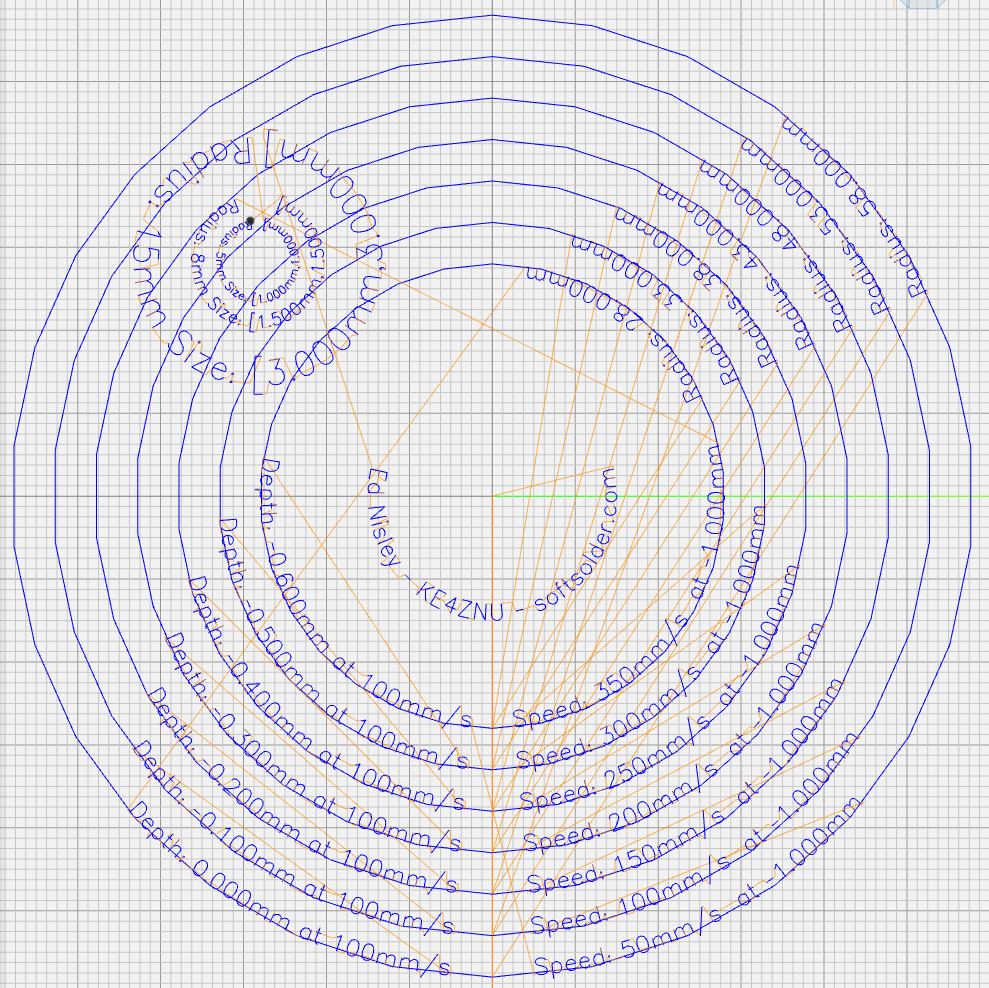
    Arc Lettering - Small radius test - NCViewer
    Arc Lettering – Small radius test – NCViewer

    The X coordinate of each point in the path (always positive from the X origin) in the path gives its angle (positive counterclockwise) from 0°:

    a = 360° x / 2πR (say "eks")

    You can add a constant angle of either sign to slew the whole text arc around the center point.

    The letter baseline Y=0 sits at radius R, so the Y coordinate of each point (positive above and negative below the Y=0 baseline) gives its radius r:

    r = R - y

    That puts the bottom of the text outward, so it reads properly when you’re facing the center point.

    Homework: Tweak the signs so it reads properly when you’re standing inside the circle reading outward.

    Converting from polar back to XY:

    x = r × cos(a) (say "times")
    y = r × sin(a)

    You can add an XY offset to the result, thereby plunking the point wherever you want.

    This obviously works best for small characters relative to the arc radius, as the lines connecting the points remain resolutely straight. That’s probably what you wanted anyway, but letters like, say, “m” definitely manspread.

    Overall, it looks pretty good:

    Arc Lettering - test plot overview - NCViewer
    Arc Lettering – test plot overview – NCViewer

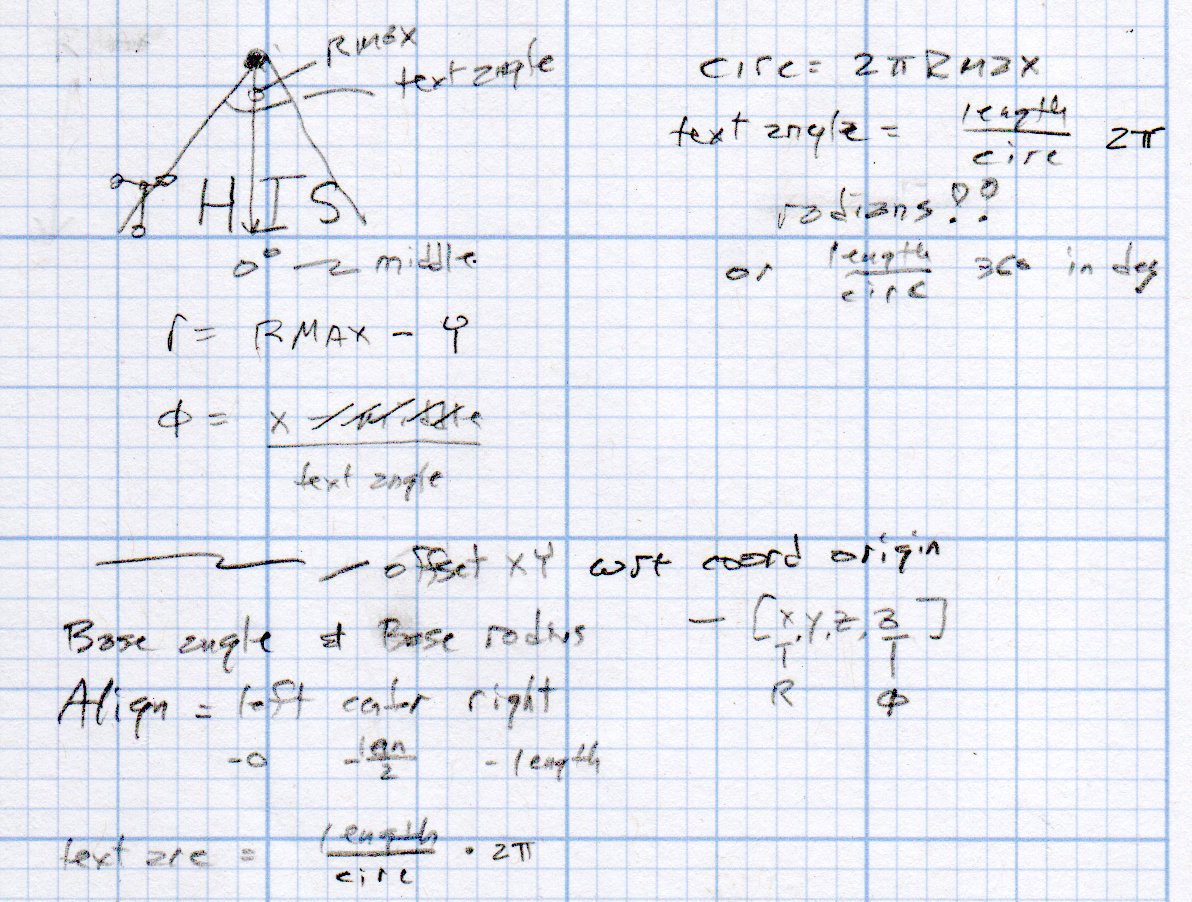
    A doodle helped lay out the geometry:

    Arc Lettering - geometry doodles
    Arc Lettering – geometry doodles

    The GCMC source code as a GitHub Gist:

    // Map text to circular arcs
    // Ed Nisley KE4ZNU – 2019-06
    //—–
    // Command line parameters
    // -D OuterDia=number
    if (!isdefined("OuterDia")) {
    OuterDia = 120mm – 2mm; // CD = 120, 3.5 inch drive = 95
    }
    OuterRad = OuterDia / 2.0;
    comment("Outer Diameter: ",OuterDia);
    comment(" Radius: ",OuterRad);
    //—–
    // Library routines
    include("tracepath.inc.gcmc");
    include("engrave.inc.gcmc");
    //—–
    // Bend text around an arc
    function ArcText(TextPath,Center,Radius,BaseAngle,Align) {
    PathLength = TextPath[-1].x – TextPath[1].x;
    Circumf = 2*pi()*Radius;
    TextAngle = to_deg(360 * PathLength / Circumf);
    AlignAngle = BaseAngle + (Align == "Left" ? 0 :
    Align == "Center" ? -TextAngle / 2 :
    Align == "Right" ? -TextAngle :
    0);
    ArcPath = {};
    foreach(TextPath; pt) {
    if (!isundef(pt.x) && !isundef(pt.y) && isundef(pt.z)) { // XY motion, no Z
    r = Radius – pt.y;
    a = 360deg * (pt.x / Circumf) + AlignAngle;
    ArcPath += {[r*cos(a) + Center.x, r*sin(a) + Center.y,-]};
    }
    elif (isundef(pt.x) && isundef(pt.y) && !isundef(pt.z)) { // no XY, Z up/down
    ArcPath += {pt};
    }
    else {
    error("Point is not pure XY or pure Z: " + to_string(pt));
    }
    }
    return ArcPath;
    }
    //—–
    // Set up for drawing
    TravelZ = 1.0mm; // no clamps above workpiece!
    PlotZ = -1.0mm; // tune for best results
    TextSpeed = 100mm; // minimal shaking
    DrawSpeed = 500mm; // smooth curve drawing
    TextFont = FONT_HSANS_1_RS;
    TextSize = [2.0mm,2.0mm];
    TextLeading = 5.0mm; // line spacing
    DiskCenter = [0mm,0mm]; // middle of the platter
    if (1) {
    comment("Circles begin");
    TextRadius = OuterRad;
    for (r = OuterRad; r >= 25mm; r -= TextLeading) {
    feedrate(DrawSpeed);
    goto([-,-,TravelZ]);
    goto([r,0,-]);
    move([-,-,PlotZ]);
    circle_cw([0,0]);
    goto([-,-,TravelZ]);
    tp = scale(typeset("Radius: " + to_string(r),TextFont),TextSize);
    tpa = ArcText(tp,DiskCenter,r,115deg,"Left");
    feedrate(TextSpeed);
    engrave(tpa,TravelZ,PlotZ);
    }
    }
    if (1) {
    comment("Depth variations begin");
    TextRadius = OuterRad;
    feedrate(TextSpeed);
    for (pz = 0.0mm; pz >= -0.6mm; pz -= 0.10mm) {
    comment(" depth: " + to_string(pz));
    ts = "Depth: " + to_string(pz) + " at " + to_string(TextSpeed) + "/s";
    tp = scale(typeset(ts,TextFont),TextSize);
    tpa = ArcText(tp,DiskCenter,TextRadius,-5deg,"Right");
    engrave(tpa,TravelZ,pz);
    TextRadius -= TextLeading;
    }
    }
    if (1) {
    comment("Feedrate variations begin");
    TextRadius = OuterRad;
    for (ps = 50mm; ps <= 350mm; ps += 50mm) {
    feedrate(ps);
    comment(" speed: " + to_string(ps) + "/s");
    ts = "Speed: " + to_string(ps) + "/s at " + to_string(PlotZ);
    tp = scale(typeset(ts,TextFont),TextSize);
    tpa = ArcText(tp,DiskCenter,TextRadius,5deg,"Left");
    engrave(tpa,TravelZ,PlotZ);
    TextRadius -= TextLeading;
    }
    }
    if (1) {
    comment("Off-center text arcs begin");
    feedrate(TextSpeed);
    tc = [-40mm/sqrt(2),-40mm/sqrt(2)]; // center point
    r = 8mm;
    s = [1.5mm,1.5mm];
    ts = "Radius: " + to_string(r) + " Size: " + to_string(s);
    tp = scale(typeset(ts,TextFont),s);
    tpa = ArcText(tp,tc,r,0deg,"Center");
    engrave(tpa,TravelZ,PlotZ);
    r = 5mm;
    s = [1.0mm,1.0mm];
    ts = "Radius: " + to_string(r) + " Size: " + to_string(s);
    tp = scale(typeset(ts,TextFont),s);
    tpa = ArcText(tp,tc,r,0deg,"Center");
    engrave(tpa,TravelZ,PlotZ);
    r = 15mm;
    s = [3.0mm,3.0mm];
    ts = "Radius: " + to_string(r) + " Size: " + to_string(s);
    tp = scale(typeset(ts,TextFont),s);
    tpa = ArcText(tp,tc,r,0deg,"Center");
    engrave(tpa,TravelZ,PlotZ);
    }
    if (1) {
    comment("Attribution begins");
    tp = scale(typeset("Ed Nisley – KE4ZNU – softsolder.com",TextFont),TextSize);
    tpa = ArcText(tp,DiskCenter,15mm,0deg,"Center");
    feedrate(TextSpeed);
    engrave(tpa,TravelZ,PlotZ);
    }
    goto([-,-,10mm]);
    goto([0mm,0mm,-]);
    comment("Done!");
    view raw ArcLetter.gcmc hosted with ❤ by GitHub
    #!/bin/bash
    # Arc Lettering Generator
    # Ed Nisley KE4ZNU – 2019-06
    Diameter='OuterDia=116mm'
    Flags='-P 3 –pedantic'
    # Set these to match your file layout
    LibPath='/opt/gcmc/library'
    Prolog='/mnt/bulkdata/Project Files/Mostly Printed CNC/Firmware/gcmc/prolog.gcmc'
    Epilog='/mnt/bulkdata/Project Files/Mostly Printed CNC/Firmware/gcmc/epilog.gcmc'
    Script='/mnt/bulkdata/Project Files/Mostly Printed CNC/Patterns/Arc Lettering/ArcLetter.gcmc'
    ts=$(date +%Y%m%d-%H%M%S)
    fn='ArcLetter_'${ts}'.ngc'
    echo Output: $fn
    rm -f $fn
    echo "(File: "$fn")" > $fn
    gcmc -D $Diameter $Flags \
    –include "$LibPath" –prologue "$Prolog" –epilogue "$Epilog" \
    "$Script" >> $fn
    view raw ArcLetter.sh hosted with ❤ by GitHub

  • Security Theater: Combination Lock Division

    When dialing the proper combination becomes too troublesome:

    Security Theater - Combination Snap Hook
    Security Theater – Combination Snap Hook

    At a quick glance, though, it looks secure!

    Security theater isn’t harmless, not that we have any say in the matter.

  • Whirlpool Refrigerator Drawer Support Re-Re-Re-Gluing

    Spring cleaning provided the opportunity for Yet Another Episode in my long-standing battle with the Whirlpool refrigerator entropy generator:

    Whirlpool Refrigerator - drawer support gluing
    Whirlpool Refrigerator – drawer support gluing

    That little thing supports half the weight of the two drawers across the bottom of the refrigerator; how such a thin plastic member was supposed to be adequate to the task continues to escape me.

    If we had to pay real money for all the repairs I’ve made to that piece of crap, we’d have replaced it long ago. The only thing that hasn’t failed so far is the compressor, so driving it until it drops continues to make sense; replacing a working anything seems like a bad idea.