The Smell of Molten Projects in the Morning

Ed Nisley's Blog: Shop notes, electronics, firmware, machinery, 3D printing, laser cuttery, and curiosities. Contents: 100% human thinking, 0% AI slop.

Month: September 2017

  • American Standard Kitchen Faucet: Cleaning and O-Rings

    The O-rings on the spout of our American Standard kitchen faucet wore out again; having described that repair many times, there’s no need to say much more about it. I didn’t want to get into this repair while thinking about the hot limit problem, but I did check to make sure the box under the sink had some O-ring replacement kits.

    A bench vise with soft jaws holds the spout while you remove the escutcheon ring retainer:

    Kitchen faucet spout - in vise
    Kitchen faucet spout – in vise

    Basically, just tap around the ring with a long drift punch and it’ll eventually fall out onto the reasonably clean rag below it.

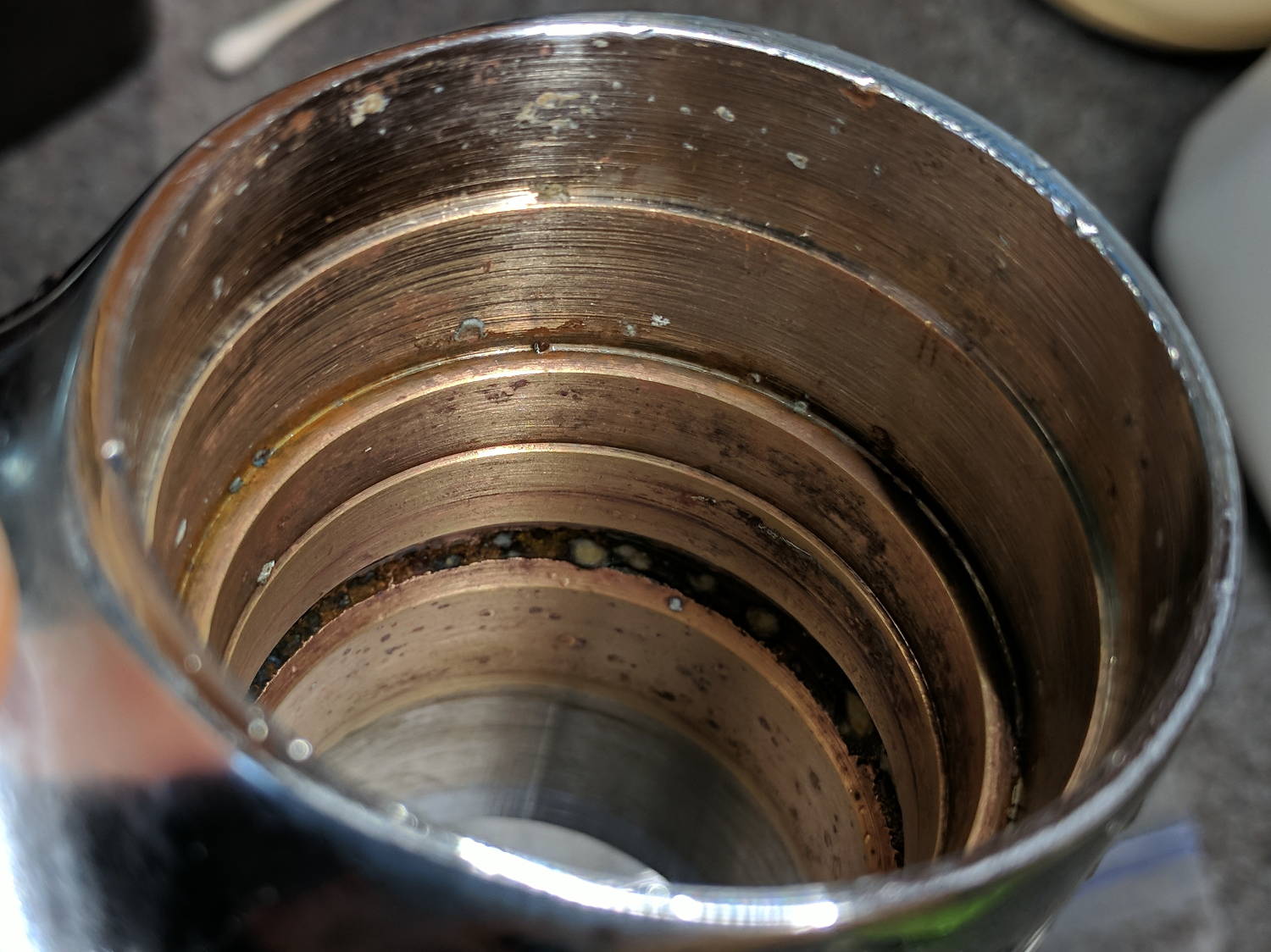
    The interior of the spout before cleaning shows why you should never look into your plumbing:

    Kitchen faucet spout interior - before
    Kitchen faucet spout interior – before

    After a few hours in a white vinegar bath and a few minutes of scrubbing with a ScotchBrite pad:
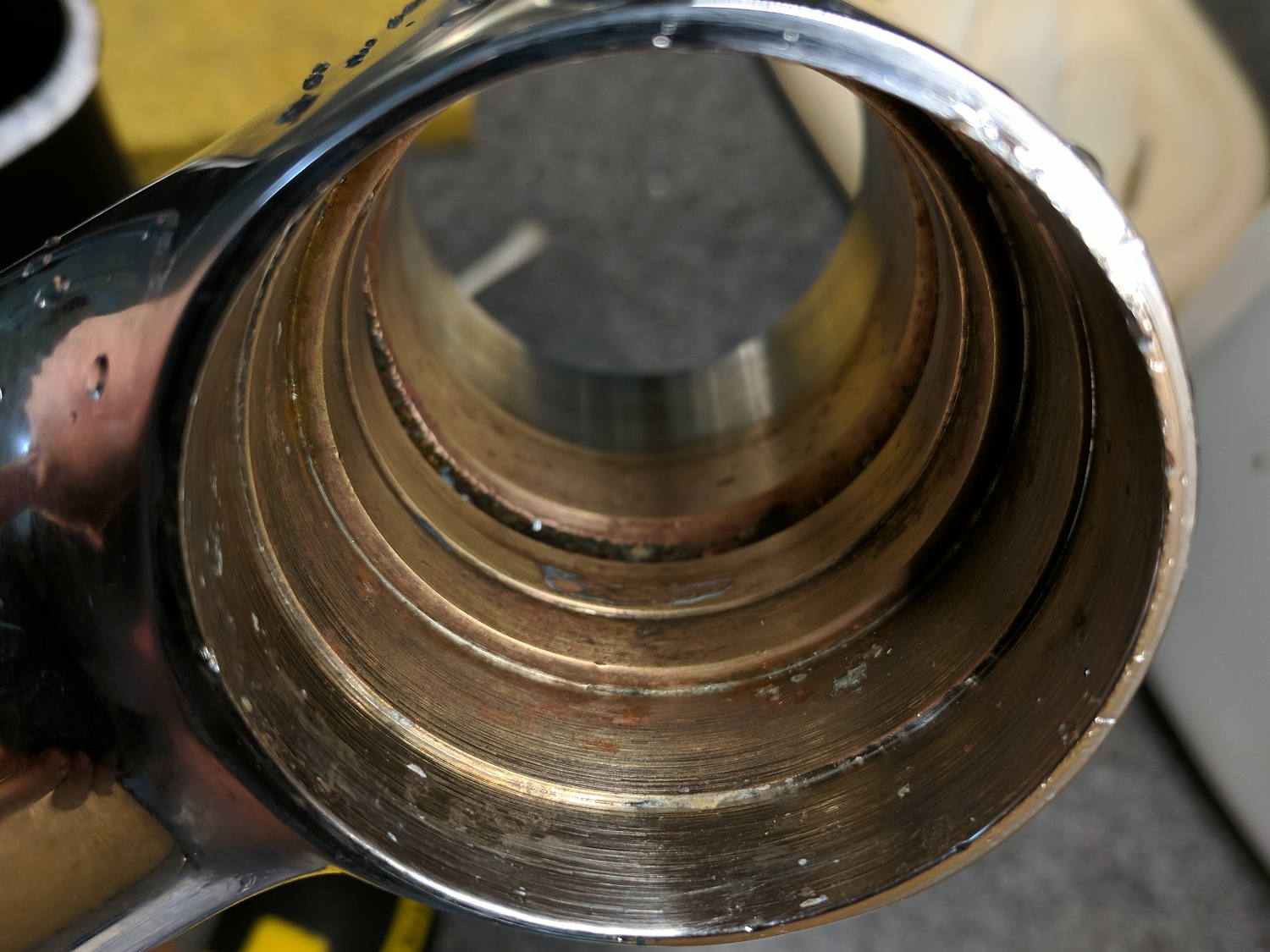
    Kitchen faucet spout interior - after - 1
    Kitchen faucet spout interior – after – 1

    Another view:

    Kitchen faucet spout interior - after - 2
    Kitchen faucet spout interior – after – 2

    Obviously, you could do better, but it’s hard to get excited about the last few nodules. For whatever it’s worth, the nodules grow despite our water softener; I have no clue what’s going on in there.

    A few wipes of silicone grease, reassemble in reverse order, apply a firm shove, and it’s leakless again. For a while, anyhow.
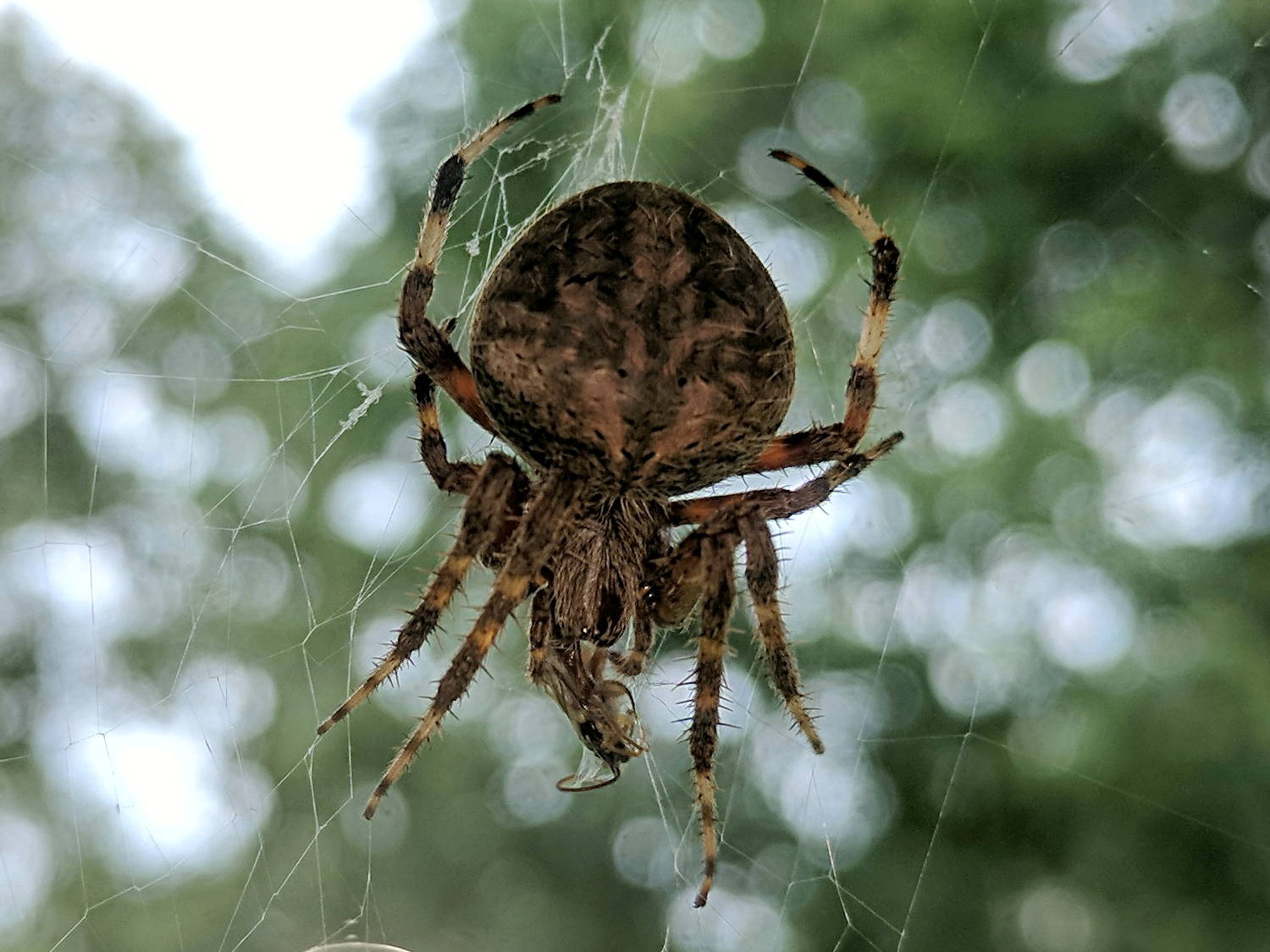
  • Monthly Image: Orb-Weaving Spider

    Once again, the season of orb-weaving spiders has arrived, with this one building her web across a living room window:

    Orb Weaving Spider - with insect
    Orb Weaving Spider – with insect

    I set the Sony HDR-AS30V atop a tripod, told it to take photos at 5 second intervals, then stitched the images into a Youtube video. It won’t go viral, but watching the spider construct her web over the course of two hours was fascinating.

    She finishes the spiral at about 1 m video = 1.25 h real time, settles down for what might be a nap (it’s hard to tell with spiders), and has an insect join her for supper at 1:28, half an hour later. Spiders go from “inert” to “death incoming” almost instantly, even in real time running.

    Another orb weaver set up shop in the adjacent window, but moved out the next day. Perhaps there’s a minimum spacing requirement?

    Two more orb weavers guard windows in the kitchen and laundry room. We sometimes leave the lights on for them.

    YouTube has other web-building videos with far more detail, of course.

    The magic incantation to create the video from a directory of images in the form DSC01234.JPG:

    sn=1 ; for f in *JPG ; do printf -v dn 'dsc%04d.jpg' "$(( sn++ ))" ; mv $f $dn ; done
    ffmpeg -r 15 -i /mnt/video/2017-09-03/100MSDCF/dsc%04d.jpg -q 1 Orb-Weaving-2017-09-03.mp4
    
  • LF Crystal Tester: 60 kHz Resonator Frequency Distribution

    Histogramming all 50-ish resonator frequencies shows reasonably good distributions:

    Notably, there’s no obvious suckout in the middle, as with those eBay Hall-effect sensors.

    60 kHz Resonant Frequencies - CX 24 pF - histogram
    60 kHz Resonant Frequencies – CX 24 pF – histogram

    I don’t know what to make of the difference between the parallel series-capacitor and basic serial resonant frequencies for each tuning fork:

    60 kHz Resonant Frequencies - CX 24 pF - delta histogram
    60 kHz Resonant Frequencies – CX 24 pF – delta histogram

    Perhaps each resonator’s frequency depends on its (laser-trimmed) tine mass and follows a more-or-less normal distribution, but the parallel-serial difference series capacitor changes the frequency based on (well-controlled) etched dimensions producing quantized results from three different masks / wafers / lots, with the motional inductance and capacitance incompletely modeling the physics?

    For reference, the resonators look like this:

    Quartz resonator - detail
    Quartz resonator – detail

    Producing the histograms uses the LibreOffice frequency() array function, which requires remembering to whack Ctrl-Shift Enter to activate the function’s array-ness.

    [Update: Faceplant about “parallel” resonance, which is actually the shifted resonant peak due to the 24 pF series cap. Apparently I typo-ed the second histogram subheading and ran with the error; the figures are now correct.]

  • LF Crystal Tester: Grounded CX Case

    The usual model for a quartz resonator apportions half the measured both-leads-to-case capacitance to each lead:

    AT26 crystal capacitance fixture - Cpar detail
    AT26 crystal capacitance fixture – Cpar detail

    These AT26 / TF26 cases run around 0.6 pF, so each parasitic capacitor is 300 fF:

    60 kHz Quartz Resonator - model
    60 kHz Quartz Resonator – model

    For ordinary quartz crystals, you solder the case to the ground plane to get rid of the sneak path around the central capacitor (normally C0, but labeling it properly in LTSpice just isn’t happening), but those little aluminum cans aren’t solderable. One could blob some Wire Glue over them, but …

    So I just wrapped a wire around the case and soldered it to a convenient ground point under the board:

    LF Crystal Tester - grounded TF26 case
    LF Crystal Tester – grounded TF26 case

    Aaaand ran the obvious measurements:

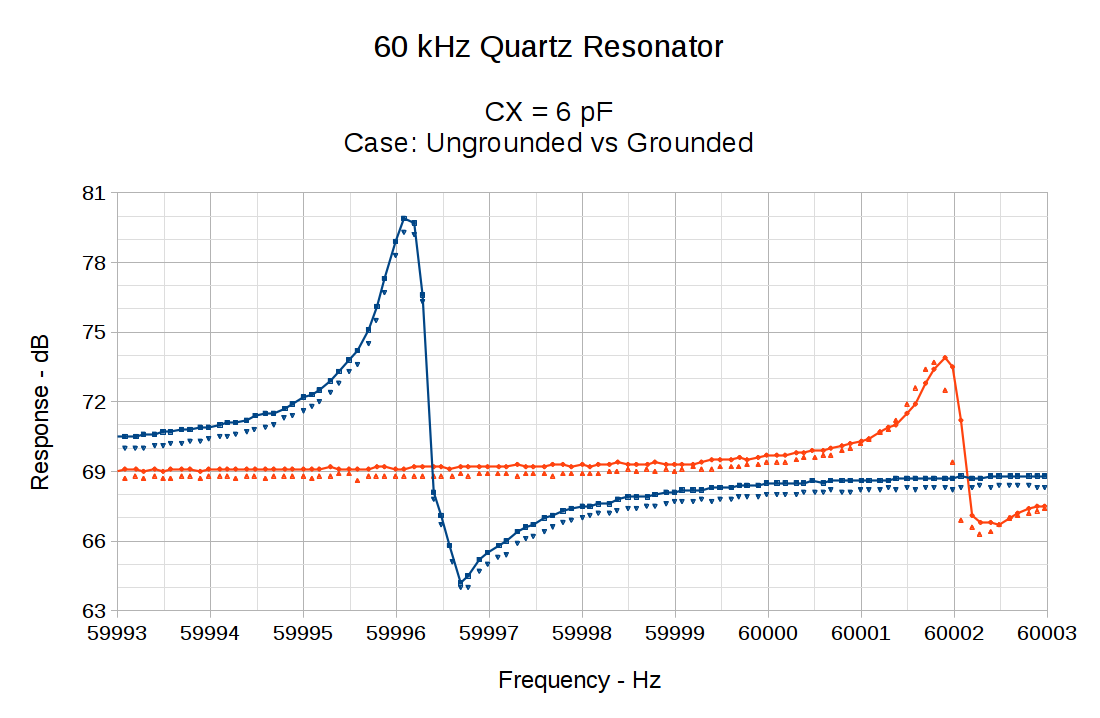
    60 kHz Quartz Resonator 0 - CX 6 pF - grounded vs float
    60 kHz Quartz Resonator 0 – CX 6 pF – grounded vs float

    Solid lines = case ungrounded. Dotties = case grounded.

    Grounding the case knocks the off-peak response down by less than 1 dB. The on-peak response remains about the same, so eliminating the series capacitance does reduce the blowthrough.

    With the case grounded and CX = 6 pF in the circuit, the peaks over on the right seem ever so slightly lower in frequency, which suggests a slightly higher motional capacitance. There’s not much to write home about, though, so I’d say there’s very little effect, even on this scale.


  • LF Crystal Tester: Resonance Frequencies vs CX

    Adjusting the series capacitor produces pretty much the expected results, with the parallel resonance still tracking the series peak.

    CX = 19.3 pF
    Fs peak: 59996.18 Hz 80.4 dbV
    Fc peak: 59998.19 Hz 78.2 dbV
    Delta frequency: 2.01

    60 kHz Quartz Resonator 0 - CX 19.3 pF
    60 kHz Quartz Resonator 0 – CX 19.3 pF

    CX = 9.9pF
    Fs peak: 59996.19 Hz 79.4 dbV
    Fc peak: 59999.97 Hz 75.8 dbV
    Delta frequency: 3.78

    60 kHz Quartz Resonator 0 - CX 9.9 pF
    60 kHz Quartz Resonator 0 – CX 9.9 pF

    CX = 6.8 pF
    Fs peak: 59996.10 Hz 80.3 dbV
    Fc peak: 60001.48 Hz 74.6 dbV
    Delta frequency: 5.38

    60 kHz Quartz Resonator 0 - CX 6.8 pF
    60 kHz Quartz Resonator 0 – CX 6.8 pF

    At the frequency resolution of these graphs, none of the standard equations are helpful; this is definitely a “tune for best picture” situation.

    So, assuming the same general conditions apply in a filter, a series capacitance around 10 pF should pull the resonant peak to 60.000 kHz. Unfortunately, the cheery 76 dB level is relative to the AD8310‘s nominal -108 dBV intercept at 4 μV: the log amp sees 25 mV after the MAX4255 op amp applies 40 dB (×100) of gain to the 250 μV coming from the resonator. The resonator drive is 1 μW = 150 mV, so the resonator produces a 55 dB loss for a signal dead on frequency.

    The off-peak attenuation looks like a mere 7 dB, although I hope plenty of noise masks the true result in this circuit.

    Phew & similar remarks.

  • Google Pixel XL Camera Oddity: LED Flicker Stripes

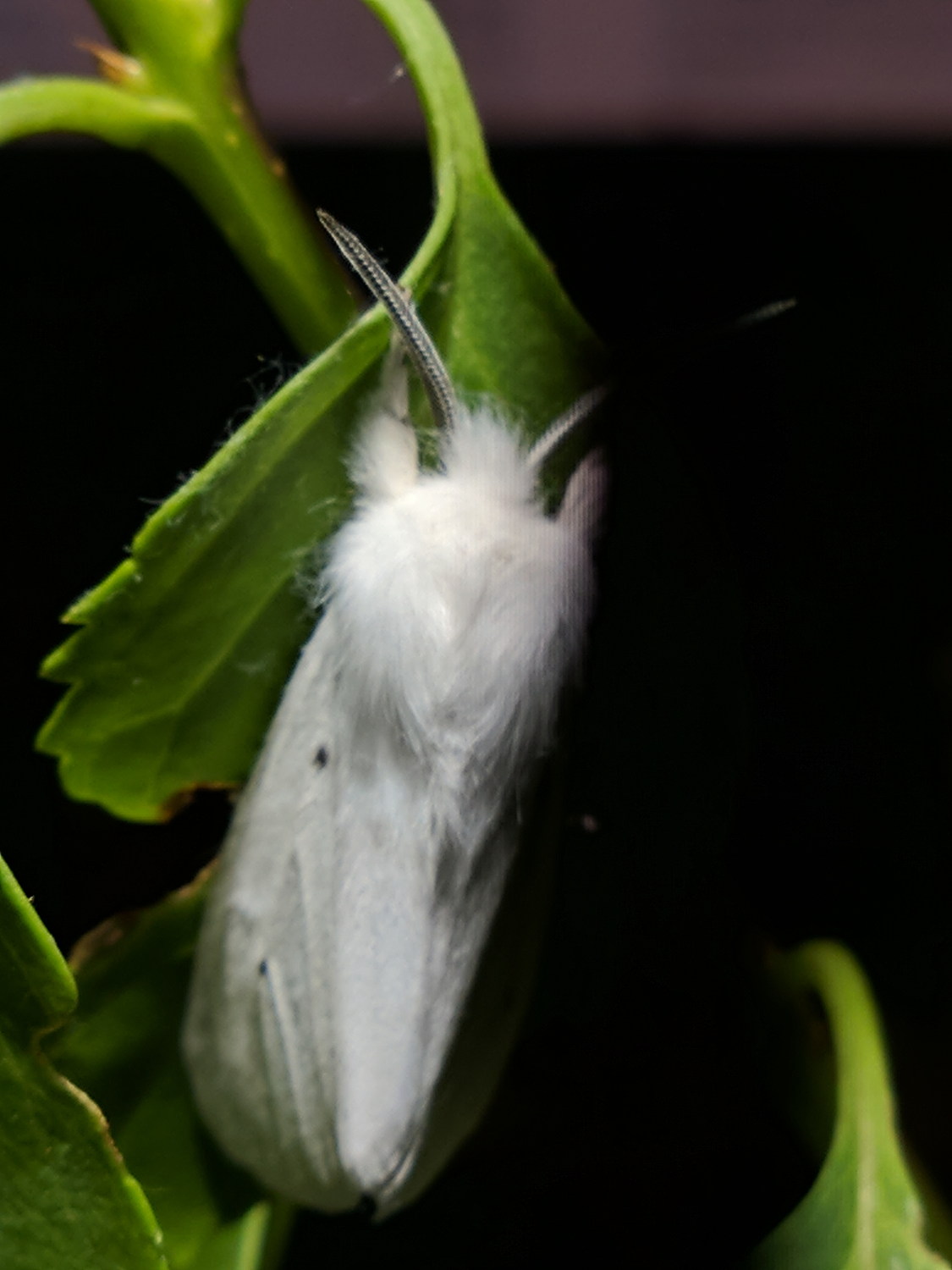
    The Pixel’s camera shows a black stripe across both the live preview and the final image:

    Pixel XL Camera - shutter stripe
    Pixel XL Camera – shutter stripe

    That’s under the high-intensity LED lamp on my desk, which must have a high-frequency flicker. I’m amazed the camera remains in absolutely stable sync with the flicker for as long as I’m willing to aim it.

    The stripe covers only the moth and greenery, not the LCD monitor in the background, so it’s caused by the overhead lamp, not something internal to the Pixel or its camera.

    A closer look shows shading on either side of the deepest black (clicky for more dots):

    Pixel XL Camera - shutter stripe - detail
    Pixel XL Camera – shutter stripe – detail

    The stripe location and width differ based on the image zoom level, although in no predictable way:

    Pixel XL Camera - shutter stripe - 2
    Pixel XL Camera – shutter stripe – 2

    The Pixel camera definitely doesn’t have optical zoom, so it’s surely related to the scaling applied to convert the physical sensor array into the final image. Even though all images have 4048×3036 pixels (or the other way around, at least for these portrait-layout pix), zoomed images get made-up (pronounced “interpolated”) data in their pixels.

    Not a problem under any other illumination I’ve encountered so far, so it’s likely something to do with this specific and relatively old LED lamp.

  • Turkey Vultures on a Rainy Day

    These vultures decided to hang out high atop our neighbor’s tree during a recent day-long rainstorm:

    Turkey Vultures - rainy day
    Turkey Vultures – rainy day

    There may be a third vulture on the branch behind the big clump of pine cones near the trunk.

    This seems about as disgusted as a vulture can appear:

    Turkey Vultures - rainy day - detail
    Turkey Vultures – rainy day – detail

    I think that’s a young vulture, without the red face of more mature specimens.

    They spent most of the day there, then flew off about their business. We’re sure they spent most of the next day drying out.

    Taken with the (new-to-me) DSC-H5 and 1.7× teleadapter; no extra charge for the purple fringes.