Ed Nisley's Blog: Shop notes, electronics, firmware, machinery, 3D printing, laser cuttery, and curiosities. Contents: 100% human thinking, 0% AI slop.
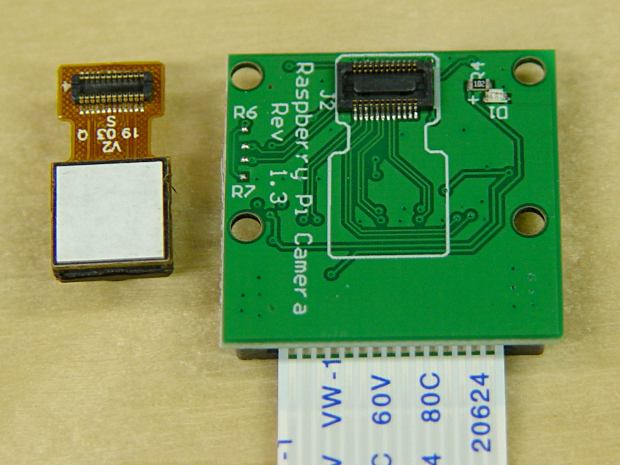
I picked up a pair of Raspberry Pi V1 cameras, both of which arrived unstuck to their breakout board:
RPi V1 camera adhesive
Requiring the customer to peel off the white layer and stick the camera to the PCB helps keep costs low. They’re $4 if you’re willing to wait two months or $7 from a “USA Seller”.
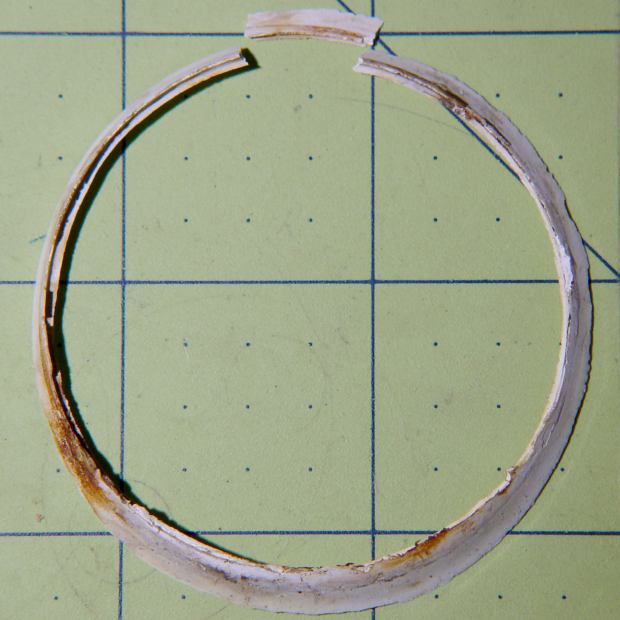
It came loose from the drain rim while I was cleaning the sink; I wasn’t doing anything particularly vigorous.
The stain in the lower right goes all the way around the epoxy:
Bathroom sink epoxy – bottom
For what should be obvious reasons, I was loathe to scuff up the sink surface to give the epoxy a better grip, so it couldn’t make a watertight seal all the way around.
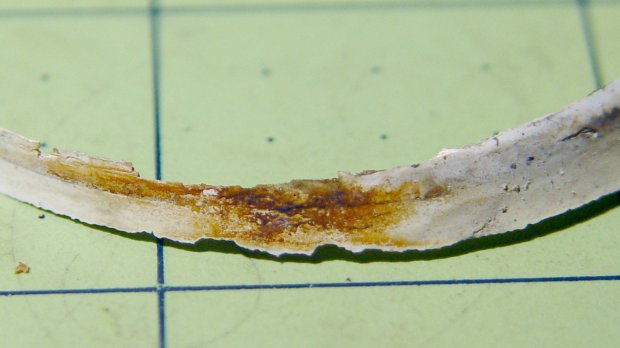
A closer look at the stain:
Bathroom sink epoxy – detail
I’m reasonably sure that’s iron bacteria colony, rather than actual rust, as there’s no iron to be found anywhere nearby.
For lack of anything smarter, I’ll apply another dose of the same epoxy, although this time I won’t be expecting a long-term fix.
Riding south on Rt 376 takes us across the Mighty Wappinger Creek on a four-lane concrete bridge built about 1995. This Dutchess County Aerial Access photo shows it in 2016:
Rt 376 – Wappinger Bridge – 2016 overhead
A pothole opened up on the south end of the span last year:
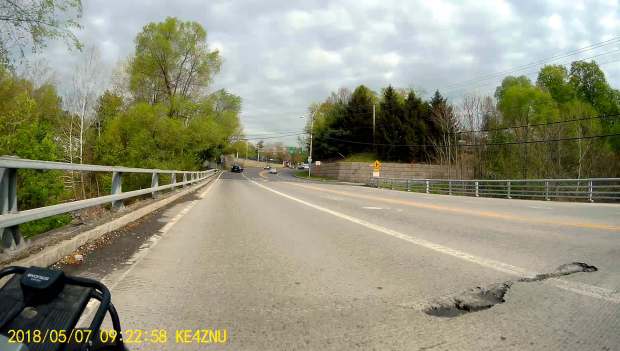
This year, we’ve been avoiding a new pothole opening on the north end:
Rt 376 – Wapp Bridge – 2019-09-11 – 0295
It’s difficult to ride between the right side of the hole and the weeds growing from the curb joint under the guide rail, so we take the lane whenever we can. The extensive vegetation growing in the bridge structure can’t possibly be a good thing.
The concrete seems to be failing by tension overload as the beams flex downward under traffic loading and pull the top surface apart. The surface has irregular transverse cracks across the deck width, not all of which look like control joints.
With potholes and surrounding cracks allowing brine into the deck, we expect much worse deterioration during the next few years.
My Professional Engineer license has long lapsed, not that I ever knew anything about bridge design, so this is mostly observational.
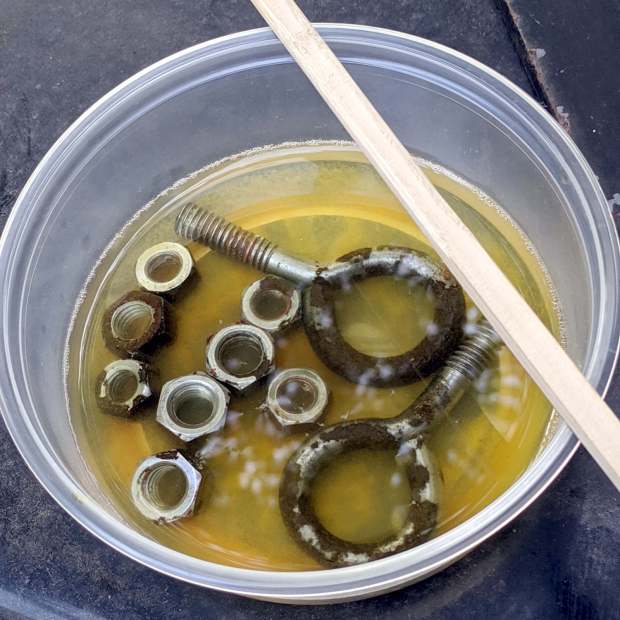
The dark areas are iron oxide being converted to loose iron sulfide, which is what Evapo-Rust does for a living.
One could, of course, simply buy new eye screws & nuts, but we’re deep into historical preservation around here.
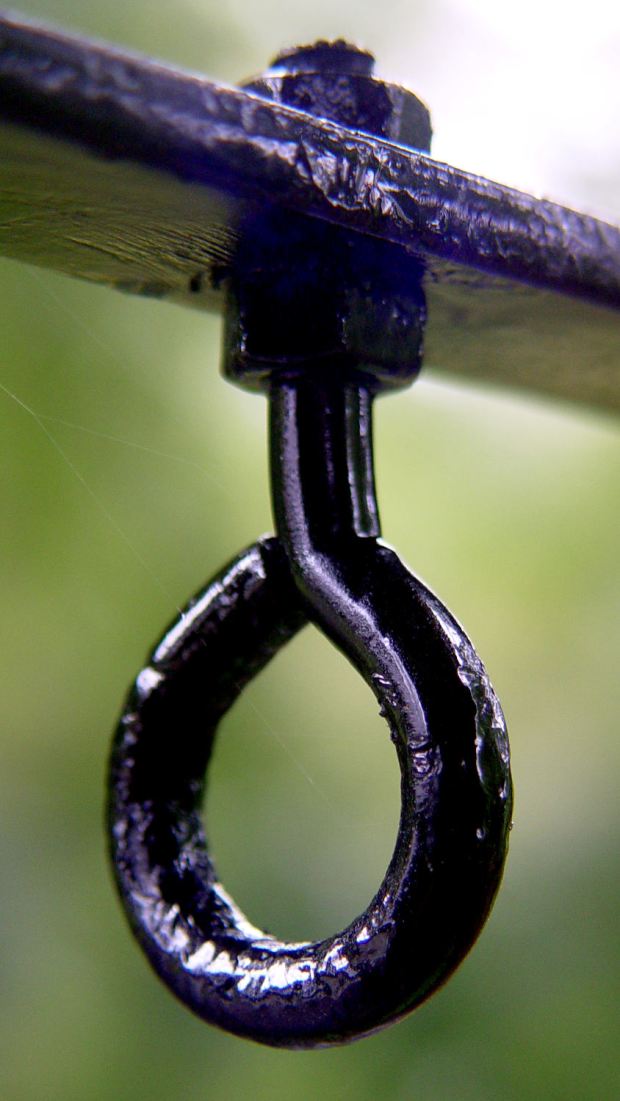
An hour of soaking and a few minutes of wire-wheeling got everything down to bare metal, ready for some rattle-can primer and black paint action:
Suet Feeder Bracket Hardware – installed
It’s a version of what Eks calls a “used car finish”: high shine over deep pits.
Discussion of why one should not paint threaded parts will be unavailing; in this case, paint serves as permanent threadlock. I re-spritzed the eyescrews & nuts after getting everything aligned, so as to produce a lovely two-coat over-all finish.
The display on Mary’s Cateye Astrale “Cyclocomputer” had once again faded to gray, so it’s time for a new CR2032 lithium cell:
Cateye Astrale – battery change 2019-09-22
The old cell read 2.5 V, well below what it should be.
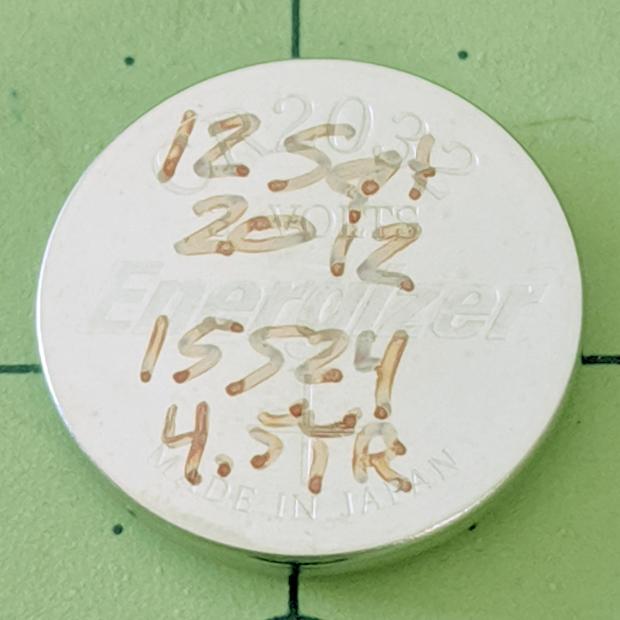
The notes scrawled on the cell become readable under better light:
Cateye Astrale – CR2032 life
Seven years (at 1942 mile/yr) ain’t bad at all!
To replace the cell fast enough to maintain the odometer reading, just unscrew & remove the battery cover, slam the back of the Astrale on the bench, and pop in the new cell.
Maybe I should replace the cell twice a decade, regardless of how feeble it might be?
Back in the early 90s, I bought a Branson Ultrasonic Cleaner for small parts. It turned out to be ideal for eyeglasses, migrated to the bathroom, and has been used at least daily ever since. After nigh onto three decades, this happened:
Branson ultrasonic cleaner – failed switch cover
We tend to push the ON button and let it turn off by itself after a little over four minutes (exactly 255 seconds!), so the gray plastic sheet over the ON switch failed first. You can barely see the outline of the transparent film previously covering both switches, which probably helped waterproof the switches.
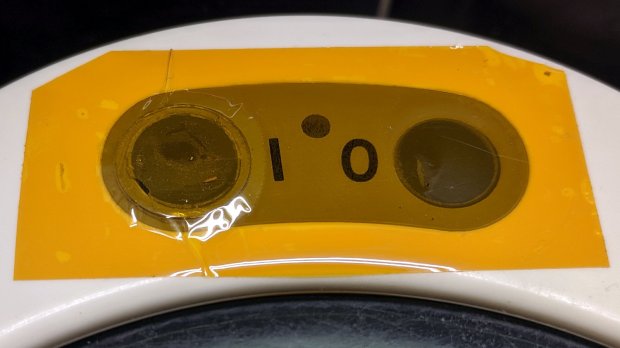
The gray plastic disk sits atop the switch actuator, so I punched a slightly larger polypropylene disk (from my stash of clamshell packages), stuck it to the disk with double-sided tape, lined it up over the hole, and covered the mess with Kapton tape:
Branson ultrasonic cleaner – expedient fix
This is in the nature of an expedient fix, as I’m not sure the polypro disk is flexible enough. The next iteration will cover the entire gray area and I’ll see about a transparent tape covering.







 The Smell of Molten Projects in the Morning