The Smell of Molten Projects in the Morning

Ed Nisley's Blog: Shop notes, electronics, firmware, machinery, 3D printing, laser cuttery, and curiosities. Contents: 100% human thinking, 0% AI slop.

Tag: Repairs

If it used to work, it can work again

  • Shower Faucet Handle Tightening

    Some years back I replaced the shower stall faucets; they’d lasted about half a century, which is good enough. The new faucets were American Standard Cadet/Colony (their choice of name, the current Colony valves seem similar) with a nice, smooth exterior. Of late, both handles had become slightly loose and I finally got around to tightening them.

    Shower faucet valve stem
    Shower faucet valve stem

    The handle setscrews accept a 5/64 inch hex key and pop easily off the stems, revealing the splined plastic (noncorrosive!) mount on the valve stem. The Philips screw in that is what’s loose and allows the whole handle to wiggle just a bit; tightening the setscrew doesn’t help.

    Of course, tightening the screw in the cold water stem tends to open the valve, so you must firmly wedge the splined mount. I’m sure there’s a special wrench for that, but I just held it tightly; next time I’ll try a strap wrench.

    One would ordinarily dose the screws with threadlocker, so as to never have to endure this dance again, but these screws have coarse threads that engage another plastic doodad that engages two wings on the splined mount. So I guess I must retighten them twice a decade or so.

    The handle interiors sport a bit of corrosion (which does not respond to vinegar, so it’s not hard water mineralization), but nothing terrible. The setscrew, mirabile dictu, seems to be stainless steel…

    Shower faucet handle - splines
    Shower faucet handle – splines
  • Another Tread Gash: Tire Liners FTW Again!

    Found this in the front tire of my Shop Assistant’s bike.

    Front tire gash
    Front tire gash

    It’s a Primo Comet Kevlar, not that the Kevlar belts can cope with an assault like that. The smooth surface at the bottom of the gash is the tire liner, of course.

    She won’t be using the bike for a while, though, so I’ll keep our stock of new tires for our bikes. I’m sure they’ll come in handy this season.

    Sheesh!

  • Toyota Sienna Bank 1 Oxygen Sensor: Replacement Thereof

    So there we were, on our way to the Dutchess County Fair when I noticed the Check Engine light glowing beyond my right hand on the dashboard. We decided to not stop at the fair, drove through Rhinebeck, and returned home without turning the engine off.

    The last time that light came on, my Shop Assistant and I were on our way to Cabin Fever in York PA one Friday afternoon in mid-January. The Mass Air Flow Sensor had just failed, rendering the car un-driveable: the engine ran so poorly we barely got off I-81 to drift into a parking lot. Although the local Toyota dealer was just across the road, I replaced that sensor on Monday morning in the Autozone parking lot, half a mile down the road, at 19 °F in a stiff wind with inadequate tools; said Toyota dealer being useless like tits on a bull during the entire weekend.

    After the obligatory research, I put the van up on jack stands, crawled underneath, and discovered that the Bank 1 Oxygen Sensor lies behind & below the transverse-and-rotated engine, directly above and front of the chassis cross-support strut, where it cannot be seen or touched from any position. That’s why there are no pictures: there was no room for a camera and nothing to see.

    I had to buy a 3/8 inch breaker bar, as the sensor position lacked clearance for a socket wrench, a U-joint, a T-handle, or a step-down adapter from my 1/2 breaker bar behind the special 22 mm Oxygen Sensor Socket. I eventually got the sensor loose and unscrewed it one painful eighth of a turn at a time, with the exhaust pipe preventing a full 1/4 turn, removing and reseating the breaker bar with my fingertips for every single one of those increments.

    I deleted all over Toyota’s censored for quite some time thereafter…

    It’s been a couple of weeks, the Check Engine light remains off, and I hereby declare victory.

  • Silent Headphone: It’s Always the Cable

    Before trotting off to college, my Shop Assistant repaired a pair of headphones she’d scrounged at the end of her Senior year; they were nice Skullcandy on-ear phones with one dead cup. The previous owner evidently wasn’t into fixing things and bequeathed them to her.

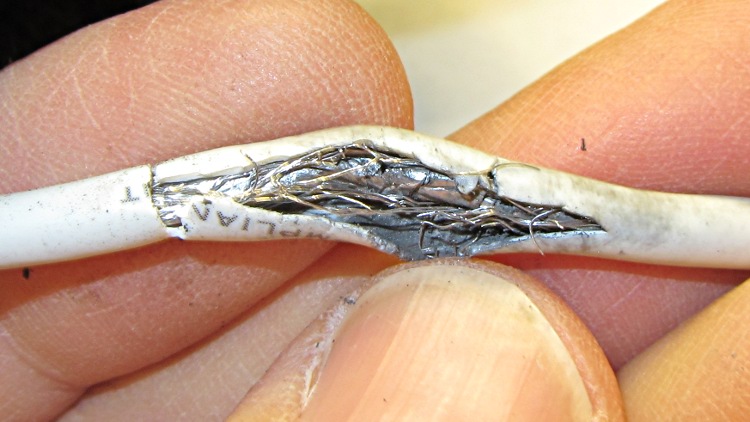
    She dismantled the offending cup to find some really grody soldering that ought to have produced a cold solder joint: the common lead wasn’t making contact with the plug. Alas, the only way to proceed was to slice the injection-molded cover off the plug and see what was inside; to our surprise, everything looked fine.

    We then cut an inch off the cable and pulled the conductors out:

    Broken headphone cable conductors
    Broken headphone cable conductors

    Well, that was easy! Here’s a closer look:

    Broken headphone conductor - detail
    Broken headphone conductor – detail

    The three broken wires (only one of which was completely disconnected) failed exactly at the end of that plug covering. It had strain relief notches, but we guessed the previous owner had no qualms about bending the cable hard against the end of the plug.

    She soldered it up, shrank some heat stink tubing around the plug and its sliced cover, wrapped self-vulcanizing tape around the junction for better strain relief, and it’s all good. She’ll get plenty of use out of the headphones in the dorm …

  • New Clamp Pads: FAIL

    Well, that didn’t work quite right…

    Dislocated clamp pads
    Dislocated clamp pads

    I’d waited for a few days for the silicone to cure, then put the clamps back in their home. When I went to use them, the pads were firmly affixed to the plate. Evidently, the copper-loaded silicone gasket compound takes a few days longer than forever to cure, which is not what I gathered from reading the label.

    It may well be that adhesive has aged out, because when I went to try it again, the first half-inch inside the tube had turned into solid gum. Yes, it cures inside the tube and not outside.

    Other than that, it seems like good stuff; I may pick up another tube and give it a second chance. Who knows? It might be useful in a plastic extruder or something like that.

  • Casio EX-Z850 Camera Buttons Repaired!

    As described there, the buttons on the back of my pocket camera stopped working, but the obvious laying-on-of-hands repair (i.e., wiggling the cables) didn’t improve things. I later discovered out that two other buttons on the side that didn’t go through the same flex cable were also dead, which suggested that the common failure was on the CPU board deep inside the camera. I gave it to my Shop Assistant with some handwaving about how she could maybe fix it by delving deep inside, tracing the cables, and doing some jiggling: if she could fix it, she could have it.

    The first step was to take both covers off, which required a Philips 00 bit:

    EX-Z850 front cover removed
    EX-Z850 front cover removed

    Then the side plate comes off, which requires maneuvering the spring-loaded battery latch out of its recess, at which point the lug for the carry strap will fall out:

    EX-Z850 battery latch and carrying lug
    EX-Z850 battery latch and carrying lug

    En passant, we discovered why the clock dies while changing the battery pack. It seems the miniature rechargeable lithium (?) NiMH (?) cell has rotted out:

    EX-Z850 internal battery corrosion
    EX-Z850 internal battery corrosion

    Fortunately, it charges in a cradle, so the main battery can remain in place indefinitely. We’ll replace that thing at some point.

    The CPU board has two flex cable connectors on the front surface and two on the back. My Shop Assistant released the clamps, removed the cables, wiped down the contacts with DeoxIT Red, gave it a test run with the covers off, and came bounding up the stairs as happy as I’ve ever seen her: the camera worked perfectly again!

    Not being used to these things, though, she managed to crack one of the side latches on the far connector. I’ll admit to doing exactly the same thing, so I knew how to fix it: a dab of acrylic adhesive holds the fragment in place with a bit of springiness to hold the latch down.

    EX-Z850 connector repair
    EX-Z850 connector repair

    The connector in question comes from the flash control board, to which those other two buttons (Ex and Drive mode) connect. The inside of the camera is a maze of connections, so I guess that was the simplest way to get the conductors through the body.

    She reassembled the camera and it continued to work; we declared the job a complete success.

    Shortly after that, I promoted her from Shop Assistant to Larval Engineer, First Instar, and we installed her in her new socket at college, where that camera should come in handy for something.

    I think she’ll ace the Freshman Engineering Practicum, wherein her compadres will learn how to solder components to circuit boards, use multimeters & oscilloscopes & other instruments, and generally survive in a laboratory. Maybe she can wrangle a job as a Lab Assistant?

  • Ampeg B-12-XY Cap Autopsy

    Before trashing (*) all those caps from the Ampeg, I marched them past a capacitance meter that gives the dissipation factor D. As D = tan δ = ESR / ¦X¦, we know ESR =  D*¦X¦ at the meter’s 1 kHz test frequency. We don’t know the magnitude of the total reactance X (the meter doesn’t tell us that) and in this case we can’t assume the ESR will be small with respect to the capacitive reactance Xc = 1/2πfC.

    Ampeg capacitors
    Ampeg capacitors

    The smaller green 0.022 µF Cornell-Dubilier caps all came in with D=0.05, so they’re marginal.

    The larger green 0.15 µF Cornell-Dubilier caps had D=0.00 and the black 0.1 µF was D=0.01. Those are OK.

    The small black caps had D=0.14. Yikes! The larger one and the yellow cap had D= 0.01 or 0.02.

    The blue Ducati (!) electrolytics ranged from 0.06 to 0.48. That was without reforming, as the last time Phil turned it on, the finals about melted down: I wasn’t going to risk that again just to find out if you can reform all the electrolytic caps without the tubes in place.

    So, yeah, some of the coupling caps were exceedingly bad. If you’d like to rub the values & data against the schematic to find out which one(s) were killing the finals, go ahead.

    All of the measured capacitance values were within spitting distance of their nominal values.

    [Update: Eks points out that I really should measure the leakage at operating voltage, so as to find the current that would drive the grids off their normal bias points. That’s a project for another day… ]

    (*) They’re in the e-waste recycling box, of course.

    The raw data, not that anybody cares: