Ed Nisley's Blog: Shop notes, electronics, firmware, machinery, 3D printing, laser cuttery, and curiosities. Contents: 100% human thinking, 0% AI slop.
The Y axis on my Sherline CNC mill has developed about 8 mils of backlash, a bit more than seems reasonable. Some poking around shows that the anti-backlash nut is loose while in the middle of the leadscrew and snug while at either end, which suggests the leadscrew thread is also worn. That’s no surprise, as I didn’t figure out that having a bellows over the leadscrew was a Good Thing until, let us say, considerably later than I should.
If I must replace the leadscrew, I may as well take the whole XY assembly apart, clean everything, and replace the consumables. So I ordered a sack o’ parts from Sherline; they’re all cheap and readily available. The overall index has the exploded diagrams and the parts list for my mill boiled down to:
54161 Y axis leadscrew (9 inch)
50140 Y axis anti-backlash nut
50200 Y axis nut
50171 X axis leadscrew
50130 X axis anti-backlash nut
40890 X axis nut
50150 anti-backlash lock
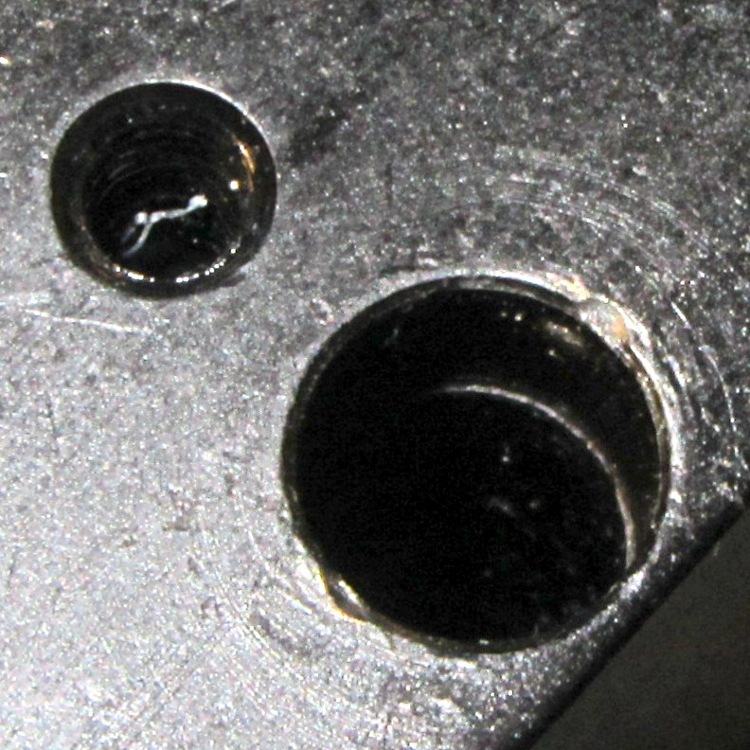
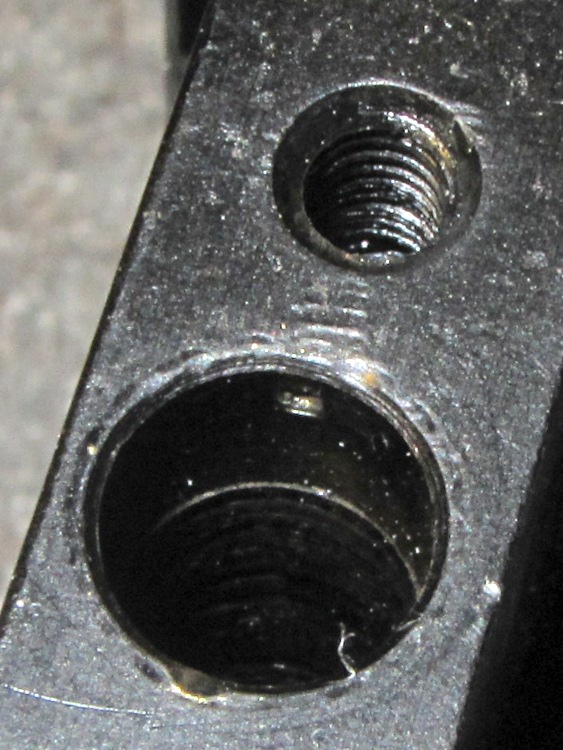
The only gotcha: nowhere (that I can find, anyway) is it written how to get the leadscrew nuts out of the stage. It turns out that the holes through the stage aren’t uniform: the X narrower on the right and the Y on the front, so you must drive the X axis nut out to the left and the Y axis nut out to the rear. The counterbore is visible just behind the anti-backlash nut if you know what to look for, so you’re driving the axis nut away from the backlash nut.
On the X axis:
X axis leadscrew hole counterbore
On the Y axis:
Y axis leadscrew hole counterbore
Trust me on this: you cannot drive a 5/16 inch nut through a 19/64 inch counterbore. If you have a 19/64 inch transfer punch, that’s a dandy way to get the nuts out.
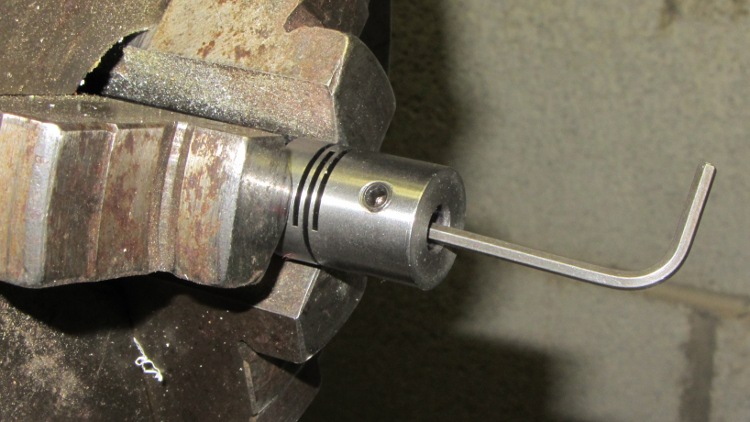
The easiest way to loosen the socket head cap screw holding the flex coupling to the leadscrew is to grab the coupling in a lathe chuck (with the leadscrew protruding into the headstock) and then apply the hex key:
Loosening leadscrew bolt
They used red (high-strength) Loctite on all the leadscrew bolts, as well as on the tapered joint between the leadscrew and the flex coupling, and on the bearing preload nut… so I will, too.
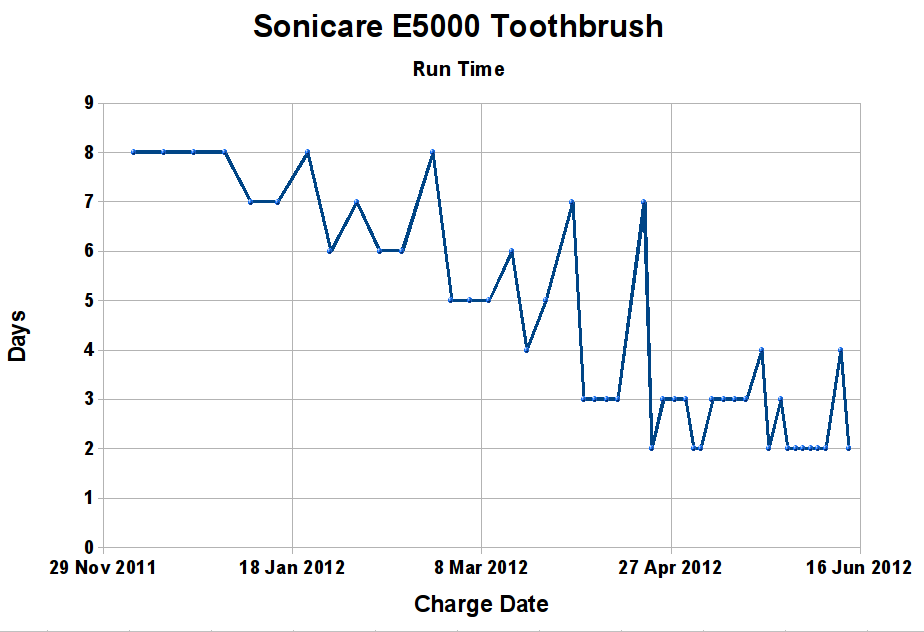
Back when I got a Philips Sonicare (on the recommendation of my dental hygenist, after a particularly nasty bout of plaque removal), the battery gave nearly two weeks of service between charges. As shown in that graph, the runtime gradually faded away to two days, at which point I decided it was time to tear the thing apart and see about replacing the batteries.
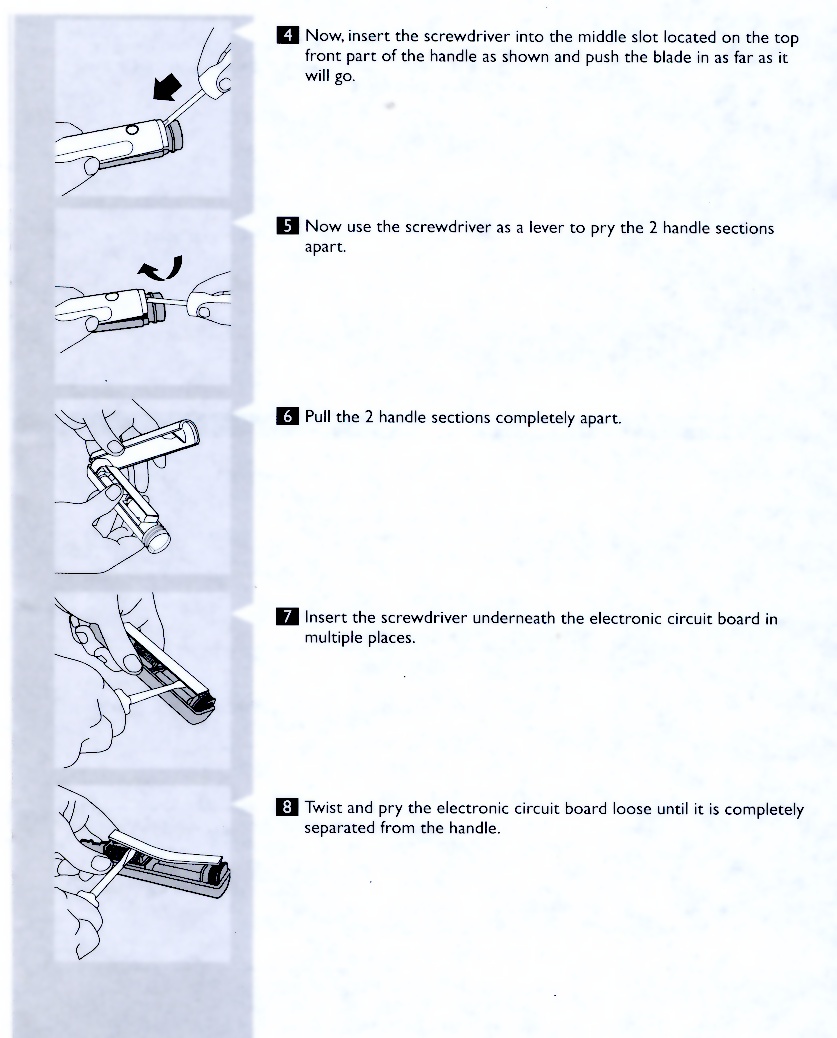
The instruction manual tells how to dismantle the case and extract the NiCd battery for recycling:
Please note that this process is NOT reversible.
Well, there’s a challenge if I ever read one, but Wouldn’t It Be Nice If you could take something apart, unplug its defunct battery, install a new one, and button it up again? Then you wouldn’t be forced to buy a new $70 toothbrush, which probably explains everything… and I suppose the replacement battery would cost $40, even if it were a pair of AA cells.
For reference, the instructions (clicky for more dots):
As predicted, suasion applied through a small screwdriver popped the top end of the case apart, but the remainder required concerted prying and muttering. The case halves mate with a tongue-and-groove joint that’s either sonic welded or adhesive bonded to form a watertight seal all the way around, to the extent that they suggested cleaning the thing in a dishwasher.
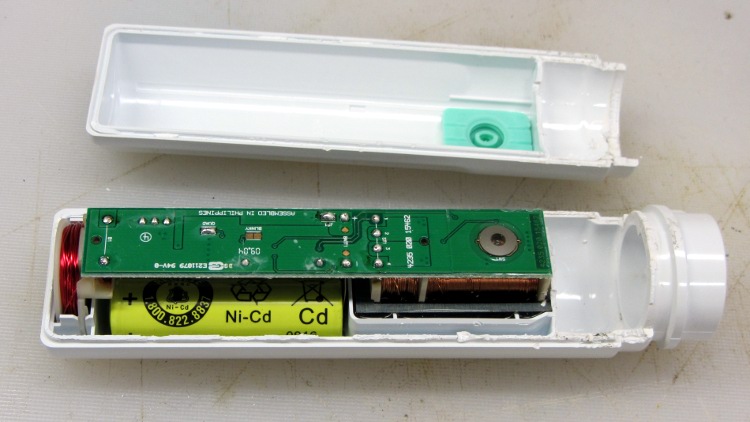
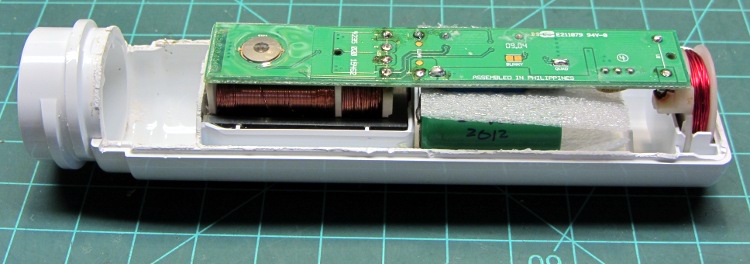
Eventually, though, it came apart:
Sonicare – case opened
The “motor” (actually, a solenoid that couples to the magnet on the brush stem) is firmly potted in place (on the right), as are the NiCd cells and the charging power pickup coil at the base on the left. The potting compound seems to be a clear epoxy, rather than a compliant rubber, and it doesn’t bond to the case at all. It is, however, a perfect fit and doesn’t pop loose without a struggle; their instructions will definitely break the PCB.
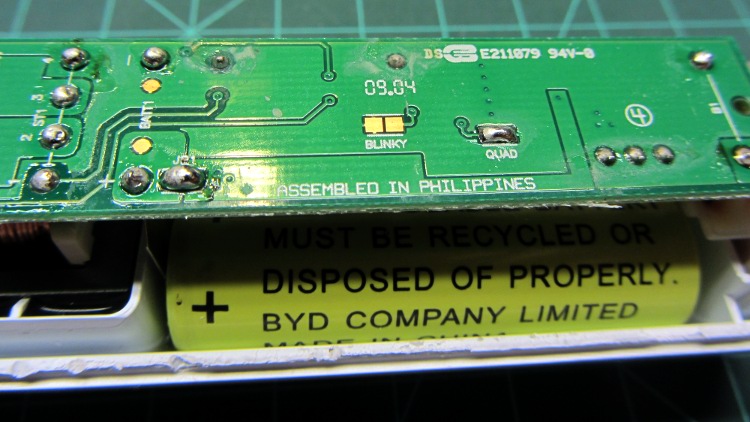
Seen from the other direction, six connections join the PCB to those immovable objects. The four pins (on the far left) go to the solenoid and the pair (just to their right) to the battery:
Sonicare PCB solder points
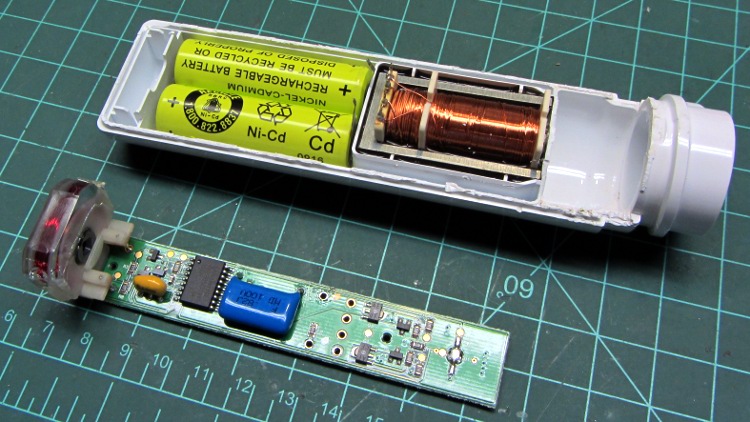
A few dabs of desoldering wick suffice to free the pins and release the PCB. Mercifully, the potting compound surrounding the charging coil slid out easily, as they (inexplicably) omitted a mechanical lock molded into the case:
Sonicare – PCB removed
Removing the NiCd cells required considerable prying, as described in the instructions, that en passant damaged their cases. I think if you weren’t paying attention, you could easily rupture a cell case with the screwdriver and spatter the area with potassium hydroxide, perhaps shorting the cell in the process and producing rather more excitement than most folks expect.
A closeup of one cell; the other bears similar damage:
Sonicare – damaged NiCd cells
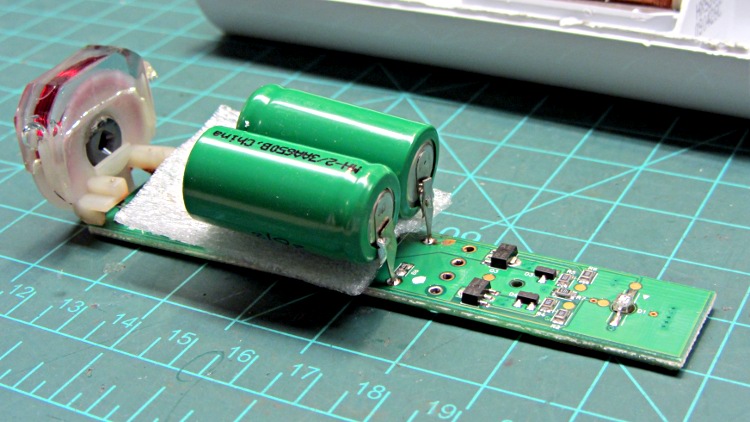
I snipped off the cell tabs and applied them to the new NiMH cells. A bit of closed-cell foam between the cells and the PCB cushions the assembly:
Sonicare – new NiMH cells on PCB
Stacking more foam snippets under the cells filled the space left by the potting compound, then soldering the solenoid pins held everything together:
Sonicare – new NiMH in place
A wrap of clear adhesive (rather than the obligatory Kapton) makes for a tidy joint that probably won’t last very long, but it looks much the way it did before the operation. The case is no longer waterproof and won’t withstand the dishwasher. In fact, I must now store it with the brush end downward to keep the last few drops out of the handle.
There’s an interesting solder jumper on the PCB that I didn’t bridge, but the next time it’s opened up I’ll apply a dab:
Sonicare – BLINKY jumper
The alert reader will notice that I’ve replaced 2000 mA·h AA NiCd cells with 600 mA·h 2/3 AANiMH cells, without changing the charger. The power transfer through the inductive coupling drives a trickle charger at about one hour of recharge per brushing, so there’s not much danger of overcharging the cells.
Now, to discover what runtime fresh cells deliver. This calls for another slip of geek scratch paper in the bathroom.
Being that type of guy, I noted each date when my Sonicare toothbrush needs recharging, at least after the battery had declined to about a week between charges, specifically so I could produce this graph:
Sonicare Runtime
The peaks include trips where I didn’t use the toothbrush and I’ve certainly blundered a few dates, but you can eyeball a trendline: those cells are kaput!
In round numbers, I bought the thing in early 2010, so the cells lasted maybe 2-½ years. I routinely run the toothbrush until the blinky light indicates that it needs charging, then fill it up overnight, to avoid having the cells fail like the ones in the beard trimmer.
Somehow the notion of discarding the whole toothbrush seems wrong, even though the instruction manual describes how to remove the battery for recycling before you junk the carcass. Talk about planned obsolescence!
Alas, urethane glue didn’t hold the eye marbles in the garden dragonfly ornament for very long. Although the cured glue had a wonderfully smooth surface where it contacted the balls and it had plenty of contact area, that wasn’t enough.
This time, I used acrylic caulk that should stay gummy enough to maintain a good grip:
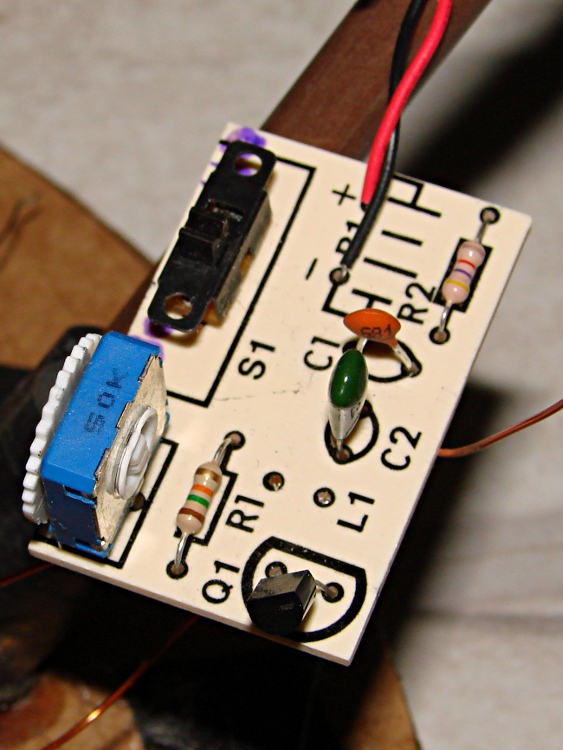
There ought to be a survey marker pin at the front corner of the lot where it’d come in handy for locating the edge of the yet-to-be-contracted driveway paving, but if it’s there it’s been pushed below ground level. So I mooched a homebrew metal detector based on the Elenco K-26 PCB…
K-26 Metal Detector PCB
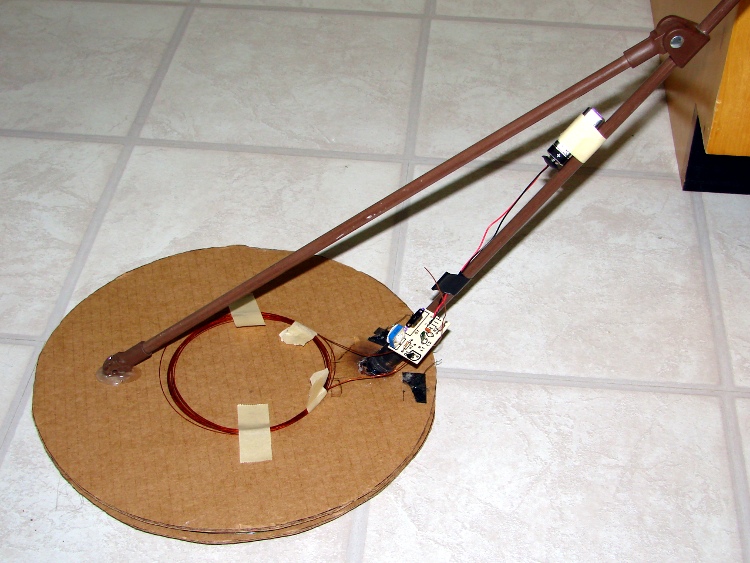
The kit included 45 feet of 22 AWG enamel wire that should have become a 5 inch diameter coil with 30 turns, but the as-built detector had a coil wrapped around a 1 foot diameter cardboard form. The coil inductance sets the oscillation frequency, which turned out to be around 300 kHz: far below the nominal 1000 kHz. So I wound 40 turns of 22 AWG magnet wire around an old CD-ROM spindle case (which is, quite coincidentally, just over 5 inches in diameter), and taped it atop the cardboard form.
The datasheet recommends a nonmetallic handle, so I swapped in a plastic umbrella support for the original metal mop (?) handle.
Rewound homebrew metal detector
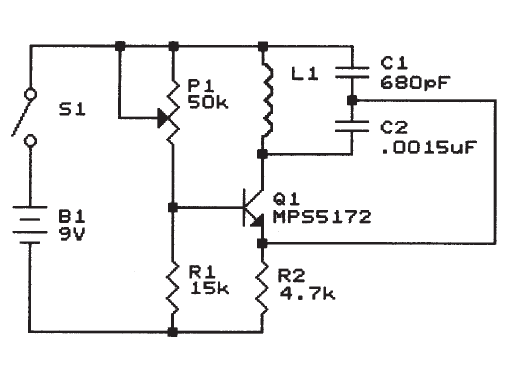
The K-26 schematic looks like a common-base Colpitts oscillator, with only the most utterly absolutely vital essential components:
K-26 Schematic
In round numbers, the oscillation frequency varies inversely with the number of turns:
F = 1/(2π√(LC)) (for a simple tank)
L = stuff × N2 (stuff = various constants & sizes)
F = stuff / N
The rewound coil oscillated at 350 kHz, so I spilled off a few turns at a time to produce these results and a tangle of wire on the floor:
L – µH
Freq – kHz
330
350
186
535
107
711
65
840
42
1140
For the record, the coil in the photo corresponds to the last line and has 12 turns.
Contrary to what the instructions imply, trimpot P1 does not adjust the oscillation frequency. It tweaks the transistor bias for best oscillation, so it’s more of an amplitude control than anything else. I adjusted P1 while watching an oscilloscope connected across the negative battery terminal and the emitter of Q1, but you could probably use a small sniffer loop to good effect.
It draws about 2 mA, so the battery should last quite a while; labeling the switch positions should help a lot.
The oscillator produces an unmodulated carrier, so I tuned a Kenwood TH-F6A HT in LSB mode for maximum squeal. Any variation in L changes the carrier frequency and thus the pitch of the demodulated audio; an earbud just barely in one ear makes this almost tolerable.
As you should expect from the picture, that metal detector lashup is mightily microphonic, to the extent that touching a blade of grass wobbles the audio pitch and bumping the cardboard plate against an object can detune the whole affair. A bit more attention to rigid coil mounting would certainly help, but this isn’t the most stable of designs to begin with and I doubt anything will help very much at all.
The coil can detect a chunk of rebar sticking out of the ground at a range of maybe half a foot, but it’s not clear how well it will cope with buried treasures (like, oh, let’s say a survey marker pin). In any event, I must mow the grass down there before going prospecting.
Now that I carry a spare tube on the bike to avoid on-the-road patching, a tangle of tubes has been accumulating in the Basement Laboratory. A protracted patching session shows why you can never have too many clamps:
Repaired bike tubes with clamps
Yes, I know they’re supposed to be ready to ride immediately after slapping the patch in place. Clamping the patch overnight won’t hurt and might actually help eliminate slow leaks, soooo… after this, they’re rolled up and ready for another season of punctures.
Repairing tubes goes much easier in the shop than by the side of the road, though. For what it’s worth, those silicone tape pads didn’t help much at all; the tube still eroded at the liner. Grumble…
The relatively low capacity at 100 mA (black) shows that the boost converter isn’t particularly efficient; the discharge time is long enough that power loss in the booster outweighs the cell’s higher capacity at lower loads.
Surprisingly, the voltage drops to 4.5 V at 500 mA, which is what you should get from a typical USB port. If the device you’re charging expects the nominal 5 V at 500 mA, it will be sorely disappointed. Admittedly, that’s only 10% low, but …
The booster produces only 4.0 V at 1 A, with odd bumps as the cell discharges. Huh?
I know for a fact that my 1.8 A @ 5.0 V Kindle Fire doesn’t even notice it’s plugged into the Powermonkey. The voltage is probably too low to trigger the “External Power, Ahoy!” signal.
Bottom line: it’s not clear this thing actually works for contemporary devices. Maybe newer Powermonkey products behave better?







 The Smell of Molten Projects in the Morning