The Smell of Molten Projects in the Morning

Ed Nisley's Blog: Shop notes, electronics, firmware, machinery, 3D printing, laser cuttery, and curiosities. Contents: 100% human thinking, 0% AI slop.

Tag: Repairs

If it used to work, it can work again

  • Faucet Washers

    The slop sink in the rental house developed a drip and, unlike our kitchen faucet, required only a new washer. Of course, choosing the right size from that assortment posed a bit of a problem:

    Slop sink valve with washers
    Slop sink valve with washers

    The old washer is in the upper right; you can see the indentation from the valve seat.

    There’s a variety of sizes & shapes; these represent just the closest matches. I have no idea what 3/8, 3/8R, and 3/8L might signify, but they’re all slightly different, some with conical cross-sections that may also be slightly different. Worst case, of course, you can sand down the rim of a too-large washer to make the diameter come out right.

    [Update: a table of sizes mentioned in the comments.]

    The washer just in front of the old one has information molded right into the back: GOLDEN STATE 10¢ 1/2. Now there’s a show of confidence in price stability that you don’t see much any more!

    I found one that fit snugly in the recess of the valve stem, turned the screw tight, and it’s all good.

  • LED Flashlight PCB Contacts

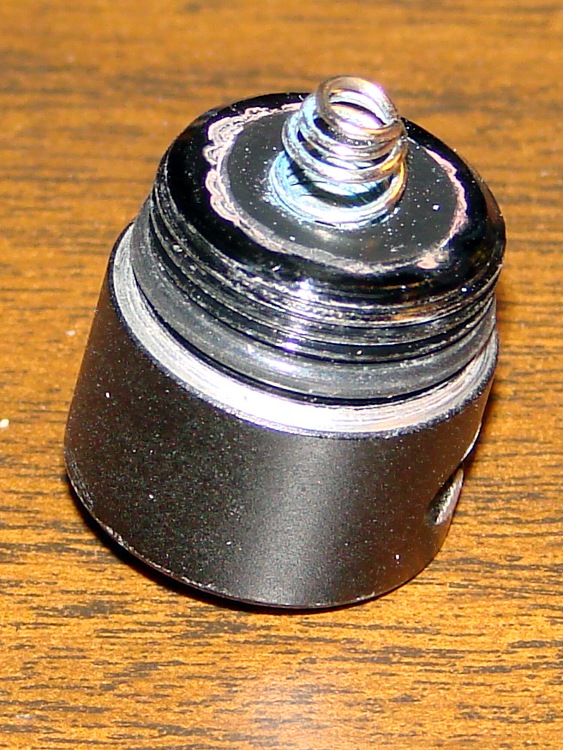
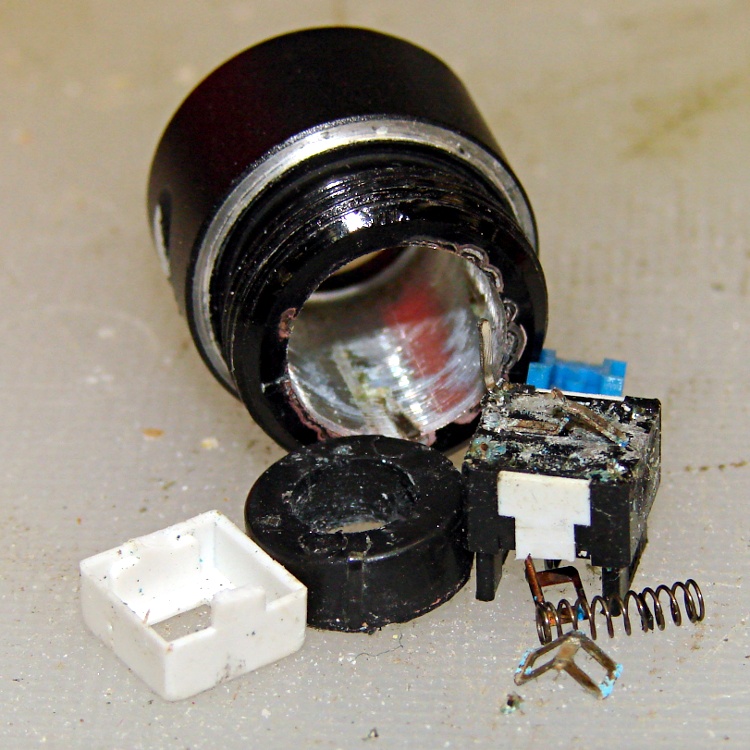
    One of the myriad cheap LED flashlights around the house & shop stopped working. This one consists of an aluminum shell with a pushbutton switch in the screw-on rear cap; somewhat to my surprise, the switch worked fine.

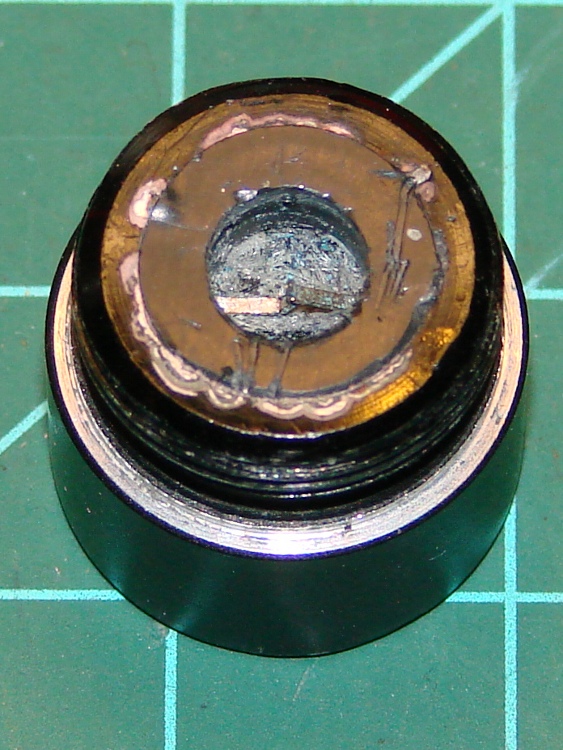
    Poking around the PCB in the front revealed the problem: only friction held it in place against the springs contacting the three AA cell battery container. Pushing a bit harder shoved the lens and the LED / reflector / PCB assembly out:

    LED flashlight PCB
    LED flashlight PCB

    The spring in the middle contacts the positive battery terminal. Those three square pads pressing against a locating shoulder inside the shell, but two of the pads have a solder layer and one is bare. I don’t know if the long lead on the LED at about two o’clock is a deliberate attempt to form an additional contact.

    Peering inside the shell reveals three teeny nubs on the locating shoulder that could, presumably, dig into the solder pads:

    LED flashlight - shell contact points
    LED flashlight – shell contact points

    If you’re having trouble spotting them, so did I. Running a fingernail around the shoulder helps: one is at the bottom, another about 10 o’clock, and the third at about 1 o’clock. They’re not evenly spaced at 120° to match up with the pads.

    With only friction holding the PCB in place, I understand why the flashlight didn’t work; given enough of an impact, the battery would push the PCB just far enough forward to make the connection at least intermittent.

    I aligned the two solder-coated pads with two nubs, shoved everything together, pressed the lens firmly in place, and we’ll see how long that lasts…

  • Garden Hose Ball Valve Handle Replacement

    The handle cracked and fell off this ball valve while I collected the hoses and suchlike from the Vassar Farms plot:

    Ball valve with broken handle
    Ball valve with broken handle

    Surprisingly, it’s not plastic, but (most likely) some cheap & grainy pot metal that wasn’t designed for durability. Rather than throw out that nice brass and stainless steel valve body, I figured a new handle was in order.

    To the Basement Laboratory Machine Shop Wing!

    The ball rotates freely inside the valve with the handle missing, so I found an aluminum rod (which, IIRC, was the original kickstand from my Linear Mach III ‘bent) that exactly fit the ball opening’s ID:

    Ball valve - removing nut
    Ball valve – removing nut

    What with it being a dark and stormy night outside (and having shut down all the computers in anticipation of a monster thunderstorm), I decided to get medieval with some hand tools. The first step involved finding an aluminum plate of about the right size and thickness, with markings left over from whatever I’d been building when it last saw the ceiling lights:

    Ball valve handle - initial layout
    Ball valve handle – initial layout

    After carefully drilling & filing the shaft hole, it looked like it’d work fine. Then I realized that, for whatever reason, the original design aligned the handle parallel to the hose when the valve was closed, which made very little sense when analyzed according to the Principle of Least Surprise.

    So I drilled-and-filed another hole on the other end at right angles to the first one:

    Ball valve handle - proper alignment
    Ball valve handle – proper alignment

    The original handle had two bumps molded on the bottom that acted as stops at each end of its 90° rotation. I figured a pair of 10-32 screws would suffice, not to mention they’d provide a bit of adjustment in case I blundered the hole positions. I planned to chop these stubs to whatever set the proper length below the plate:

    Ball valve handle - trial fit
    Ball valve handle – trial fit

    It turned out that the proper length was just about exactly that of a 1/4 inch 10-32 set screw flush with the top of the plate, so that’s what I used instead. They’re located one radius out from the outline of the valve body; trace the body shape on the handle in each orientation, eyeball one setscrew radius out from those intersections, and drill the holes.

    Lay out a nice handle shape by eye, rough it on the bandsaw, introduce it to Mr Belt Sander for final shaping, touch up the concave corners with a rat-tail file, scuff the flat surfaces clean with a Dremel stainless steel wire brush to produce a used-car finish (nice polish over deep scratches), and it’s all good:

    Ball valve handle - top view
    Ball valve handle – top view

    The knob on the end is actually a foot intended for the bottom of a widget case:

    Ball valve handle - bottom view
    Ball valve handle – bottom view

    It won’t get leak-tested until next year, but what could possibly go wrong?

    One thing, perhaps: that screw likely lies too close to the hose, particularly one sporting a replacement connector. I may be forced to bend the narrow part of the handle up a bit…

  • Cutting Music Wire

    It should go without saying, but you do not cut music wire with diagonal cutters intended for electrical wire or the low-carbon steel shears built into wire strippers. I use a bicycle cable cutter that easily slices through the hard wire used in brake cables and their housing:

    Bicycle cable cutter
    Bicycle cable cutter

    I’ve owned this one forever, but those cutters from Park should work just as well; the odd protrusions behind the pivot crimp aluminum caps on stranded cable. I also have diagonal cutters with hardened jaws, but they’re too bulky for fine work and tend to fire the stub ends across the Basement Laboratory.

    Every now and again I touch up the jaws with a diamond file to get rid of small dings; despite being hardened, those fine points seem particularly prone to burrs.

    When you see an ordinary wire cutter with matching half-moons in each blade, you know what happened…

  • Needle Nose Pliers Reshaping

    Reshaped needle nose pliers jaws
    Reshaped needle nose pliers jaws

    Wrestling with those springs suggested the tips of the needle nose pliers needed attention, so I introduced them to Mr. Grinding Wheel:

    That flattened the tips, but the jaws no longer meet flush at their ends. They’ve been reshaped a while ago, so (much though it pains me to admit this) it’s time to deploy the backup pliers…

  • Nike Cycling Shoe Latches: Resprung

    The Nike cycling shoes I bought some years ago (at a steep discount when they got out of the cycling shoe biz) close with a ratcheting plastic strap rather than laces, so I bought a spare set of straps: the plastic part always breaks first. As it turned out, a coil spring inside each latch failed and the stub end (on the right side here) gradually worked its way between the latch tab and the frame:

    Cycling shoe latch - broken spring
    Cycling shoe latch – broken spring

    Eventually this got to the point where the latches jammed and I had to do something. The first step was to drill out the rivet holding the spring and tab in place:

    Drilling latch rivet - magnetized bit
    Drilling latch rivet – magnetized bit

    You’ll note the rich collection of swarf clinging to the drill bit, which indicates this one hasn’t been used since a lightning strike magnetized all the steel in the house. A pass through that demagnetizer shook off the swarf and prepared the bit for the next time.

    Releasing all the parts shows the problem:

    Nike cycling shoe latch - broken spring
    Nike cycling shoe latch – broken spring

    The OEM springs used 24 mil spring wire that, surprisingly, matched a box of music wire in the Basement Laboratory Warehouse Wing. The spring coils have 5 turns that just clear the 3 mm rivet that I recycled as a mandrel; I think a 2.5 mm pin would produce a better fit. Not being a fan of rivets, I replaced them with 4-40 machine screws, even though the threads probably won’t do the aluminum frame any good at all.

    A protracted bending and wrapping session produced a reasonable approximation of the OEM spring:

    Latch spring - formed
    Latch spring – formed

    It’s worth noting that each of those coils uses up about 55 mm of wire: 5 × 3.5 mm × π. Cut an excessively long piece from the music wire coil!

    Trimming and shaping the ends to fit through the notches and around the outside of the frame shows that my wire-bending skills need considerably more practice. This spring (the second one I made) also shows that my beginner’s luck with the first coils wore off all too quickly:

    OEM springs with homebrew replacement
    OEM springs with homebrew replacement

    But both springs fit and work fine, so I’ll call it done for now:

    Repaired latch - nut side
    Repaired latch – nut side

    Will a replacement spring break before the plastic strap?

    Obviously, I need a CNC spring bender

  • Dead-on-arrival Lithium Cell

    DOA Energizer CR2032 cell
    DOA Energizer CR2032 cell

    The display on Mary’s Cateye Astrale cyclocomputer (remember cyclocomputers?) faded to gray, which meant a new CR2032 lithium cell was in order. I grabbed one from the heap, popped out the old cell, inserted the new cell, and … the display stayed blank.

    Quick like a bunny, I reinserted the old cell to save the odometer (15524 miles) and wheel circumference (1475 mm) data; the display returned to dim gray.

    The “new” cell, which came from an unopened pack, read 0.45 V with no load…

    The cell didn’t have a date code, but the package sports a cryptic MU that might encode the date of manufacture or the date of packaging or the copyright date or something; the various search results aren’t forthcoming and the Energizer site gives no explanation.

    I’m pretty sure I haven’t owned that package for more than a few years and it’s been in a shirtsleeve environment (plus the occasional hot van) ever since.

    Another Energizer cell from a more recent lot, bearing CA on the package and YA on the cell, worked fine.

    Being that sort of bear, I wrote the date and mileage on the previous cell (a Newsun, whoever they are, with a 3Y code), because the last time around the odometer value didn’t survive the cell change. The current total works out to 277 miles/month = 3300 miles/year, including winter downtime, which is fine with us; we mostly ride the bikes around town on errands and take the occasional tour.