The Smell of Molten Projects in the Morning

Ed Nisley's Blog: Shop notes, electronics, firmware, machinery, 3D printing, laser cuttery, and curiosities. Contents: 100% human thinking, 0% AI slop.

Tag: Repairs

If it used to work, it can work again

  • Sony DSC-H5: Disassembly

    The half-pressed shutter switch position on my Sony DSC-H5 recently stopped working, which seems to be one of two common failures. The other, a broken switch shaft, happened to Tee’s camera, as described there, and I figured I should preemptively fix that while I was inside my camera.

    This being a common failure, several folks have described how to dismantle the camera; I followed that guide’s English version.

    The DSC-H5 differs slightly from that description. After I got the thing apart, it became obvious that there’s no need to remove the LCD panel, the main control board, and most of the ribbon cables if you have a Philips #0 or #00 screwdriver with a very thin shaft. There’s no way to describe this operation, so take it apart his way, then you’ll see what I mean: the guts can come out as one big lump.

    In any event, all the camera controls eventually emerge from the body:

    DSC-H5 Control Assembly
    DSC-H5 Control Assembly

    Looking back into the camera body reveals the bottom of the shutter button, captured by a static discharge contact and the gray plastic frame of the Focus / Break button caps:

    DSC-H5 Shutter Button - interior view
    DSC-H5 Shutter Button – interior view

    Removing the pushbutton frame and pushing the left button bezel latch with a small flat-blade screwdriver extracts the shutter button; it falls out of the inverted body. This is one of the few intact DSC-H[1-9] shutter buttons you’ll ever see:

    DSC-H5 Shutter Button - bottom view
    DSC-H5 Shutter Button – bottom view

    Those rectangular protrusions lock into the slots in the black plastic cap that appears almost silver in this front view that shows the dimple in the switch membrane:

    DSC-H5 Shutter Button Switch - depressed surface
    DSC-H5 Shutter Button Switch – depressed surface

    You must remove the cap to release the flex PCB with the shutter switches. Two heat-staked pins retain the cap; a scalpel neatly slices off the melted plastic:

    DSC-H5 Shutter Switch - cover removed
    DSC-H5 Shutter Switch – cover removed

    Nota bene: the DSC-H1 button bezel I repaired earlier does not have features that lock into the cap over the switch assembly, which means you can remove and replace it without disassembling the camera. You cannot remove or install the DSC-H5 button without taking the camera apart. I suppose this counts as a continuous product improvement, but …

    The shutter switch has two parts:

    • The full-press switch that takes the picture (the white dot on the blue flex, shown above)
    • The half-press switch that triggers the focus & exposure is in a black plastic tray (seen edge-on above the white dot)

    The bottom of the half-press tray has a small nub that activates the full-press switch, so the force required to activate the half-press switch must be considerably less than the force that activates the full-press switch. This turns out to be a critical part of the repair…

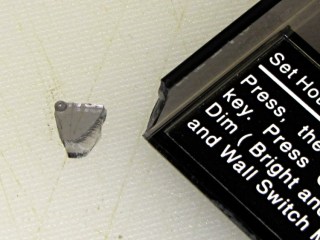
    A closeup of the half-press switch with the protective cover sheet (the “damn confetti” of the disassembly instruction) and the dimple that held the contacts together with the button released:

    DSC-H5 Shutter Switch - dimpled protector
    DSC-H5 Shutter Switch – dimpled protector

    A closeup of the switch through a snippet of PET plastic shows the switch membrane itself is in fine shape:

    DSC-H5 Shutter Switch - cover removed
    DSC-H5 Shutter Switch – cover removed

    However, the new plastic shield did not work out well, for reasons having to do with the new button plunger. That’s the next step: rebuild the plunger…

  • Splinting an Umbrella Strut

    One of the ribs in the six-passenger umbrella we keep in the van snagged on something and snapped its fitting on the spreader strut:

    Umbrella strut - broken connector
    Umbrella strut – broken connector

    This being wonderful engineering plastic that cannot be solvent-bonded, epoxy is the only adhesive that will work. However, those joints undergo tremendous stress in a deployed umbrella, so a bare epoxy joint won’t have enough strength for the job. What to do?

    Wonder of wonders, when I got the umbrella into the Basement Laboratory Repair Wing, I discovered:

    • The not-quite-round strut fitting stub slipped right into a short brass tube from the heap and
    • Just enough of the fitting remained on the rib to anchor the tubing

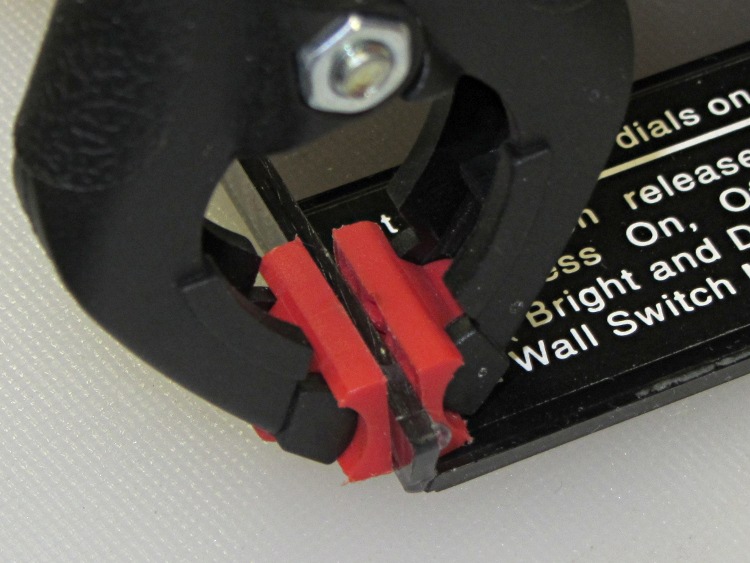
    A silicone tape wrap kept most of the epoxy inside while it cured:

    Umbrella strut - epoxy curing
    Umbrella strut – epoxy curing

    Clearing off a few blobs made it all good:

    Umbrella strut - brass tubing splint
    Umbrella strut – brass tubing splint

    We don’t play golf, but such a big umbrella keeps most of the rain off two people; it’s a tchotchke from back when Mary worked at IBM (hence the color scheme). We call it our “six-passenger” umbrella because it looks about that big when we deploy it…

  • Bicycle Mobile: New Windscreen Mic Ball

    The bikes stand upright inside the van and the helmets ride on the floor with all their stalks sticking up. This usually works out well, but on our last trip my helmet rolled under my bike and rubbed the foam ball surrounding its mic against the chain, producing a result so awful that I had to install new foam.

    For posterity, here’s the current state of the electret mic and its mount:

    Electret mic on bike helmet boom
    Electret mic on bike helmet boom

    The foam comes from a sheet of Sonex acoustic foam baffle, snipped into a reasonable approximation of a ball, with a slit deep enough to surround the mic, and a cable tie holding it closed:

    Foam mic ball on bike helmet boom
    Foam mic ball on bike helmet boom

    For what it’s worth, I’ve found that excessive wind noise correlates with too much mic gain. The mic rides about a finger’s width from the corner of my mouth, I talk at a normal volume, the amp supplies about 20 dB of gain, and we have no trouble with wind noise. The amp gain depends on the mic sensitivity, so your results will certainly differ; these mics came from the heap with no specs whatsoever.

    I suppose wind noise also depends on the bike’s speed, but when I’m going that fast I don’t have enough brain or lungs left over to hold a conversation…

  • Sink Soap Dispenser Pump: Nozzle Fitting

    The absurdly heavy pump nozzle atop the kitchen sink soap dispenser seemed more wobbly than usual. Some investigation suggested the fitting atop the plastic pump has gotten smaller, which may be due to having the nozzle wobble around on it.

    In any event, a wrap of Kapton tape snugged it up just fine:

    Sink soap dispenser pump
    Sink soap dispenser pump

    We’ll see how long that lasts; this thing may be nearing the end of its useful life.

  • Sienna Anti-Theft Blinky Light

    Our Toyota Sienna arrived with a blank cover plate where a fancier model would have a switch. It seemed a shame to let that space go to waste, so I popped the plate out, rummaged around in the heap, found a small circuit board with a blinky LED that just exactly fit the space available, and drilled a suitable hole:

    Sienna anti-theft blinker - inside
    Sienna anti-theft blinker – inside

    When it’s installed in the van, it looks and acts just like the security system we don’t have. For all I know, that plate was for the security system control, so perhaps it’s an exact match!

    Sienna anti-theft blinker - bezel
    Sienna anti-theft blinker – bezel

    The batteries last about two years, a few months later I notice the lack of blinkiness (it’s hidden behind the steering wheel in my normal driving position), and eventually I replace the corroded batteries. This time, I had to replace the entire battery holder; things got pretty nasty in there.

    As I recall, the PCB came from a fancy “greeting card” mailed to me by the Business Software Alliance, with the implied threat that if all my paperwork wasn’t up to par, my use of potentially unlicensed software would blow up in my face. That was back in the day when mailing something that pretended to be a bomb was considered a cute joke and when I actually ran more than one Windows PC.

    Linux is a lot more relaxing…

  • Utility Knife Blade: Corrosion Thereof

    This little utility knife lives in my belt pack for those occasions when I need a sharper blade than my long-suffering Swiss Army Knife can provide. Alas, I must have sliced up something awful in the recent past:

    Corroded mini utility knife blade
    Corroded mini utility knife blade

    Although the knife frame is slightly magnetic, it’s also reasonably noncorrosive and cleaned up pretty well after some Topsaver and wire-wheel brushing activity:

    Mini utility knife - somewhat cleaned
    Mini utility knife – somewhat cleaned

    Whew!

    For whatever it’s worth, this is the same knife that made it through the Washington DC “security scans” that eventually confiscated Mary’s Swiss Army Knife. She didn’t look any more guilty than I did…

  • Wouxun PTT Voltage Limit

    TinyTrak3+ D6 - SMD Schottky diode
    TinyTrak3+ D6 – SMD Schottky diode

    It seems that Wouxun KG-UV3D HTs require nearly 0 V to activate the PTT input, which I discovered after the radio on Mary’s bike began acting intermittently. The TinyTrak3+ would transmit correctly, but the PTT button on the handlebar began to not work at all / work intermittently / work perfectly. The switch and cable were OK, pushing the button produced nearly 0 Ω at the 3.5 mm plug, the connections seemed solid, but the radio didn’t transmit reliably.

    I finally got the thing to fail on the bench, which led to the discovery that:

    • Shorting the PTT input to the GPS+voice adapter PCB to ground didn’t make the radio transmit and
    • Data bursts from the TinyTrack3 worked perfectly

    Gotcha!

    TT3 PTT In-Out
    TT3 PTT In-Out

    The TT3+ pulls its PTT OUT pin down from +5 V using a 2N2222A NPN transistor (off to the right in the schematic snippet), but, for reasons having to do with ESD, the input from the PTT switch on the handlebars goes through a 100 Ω series resistor, then passes to the TT3 board through PTT IN to D6 before joining the TT3 transistor collector. The low-active diode-ORed signal heads off through PTT OUT to a 10 Ω series resistor, thence to the KG-UV3D PTT input. D6 is an ordinary 1N4148, with the net result that the PTT input voltage at the radio dropped to 630 mV with the PTT button pressed.

    Not finding anything else wrong, I replaced D6 with a BAT54 Schottky diode that pulled the PTT voltage down to 300 mV and the radio worked fine.

    Of course, a BAT54 is a surface-mount diode, so I clipped off the unused no-connect lead (it’s the only way to be sure it doesn’t do anything) and tacked it down slaunchwise between the PCB thru-hole pads. If I had a BAT54C with common cathodes, I could replace both D5 and D6 in one shot, but D5 just pulls down a PIC input that has an ordinary logic-level threshold voltage.

    I don’t know why the KG-UV3D PTT is so fussy, although it may really be a current-driven signal that requires more current than can flow through the 110 Ω + diode forward drop in series with the PTT button. Wouxun presents no specifications that I can find.

    The identical circuitry on my bike works fine with the stock D6 diode and a presumably identical KG-UV3D. I should replace that diode before it gives me any trouble, but I’ll wait until I must take the box apart for some other reason.