The Smell of Molten Projects in the Morning

Ed Nisley's Blog: Shop notes, electronics, firmware, machinery, 3D printing, laser cuttery, and curiosities. Contents: 100% human thinking, 0% AI slop.

Tag: Repairs

If it used to work, it can work again

  • Wouxun KG-UV3D Battery Contact Locations

    Having gone to great pains to put the center of the contact studs on the GPS+voice case exactly at the center of the screws on the back of the radio:

    HT-GPS Case - Wouxun KG-UV3D rear view
    HT-GPS Case – Wouxun KG-UV3D rear view

    I now discover why Wouxun used 7 mm square pads on the batteries: the springy contacts hit the pack so far off-center from the studs that they very nearly miss the heads on the 4-40 brass screws I’m using as contacts. This family portrait shows the radio, the battery pack, and the GPS+voice case:

    Wouxun KG-UV3D - battery contact locations - GPS case
    Wouxun KG-UV3D – battery contact locations – GPS case

    The lines on the masking tape highlight where the spring contacts touch the case and barely kiss the screw heads:

    KG-UV3D contact marks on GPS case
    KG-UV3D contact marks on GPS case

    Squinting at the marks on the battery case contacts (you can’t see it in the pictures), the contact line is maybe 2.5 mm beyond the centerline of the square pads. How this worked on the first case I built, I have no clue. For this version, I deliberately filed the heads a bit less and recessed them into the case a bit more; obviously, that was the wrong thing to do, as the connection was intermittent at best.

    For the purposes of getting things working, I wrapped snippets of copper mesh tape (from NASA, according to the surplus blurb, with conductive adhesive) around thin chunks of conductive foam, then put them over the studs. The scars in the plastic came from an abortive attempt to get the springs far enough into the case surface to kiss the very edge of the studs:

    Copper mesh on GPS case contacts
    Copper mesh on GPS case contacts

    There’s no point in having a contact patch on the near side of the radio springs, because nothing ever touches there. So the right thing to do is simply move the contact studs to the far side by 3 mm, centering them around the actual contact point. That means changing the PCB layout by the same amount. That’s easy enough to do, but … drat!

    When I took the case apart to boost the mic gain, I replaced those neatly filed studs with unfiled pan head 4-40 brass screws from the same parts stock. The heads were tall enough to touch the radio spring contacts closer to their centers and make perfect contact. Not elegant, but better than that copper braid tape.

    The one thing I do not like about the Wouxun battery packs: the radio contact pads are flush with the pack surface, so there’s absolutely no protection against casual shorts when the pack isn’t on the radio. The packs also sport four bare round contacts on their outer surface that mate with the charger, two of which make direct contact with the battery; those sit inside a shallow molded recess that helps prevent inadvertent shorts.

    assume there’s a protective circuit inside the pack that turns off the current on a dead short, but I am most assuredly not going to test that assumption. When the packs aren’t on the radio (which they never will be, effective immediately), they sport a strip of tape across those radio contact pads.

  • TinyTrak3+ Trimpots: Not All Are Created Equal

    I designed the GPS+Audio case around the TinyTrak3+ board in my radio, which has two square, blue-plastic trimpots. The case worked fine for that board. Then I printed the case for the next bike and that TT3+ didn’t slide neatly into place:

    TinyTrak3+ trimpot overhang
    TinyTrak3+ trimpot overhang

    Turns out that one of the three TT3+ boards uses plastic trimpots and the other two have metal trimpots bent to fit the existing holes (so they’re not a drop-in replacement), with a very slight overhang beyond the edge of the PCB.

    So I attacked the case with some riffler files and carved a notch above the PCB slot. No pictures of that, lest you think I’m a butcher of lovely 3D printed objects. Next time: build the notch into the case’s solid model.

    Most likely, this is the only instance of those pots causing anyone a problem…

  • SPD Bicycle Cleats: Wearout Thereof

    Mary decided her cycling shoes were worn out after about four years and maybe 8000 miles. Walking with cleated shoes doesn’t work well (no, we don’t bother with cleat covers), but they’ve seen a few miles of pavement, too:

    Worn SPD cleat in cycling shoe
    Worn SPD cleat in cycling shoe

    A closeup shows that the surface of the old cleat really has worn away:

    SPD cleats - new and worn
    SPD cleats – new and worn

    The rear tang is mostly there:

    SPD cleats - rear tang
    SPD cleats – rear tang

    But the front tang is mostly gone:

    SPD cleats - front tang
    SPD cleats – front tang

    New shoes, new cleats, new pedals… we’re still tuning for best fit.

  • ThinkPad 560Z BIOS Battery Replacement

    Quite some time ago I picked up a trio of IBM Thinkpad 560Z laptops from the usual eBay suppliers as part of a DDJ column project. One turned into a digital picture frame, our Larval Engineer has another (because it was maxed out with 128 MB of RAM), and I just fired up the third (96 MB!) to discover whether it could serve as a text-only terminal without too much trouble.

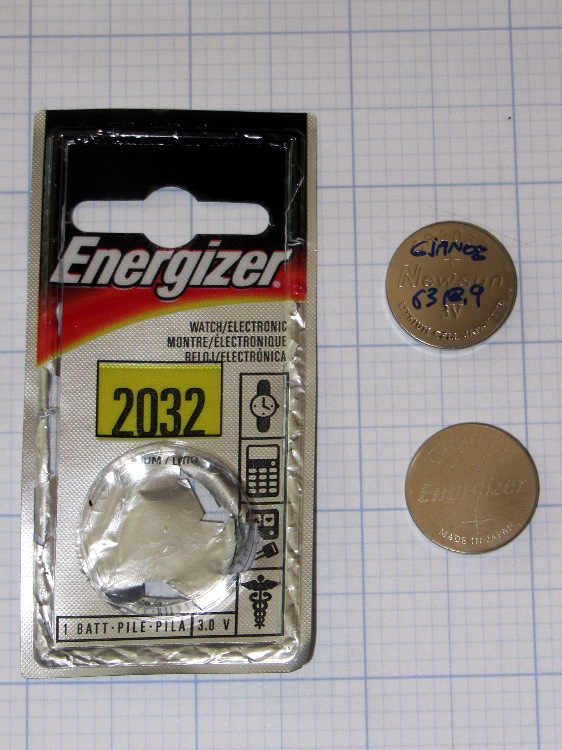
    Alas, the BIOS battery was dead. I’d replaced the dead OEM cell some years back with a (surplus) lithium cell that’s a bit too small, so it only lasted a few years rather than a decade, but the cells were on the shelf. Soooo, I put in another one, just like the other one:

    Thinkpad 560Z BIOS battery
    Thinkpad 560Z BIOS battery

    After nudging the date & time into the current millennium, it then failed to boot Ubuntu 8.04: evidently the mighty 4 GB CompactFlash drive (jammed into a CF-to-IDE adapter) has bit rot.

    It’s a prime candidate for the text-only version of Tiny Core Linux, except that a 560Z can’t boot from either USB or CD-ROM, which means getting the files on the “hard drive” requires extraordinary fiddling. Drat!

    FWIW, when this battery fails, I think the (empty) main battery compartment has room for a CR123A cell that should outlast the rest of the hardware. I could blow two bucks on a replacement from eBay, but what fun is that?

  • Tour Easy: Front Tire Aneurysm

    Front tire aneurysm
    Front tire aneurysm

    Found this aneurysm on the front tire just before a grocery ride, so I stuffed a spare tire and tube into a pannier before rolling away. As expected, it didn’t blow out, but …

    I think this started with a gash in the Kevlar belt that didn’t quite penetrate the cords holding the tire together. As you’ve seen, our tires collect a remarkable number of cuts due to broken glass.

    The cords inside the tire seemed fine, although the weave was somewhat distorted. The inner rubber layer wasn’t punctured, despite what it looks like here.

    The tube also looked fine, despite riding on a tire liner for at least a year. The tube abrasion failures in the rear tire must be due to something other than just the combination of tube and liner; perhaps the tube flexes just enough to erode at the discontinuities.

    This tire went directly to the trash!

  • Reworking Sherline Anti-Backlash Nuts

    The new Y axis anti-backlash nuts for the Sherline mill have a countersink on the end that fits into the saddle. The nut on the left is as-delivered (I bought two) and the nut on the right is after cleanup:

    Sherline Y axis anti-backlash nuts - original vs cleared
    Sherline Y axis anti-backlash nuts – original vs cleared

    The thread was munged enough to jam the leadscrew; it started fine from the knurled end, but wouldn’t emerge from the countersink. This being a left-hand thread, I couldn’t just run a tap through the nut, so clearing the thread required:

    • Some tedious handwork to clear enough of a path until …
    • I could force the nut over the old leadscrew, which re-formed the thread enough that …
    • More tedious handwork could remove the debris and bent brass

    After that, the OD of both nuts was slightly oversized: 0.316 inch, which didn’t fit in the 5/16 inch (0.3125) bore. So I mounted the nut on the old leadscrew, took advantage of the fact that a left-hand thread gets tighter with cutting force from the lathe bit [Edit: wrong! See comments], and turned it down just a hair:

    Turning down anti-backlash nut OD
    Turning down anti-backlash nut OD

    Purists will quibble that I should have used the four-jaw chuck. Turns out the three-jaw has under 1 mil of runout, which is as good as one could possibly want in light of the bearings.

    The X axis nuts were fine, so I suspect a recent production run had a bit of a tooling problem.

    [Update: The mail brings replacement nuts that look just fine. Must have been one of those glitches. No hard feelings!]

  • Canon S630: Bulk Ink Rot

    Something has gone badly wrong with the yellow bulk ink that I’m using in the Canon S630. Over the winter a precipitate formed in the bottles:

    Sediment in ink bottles
    Sediment in ink bottles

    And in the ink tanks:

    Sediment in ink tank
    Sediment in ink tank

    But now that the Basement Laboratory has warmed up, not only does the precipitate remain, but some of it is growing:

    Growth in ink tank
    Growth in ink tank

    The picture doesn’t do it justice; it looks like pond scum in there. Only the yellow ink behaves like that, so it’s likely some contaminant in that batch. Because I buy ink in pint bottles, it’s a long time since that batch arrived and there’s no point in kvetching to the vendor. IIRC, I actually got this bottle from a friend who scrapped out his S630; he’d been refilling cartridges from the same source, too.

    I ordered four sets of five tanks (CMYKK) from the usual eBay vendor for 20 bucks and will toss the old tanks & ink when those arrive.

    There’s a set of four bulk ink bottles from a long-dead HP2000C printer on the shelf, but I suspect the ink chemistry differs by enough to ruin the Canon’s printhead… which is discontinued, so when the head dies, the printer dies, too.