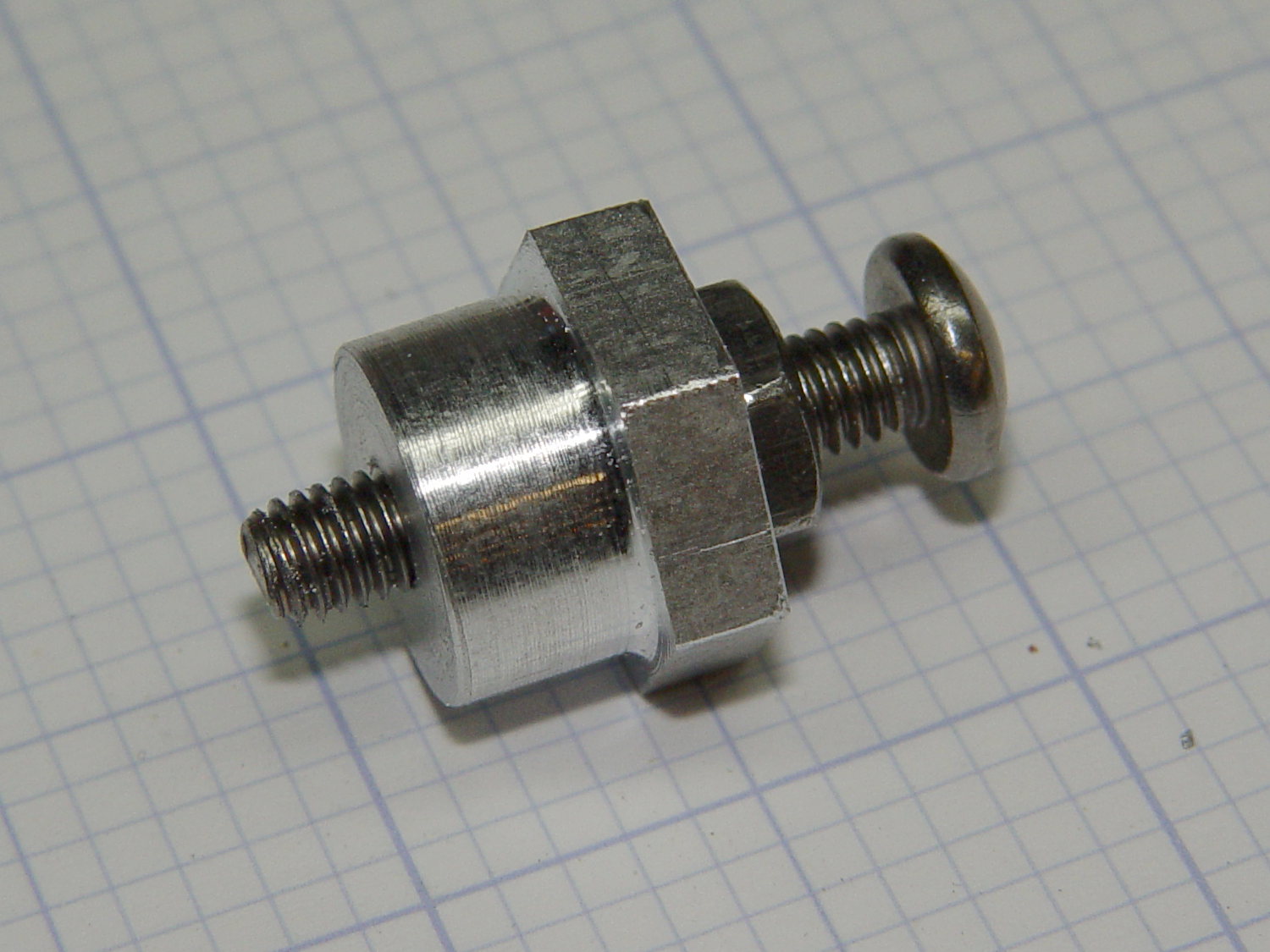
One of the clips holding the rear fender on my Tour Easy broke:

Well, if the truth be told, the fender jammed against the tire when I jackknifed the trailer while backing into a parking spot, dragged counterclockwise with the tire, and wiped that little tab right off the block. After 16 years of service, it doesn’t owe me a thing.
Although the clip around the fender sits a bit lower than it used to (actually, the entire fender sits a bit lower than it should be), you can see the tab had a distinct bend at the edge of the aluminum block supporting the underseat bag frame: the block isn’t perpendicular to the tire / fender at that point.
After devoting far too long to thinking about how to angle the tab relative to the clip, I realized that I live in the future and can just angle the clip relative to the tab. Soooo, the solid model has a rakish tilt:
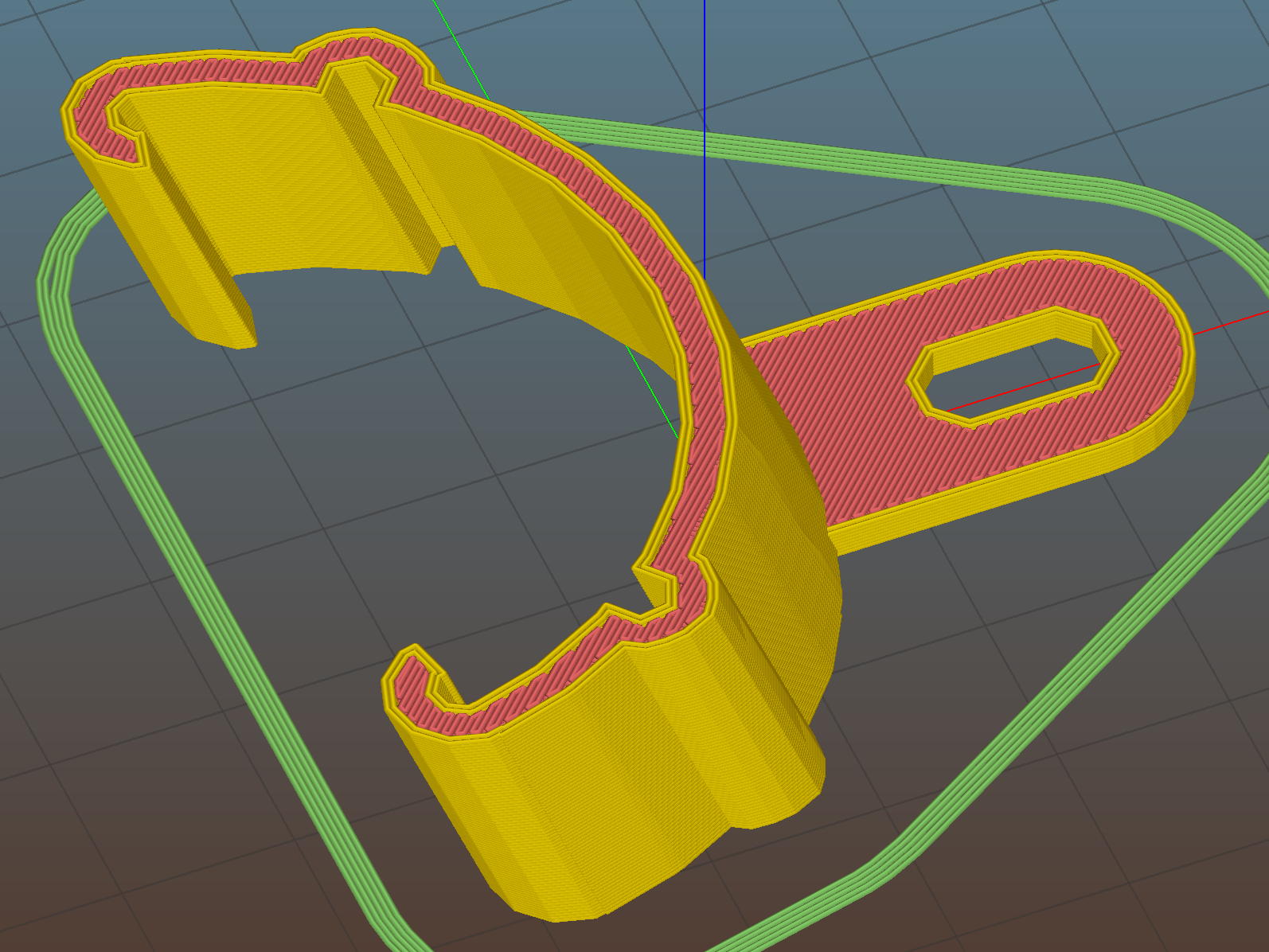
The original design had a pair of strain relief struts where the tab meets the clip, but I figured I’ll add those after the PETG fractures.
I mooched the small bumpouts along the arc from the original design; they provide a bit of stretch & bend so to ease the hooks around the fender.
The hooks meet the clip with very slight discontinuities that, I think, come from slight differences between the 2D offset() operation and the circle() diameter; the usual 1/cos(180/numsides) trick was unavailing, so I tinkered until the answer came out right.
Despite those stretchy bumps, it took three iterations, varying the chord height by about 1.5 mm, to securely snap those hooks onto the fender:
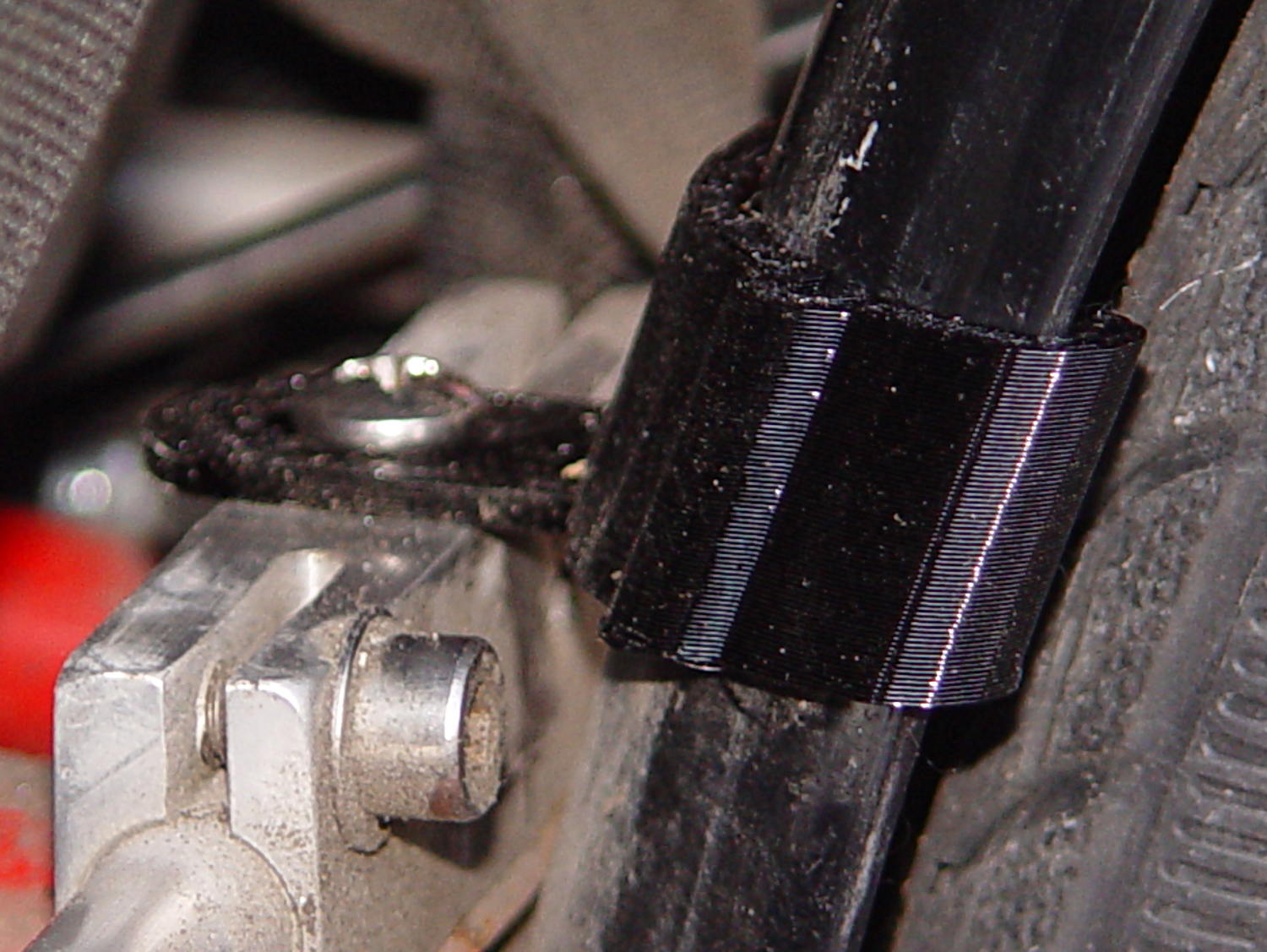
Yeah, sorry ’bout the fuzzy focus on the screw head.
It’s impossible to measure the chord height accurately enough in that position and I was not going to dismount the rear tire just to get a better measurement.
You can see how the clip’s rakish tilt matches the fender’s slope, so the tab isn’t bent at all. It’ll probably break at the block the next time I jackknife the trailer, of course.
I heroically resisted the urge to run off a lower fender mount.
The OpenSCAD source code as a GitHub Gist:
| // Tour Easy rear fender clip | |
| // Ed Nisley KE4ZNU February 2017 | |
| Layout = "Build"; // Build Profile Tab Clip | |
| //- Extrusion parameters must match reality! | |
| ThreadThick = 0.25; | |
| ThreadWidth = 0.40; | |
| HoleWindage = 0.2; | |
| Protrusion = 0.1; // make holes end cleanly | |
| inch = 25.4; | |
| function IntegerMultiple(Size,Unit) = Unit * ceil(Size / Unit); | |
| //———————- | |
| // Dimensions | |
| // special case: fender is exactly half a circle! | |
| FenderC = 47.0; // fender outside width = chord | |
| FenderM = 18.5; // height of chord | |
| FenderR = (pow(FenderM,2) + pow(FenderC,2)/4) / (2 * FenderM); // radius | |
| echo(str("Fender radius: ", FenderR)); | |
| FenderD = 2*FenderR; | |
| FenderA = 2 * asin(FenderC / (2*FenderR)); | |
| echo(str(" … arc: ",FenderA," deg")); | |
| FenderThick = 2.5; // fender thickness, assume dia of edge | |
| ClipHeight = 18.0; // top to bottom, ignoring rakish tilt | |
| ClipThick = 3.0; // thickness of clip around fender | |
| ClipD = FenderD; // ID of clip against | |
| ClipSides = 4 * 8; // polygon sides around clip circle | |
| BendReliefD = 2.5; // bend arch diameter | |
| BendReliefA = 2/3 * FenderA/2; // … angle from dead ahead | |
| BendReliefCut = 1.0; // factor to thin outside of bend | |
| TabAngle = -20; // angle from perpendicular to fender | |
| TabThick = 2.0; | |
| TabWidth = 15.0; | |
| ScrewOffset = 15.0; // screw center to fender along perpendicular | |
| ScrewD = 5.0; | |
| ScrewSlotLength = 2*ScrewD; | |
| //———————- | |
| // Useful routines | |
| module PolyCyl(Dia,Height,ForceSides=0) { // based on nophead's polyholes | |
| Sides = (ForceSides != 0) ? ForceSides : (ceil(Dia) + 2); | |
| FixDia = Dia / cos(180/Sides); | |
| cylinder(r=(FixDia + HoleWindage)/2, | |
| h=Height, | |
| $fn=Sides); | |
| } | |
| //———————- | |
| // Clip profile around fender | |
| // Centered on fender arc | |
| module Profile(HeightScale = 1) { | |
| linear_extrude(height=HeightScale*ClipHeight,convexity=5) { | |
| difference() { | |
| offset(r=ClipThick) // outside of clip | |
| union() { | |
| circle(d=ClipD,$fn=ClipSides); | |
| for (i=[-1,1]) | |
| rotate(i*BendReliefA) { | |
| translate([ClipD/2 + BendReliefD/2,0,0]) | |
| circle(d=BendReliefD,$fn=6); | |
| } | |
| } | |
| union() { // inside of clip | |
| circle(d=ClipD,$fn=ClipSides); | |
| for (i=[-1,1]) | |
| rotate(i*BendReliefA) { | |
| translate([ClipD/2 + BendReliefCut*BendReliefD/2,0,0]) | |
| circle(d=BendReliefD/cos(180/6),$fn=6); | |
| translate([ClipD/2,0,0]) | |
| square([BendReliefCut*BendReliefD,BendReliefD],center=true); | |
| } | |
| } | |
| translate([(FenderR – FenderM – FenderD/2),0]) // trim ends | |
| square([FenderD,2*FenderD],center=true); | |
| } | |
| for (a=[-1,1]) // hooks around fender | |
| rotate(a*(FenderA/2)) | |
| translate([FenderR – FenderThick/2,0]) { | |
| difference() { | |
| rotate(1*180/12) | |
| circle(d=FenderThick + 2*ClipThick,$fn=12); | |
| rotate(1*180/8) | |
| circle(d=FenderThick,$fn=8); | |
| rotate(a * -90) | |
| translate([0,-2*FenderThick,0]) | |
| square(4*FenderThick,center=false); | |
| } | |
| } | |
| } | |
| } | |
| //———————- | |
| // Mounting tab | |
| module Tab() { | |
| linear_extrude(height=TabThick,convexity=3) | |
| difference() { | |
| hull() { | |
| circle(d=TabWidth,$fn=ClipSides); | |
| translate([(ScrewSlotLength – ScrewD)/2 + (FenderR + ScrewOffset),0,0]) | |
| circle(d=TabWidth,$fn=ClipSides); | |
| } | |
| circle(d=ClipD,$fn=ClipSides); // remove fender arc | |
| hull() // screw slot | |
| for (i=[-1,1]) | |
| translate([i*(ScrewSlotLength – ScrewD)/2 + (FenderR + ScrewOffset),0,0]) | |
| rotate(180/8) | |
| circle(d=ScrewD/cos(180/8),$fn=8); | |
| } | |
| } | |
| //———————- | |
| // Combine at mounting angle | |
| module Clip() { | |
| difference() { | |
| union() { | |
| translate([-FenderR,0,0]) | |
| Tab(); | |
| rotate([0,TabAngle,0]) | |
| translate([-FenderR,0,0]) | |
| Profile(2); // scale upward for trimming | |
| } | |
| translate([0,0,-ClipHeight]) // trim bottom | |
| cube(2*[FenderD,FenderD,ClipHeight],center=true); | |
| translate([0,0,ClipHeight*cos(TabAngle)+ClipHeight]) // trim top | |
| cube(2*[FenderD,FenderD,ClipHeight],center=true); | |
| } | |
| } | |
| //———————- | |
| // Build it | |
| if (Layout == "Profile") { | |
| Profile(); | |
| } | |
| if (Layout == "Tab") { | |
| Tab(); | |
| } | |
| if (Layout == "Clip") { | |
| Clip(); | |
| } | |
| if (Layout == "Build") { | |
| Clip(); | |
| } |
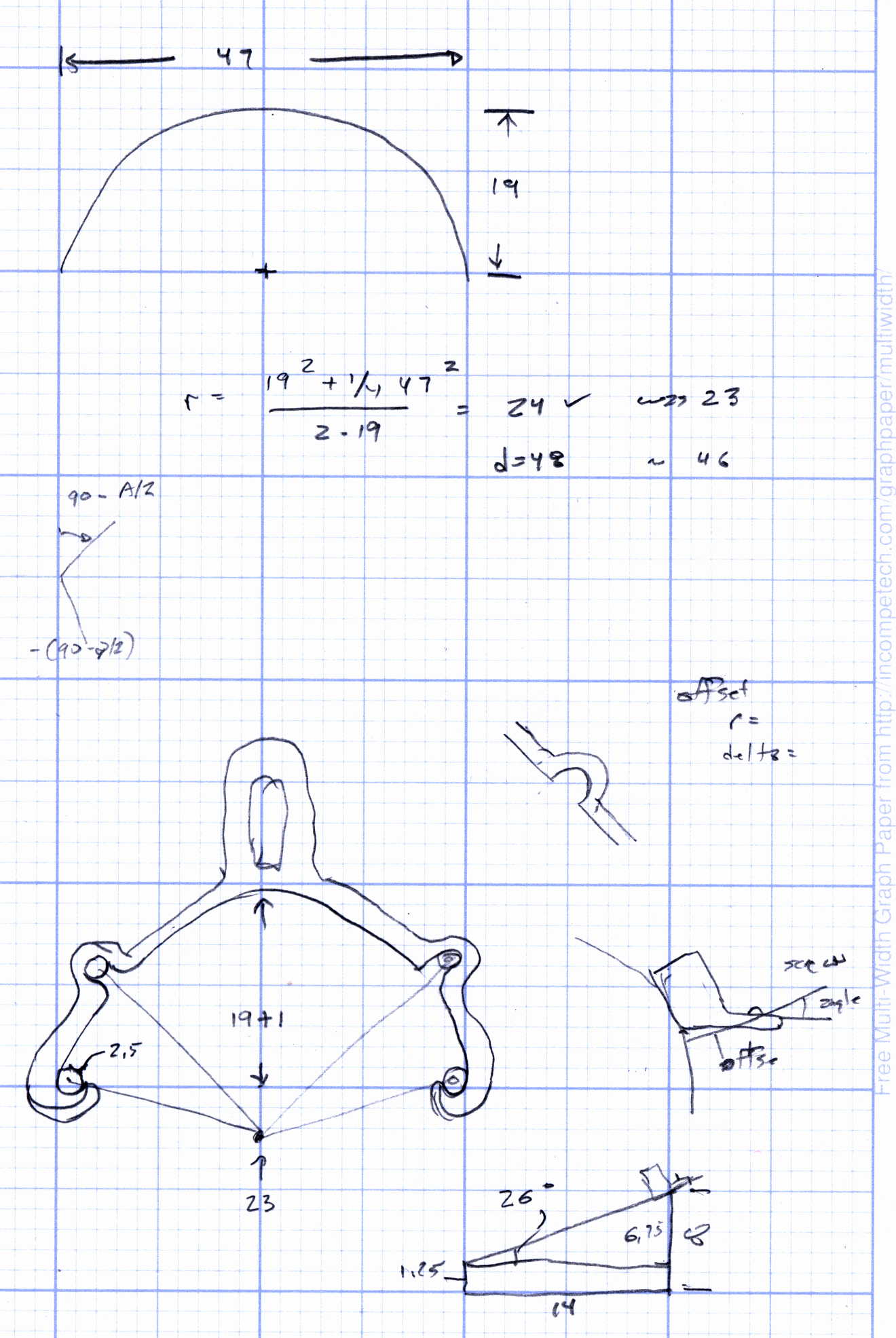
The original doodle, with some measurements unable to withstand the test of time: