The Smell of Molten Projects in the Morning

Ed Nisley's Blog: Shop notes, electronics, firmware, machinery, 3D printing, laser cuttery, and curiosities. Contents: 100% human thinking, 0% AI slop.

Tag: Laser Cutter

  • Bed Frame Feet

    Bed Frame Feet

    Quite some time ago I slipped felt pads under the feet holding the bed frame off the wood floor and recently noticed two of them perpetrating an escape. My first thought was a variation of the 3D printed Fuzzy Felt Feet holders under our power chairs, but the bed frame feet are much larger.

    The holders are basically rings surrounding the feet and felt, which LightBurn makes easy enough:

    Bed Frame Feet - LB layout
    Bed Frame Feet – LB layout

    The Foot Retainer is 6 mm plywood, the Plate and Felt Retainer are 3 mm.

    I fired a ranging shot to verify the sizes:

    Bed Feet - clamping
    Bed Feet – clamping

    Then do three more, apply wood glue, and deploy Too Many Clamps.

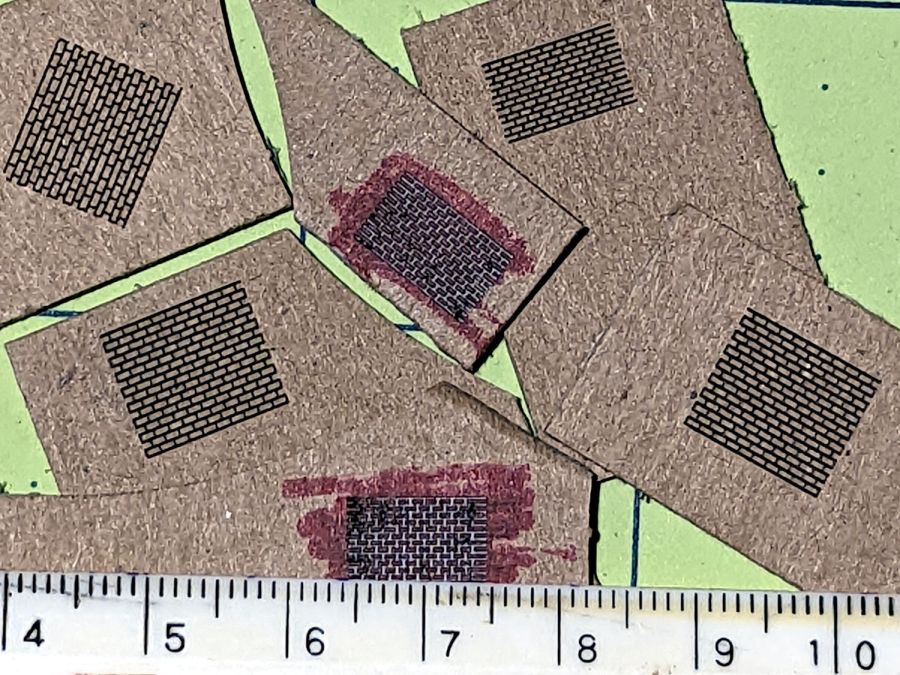
    The fuzzy felt feet are about 5 mm thick, so the 3 mm plywood shouldn’t quite touch the floor. Alas, the fuzz squishes more than I expected, so I added the chipboard Felt Spacers for a millimeter more clearance:

    Bed Feet - chipboard spacer
    Bed Feet – chipboard spacer

    They’re glued to the Plate with the felt adhesive side stuck to them:

    Bed Feet - fuzzy felt foot
    Bed Feet – fuzzy felt foot

    The felt and chipboard compress under load so now it behaves as it should:

    Bed Feet - installed
    Bed Feet – installed

    Gotta get better at gluing plywood together, though.

  • Laser Cutter: Fire Extinguisher Brackets

    Laser Cutter: Fire Extinguisher Brackets

    A Genuine Kidde Fyre Freez CO₂ extinguisher that Came With The House™ finally found its ideal location:

    Fyre Freez extinguisher - mounted
    Fyre Freez extinguisher – mounted

    It was last refilled 65 years ago:

    Fire Extinguisher Recharge Tag - 1957
    Fire Extinguisher Recharge Tag – 1957

    I know it’s still good, because the label has its 4 lb 7 oz refilled gross weight stamped into it, which is exactly what it weighs today.

    Walter Smith Welding Supplies may still be in business, perhaps in Poughkeepsie, but their former 18 Downs St location in Kingston has become Noble Gas Solutions:

    Noble Gas Solutions - 18 Downs St Kingston - 2019
    Noble Gas Solutions – 18 Downs St Kingston – 2019

    Back then, you could call Smith Welding at a four digit phone number in Kingston: 5061. Nowadays, you must call Noble Gas with three more digits: 338-5061. As Charles Stross observed, something like 70% of the future is already in place, because infrastructure is so tenacious.

    Heck, just look at that Quonset hut!

    Keep calm and extinguish on:

    Fyre Freez extinguisher - step 4
    Fyre Freez extinguisher – step 4

    Two thoughts spring to mind:

    • Most kitchen fires start waist-high (it’s the late 1950s: where else would she be?)
    • She’s gonna lose skin on that metal tank

    Seems to me a Fyre Freez will get cold enough to freeze skin while discharging, but I admit to not having actually tried it.

    Anyhow, given the overall basement decor, the brackets have the right general style:

    Fyre Freez extinguisher - bracket detail
    Fyre Freez extinguisher – bracket detail

    Here’s hoping its future will be as dull as its past …

  • Sears / Kenmore Progressive Vacuum Cleaner: Motor FAIL

    Sears / Kenmore Progressive Vacuum Cleaner: Motor FAIL

    After seven years, our Sears / Kenmore Progressive vacuum cleaner gave off a horrible screech and an intense smell of electrical death, prompting me to tear it apart.

    It’s easy to find the two front screws holding the top in place, although you’ll need either a bendy or offset screwdriver to remove them:

    Sears Progressive Vacuum - front case screws
    Sears Progressive Vacuum – front case screws

    Pull up hard on the cord retraction plunger to remove it, revealing the two rear screws:

    Sears Progressive Vacuum - rear case screws
    Sears Progressive Vacuum – rear case screws

    Extract the wires and motor control PCB from their niches:

    Sears Progressive Vacuum - motor assembly overview
    Sears Progressive Vacuum – motor assembly overview

    Prying the latch in the middle of the rear panel (over on the right) releases the motor assembly, which you can then wiggle-n-jiggle upward and out:

    Sears Progressive Vacuum - extracting motor assembly
    Sears Progressive Vacuum – extracting motor assembly

    Disconnect the wires, peel off various foam bits, and extract the motor from its carapace. Measure the blower diameter and cut a suitable plywood clamp for the bench vise:

    Sears Progressive Vacuum - custom motor clamp
    Sears Progressive Vacuum – custom motor clamp

    I loves me some good laser cutter action, even when the plywood crate the laser came in doesn’t have much to recommend it:

    Sears Progressive Vacuum - failed plywood clamp
    Sears Progressive Vacuum – failed plywood clamp

    I vaguely recall reading the purple tinge comes from the bromine vapor used to dis-insect the wood during manufacturing, before shipping it halfway around the planet.

    One area of the commutator looks like it’s in bad shape:

    Sears Progressive Vacuum - as-found commutator
    Sears Progressive Vacuum – as-found commutator

    Clean the commutator bars in the desperate hope it’s just random crud, even though that seems unlikely, then connect a widowmaker cord to the motor terminals:

    Sears Progressive Vacuum - widowmaker line cord
    Sears Progressive Vacuum – widowmaker line cord

    Use a Variac to spin the motor at a (relatively) low speed while watching the brushes and commutator:

    Sears Progressive Vacuum - commutator sparking
    Sears Progressive Vacuum – commutator sparking

    Now, that is not a nominal outcome.

    The cleaned commutator again shows signs of distress:

    Sears Progressive Vacuum - scarred commutator
    Sears Progressive Vacuum – scarred commutator

    Indeed, measuring the resistance across the line cord terminals shows a shorted winding: 0.0 Ω with the brushes aligned on the bars just antispinward of the scars.

    So the motor is definitely, irretrievably dead.

    Extracting the brushes shows the arcs have eroded their spinward edges:

    Sears Progressive Vacuum - eroded motor brushes
    Sears Progressive Vacuum – eroded motor brushes

    The dark smudge on the windings seems due to internal problems, rather than just the arcs, because the wiring crossing between the commutator and the smudge remains clean:

    Sears Progressive Vacuum - charred motor windings
    Sears Progressive Vacuum – charred motor windings

    One can buy a used motor assembly on eBay for about $40, with no assurance it doesn’t also have a shorted winding.

    Dang, now I gotta make more adapters for whatever vacuum comes next …

  • Laser Cutter: LightBurn Camera Accuracy

    Laser Cutter: LightBurn Camera Accuracy

    After going through the LightBurn camera alignment / calibration process, I thought it would be interesting to see how well the corrected image matches the design grid.

    Burn some holes and draw lines 10 mm in from the physical corners, like this:

    LB Camera Cal - corner target
    LB Camera Cal – corner target

    Burn holes and lay in a 10 mm grid at the center point:

    LB Camera Cal - center grid
    LB Camera Cal – center grid

    The center grid as seen through the camera:

    LB Camera Cal - center grid overlay
    LB Camera Cal – center grid overlay

    That’s after adjusting the X and Y offset to align the center of the imaged grid with the center of the design grid. That’s using the non-faded image to make the target lines more visible.

    The corner markers don’t quite line up with the grid, but they’re not off by much (using the faded image to make the grid more visible):

    • LB platform overlay - adj - rear left
    • LB platform overlay - adj - rear right
    • LB platform overlay - adj - front left
    • LB platform overlay - adj - front right

    You could, of course, split the difference among all five sites, but I think having the middle of the platform be more accurate than the far corners makes more sense.

    In any event, a few millimeters works for most purposes, even if you’d want to verify the alignment for critical operations before firing the laser in earnest.

  • Laser Cutter: LightBurn Camera Calibration

    Laser Cutter: LightBurn Camera Calibration

    Going through the LightBurn lens calibration and camera alignment routine produces an orthographic view of the laser platform from a camera with an ordinary lens perched somewhere above it.

    Early on, I stuck a camera to the lid of my OMTech 60 W laser:

    OMTech Laser - camera mount
    OMTech Laser – camera mount

    The uncorrected view from the camera (through VLC):

    LB Uncorrected Camera View
    LB Uncorrected Camera View

    After calibration and alignment, LightBurn underlays this view of the platform behind the workspace:

    LB Corrected Camera View
    LB Corrected Camera View

    The correction depends critically on the camera maintaining its position / orientation / focus, which turns out to be a bad assumption for the camera I’ve been using, because the (metal) focus locking screw binds directly on the (metal) lens threads. This works, until vibrations slightly loosen the screw and the lens shifts ever so slightly.

    After noticing the focus had shifted again, I tucked a snippet of silicone insulation from some 30 AWG hookup wire into the screw hole to compress against the lens thread, then re-did the entire sequence with some attention to detail.

    Pulsing the laser in each corner produced pinholes exactly 700×500 mm apart. One diagonal is 859.0 mm and the other is 861.5 mm, pretty close to the ideal 860.2 mm.

    Next, to measure the offsets from some known positions …

  • Rolltop Cupcake Box

    Rolltop Cupcake Box

    It’s actually the sample Bread Box, sized just about right for a cupcake or two:

    Rolltop cupcake box - closed
    Rolltop cupcake box – closed

    Even if I have a soft spot for cupcakes, it’s also the right size to corral the batteries we use on the bikes:

    Rolltop cupcake box - open
    Rolltop cupcake box – open

    I’d never done anything with flexible plywood sheets, so I started by cutting the door all by itself. Turns out 3 mm plywood flexes wonderfully well, which led to cutting the rest of the box.

    The zit on the left side is a knot on the “bad” side of the plywood, visible due to not reversing that piece to put its “good” side downward. I also had to re-cut the curved door guides along the front edge (using the paper support) after they fell through the stock (up on spikes) and got torched during subsequent cuts:

    Rolltop cupcake box - cutting guides
    Rolltop cupcake box – cutting guides

    The instructions recommend applying wax to the sliding surfaces and that’s a very good idea; although I used cutting wax, paraffin should work. In addition, I filed off the projecting edges of the guide plates around the interior curve, if only to be sure the door couldn’t possibly catch after it was permanently assembled.

    I glued it in about five stages to keep everything aligned, starting with the right rear corner stabilized by the bench block and eventually coaxing the left side over all those fingers.

    Hit the festi.info custom URL with all the build parameters to make your own, although you should tweak the measurements to suit your plywood.

  • CPAP Hose Dryer: Filter Bottle

    CPAP Hose Dryer: Filter Bottle

    With the general idea being to dry a CPAP hose by pulling clean air through it, putting laser-cut MDF upwind of the inlet was a known-bad idea:

    CPAP Dryer - overview
    CPAP Dryer – overview

    It did, however, dry the tubing and the construction was Pretty Close™ to being the proper size.

    Making the stand from acrylic sheet eliminates the MDF stench:

    CPAP Dryer filter - acrylic stand - fitting end
    CPAP Dryer filter – acrylic stand – fitting end

    Incoming air passes through a dome-style N95 mask:

    CPAP Dryer filter - acrylic stand - filter end
    CPAP Dryer filter – acrylic stand – filter end

    The mask sets the overall size of the stand:

    CPAP Dryer - Filter holder - LB layout
    CPAP Dryer – Filter holder – LB layout

    Given that we’re not talking Level 4 Biohazard, any filter would work equally well. A dome mask has a nicely defined and self-supporting shape with a flange around the edge.

    The flange provides a convenient way to build the clamp ring, starting with a scan from the face side:

    Demetech Dome Mask - interior scan
    Demetech Dome Mask – interior scan

    Tracing the flange outline using GIMP’s Scissor Select tool and doing a little cleanup in Quick Mask mode produced a selection suitable for becoming a binary mask of the N95 mask:

    Demetech Dome Mask - perimeter mask
    Demetech Dome Mask – perimeter mask

    Ex post facto, I realized the mask has a sufficiently regular outline to fit a much simpler Beziér spline:

    CPAP Dryer - Filter holder - LB splines
    CPAP Dryer – Filter holder – LB splines

    That began in LightBurn as a circle fitting the lower part of the mask, converted to a path, then tweaked with the Node Editor to fit the top of the nose and add two nodes to pull the path inward on either side. In the unlikely event I make another bottle stand, the cut will be irrelevantly smoother.

    The hole in the clamp comes from insetting that path by the flange width of 4 mm, whereupon the N95 mask pretty much self-centers in the hole:

    CPAP Dryer filter - acrylic stand - filter clamp
    CPAP Dryer filter – acrylic stand – filter clamp

    You could draw a face on that thing…

    The four small holes fit M3 aluminum rivet nuts:

    CPAP Dryer filter - trimmed Rivnuts
    CPAP Dryer filter – trimmed Rivnuts

    They’re shortened by 1 mm (from the original length shown in the upper right) to fit 1 mm of mask sandwiched inside a pair of 3 mm acrylic sheets:

    CPAP Dryer filter - Rivnut installed
    CPAP Dryer filter – Rivnut installed

    The glowy edge-lit acrylic sheet has 4.8 mm holes for a snug push fit and the white clamp ring has 5.1 mm holes for a loose alignment fit. I drilled out the laser-cut holes for nice smooth sides.

    I picked a bottle large enough to also hold the mask’s elbow, so that it would dry in the same stream of clean air. So far, the elbows dry well enough on their own, but the bottle remains a convenient size for fitting the mask on its end.

    On the other end of the bottle, the lid gets a hose fitting turned from PVC pipe:

    CPAP Dryer - filter hose fitting glue rings
    CPAP Dryer – filter hose fitting glue rings

    The Official ResMed fittings on the masks and the AirSense 11 machine are about 20 mm long and just over 22 mm OD with a slight taper. The unheated hose has silicone rubber ends fitting very snugly around those cylinders, so I made the pipe fittings 25 mm long and 21 mm OD to ensure a low-effort, but still secure, fit.

    The grooves cut into the fitting anchor a generous hot-melt glue blob sealing it to the lid:

    CPAP Dryer - filter hose fitting inside
    CPAP Dryer – filter hose fitting inside

    Yes, the foam disk and the hole through the lid were both laser-cut. Making perfect circles in thin organic material with zero drama is wonderful.

    The downstream / mask end of the heated ClimateLine hose (left) is physically identical to the unheated hose ends, but the machine / upstream end (right) sports an electrical connector for the spiral heating element and the thermistor (in the white stud protruding into the mask end lumen):

    ResMed ClimateLine heated hose ends
    ResMed ClimateLine heated hose ends

    Yes, that does look a lot like a naked USB connector, as does the main power connection on the machine, and you can actually slide a Type A USB connector around it. The ResMed manual pointedly notes:

    •Do not insert any USB cable into the AirSense 11 device or attempt to plug the AC adaptor into a USB device. This may cause damage to the AirSense 11 device or USB device.
    •The electrical connector end of the heated air tubing is only compatible with the air outlet at the device end and should not be fitted to the mask.

    ResMed AirSense 11 Clinical Guide

    Protip: When you must carefully explain why T. C. Mits should not mate two obviously compatible and mutually antagonistic devices, your design-fu has failed.

    The four ribs inside the upstream end slide over a 23.5 mm cylinder, which is enough larger than the 22 mm cylinder on the machine to wiggle the not-USB connector into place. Without a connector to worry about, I turned a sleeve adapting the smaller fitting to those ribs:

    CPAP Dryer filter - heated hose bushing
    CPAP Dryer filter – heated hose bushing

    It’s 27 mm long to keep the lip of the silicone seal away from the setscrew, 23.5 mm OD to exactly fit between the ribs, and a 21.5 mm ID slip fit over the bottle snout.

    The tiny M3 setscrew lives in a hole tapped into the inner tube, because the sleeve is only 1 mm thick:

    CPAP Dryer filter - acrylic stand - bushing center drill
    CPAP Dryer filter – acrylic stand – bushing center drill

    The setscrew turns outward into a clearance hole drilled in the sleeve to lock it in place.

    The outer PVC pipe in the vise is a simple cylinder fixture bored to match the sleeve, so I could grab it in the lathe chuck / vise without distortion. Just the force from a normal grip squishes the fixture enough to keep the sleeve from turning / moving / getting annoyed.

    Improving the MDF fan box awaits a few parts, but, being downstream, isn’t on the critical path for drying hoses. The only trick is keeping the bottle inlet upstream of the fan exhaust.