The Smell of Molten Projects in the Morning

Ed Nisley's Blog: Shop notes, electronics, firmware, machinery, 3D printing, laser cuttery, and curiosities. Contents: 100% human thinking, 0% AI slop.

Tag: Improvements

Making the world a better place, one piece at a time

  • Homage Tektronix Circuit Computer: Ball-point Pens vs. Paper

    Extra Fine Pilot V5 pens have a 0.5 mm ball, in contrast to the 1.0 mm ball in the cheap pens I’ve been using, so they should produce much finer lines.

    Which turns out to be the case:

    Tek Circuit Computer - pen and paper comparison
    Tek Circuit Computer – pen and paper comparison

    That’s a stack of three “Homage” Tek CC bottom decks under a Genuine Tektronix Circuit Computer.

    The black scale at the top of the picture (and the bottom of the stack) came from a 1 mm cheap pen in the collet holder, the two green scales come from a 0.5 mm Pilot V5RT cartridge in its new holder, and the Original is (most likely) laser-printed back when that was a New Thing.

    As always, paper makes a big difference in the results. The brownish paper is 110 pound card stock with a relatively coarse surface finish. The white paper is ordinary 22 pound general-purpose laser / inkjet printer paper.

    The 1.0 mm pen (top) doesn’t much care what it’s writing on, producing results on the low side of OK: some light sections, no blobs. Perfectly serviceable, but not pretty.

    1.0 mm ball pen
    1.0 mm ball pen

    The Pilot V5RT really likes better paper, as it bleeds out on the card stock whenever the CNC 3018XL so much as pauses at the end of a stroke. Using white paper slows, but doesn’t completely stop, the bleeding, making the blobs survivable.

    0.5 mm ball Pilot V5RT pen
    0.5 mm ball Pilot V5RT pen

    I’ve been using card stock to get stiffer, more durable, and more easily manipulated decks, but the improved line quality on the white paper says I should laminate the decks in plastic, just like the original Tektronix design.

    No surprise there!

  • Google Pixel 3a Photomicrography vs. Ballpoint Pens

    The Google Pixel 3a camera, unlike the camera in my older Google Pixel XL, takes spectacularly good images through a widefield 5X eyepiece on the stereo zoom microscope:

    0.5 1.0 mm ball pens - 0.7 mm lead pencil
    0.5 1.0 mm ball pens – 0.7 mm lead pencil

    That’s hand-holding the phone against the eyepiece while manipulating it with the other hand. Definitely not the most stable arrangement, but the camera copes well with slight motions. I really need a gripping hand for the camera, to free up another for the microscope’s focus knob.

    For the record:

    Zooming in (because it’s a stereo zoom microscope and I can), the 1.0 mm ball seems surprisingly un-wetted by its ink:

    1.0 mm ball pen
    1.0 mm ball pen

    The Pilot V5 ball seems more smoothly covered:

    0.5 mm ball Pilot V5RT pen
    0.5 mm ball Pilot V5RT pen

    Those are at the same magnification & crop size, so they’re to the same scale.

    This definitely calls for a customized phone-to-eyepiece holder!

  • CNC 3018XL: Pilot V5RT Pen Holder

    It turns out my all-time favorite Pilot Precise V5 Extra Fine stick pen also comes in a clicky-top retractable version:

    Pilot V5 and V5RT pens
    Pilot V5 and V5RT pens

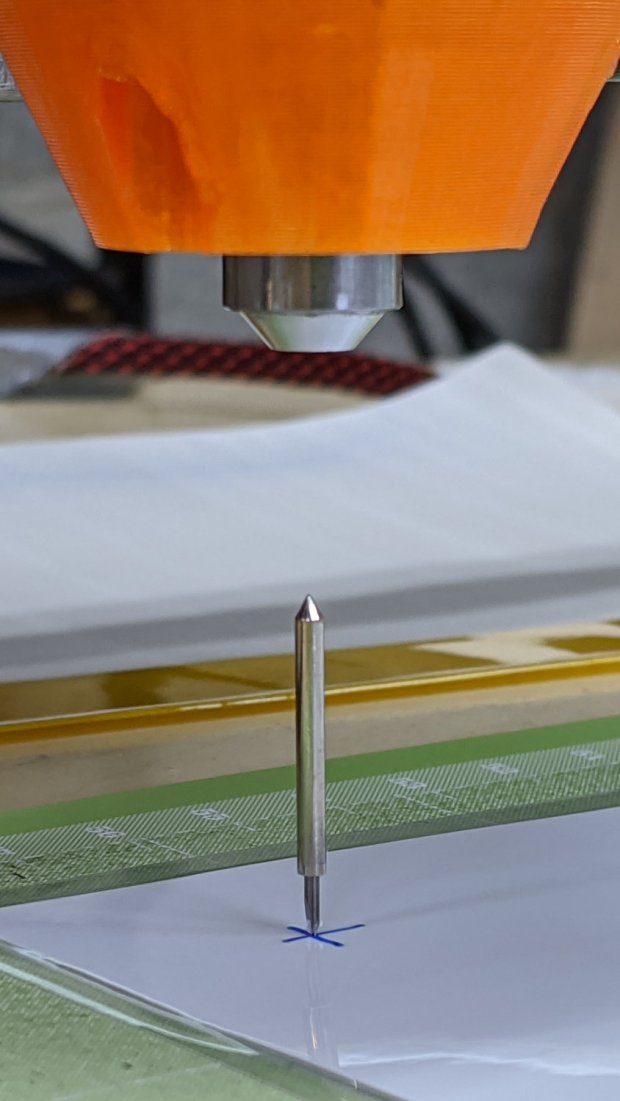
    The cartridge is a nice 6 mm cylinder, eminently transformable into a plotter pen:

    Pilot V5RT holder - installed
    Pilot V5RT holder – installed

    A few minutes with a caliper provides key measurements for a snout surrounding the business end:

    Pilot V5RT Pen Holder - snout dimension doodle
    Pilot V5RT Pen Holder – snout dimension doodle

    The green letters & numbers give the nearest drill sizes. The “T” values along the bottom are the tailstock turns (at 1.5 mm/turn) required to poke the drills to the indicated depths, eyeballed when the body just enters the hole.

    Having recently decomissioned the Thing-O-Matic and harvested its organs parts, I have a vast collection of 3/8 inch = 9.52 mm shafts and matching bronze bushings:

    9.52 mm shaft and bushings
    9.52 mm shaft and bushings

    Bronze bushings have low stiction, at least when they’re co-axial, and are much shorter than linear ball bearings.

    I chopped off a 70 mm length of shaft and faced the raw end:

    Pilot V5RT holder - facing shaft
    Pilot V5RT holder – facing shaft

    The other end had a maker’s logo, but I don’t recognize it:

    Pilot V5RT holder - center drill
    Pilot V5RT holder – center drill

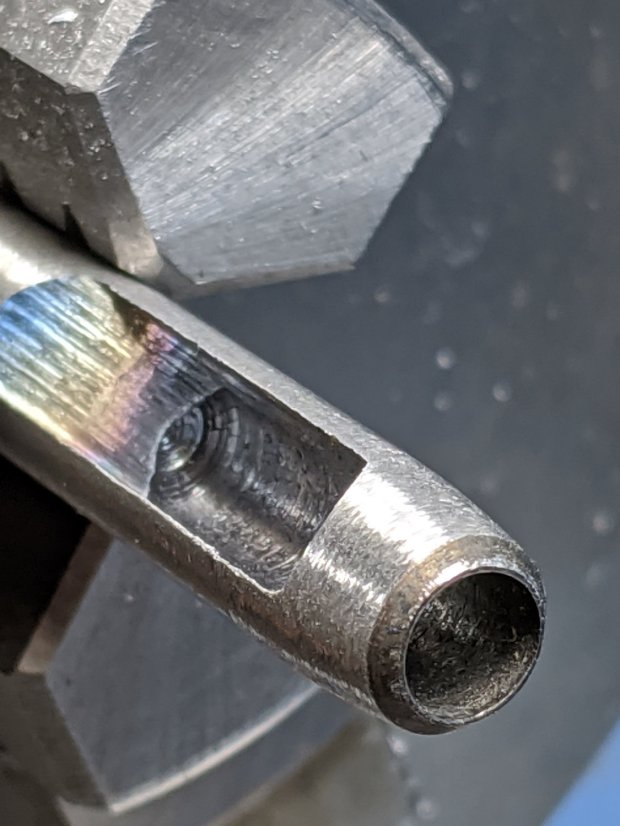
    I really wanted an 8 mm bore around the snout, but it just didn’t work out. The ring around the 7.5 mm counterbore shows where the larger drill just … stopped:

    Pilot V5RT holder - drilled shaft
    Pilot V5RT holder – drilled shaft

    A trial fit with the pen cartridge:

    Pilot V5RT holder - pen in shaft
    Pilot V5RT holder – pen in shaft

    The top of the shaft gets a somewhat longer knurled ring for the 3 mm SHCS holding the cartridge in place:

    Pilot V5RT holder - knurling pen clamp
    Pilot V5RT holder – knurling pen clamp

    The screw bears on a split collar turned and drilled from a Delrin rod:

    Pilot V5RT holder - drilling Delrin clamp
    Pilot V5RT holder – drilling Delrin clamp

    The “split” came from a simple saw cut across one side and I milled a flat spot in the knurling to seat the screw. As usual, the knurled ring got epoxied to the shaft.

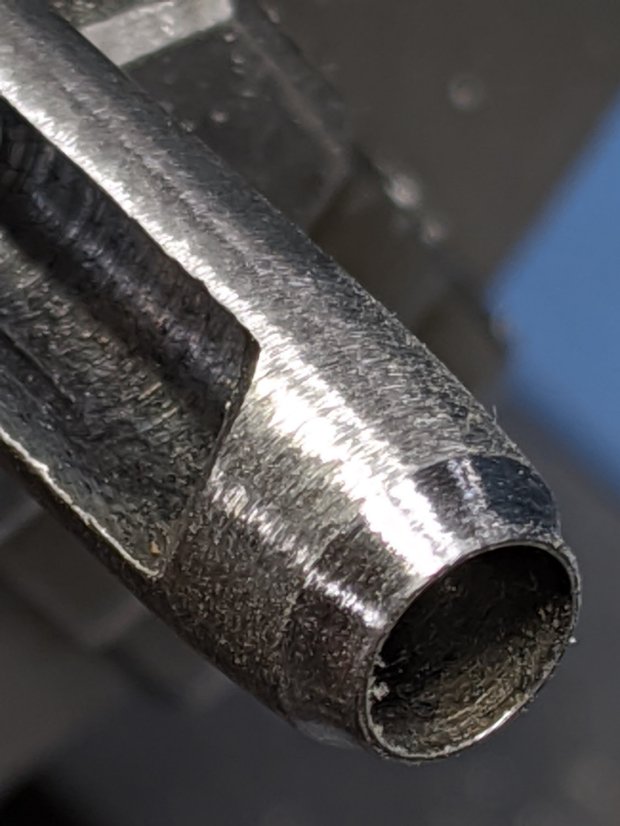
    The snout started as a 3/8 inch aluminum rod, drilled as shown in the sketch, with a (scant) 7.5 mm section to fit the shaft. The carbide insert left a nicely rounded shoulder that required trimming to fit snugly into the shaft:

    Pilot V5RT holder - shaping snout seat
    Pilot V5RT holder – shaping snout seat

    The compound can handle the shallow angle required to shape the snout:

    Pilot V5RT holder - tapering snout
    Pilot V5RT holder – tapering snout

    A trial fit showed the snout was a bit too long for comfort:

    Pilot V5RT holder - snout test fit
    Pilot V5RT holder – snout test fit

    Making something shorter doesn’t pose much of a challenge:

    Pilot V5RT holder - trimming snout
    Pilot V5RT holder – trimming snout

    Another trial fit shows it’s spot on:

    Pilot V5RT holder - shaft snout pen test fit
    Pilot V5RT holder – shaft snout pen test fit

    The critical part is having the snout support the plastic around the pen tip to prevent wobbulation.

    Epoxy the whole thing together, add a suitable spring, tighten the screws & nuts for the reaction plate, and it’s all good. I write with about 50 g of force for these pens, so a light preload seemed in order:

    Pilot V5RT Pen Holder - initial downforce measurement
    Pilot V5RT Pen Holder – initial downforce measurement

    If I’d weighed the full-up shaft + snout + collar + cartridge, I’d know if the Y intercept matches that weight. It seems a little lighter, but I’m not taking the thing apart to find out.

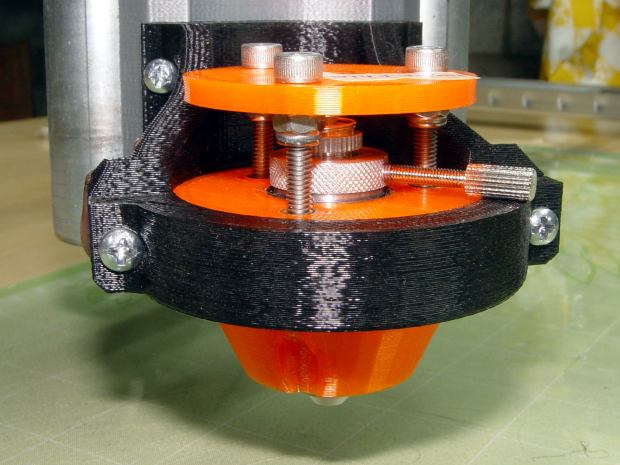
    The first version of the 3D printed holder (shown above) is a straightforward modification of the LM12UU diamond drag bit holder, but, after building enough of these things, I realized the circular reaction plate should be triangular to get more clearance in front of the Z-axis stepper motor when installing & removing the holder:

    Pilot V5RT Pen Holder - solid model - show view
    Pilot V5RT Pen Holder – solid model – show view

    It also has a recess for the serrated top of the bearing, to prevent the knurled collar from clicking annoyingly as the Z-axis rises at the end of each stroke.

    Now, to see how well it draws!

    The OpenSCAD source code as a GitHub Gist:

    // Diamond Scribe in linear bearings for CNC3018
    // Ed Nisley KE4ZNU – 2019-08-9
    Layout = "Build"; // [Build, Show, Base, Mount, Plate]
    /* [Hidden] */
    ThreadThick = 0.25; // [0.20, 0.25]
    ThreadWidth = 0.40; // [0.40, 0.40]
    /* [Hidden] */
    Protrusion = 0.1; // [0.01, 0.1]
    HoleWindage = 0.2;
    inch = 25.4;
    function IntegerMultiple(Size,Unit) = Unit * ceil(Size / Unit);
    ID = 0;
    OD = 1;
    LENGTH = 2;
    //- Adjust hole diameter to make the size come out right
    module PolyCyl(Dia,Height,ForceSides=0) { // based on nophead's polyholes
    Sides = (ForceSides != 0) ? ForceSides : (ceil(Dia) + 2);
    FixDia = Dia / cos(180/Sides);
    cylinder(r=(FixDia + HoleWindage)/2,h=Height,$fn=Sides);
    }
    //- Dimensions
    PenOD = 6.1; // pen refill shaft, max OD
    Bearing = [(3.0/8.0)*inch,16.0,10.6]; // linear bearing body, ID = shaft diameter
    BearingFlange = [Bearing[OD],17.2,1.0]; // flange around end of bearing
    Spring = [8.5,9.5,15.5]; // compression spring around shaft, LENGTH = uncompressed
    SpringRecess = 4*ThreadThick;
    WallThick = 4.0; // minimum thickness / width
    Screw = [3.0,6.75,25.0]; // holding it all together, OD = washer
    Insert = [3.0,4.2,7.9]; // brass insert
    //Insert = [3.0,5.0,8.0];
    //Insert = [4.0,6.0,10.0];
    Clamp = [43.2,44.0,34.0]; // tool clamp ring, OD = clearance around top
    LipHeight = IntegerMultiple(2.0,ThreadThick); // above clamp for retaining
    BottomExtension = 15.0; // below clamp to reach workpiece
    MountOAL = LipHeight + Clamp[LENGTH] + BottomExtension; // total mount length
    echo(str("Mount OAL: ",MountOAL));
    Plate = [PenOD + 4*ThreadWidth,Clamp[ID] – 0*2*WallThick,WallThick]; // spring reaction plate
    echo(str("Screw length: ",Spring[LENGTH] + Plate[LENGTH] + Insert[LENGTH]));
    NumScrews = 3;
    ScrewBCD = Bearing[OD] + Insert[OD] + 2*WallThick;
    echo(str("Retainer max OD: ",ScrewBCD – Screw[OD]));
    NumSides = 9*4; // cylinder facets (multiple of 3 for lathe trimming)
    // Basic mount shape
    module CNC3018Base() {
    translate([0,0,MountOAL – LipHeight])
    cylinder(d=Clamp[OD],h=LipHeight,$fn=NumSides);
    translate([0,0,MountOAL – LipHeight – Clamp[LENGTH] – Protrusion])
    cylinder(d=Clamp[ID],h=(Clamp[LENGTH] + 2*Protrusion),$fn=NumSides);
    cylinder(d1=Bearing[OD] + 2*WallThick,d2=Clamp[ID],h=BottomExtension + Protrusion,$fn=NumSides);
    }
    // Mount with holes & c
    module Mount() {
    difference() {
    CNC3018Base();
    translate([0,0,-Protrusion]) // bearing
    PolyCyl(Bearing[OD],2*MountOAL,NumSides);
    translate([0,0,-Protrusion]) // bearing flanges
    PolyCyl(BearingFlange[OD],BearingFlange[LENGTH] + Protrusion,NumSides);
    translate([0,0,MountOAL – 1.5*BearingFlange[LENGTH]]) // sink into surface
    PolyCyl(BearingFlange[OD],2*BearingFlange[LENGTH],NumSides);
    for (i=[0:NumScrews – 1]) // clamp screws
    rotate(i*360/NumScrews)
    translate([ScrewBCD/2,0,MountOAL – Clamp[LENGTH]])
    rotate(180/8)
    PolyCyl(Insert[OD],Clamp[LENGTH] + Protrusion,8);
    }
    }
    module SpringPlate() {
    difference() {
    hull()
    for (i=[0:NumScrews – 1])
    rotate(i*360/NumScrews)
    translate([ScrewBCD/2,0,0])
    cylinder(d=Screw[OD] + 4*ThreadWidth,h=Plate[LENGTH],$fn=24);
    translate([0,0,-Protrusion])
    PolyCyl(Plate[ID],2*MountOAL,NumSides);
    translate([0,0,Plate[LENGTH] – SpringRecess]) // spring retainer
    PolyCyl(Spring[OD] + 4*ThreadWidth,SpringRecess + Protrusion,NumSides);
    for (i=[0:NumScrews – 1]) // clamp screws
    rotate(i*360/NumScrews)
    translate([ScrewBCD/2,0,-Protrusion])
    rotate(180/8)
    PolyCyl(Screw[ID],2*MountOAL,8);
    }
    }
    //—–
    // Build it
    if (Layout == "Base")
    CNC3018Base();
    if (Layout == "Mount")
    Mount();
    if (Layout == "Plate")
    SpringPlate();
    if (Layout == "Show") {
    Mount();
    translate([0,0,MountOAL + Plate[LENGTH] + Spring[LENGTH]])
    rotate([180,0,0])
    SpringPlate();
    }
    if (Layout == "Build") {
    translate([0,-0.75*Clamp[OD],MountOAL])
    rotate([180,0,0])
    Mount();
    translate([0,0.75*Plate[OD],0])
    SpringPlate();
    }
  • Cheese Slicer: JB Weld Epoxy FTW

    The JB Weld epoxy I slathered on our trusty hand-held cheese slicer a year ago continues to withstand daily washing and occasional trips through the dishwasher:

    Cheese Slicer JB Weld 1 year - top
    Cheese Slicer JB Weld 1 year – top

    The bottom is in fine shape, too:

    Cheese Slicer JB Weld 1 year - bottom
    Cheese Slicer JB Weld 1 year – bottom

    Compare it with XTC-3D epoxy, which admittedly isn’t rated for continuous water exposure, after a year:

    Cheese Slicer - epoxy coating split
    Cheese Slicer – epoxy coating split

    JB Weld FTW!

  • MPCNC Drag Knife Holder: Showing More Blade

    Attempting to cut laminated cardstock decks for the Homage Tektronix Circuit Computer required a bit more blade extension than my LM12UU holder made available:

    Drag Knife - LM12UU ground shaft - assembled
    Drag Knife – LM12UU ground shaft – assembled

    Shortening the 12 mm shaft wasn’t going to happen, so I knocked a little bit off the blade holder to give the knurled lock ring slightly more travel:

    Drag Knife Holder - shortening stop
    Drag Knife Holder – shortening stop

    The lathe cutoff blade is a bit to the right of the new cut, but you get the general idea: not a whole lot of clearance in there.

  • Huion H610Pro (V2) Tablet vs. Ubuntu 18.04

    Given the hassle involved with getting my ancient Wacom Graphire3 tablet working with various Linux versions, I was unsurprised to find a Huion H610Pro (V2) tablet (*) didn’t quite work out of the box.

    Good old lsusb showed the tablet’s USB info:

    lsusb
    Bus 002 Device 002: ID 8087:0024 Intel Corp. Integrated Rate Matching Hub
    Bus 002 Device 001: ID 1d6b:0002 Linux Foundation 2.0 root hub
    Bus 001 Device 004: ID 248a:ff0f  
    Bus 001 Device 007: ID 058f:9410 Alcor Micro Corp. Keyboard
    Bus 001 Device 006: ID 047d:1020 Kensington Expert Mouse Trackball
    Bus 001 Device 005: ID 046d:c508 Logitech, Inc. Cordless Trackball
    Bus 001 Device 003: ID 0451:2046 Texas Instruments, Inc. TUSB2046 Hub
    Bus 001 Device 002: ID 8087:0024 Intel Corp. Integrated Rate Matching Hub
    Bus 001 Device 001: ID 1d6b:0002 Linux Foundation 2.0 root hub
    Bus 004 Device 006: ID 05e3:0748 Genesys Logic, Inc. 
    Bus 004 Device 005: ID 0480:a202 Toshiba America Inc Canvio Basics HDD
    Bus 004 Device 004: ID 0bda:0411 Realtek Semiconductor Corp. 
    Bus 004 Device 003: ID 0451:8041 Texas Instruments, Inc. 
    Bus 004 Device 002: ID 0bda:0411 Realtek Semiconductor Corp. 
    Bus 004 Device 001: ID 1d6b:0003 Linux Foundation 3.0 root hub
    Bus 003 Device 006: ID 256c:006d  
    Bus 003 Device 004: ID 0bda:5411 Realtek Semiconductor Corp. 
    Bus 003 Device 003: ID 0451:8043 Texas Instruments, Inc. 
    Bus 003 Device 002: ID 0bda:5411 Realtek Semiconductor Corp. 
    Bus 003 Device 001: ID 1d6b:0002 Linux Foundation 2.0 root hub

    Yes, the space normally occupied by the product description is blank. The first blank description comes from a generic wireless keypad’s USB receiver; the 0x248a Vendor ID claims be Maxxter, a step down from the usual Logitech ID rip, and its 0xff0f Device ID looks bogus to me, too.

    The 0x256c Vendor ID isn’t in the online databases yet, but some grepping found it in /lib/udev/rules.d/65-libwacom.rules:

    # Huion H610 Pro
    ENV{ID_BUS}=="usb", ENV{ID_VENDOR_ID}=="256c", ENV{ID_MODEL_ID}=="006e",  ENV{ID_INPUT}="1", ENV{ID_INPUT_JOYSTICK}="", ENV{ID_INPUT_TABLET}="1"
    ATTRS{name}=="* Pad", ENV{ID_BUS}=="usb", ENV{ID_VENDOR_ID}=="256c", ENV{ID_MODEL_ID}=="006e",  ENV{ID_INPUT_TABLET_PAD}="1"
    # Huion H610 Pro
    ENV{ID_BUS}=="usb", ENV{ID_VENDOR_ID}=="256c", ENV{ID_MODEL_ID}=="006e",  ENV{ID_INPUT}="1", ENV{ID_INPUT_JOYSTICK}="", ENV{ID_INPUT_TABLET}="1"
    ATTRS{name}=="* Pad", ENV{ID_BUS}=="usb", ENV{ID_VENDOR_ID}=="256c", ENV{ID_MODEL_ID}=="006e",  ENV{ID_INPUT_TABLET_PAD}="1"
    

    Note, however, that the Device ID is 0x006e, where the upgraded V2 tablet is 0x006d; I have no idea why the number goes down as the version goes up. Change all instances of the former to the latter.

    Even though the Wacom driver can apparently handle the older H610Pro, the V2 tablet’s buttons were missing in action.

    The solution seems come from the Digimend project, although it also expects the 0x006e Device ID, and as is usually the case, installing the latest & greatest version, hot from GitHub, did the trick.

    For this first pass, I didn’t use DKMS, which this post will remind me to do after the next kernel upgrade.

    A reboot settled all the drivers into place, after which:

    xsetwacom --list
    HUION Huion Tablet Pen stylus   	id: 10	type: STYLUS    
    HUION Huion Tablet Pad pad      	id: 11	type: PAD 

    Yes, it’s “Tablet Pad pad” and capitalization is important.

    For my simple needs, confining the stylus cursor to the landscape monitor makes sense. Adding this to ~/.config/startup.sh did the same thing as similar invocations for the Wacom:

    xsetwacom --verbose set "HUION Huion Tablet Pen stylus" MapToOutput "DP-1"

    The various buttons still need configuration, although that’s in the nature of fine tuning. The top three buttons are 1, 2, 3, with the rest tagging along at 8 through 12. They take trendy gray-on-black labeling to an absurd limit:

    Huion H610Pro V2 - embedded gray-on-black buttons
    Huion H610Pro V2 – embedded gray-on-black buttons

    That’s with intense overhead lighting shining into the buttons and lighting up the lower-surface iconography. In normal light, they’re shiny black disks with invisible legends and, no, they’re not backlit.

    The overall button-tweaking syntax:

    xsetwacom set "HUION Huion Tablet Pad pad" button 12 key whatever

    Where whatever comes from the list in /usr/include/X11/keysymdef.h, per the doc in man xsetwacom and a list of possibilities from:

    xsetwacom --list modifiers  "HUION Huion Tablet Pad pad"

    For example, this causes the bottom button to spit out a question mark:

    xsetwacom set "HUION Huion Tablet Pad pad" button 12 key shift /

    It’s not obvious changing the buttons from their default button numbers to anything else makes any sense; just tweaking individual programs to map those numbers into useful actions should work better.

    (*) It has a “battery-free” stylus which, to my way of thinking, is a major selling point.

  • American Standard Elite Kitchen Faucet: Spout Bearing Improvement

    Removing the failed hot limit stop ring from the kitchen faucet reminded me of a fix I’d done a few months ago. The faucet spout eats the O-rings sealing it to the column rising out of the sink, as evidence by the far-too-many replacements I’ve installed over the years.

    The O-ring replacement kit includes a pair of nylon (?) split rings which should provide bearing surfaces for the spout, but the upper ring sits in a groove putting its OD almost flush with the column:

    Faucet column
    Faucet column

    This may be tolerance creep or just a design screwup, but the spout squashes the O-ring much more than (IMO) it should and wears it out entirely too soon.

    This time around, I cut a strip of 0.4 mm thick polypropylene (from the Big Box o’ Clamshell Packages) long enough to wrap around the column and narrow enough to fit inside the groove, with the split ring holding it in place. The strip expands the ring’s OD to just barely fit inside the spout, so the spout now bears mostly on the ring, not the O-ring.

    Despite measuring the groove OD and the spout ID, I had to cut-and-try several strips to find the proper thickness. Your mileage will certainly differ.

    The spout now turns smoothly and freely, without leakage. We’ll see whether the new O-rings last longer than before.