The Smell of Molten Projects in the Morning

Ed Nisley's Blog: Shop notes, electronics, firmware, machinery, 3D printing, laser cuttery, and curiosities. Contents: 100% human thinking, 0% AI slop.

Category: Recumbent Bicycling

Cruisin’ the streets

  • KG-UV3D GPS+Voice: Box Model

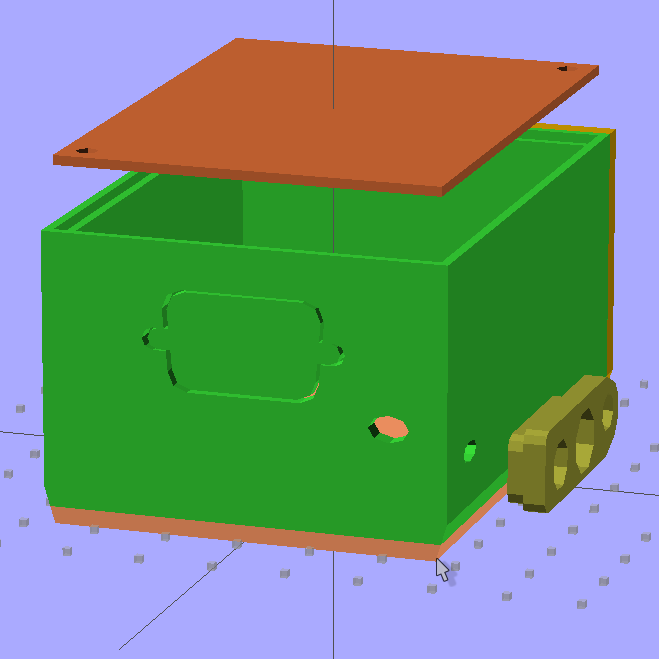
    The first pass at the box that will eventually hold the GPS+voice interface for the KG-UV3D radio looks like this, from the end that engages the alignment tabs on the bottom of the radio:

    Case Solid Model - Tab End View - Fit
    Case Solid Model – Tab End View – Fit

    The other end has the opening for the TT3’s serial connector to the GPS receiver, a probably too-small hole for the external battery pack cable / helmet cable / PTT cable, and a hole on the side for the radio mic/speaker cables.

    Case Solid Model - Connector End View - Fit
    Case Solid Model – Connector End View – Fit

    The serial connector opening has a built-in support plate that’s the shape shrunken by 5% so it’s easy to punch out. That worked surprisingly well; the line just above the right edge isn’t a break, it’s a stack of Reversal Zits. This version is rectangular; the solid model shows the proper D shape.

    KG-UV3D box - connector hole support removal
    KG-UV3D box – connector hole support removal

    The bottom has battery contact recesses and counterbores (if that’s the right term for a molded feature) for the PCB mounting  screws. In retrospect, those holes should be tapping diameter and the screws inserted from the top, through the PCB.

    Case Solid Model - Battery Contact View - Fit
    Case Solid Model – Battery Contact View – Fit

    The colors mark individual pieces that get glued together. I can probably reduce the wall thickness on the top & bottom by three threads, which is in the nature of fine tuning. The latch mechanism that holds this affair to the radio is conspicuous by its absence…

    The OpenSCAD source code:

    // Wouxun KB-UV3D Battery Pack Case
    // Ed Nisley KE4ZNU September 2011
    
    include </home/ed/Thing-O-Matic/lib/MCAD/units.scad>
    include </home/ed/Thing-O-Matic/Useful Sizes.scad>
    include </home/ed/Thing-O-Matic/lib/visibone_colors.scad>
    
    // Layout options
    
    Layout = "Fit";		// Envelope Plate Base Lid Shell Fit Buildx ScrewSupport
    								// PlugPlate
    
    //- Extrusion parameters must match reality!
    //  Print with +1 shells and 3 solid layers
    //  Use 210 C extrusion temperature to improve layer bonding
    
    ThreadThick = 0.33;
    ThreadWidth = 2.0 * ThreadThick;
    
    HoleWindage = 0.2;
    
    function IntegerMultiple(Size,Unit) = Unit * ceil(Size / Unit);
    
    Protrusion = 0.1;			// make holes end cleanly
    
    BuildOffset = 2.0;			// clearance for build layout
    
    //----------------------
    //- Case dimensions
    
    CaseOverallHeight = 40;
    CaseOverallWidth = 56;
    CaseOverallLength = 80.0;
    
    PlateWidthMin = 53.0;			// plate interfacing with radio contacts
    PlateWidthMax = 54.5;
    PlateLength = 75.0;
    PlateThick = IntegerMultiple(2.0,ThreadThick);
    
    ContactWidth = 7.0 + HoleWindage;
    ContactLength = 7.0 + HoleWindage;
    ContactRecess = 2*ThreadThick;	// recess for contact metal plate
    ContactGapX = 10.5;				// X space between contacts
    Contact1Y = 53.0;				// offset from base
    Contact2Y = 56.5;
    
    BaseWidthInner = PlateWidthMin;
    BaseWidthOuter = CaseOverallWidth;
    BaseLength = CaseOverallHeight;
    BaseThick = 1.0;
    BaseWidthTaper = 5.0;
    
    BaseOpeningMax = 42.0;
    BaseOpeningMin = 33.0;
    BaseOpeningY = 5.25;
    BaseOpeningDepth = 2.0;
    
    BaseTabWidth = 6.0;
    BaseTabThick = 2.0;
    BaseTabGap = 7.0;
    BaseTabOC = BaseTabWidth + BaseTabGap;
    
    BaseToothBase = 6.0;
    BaseToothTip = 3.0;
    BaseToothThick = 2.0;
    BaseToothOC = BaseTabOC;
    
    WedgeAngle = atan(BaseWidthTaper/((BaseWidthOuter - BaseWidthInner)/2));
    echo(str("Plate & Shell Wedge Angle: ",WedgeAngle));
    
    BaseEndLip = ThreadThick;			// should be 0.25 mm or so
    BaseEndWidth = (PlateWidthMin - 3*BaseToothBase - 2*BaseToothTip)/2;
    BaseEndAngle = atan((BaseOpeningDepth - BaseEndLip)/BaseOpeningY);
    
    echo(str("Plate End Angle: ",BaseEndAngle));
    
    PCBWidth = 2.00 * inch;
    PCBLength = 2.75 * inch;
    PCBMargin = Head2_56;
    PCBClearBottom = IntegerMultiple(2*Nut2_56Thick,ThreadThick);
    PCBHoleDia = Tap2_56;
    PCBHoleY = 2.50 * inch;
    PCBHoleX = 1.75 * inch;
    
    echo(str("PCB Mounting Holes OC X: ",PCBHoleX," Y: ",PCBHoleY));
    echo(str("       bottom clearance: ",PCBClearBottom));
    
    ShellHeight = CaseOverallHeight - PlateThick;
    ShellWidth = CaseOverallWidth;
    ShellLength = PlateLength;
    ShellWallX = IntegerMultiple((ShellWidth - PCBWidth)/2,ThreadWidth);
    ShellWallY = IntegerMultiple((ShellLength - PCBLength)/2,ThreadWidth);
    ShellWallMax = max(ShellWallX,ShellWallY);
    
    echo(str("Wall thick X: ",ShellWallX," Y: ",ShellWallY));
    
    LidThick = IntegerMultiple(1.0,ThreadThick);
    LidMargin = IntegerMultiple(1.0,ThreadWidth);
    LidWidth = ShellWidth - 2*LidMargin;
    LidLength = ShellLength - 2*LidMargin;
    
    LidScrewHead = Head3_48;
    LidScrewTap = Tap3_48;
    LidScrewClear = Clear3_48;
    LidScrewLength = 5.0;
    LidScrewOffsetX = ShellWidth/2 - LidMargin - 0.75*LidScrewHead;
    LidScrewOffsetY = ShellLength/2 - LidMargin - 0.75*LidScrewHead;
    
    HTCableDia = 5.0;
    HTCableAspect = 2.0;			// width of hole
    HTCableY = 65;
    HTCableZ = 10;
    
    SerialZ = ShellHeight - LidThick - 12.0;
    
    BikeCableDia = 5.0;
    BikeCableAspect = 1.5;
    BikeCableX = -20;
    BikeCableZ = 15;
    
    JackOC = 11.20;						// 14.25 OD - (3.58 + 2.58)/2
    
    JackScrewDia = 4.6;
    JackScrewOffsetX = 1.00;
    JackScrewOffsetY = 5.25;				//  mounting screw to edge of lower recess
    
    PlugBaseWidth = 9.25;				// lower section of plate
    PlugBaseLength = 22.0;
    PlugBaseThick = 2.5;
    PlugBaseRadius = 1.75;
    
    Plug3Offset = 5.25;					// edge of base recess to 3.5 mm jack
    
    Plug2BezelDia = 7.1;				// 2.5 mm plug
    Plug2BezelThick = 1.04;
    Plug2ScrewDia = 6.0;
    Plug3ScrewLength = 3.0;
    
    Plug3BezelDia = 8.13;				// 3.5 mm plug
    Plug3BezelThick = 1.6;
    Plug3ScrewDia = 7.95;
    Plug3ScrewLength = 4.0;
    
    PlugFillOffsetX = JackScrewOffsetX - 0.5;		// base recess CL to fill CL
    PlugFillOffsetY = -10.5;				//  ... to edge of fill plate
    PlugFillWidth = 11.0;
    PlugFillLength = 34.00;
    PlugFillThick = 3.0;
    PlugFillRadius1 = 1.5;
    PlugFillRadius2 = 4.5;
    
    PlugFillOffsetYTotal = 0;
    
    //----------------------
    // Useful routines
    
    module PolyCyl(Dia,Height,ForceSides=0) {			// based on nophead's polyholes
    
      Sides = (ForceSides != 0) ? ForceSides : (ceil(Dia) + 2);
    
      FixDia = Dia / cos(180/Sides);
    
      cylinder(r=(FixDia + HoleWindage)/2,
               h=Height,
    	   $fn=Sides);
    }
    
    module ShowPegGrid(Space = 10.0,Size = 1.0) {
    
      Range = floor(50 / Space);
    
    	for (x=[-Range:Range])
    	  for (y=[-Range:Range])
    		translate([x*Space,y*Space,Size/2])
    		  %cube(Size,center=true);
    
    }
    
    //- Hack job for DB-9 (DE-9) panel opening
    //  Snug fit around the shell surrounding the male pins
    //  DB-9 should mount on outside, but if it's already soldered to the board,
    //   that doesn't work and you must mount it inside the box
    
    module DSubMin9(Height=1.0) {
    
      union() {
    
    	linear_extrude(height=Height,center=false) {
    	  hull() {
    /*
    		translate([-(19.28+0.13)/2,(10.72+0.13)/2,0])			// rectangular outline
    		  circle(r=3.05/2,$fn=8);
    		translate([-(19.28+0.13)/2,-(10.72+0.13)/2,0])
    		  circle(r=3.05/2,$fn=8);
    		translate([ (19.28+0.13)/2,(10.72+0.13)/2,0])
    		  circle(r=3.05/2,$fn=8);
    		translate([ (19.28+0.13)/2,-(10.72+0.13)/2,0])
    		  circle(r=3.05/2,$fn=8);
    */
    		translate([-(17.0+0.05)/2,-(8.48+0.05)/2,0])
    		  circle(r=0.105*inch,$fn=8);
    		translate([ (17.0+0.05)/2,-(8.48+0.05)/2,0])
    		  circle(r=0.105*inch,$fn=8);
    		translate([ (15.5+0.05)/2, (8.48+0.05)/2,0])
    		  circle(r=0.105*inch,$fn=8);
    		translate([-(15.5+0.05)/2, (8.48+0.05)/2,0])
    		  circle(r=0.105*inch,$fn=8);
    	  }
    	  hull() {
    		translate([-24.99/2,0,0])
    		  circle(r=3.05/2,$fn=8);
    		translate([ 24.99/2,0,0])
    		  circle(r=3.05/2,$fn=8);
    	  }
    	}
      }
    
    }
    
    //-------------------
    
    //- Overall case outline
    //  This defines the mating taper into the radio shell
    
    module CaseEnvelope(Length=1) {
    
    	rotate([90,0,0])
    	  linear_extrude(height=Length,center=true,convexity=5)
    		polygon(points=[
    				  [-BaseWidthOuter/2,BaseLength],
    				  [-BaseWidthOuter/2,BaseWidthTaper],
    				  [-BaseWidthInner/2,0],
    				  [-BaseOpeningMax/2,0],
    
    				  [ BaseOpeningMax/2,0],
    				  [ BaseWidthInner/2,0],
    
    				  [ BaseWidthOuter/2,BaseWidthTaper],
    
    				  [ BaseWidthOuter/2,BaseLength]
    				],
    				convexity=1
    		);
    
    }
    
    //- Battery contact plate recess
    //  This gets subtracted from the bottom plate in two places
    
    module Contact() {
    
      union() {
    	translate([0,0,-(ContactRecess - Protrusion)/2])
    	  cube([ContactWidth,ContactLength,(ContactRecess + Protrusion)],center=true);
    	translate([0,0,-(PlateThick + Protrusion)])
    	PolyCyl(Clear3_48,(PlateThick + 2*Protrusion));
    	translate([0,0,-(ContactRecess + Head3_48Thick/3)])
    	  PolyCyl(Head3_48,Head3_48Thick);				// allow for solder blob
      }
    }
    
    //- Back interface plate with battery contacts
    
    module Plate() {
    
      difference() {
    
    	translate([0,PlateLength/2,0])
    	  intersection() {
    		translate([0,0,PlateThick])
    		  rotate([180,0,0])
    			CaseEnvelope(PlateLength);
    	  translate([-PlateWidthMax/2,-PlateLength/2,0])
    		cube([PlateWidthMax,PlateLength,PlateThick],center=false);
    	  }
    
    	translate([-(ContactGapX/2 + ContactWidth/2),(Contact1Y + ContactLength/2),PlateThick])
    	  Contact();
    	translate([+(ContactGapX/2 + ContactWidth/2),(Contact2Y + ContactLength/2),PlateThick])
    	  Contact();
    
    	translate([0,PlateLength/2,0])
    	  PCBHoles(PCBHoleDia,PlateThick);
    
    	translate([0,PlateLength/2,(PlateThick - 2*Head2_56Thick/3)])
    	  PCBHoles(IntegerMultiple(Head2_56,ThreadWidth),IntegerMultiple(Head2_56Thick,ThreadThick));
      }
    
    }
    
    //- Radio bottom locating feature
    //  This polygon gets subtracted from the battery pack base
    
    module RadioBase() {
    
    linear_extrude(height=(BaseOpeningDepth + Protrusion),center=false,convexity=5)
      polygon(points=[
    			[-BaseOpeningMax/2,-Protrusion],
    
    			[-BaseOpeningMin/2,BaseOpeningY],
    			[-(BaseToothOC/2 + BaseToothBase/2),BaseOpeningY],
    
    			[-(BaseToothOC/2 + BaseToothTip/2),(BaseOpeningY - BaseToothThick)],
    			[-(BaseToothOC/2 - BaseToothTip/2),(BaseOpeningY - BaseToothThick)],
    			[-(BaseToothOC/2 - BaseToothBase/2),BaseOpeningY],
    
    			[ (BaseToothOC/2 - BaseToothBase/2),BaseOpeningY],
    			[ (BaseToothOC/2 - BaseToothTip/2),(BaseOpeningY - BaseToothThick)],
    			[ (BaseToothOC/2 + BaseToothTip/2),(BaseOpeningY - BaseToothThick)],
    			[ (BaseToothOC/2 + BaseToothBase/2),BaseOpeningY],
    			[ BaseOpeningMin/2,BaseOpeningY],
    
    			[ BaseOpeningMax/2,-Protrusion],
    
    			[ (BaseTabOC + BaseTabWidth/2),-Protrusion],
    			[ (BaseTabOC + BaseTabWidth/2),BaseTabThick],
    			[ (BaseTabOC - BaseTabWidth/2),BaseTabThick],
    			[ (BaseTabOC - BaseTabWidth/2),-Protrusion],
    
    			[ BaseTabWidth/2,-Protrusion],
    			[ BaseTabWidth/2,BaseTabThick],
    			[-BaseTabWidth/2,BaseTabThick],
    			[-BaseTabWidth/2,-Protrusion],
    
    			[-(BaseTabOC + BaseTabWidth/2),-Protrusion],
    			[-(BaseTabOC + BaseTabWidth/2),BaseTabThick],
    			[-(BaseTabOC - BaseTabWidth/2),BaseTabThick],
    			[-(BaseTabOC - BaseTabWidth/2),-Protrusion],
    		  ],
    		  convexity=5
      );
    }
    
    //- PCB Mounting Holes
    
    module PCBHoles(HoleDia=PCBHoleDia,Height=1.0) {
    
      for (x=[-1,1])
    	for (y=[-1,1])
    	  translate([(x*PCBHoleX/2),
    				(y*PCBHoleY/2),
    				-Protrusion])
    		PolyCyl(HoleDia,(Height + 2*Protrusion));
    
    }
    
    //-- Battery pack base
    
    module Base() {
    
      difference() {
    
    	translate([0,0,(BaseThick + BaseOpeningDepth)/2])
    	  rotate([-90,0,0])
    		CaseEnvelope(BaseThick + BaseOpeningDepth);
    
    	translate([0,0,BaseThick])
    	  RadioBase();
    
    	translate([(BaseToothOC + BaseTabWidth/2),
    			  -(BaseThick + BaseEndLip)/tan(BaseEndAngle),
    			  0])
    	  rotate([BaseEndAngle,0,0])
    		cube([BaseEndWidth,3*BaseOpeningY,BaseOpeningDepth],center=false);
    
    	translate([-(BaseToothOC + BaseTabWidth/2 + BaseEndWidth),
    			  -(BaseThick + BaseEndLip)/tan(BaseEndAngle),
    			  0])
    	  rotate([BaseEndAngle,0,0])
    		cube([BaseEndWidth,3*BaseOpeningY,BaseOpeningDepth],center=false);
      }
    }
    
    //- Lid
    
    module Lid(WithHoles = false) {
    
      translate([0,LidLength/2,LidThick/2])
    	difference() {
    	  cube([LidWidth,LidLength,LidThick],center=true);
    	  if (WithHoles) {
    		translate([LidScrewOffsetX,LidScrewOffsetY,-(LidThick/2 + Protrusion)])
    		  PolyCyl(LidScrewClear,(LidThick + 2*Protrusion));
    		translate([-LidScrewOffsetX,-LidScrewOffsetY,-(LidThick/2 + Protrusion)])
    		  PolyCyl(LidScrewClear,(LidThick + 2*Protrusion));
    	  }
    	}
    }
    
    //- Lid screw support shape
    
    module LidScrewSupport(WithHole = false) {
    
      SupportSize = IntegerMultiple(LidScrewHead,ThreadWidth);
    
      difference() {
    	translate([0,0,LidScrewLength/2])
    	cube([SupportSize,SupportSize,LidScrewLength],center=true);
    	if (WithHole)
    	  translate([0,0,-Protrusion])
    		PolyCyl(LidScrewTap,(LidScrewLength + 2*Protrusion));
      }
    
      translate([-SupportSize/2,SupportSize/2,-2*SupportSize])
    	rotate([90,0,0])
    	  linear_extrude(height=SupportSize,center=false)
    		polygon(points=[
    				  [0,0],[0,2*SupportSize],[SupportSize,2*SupportSize]]);
    
    }
    
    //- Battery pack shell
    
    module Shell() {
    
      union() {
    	difference() {
    
    	  translate([0,0,-PlateThick])
    		intersection() {
    		  CaseEnvelope(ShellLength);
    		  translate([0,0,(ShellHeight/2 + PlateThick)])
    			cube([ShellWidth,ShellLength,ShellHeight],center=true);
    		}
    
    	  translate([0,-LidLength/2,(ShellHeight - LidThick)])
    		scale([1,1,2])				// ensure clean cut across top
    		  Lid(false);
    
    	  translate([0,0,
    				((ShellHeight - PCBClearBottom - LidThick + Protrusion)/2 + PCBClearBottom)])
    		cube([PCBWidth,PCBLength,
    			 (ShellHeight - PCBClearBottom - LidThick + Protrusion)],
    			 center=true);
    
    	  render()
    		difference() {
    		  translate([0,0,ShellHeight/2])
    			cube([(PCBWidth - 2*PCBMargin),
    				(PCBLength - 2*PCBMargin),
    				(ShellHeight + 2*Protrusion)],
    				center=true);
    		  for (x=[-1,1])
    			for (y=[-1,1])
    			  translate([(x*PCBHoleX/2),(y*PCBHoleY/2),-Protrusion])
    				cylinder(r=PCBMargin,(ShellHeight + 2*Protrusion),$fn=4);
    		}
    
    	  PCBHoles(PCBMargin);
    
    	  translate([-(PCBWidth/2 - Protrusion),(HTCableY - PlateLength/2),HTCableZ])
    		rotate([0,-90,0])
    		  scale([1/HTCableAspect,1,1])
    			PolyCyl(HTCableDia,(ShellWallMax + 2*Protrusion),8);
    
    	  translate([BikeCableX,(PCBLength/2 - Protrusion),BikeCableZ])
    		rotate([0,90,90])
    		  scale([1/BikeCableAspect,1,1])
    			PolyCyl(BikeCableDia,(ShellWallMax + 2*Protrusion),8);
    
    	  translate([0,(PCBLength/2 - Protrusion),SerialZ])
    		rotate([-90,0,0])
    		  DSubMin9(ShellWallMax + 2*Protrusion);
    
    	}
    
      	translate([0,(PCBLength/2 + ThreadWidth/2),SerialZ])
    	  rotate([-90,0,0])
    		scale([0.95,0.95,1])
    		  DSubMin9(ShellWallY - ThreadWidth);		// thin support plug in hole
    
      }
    
    }
    
    //- Speaker-Mic plug mounting plate
    
    module PlugPlate() {
    
      BaseX = PlugBaseWidth/2 - PlugBaseRadius;
      BaseY = PlugBaseLength/2 - PlugBaseRadius;
    
      difference() {
    	union() {
    	  linear_extrude(height=PlugBaseThick,center=false,convexity=3)
    		hull() {
    		  translate([-BaseX,-BaseY,0])
    			circle(r=PlugBaseRadius,$fn=8);
    		  translate([-BaseX, BaseY,0])
    			circle(r=PlugBaseRadius,$fn=8);
    		  translate([ BaseX, BaseY,0])
    			circle(r=PlugBaseRadius,$fn=8);
    		  translate([ BaseX,-BaseY,0])
    			circle(r=PlugBaseRadius,$fn=8);
    		}
    
    	  translate([PlugFillOffsetX,
    				(PlugFillLength/2 - PlugBaseLength/2 + PlugFillOffsetY),
    				PlugBaseThick])
    		linear_extrude(height=PlugFillThick,center=false,convexity=5)
    		  hull() {
    			translate([0,-(PlugFillLength/2 - PlugFillRadius2),0])
    			  circle(r=PlugFillRadius2,$fn=10);
    			translate([-(PlugFillWidth/2 - PlugFillRadius1),-PlugBaseLength/2,0])
    			  circle(r=PlugFillRadius1,$fn=8);
    			translate([-(PlugFillWidth/2 - PlugFillRadius1),
    					  (PlugFillLength/2 - PlugFillRadius1),0])
    			  circle(r=PlugFillRadius1,$fn=8);
    			translate([(PlugFillWidth/2 - PlugFillRadius1),
    					  (PlugFillLength/2 - PlugFillRadius1),0])
    			  circle(r=PlugFillRadius1,$fn=8);
    			translate([(PlugFillWidth/2 - PlugFillRadius1),-PlugBaseLength/2,0])
    			  circle(r=PlugFillRadius1,$fn=8);
    		  }
    	}
    
    	translate([0,-JackOC/2,-Protrusion])
    	  rotate(360/16) {
    		PolyCyl(Plug3BezelDia,(Plug3BezelThick + Protrusion),8);
    		PolyCyl(Plug3ScrewDia,(PlugBaseThick + PlugFillThick + 2*Protrusion),8);
    	  }
    
    	translate([0,+JackOC/2,-Protrusion])
    	  rotate(360/16) {
    		PolyCyl(Plug2BezelDia,(Plug2BezelThick + Protrusion),8);
    		PolyCyl(Plug2ScrewDia,(PlugBaseThick + PlugFillThick + 2*Protrusion),8);
    	  }
    
    	translate([JackScrewOffsetX,-(PlugBaseLength/2 + JackScrewOffsetY),0])
    	  PolyCyl(JackScrewDia,(PlugBaseThick + PlugFillThick + Protrusion));
      }
    
    }
    
    //-------------------
    // Build it!
    
    ShowPegGrid();
    
    if (Layout == "Envelope")
      CaseEnvelope(CaseOverallLength);
    
    if (Layout == "Plate")
      Plate();
    
    if (Layout == "Base")
      Base();
    
    if (Layout == "Lid")
      Lid(true);
    
    if (Layout == "ScrewSupport")
      LidScrewSupport(true);
    
    if (Layout == "Shell")
      Shell();
    
    if (Layout == "PlugPlate")
      PlugPlate();
    
    if (Layout == "DSub")
      DSubMin9();
    
    if (Layout == "Fit") {
    
      translate([0,-PlateLength/2,0]) {
    
    	translate([0,0,PlateThick])
    	  rotate([0,180,0])
    		color(LOR) Plate();
    
    	rotate([90,0,0])
    	  color(DYO) Base();
    
    	translate([0,LidMargin,10 + (CaseOverallHeight - LidThick)])
    	  color(MOR) Lid(true);
    
    	translate([0,PlateLength/2,PlateThick])
    	    color(MFG) render() Shell();
    
    	translate([-(ShellWidth/2 +10),70,15])
    	  rotate([0,-90,0])
    		color(DDY) PlugPlate();
      }
    }
    
    if (Layout == "Build1") {
    
      translate([-20,-PlateLength/2,0])
    	Plate();
    
        translate([10,0,0])
    	rotate([0,0,-90])
    	  Base();
    
    }
    
    if (Layout == "Build2") {
    
      translate([0,-LidLength/2,0])
    	Lid(true);
    
    }
    
    if (Layout == "Build3") {
    
      translate([-20,0,0])
    	Shell();
    
    }
    
    if (Layout == "Build4") {
    
      translate([0,0,(PlugBaseThick + PlugFillThick)])
    	rotate([180,0,0])
    	  PlugPlate();
    
    }
    
  • KG-UV3D GPS+Voice: Box

    The previous iteration of GPS+voice interface boxes came from the Sherline CNC mill, with a considerable amount of huffing & puffing. I got the Thing-O-Matic to simplify that process…

    The general idea is to build a box that clips onto the radio in place of the standard battery pack. External power comes into the box and goes directly to the radio’s battery contacts; this will pose a problem with the Wouxun KG-UV3D, because it wants 7.2 V rather than the stepped-up 9 V from the Li-Ion packs I’ve been using. I think a three-wire power cord is in order: +9 V for the interface, +7.2 V for the radio, and common.

    The box also interfaces with the radio’s mic and speaker jacks. Last time around, I made a gluing fixture to keep the plugs in alignment while the epoxy cured around the plugs in the plate, but maybe I can simplify that with 3D printing. Plastic will be better in one respect: the shells of the two plugs must be electrically isolated.

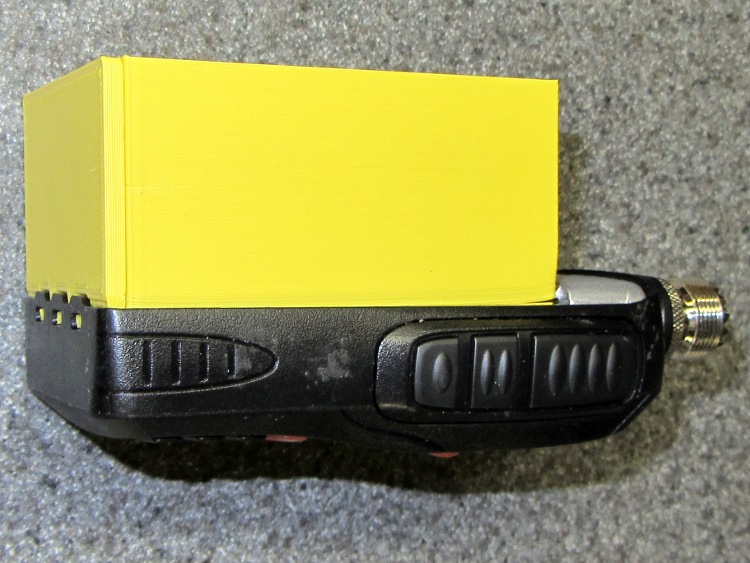
    This first-pass (*) approximation shows the three tabs on the pack that engage the radio’s base:

    KG-UV3D Interface Box prototype - right side
    KG-UV3D Interface Box prototype – right side

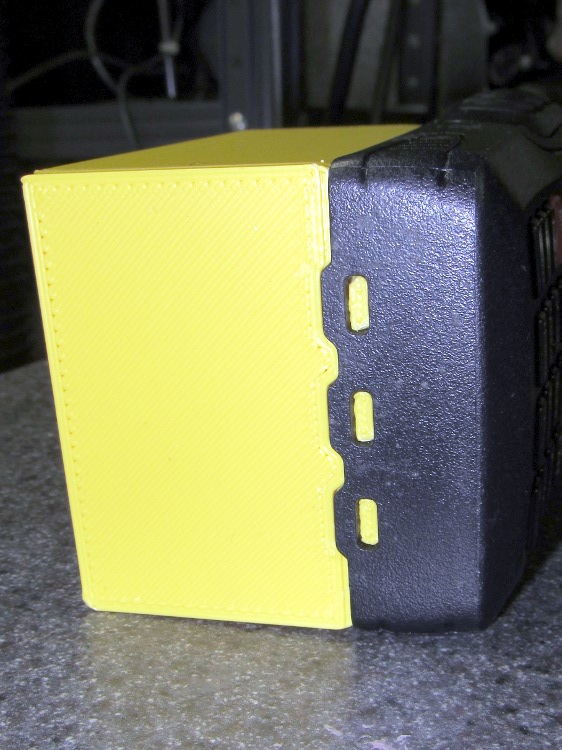
    A detail of those tabs, as seen from the bottom:

    KG-UV3D Interface Box prototype - end tabs
    KG-UV3D Interface Box prototype – end tabs

    The ICOM IC-Z1A battery pack had a set of slip-in alignment features that held the pack on the radio, so two strips of tape sufficed to hold the interface box in place. Each Wouxun battery pack includes a spring-loaded latching mechanism that engages a pair of ramped tabs on the radio body that hold the pack against the spring-loaded battery contacts. That means I must come up with an actual latch of some sort to oppose the contact springs, but I haven’t figured that out yet.

    The solid model, with the plug mounting plate floating beside it, looks like this:

    Case Solid Model - Tab End View - Fit
    Case Solid Model – Tab End View – Fit

    Tomorrow, the solid modeling…

    * It’s actually the third printing of the bottom plate with the three tabs and the base plate with the battery contacts. That’s how I figured out the 0. 5% shrinkage thing.

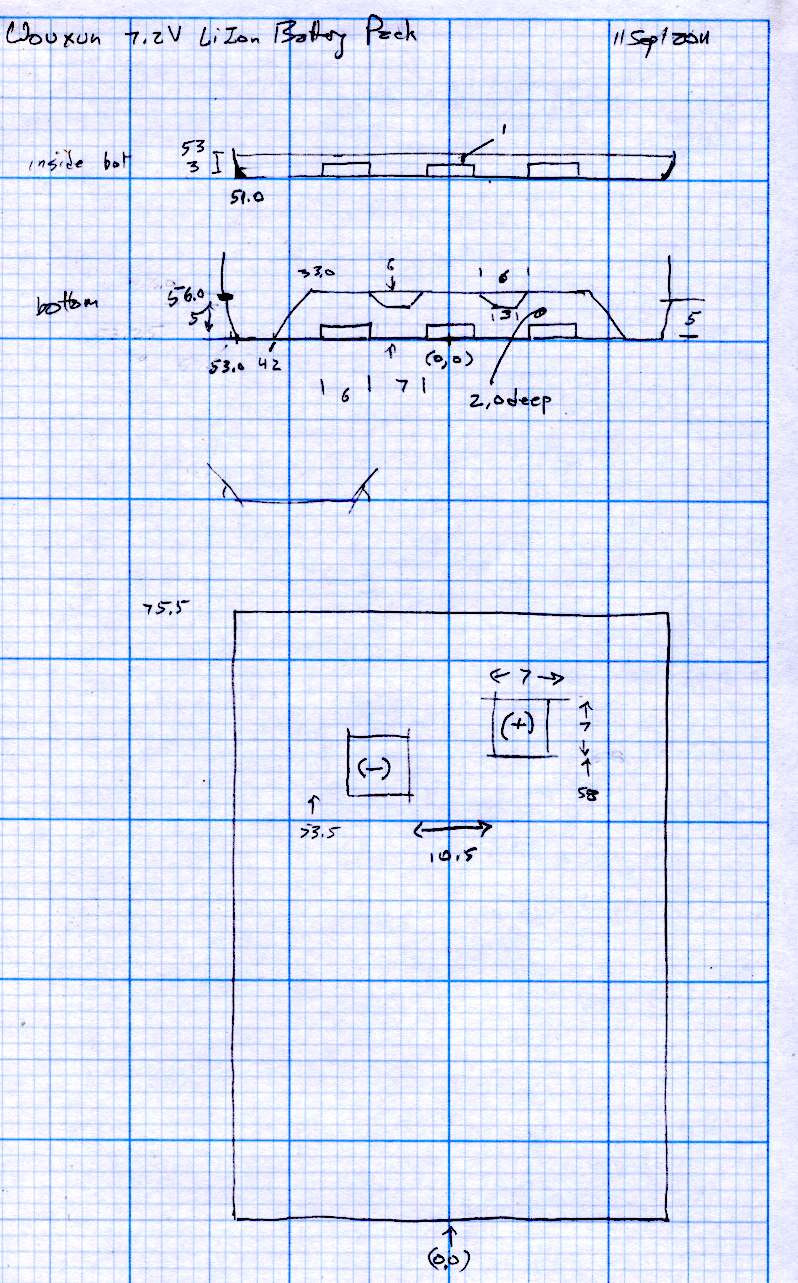
    [Update: The sketch with the dimensions emerged from beneath a pile o’ stuff…]

    Wouxun KG-UV3D Battery Pack Dimensions
    Wouxun KG-UV3D Battery Pack Dimensions


  • GPS+Voice Interface for Wouxun KG-UV3D: Circuit Hackage

    Having had my old ICOM IC-Z1A HT stop working, most likely due to the innards finally shaking loose, I replaced it with a Wouxun KG-UV3D dual-band radio. Unfortunately, the interface box I designed to connect the Byonics TinyTrak 3+ GPS modem, the helmet earbud/mic, and the external battery pack to the Z-1A doesn’t work with the Wouxun. It’s all different:

    • Mechanical interface to the radio
    • Battery voltage
    • Power control
    • Mic level
    • PTT interface

    I modified the interface box from my bike thusly:

    GPS-HT Interface Circuit Mods for Wouxun
    GPS-HT Interface Circuit Mods for Wouxun

    Because the KG-UV3D uses the Kenwood HT interface with a single ground for mic, speaker, and PTT functions, there’s no need for galvanic isolation; all the optoisolators & the audio transformer will Go Away when I rebuild it.

    The plug connections:

    Wouxun KG-UV3D Mic & Speaker Jacks
    Tip Ring Shell
    3.5 mm +5 V Mic audio PTT
    2.5 mm Speaker audio Buttons Ground

    One distressing change: the IC-Z1A mic power was 3.5 V behind 400 Ω = 6 mA into an optoisolator LED, but the KG-UV3D puts 5 V behind 50 kΩ = 100 µA into a dead short. I think the voltage will suffice to drive a logic-gate MOSFET to switch the power through a PNP transistor, but, for the moment, I hotwired OK1 and “control” the interface power by unplugging the external battery. The radio runs from its own snap-on Li-Ion pack.

    The PTT now has a separate logic wire and is no longer multiplexed as a DC current on the audio line. The hack on OK2 was the easiest way to make that happen on the existing board, but the TT3 PTT Out line can  probably drive the PTT directly.

    I’m not happy with the audio levels; the KG-UV3D requires more mic gain (which change doesn’t appear in the mods) and more TT3 output. Having tediously calibrated the TT3 for the IC-Z1A, I’m not looking forward to doing that again. I still like using an analog multiplexer to switch the audio signal, though, because it doesn’t mix the machine noise with the voice transmissions.

    Bungied GPS Interface Box
    Bungied GPS Interface Box

    There being no way to mount the box on the radio and no way to control the interface power if I did, I simply lashed it to the side of the pack holding the radio behind the seat. Obviously, that can’t last forever…

    I think the KG-UV3D stuffs more RFI into the mic circuit, because that box is now in the only position that doesn’t result in weird voice audio dropouts. Given the precarious nature of the thing, though, I must look again after getting it in a box on the radio.

    Earth to amateur radio manufacturers: seen from out here, it’d be perfectly OK to standardize some of this stuff!

  • Another Tread Gash: Tire Liners FTW Again!

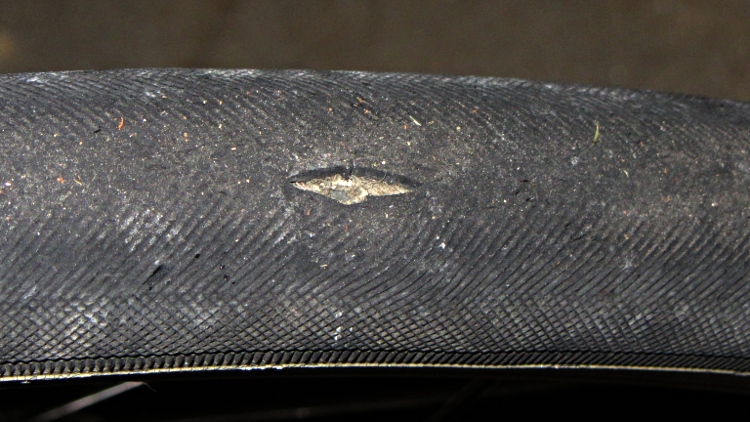
    Found this in the front tire of my Shop Assistant’s bike.

    Front tire gash
    Front tire gash

    It’s a Primo Comet Kevlar, not that the Kevlar belts can cope with an assault like that. The smooth surface at the bottom of the gash is the tire liner, of course.

    She won’t be using the bike for a while, though, so I’ll keep our stock of new tires for our bikes. I’m sure they’ll come in handy this season.

    Sheesh!

  • Bicycle Water Pack Leak Repair

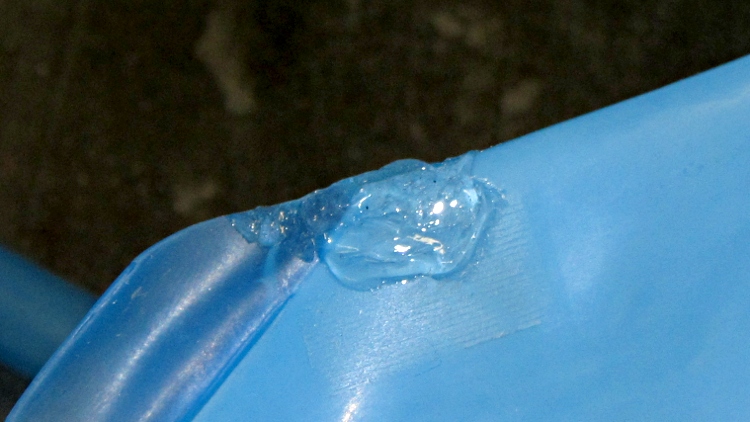
    So the hydration pack I’ve been using for a few years started piddling all over the floor, whereupon some debugging revealed a pinhole leak where the large thermally sealed flange meets the bag side. Nothing, but nothing adheres to the polyethylene (or some such) bag material, but a blob of acrylic caulk (armored with a layer of electrical tape, not shown) may suffice for a while.

    Hydration pack leak repair blob
    Hydration pack leak repair blob

    I did the same thing to the other side as a prophylactic measure…

  • Tour Easy: Squeaky Pedal

    Of late my Tour Easy has developed a squeak at the pedal-go-round rate. It has Performance Bike Campus pedals, with SPD cleats on one side and a rat-trap surface on the other, and only the SPD side squeaked.

    Turns out that the two little mounting screws holding the cleat dingus worked their way loose.

    SPD pedal screws
    SPD pedal screws

    I should probably ease some lube under that plate, just to be sure, but the simple fix worked fine…

    (And, yeah, I should clean it, just once, to see what it’s like, right?)
  • I Loves Me My Tour Easy

    ZNU APRS speed
    ZNU APRS speed

    My speedometer stored 39.3 mph max somewhere near that point, downhill along nice S curves that end, alas, in that abrupt left turn at the creek. By glancing across the field inside the corner, hoping for the best, and clipping the yellow line, I can emerge at 20+ mph, but some day that’ll have a bad outcome.

    I can’t hold that pace on the flats, of course, but the 22 mile ride came out at 15 mph average and, unlike the guy on the Rail Trail about five miles later, I wasn’t trying to find a more comfortable position on the saddle.

    News Flash: when you go Rail Trail dueling, don’t match your knobby-tire mountain bike against a faired Tour Easy, even if the TE driver is the canonical Fat Old Guy with a Beard and the bike carries all manner of racks and packs and accoutrements. Heh!