The Smell of Molten Projects in the Morning

Ed Nisley's Blog: Shop notes, electronics, firmware, machinery, 3D printing, laser cuttery, and curiosities. Contents: 100% human thinking, 0% AI slop.

Category: Recumbent Bicycling

Cruisin’ the streets

  • Tour Easy: SRAM X.9 Grip Shift Replacement

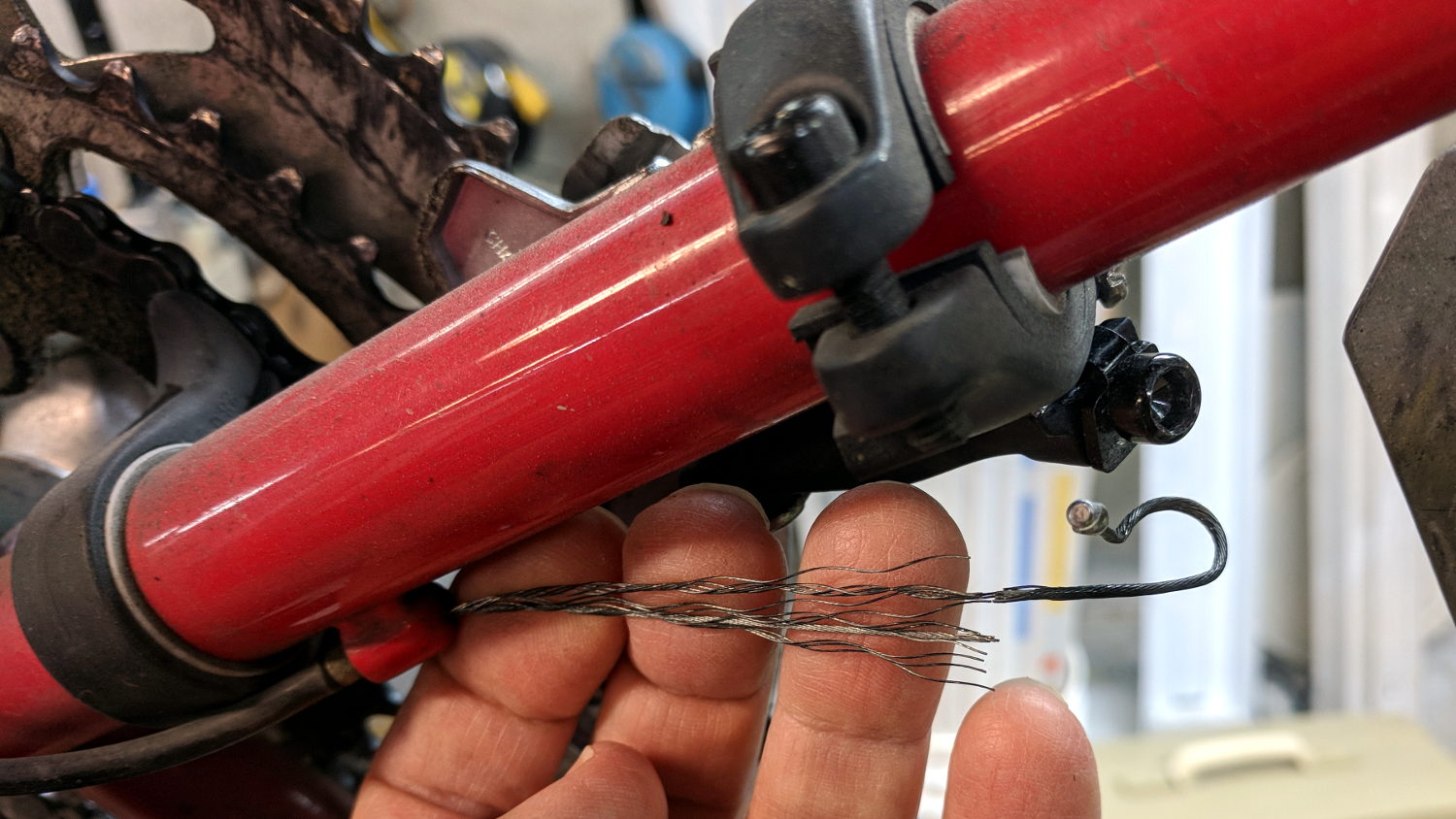
    The rear shifter on my Tour Easy stopped working when we were most of the way to the grocery store, due to what turned out to be due to a broken cable. I managed to yank the frayed end out of the shifter, pulled the derailleur into a middling gear, and belayed the cable into a deadly cactus:

    SRAM X.9 Rear Shifter - frayed cable
    SRAM X.9 Rear Shifter – frayed cable

    A three-speed recumbent got me home again, albeit with spin-it-out high gear and a low gear barely sufficient for trailer hauling.

    Attempting to remove the frayed cable from the SRAM X.9 grip shifter didn’t go well at all:

    SRAM X.9 Rear Shifter - cable tangle
    SRAM X.9 Rear Shifter – cable tangle

    I managed to extract the lead pellet, but, while it may be possible to extract the remaining tangle, even pulling on individual wires wasn’t productive.

    AFAICT, the shifter came as original equipment on the bike, so it’s been in constant use for the last 17-ish years. The nice soft grip material (and the cover over the cable port) turned into gummy sludge under the cheerful silicone tape I applied some years ago, so I sliced the old grip and pulled it off:

    SRAM X.9 Rear Shifter - gummified grip
    SRAM X.9 Rear Shifter – gummified grip

    Popping a new-old-stock X.9 shifter from the Big Box o’ Bike Parts and installing it proceeded without problems. This being the rear shifter, I had to remove the shiny OEM cable and replace it with a PTFE-coated tandem-length rear cable, but that’s normal for a long wheelbase recumbent.

    For the record, both black shift indicator tabs still show no signs of failing after half a year, so a bent piece of polypropylene sheet looks like a win.

  • Roadside Debris: Cannabis Energy Drink

    Spotted this on Rt 376 during a ride around the block:

    Cannabis Energy Drink - roadside debris
    Cannabis Energy Drink – roadside debris

    A “Cannabis Energy Drink” without the obvious active ingredient seems like deceptive marketing to me, but, apparently, there was no law against that, even here in New York State.

    It’s becoming obvious I don’t get out nearly enough.

  • Baofeng BL-5 Pack Rebuild

    The 18650 cell protection PCBs with 8205 ICs arrived and seemed small enough to simply tuck into the gap between the rounded cells in the second Baofeng BL-5 pack:

    Baofeng BL-5 - new protection PCB - wiring 1
    Baofeng BL-5 – new protection PCB – wiring 1

    For whatever it might be worth, you’re looking at the only Baofeng battery pack containing an actual 10 kΩ thermistor, harvested from the benchtop Tray of Doom:

    Baofeng BL-5 pack - thermistor
    Baofeng BL-5 pack – thermistor

    Unfortunately, the components on the PCB stuck up a bit too far from the cell surface and held the lid just slightly proud of the case. Applying pressure to lithium cells being a Bad Idea, I rearranged the layout by flipping the cells over, tucking the PCB components between the cells, and connecting everything with nickel tape instead of insulated wires:

    Baofeng BL-5 - new protection PCB - wiring 2
    Baofeng BL-5 – new protection PCB – wiring 2

    The snippets of manila paper and Kapton tape hold things apart and together, as needed. Looks ugly, fits better.

    Pop it in the charger to reset the protection PCB lockout and it’s all good again.

  • Baofeng BL-5 Battery Pack Base Dimensions

    My original idea for the APRS + voice gadget was a snap-in battery pack replacement holding the circuit boards and connected to an external battery pack. A trio of dead Wouxun radios, plus the ready availability of 18650 lithium cells, suggested putting two cells in the backpack, along with the circuitry, and skipping the external pack.

    Here’s the base of a Baofeng BL-5 pack overlaid with a 1 mm grid:

    Baofeng BL-5 - Base with mm grid overlay
    Baofeng BL-5 – Base with mm grid overlay

    The grid is parallel to the case body and centered left-to-right, with a Y grid line set at the front face of the pack, where it’s also flush with the lid surface. You can read off the coordinates of all the points, feed them into your CAD model, and maybe, with a bit of care, get something 3D-print-able.

    Haven’t used it yet, but it’s bound to come in handy at some point.

  • Baofeng BL-5 Battery Pack: Recharge and Reassembly

    Separately charging all four cells from the Baofeng BL-5 packs covered the Electronics Bench with wires:

    Baofeng BL-5 cell charging
    Baofeng BL-5 cell charging

    The cell sits on a ceramic tile as a nod to fire safety, although I doubt it makes any difference.

    The discharge tests showed two nearly identical pairs:

    Baofeng BL-5 Cells - Separate Charge - 2018-02-24
    Baofeng BL-5 Cells – Separate Charge – 2018-02-24

    Surprisingly, cells A and B (upper traces) were deaders in the original packs. Cells C and D (lower traces) were more-or-less fully charged, but now have a lower terminal voltage and slightly lower capacity. I have no explanation for that, nor for the voltage undulations.

    The rebuilt packs pair up A+B and C+D.

    Reassembling pairs into the pack shell and resoldering all the leads produces a good pack:

    Baofeng BL-5 battery rebuild
    Baofeng BL-5 battery rebuild

    I later added a snippet of heavy manila paper under the nickel tape bent around the edge of the pack as a third level of insulation, in the interest of having the nickel tape not produce a dead short between the isolated – terminal and the + cell case.

    Memo to Self: tape the long wiggly leads from the protection PCB to the radio contacts (at the left side) before soldering the PCB to the cell terminals, because an inadvertent short will convert the 8205A battery protection IC into a Light-Emitting IC, at least for a moment, and subsequently release the Acrid Smell of Electrical Death. A handful of charge PCBs are en route halfway around the planet, from which I intend to liberate one IC for this board; with luck, I didn’t incinerate anything else.

    The pack works fine in the radio, as does the APRS interface:

    APRS Coverage in Poughkeepsie - 2018-03-01
    APRS Coverage in Poughkeepsie – 2018-03-01

    Unfortunately, two APRS iGates vanished in the last year, leaving poor coverage south of Poughkeepsie.

  • SJCAM M20 Camera: Dimensions

    The SJCAM M20 action camera came with a whole bunch of doodads:

    SJCAM M20 Accessories - Manual pg 25
    SJCAM M20 Accessories – Manual pg 25

    Including a waterproof case, some right-angle connectors, and a pipe clamp:

    M20 in waterproof case - Tour Easy seat
    M20 in waterproof case – Tour Easy seat

    The stack turns out to be about as flexy as one might imagine, definitely a Bad Thing for a bike-mounted camera, and a somewhat more rugged mount seems in order.

    A diagram from the M20 manual shows the parts:

    SJCAM M20 Overview - Manual pg 5
    SJCAM M20 Overview – Manual pg 5

    Some camera dimensions:

    • 40.2 mm wide + 0.5 mm for the Up/Down buttons
    • 21.8 mm thick + 1.0 mm cylindrical front curve + 1.0 mm rear screen
    • 50.0 mm tall + 4.0 mm cylindrical top curve + buttons
    • 21.7 mm OD × 6.0 mm long lens housing, 1.3 mm down from top center

    All the edges have neat chamfers or radius rounding on the order of a few millimeters.

    Applying the chord equation to the spans inside the rounding:

    • Front radius: 162.5 mm
    • Top radius: 42.5 mm

    The new batteries survive for a bit over an hour, not quite enough for our usual rides. Rather than conjure a fake battery pack connected to an external 18650 cell with a wire chewed through the case, the least awful way to go may involve a relatively small battery pack (with internal 18650 cells, of course) plugged into the USB port with a right-angle cable and a rigid mount holding both the camera and the pack to the seat frame.

    More pondering is in order.

  • SJCAM M20 vs. Cycliq Fly6 Resolution: License Plates

    The Cycliq Fly6 has marginal resolution for license plates at anything other than lethally close distances and, after its recent battery failure and rebuild, I picked up an SJCAM M20 to see whether more dots would be useful.

    The Fly6 records 1280×720 @ 30 fps, with somewhat high contrast and weird color balance:

    Fly6 - Backlit license
    Fly6 – Backlit license

    It works better with a stationary target in good light:

    Fly6 - Stationary license
    Fly6 – Stationary license

    The M20 records 1920×1080 @60 fps (among many other choices), with reasonable contrast and coloring:

    M20 - backlit license
    M20 – backlit license

    Good lighting and no motion helps it along, too:

    M20 - Stationary license
    M20 – Stationary license

    The original frames-grabbed-from-the-video aren’t visibly different from the JPGs you see here.

    Collecting all the plates in one montage:

    Fly6 vs M20 - License Plates
    Fly6 vs M20 – License Plates

    I enlarged the left pair by 200% and the right pair by 300%, using GIMP’s cubic interpolation, to make them large enough to see with the naked eye. The interpolation algorithm slightly smooths the edges, but the cameras put those weird compression artifacts / blobs in the original images.

    The left pair also got auto-brightness adjustments to drag ’em out of the murk.

    I saved the montage as a PNG, rather than a JPG, although JPG image compression made no difference.

    All in all, the M20 has better image quality than the Fly6, but its 1.5× higher resolution isn’t a slam-dunk win and, IMO, video compression has more effect than image resolution. The Fly6 has no compression controls and I’ve set all the M20 controls to as good as they can be.

    Both those license plates sport NYS’s now-obsolete high-contrast blue-on-white color scheme: the current blue-on-gold NYS plates have much lower contrast. In this age of ubiquitous license plate reading and storing, I cannot explain why this was allowed to happen.

    The Fly6, now equipped with a high-quality 18650 lithium cell, should have more hours of run time than I can measure this early in the season. Perhaps six hours, with its red blinky LED at full throttle, according to the doc.

    The M20 lasted 72 minutes with a freshly charged battery, which means it didn’t quite survive the trip. Performing battery maintenance in the middle of a ride for groceries isn’t appealing; I should conjure an external 18650 battery pack for the thing.