The Smell of Molten Projects in the Morning

Ed Nisley's Blog: Shop notes, electronics, firmware, machinery, 3D printing, laser cuttery, and curiosities. Contents: 100% human thinking, 0% AI slop.

Category: Recumbent Bicycling

Cruisin’ the streets

  • Baofeng BL-5 Battery Pack: Disassembly

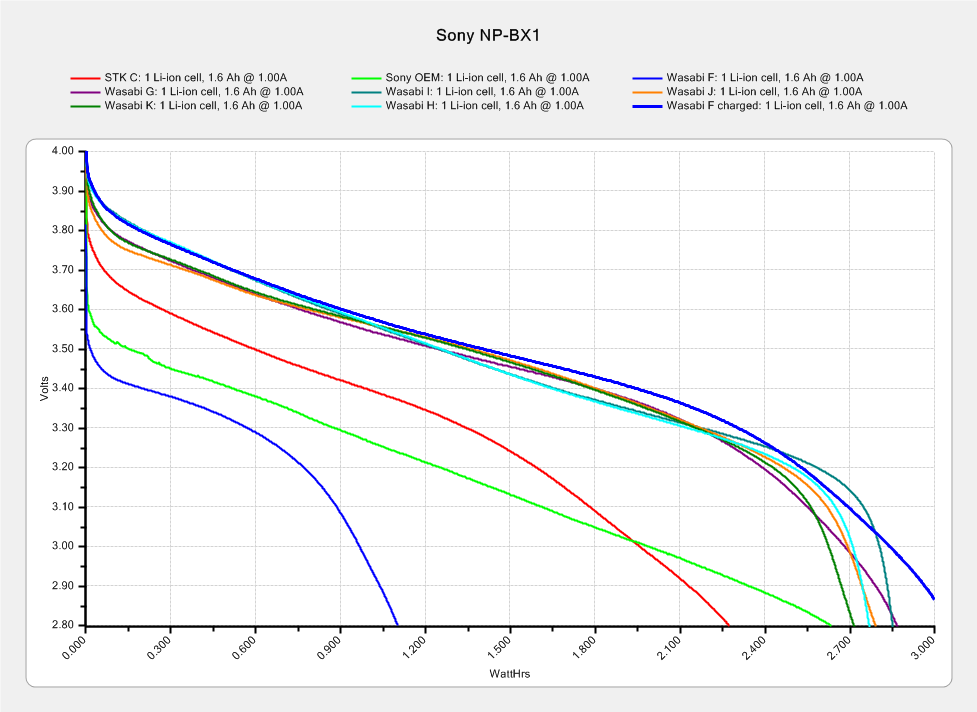
    Not much to my surprise, both Baofeng BL-5 lithium batteries went bad on the shelf:

    Baofeng BL-5 Packs - Final Failure - 2018-02-21
    Baofeng BL-5 Packs – Final Failure – 2018-02-21

    The longer traces show their original capacity, back in the day.

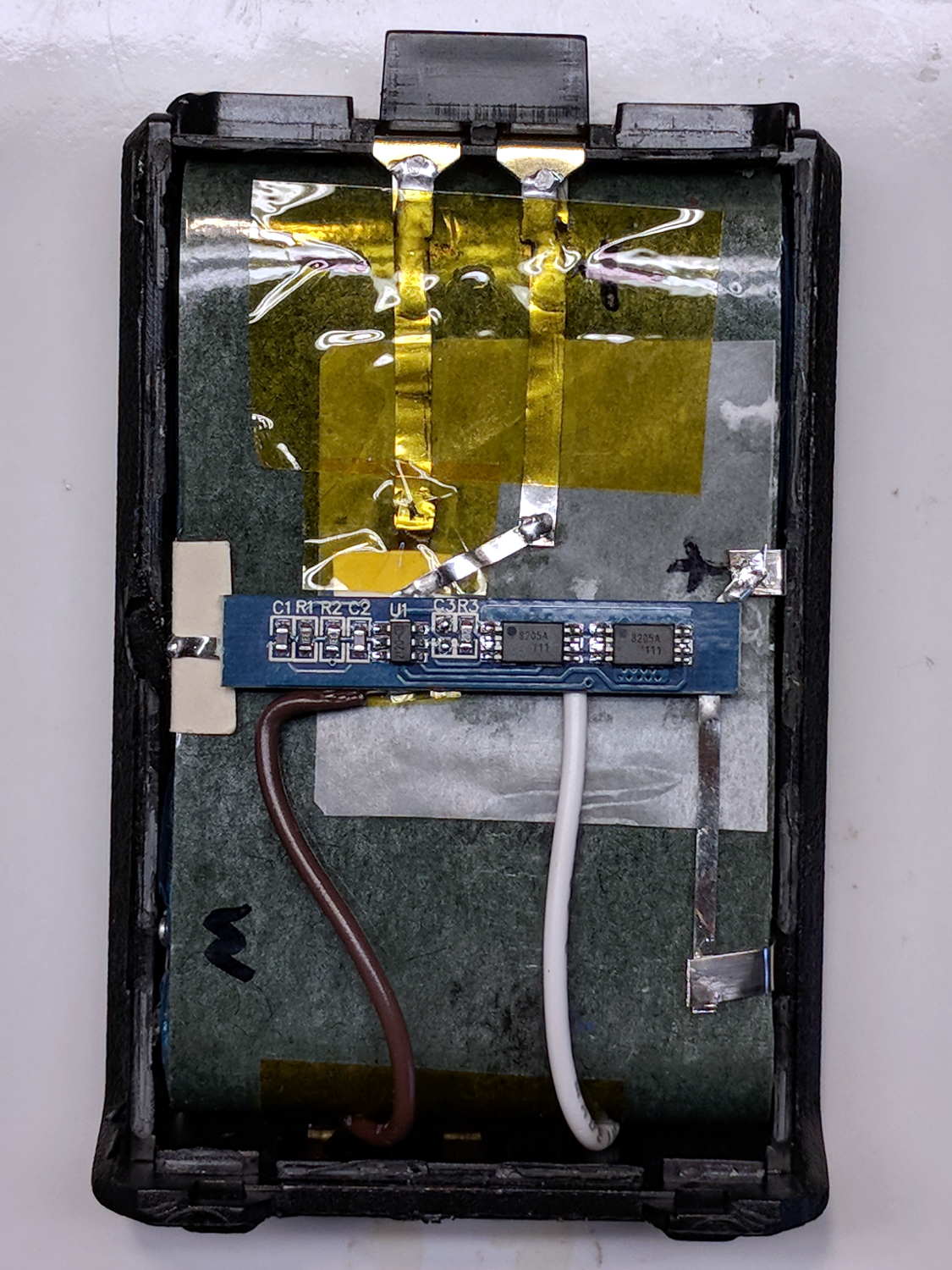
    Whacking a chisel into the obvious split lines broke the solvent glue bonds holding the case sections together, after which some slow prying defeated the double sticky foam tape on the cells:

    Baofeng BL-5 battery pack - innards
    Baofeng BL-5 battery pack – innards

    A closer look at the (dis)charge controller PCB:

    Baofeng BL-5 battery pack - protection PCB
    Baofeng BL-5 battery pack – protection PCB

    The other side of the PCB has no components, so what you see is what you get. The larger IC proclaims FS8205A EP050C, which may indicate a vague relation to an S8205 protection IC. The datasheet shows a 16 pin TSSOP package containing an IC for four or five cell batteries, completely unlike the 8 pin package on the PCB, but when you buy enough of anything, you can get anything you want.

    In common with all cheap lithium batteries around here, the “thermistor” terminal connects to a 10 kΩ SMD resistor steadfastly maintaining its resistance in the face of all temperature variations.

    Some probing shows one feeble cell in each pack. Perhaps a Frankenbattery built from the debris will have enough capacity for a standard ride around the block.

  • APRS/Voice HT Interface: Cap Failure

    The TinyTrak3 on the Wouxun adapter wasn’t working, showing a dim red Power LED to indicate it wasn’t getting enough juice. A bit of tracing showed my adapter board provided just over 5 V to the poor thing, not the nearly 9 V it should be getting, which led me to believe the transistor switching the supply had failed. A bit more tracing, however, revealed the true problem:

    Failed electrolytic cap
    Failed electrolytic cap

    The schmutz on the black cap matches up with a crater in the rear of the (originally not so) brown cap.

    The Little Box o’ SMD Caps revealed two nearly identical sets of 33 μF caps, one with a 6 V rating, the other with 16 V rating. Yup, when I added that cap in the hopes of reducing RFI troubles, I soldered the wrong one onto the PCB: it’s my fault!

    The poor thing lasted for over six years with just under 9 V applied to it, so I can’t complain.

    I removed the corpse and reassembled the box without the additional cap (and without the terminals contacting the back of the Wouxun, because reasons). If RFI turns out to be a problem, I’ll take another look at the situation.

  • APRS/Voice HT Interface: Baofeng Mods

    My carefully contrived plug plates for Wouxun radios:

    Wouxun plug plate - epoxy cap
    Wouxun plug plate – epoxy cap

    … of course don’t fit the Baofeng radio. This being in the nature of a final fix, I chopped off enough protrusions to make the remainder fit snugly into the recess.

    APRS-voice HT interface - Baofeng mods
    APRS-voice HT interface – Baofeng mods

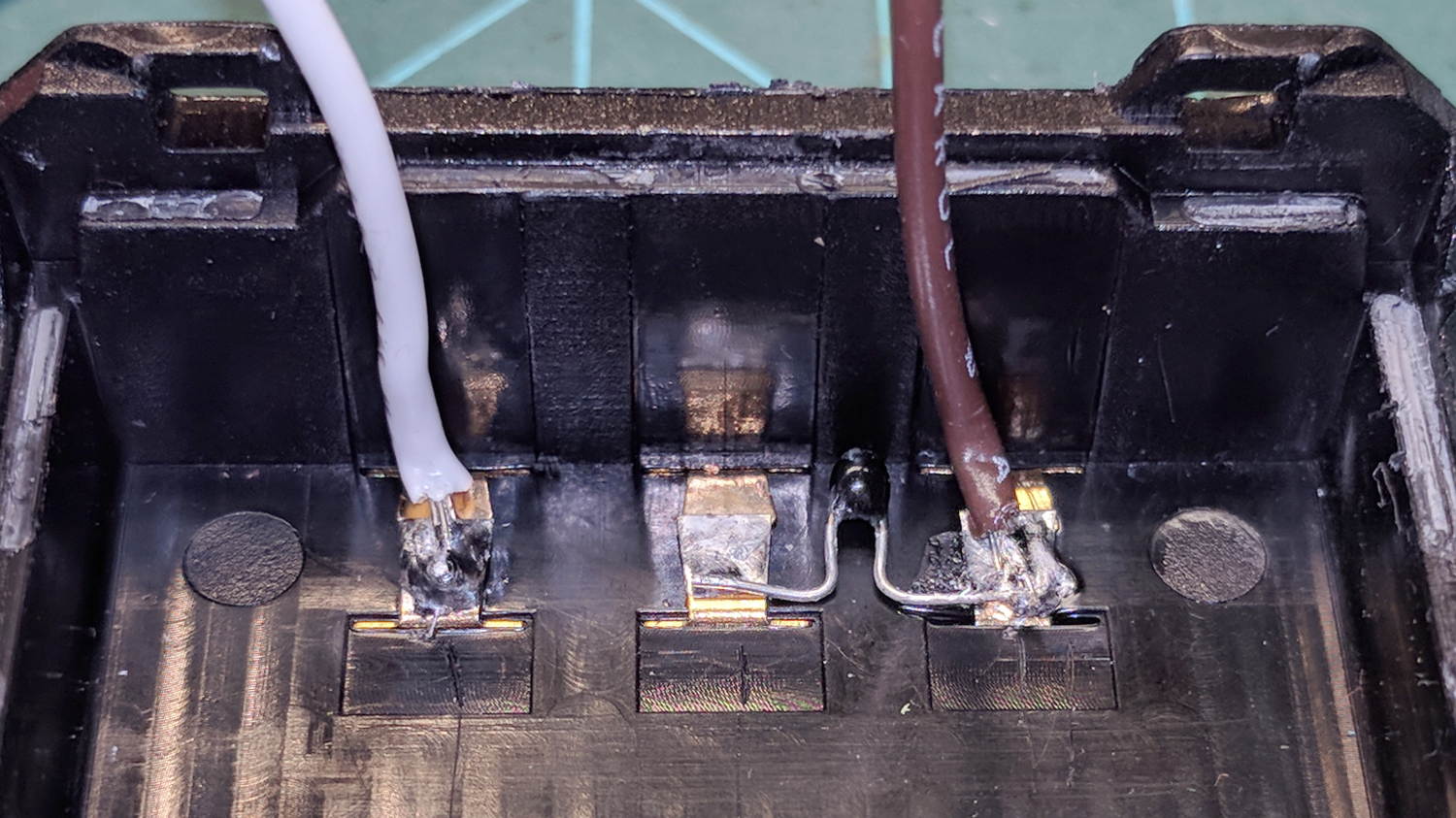
    The case containing the TinyTrak3 GPS board and the APRS-voice adapter PCB of course doesn’t fit in place of the Baofeng battery pack, so I replaced the battery contact studs with simple 4-40 screws to prevent heartache & confusion.

    Based on one ride, both Baofeng batteries have very little capacity left after several years on the shelf, which comes as absolutely no surprise whatsoever.

  • Rt 376 Pavement Deterioration

    The pavement along Rt 376 between markers 1111 and 1108 has deteriorated into deep chasms, potholes, and fissures.

    The linear disintegration south of marker 1111 seems to follow an underlying concrete joint. The shoulder has deep, tire-trapping fissures, forcing cyclists far out into the travel lane along a narrow and curved part of Rt 376:

    Rt 376 SB deterioration - S of marker 1111 - 2018-02-20
    Rt 376 SB deterioration – S of marker 1111 – 2018-02-20

    The hole at address 2181 (across from Paula’s House / GastroPub) was previously patched, but recent weather has excavated it nearly a foot deep. The shoulder has also deteriorated, again forcing cyclists into the travel lane:

    Rt 376 SB deterioration - at 2181 driveway - 2018-02-20
    Rt 376 SB deterioration – at 2181 driveway – 2018-02-20

    The previous patches along the inside of the curve just north of Heathbrook Drive (south of marker 1108) have disintegrated. There’s no shoulder at all along that section and the fissures in the travel lane force cyclists into the lane along a blind curve:

    Rt 376 NB deterioration - S of marker 1108 - 2018-02-20
    Rt 376 NB deterioration – S of marker 1108 – 2018-02-20

    This section of NYS Bicycle Route 9 poses an immediate danger to both cyclists and motorists, so I reported all these to NYS DOT and, a day later, a crew traveled along Rt 376 shoveling cold patch into many of the holes and flattening the lumps more-or-less parallel to the road surface: it’s now driveable, if still a hazard for bicycle traffic.

    Hope springs eternal; after all, they did repave Rt 376 around Red Oaks Mill.

  • Wouxun KG-UV3D: Enemy Action

    Once is happenstance, twice is coincidence, three times is enemy action:

    Wouxun KG-UV3D - failure 3
    Wouxun KG-UV3D – failure 3

    All of the (surviving) battery packs produce 9.0 to 9.2 V, a bit hotter than the pair of fully charged lithium cells the radio expects to see, but the first two radios lasted for six years under that abuse.

    This one failed after a few hours. It’s a new radio, but I’m willing to assume I killed the thing and will just eat the cost.

    I have no theories about what’s going on, but I must tweak my APRS interface to work with a Baofeng radio I have on the shelf.

    From now on, though, both radios will run from their stock battery packs.

    Maybe I’m just a slow learner.

  • VFAT Time Zone Offset Correction

    An SJCAM M20 action camera includes the date and time in its file names, but the directory entries appear with the wrong timestamp:

    sudo mount -o uid=ed /dev/sdc1 /mnt/part
    ll -tr /mnt/part/DCIM/Photo/ | head
    total 4.8G
    drwxr-xr-x 4 ed root  16K Apr  8  2016 ../
    drwxr-xr-x 2 ed root 144K Jan 25 18:52 ./
    -rwxr-xr-x 1 ed root 3.8M Jan 26 05:08 2018_0126_100825_001.JPG*
    -rwxr-xr-x 1 ed root 3.8M Jan 26 05:08 2018_0126_100830_002.JPG*
    

    I’m in the Eastern US time zone, -5 hr from UTC.

    By definition, FAT directory entries contain the “local time” when the file was created / changed. Because it cannot know which “local time” applies, the Linux VFAT filesystem treats the timestamp as UTC and adjusts it by -5 hr.

    So the camera writes the directory timestamps properly. When mounted, Linux correctly (for a reasonable definition of correctly) regards them as UTC, knocks off five hours to match this time zone, and displays the result.

    Alas, disabling the VFAT timestamp conversion has no effect:

    sudo mount -o uid=ed,tz=UTC /dev/sdc1 /mnt/part
    ll -tr /mnt/part/DCIM/Photo/ | head
    total 4.8G
    drwxr-xr-x 4 ed root  16K Apr  8  2016 ../
    drwxr-xr-x 2 ed root 144K Jan 25 18:52 ./
    -rwxr-xr-x 1 ed root 3.8M Jan 26 05:08 2018_0126_100825_001.JPG*
    -rwxr-xr-x 1 ed root 3.8M Jan 26 05:08 2018_0126_100830_002.JPG*
    

    I’m not sure why that doesn’t do anything; it doesn’t generate any error messages.

    Although it seems like a reasonable thing, one cannot force a specific time zone with, say, tz=EST or tz=EDT or tz=UTC8 or whatever.

    You can specify an offset in minutes:

    sudo mount -o uid=ed,time_offset=$((-5*60)) /dev/sdc1 /mnt/part
    ll -tr /mnt/part/DCIM/Photo/ | head
    total 4.8G
    drwxr-xr-x 4 ed root  16K Apr  8  2016 ../
    drwxr-xr-x 2 ed root 144K Jan 25 23:52 ./
    -rwxr-xr-x 1 ed root 3.8M Jan 26 10:08 2018_0126_100825_001.JPG*
    -rwxr-xr-x 1 ed root 3.8M Jan 26 10:08 2018_0126_100830_002.JPG*
    

    The time_offset value is subtracted from the directory timestamp, which means you’re feeding in the actual time offset from UTC, including whatever Daylight Saving Time offset may be in order.

    So Linux takes the FAT timestamp, adds (subtracts a negative) 5 hr, and displays the result as my (now correct) local time.

    I suppose I could set the camera to UTC, but then the camera’s on-screen and in-video timestamps would be off by four or five hours, depending on the season. So it goes.

  • Wouxun KG-UV3D: Another Failure

    Once is happenstance, twice is coincidence:

    Wouxun KG-UV3D - failure
    Wouxun KG-UV3D – failure

    Three times is enemy action, but we’re not there yet. I was willing to believe something I’d done had killed both of the radios, even though it seemed unlikely for them to last five years and fail almost simultaneously.

    So I dismantled this one to see what’s inside. Pull off both knobs, remove the two screws at the bottom of the battery compartment, pry gently with a small screwdriver, and the whole PCB pulls out:

    Wouxun KG-UV3D - disassembly
    Wouxun KG-UV3D – disassembly

    A bit more prying separates the big pieces:

    Wouxun KG-UV3D - interior
    Wouxun KG-UV3D – interior

    Looking closely at the main PCB showed some problems I definitely didn’t cause:

    Wouxun KG-UV3D - PCB overview
    Wouxun KG-UV3D – PCB overview

    Although it’s been riding around on my bike, the white blotches on the PCB came from inadequate flux removal after hand soldering.

    A collection of images taken through the microscope reveals the problems:

    This slideshow requires JavaScript.

    I swabbed off the crud with denatured alcohol to no avail. The bottom side of the PCB has even more components and, I’m sure, even more crud, but I didn’t bother removing all the screws required to expose it, nor did I dismantle the other failed HT.

    I doubt Wouxun’s QC improved over the last few years, which means the two replacement KG-UV3D radios I just bought are already on their last legs, despite my paying top dollar to the same reputable source that sold me the first pair.

    We’ll be ready for new radios on new bikes by the time these fail.