The Smell of Molten Projects in the Morning

Ed Nisley's Blog: Shop notes, electronics, firmware, machinery, 3D printing, laser cuttery, and curiosities. Contents: 100% human thinking, 0% AI slop.

Category: Recumbent Bicycling

Cruisin’ the streets

  • Tour Easy: Bafang 48 V 11.6 A·h Battery Mount

    Tour Easy: Bafang 48 V 11.6 A·h Battery Mount

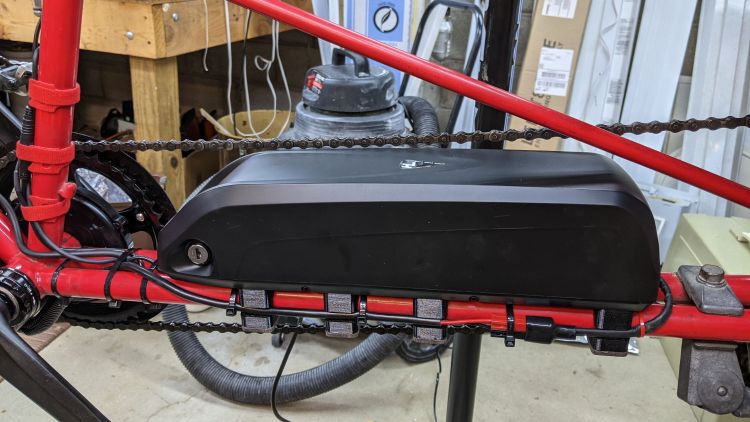
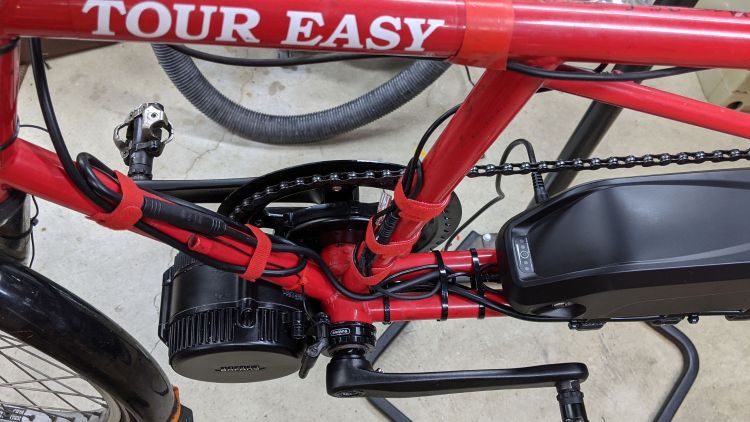
    Bafang BBS02 batteries should mount on the water bottle bosses along a more-or-less standard bicycle’s downtube, which a Tour Easy recumbent has only in vestigial form. The battery does, however, fit perfectly along the lower frame tubes:

    Tour Easy Bafang mid-drive - battery
    Tour Easy Bafang mid-drive – battery

    You might be forgiven for thinking Gardner Martin (not to be confused with Martin Gardner of Scientific American fame) designed the Tour Easy frame specifically to hold that battery, but the design dates back to the 1970s and it’s just a convenient coincidence.

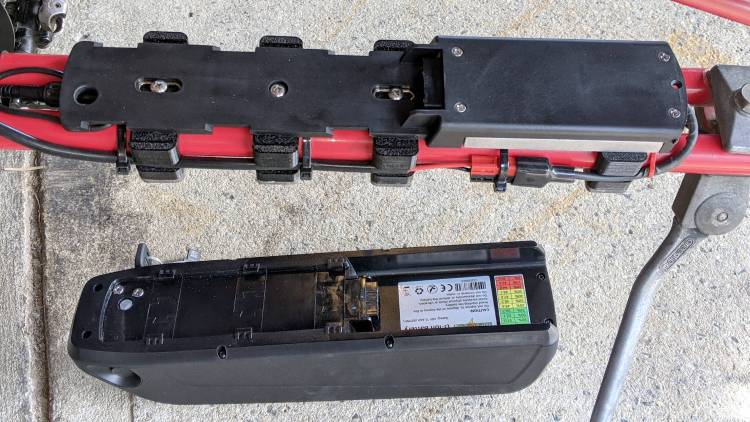
    The battery slides into a flat baseplate and locks in place, although it’s definitely not a high-security design. Mostly, the lock suffices to keep honest people honest and prevent the battery from vibrating loose while riding:

    Tour Easy Bafang battery mount - baseplate installed
    Tour Easy Bafang battery mount – baseplate installed

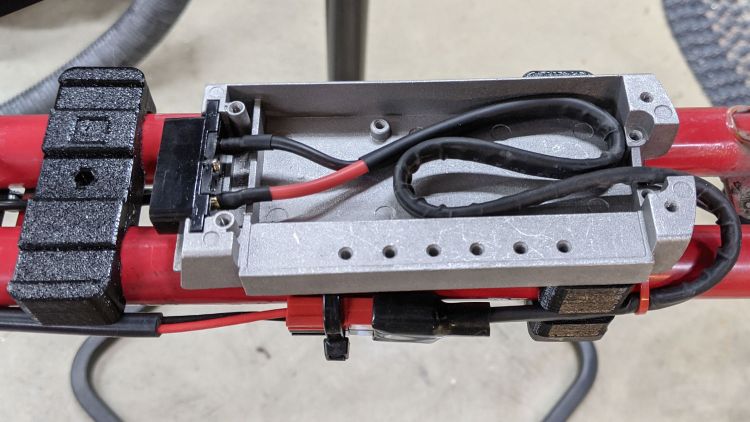
    The flat enclosure toward the rear was obviously designed for more complex circuitry than it now contains:

    Tour Easy Bafang battery mount - interior
    Tour Easy Bafang battery mount – interior

    Those are all neatly drilled and tapped M3 machine screw holes. The cable has no strain relief, despite the presence of suitable holes at the rear opening. I tucked the spare cable inside, rather than cut it shorter, under the perhaps unwarranted assumption they did a good job crimping / soldering the wires to the terminals.

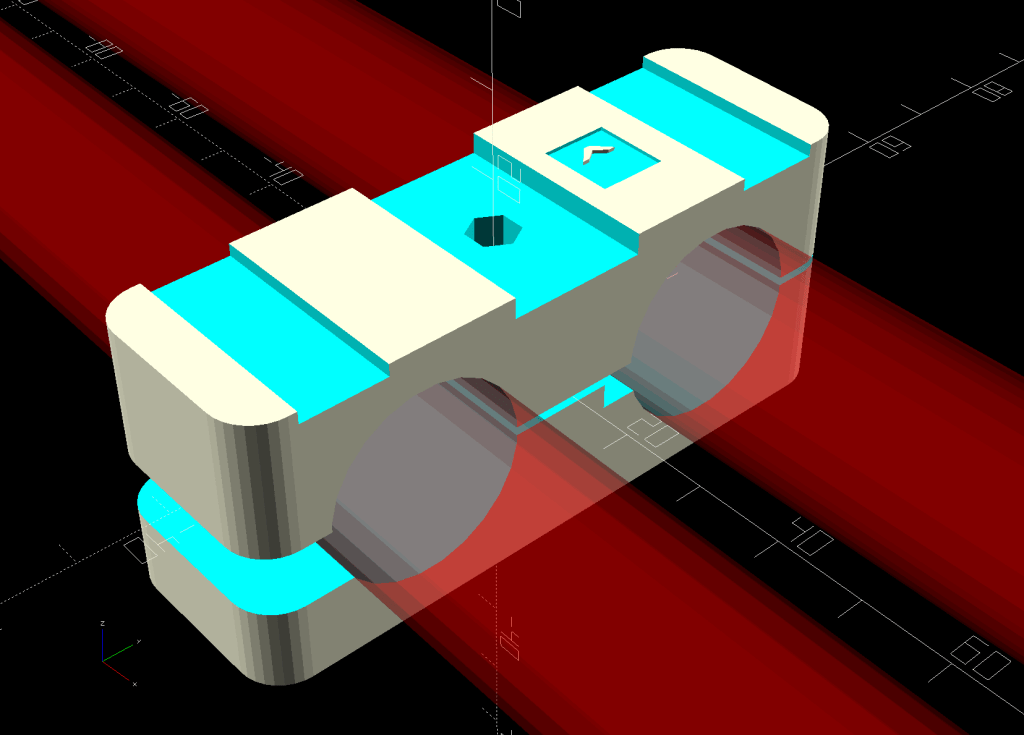
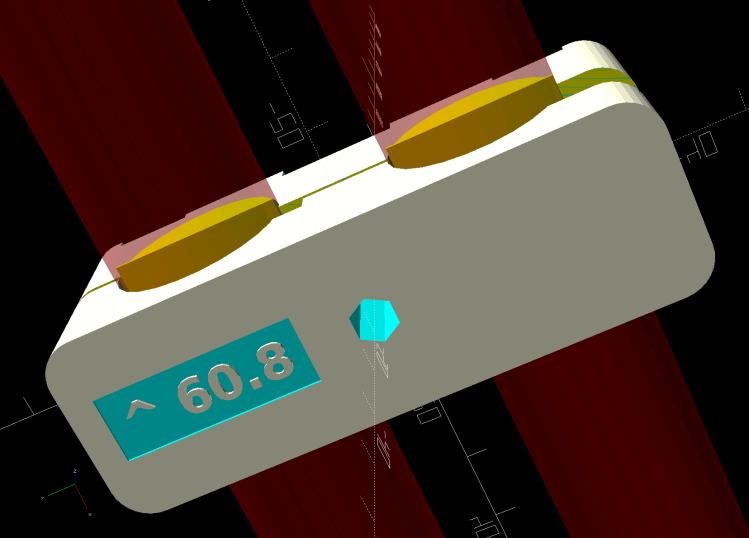
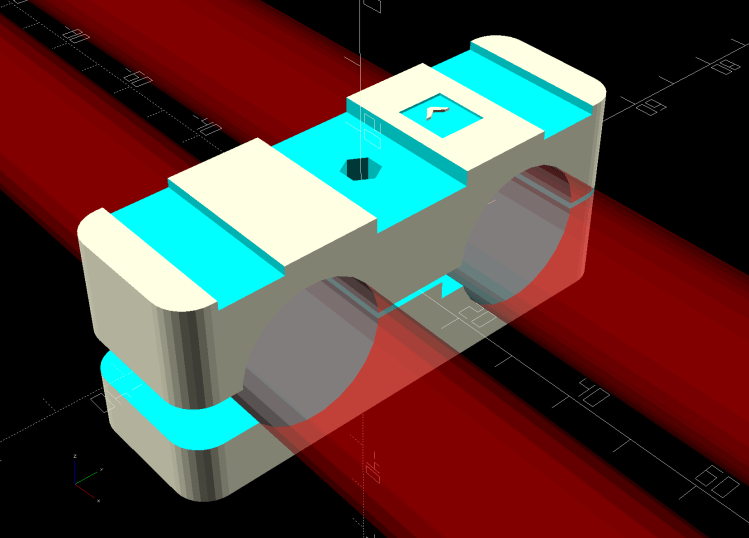
    The red frame tubes are not parallel, so each of the four mounting blocks fits in only one location. They’re identified by the side-to-side tube measurement at their centerline and directional pointers:

    Bafang Battery Mount - Show bottom
    Bafang Battery Mount – Show bottom

    The first three blocks have a hole for the mounting screw through the battery plate. The central slot fits around the plate’s feature for the recessed screw head. The two other slots clear the claws extending downward from the battery into the plate:

    Bafang Battery Mount - Show view
    Bafang Battery Mount – Show view

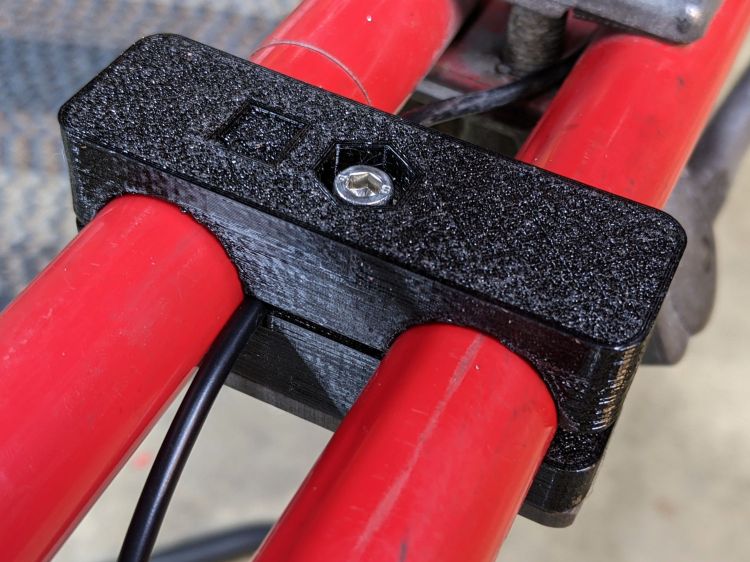
    The rear block has a flat top and a recessed screw head, because the fancy metal enclosure doesn’t have a screw hole:

    Tour Easy Bafang battery mount - top detail
    Tour Easy Bafang battery mount – top detail

    I thought of drilling a hole through the plate, but eventually put a layer of carpet tape atop the block to encourage it to not slap around, as the whole affair isn’t particularly bendy. We’ll see how well it works on the road.

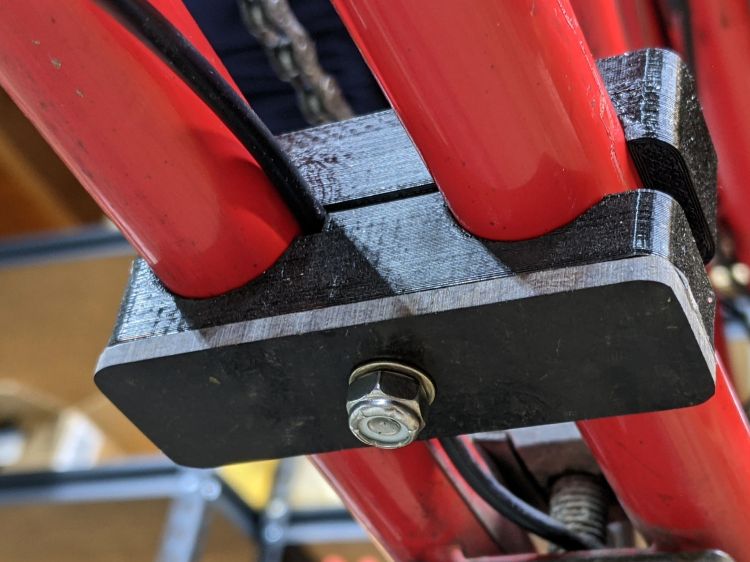
    I had intended to put an aluminum plate across the bottom to distribute the clamping force from the screw, but found a suitable scrap of the institutional-grade cafeteria tray we used as a garden cart seat:

    Tour Easy Bafang battery mount - bottom detail
    Tour Easy Bafang battery mount – bottom detail

    I traced around the block, bandsawed pretty close to the line, then introduced it to Mr Disk Sander for final shaping.

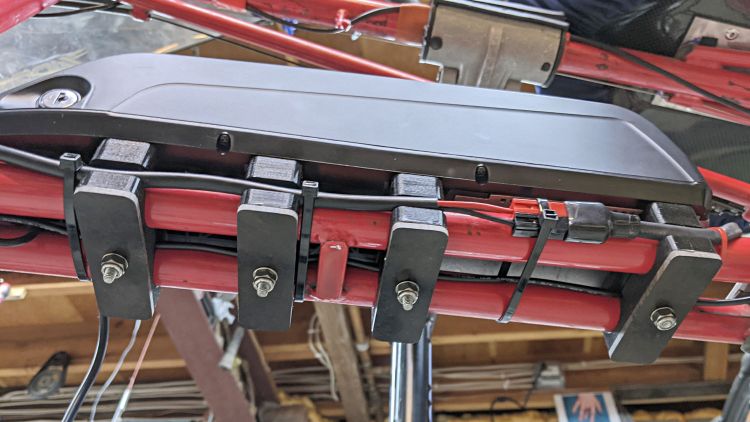
    The round cable runs from the rear wheel speed sensor through all four blocks to join the motor near the bottom bracket. Because a recumbent bike’s rear wheel is much further from its bottom bracket, what you see is actually an extension cable with a few extra inches doubled around its connection just ahead of the battery.

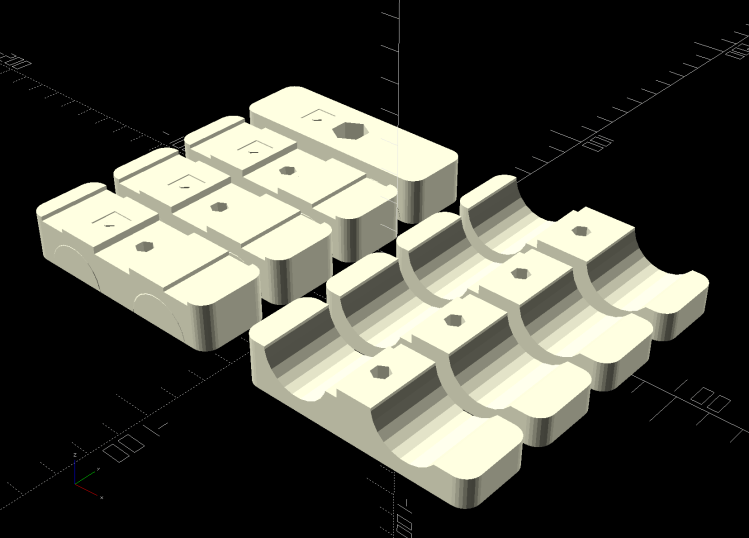
    Each of the four blocks takes about an hour to print, so I did them individually while making continuous process improvements to the solid model:

    Bafang Battery Mount - Build view
    Bafang Battery Mount – Build view

    The heavy battery cable runs along the outside of the left frame tube, with enough cable ties to keep it from flopping around:

    Tour Easy Bafang battery mount - bottom view
    Tour Easy Bafang battery mount – bottom view

    I wanted to fit it between the tubes, but there just wasn’t enough room around the screw in the front block where the tubes converge. It’s still pretty well protected and should be fine.

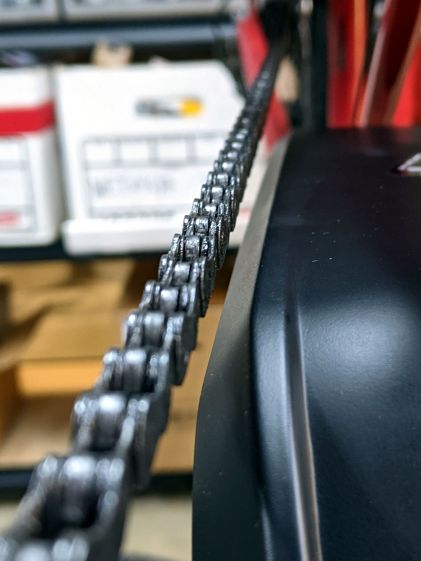
    The chainline worked out much better than I expected:

    Tour Easy Bafang battery mount - chainline
    Tour Easy Bafang battery mount – chainline

    That’s with the chain on the lowest (most inboard) rear sprocket, so it’s as close to the battery as it gets. I’m sure the battery will accumulate oily chain grime, as does everything else on a bike.

    Lithium batteries have a vastly higher power density than good old lead acid batteries, but seven pounds is still a lot of weight!

    The OpenSCAD source code as a GitHub Gist:

    // Tour Easy Bafang Battery Mount
    // Ed Nisley KE4ZNU 2021-04
    Layout = "Build"; // [Frame,Block,Show,Build,Bushing,Cateye]
    FrameWidths = [60.8,62.0,63.4,66.7]; // last = rear overhang support block
    Support = true;
    //- Extrusion parameters must match reality!
    /* [Hidden] */
    ThreadThick = 0.25;
    ThreadWidth = 0.40;
    HoleWindage = 0.2;
    Protrusion = 0.1; // make holes end cleanly
    inch = 25.4;
    function IntegerMultiple(Size,Unit) = Unit * ceil(Size / Unit);
    ID = 0;
    OD = 1;
    LENGTH = 2;
    //———-
    // Dimensions
    // Bike frame lies along X axis, rear to +X
    FrameTube = [350,22.6 + HoleWindage,22.6 + HoleWindage]; // X = longer than anything else
    FrameAngle = atan((65.8 – 59.4)/300); // measured distances = included angle between tubes
    TubeAngle = FrameAngle/2; // .. frame axis to tube
    FrameSides = 24;
    echo(str("Frame angle: ",FrameAngle));
    SpeedOD = 3.5; // speed sensor cable along frame
    PowerOD = 6.7; // power cable between frame tubes
    BatteryBoss = [5.5,16.0,2.5]; // battery mount boss, center is round
    BossSlotOAL = 32.0; // .. end bosses are elongated
    BossOC = 65.0; // .. along length of mount
    LatchWidth = 10.0; // battery latches to mount plate
    LatchThick = 1.5;
    LatchOC = 56.0;
    WallThick = 5.0; // thinnest wall
    Block = [25.0,78.0,FrameTube.z + 2*WallThick]; // must be larger than frame tube spacing
    echo(str("Block: ",Block));
    // M5 SHCS nyloc nut
    Screw = [5.0,8.5,5.0]; // OD, LENGTH = head
    Washer = [5.5,10.1,1.0];
    Nut = [5.0,9.0,5.0];
    // 10-32 Philips nyloc nut
    Screw10 = [5.2,9.8,3.6]; // OD, LENGTH = head
    Washer10 = [5.5,11.0,1.0];
    Nut10 = [5.2,10.7,6.2];
    Kerf = 1.0; // cut through middle to apply compression
    CornerRadius = 5.0;
    EmbossDepth = 2*ThreadThick; // lettering depth
    //———————-
    // Useful routines
    module PolyCyl(Dia,Height,ForceSides=0) { // based on nophead's polyholes
    Sides = (ForceSides != 0) ? ForceSides : (ceil(Dia) + 2);
    FixDia = Dia / cos(180/Sides);
    cylinder(d=(FixDia + HoleWindage),h=Height,$fn=Sides);
    }
    // clamp overall shape
    module ClampBlock() {
    difference() {
    hull()
    for (i=[-1,1], j=[-1,1])
    translate([i*(Block.x/2 – CornerRadius),j*(Block.y/2 – CornerRadius),-Block.z/2])
    cylinder(r=CornerRadius,h=Block.z,$fn=4*8);
    translate([0,0,-(Block.z/2 + Protrusion)])
    rotate(0*180/6)
    PolyCyl(Screw[ID],Block.z + 2*Protrusion,6);
    cube([2*Block.x,2*Block.y,Kerf],center=true);
    translate([0,-(Block.y/2 – PowerOD + Protrusion/2),-PowerOD/2])
    cube([2*Block.x,2*PowerOD + Protrusion,PowerOD],center=true);
    }
    }
    // frame tube layout with measured side-to-side width
    module Frame(Outer = FrameWidths[0],AdjustDia = 0.0) {
    TubeOC = Outer – FrameTube.y/cos(TubeAngle); // increase dia for angle
    for (i=[-1,1])
    translate([0,i*TubeOC/2,0])
    rotate([0,90,i*TubeAngle]) rotate(180/FrameSides)
    cylinder(d=FrameTube.z + AdjustDia,h=FrameTube.x,center=true,$fn=FrameSides);
    }
    // complete clamp block
    module Clamp(Outer = FrameWidths[0]) {
    TubeOC = Outer – FrameTube.y/cos(TubeAngle); // increase dia for angle
    difference() {
    ClampBlock();
    Frame(Outer);
    translate([0,(TubeOC/2 – FrameTube[OD]/2),-SpeedOD/2])
    cube([2*Block.x,2*SpeedOD,SpeedOD],center=true);
    translate([0,15,Block.z/2 – EmbossDepth/2 + Protrusion])
    cube([9.0,8,EmbossDepth],center=true);
    translate([0,22,-Block.z/2 + EmbossDepth/2 – Protrusion])
    cube([9.0,26,EmbossDepth],center=true);
    if (Outer == FrameWidths[len(FrameWidths) – 1]) { // special rear block
    translate([0,0,Block.z/2 – 2*Screw10[LENGTH]])
    PolyCyl(Washer10[OD],2*Screw10[LENGTH] + Protrusion,6);
    }
    else { // other blocks have channels
    translate([0,0,Block.z/2 – BatteryBoss[LENGTH]/2 + Protrusion])
    cube([BossSlotOAL,BatteryBoss[OD],BatteryBoss[LENGTH] + Protrusion],center=true);
    for (i=[-1,1])
    translate([0,i*LatchOC/2,Block.z/2 – LatchThick/2 + Protrusion])
    cube([BossSlotOAL,LatchWidth,LatchThick + Protrusion],center=true);
    }
    }
    translate([0,15,Block.z/2 – EmbossDepth])
    linear_extrude(height=EmbossDepth)
    rotate(90)
    text(text="^",size=5,spacing=1.00,font="Bitstream Vera Sans:style=Bold",
    halign="center",valign="center");
    translate([0,22,-Block.z/2])
    linear_extrude(height=EmbossDepth)
    rotate(-90) mirror([0,1,0])
    text(text=str("^ ",Outer),size=4.5,spacing=1.00,font="Bitstream Vera Sans:style=Bold",
    halign="center",valign="center");
    if (Support)
    color("Yellow") {
    NumRibs = 7;
    RibOC = Block.x/(NumRibs – 1);
    intersection() {
    translate([0,0,Block.z/2 + Kerf/2])
    cube([2*Block.x,2*Block.y,Block.z],center=true);
    union() for (j=[-1,1]) {
    translate([0,j*TubeOC/2,Kerf/2])
    cube([1.1*Block.x,FrameTube.y – 2*ThreadThick,4*ThreadThick],center=true);
    for (i=[-floor(NumRibs/2):floor(NumRibs/2)])
    translate([i*RibOC,j*TubeOC/2,0])
    rotate([0,90,0]) rotate(180/FrameSides)
    cylinder(d=FrameTube.z – 2*ThreadThick,h=2*ThreadWidth,$fn=FrameSides,center=true);
    }
    }
    }
    }
    // Half clamp sections for printing
    module HalfClamp(i = 0, Section = "Upper") {
    render()
    intersection() {
    translate([0,0,Block.z/4])
    cube([Block.x,Block.y,Block.z/2],center=true);
    if (Section == "Upper")
    translate([0,0,-Kerf/2])
    Clamp(FrameWidths[i]);
    else
    translate([0,0,Block.z/2])
    Clamp(FrameWidths[i]);
    }
    }
    // Handlebar bushing for controller
    BushingSize = [16.0,22.2,15.0];
    module Bushing() {
    difference() {
    cylinder(d=BushingSize[OD],h=BushingSize[LENGTH],$fn=24);
    translate([0,0,-Protrusion])
    cylinder(d=BushingSize[ID],h=2*BushingSize[LENGTH],$fn=24);
    translate([0*(BushingSize[OD] – BushingSize[ID])/4,0,BushingSize[LENGTH]/2])
    cube([2*BushingSize[OD],2*ThreadWidth,2*BushingSize[LENGTH]],center=true);
    }
    }
    // Cateye cadence sensor bracket
    module Cateye() {
    Pivot = [3.0,10.0,8.0];
    Slot = [4.2,14.0,14.0];
    Clip = [8.0,Slot.y,Slot.z + Pivot[OD]/2];
    translate([0,0,Clip.z])
    difference() {
    union() {
    translate([0,0,-Clip.z/2])
    cube(Clip,center=true);
    translate([-Clip.x/2,0,0])
    rotate([0,90,0])
    cylinder(d=Clip.y,h=Clip.x,$fn=12);
    }
    translate([-Clip.x,0,0])
    rotate([0,90,0]) rotate(180/6)
    PolyCyl(3.0,2*Clip.x,6);
    translate([0,0,-(Clip.z – Slot.z/2)])
    cube(Slot + [0,Protrusion,Protrusion],center=true);
    }
    }
    //———-
    // Build them
    if (Layout == "Frame")
    Frame();
    if (Layout == "Block")
    ClampBlock();
    if (Layout == "Bushing")
    Bushing();
    if (Layout == "Cateye")
    Cateye();
    if (Layout == "Upper" || Layout == "Lower")
    HalfClamp(0,Layout);
    if (Layout == "Show") {
    Clamp();
    color("Red", 0.3)
    Frame();
    }
    if (Layout == "Build") {
    n = len(FrameWidths);
    gap = 1.2;
    for (i=[0:n-1]) {
    j = i – ceil((n-1)/2);
    translate([-gap*Block.y/2,j*gap*Block.x,0])
    rotate(90)
    HalfClamp(i,"Upper");
    translate([gap*Block.y/2,j*gap*Block.x,0])
    rotate([0,0,90])
    HalfClamp(i,"Lower");
    }
    }
  • Tour Easy: Bafang BBS02 Configuration

    Tour Easy: Bafang BBS02 Configuration

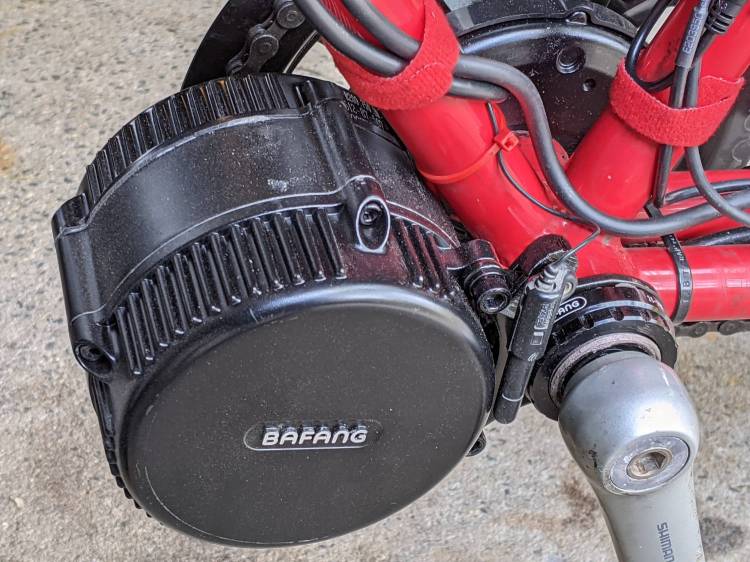
    The Bafang BBS02 motor claims a 750 W power output, although I suspect that’s measured at the instant before it flings its guts across the test lab:

    Tour Easy Bafang BBS02 motor
    Tour Easy Bafang BBS02 motor

    With a nominal 48 V battery supplying the motor’s nominal 24 A (some say 25 A) current, it dissipates well over 1100 W, although that’s obviously a short-term thing. With 750 W calling for 15-ish A, most likely it will (ideally) suffer thermal shutdown long before the battery runs out.

    Torque being more-or-less proportional to current, its nominal 160 N·m torque at 24 A scales downward by the same factor as the current, for 100 N·m at 15 A.

    The as-received Bafang BBS02 motor controller configuration provided far too much torque for our riding style; I think it’s intended for much younger folks tackling off-road trails on what used to be called mountain bikes, rather than assisting us with normal street riding.

    For example, the default maximum current was 24 A and the first step of pedal assistance was 28% = 6.7 A → 45 N·m: a pretty hefty shove right off the starting line. The Tour Easy was pretty much uncontrollable in the driveway, which is a Bad Sign.

    I started with the “Limitless” configuration (wherein the assistance for all steps continues up to the 20 mph overall speed limit) and reduced the maximum current to 15 A.

    The first assistance step of 5% = 0.8 A → 5 N·m now compensates for the additional weight of the Bafang motor + battery and feels like the unloaded bike.

    The second step was 37% = 8.9 A → 59 N·m and is now 7% = 1 A → 7 N·m, so Mary can ride along with a little oomph for minor hills.

    The third step was 46% = 11 A → 74 N·m and is now 16% = 2.4 A → 16 N·m, enough for the admittedly gentle hills along Vassar Road.

    The throttle uses the ninth step setting (100% = 15 A → 100 N·m) to provide a “get out of Dodge” boost at intersections.

    So far, the BBS02 configuration file looks like this:

    [Basic]
    LBP=42
    LC=15
    ALC0=0
    ALC1=5
    ALC2=7
    ALC3=16
    ALC4=25
    ALC5=37
    ALC6=51
    ALC7=67
    ALC8=85
    ALC9=100
    ALBP0=0
    ALBP1=100
    ALBP2=100
    ALBP3=100
    ALBP4=100
    ALBP5=100
    ALBP6=100
    ALBP7=100
    ALBP8=100
    ALBP9=100
    WD=12
    SMM=0
    SMS=1
    [Pedal Assist]
    PT=3
    DA=0
    SL=0
    SSM=3
    WM=0
    SC=10
    SDN=5
    TS=10
    CD=8
    SD=1
    KC=100
    [Throttle Handle]
    SV=11
    EV=42
    MODE=1
    DA=10
    SL=0
    SC=10
    

    Mary says she’s getting entirely enough exercise and, frankly, so am I. We have yet to try faster paces and steeper hills.

  • Tour Easy: Bafang BBS02 Mid-Drive Motor

    Tour Easy: Bafang BBS02 Mid-Drive Motor

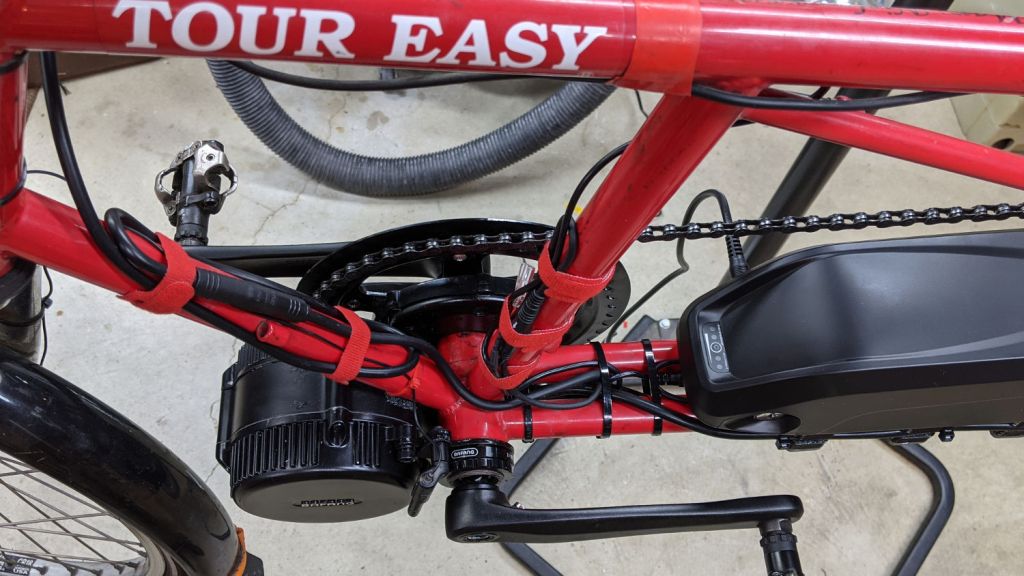
    For reasons not relevant here, Mary’s Tour Easy recumbent now sports a Bafang BBS02 Mid-drive motor:

    Tour Easy Bafang mid-drive - overview
    Tour Easy Bafang mid-drive – overview

    It pretty much Just Fit, although the lithium battery sits atop mounts conjured from the vasty digital deep:

    Tour Easy Bafang mid-drive - battery
    Tour Easy Bafang mid-drive – battery

    Many cables connect all the doodads, which a custom-made e-bike can hide inside the frame, but … that’s not an option for us.

    The Bafang BBS02 kit is basically plug-n-play, at least if you own a standard-ish bike. I included some useful options for our setup:

    Changing the controller parameters, usually called “programming”, required firing up the Token Windows Laptop:

    As you might expect, I set up a relatively sedate and low-powered pedal assist mode in place of the default rocket sled mode.

    The motor design seems a decade old, so Bafang (née 8Fun) has had time to work out some of the original design misfeatures. It definitely has shortcomings, but nothing insurmountable so far.

    Early results suggest Mary is now riding her familiar bike over much flatter terrain.

    Some background reading:

    More on all of this as I compile my notes …

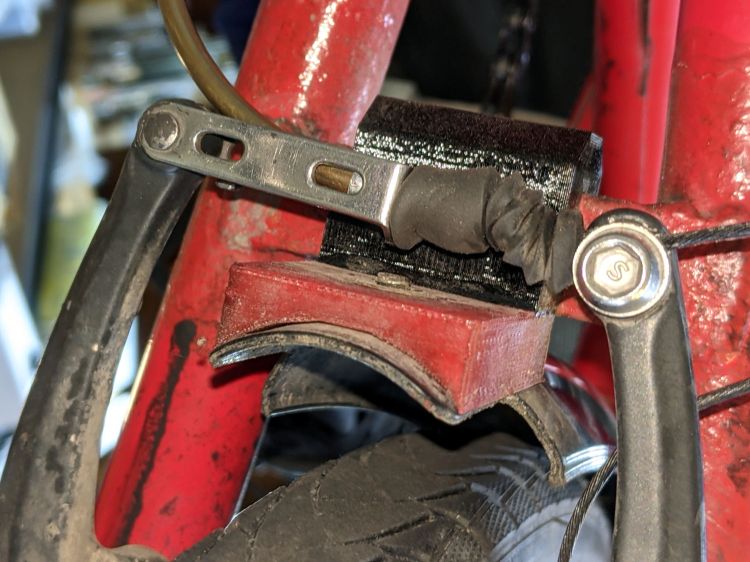
  • Tour Easy Rear Fender Bracket: More Cable Clearance

    Tour Easy Rear Fender Bracket: More Cable Clearance

    Most likely due to the fiddling around the larger rear brake noodle, the 3D printed bracket holding the fender to the frame failed:

    Tour Easy Rear Fender Bracket - failed joint
    Tour Easy Rear Fender Bracket – failed joint

    Hey, it lasted for six years.

    Making another one just like the other one, but with a little more clearance for the brake cable fittings, required a few tweaks to the solid model:

    Rear Fender Bracket - more clearance
    Rear Fender Bracket – more clearance

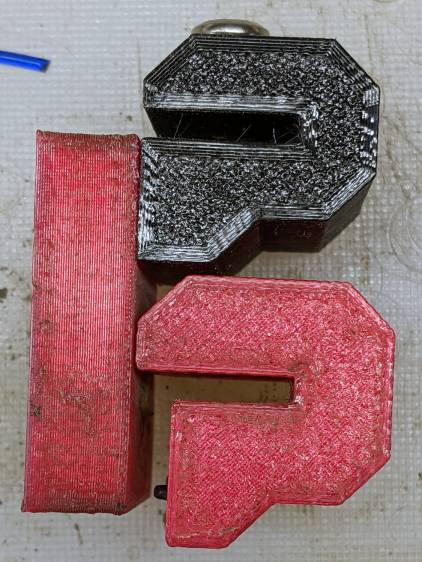
    It’s slightly less chunky and holds the fender a bit closer to the tire:

    Tour Easy Rear Fender Bracket - new vs old clearance
    Tour Easy Rear Fender Bracket – new vs old clearance

    The piece over on the left cupping the fender wasn’t broken, so I scuffed up the mating surfaces, applied a layer of JB Plastic Bonder (my new go-to adhesive for printed stuff), clamped it overnight, and it looked OK.

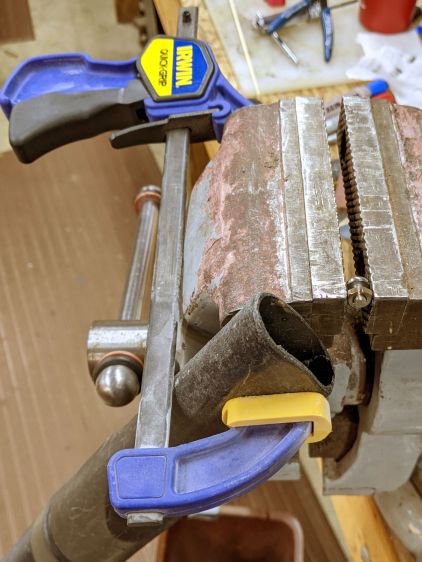
    While that was curing, I shortened the screw holding the clamp to the bike frame:

    Tour Easy Rear Fender Bracket - cutoff wheel dust collection
    Tour Easy Rear Fender Bracket – cutoff wheel dust collection

    The shop vac nozzle does a great job of collecting all the abrasive dust; highly recommended.

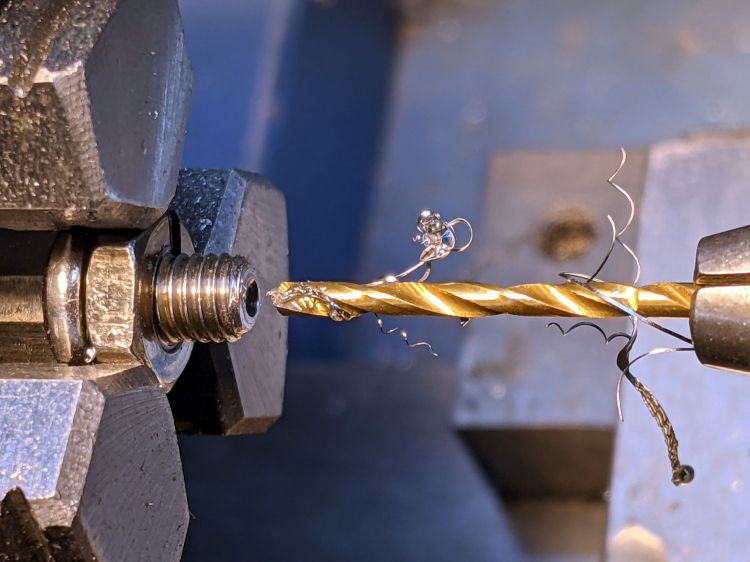
    Because I had a dollop of adhesive left over, I applied a 1.8 mm drill (from a set of metric bits I’d been meaning to buy for far too long) to the screw:

    Tour Easy Rear Fender Bracket - screw drilling
    Tour Easy Rear Fender Bracket – screw drilling

    And glued a snippet of pretty blue PETG filament in the hole:

    Tour Easy Rear Fender Bracket - frame screw PETG insert
    Tour Easy Rear Fender Bracket – frame screw PETG insert

    As far as I can tell, this will have no effect on the screw’s goodness, but it makes me feel better about crunching it onto the frame.

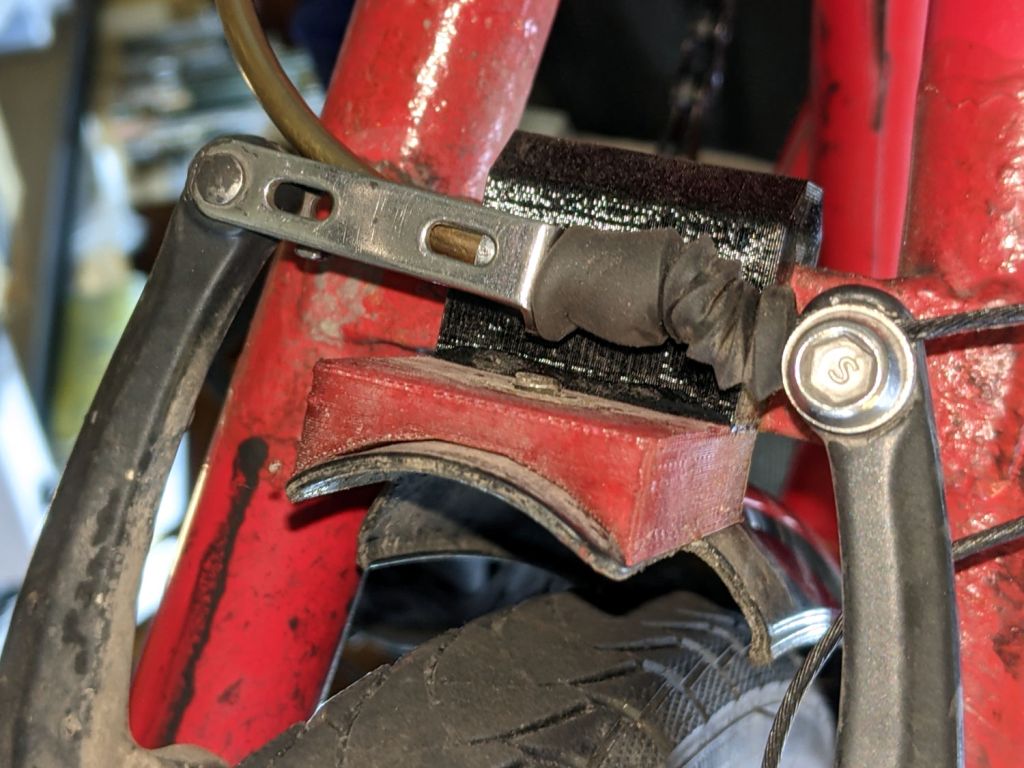
    Installation goes like you’d expect and there’s now enough clearance to keep the brake hardware off the bracket:

    Tour Easy Rear Fender Bracket - installed
    Tour Easy Rear Fender Bracket – installed

    I replaced the boot while installing the larger noodle; perhaps I should have trimmed most of it away.

    The riding season is upon us!

  • Tour Easy: Extended V-brake Noodle

    Tour Easy: Extended V-brake Noodle

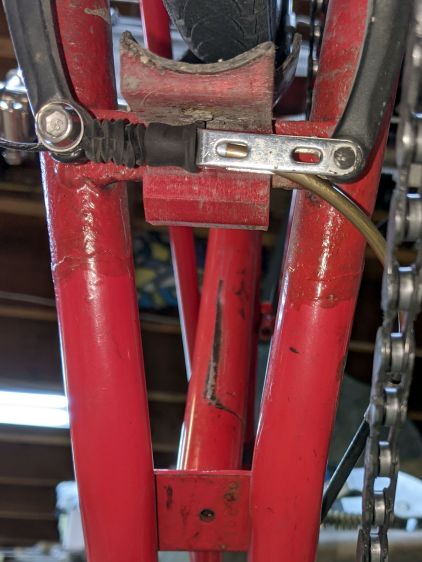
    Although our Tour Easy recumbents use ordinary (*) V-brakes, their frame geometry doesn’t route the rear cable quite the way the brake designers expected. Mary’s Medium-Small frame always had its rear brake cable resting against the frame tube, where it bent slightly as she applied the brakes:

    Tour Easy rear V-brake layout
    Tour Easy rear V-brake layout

    That’s looking up from under the rear wheel, with the bike on a workstand, and, yeah, it’s pretty grubby down there.

    The squashed rubber boot suggests the brake arms are too close together, but that’s where they must be to hold the brake pads in the proper position, even with new pads and big spacer washers. As a result, the cable stop over on the right at the end of the noodle rests against the frame and dings the paint.

    My first thought was to add some length to the end of the noodle inside the stirrup, so I made an adapter with the ID on the noodle end matching the OD on the fitting end:

    V-brake - larger noodle - end stop adapter
    V-brake – larger noodle – end stop adapter

    Which worked poorly, because the noodle has a straight section leading up to the fitting inside the stirrup; any additional length pushes the noodle curve against the stirrup pivot and cants it out of line:

    Tour Easy rear V-brake noodle
    Tour Easy rear V-brake noodle

    I’ve been avoiding the fallback plan of building a bigger noodle for years, but finally combined a foot of 3/32 inch brass tubing, a tube bender spring, and various large-diameter round-ish objects from the Basement Warehouse Wing:

    V-brake - larger noodle - bending
    V-brake – larger noodle – bending

    I annealed the tube by running a torch along its length until the color changed to the obvious “I’m hot enough” copper color, then let it air-cool while I did something else. Brass work-hardens quickly and required two more annealings while finishing that smooth curve; as far as I know, brass doesn’t harden with the heat-and-quench cycle used for steel.

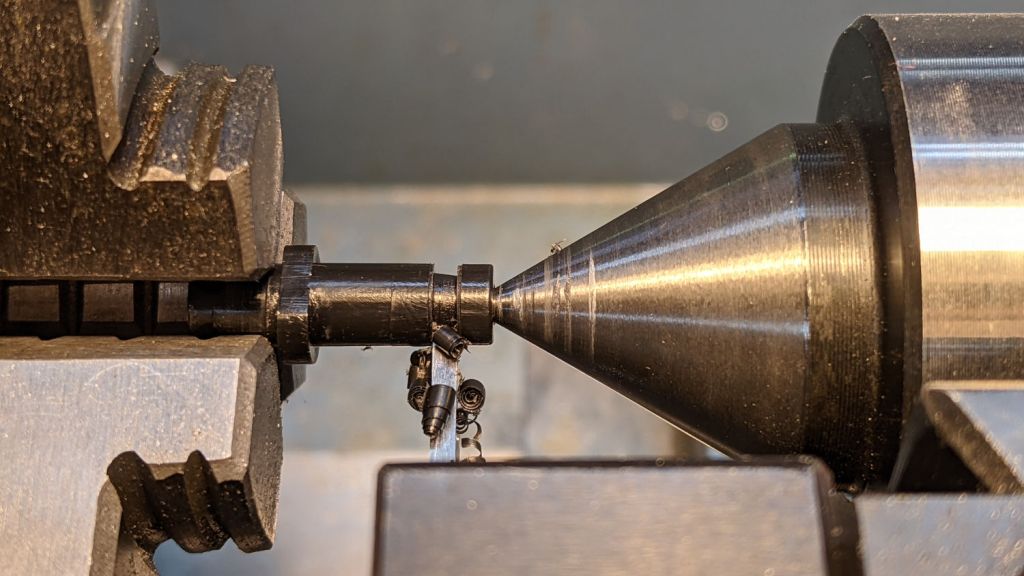
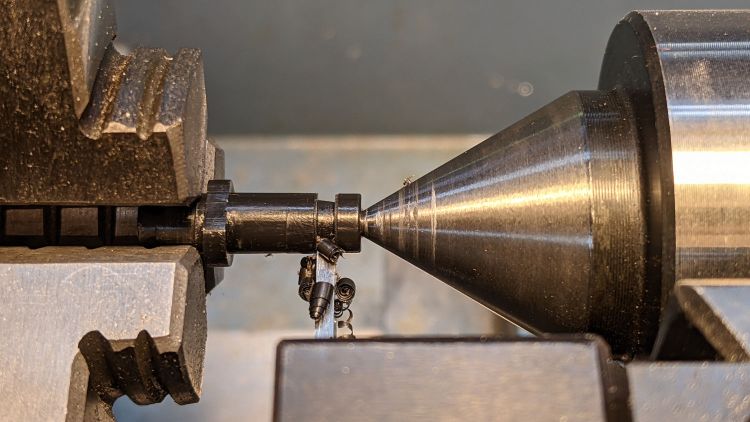
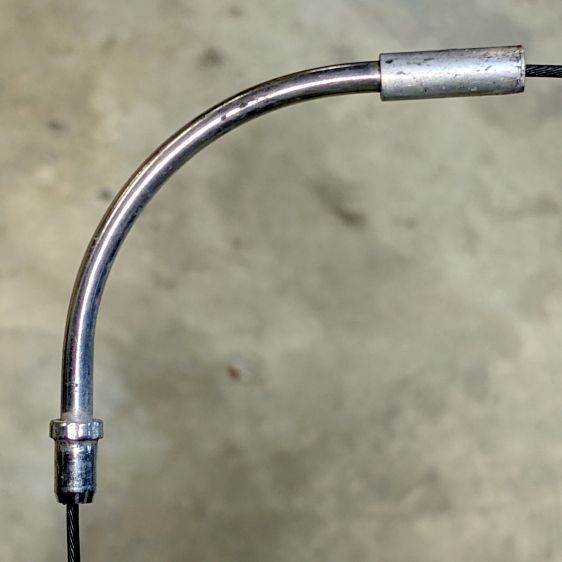
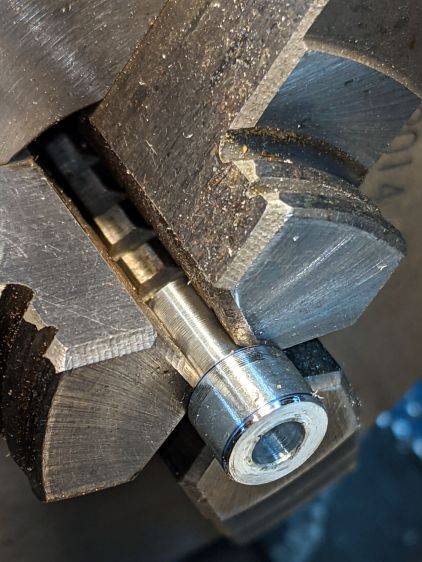
    A little more lathe work produced a replacement fitting:

    V-brake - larger noodle - end stop
    V-brake – larger noodle – end stop

    The hole is barely one diameter deep, but I think it’ll align the tube well enough for my simple needs. The failure will most likely involve having the cable chew through the inward side of the mis-aligned tube, which should become obvious in short order.

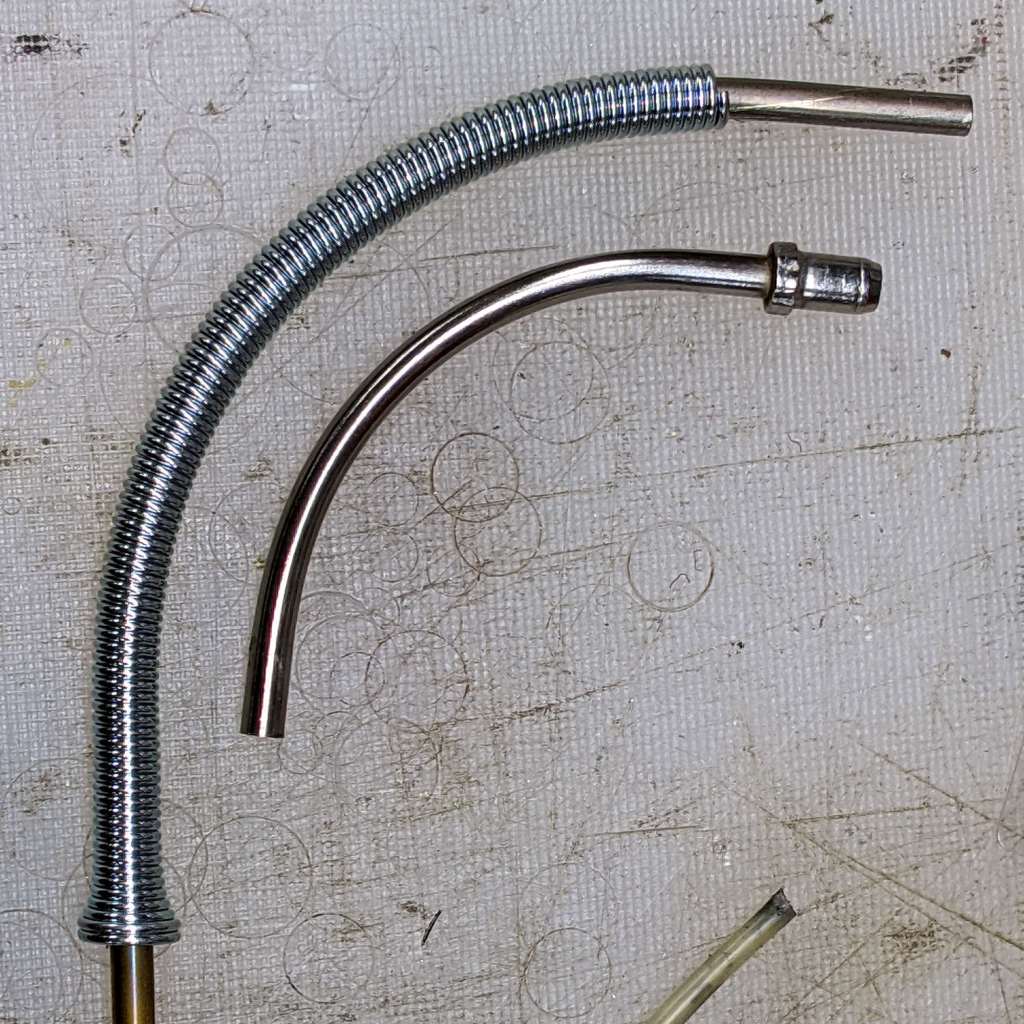
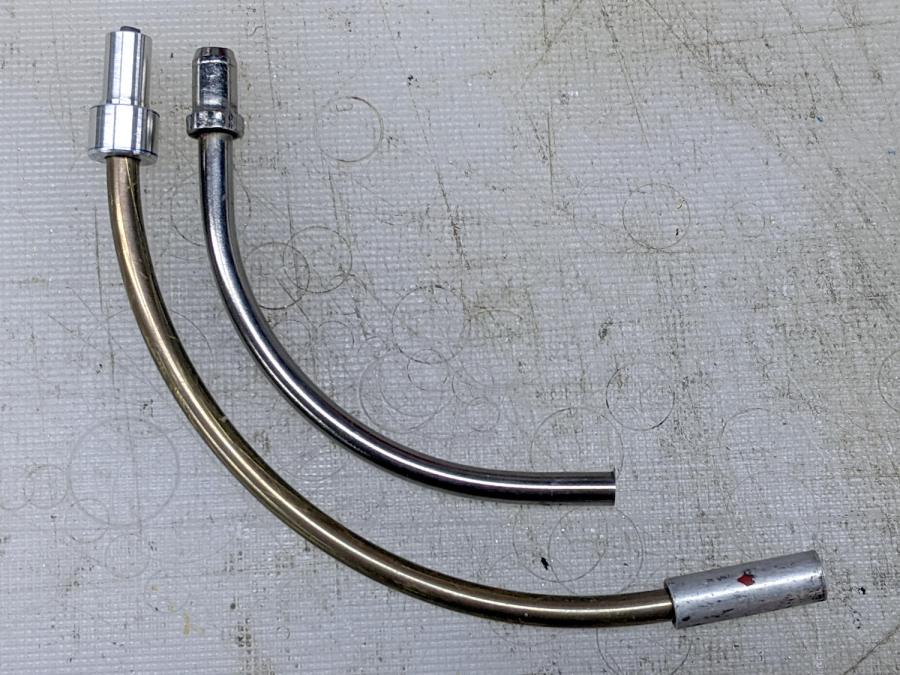
    The fitting on the OEM noodle seems to be crimped in place, but I figure my version is unlikely to fall off in normal use:

    V-brake - larger noodle vs OEM
    V-brake – larger noodle vs OEM

    Lined up thusly, you can see the reduced straight section behind my fitting and the much larger sweep out to the cable stop.

    The OEM noodle had a (presumably) PTFE liner, so I adapted a length of PTFE brake cable liner by mashing the end with various conical objects until it kinda-sorta looked like the cable stop might capture the ragged flange:

    V-brake - larger noodle - PTFE liner
    V-brake – larger noodle – PTFE liner

    Reassembling in reverse order produces a comforting sight:

    V-brake - larger noodle - installed
    V-brake – larger noodle – installed

    Despite appearances, the new noodle sits below the frame and well above the chain in normal use. In the most extreme small-small cross gearing position the chain barely clears it, but the takeup arm on the rear derailleur starts clattering enough to remind us not to do that.

    Brass is certainly not as strong as stainless (?) steel, although I think it ended up in a reasonably hard condition after all the bending. I’m certain neither of us can squeeze the brake lever enough to come anywhere close to causing a problem.

    Making a noodle was easier than I expected and, in a month or so, we’ll see how it behaves under actual riding conditions.

    (*) “Ordinary” as of many decades ago, because the design dates back to the mid-70s, when Fast Freddy Markham broke 65 mph on a rather customized Easy Racers Gold Rush.

  • Tour Easy Seat Hatchery

    Tour Easy Seat Hatchery

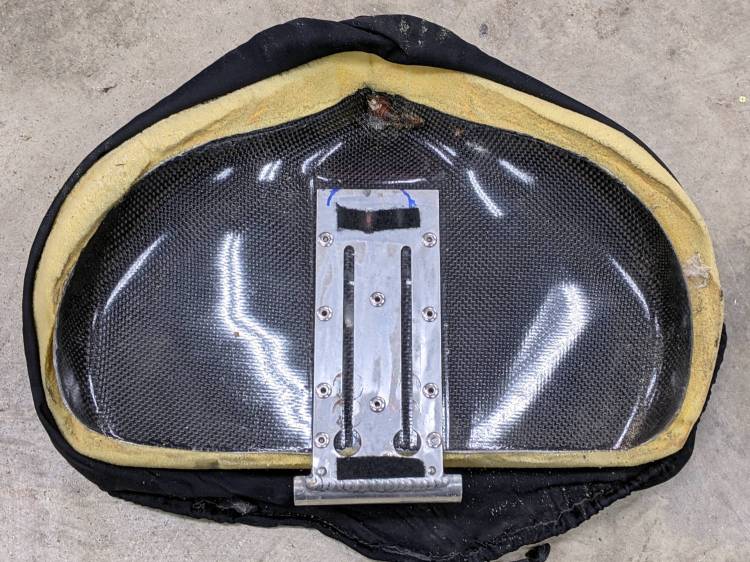
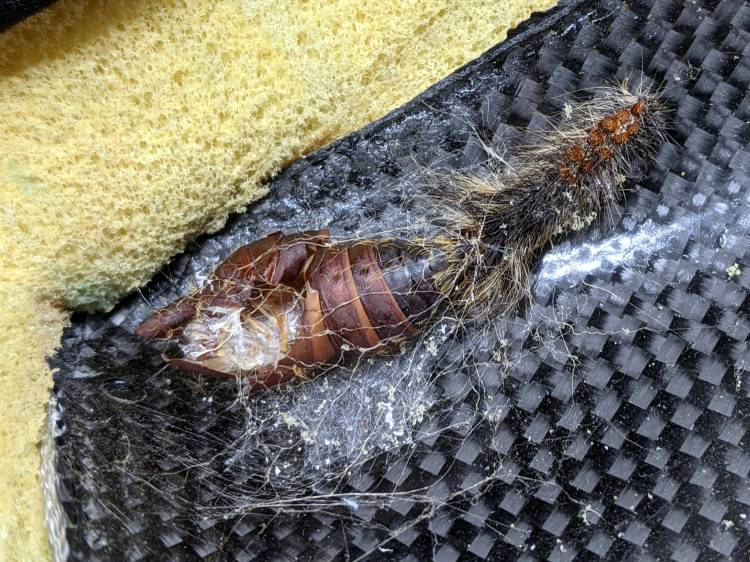
    Removing the seat from Mary’s Tour Easy revealed an unexpected sight:

    Tour Easy seat - bottom view
    Tour Easy seat – bottom view

    A closer view:

    Tour Easy seat - pupal remains
    Tour Easy seat – pupal remains

    An insect, most likely a rather large butterfly or moth, decided to pupate on the underside of the seat, tucked inside the old seat cover. We can’t fault the critter’s logic!

    Mary is sewing up new seat covers for our Tour Easy ‘bents in preparation for the new riding season. Who knows what we’ll find under there in a few years?

  • Sharing the Lane in Red Oaks Mill

    Sharing the Lane in Red Oaks Mill

    We’re in the middle of three southbound lanes on Rt 376 in Red Oaks Mill, turning left into the rightmost lane going down the hill across the bridge, when a car approaches from behind:

    Red Oaks Mill Intersection - close pass - approach - 2020-12-24
    Red Oaks Mill Intersection – close pass – approach – 2020-12-24

    Most drivers seem content to wait behind us until we get into the huge intersection where there’s plenty of room (comparatively speaking) to pass, but not this one:

    Red Oaks Mill Intersection - close pass - waiting - 2020-12-24
    Red Oaks Mill Intersection – close pass – waiting – 2020-12-24

    I warned Mary (one the reasons we have radios on our bikes) about the mirror just behind her shoulder and she verified the minimal clearance:

    Red Oaks Mill Intersection - close pass - arms length - 2020-12-24
    Red Oaks Mill Intersection – close pass – arms length – 2020-12-24

    Prudence dictated we wait until he was clear before moving:

    Red Oaks Mill Intersection - close pass - rolling - 2020-12-24
    Red Oaks Mill Intersection – close pass – rolling – 2020-12-24

    Of course, the signal timing doesn’t let us get all the way through the intersection under the best of conditions, but we make an impressive enough parade to keep oncoming cars from moving before we’re out of their way.

    This section of NY Rt 376 is also NY Bike Route 9, which doesn’t explain why NYS DOT pays so little attention to bicycle safety.