Ed Nisley's Blog: Shop notes, electronics, firmware, machinery, 3D printing, laser cuttery, and curiosities. Contents: 100% human thinking, 0% AI slop.
A few minutes after we started riding, an insect collided with my helmet. About 3/60 second before impact:
HDR-AS30V 1280×720-60 – Insect – crop
We paused in a park at the far end of the ride, rolled out, and another insect buzzed past:
HDR-AS30V 1280×720-60 – Insect 2 – crop
Both of those flew within a few inches of the lens, far inside the camera’s fixed-focus near point, and it’s a wonder they look as good as they do. Looking at successive frames reveals wingbeats, although they’re surely flapping much faster than frame rate and therefore heavily aliased.
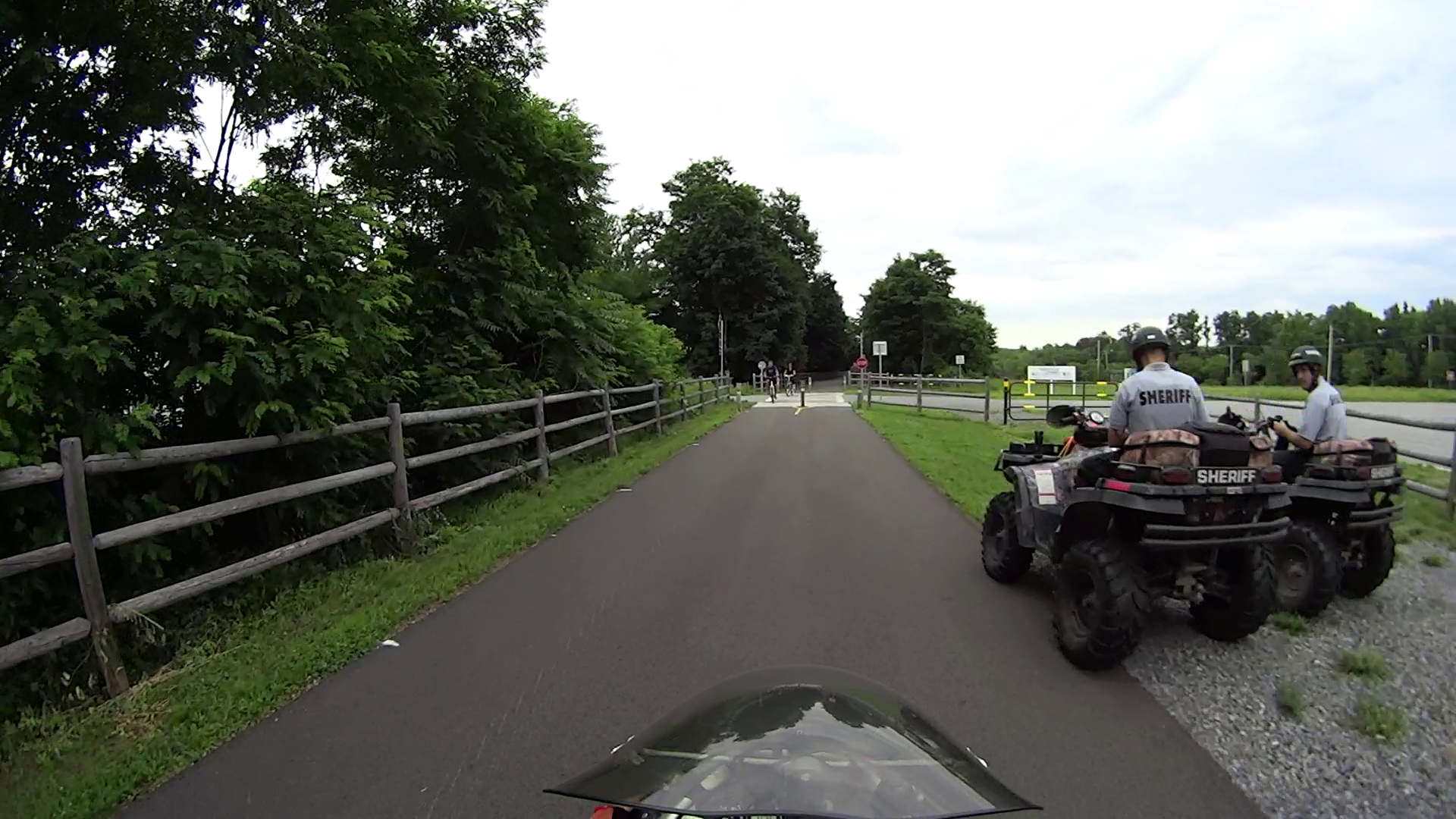
Fortunately, a Gas Hawk didn’t come that close:
Rt 376 – Dutchess Airport – landing
All from the Sony HDR-AS30V in 1280×720 at 60 frame/s. The bug images were ruthlessly cropped to show the full-size dot-for-dot camera image, then stored with minimal compression.
This isn’t the first time I’ve been buzzed on the bike, but it’s a record for one ride.
Our Larval Engineer stopped by, on her way to a half-year co-op job out around Route 128, and devoted a few days to merge-sorting / triaging her possessions. Having shown her the HP 74754A plotter project, she later dropped a bag o’ stuff on my desk without comment:
HP7475A – My old pens racks doodles
The perforated pen holder stuck to the plotter case (hey, it would still fit!) in front of the carousel with a bit of foam tape on an angled bracket you can’t quite see. It held 15 pens at the ready: I really used that plotter.
The doodle on the yellow sheet sketches a bulky adapter between the spindle nose thread on the Sherline CNC mill and a plotter cartridge. The flange-less pen body might just fit into the spindle bore, but I remember concluding that machining pen bodies or adapters wasn’t worth the effort. Now it’s a simple matter of some OpenSCAD source code and a few hours of hands-off production, so perhaps I should re-think that.
No dates on anything, but I got the Sherline in 2004. The pen holder probably dates back to the late 80s, shortly after I got the plotter. Most likely, I gave her the bag o’ stuff and told her to make something interesting; it could still happen…
After a bit of sorting, I had a quartet of “disposable” liquid ink pens with contents ranging from desiccated to gummy. With nothing to lose (and having already cut a clearance slot in the plotter case), I drilled a small hole in the top of each reservoir, squirted some inkjet printer ink into the void, and taped the hole closed.
Surprisingly, a little liquid love restored all but the black pen to working condition, if not perfect heath:
HP7475A disposable liquid pen – refilled
I think the blurred white disk floating in the reservoir sealed the end where you jam the tip in place to activate the pen. The blob of dark gunk shows the reservoir didn’t start with yellow ink, but I had nothing to lose.
The top pen in this picture is another style / brand with a smaller reservoir:
HP7475A pens – disposable liquid and ceramic tip
The white pen in the foreground has a 0.3 mm ceramic tip, contains its original green ink, and works as well as it ever did; it might be refillable, too.
The liquid-ink pens have a serpentine vent in the tip. This is a Genuine New-Old-Stock pen in a four-pen case labeled HP 5061-7566:
HP7475A disposable liquid pen – new
The serpentine path connects the exterior vent opening (facing you) to a tiny hole (on the other side of the blue shaft) into the ink chamber. As it turns out, a new hole drilled in the reservoir admits enough air to drain the (freshly refilled) liquid ink through the serpentine path all over the workbench. Having some experience with refilling inkjet cartridges, I deployed a towel decorated with colorful splotches in anticipation of such an unexpected event, although my fingers looked considerably more cheerful than usual for a few days.
The black pen never worked quite right, but the other three did fine. The ceramic pen is at the top:
HP7475A – KBR to YCM Refilled disposable pens – G ceramic pen
Protip: the blown contrast and rear-surface bleedthrough behind the yellow ink should tell you it isn’t visible in normal room light. I must mix yellow with another color if I ever refill that pen that again.
KiCad uses only one pen for the entire schematic, even when you select “plot in color”, suggesting nobody has sent the “plotter” output stream to an actual plotter in a long, long time.
Despite the charm of watching the plotter crank out an entire schematic page, it’s not a compelling enough user experience to replace an inkjet printer. For an art project, one might be seeking an entirely different user experience and the answer might be different, too.
There’s no obvious mechanical damage at the center of the orange blotch, so it must be something internal to the LCD panel going bad. The fading along the left edge might be part of the same QC glitch.
Confidence-inspiring, this is not, even though it has nothing to do with the credit union itself…
At first glance, I thought Mary had taken a tour of The Great Swamp south of the Vassar Farm gardens:
APRS Bicycle Tracking – Flying High
Having helped put the fence up, I’m absolutely certain nothing growing in the garden could get her to 4373 feet, much less boost the bike that high.
Before that, it seems she did some high-speed tunneling:
2015-05-10 18:17:31 EDT: KF4NGN-9>T1TP4X,WIDE1-1,WIDE2-1,qAR,KB2ZE-4:`eP}nAIb/"/k}
type: location
format: mice
srccallsign: KF4NGN-9
dstcallsign: T1TP4X
latitude: 41.67466666666667 °
longitude: -73.88283333333334 °
course: 345 °
speed: 42.596 km/h
altitude: -371 m
symboltable: /
symbolcode: b
mbits: 101
posresolution: 18.52 m
posambiguity: 0
The bike’s altitude began falling while she was on the way to the garden, from a reasonable 66 meters on the entrance road, bottoming out at -371 m as she hit 42.6 km/h (!), rising to 1341 meters with the bike leaning against a fence post, and returning to 53 meters as she started riding home.
Obviously, you shouldn’t trust consumer-grade GPS tracks without verification: it can get perfectly bogus numbers from fixes with poor satellite geometry. Altitude values tend to be only close, at best, even when you’re not too fussy about accuracy.