A new Dunkin’ opened up about a week ago, whereupon this happened in the right-angled drive-thru lane:

A closer look shows they need more concrete down there:

If that were my gas service, I might have put up two ineffective bollards.
The Smell of Molten Projects in the Morning
Ed Nisley's Blog: Shop notes, electronics, firmware, machinery, 3D printing, laser cuttery, and curiosities. Contents: 100% human thinking, 0% AI slop.
Who’d’a thunk it?

A new Dunkin’ opened up about a week ago, whereupon this happened in the right-angled drive-thru lane:
A closer look shows they need more concrete down there:
If that were my gas service, I might have put up two ineffective bollards.

Sharper eyes than mine pointed out I misspelled Poughkeepsie, so I took advantage of the opportunity to make the whole thing look better:

It turns out the low-surface-energy tape stuck like glue to the acrylic tag (because that’s what it’s designed for) and peeled right off the laminating film on the printed paper. So I stuck some ordinary adhesive film to the back of the new paper label, left its protective paper on the other side, cold laminated the film+paper, laser-cut the outline, peeled off the back side of the laminating film with the protective paper, and stuck the new adhesive to the LSE tape still on the tag.
I have no idea how well this will work out in the long term, what with two adhesive layers bonded to each other, but this whole thing is in the nature of an experiment.

Another specimen at the corner gas station atop their flatbed hauler:

The exposed ICs add a piquant touch, don’t they?
We’ll never know the rest of the story …

The improved Holly Mirror Coaster looks pretty good:

Until you realize some of those specks aren’t surface dust and take a closer look:

The surface scratches are doubled by their reflection in the bottom mirror. The little dots that aren’t doubled reveal marks in the mirror surface itself.
An even closer look:
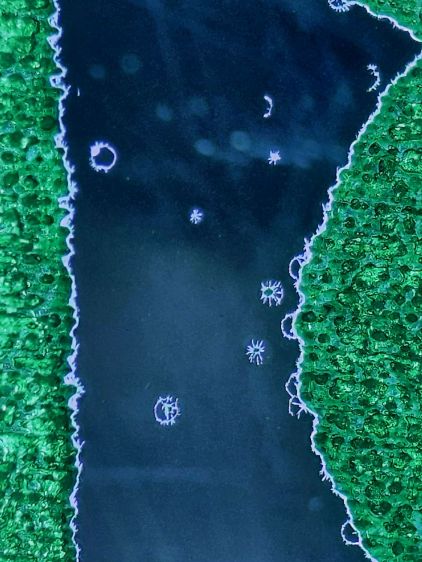
As nearly as I can tell, those are random speckles caused by the laser tube firing when it shouldn’t, due to the chaotic nature of the gas discharge going on inside.
In this case, they cause defects in the mirror coating allowing alcohol from the fat-tip permanent markers coloring the engraved areas to hit the acrylic. The starbursts come from stress cracks around the punctures.
Peering even closer shows similar cracks along the edges of the colored areas:

Not much to do about the random speckles, but it’s obvious I must up my coloring game.
Which would be significantly easier if rattlecan spray paint sprayed at winter temperatures …

After the first two snowflake coasters, it finally penetrated my thick skill that putting a 1 mm hole in the flake cut from the center of the plywood would convert it into a decorative window hanging:
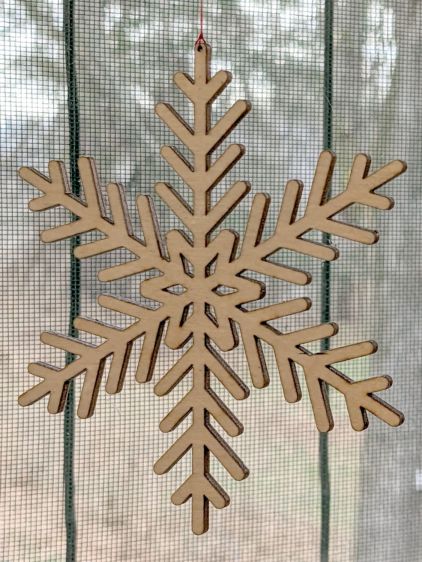
Admittedly, I may be using the word “decorative” in a manner you had not previously encountered, but work with me on this.
Cutting a similar flake from transparent acrylic looks better:
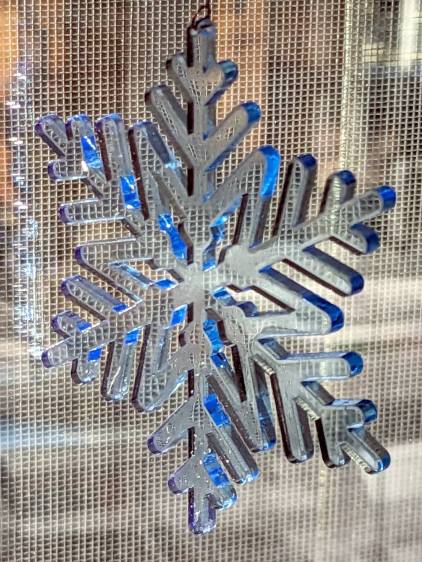
Transparent acrylic turned out to be, well, too transparent, so I set up a LightBurn layout to “engrave” a light frosting on the flake before cutting it out:

That worked for all subsequent flakes, but I had to do something about the first few flakes. After realizing that the time to engrave an object depends only on its width, I set up a rectangle with the proper parameters, snugged two forlorn flakes next to each other, and fired the laser:

I thought using cardboard was a Good Idea™ for a stable backing, but lightly vaporizing the top layer produced an unbelievable amount of filth:
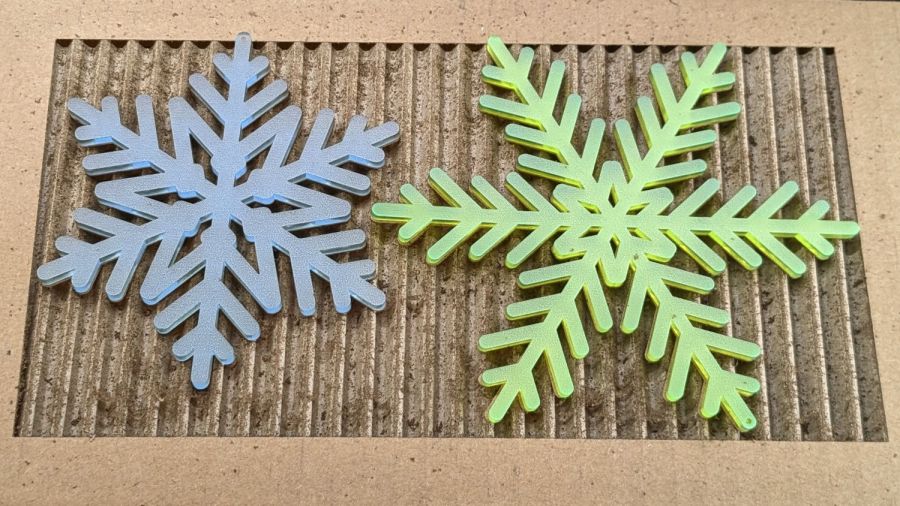
I had to scrub those poor flakes with dish detergent and a toothbrush to get them even close to their former pristine state; the blue one may never recover.
Anyhow, frosted flakes look good if you don’t look closely:

The grid pattern comes from the window screen in direct sunlight; the vertical bars are DIY BirdSavers.
The LightBurn layout produces 120 mm coasters to fit my 20 ounce mugs:
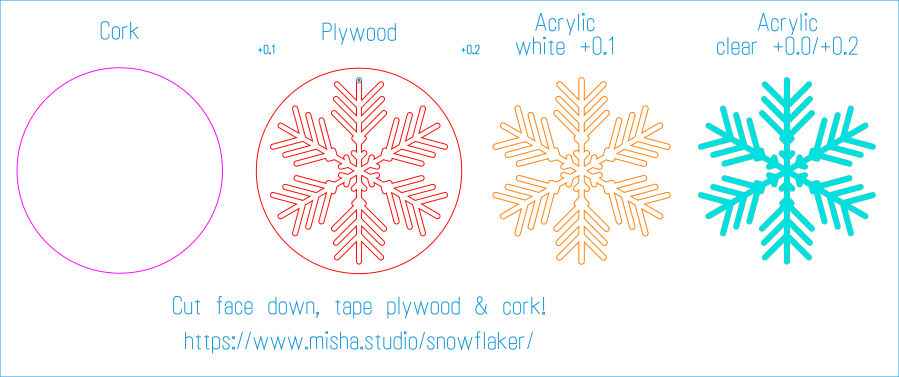
You get two hanging flakes: one plain plywood and one frosted acrylic!
The LightBurn SVG layout as a GitHub Gist:
A blog about GRBL configuration and water heat anode rod wrenches, perhaps with a few pictures, would have killer SEO:
| Home page / Archives | 21053 |
| CNC 3018-Pro: GRBL Configuration | 5341 |
| Why You Need a 6-Point Socket to Remove a Water Heater Anode Rod | 5197 |
| G-Code and M-Code Grand Master List | 3250 |
| Toyota Sienna: ABS Trouble Codes | 2385 |
| American Standard Elite Kitchen Faucet Disassembly | 2297 |
| Homage Tektronix Circuit Computer | 1898 |
| Subaru Forester Fuse Boxes | 1607 |
| Bed Bugs: Thermal Kill | 1581 |
| Broom Handle Screw Thread: Replacement Plug | 1512 |
| Kensington Expert Mouse Trackball: Scroll Ring Troubles | 943 |
| Whirlpool Water Heater “Lifetime” Warranty: The Good and the Bad | 922 |
| Digital Tattoo Power Supply: Polarity Doesn’t Matter | 868 |
| Auto-V.I.N Gauge Scam | 829 |
| Review Phreesia Authorization | 827 |
| Baofeng UV-5R Squelch Settings | 806 |
| Raspberry Pi: Forcing VNC Display Resolution | 777 |
| Kenmore 158.17032 Handwheel Clutch Disassembly | 758 |
| 2000 Toyota Sienna: Replacing the Bank 1 Sensor 2 Oxygen Sensor | 751 |
| Bafang USB Programming Adapter | 747 |
| Removing a Water Heater Anode Rod | 724 |
| CNC 3018-Pro: DRV8825 Hack for 1:8 Microstep Mode | 710 |
| Low Budget Bench Power Supply | 691 |
| Kensington Expert Mouse Scroll Ring Fix | 648 |
| Juki JC-001 Foot Control: Resolving Uncommanded Thread Cutting | 646 |
| Browning Hi-Power Magazine Dimensions | 633 |
| Displaying Variables in Gnuplot | 622 |
| Replacing Phil Wood Hub Bearings | 619 |
| Makerbot-style Endstop Power Adapter for Protoneer Arduino CNC Shield | 593 |
| Schwab / Symantec VIP Access vs. Yubikey | 581 |
| Shimano SPD Pedals: Creaking Resolved | 573 |
| Raspberry Pi Interrupts vs. Rotary Encoder | 566 |
| Kohl’s Guest WiFi Terms & Conditions: The Short Version | 558 |
| GRBL Error 33: Arc Coordinates vs. Decimal Places | 516 |
| Abusing a Leather Punch for Manhattan-Style Circuit Construction | 515 |
| OMTech 60 W Laser: Adjustable Honeycomb Stops | 511 |
| LTSpice Diode Models Sorted By Forward Voltage | 511 |
| Why You Shouldn’t Use Heat Pumps in the Northeast US | 509 |
| HP-48GX Calculator Disassembly: Case Rivets | 508 |
| Homage Tektronix Circuit Computer: Laser-Engraved Hairline Tests | 504 |
| Homebrew Magnetizer-Demagnetizer | 488 |
| Quick-and-easy IR-passing / Visible-blocking Optical Filter | 475 |
| Old Kenmore Sewing Machine Foot Control Repair | 467 |
| Reversible Belt Buckle: Post Restaking | 464 |
| Toyota Sienna: Rear ABS / Speed Sensor Failure | 461 |
| Mini-Lathe Tailstock: Alignment | 455 |
| Philips Sonicare Essence 5000: Battery Replacement | 445 |
| Mysterious Noise in Toyota Sienna Minivan: Fixed! | 440 |
| Demolition Card GTA 5-10-9 | 434 |
| Icecast and Ezstream Configuration | 424 |
| OMTech 60 W Laser: Controlling the Air Assist Pump | 418 |
| Multimeter Range Switch Contacts: Whoops! | 417 |
| Chili Powder Beetles | 410 |
| Mini-Lathe Metric Threading: 21 Tooth Gear | 407 |
| Water Bottle Spring Cap Repair | 404 |
| Baofeng UV-5: Squelch Tail Elimination | 399 |
So much for all the techie stuff.
Overall readership continues to decline, which would matter a whole lot more were I drumming up business engagement:

My shop notes occasionally come in handy for other folks, so it’s not a dead loss …

A filled box of worn-out clothing produced more shop wipes:

The last few pieces were a bit finicky, but provided good on-the-fly practice with linear arrays:

This trick never grows old:

I washed those neat stacks (in their very own load!), which didn’t turn out well:

They’ll get used no matter what they look like!


