The Smell of Molten Projects in the Morning

Ed Nisley's Blog: Shop notes, electronics, firmware, machinery, 3D printing, laser cuttery, and curiosities. Contents: 100% human thinking, 0% AI slop.

Category: Home Ec

Things around the home & hearth

  • American Standard Elite Kitchen Faucet: Hot Limit Safety Stop FAIL

    During an evening KP session, the kitchen faucet handle jammed at the clockwise (hottest) end of its travel and refused to turn; it continued to move vertically and I turned off the water. This had happened before, so I knew roughly what to expect:
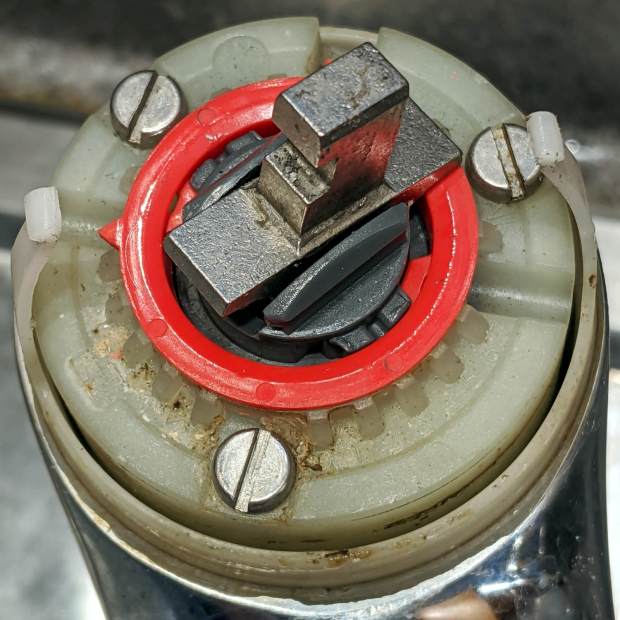
    Am Std Elite Faucet - misaligned hot limit stop

    The pointer on the red hot limit safety stop ring should be aimed just right of the front screw, at the 0 position producing maximum hotness. The scale reads backwards, perhaps in units of increasing safety.

    In that position, the ring prevents the valve core from turning counterclockwise, which explains the symptoms. With the water turned off (at the ball valves in the basement) and the valve stub tilted vertically, the ring popped loose (it shouldn’t move on its own) and exposed the problem:
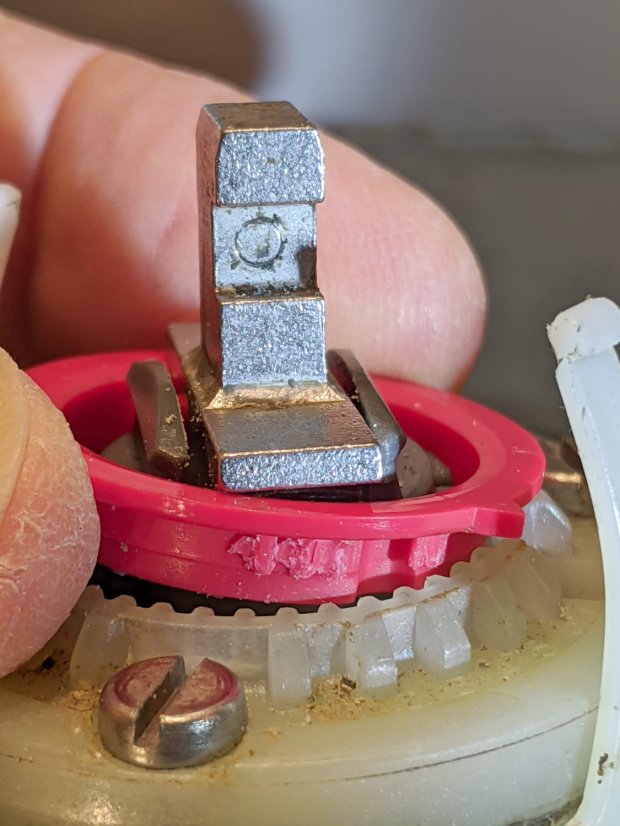
    Am Std Elite Faucet - wrecked hot limit splines - as found
    Am Std Elite Faucet – wrecked hot limit splines – as found

    Neither Mary nor I recall applying that much force to the handle, but ya never know.

    The flanges protruding from the stem prevent you from removing the ring, but a pair of small diagonal cutters will chop right through the plastic. If you’re one of the six people depending on the limit stop to keep the water temperature under control, you probably don’t want to cut the ring out; I have no suggestions on how to repair it.

    It’s obvious the splines won’t ever be the same again:
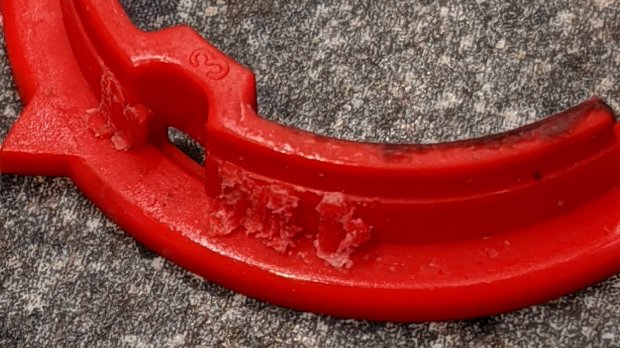
    Am Std Elite Faucet - wrecked hot limit splines - detail 1
    Am Std Elite Faucet – wrecked hot limit splines – detail 1

    The ring has two sets of splines and they’re both wrecked:
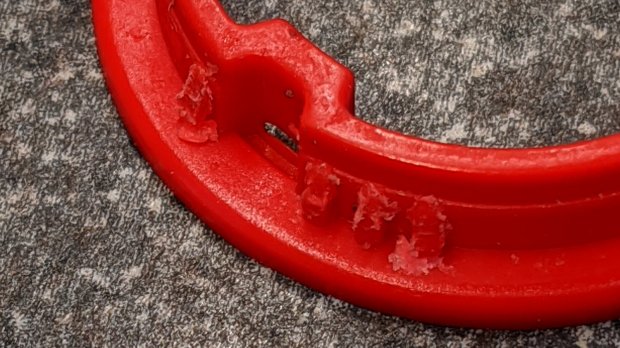
    Am Std Elite Faucet - wrecked hot limit splines - detail 2
    Am Std Elite Faucet – wrecked hot limit splines – detail 2

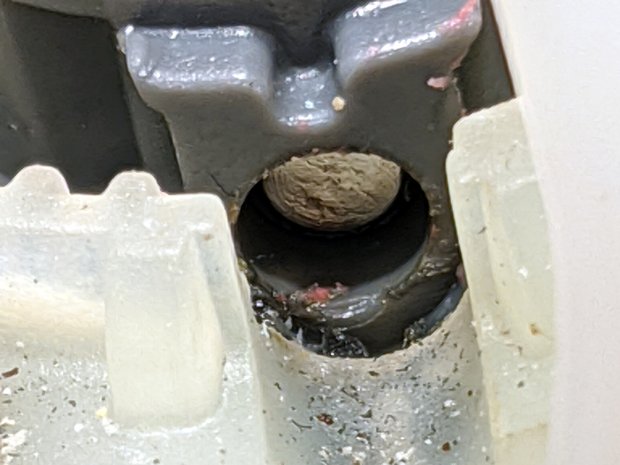
    With the ring out of the way, it’s easy to see the trunnion shaft has moved leftward:
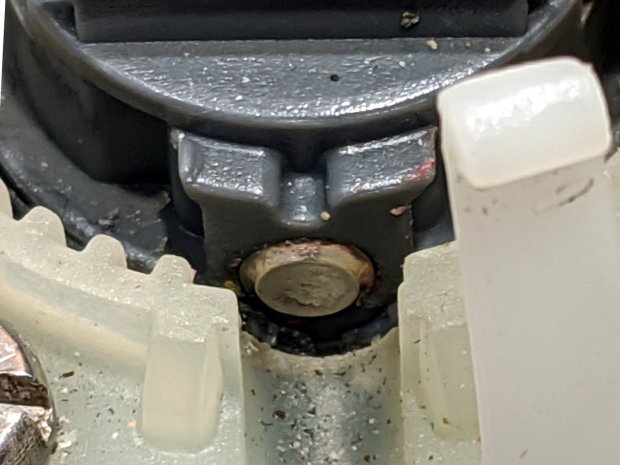
    Am Std Elite Faucet - misaligned pivot shaft
    Am Std Elite Faucet – misaligned pivot shaft

    There’s essentially no clearance between the shaft and the ring, so it was rubbing against the ring, as evidenced by the red debris left behind when I tapped it to the far end of its travel:
    Reassemble in reverse order and it works fine again.

    I expect the shaft will resume moving leftward and eventually jam in the notch, probably after abrading the white plastic, but I don’t see how to lock it in place.


  • Monthly Science: Vegetable Ice Crystals

    Mary made a batch of veggies in tomato sauce and froze meal-size portions as winter treats. The moist air inside the containers froze into delicate ice blades on the zucchini slices:

    Veggie ice crystals - overview
    Veggie ice crystals – overview

    A closer look:

    Veggie ice crystals - detail
    Veggie ice crystals – detail

    The blade cross-sections might be oblong hexagons, but it’s hard to tell with crystals melting almost instantly after the lid comes off. Some of the smaller hair-like blades reminded me of tin whiskers.

    Yummy!

  • LED Floor Lamp UI Improvement

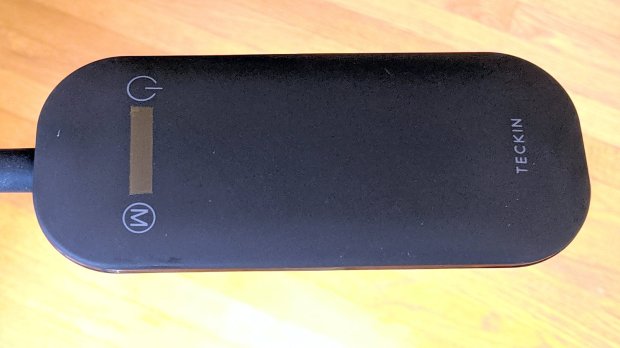
    A new floor lamp arrived with the usual dark-gray-on-black annotations on an absolutely non-tactile pair of capacitive controls. For a device intended for use in a dim room, this makes little sense, unless you’re both trendy and concerned about manufacturing costs.

    A strip of 1/4 inch Kapton tape added just enough tactility to find the damn buttons without looking at the lamp head:

    Teckin floor lamp - tactile switch tape
    Teckin floor lamp – tactile switch tape

    The pole’s non-adjustable length put the lamp head well above eye level, so I removed one pole segment. This required cutting the 12 V zipcord and crimping a pair of connectors:

    Teckin floor lamp - spliced wire
    Teckin floor lamp – spliced wire

    I briefly considered conjuring a skinny connector, but came to my senses: there’s plenty of zipcord if I must chop out the connectors, particularly seeing as how shortening the pole added a foot.

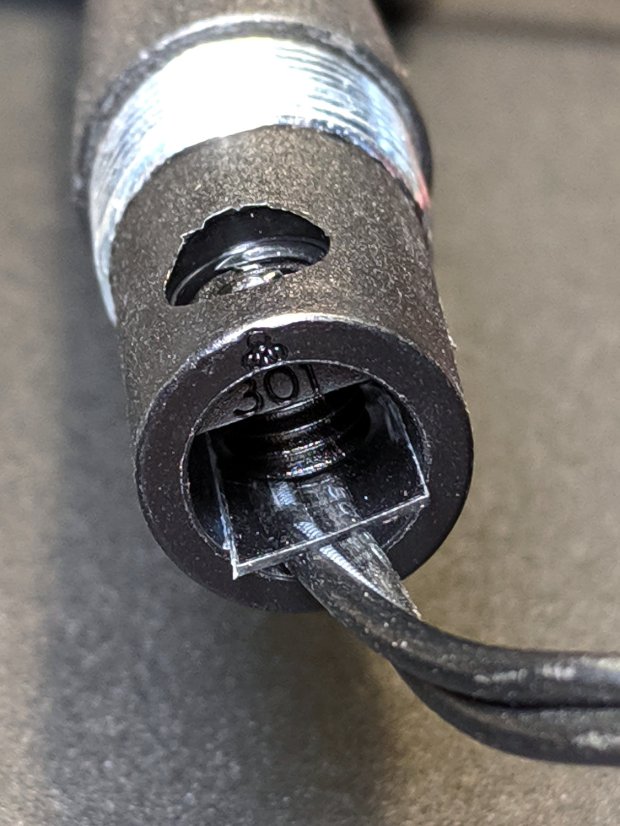
    The setscrew at the bottom of the gooseneck crunched the zipcord against the metal shell. A polypropylene snippet made me feel better, even if it makes no difference:

    Teckin floor lamp - wire clamp pad
    Teckin floor lamp – wire clamp pad

    After all that, It Just Worked™:

    Teckin floor lamp - installed
    Teckin floor lamp – installed

    Done!

  • Wood Board Cheese Slicer Rebolting

    Long ago, a wood-base countertop cheese slicer arrived with a tenuous connection between its screw-on knob / handle and the bolt securing the cutting wire. The problem seemed to be boogered bolt threads:

    Cheese slicer - original bolt
    Cheese slicer – original bolt

    The knob screwed firmly onto a known-good 10-24 screw, not the M5 bolt I expected, so the slicer may be old enough to be Made In America. Ya never know around here.

    However, the hex head is essential, because you must hold it while tightening the nut capturing the slicing wire. Not having a 10-24 or even 10-32 bolt in hand, I went full-frontal metric with an M5 bolt.

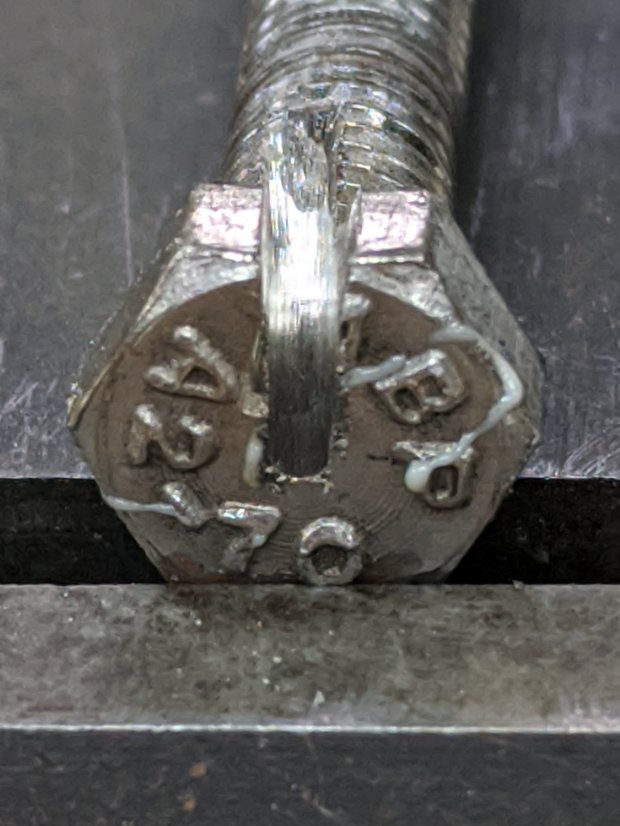
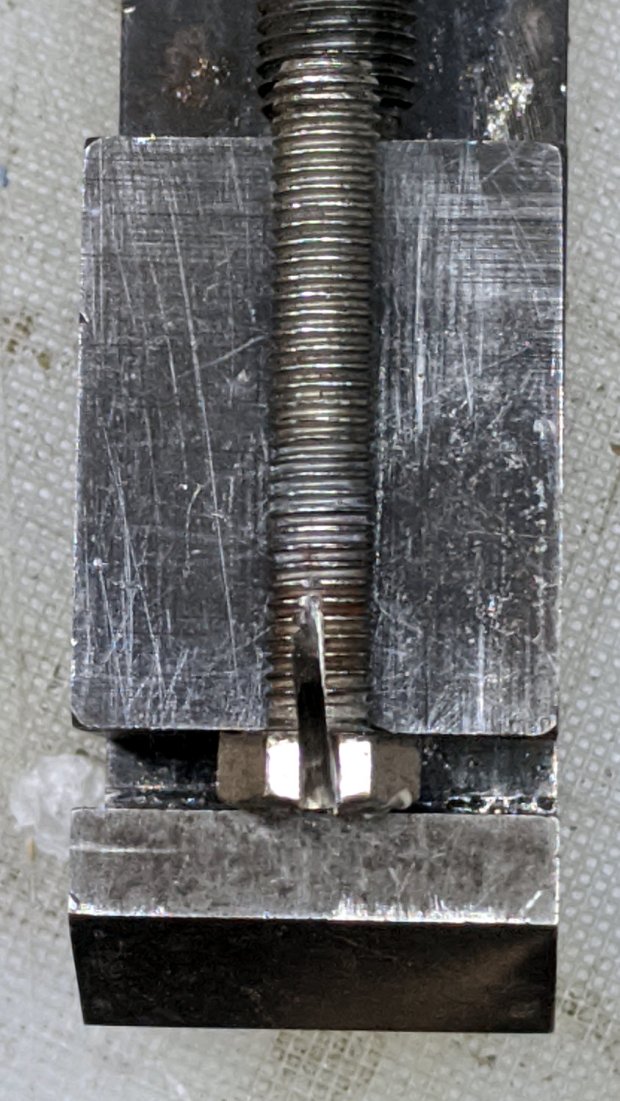
    Even with a full face shield, I don’t like standing in the plane of an abrasive cutting tool, even a piddly Dremel disk, so the slot through the head isn’t the best work I’ve ever presented:

    Cheese slicer - slotted bolt head
    Cheese slicer – slotted bolt head

    Indeed:

    Cheese slicer - skewed slot
    Cheese slicer – skewed slot

    But it’s hereby defined to be Good Enough™ for the purpose.

    As you might expect, I ran an M5×0.8 tap into the existing 10-24 knob thread, hand-turning the lathe chuck and lining up the tap wrench with the tailstock.

    Drill out the slicer’s frame hole to clear the bolt, re-string wire through slot, tighten jam nut, add a locking nut on the other side, screw on the knob, and it’s All Good:

    Cheese slicer - repaired
    Cheese slicer – repaired

    Ugly, but good.

    I expect the re-wrapped wire will break in short order, because you just can’t re-bend steel wire with impunity. So far, so good.

  • Always Bring Duct Tape

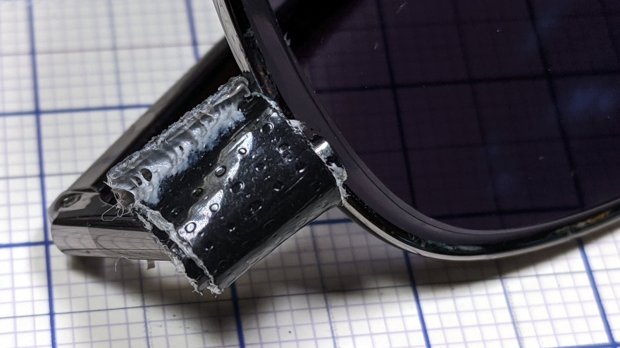
    My pre-trip checklist now includes “Duct Tape”, so, when the tiny screw holding my sunglasses together went spung and dropped the lens on the parking lot gravel, I was prepared:

    Sunglasses - duct tape FTW
    Sunglasses – duct tape FTW

    I continued the mission in full-frontal Harry Potter mode.

    Fortunately, it’s a captive screw and returned home with us. Back in the Basement Laboratory, with a Philips 00 screwdriver and threadlocker at hand, the repair was no big deal:

    Sunglasses - loose lens screw
    Sunglasses – loose lens screw

    You’re looking at the screw head, believe it or not.

    And, no, I’m not packing a Philips 00 screwdriver on our next trip.

  • Wireless Keypad Cap Swap

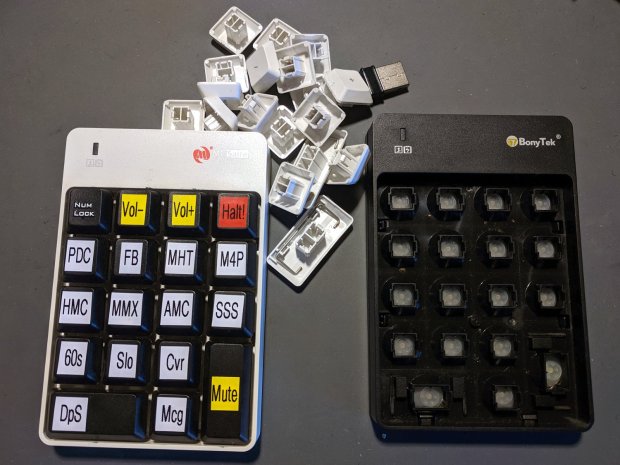
    One of the wireless numeric keypads I’ve been using with the streaming radio players developed some intermittent key switch failures resisting all the usual blandishments. Eventually it hard-failed, but I was unwilling to scrap the tediously printed keycap labels:

    Wireless keypads - swapped caps
    Wireless keypads – swapped caps

    Hard to believe, but I’ve been using the white keypad for plain old numeric entry with the keypad-less Kinesis Freestyle 2 keyboard.

    I swapped the Frankenpad + receiver to the least-conspicuous streamer and, someday, I’ll update all the labels on all the keypads to match the current streams. Until then, the white keycaps shall remain in the same bag as the defunct black keypad, tucked into the Big Box o’ USB mice & suchlike.

  • Crock Pot Base Screw

    While washing our ancient electric crock pot (“slow cooker”), I wondered how corroded the inside of the steel shell had become. A simple nut secured the base plate and unscrewed easily enough, whereupon what I thought was a stud vanished inside the shell.

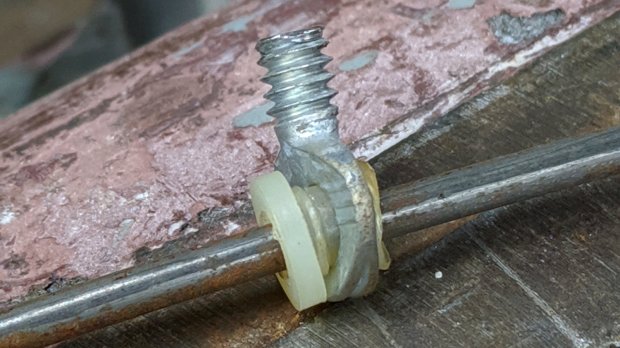
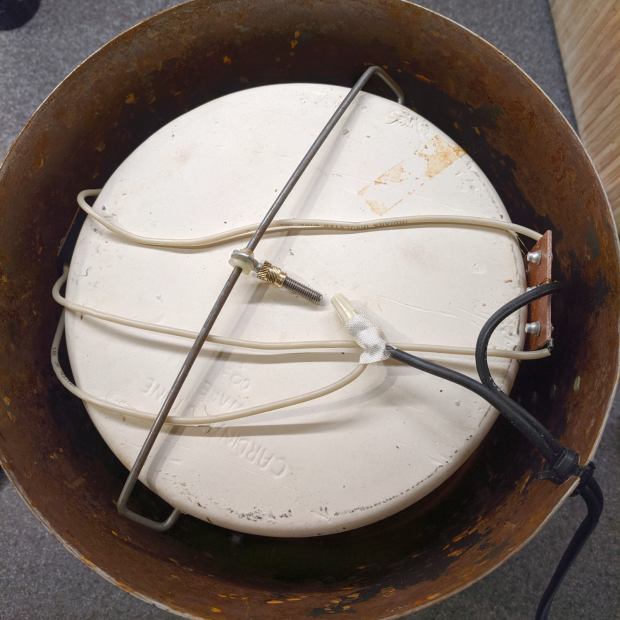
    The shell wasn’t rusty enough to worry about, but the stud turned out to be a crudely chopped-off thumbscrew on a springy rod pulling the base toward the ceramic pot:

    Crock Pot Base - OEM thumbscrew
    Crock Pot Base – OEM thumbscrew

    Evidently, they pulled the thumbscrew through the base, tightened the nut, then cut off the thumbscrew flush with the nut.

    I desperately wanted to drill a hole in a new thumbscrew and repeat the process, but I no longer have a small drawer full of assorted thumbscrews. So I must either lengthen the existing thread just enough to complete the mission or build a screw from scratch.

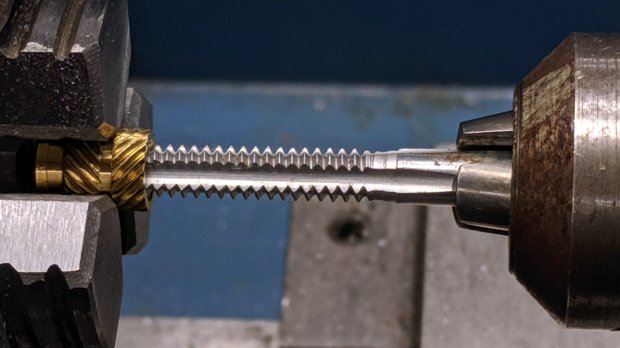
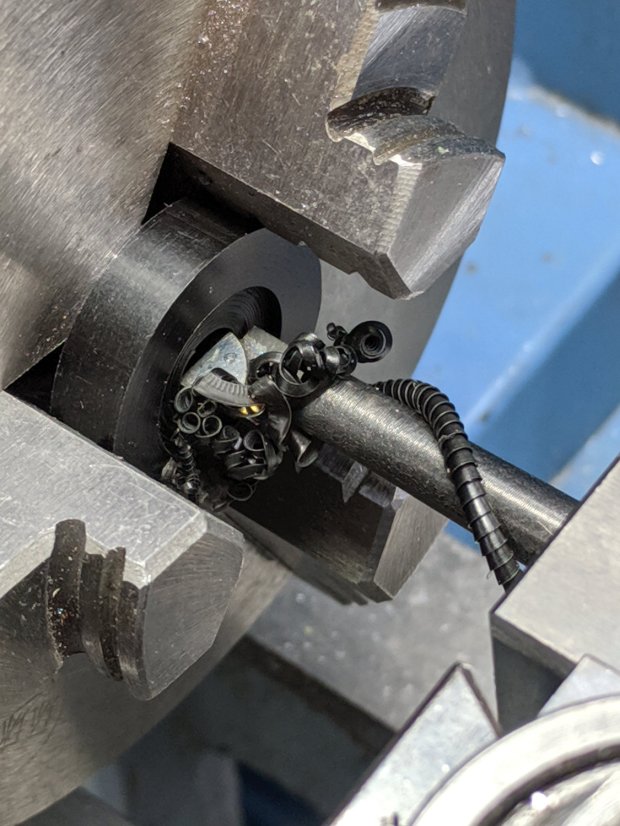
    The thumbscrew is threaded 10-24, I have a bunch of 10-32 threaded inserts, so pretend they have the same thread diameter and tap one end to 10-24:

    Crock Pot Base - tapping insert
    Crock Pot Base – tapping insert

    Jam the new threads on the thumbscrew and jam a 10-32 setscrew into the un-wrecked end:

    Crock Pot Base - thumbscrew extender
    Crock Pot Base – thumbscrew extender

    You can see the surface rust in there, right?

    Make a Delrin bushing to fit around the insert poking through the base:

    Crock Pot Base - drilling Delrin button
    Crock Pot Base – drilling Delrin button

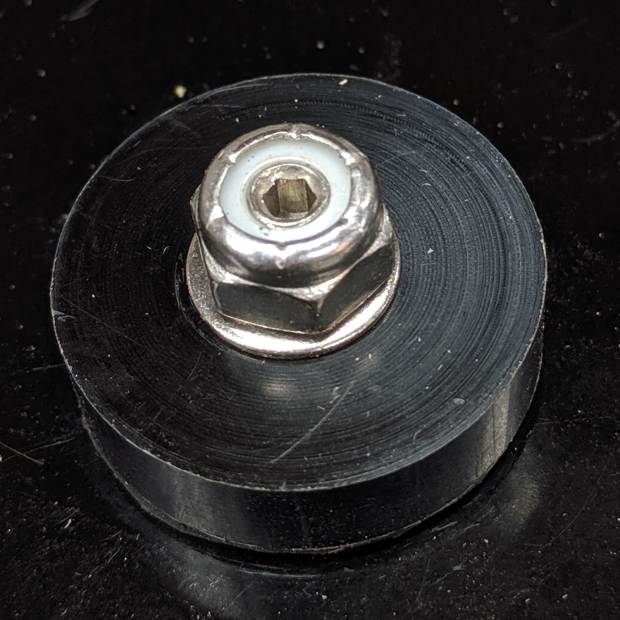
    Reassemble the internal bits with permanent Loctite, top with a nyloc nut, and it’s only a little taller than the original nut:

    Crock Pot Base - assembled
    Crock Pot Base – assembled

    The setscrew let me hold the new “stud” in place while torquing the nut, plus it looks spiffy.

    Memo to Self: If it ain’t broke, don’t look inside. Hah!

    Surprisingly, both Amazon and eBay lack useful thumbscrew assortments …