The Smell of Molten Projects in the Morning

Ed Nisley's Blog: Shop notes, electronics, firmware, machinery, 3D printing, laser cuttery, and curiosities. Contents: 100% human thinking, 0% AI slop.

Category: Home Ec

Things around the home & hearth

  • Motor Starting vs. Long Wires

    A recent email conversation may prove relevant to someone else …

    I have a pole barn which has approximately 100′ run of 10 gauge copper supplying power to the building. I … did not care to pay … $12,000 for a new 200′ line from the road … [with] only lights and 2 door openers for demand.

    I … put a 30 gallon air compressor in […]. When I first put it in, it struggled to start @<40 F. They called it a 1.6 running h.p. (whatever that means) motor. Nameplate shows 15/7.5 F.L.A. I switched it to 240v and the problem went away.

    Aren’t I likely to get the same problem as I had before or do 240 volt motors start easier?

    I screwed up when they buried the wire – in retrospect I would have buried 6ga to the barn to lessen the voltage drop.

    After running a few numbers, here’s what I came up with …

    do 240 volt motors start easier?

    The trouble with motors is they draw far more current while starting than they do while running. A factor of ten more is a good rule of thumb.

    So a “1.6 running HP” motor draws 1.2 kW while running at full load:
     – 10 A at 120 V
     –  5 A at 240 V

    The “full load amps” will be higher than that, because the motor isn’t 100% efficient. You can plug the FLA values into the calculation for an even more depressing result.

    During the fraction of a second when it’s starting, however, it will (try to!) draw 100 A or 50 A, depending on which line voltage you’ve wired it for.

    100′ run of 10 gauge copper

    That’s 200 feet of wire out-and-back.

    Look up the resistance per foot in a wire table, finding 10 AWG wire has a (convenient!) resistance of 1 mΩ/ft, so a 200 ft length has 0.2 Ω of resistance:

     – A 10 A load drops 2 V
     – A  5 A load drops 1 V

    Both of which are survivable in normal operation at their respective line voltages.

    However, the motor starting currents will be completely different. A 100 A current will (try to!) drop 20 V, reducing the line voltage to 100 V and stalling the motor. Running the motor from 240 V means the 50 A starting current drops only 10 V and the remaining 230 V can get the motor up to speed.

    Now, 240 V service isn’t a complete solution. The new compressor draws 15 “full load amps”, so it’ll drop 3 V while it’s running and 30 V while starting. It’ll probably start at 210 V, but it may grunt for a bit longer than you like as the speed comes up and the current goes down.

    in retrospect I would have buried 6ga to the barn

    There’s a Pennsylvania Dutch saying: “We grow too soon old and too late smart.” [grin]

  • Monthly Image: Wren Traffic

    Monthly Image: Wren Traffic

    A pair of wrens, having found the new entrance reducer entirely satisfactory, set up housekeeping in the front bird box and raised their nestlings.

    Somehow, they manage to fly directly into the hole without stopping:

    Wren - front box - entering
    Wren – front box – entering

    Outbound trips require a security check:

    Wren - front box - exit check
    Wren – front box – exit check

    And away!

    Wren - front box - fly away
    Wren – front box – fly away

    After those nestlings fledged, they began building a nest in one of the garden bird boxes a few hundred feet away. In short order, we’ll be awash in wrens!

  • OXO Pepper Grinder: Inadvertent Abuse

    OXO Pepper Grinder: Inadvertent Abuse

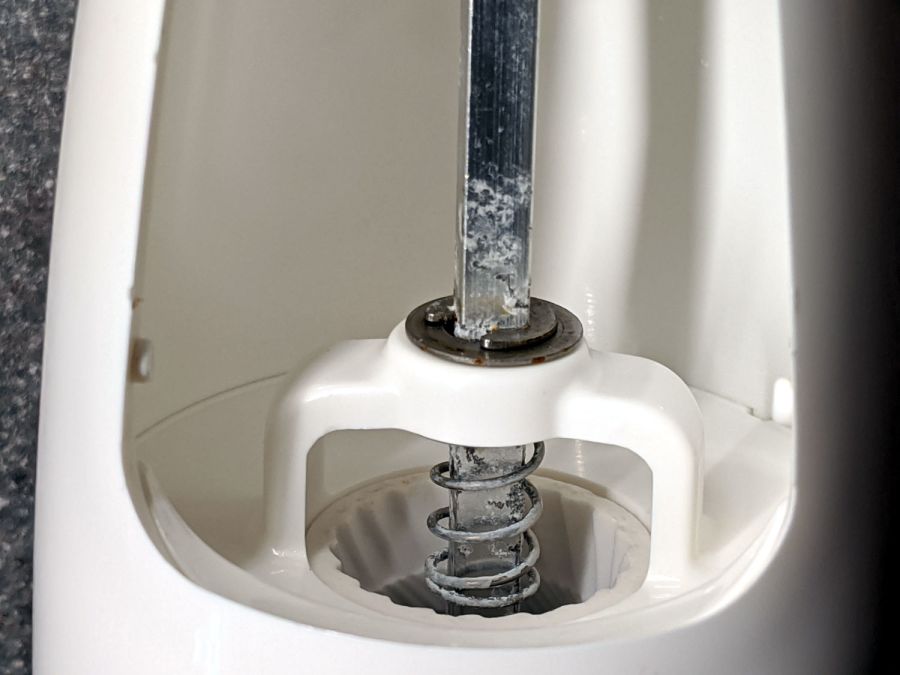
    Being that type of guy, I’m reasonably sure I would not have bought what’s now clearly labeled as an OXO Radial Pepper Grinder for use as a salt mill:

    OXO Salt Mill - corrosion
    OXO Salt Mill – corrosion

    Mary recalls we got it at Target, back when one could go places and buy things, and I vaguely recall contemplating a wall of OXO gadgets. It’s been a while and I neglected to save the packaging for future reference.

    Obviously not stainless steel, but not lethal, so we’ll continue abusing it.

  • Bathroom Door Retainer: Bigger and Stronger

    Bathroom Door Retainer: Bigger and Stronger

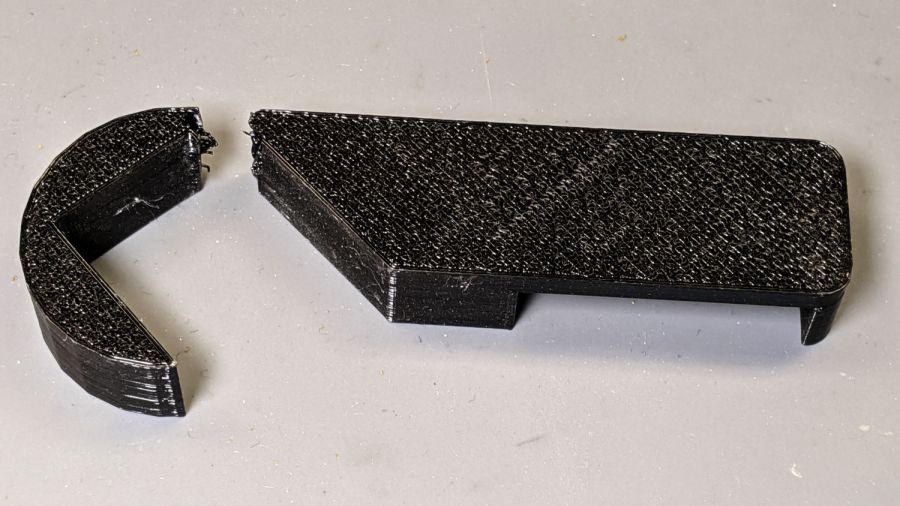
    After three years, the retainer holding the front bathroom door open against winds blowing through the house on stormy days finally fractured, right at the top of the towel rack where you’d expect it:

    Bathroom Door Retainer - fractured
    Bathroom Door Retainer – fractured

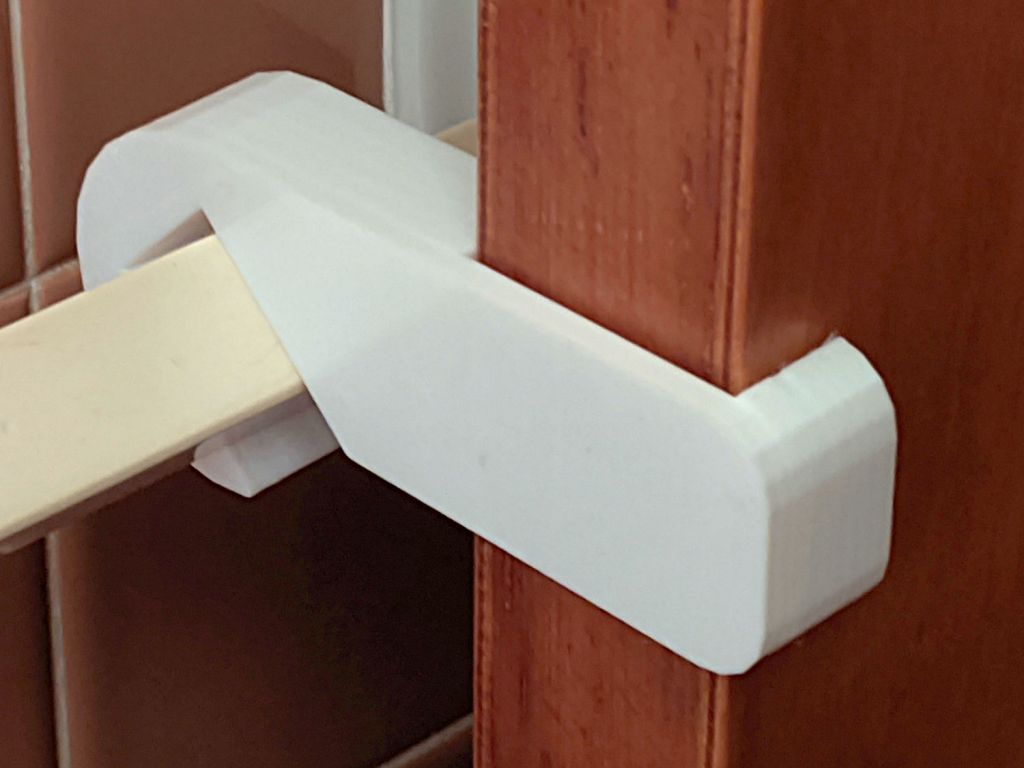
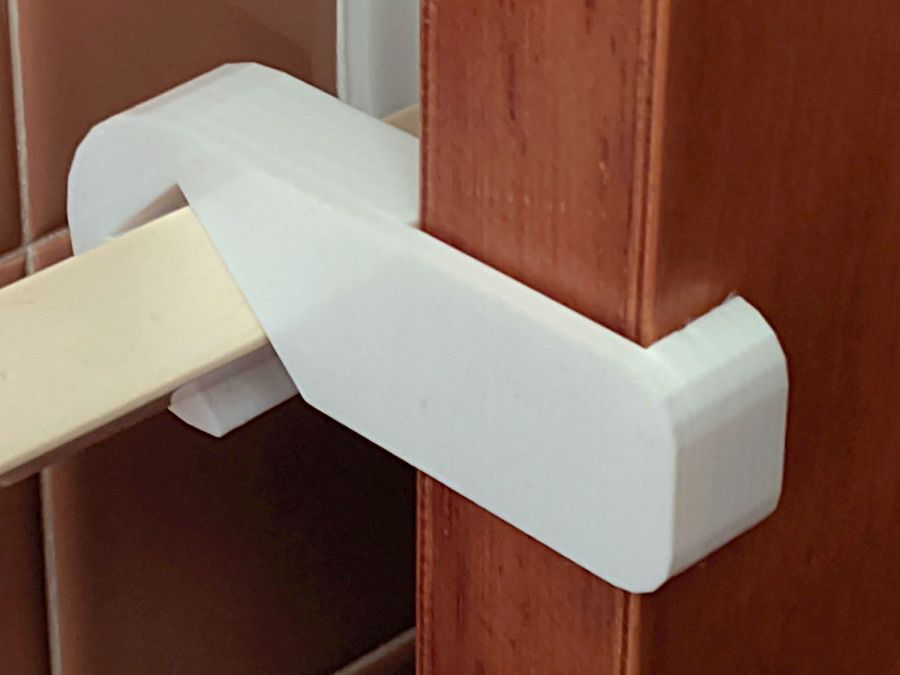
    I was all set to add reinforcing pins and whatnot, then came to my senses and just made the whole thing a few millimeters larger:

    Bathroom Door Retainer - stronger
    Bathroom Door Retainer – stronger

    Customer feedback indicates white blends better with the background.

    I made a few minor tweaks to the original design, including slightly larger bumps to hold it against the towel bar that, regrettably, put corresponding gouges into the bar. Who knew they used such soft plastic back in the day?

    The OpenSCAD source code as a GitHub Gist:

    // Bathroom Door Retainer
    // Ed Nisley KE4ZNU – May 2017
    // 2020-07 beef up, particularly at top of bar
    Layout = "Show"; // [Show, Build]
    //——-
    //- Extrusion parameters must match reality!
    /* [Hidden] */
    ThreadThick = 0.20;
    ThreadWidth = 0.40;
    HoleWindage = 0.2;
    Protrusion = 0.1; // make holes end cleanly
    function IntegerMultiple(Size,Unit) = Unit * ceil(Size / Unit);
    //——-
    // Dimensions
    /* [Dimensions] */
    TowelBarSide = 20.5; // towel bar across flat side
    TowelBarAngle = 45; // rotation of top flat from horizontal
    BumpOD = 2.0; // retaining ball
    DoorOffset = 14.0; // from towel bar to door
    DoorThick = 37.0;
    WallThick = 8.0; // minimum wall thickness
    PlateThick = 4.0; // … slab
    RetainerDepth = 15.0; // thickness of retaining notch
    NumSides = 6*4;
    CornerRad = WallThick;
    BarClipOD = TowelBarSide*sqrt(2) + 2*WallThick;
    BarClipRad = BarClipOD/2;
    OAH = RetainerDepth + PlateThick;
    module LatchPlan() {
    union() {
    linear_extrude(height=OAH,convexity=4)
    difference() {
    union() {
    circle(d=BarClipOD,$fn=NumSides);
    hull()
    for (i=[0,1], j=[0,1])
    translate([i*(BarClipRad + DoorOffset + DoorThick + WallThick – CornerRad),j*(BarClipRad – CornerRad)])
    circle(r=CornerRad,$fn=4*4);
    }
    rotate(TowelBarAngle) // towel bar shape
    square(size=TowelBarSide,center=true);
    translate([0,-TowelBarSide/sqrt(2)]) // make access slot
    rotate(-TowelBarAngle)
    square(size=[2*TowelBarSide,TowelBarSide],center=false);
    }
    for (a=[0:180:360])
    rotate(a + TowelBarAngle)
    translate([TowelBarSide/2,0,OAH/2])
    rotate([90,0,45])
    sphere(d=BumpOD,$fn=4*3);
    }
    }
    module Latch() {
    difference() {
    LatchPlan();
    translate([BarClipRad + DoorOffset,-BarClipRad/2,-Protrusion])
    cube([DoorThick,BarClipOD,RetainerDepth + Protrusion],center=false);
    }
    }
    //——-
    // Build it!
    if (Layout == "Show") {
    Latch();
    }
    if (Layout == "Build") {
    translate([0,0,OAH])
    rotate([180,0,0])
    Latch();
    }

    Done!

  • Garden Soaker Hose Repairs In Use

    Garden Soaker Hose Repairs In Use

    Just for completeness, here’s what the various soaker hose clamps look like in the garden, as solid models only let you visualize the ideal situation:

    Soaker Hose Connector Clamp - Show view
    Soaker Hose Connector Clamp – Show view

    This one prevents a puddle in the path to the right:

    Soaker hose repairs in situ - clamp
    Soaker hose repairs in situ – clamp

    Bending the hoses around the end of a bed puts them on edge, with this clamp suppressing a shin-soaking spray to the left:

    Soaker hose repairs in situ - end-on clamp
    Soaker hose repairs in situ – end-on clamp

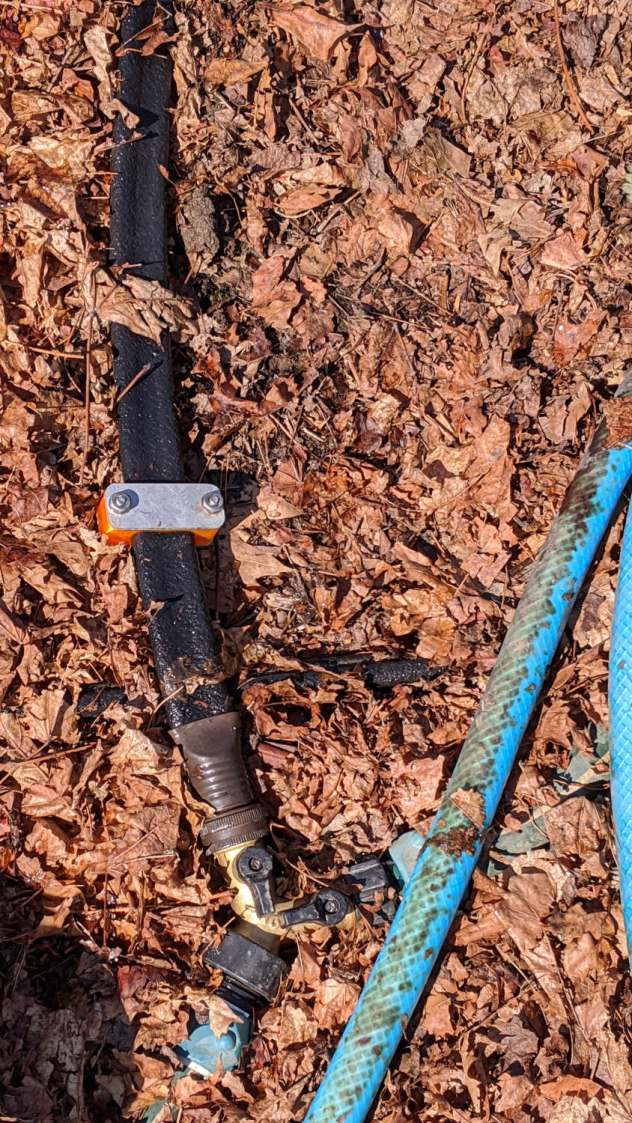
    The clamp at the connector closes a leak around the crimped brass fitting, with the other two preventing gouges from direct sprays into the path along the bottom of the picture:

    Soaker hose repairs in situ - clamps and connector fix
    Soaker hose repairs in situ – clamps and connector fix

    All in all, a definite UI improvement!

    As far as I can tell, we have the only soaker hose repairs & spritz stoppers in existence. Hooray for 3D printing!

  • Robin Nest: Fledging Day

    Robin Nest: Fledging Day

    The robin nestlings fledged fourteen days after we spotted the first eggshell on the driveway below the nest. The first one may have flown away the previous evening, leaving three increasingly restless siblings behind:

    Robin Fledging Day - three nestlings
    Robin Fledging Day – three nestlings

    They’re recognizably robins now, covered in young-bird speckle camouflage.

    Feeding continued apace:

    Robin Fledging Day - feeding
    Robin Fledging Day – feeding

    After feeding, robin nestlings produce fecal sacs, which the parents either eat or carry away:

    Robin Fledging Day - fecal sac
    Robin Fledging Day – fecal sac

    Robins aren’t big on facial expressions, but, speaking from personal experience, anything to do with diapers isn’t the high point of a parent’s day.

    And then there were none:

    Robin Fledging Day - empty nest with parasites
    Robin Fledging Day – empty nest with parasites

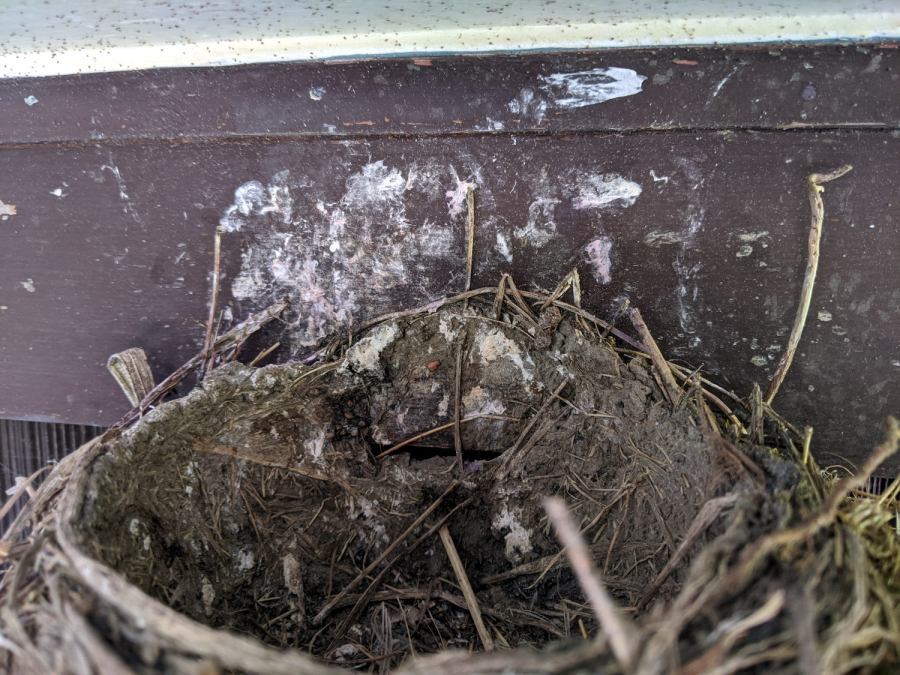
    The gazillion black dots on the soffit are pinpoint-sized insects / mites / ticks infesting the nest and, presumably, the birds. The earlier pictures don’t show them, so perhaps these missed the last bird off the nest and are now regretting their life choices.

    Go, birds, … gone!

  • Schwalbe Marathon Plus vs. W5W Bulb Fragment: Standoff

    Schwalbe Marathon Plus vs. W5W Bulb Fragment: Standoff

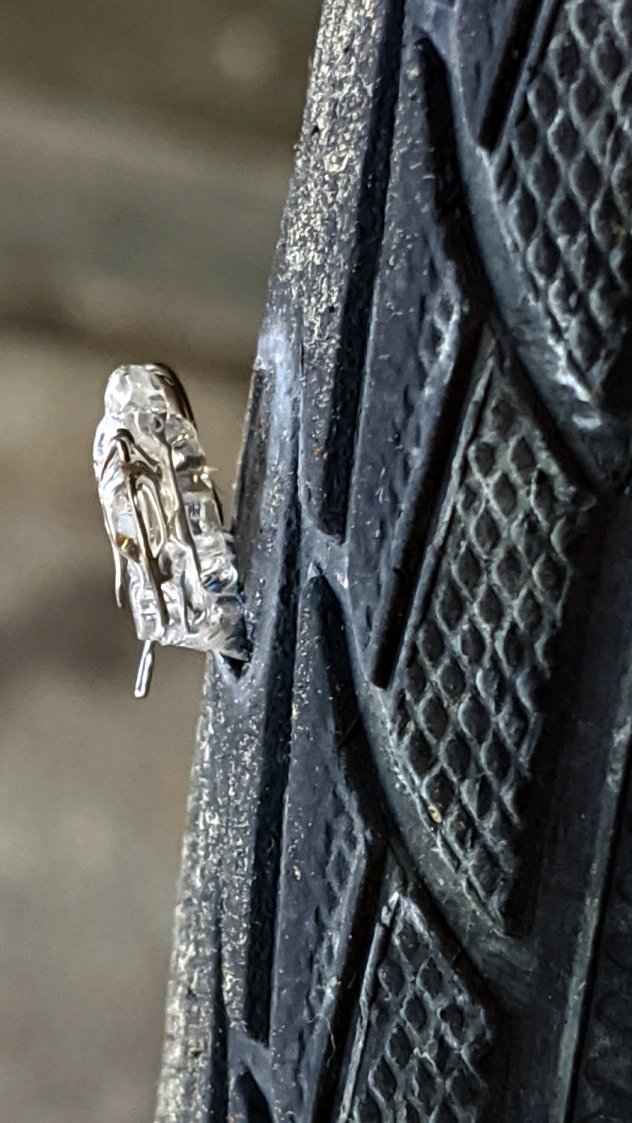
    A clicking sound from the rear of the bike suggested something was amiss as I rolled up the driveway after a recent ride. Spinning the rear tire produced this alarming sight:

    W5W fragment - on tire - side view
    W5W fragment – on tire – side view

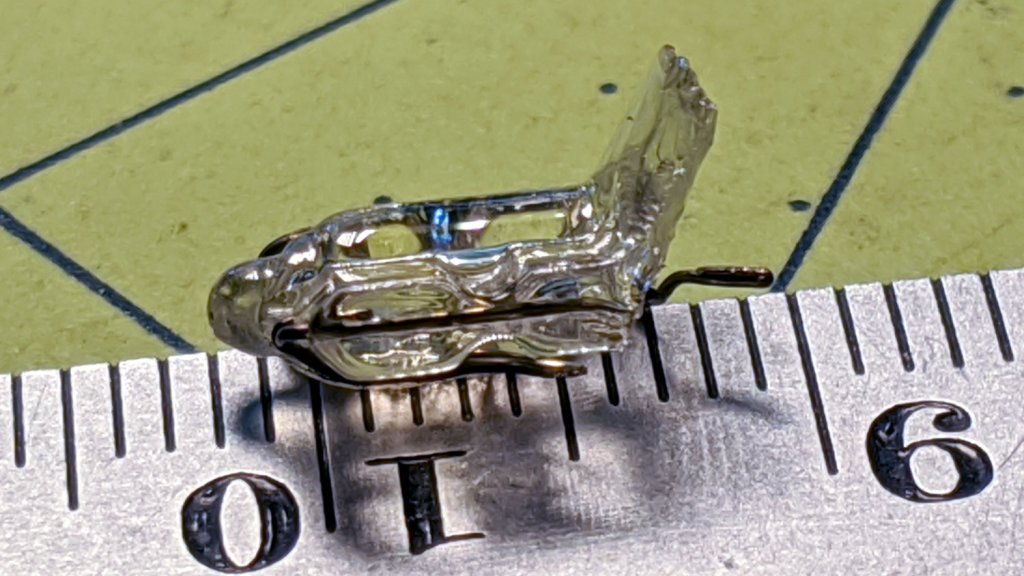
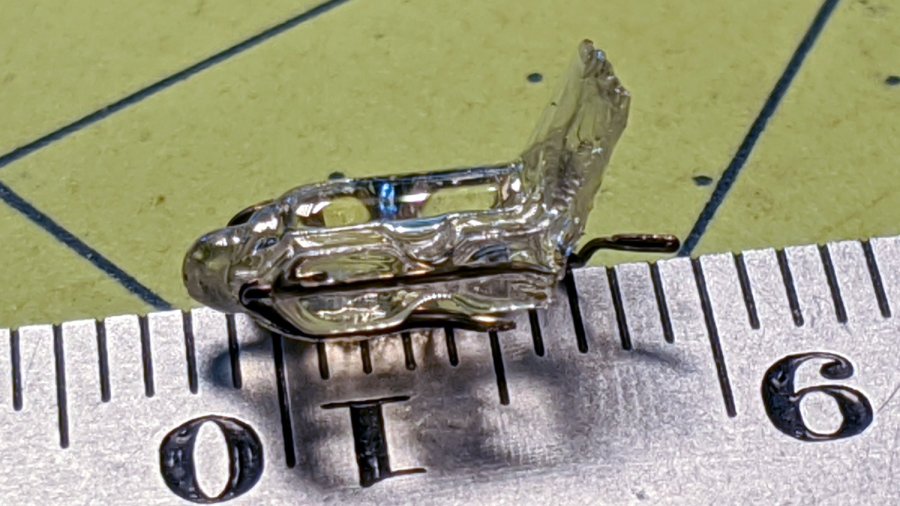
    Pulling it out of the gash shows it’s the base of a W5W (or something similar) automotive bulb:

    W5W fragment - on tire - front
    W5W fragment – on tire – front

    Which seems perfectly designed to cripple a bike tire:

    W5W fragment - millimeter scale
    W5W fragment – millimeter scale

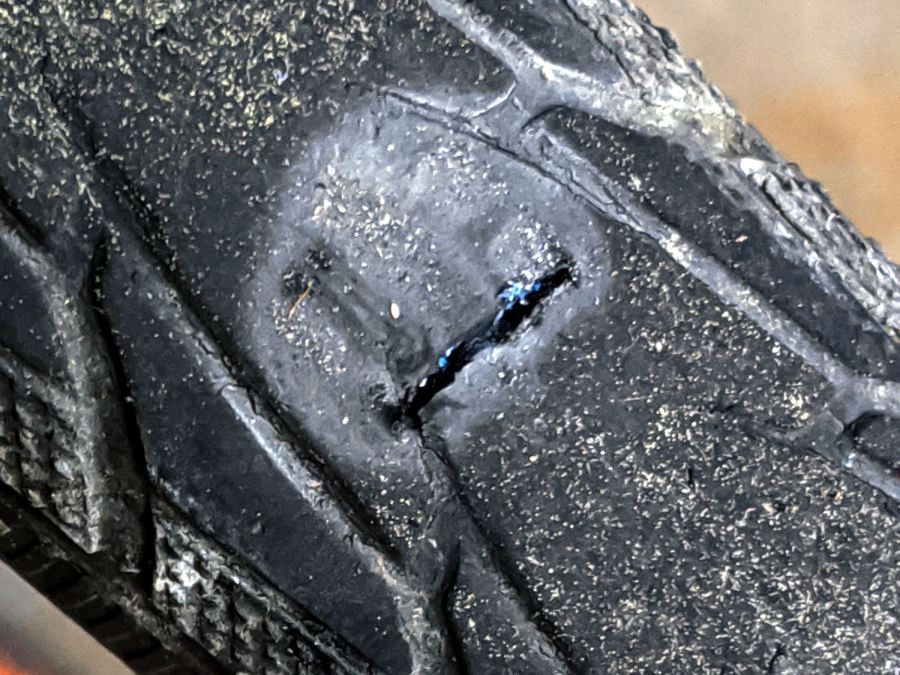
    The gash cuts all the way across the tire tread:

    W5W fragment - tire gash
    W5W fragment – tire gash

    The blue stuff is Schwalbe’s rubber / latex / plastic SmartGuard layer, all 5 mm of it hard at work separating the glass from the inner tube.

    I cleaned the wound, filled it with silicone rubber, topped it with some duct tape, and it’s still holding air after a 13 mile ride. I think the gash cut through the rubber tread and SmartGuard layer, but didn’t affect the cords in the tire carcass, so keeping further road debris out of the gash should let the tire wear out more-or-less normally.

    Putting duct tape on the tread will certainly help …