The Smell of Molten Projects in the Morning

Ed Nisley's Blog: Shop notes, electronics, firmware, machinery, 3D printing, laser cuttery, and curiosities. Contents: 100% human thinking, 0% AI slop.

Category: Home Ec

Things around the home & hearth

  • Layered Paper Coaster

    Layered Paper Coaster

    A long-forgotten pad of Art Paper in assorted colors came to the surface:

    Layered Coaster - tweaked
    Layered Coaster – tweaked

    An angled view shows off the layering a little better:

    Layered coaster - side view
    Layered coaster – side view

    Done manually with LightBurn’s Offset tool: shrink the frame’s interior openings (which lie outside the frame) by 1 mm per step, then cut each shape into a different color. The black layer is a complete disk, stuck atop a plain chipboard disk for stiffening.

    In the cold light of day, I think I offset the green layer by 2 mm.

    It’s not a particularly useful coaster, because you want a flat surface under your drink, but it does look pretty. Nowhere close to that good, but I like it.

    The next time around, I’ll automate the process by stepping the sash width by 1 mm and saving each SVG image separately.

  • High Impact Art: Smashed Glass Coaster Meniscus Removal

    High Impact Art: Smashed Glass Coaster Meniscus Removal

    After using the smashed glass coaster for a while, the beveled epoxy meniscus around the perimeter proved itself more annoying than expected:

    Glass Coaster - second test
    Glass Coaster – second test

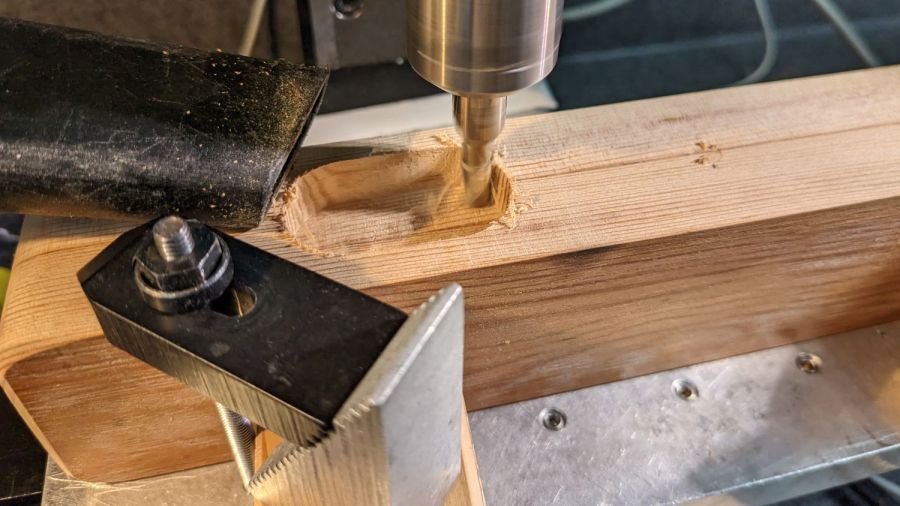
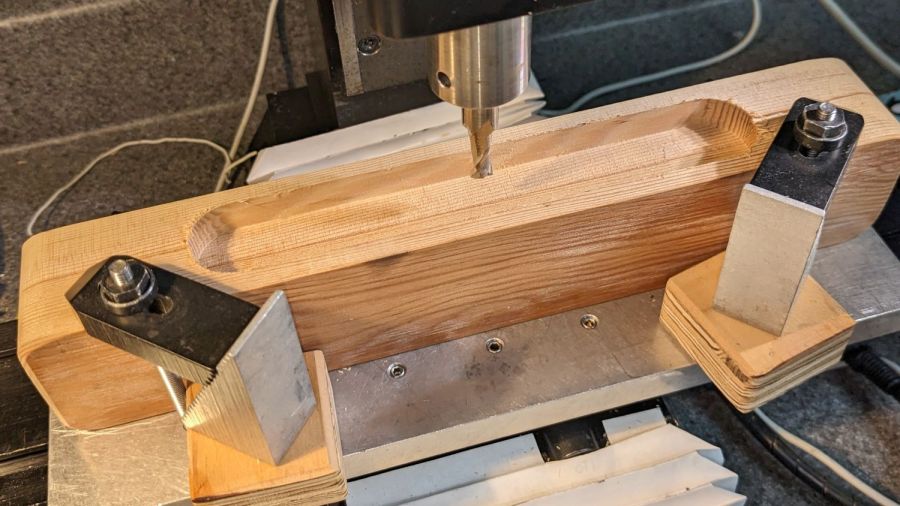
    So I clamped it to the Sherline’s tooling plate and milled off the rim:

    Smashed Glass Coaster - meniscus removal
    Smashed Glass Coaster – meniscus removal

    Given the Sherline’s cramped work envelope, all the action took place along the rearmost edge, requiring eight reclampings indexed parallel to the table with a step clamp.

    The cutter cleared off everything more than 0.3 mm above the surface of the glass chunks. I could probably have gone another 0.1 mm lower, but chopping the bit into the edge of a shattered glass fragment surely wouldn’t end well.

    Polishing the dark gray milled surface might improve it slightly, at the risk of scuffing whatever poured epoxy stands slightly proud of the glass:

    Smashed Glass Coaster - leveled edge
    Smashed Glass Coaster – leveled edge

    Perhaps if I define it to be a border, everybody will think it was intentional.

  • Hyde Edge Recharge Vape Pen Teardown

    Hyde Edge Recharge Vape Pen Teardown

    Now that vape “pen” refill cartridges are (mostly) dead, roadside debris has gotten chunkier:

    Hyde Charge Vape Pen - as found
    Hyde Charge Vape Pen – as found

    It’s a Hyde Edge Recharge vape pen or it could be a counterfeit. You (definitely not me) get “up to” 3300 puffs from the 10 ml container, with 50 mg of nicotine ensuring you can’t get enough and will come back for more. Although I don’t follow the market, “disposable” vape pens can still contain the fruity flavors prohibited in refillable pens, with the added decadence of throwing the whole thing away when the tank runs dry:

    Hyde Charge Vape Pen - components
    Hyde Charge Vape Pen – components

    My admittedly inexperienced eye says the “tank”, which is really just a fiber cylinder soaked in fruity juice + nicotine, still has plenty of hits remaining.

    The Basement Shop may never smell the same again.

    Of more interest, the silvery lump wrapped in a white felt strip is a 600 mA·hr lithium cell that slurped 406 mA·hr through its USB Micro-B jack when I recharged it. Perhaps the user victim sucker tossed it when the battery “died”, being unable / unwilling / ignorant-of-how to recharge it? The yellow aluminum case seems faded on the mouthpiece end, but that might be a stylin’ thing.

    A closer look at the electronics payload:

    Hyde Charge Vape Pen - electronics
    Hyde Charge Vape Pen – electronics

    The two red wires over on the right went to the coil in the draw tube to the right of the “tank”. Not being interested enough to care, I wrecked the coil while extracting the rest of the contents. Comfortingly, the red and black wires from the PCB go to the positive and negative battery tabs.

    A closer look at both sides of the PCB:

    Hyde Charge Vape Pen - PCB detail
    Hyde Charge Vape Pen – PCB detail

    The SOT23 IC sports an LTH7 topmark corresponding to an LTC4054-4.2 Standalone Charge Controller (Analog Devices absorbed Linear in 2017). The two LEDs to its right glow red during charge and white during each puff.

    The black felt disk covers an anonymous pressure sensor activating the coil during each puff. With four pins, the sensor must be far more complex than just a switch, but nowadays puff sensing could require an entire ARM microcontroller.

    Speaking of microcontrollers, there’s always this fate:

    Hyde Charge Vape Pen - Arduino battery
    Hyde Charge Vape Pen – Arduino battery

    I fought down an almost uncontrollable urge to amputate my arms at the elbows and cauterize the stumps …

  • Onion Maggot Flies vs. Sticky Traps: Round 2

    Onion Maggot Flies vs. Sticky Traps: Round 2

    Mary decided the second round of sticky traps had collected enough Onion Maggot Flies (and other detritus) to warrant replacement, so this season will have three sets of cards.

    The two sides of each card after about a month in the garden:

    • VCCG Onion Card A - 2022-07-17
    • VCCG Onion Card B - 2022-07-17
    • VCCG Onion Card C - 2022-07-17
    • VCCG Onion Card D - 2022-07-17
    • VCCG Onion Card E - 2022-07-17
    • VCCG Onion Card F - 2022-07-17

    There are many flies that look (to me) like Onion Maggot Flies, in contrast with the first round of cards which had far fewer flies after about six weeks in the bed.

    Some could be Cabbage Maggot Flies, but my fly ID hand is weak.

    One of the frames screwed to a fence post suffered a non-fatal mishap, so I made and deployed a seventh trap. We’re pretty sure the garden has enough flies to go around.

  • Wheelbarrow Wheel Transplant

    Wheelbarrow Wheel Transplant

    The rubber in pneumatic tires / tubes rots when left out in the open for a year or three, so I volunteered to replace the dead-flat tire (on the wheelbarrow I rebuilt last year) with the “flat free” solid foam tire+wheel harvested from an irreparably damaged wheelbarrow. Which, as it turned out, had lost one bearing and the remaining bearing wasn’t in good shape:

    Wheelbarrow Wheel - victim bearing
    Wheelbarrow Wheel – victim bearing

    The bearings in the pneumatic wheel were in comparatively good shape:

    Wheelbarrow Wheel - donor bearing
    Wheelbarrow Wheel – donor bearing

    So I knocked the good bearings out, cleaned up / re-lubed them with squirts from my lifetime supply of genuine Mobil Vactra No. 2 Sticky Way Oil, and hammered tapped them into the solid-tire wheel.

    Whereupon I discovered the two wheels have different hub lengths and, unfortunately, the axle clamps in the recipient wheelbarrow lacked enough adjustment range.

    Well, I can fix that:

    Wheelbarrow Wheel - axle clamp cutting
    Wheelbarrow Wheel – axle clamp cutting

    I briefly considered cleaning and repainting the wheel, but came to my senses when I considered the tire’s condition:

    Wheelbarrow Wheel - transplanted
    Wheelbarrow Wheel – transplanted

    I suppose when the tread flakes off, the interior foam will rapidly erode, but we’ll burn that bridge when we encounter it.

    The alert reader will have immediately noted the grease fitting on that rusty wheel: you’re supposed to periodically fill the entire hub with sufficient grease to push the crud out of the bearings. IMO, that’s so deep in silk purse territory as to be irrelevant.

    The remaining useful parts from the defunct wheelbarrow will, most likely, come to good use next year …

  • Lawn Chair Re-strapping: Countdown Hold

    Lawn Chair Re-strapping: Countdown Hold

    I planned to replace the vinyl straps on our set of (salvaged) lawn / patio chairs and made a pair of rivets for one long-missing strap:

    Lawn chair strap rivets
    Lawn chair strap rivets

    The overall project is on indefinite hold, as a Steel-blue Cricket Hunter (*) has decided at least one of the chairs is an ideal place to start a family:

    Lawn chair - wasp nest under construction
    Lawn chair – wasp nest under construction

    The patio under the chair is littered with blades of grass and twigs that didn’t quite fit through the 5 mm vent hole in the tube, but that long stem went in just fine:

    Lawn chair - wasp nest grass stem
    Lawn chair – wasp nest grass stem

    We have seen the wasp airlifting crickets near the chair, so provisioning has begun. The cricket seemed not only larger than the hole, but also larger than the wasp; we assume the wasp knows what she’s doing.

    The new wasp will hatch this year, pupate over the winter, then hatch and emerge next summer, but I plan to replace the straps after the construction season ends.

    I have no idea how to clean out whatever’s accumulating in there …

    (*) I learned them as Steel-blue Cricket Killer, but the crickets are just paralyzed, not completely dead.

  • Bathroom Sink Pop-up Drain Rod Status

    Bathroom Sink Pop-up Drain Rod Status

    Three years later, the bathroom drain stopper once again disconnected from the pop-up rod and gave me a chance to inspect how the brass is surviving:

    Bathroom drain pop-up pivot
    Bathroom drain pop-up pivot

    After five years, the epoxy plug is either creeping out of the end or the end is corroding back a bit, but there’s plenty more where that came from.

    The original steel rod disintegrated after nine years, so it’s still a horse race.