The Smell of Molten Projects in the Morning

Ed Nisley's Blog: Shop notes, electronics, firmware, machinery, 3D printing, laser cuttery, and curiosities. Contents: 100% human thinking, 0% AI slop.

Category: Electronics Workbench

Electrical & Electronic gadgets

  • Kenmore Model 158: Needle Lights, Now With Moah LEDs

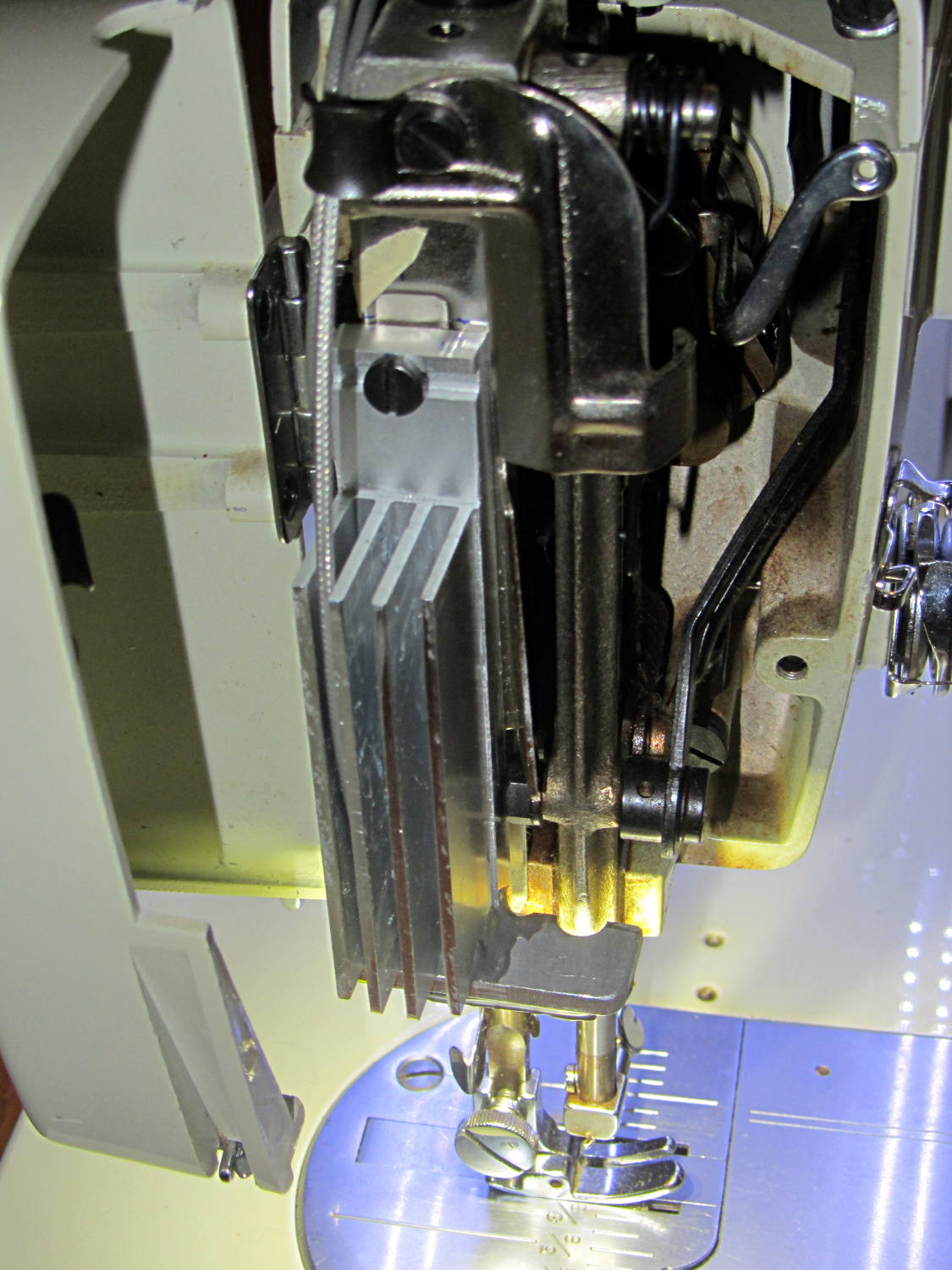
    The first pass at retrofitting SMD LEDs to light the needle area in Mary’s Model 158 sewing machine worked well enough:

    Kenmore 158 Needle Light - heatsink
    Kenmore 158 Needle Light – heatsink

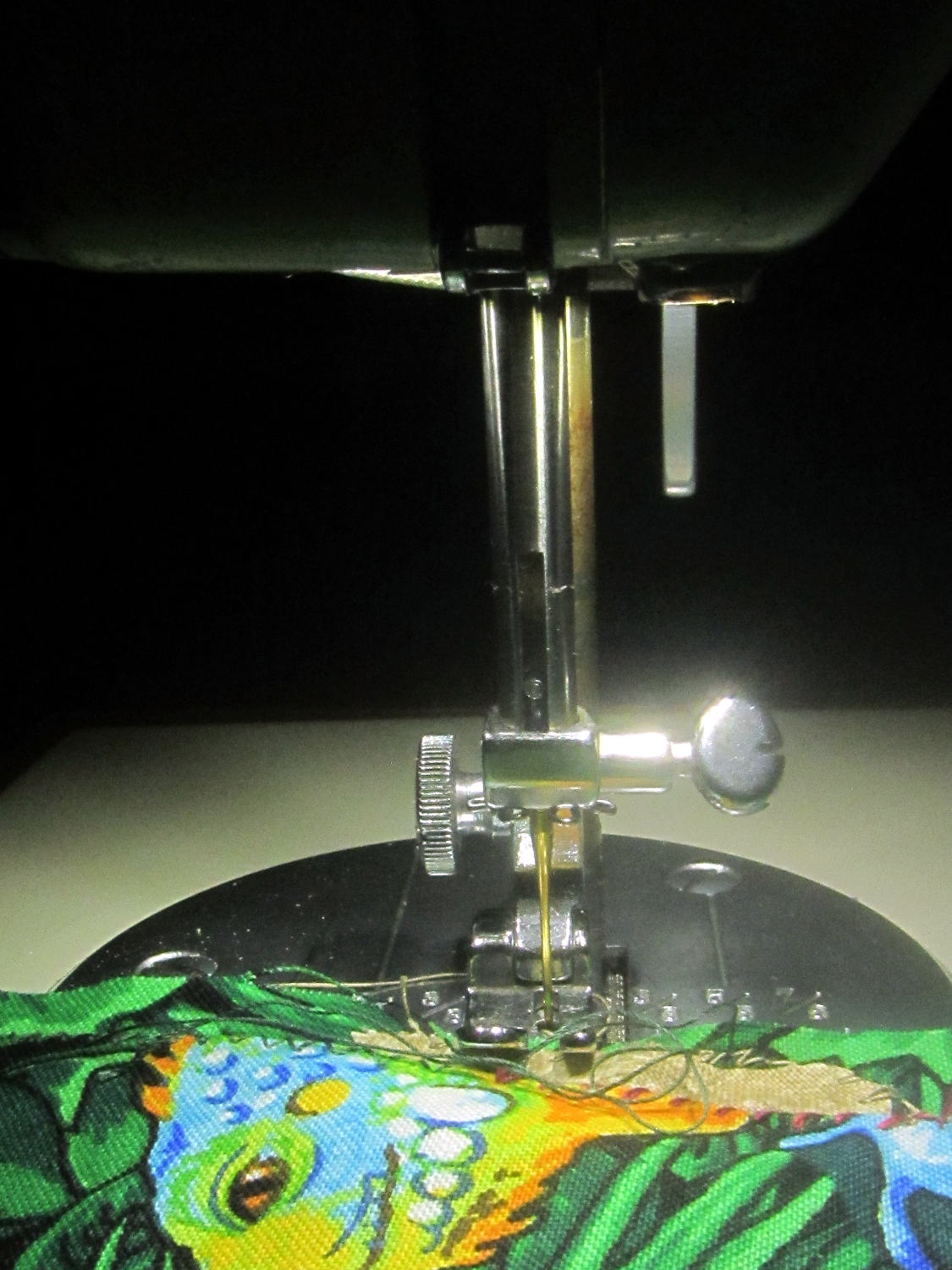
    However, she wanted more light on the right side of the needle, so now she has it:

    Needle LEDs - front
    Needle LEDs – front

    That’s without any LEDs along the front and back of the arm, hence the dark pool beyond the sewing machine’s base.

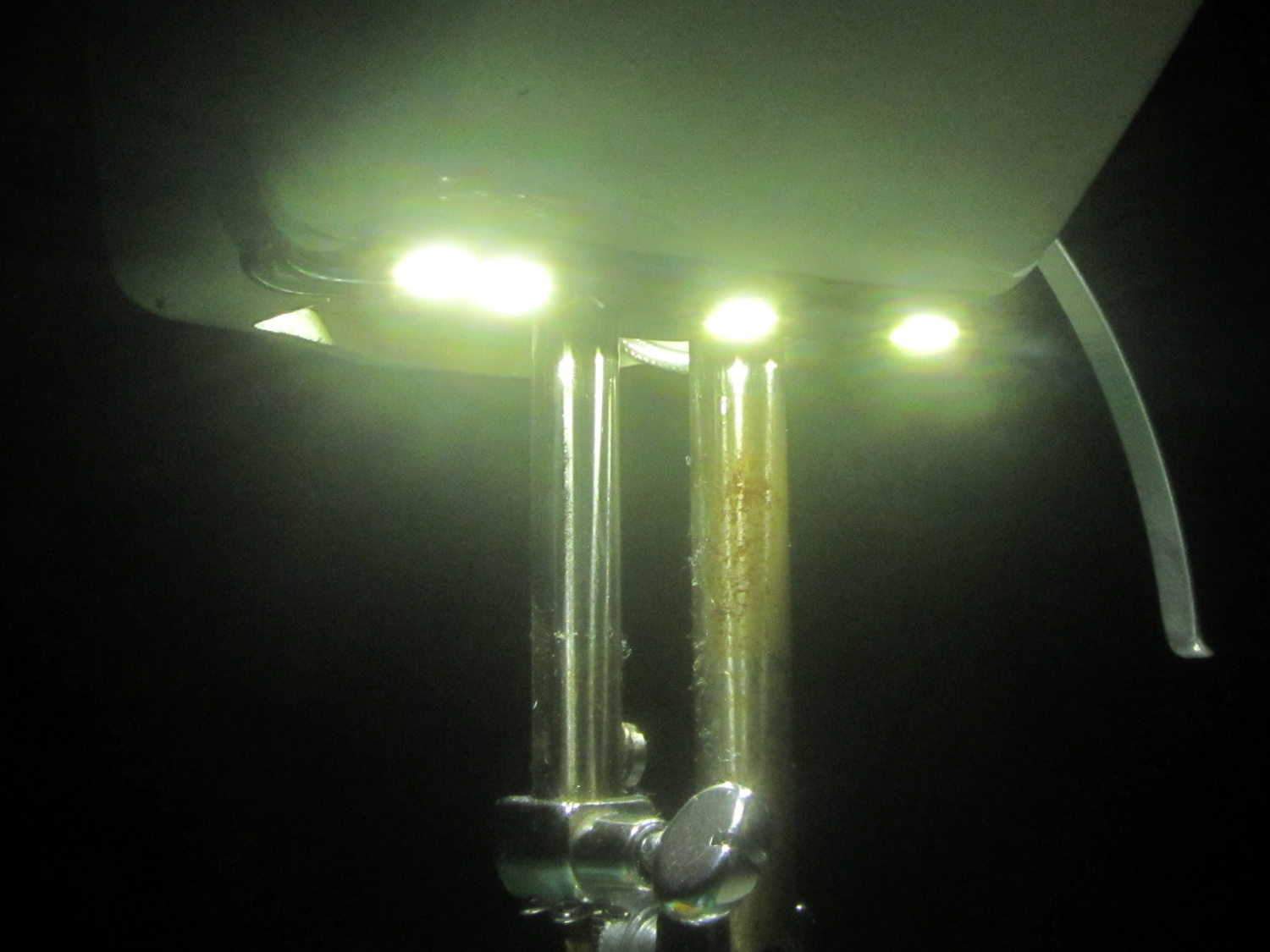
    Those are the same 5050 warm white LEDs I used on the other side:

    Needle LEDs - lower right
    Needle LEDs – lower right

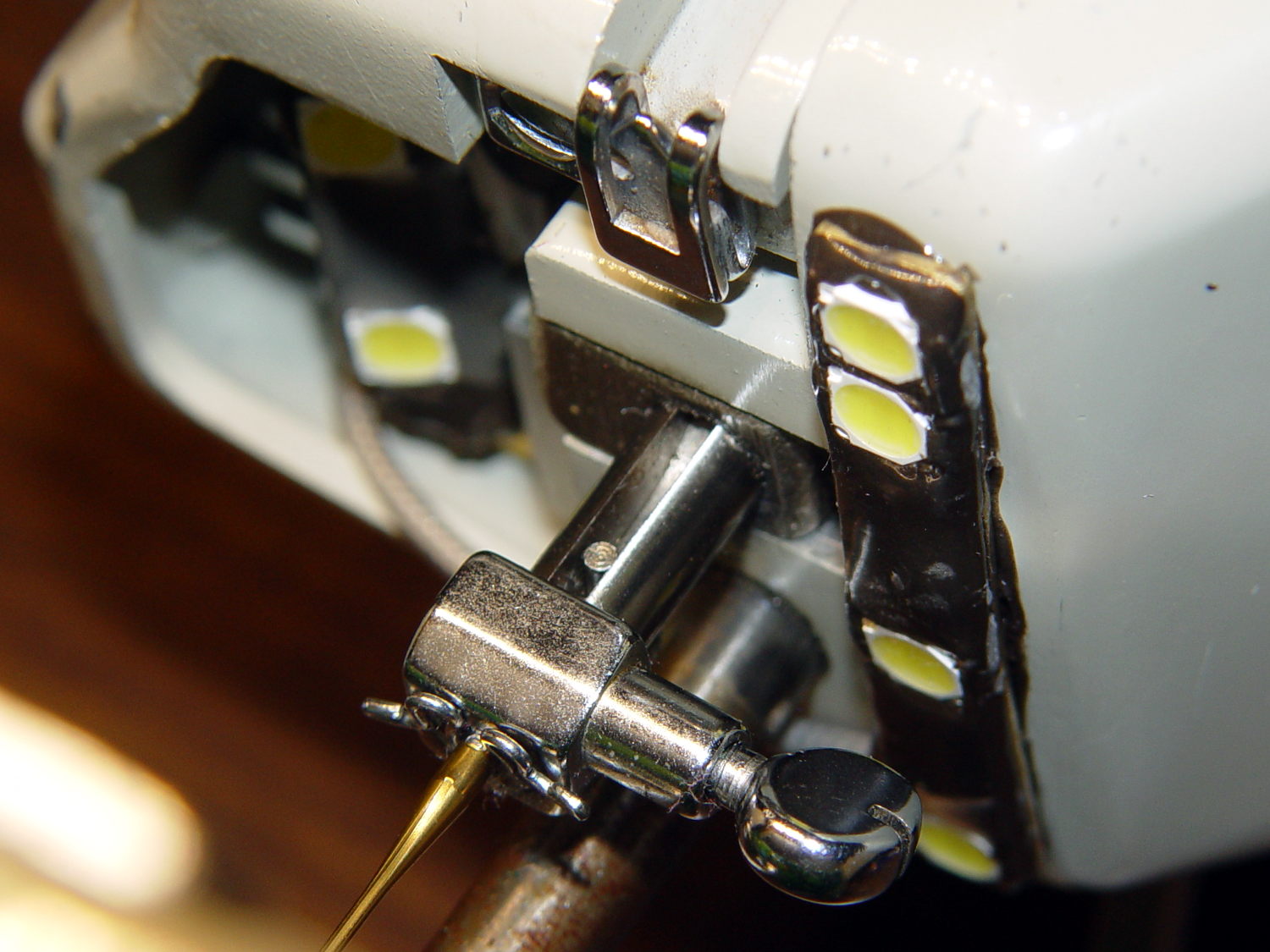
    Seen without the glare:

    Needle LEDs - bottom
    Needle LEDs – bottom

    They’re mounted on a 32 mil brass strip from the shimstock stash, carefully hand-bent and twisted to match the curvature of the arm, and held in place with JB Kwik steel-filled epoxy for good heat conduction to the aluminum arm. One can argue with the epoxy oozing out from under the brass, but it’s invisible from above.

    No construction photos, alas, because I made this in a white-hot frenzy one afternoon and managed to not take any pix during the entire session. Call it working in the flow, OK?

    All four SMD LEDs sit in epoxy blobs that isolate them from the brass strip, with 26 AWG solid wire “bus bars” soldered to the top of their terminals and a length of that lovely PTFE-insulated miniature coax leading off into the endcap. More epoxy encloses all the wiring & connections to provide a surprisingly smooth surface that shouldn’t snag the fabric.

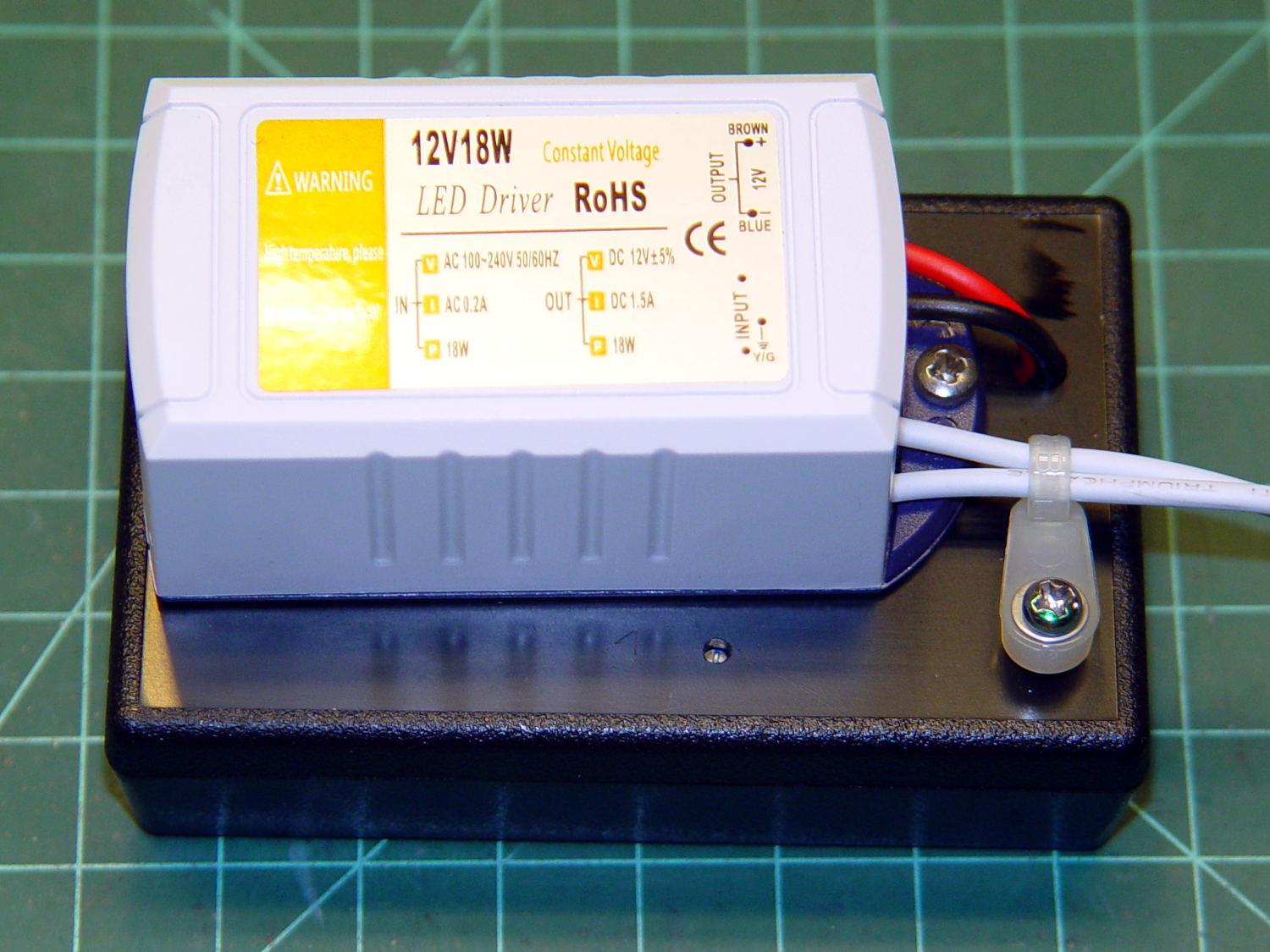
    The power supply uses an 18 W 120 VAC to 12 VDC brick intended for small LED installations:

    Needle LEDs power supply - exterior
    Needle LEDs power supply – exterior

    The AC comes from the same zip cord that formerly supplied the original 15 W incandescent bulb in the endcap, so the new lights behave the same way: push the power button to turn on the machine and the LEDs pop on just like they should. I put quick-disconnect terminals in the AC line to make it removable, although those need some sort of insulated plug to cover the exposed blades inside their housing.

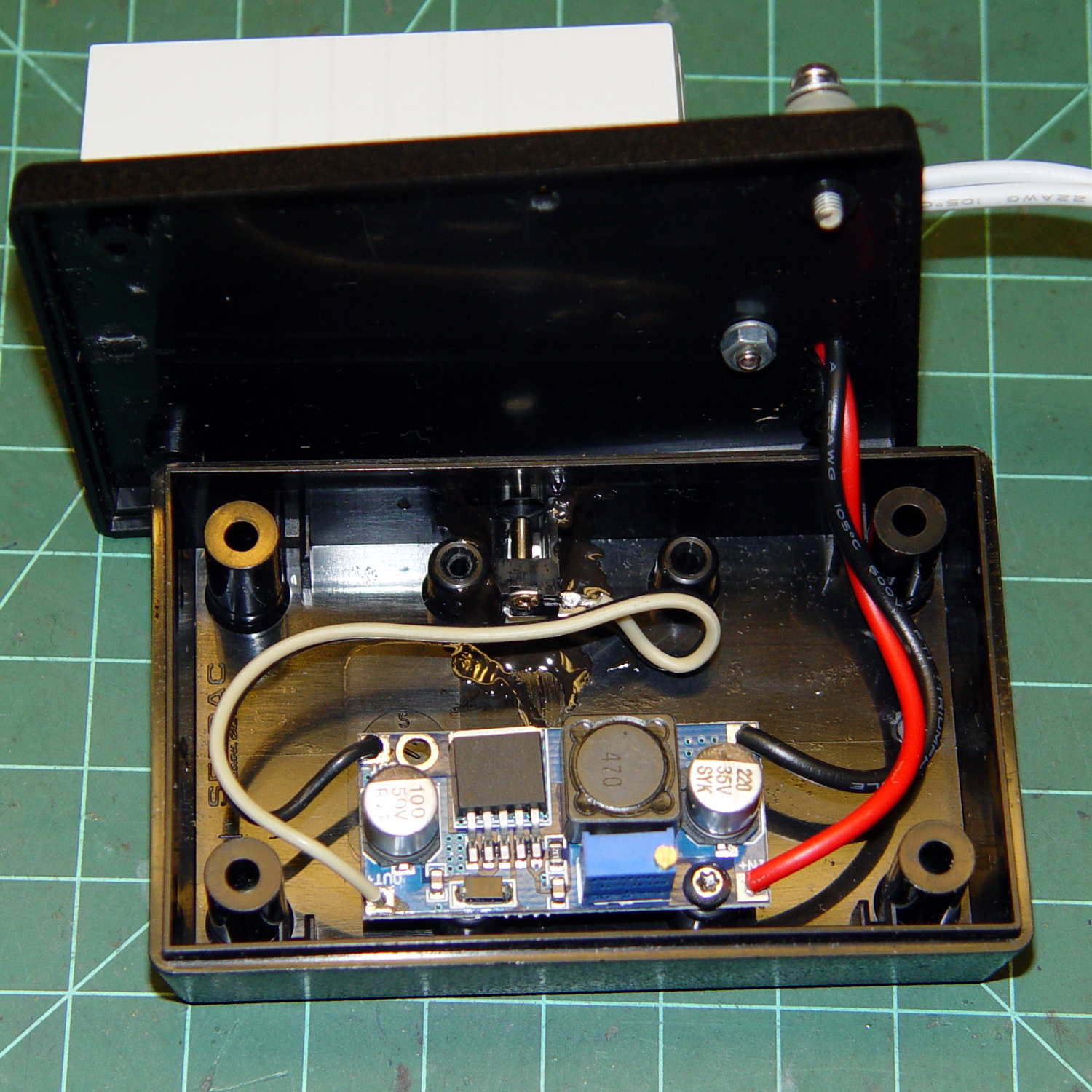
    Inside the black box, a small boost supply steps the voltage up to just under the nominal operating level of 21 VDC:

    Needle LEDs power supply - interior
    Needle LEDs power supply – interior

    You can just see the adjusting screw hole in front of the AC brick in the overall view.

    The DC output exits in the middle of the far side, through a coax jack epoxied to the base.

    As before, all six LEDs run in parallel at (for now) 18.5 VDC and maybe 50 mA each, for a total of 300 mA, and seem fearsomely bright even at that. We can now tune for best light as needed.

    This is a major major major improvement over the previous tangle of wires stuck on the outside of the machine, with all the wiring internal to the arm and the power supply out of sight under the sewing table.

    After an hour, the arm above the four LEDs runs 13 °C above ambient and the endcap over the two LED heatsink is 6 °C over ambient. The AC supply runs at 104 °C and its plastic case offers no provision for heatsinking. All in all, things are warm and not hazardous.

    I haven’t retrofit this machine with LED strips along the front & back of the arm, as those may not be needed with the intense needle lighting; the NisLite desk lamp may suffice for area illumination.

  • Vacuum Tube LEDs: 500 W Frosted Incandescent Bulb

    This turned out surprisingly well:

    500 W Incandescent - backlit dark
    500 W Incandescent – backlit dark

    In the harsh light of the Electronics Workbench, you can see there’s less than meets the eye: a single knockoff Neopixel taped to the back side of the bulb just below the equator and a knockoff Arduino Pro Mini taped to the Mogul lamp socket:

    500 W Incandescent - backlit light
    500 W Incandescent – backlit light

    The electrical box serves as a base and the cord doesn’t do anything in this incarnation.

    The 5050 SMD LED package (inside an ugly 3D printed plate cap) looks enough like a point source to shadow the filament & support structure against the frosted bulb. The blurry upper part of the filament is closer to the LED, which isn’t really a point source and must fight its way through the frosting.

    The Pro Mini runs the same firmware as the Bowl o’ Fire floodlamp, of course, dialed back for slow fades.

    It lights up the room something wonderful …

  • FG085 Function Generator

    The topic of function generators came up at Squidwrench a while ago (Sophi was tinkering with LCD shutters) and I finally picked up one of those JYE Tech FG085 DDS function generators to see how they work:

    FG085 Fn Gen - in case
    FG085 Fn Gen – in case

    Short answer: adequate, if you’re not too fussy.

    The board arrived with a bizarre solder defect. It seems a solder stalk yanked one terminal off a ceramic SMD caps:

    FG085 - Solder stalk - C26
    FG085 – Solder stalk – C26

    The schematic and adjacent parts suggested the victim was a 10 uF cap, so I replaced it with one from my stash that worked fine.

    However, after soldering enough of the switches to do something useful, the board wouldn’t power up. With a bit of poking around, I discovered the power jack had +15 V from the wall wart, but the center terminals on the DPDT power switch that should have been connected to the jack showed maybe 0.3 V. Jumpering around the failed via and a short trace on the bottom surface let the board power up correctly:

    FG085 - Jumpered power trace
    FG085 – Jumpered power trace

    If you’re building one of these, solder one pin of each switch, push all the switch caps in place, shove the faceplate over all of them, tape it to the PCB, make sure all the switches are push-able, then solder the remainder of the switch pins. If you do them one by one, you’re certain to end up with a few mis-aligned switches that will either prevent the faceplate from sliding over them or wedge firmly against the side of their assigned hole. Just sayin’.

    It lives in a case from Thingiverse:

    FG085enclosure - 1268379
    FG085enclosure – 1268379

    I tweaked the dimensions slightly to fit the (slightly larger, possibly new, maybe tolerance-eased) front panel, but the bottom mounting screw hole spacing depends on the front panel size, not a specific set of dimensions, leading me to relocate those holes by abrasive adjustment. I didn’t bother with the lid (which doesn’t clear the BNC jack anyway) or the printed plastic feet (having a supply of silicone rubber feet).

    The fancy vent gridwork along the sides printed surprisingly well, even in PETG. I’d have gone with larger slots, although I doubt the thing really needs vents in the first place.

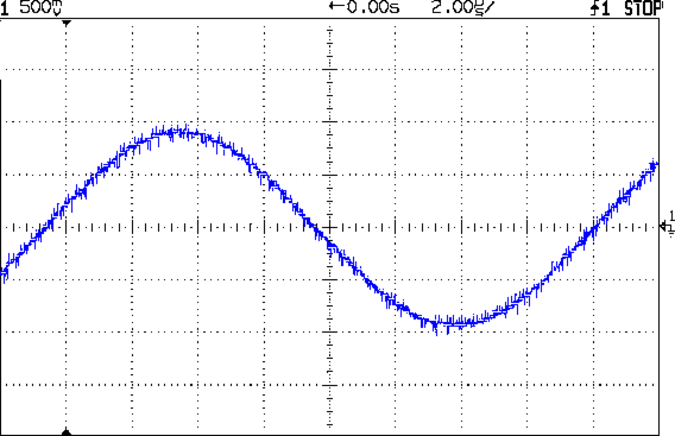
    The DDS sine wave output is rough, to say the least:

    FG085 Fn Gen - 60 kHz sine
    FG085 Fn Gen – 60 kHz sine

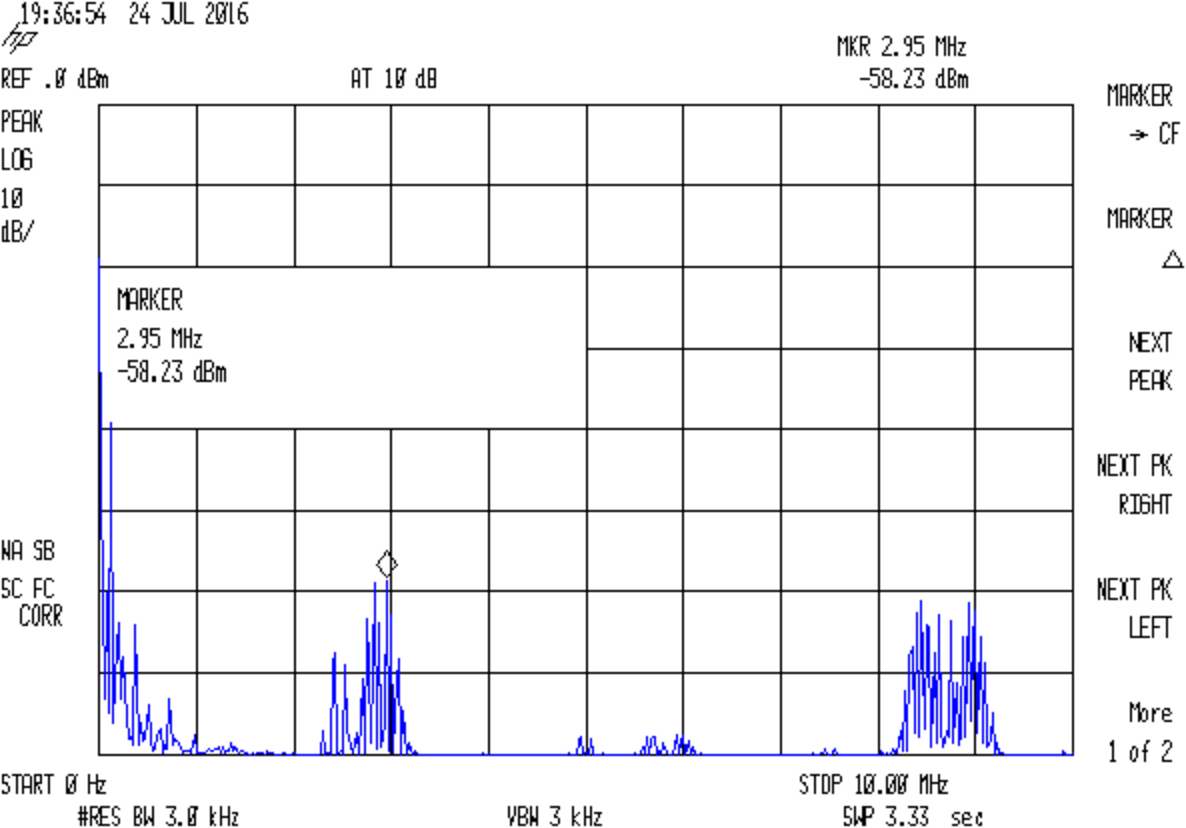
    The spectrum shows oodles of harmonic content:

    FG085 Fn Gen - 60 kHz sine - spectrum
    FG085 Fn Gen – 60 kHz sine – spectrum

    A closer look:

    FG085 Fn Gen - 60 kHz sine - spectrum - detail
    FG085 Fn Gen – 60 kHz sine – spectrum – detail

    Stepping back a bit shows harmonics of (and around) the 2.5 MHz DDS sampling frequency:

    FG085 Fn Gen - 60 kHz sine - spectrum - 10 MHz
    FG085 Fn Gen – 60 kHz sine – spectrum – 10 MHz

    For comparison, my old Fordham FG-801 analog function generator has nice smooth harmonics:

    FG-801 Fn Gen - 60 kHz sine - spectrum
    FG-801 Fn Gen – 60 kHz sine – spectrum

    Closer in:

    FG-801 Fn Gen - 60 kHz sine - spectrum - detail
    FG-801 Fn Gen – 60 kHz sine – spectrum – detail

    Of course, that crusty old analog dial doesn’t provide nearly the set-ability of a nice digital display.


  • LF Loop Antenna: GPS Frequency Check

    I stuck some old 12 V 7 A·h batteries in my homebrew power supply for the HP 3801A GPS Time / Frequency Standard, fired it up, put the antenna where it could see a good chunk of the sky, gave it a day to warm up / settle out, and it’s perfectly happy:

    ------------------------------- Receiver Status -------------------------------
    
    SYNCHRONIZATION ............................................. [ Outputs Valid ]
    SmartClock Mode ___________________________   Reference Outputs _______________
    >> Locked to GPS                              TFOM     3             FFOM     0
       Recovery                                   1PPS TI -38.3 ns relative to GPS
       Holdover                                   HOLD THR 1.000 us
       Power-up                                   Holdover Uncertainty ____________
                                                  Predict  366.2 us/initial 24 hrs
    
    ACQUISITION ............................................ [ GPS 1PPS CLK Valid ]
    Satellite Status __________________________   Time _____ +1 leap second pending
    Tracking: 4        Not Tracking: 6            UTC      18:22:19     22 Jul 2016
    PRN  El  Az   SS   PRN  El  Az                1PPS CLK Synchronized to UTC
      3  34 104   48   * 1  36  48                ANT DLY  0 ns
     17  62 308  103     6  27 220                Position ________________________
     19  39 281   50    11  21  58                MODE     Hold
     28  80 133   64   *22  Acq .
                        24  12 319                LAT      N  41:39:32.328
                        30  15 191                LON      W  73:52:26.733
    ELEV MASK 10 deg   *attempting to track       HGT               +82.87 m  (MSL)
    HEALTH MONITOR ......................................................... [ OK ]
    Self Test: OK    Int Pwr: OK   Oven Pwr: OK   OCXO: OK   EFC: OK   GPS Rcv: OK
    scpi >
    

    The FFOM 0 entry says the Frequency Figure Of Merit is “within specifications” of 10-9, averaged over one day. That means the actual frequency should be within 0.010 Hz of 10 MHz.

    Feeding the 10 MHz frequency reference into the (equally warmed up) HP 8591E spectrum analyzer and selecting an absurdly narrow span produces a comforting sight:

    HP Z2801A GPS Receiver - 10 MHz ref - HP 8591E
    HP Z2801A GPS Receiver – 10 MHz ref – HP 8591E

    Given the horizontal resolution, that’s dead on 10 MHz.

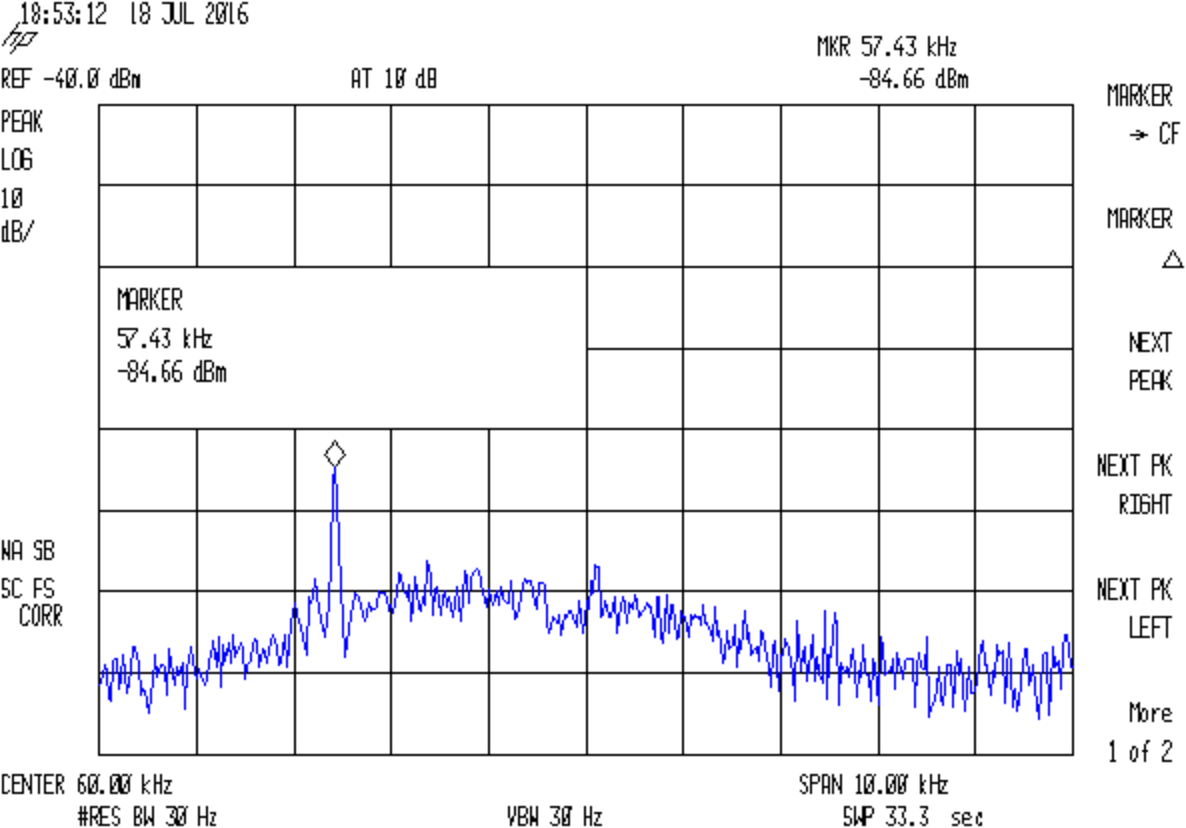
    So, yeah, that signal at 57-ish kHz really isn’t at 60.000 kHz:

    Loop - 40T 1nF - spectrum
    Loop – 40T 1nF – spectrum

    Which is good to know …

  • External Li-Ion Pack: More Sawing

    Two of the external Li-Ion battery packs I’m using with the bike radios seemed to fail quickly after being charged, so I sawed them open to check the state of the cells. This time I used the fine-tooth cutoff blades, rather than a coarse slitting saw:

    Li-Ion pack - sawing case
    Li-Ion pack – sawing case

    As before, a 2 mm depth-of-cut, done 0.25 mm per pass after the first millimeter, seems about right. I didn’t saw the front of the case near the jack, which proved to be a mistake; the interlocked case halves need cutting.

    No cell trouble found, which leads me to suspect an intermittent short in the battery-to-radio cable that trips the battery protection circuit. The spare cables went into hiding during the shop cleanout, so I can’t swap in a known-good cable just yet; of course, the existing cable behaves perfectly on the bench. The suspect cable is now on my bike and, if the problem follows the cable, further surgery will be in order.

    For the record, the insides look like this:

    Li-Ion pack - interior
    Li-Ion pack – interior

    The cell label seems to show a 2004 date code:

    Li-Ion pack - cell label
    Li-Ion pack – cell label

    Given that I got them on closeout in early 2010, it definitely isn’t 2014.

    Unlike some of the other cheap batteries around here, they’ve been spectacularly successful!

  • LF Loop Antenna: 60 kHz Tuning

    The object of soldering all 40 wires in the 5 m hank of ribbon cable  in series is to build a 40 turn loop antenna to receive LF radio signals like WWVB at 60 kHz. The antenna, being basically a big coil of wire, will have an inductance that depends on its layout, so putting a capacitor in parallel turns it into a resonant tank circuit. Given a particular layout (and, thus, an inductance), you can choose the capacitor to make the antenna resonant at whatever frequency you need (within reason).

    With the joints soldered & reinforced with epoxy, the inductance across all 40 turns:

    • 535 µH – rolled into a compact bundle
    • 6.66 mH – vaguely circular loop on the concrete floor
    • 5.50 mH – lumpy rectangle on the concrete floor

    Back in a slightly different circular layout on the floor:

    • 6.8 mH – across all 40 turns, as above
    • 2.0 mH – across either set of 20 turns from the center tap

    Given that inductance varies as the square of the number of turns, you’d expect a factor of four between those two inductances, but that’s not how it worked out.

    Hanging the loop from a pair of screws in the floor joists to make a droopy rectangle-oid shape and driving it from a 600 Ω signal generator through a 10 kΩ resistor, it’s self-resonant at 213 kHz. Repeating that with a 470 kΩ resistor drops the resonance to 210 kHz, which isn’t different enough to notice and surely has more to do with my moving the loop while dinking with resistors.

    Adding parallel capacitance (measured with an LCR meter, just to be sure) changes the resonance thusly:

    • 9.9 nF → 20 kHz
    • 900 pF → 64 kHz
    • 400 pF → 87 kHz
    • 250 pF → 108 kHz
    • none → 213 kHz

    Because the resonant frequency varies inversely as the square root of the capacitance, halving the resonant frequency means you’ve increased the capacitance by a factor of four. Because 250 pF halves the frequency (mostly kinda sorta close enough), the loop’s stray capacitance must be about 1/3 of that: 83 pF.

    Yeah, 1/3, not 1/4: the additional capacitance adds to the stray capacitance, so it goes from 83 pF to 250 + 83 pF = 333 pF, which is four times 83 pF.

    (If that sound familiar, it’s similar to the resonant snubber calculation.)

    The self-resonant frequency of 213 kHz and the 83 pF stray capacitance determines the loop inductance:

    L = 1/((2π · 213 kHz)^2 · 83 pF) = 6.9 mH

    Pretty close to the measured value from the floor, I’d say.

    To resonate the antenna at 60 kHz, the total capacitance must be:

    60 kHz = 1/(2π · sqrt(6.9 mH · C)) → C = 1050 pF

    Which means an additional 1050 – 83 =  970-ish pF should do the trick, which is about what you’d expect from the 64 kHz resonance with the 900 pF cap above. I paralleled pairs of caps until it resonated at 59.9 kHz.

    The -3 dB points (voltage = 1/sqrt(2) down from the peak) turned out to be 58.1 and 60.1 kHz, so my kludged caps are slightly too large or, once again, I nudged the loop.

    Figuring Q = (center frequency) / bandwidth = 59.1 / 2 = 30, which works out close enough to Q = X / R = 2600 / 80 = 33 to be satisfying. Using standard 26-ish AWG ribbon cable, rather than crappy 31-ish AWG eBay junk, would double the conductor area, halve the series resistance, and double the Q. Faced with that much resistance, I’m not sure better caps would make any difference.

    Attaching the spectrum analyzer through a 470 Ω resistor to reduce the load:

    Loop - 40T 1nF - spectrum
    Loop – 40T 1nF – spectrum

    I’d love to believe that big peak over on the left at 57.1 kHz is WWVB, but it’s not.

    What’s more important: the broad hump between 56 and 62 kHz, where the increased amount of background hash suggests the antenna really is resonant, with a center frequency around 59 kHz. The -3 dB points might be 57 and 61 kHz, but at 10 dB/div with 5 dB of hash, I’d be kidding myself.

    Dang, I love it when the numbers work out!

    It’s faintly possible the spectrum analyzer calibration is off by 2.5 kHz at the low end of its range. The internal 300 MHz reference shows 299.999925 and it puts FM stations where they should be, but the former could be self-referential error and the latter lacks enough resolution to be comforting. I must fire up the GPS frequency reference, let it settle for a few days, see whether it produces 10.000000 MHz like it should, then try again.

    The original measurements:

    Loop antenna tuning - measurements
    Loop antenna tuning – measurements
  • LF Loop Antenna: Joint Soldering

    Given five meters of 40 conductor ribbon cable, the object is to make a 40 turn five foot diameter loop antenna by soldering the ends together with a slight offset. After squaring off, marking, and taping the cable ends, I stripped the wires:

    LF Loop Antenna - wire stripping
    LF Loop Antenna – wire stripping

    Twirling those little snippets before pulling them off produced nicely twisted wire ends with no few loose strands. Separate the individual wires, wrap with transformer tape to prevent further separation, run a flux pen along the wire ends, tin with solder, repeat on the far end of the cable.

    Tape one end to the ceramic tile. Align the other end with a one-wire lateral offset and the stripped sections overlapping, then tape it down. Slide a paper strip between the ends, passing under every other wire, to separate the top pairs from the bottom pairs, then tape the strip in place:

    LF Loop Antenna - wire prep
    LF Loop Antenna – wire prep

    Grab each left wire with a needle point tweezer, forcibly align with the corresponding right wire, touch with the iron, iterate:

    LF Loop Antenna - top solder joints
    LF Loop Antenna – top solder joints

    The red wire trailing off to the left will become the center tap.

    Slide a strip of the obligatory Kapton tape underneath the finished joints, slobber on enough clear epoxy to bond the insulation on both sides of the joints into a solid mass, squish another strip atop the epoxy, smooth down, wait for curing.

    Untape from the tile, flip, re-tape, solder the bottom joints similarly, add Kapton / epoxy / Kapton, and that’s that:

    LF Loop Antenna - complete joint
    LF Loop Antenna – complete joint

    Prudence dictates checking for end-to-end continuity after you finish soldering and before you do the Kapton + epoxy thing, which is where I discovered I had 80 Ω of distributed resistance along 200 meters of cable. A quick check showed 40 Ω at the center tap and 20 Ω at the quarters (the black wires on the left mark those points), so it wasn’t a really crappy joint somewhere in the middle.

    The joint and its dangly wires cry out for a 3D printed stiffener which shall remain on the to-do list until I see how the loop tunes up.