Ed Nisley's Blog: Shop notes, electronics, firmware, machinery, 3D printing, laser cuttery, and curiosities. Contents: 100% human thinking, 0% AI slop.
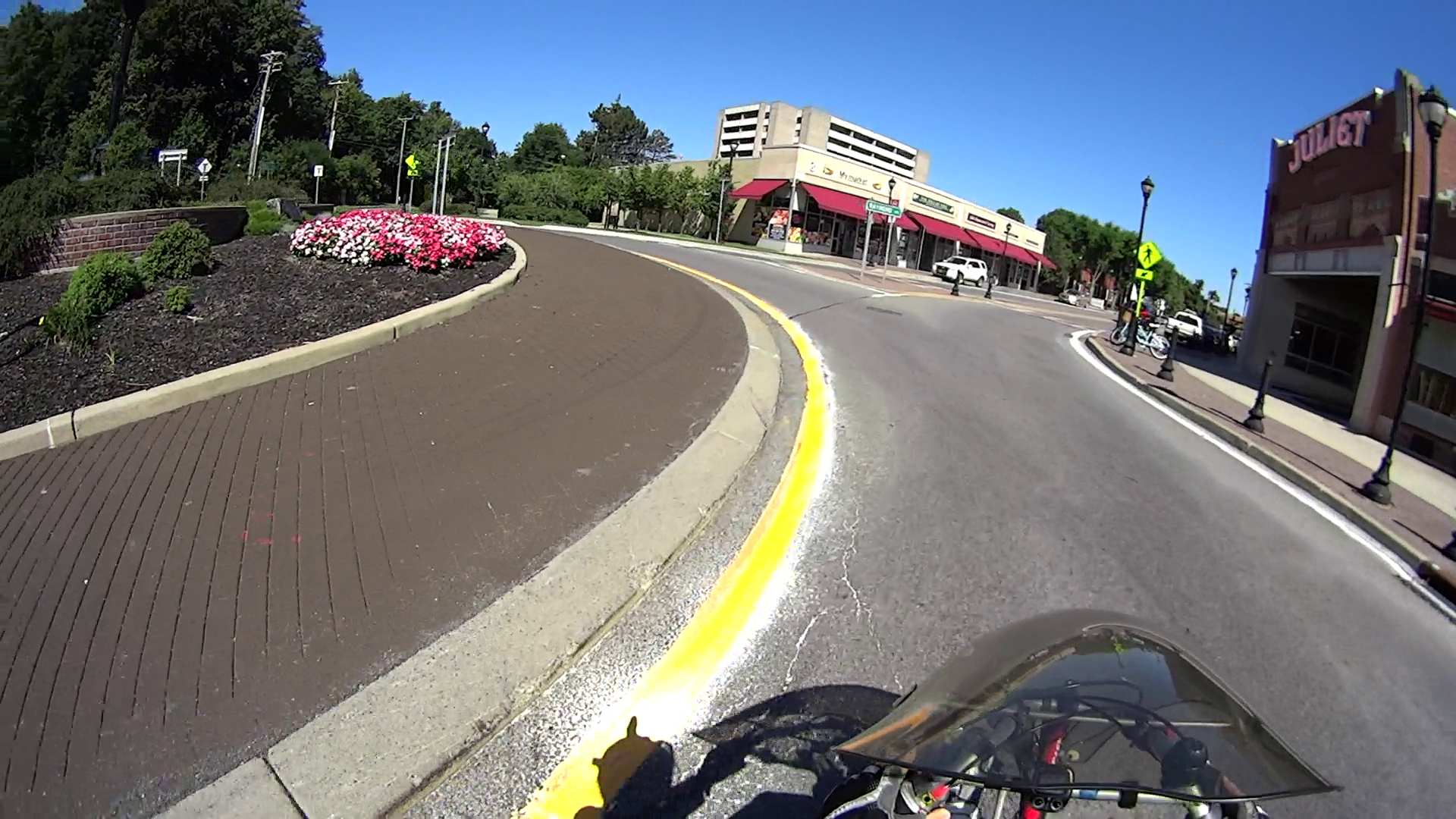
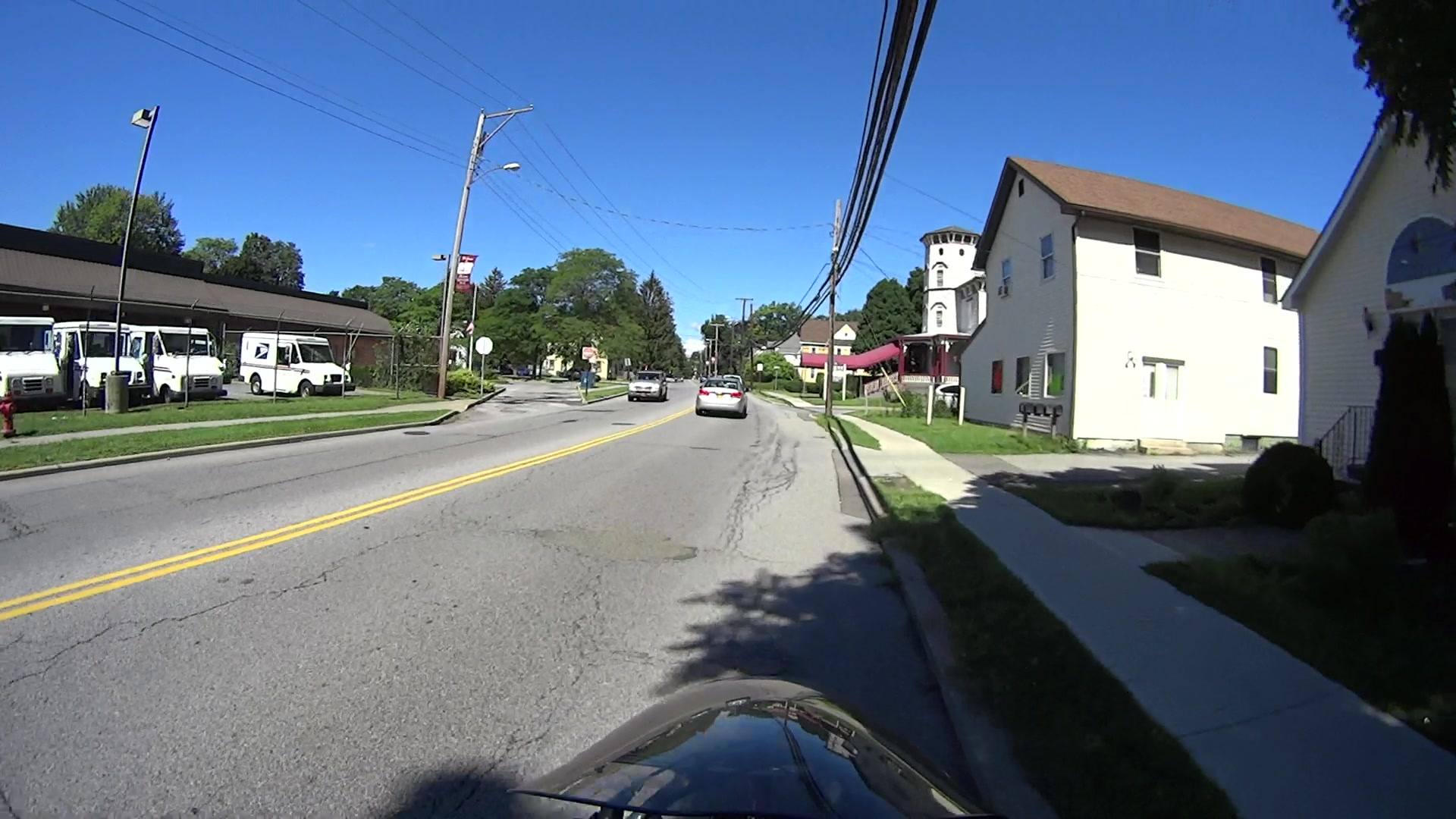
NYSDOT re-striped Rt 376 using paint with sprayed-on glass beads, rather than plastic strips, which produces lovely rainbows when the sun comes from directly behind. Alas, my helmet camera can’t resolve faint colors against the background glare and doesn’t show the circular reflection cutoff:
Glass Bead Retroreflection – 2016-07-20
However, the scattered beads light up the pavement’s cracks and crevices.
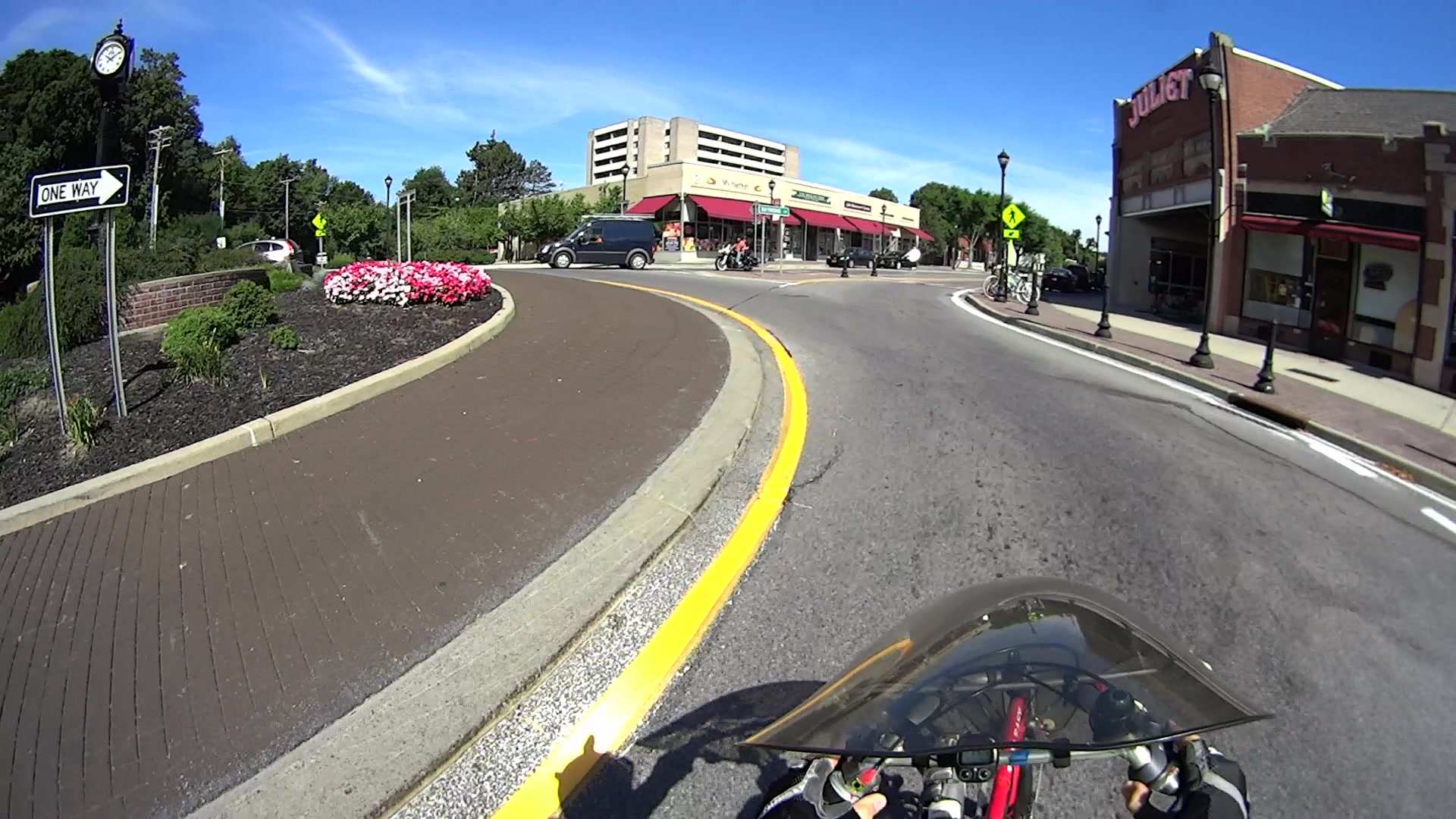
Four days later, the drifts of beads have dissipated to leave bright reflections anywhere the tires don’t reach:
Glass Bead Retroreflection – 0219
That’s along the big traffic circle at the Raymond / Collegeview / Forbus intersection.
The topic of function generators came up at Squidwrench a while ago (Sophi was tinkering with LCD shutters) and I finally picked up one of those JYE Tech FG085 DDS function generators to see how they work:
FG085 Fn Gen – in case
Short answer: adequate, if you’re not too fussy.
The board arrived with a bizarre solder defect. It seems a solder stalk yanked one terminal off a ceramic SMD caps:
FG085 – Solder stalk – C26
The schematic and adjacent parts suggested the victim was a 10 uF cap, so I replaced it with one from my stash that worked fine.
However, after soldering enough of the switches to do something useful, the board wouldn’t power up. With a bit of poking around, I discovered the power jack had +15 V from the wall wart, but the center terminals on the DPDT power switch that should have been connected to the jack showed maybe 0.3 V. Jumpering around the failed via and a short trace on the bottom surface let the board power up correctly:
FG085 – Jumpered power trace
If you’re building one of these, solder one pin of each switch, push all the switch caps in place, shove the faceplate over all of them, tape it to the PCB, make sure all the switches are push-able, then solder the remainder of the switch pins. If you do them one by one, you’re certain to end up with a few mis-aligned switches that will either prevent the faceplate from sliding over them or wedge firmly against the side of their assigned hole. Just sayin’.
I tweaked the dimensions slightly to fit the (slightly larger, possibly new, maybe tolerance-eased) front panel, but the bottom mounting screw hole spacing depends on the front panel size, not a specific set of dimensions, leading me to relocate those holes by abrasive adjustment. I didn’t bother with the lid (which doesn’t clear the BNC jack anyway) or the printed plastic feet (having a supply of silicone rubber feet).
The fancy vent gridwork along the sides printed surprisingly well, even in PETG. I’d have gone with larger slots, although I doubt the thing really needs vents in the first place.
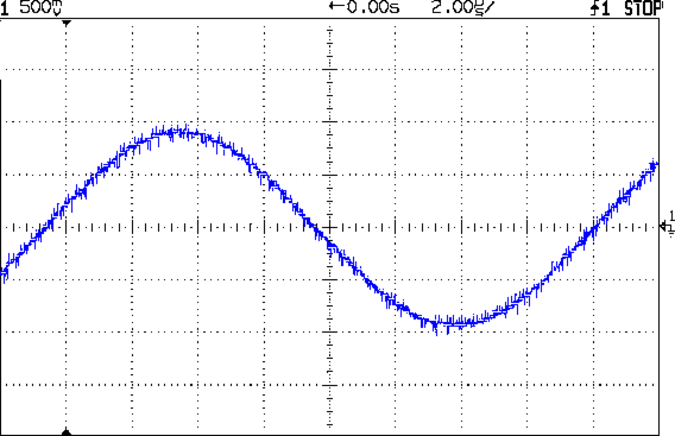
The DDS sine wave output is rough, to say the least:
FG085 Fn Gen – 60 kHz sine
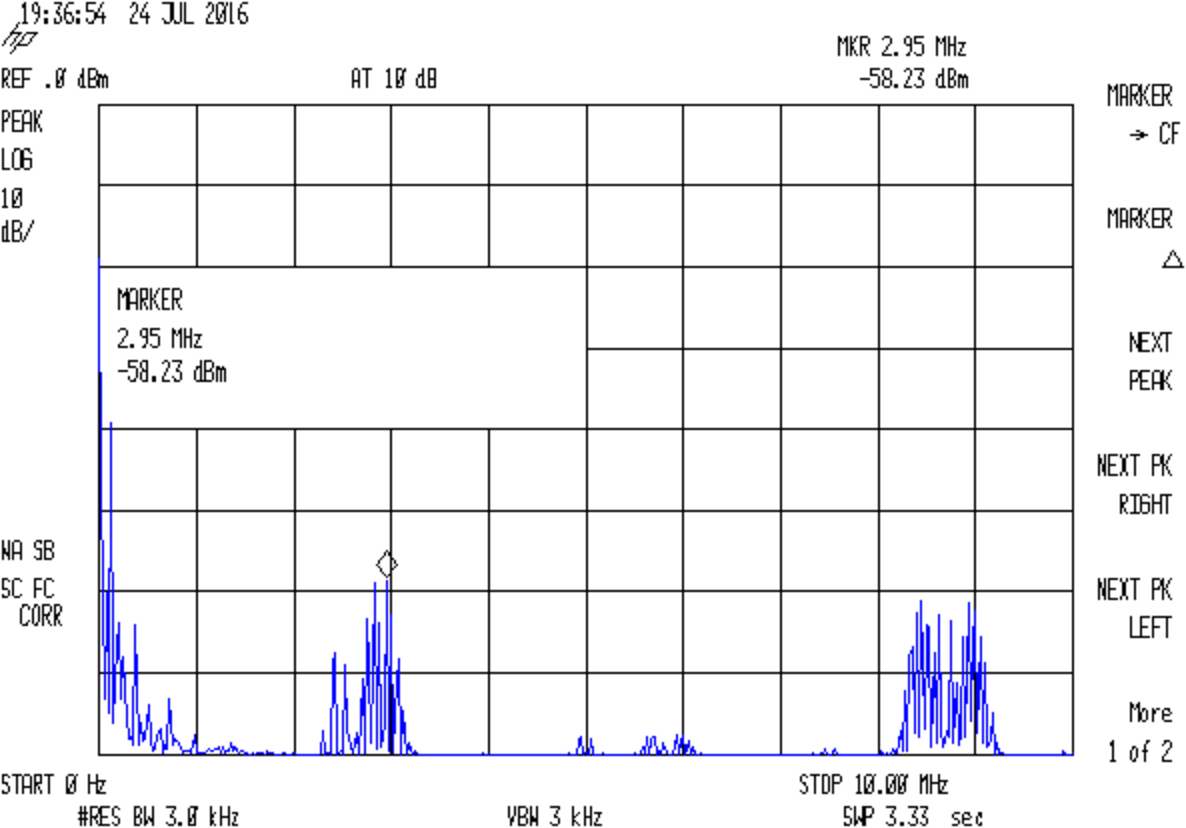
The spectrum shows oodles of harmonic content:
FG085 Fn Gen – 60 kHz sine – spectrum
A closer look:
FG085 Fn Gen – 60 kHz sine – spectrum – detail
Stepping back a bit shows harmonics of (and around) the 2.5 MHz DDS sampling frequency:
FG085 Fn Gen – 60 kHz sine – spectrum – 10 MHz
For comparison, my old Fordham FG-801 analog function generator has nice smooth harmonics:
FG-801 Fn Gen – 60 kHz sine – spectrum
Closer in:
FG-801 Fn Gen – 60 kHz sine – spectrum – detail
Of course, that crusty old analog dial doesn’t provide nearly the set-ability of a nice digital display.
I stuck some old 12 V 7 A·h batteries in my homebrew power supply for the HP 3801A GPS Time / Frequency Standard, fired it up, put the antenna where it could see a good chunk of the sky, gave it a day to warm up / settle out, and it’s perfectly happy:
------------------------------- Receiver Status -------------------------------

SYNCHRONIZATION ............................................. [ Outputs Valid ]
SmartClock Mode ___________________________   Reference Outputs _______________
>> Locked to GPS                              TFOM     3             FFOM     0
   Recovery                                   1PPS TI -38.3 ns relative to GPS
   Holdover                                   HOLD THR 1.000 us
   Power-up                                   Holdover Uncertainty ____________
                                              Predict  366.2 us/initial 24 hrs

ACQUISITION ............................................ [ GPS 1PPS CLK Valid ]
Satellite Status __________________________   Time _____ +1 leap second pending
Tracking: 4        Not Tracking: 6            UTC      18:22:19     22 Jul 2016
PRN  El  Az   SS   PRN  El  Az                1PPS CLK Synchronized to UTC
  3  34 104   48   * 1  36  48                ANT DLY  0 ns
 17  62 308  103     6  27 220                Position ________________________
 19  39 281   50    11  21  58                MODE     Hold
 28  80 133   64   *22  Acq .
                    24  12 319                LAT      N  41:39:32.328
                    30  15 191                LON      W  73:52:26.733
ELEV MASK 10 deg   *attempting to track       HGT               +82.87 m  (MSL)
HEALTH MONITOR ......................................................... [ OK ]
Self Test: OK    Int Pwr: OK   Oven Pwr: OK   OCXO: OK   EFC: OK   GPS Rcv: OK
scpi >
The FFOM 0 entry says the Frequency Figure Of Merit is “within specifications” of 10-9, averaged over one day. That means the actual frequency should be within 0.010 Hz of 10 MHz.
Feeding the 10 MHz frequency reference into the (equally warmed up) HP 8591E spectrum analyzer and selecting an absurdly narrow span produces a comforting sight:
HP Z2801A GPS Receiver – 10 MHz ref – HP 8591E
Given the horizontal resolution, that’s dead on 10 MHz.
Two of the external Li-Ion battery packs I’m using with the bike radios seemed to fail quickly after being charged, so I sawed them open to check the state of the cells. This time I used the fine-tooth cutoff blades, rather than a coarse slitting saw:
Li-Ion pack – sawing case
As before, a 2 mm depth-of-cut, done 0.25 mm per pass after the first millimeter, seems about right. I didn’t saw the front of the case near the jack, which proved to be a mistake; the interlocked case halves need cutting.
No cell trouble found, which leads me to suspect an intermittent short in the battery-to-radio cable that trips the battery protection circuit. The spare cables went into hiding during the shop cleanout, so I can’t swap in a known-good cable just yet; of course, the existing cable behaves perfectly on the bench. The suspect cable is now on my bike and, if the problem follows the cable, further surgery will be in order.
The object of soldering all 40 wires in the 5 m hank of ribbon cable in series is to build a 40 turn loop antenna to receive LF radio signals like WWVB at 60 kHz. The antenna, being basically a big coil of wire, will have an inductance that depends on its layout, so putting a capacitor in parallel turns it into a resonant tank circuit. Given a particular layout (and, thus, an inductance), you can choose the capacitor to make the antenna resonant at whatever frequency you need (within reason).
With the joints soldered & reinforced with epoxy, the inductance across all 40 turns:
535 µH – rolled into a compact bundle
6.66 mH – vaguely circular loop on the concrete floor
5.50 mH – lumpy rectangle on the concrete floor
Back in a slightly different circular layout on the floor:
6.8 mH – across all 40 turns, as above
2.0 mH – across either set of 20 turns from the center tap
Given that inductance varies as the square of the number of turns, you’d expect a factor of four between those two inductances, but that’s not how it worked out.
Hanging the loop from a pair of screws in the floor joists to make a droopy rectangle-oid shape and driving it from a 600 Ω signal generator through a 10 kΩ resistor, it’s self-resonant at 213 kHz. Repeating that with a 470 kΩ resistor drops the resonance to 210 kHz, which isn’t different enough to notice and surely has more to do with my moving the loop while dinking with resistors.
Adding parallel capacitance (measured with an LCR meter, just to be sure) changes the resonance thusly:
9.9 nF → 20 kHz
900 pF → 64 kHz
400 pF → 87 kHz
250 pF → 108 kHz
none → 213 kHz
Because the resonant frequency varies inversely as the square root of the capacitance, halving the resonant frequency means you’ve increased the capacitance by a factor of four. Because 250 pF halves the frequency (mostly kinda sorta close enough), the loop’s stray capacitance must be about 1/3 of that: 83 pF.
Yeah, 1/3, not 1/4: the additional capacitance adds to the stray capacitance, so it goes from 83 pF to 250 + 83 pF = 333 pF, which is four times 83 pF.
The self-resonant frequency of 213 kHz and the 83 pF stray capacitance determines the loop inductance:
L = 1/((2π · 213 kHz)^2 · 83 pF) = 6.9 mH
Pretty close to the measured value from the floor, I’d say.
To resonate the antenna at 60 kHz, the total capacitance must be:
60 kHz = 1/(2π · sqrt(6.9 mH · C)) → C = 1050 pF
Which means an additional 1050 – 83 = 970-ish pF should do the trick, which is about what you’d expect from the 64 kHz resonance with the 900 pF cap above. I paralleled pairs of caps until it resonated at 59.9 kHz.
The -3 dB points (voltage = 1/sqrt(2) down from the peak) turned out to be 58.1 and 60.1 kHz, so my kludged caps are slightly too large or, once again, I nudged the loop.
Figuring Q = (center frequency) / bandwidth = 59.1 / 2 = 30, which works out close enough to Q = X / R = 2600 / 80 = 33 to be satisfying. Using standard 26-ish AWG ribbon cable, rather than crappy 31-ish AWG eBay junk, would double the conductor area, halve the series resistance, and double the Q. Faced with that much resistance, I’m not sure better caps would make any difference.
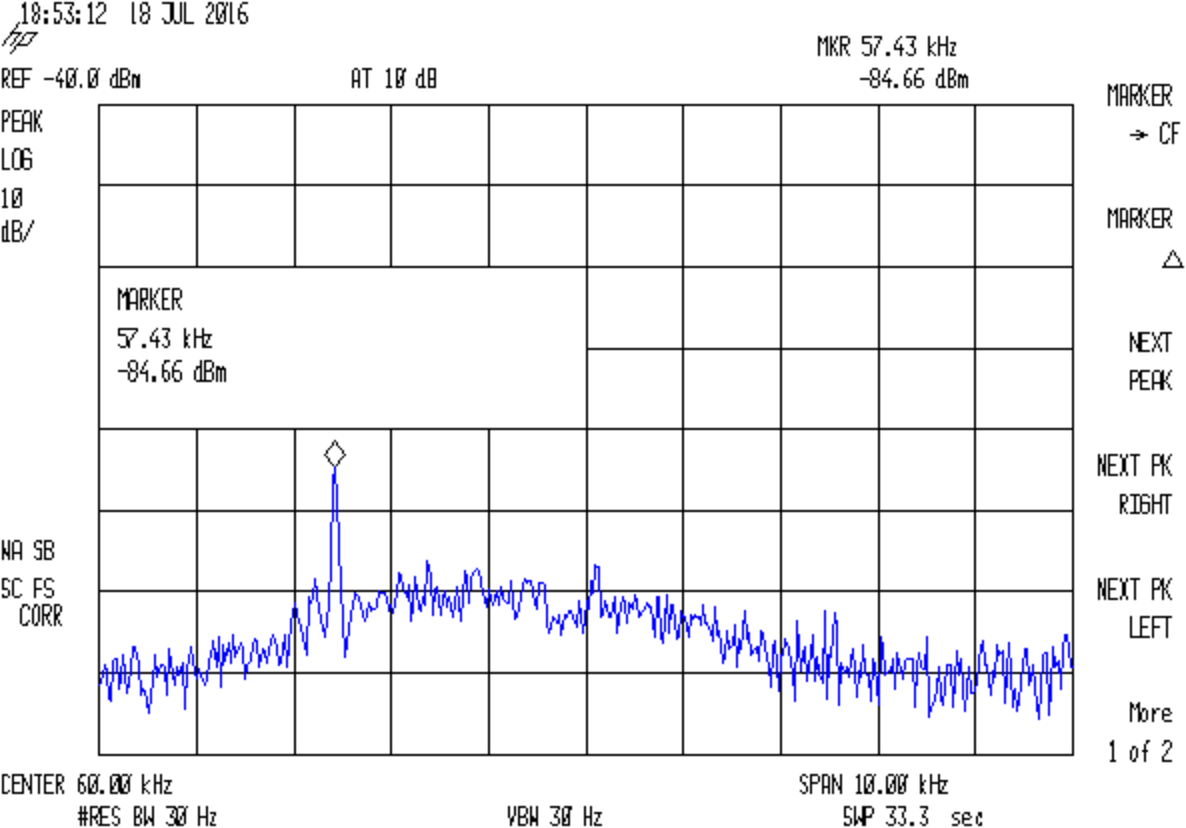
Attaching the spectrum analyzer through a 470 Ω resistor to reduce the load:
Loop – 40T 1nF – spectrum
I’d love to believe that big peak over on the left at 57.1 kHz is WWVB, but it’s not.
What’s more important: the broad hump between 56 and 62 kHz, where the increased amount of background hash suggests the antenna really is resonant, with a center frequency around 59 kHz. The -3 dB points might be 57 and 61 kHz, but at 10 dB/div with 5 dB of hash, I’d be kidding myself.
Dang, I love it when the numbers work out!
It’s faintly possible the spectrum analyzer calibration is off by 2.5 kHz at the low end of its range. The internal 300 MHz reference shows 299.999925 and it puts FM stations where they should be, but the former could be self-referential error and the latter lacks enough resolution to be comforting. I must fire up the GPS frequency reference, let it settle for a few days, see whether it produces 10.000000 MHz like it should, then try again.
Riding into the Village of Wappingers Falls, there’s a lumpy patched pothole just ahead of the fairing & front wheel:
Water Droplets – 2016-07-19 – 0196
You can watch (and I can hear) the fairing flex as the front end jounces over the patch:
This slideshow requires JavaScript.
The hydration pack slung behind the seat also jounces and, when the reservoir bag bottoms out, the sudden pressure increase squirts water out of the bite valve, all over my face and goggles, and way out in front of the camera:
This slideshow requires JavaScript.
The camera runs at 60 images/second: those 28 images span all of 450 ms.
Two seconds later, the droplet stabilized into a nice round lens:
Water Droplets – 2016-07-19 – 0360
The low humidity of a lovely day evaporated the drop after another three minutes…
Four miles later, a blowout through a tread gash previously covered by the tire liner
A puncture flat directly through the tread
Basically, erosion from the (last remaining, I think) liner in the rear tire of Mary’s bike caused the first flat; I patched the tube and didn’t notice the gash. After the blowout, I patched the tube again, booted the gash (with a snippet from a roll of PET bottle plastic I carry around for exactly that purpose), stuck an ordinary patch atop the boot to cover its edges, and the whole mess has held air just fine for the last week. I’m reluctant to mess with success.
Not having a tire liner caused the third flat, this time on my bike. The wound looked like a nail or glass shard punched directly through the Kevlar armor behind the tread. Fortunately, it happened (or, more exactly, I realized I had a flat) half a mile from home, so I fired a CO2 cartridge into the tube and pedaled like crazy, which got me halfway to the goal and I rolled the rest of the way on a dead-flat tire.
Ya can’t win.
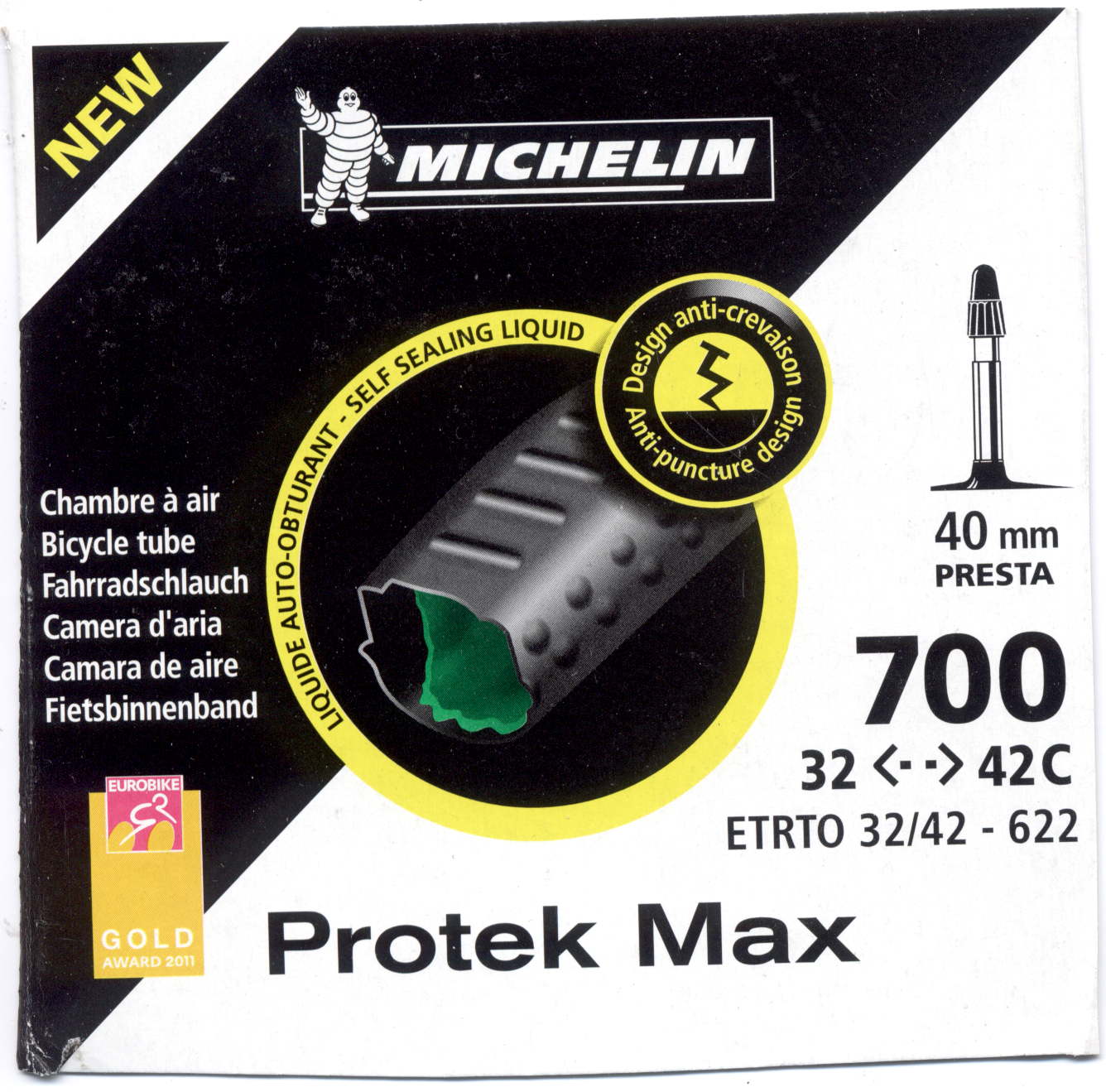
So I picked up a pair of Michelin Protek Max tubes, the weirdest things I’ve ever stuffed into a bike tire:
Michelin Protek Max Tube – carton
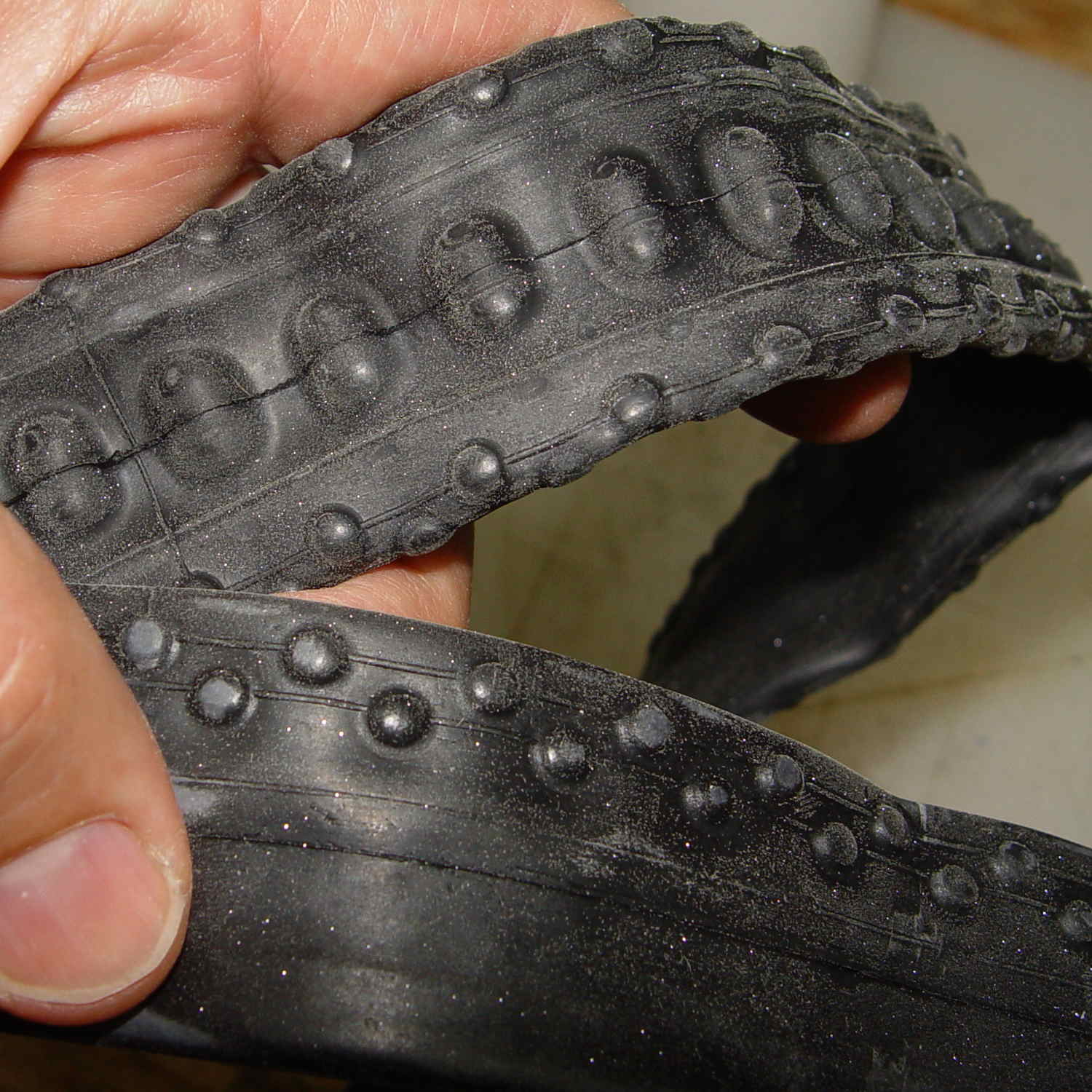
The bumps along the tread surface are much larger and uglier than shown in that picture:
Michelin Protek Max tube
The rubber forming the protrusions has the same thickness as the rest of the tube, so you’re looking at soft, flexible shapes, rather than thick bumps.
The “liquid” inside must be a thin film over the inner surface. I’ve never been a big fan of tire sealants, mostly because they’re reputed to ooze to the bottom of the tire into off-balance puddles.
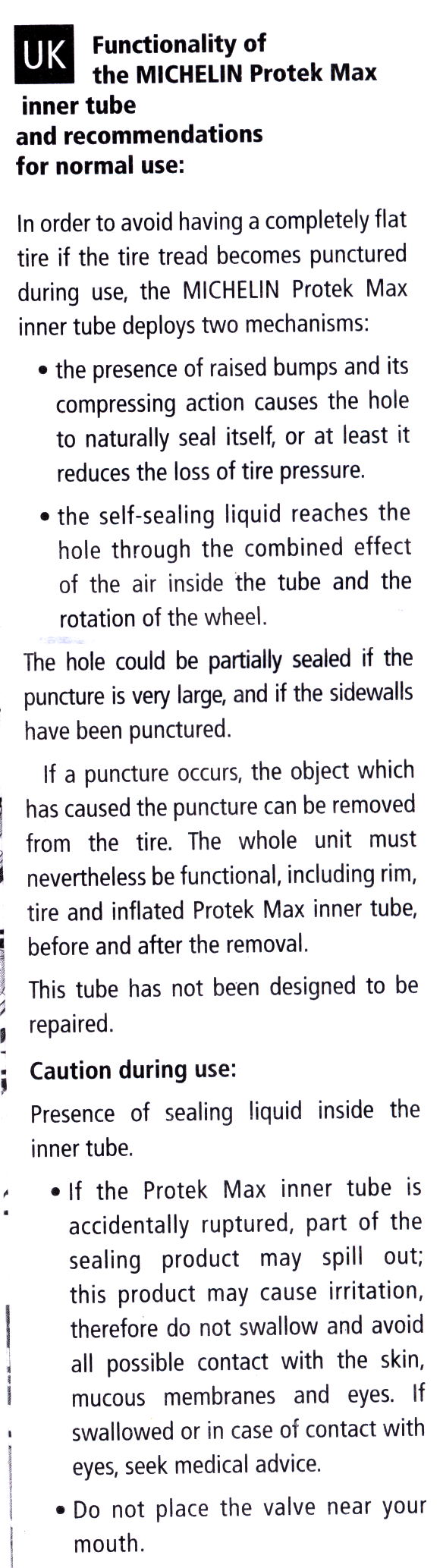
For future reference, the Official Quasi-Instruction Manual / Blurb (clicky for more dots):









 The Smell of Molten Projects in the Morning