Ed Nisley's Blog: Shop notes, electronics, firmware, machinery, 3D printing, laser cuttery, and curiosities. Contents: 100% human thinking, 0% AI slop.
I’m using good ol’ JB Weld steel-filled epoxy, rather than graphite / molybdenum disulfide loaded epoxy, mostly because:
I have it on the shelf
This is a non-sliding joint
My technique needs polishing, too
The key point: the tailstock is (astonishingly) well aligned and, if I can manage to not change how it sits on the lathe bed, this should be a zero-impact operation. Scraping / filing / fiddling with the high spots will change the alignment; I expect I must eventually do such things; this represents a first pass at the problem.
Applying a fat blue Sharpie to the tailstock ways:
Tailstock way repair – blue Sharpie
After sliding the tailstock back and forth a few times, the remaining blue shows where the ways did not make contact. Those shiny and silvery spots rubbed against the lathe bed ways.
The flat way looked like this:
Tailstock way repair – flat contacts
The patch along the upper-left edge and the small dot near the upper-right corner are the only contact points across the entire flat.
The outside of the V groove:
Tailstock way repair – outer V contacts
As nearly as I can tell, that’s actually a reasonably flat and well-aligned surface, with small contact points scattered all over. Granted, there’s a larger contact patch to the left and less to the right.
The inside of the V groove:
Tailstock way repair – inner V contacts
There’s a single point near the top left, another over on the right, and that’s about it.
I cleaned the tailstock ways with acetone to get rid of the Sharpie / grease / oil / whatever. Under normal circumstances you’d roughen the surface to give the epoxy something to grip, which definitely seemed akin to perfuming a lily.
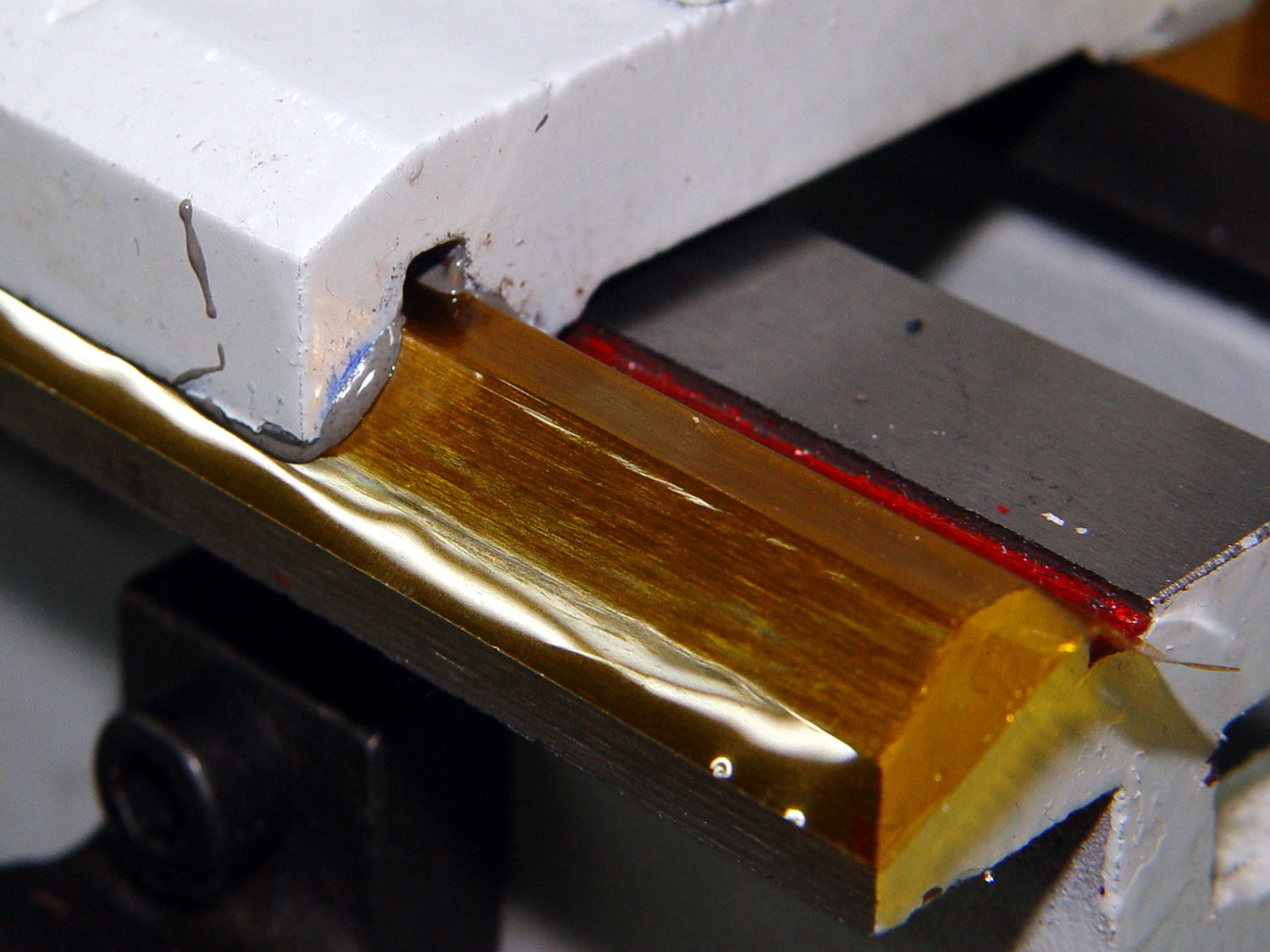
To prevent permanently affixing the tailstock to the lathe, some folks put a generous layer of oil / graphite / soot / release agent on the lathe bed ways. I used some 3 mil = 0.08 mm Kapton tape, figuring an impervious layer would pretty much guarantee I could get the tailstock off again, no matter what.
So, we begin.
Butter up the tailstock ways with epoxy and smoosh into place atop the Kapton:
Tailstock way repair – V groove on tape
Make sure the tailstock remains well-seated where it should be:
Tailstock way repair – weights
Do other things for 24 hours while the epoxy cures, pry the tailstock loose by hammering The Giant Prying Screwdriver between the lathe bed and the underside of the tailstock (just right of the V-groove, where nothing slides on the bed, but I did use a bit of plastic as a shield), chip off excess epoxy, clean things up, etc, etc.
This time, I applied Sharpie to the lathe bed, then slid the tailstock back & forth a few times. As a result, the blue areas now show the contact patches and the gray areas just slid by without touching.
The flat way looks pretty good:
Tailstock way repair – flat epoxy blued
That round dot over on the right seems to be a steel protrusion; I think it’s part of the same lump appearing in the “before” picture above. That rather sharp point seems to have indented the tape and produced a low area in the epoxy around it, which may not matter much: it was the only contact point before I did this.
The V groove isn’t anywhere near perfect:
Tailstock way repair – V groove epoxy blued
On the upside, the ways have much, much larger contact patches spread across nearly their entire lengths, which isn’t to be sniffed at.
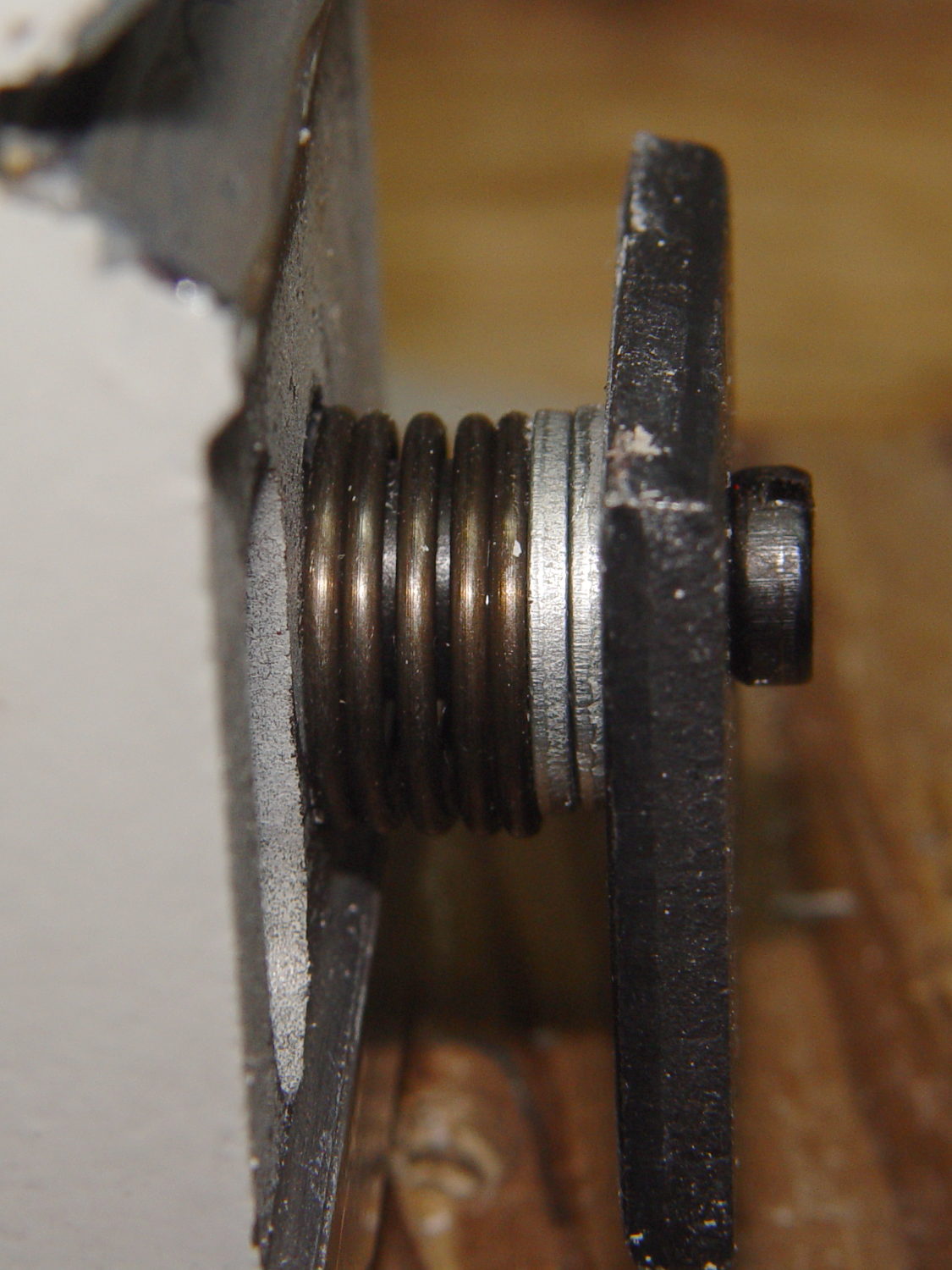
While reassembling the tailstock, I added a pair of M6 washers above the clamp plate so it cleared the bed with the screw tightened into the cam-lock post:
Tailstock clamp plate – washers
Which definitely calls for a small bushing, of course. If you put a lockwasher under the screw head, it won’t clear the end of the bed casting. So it goes.
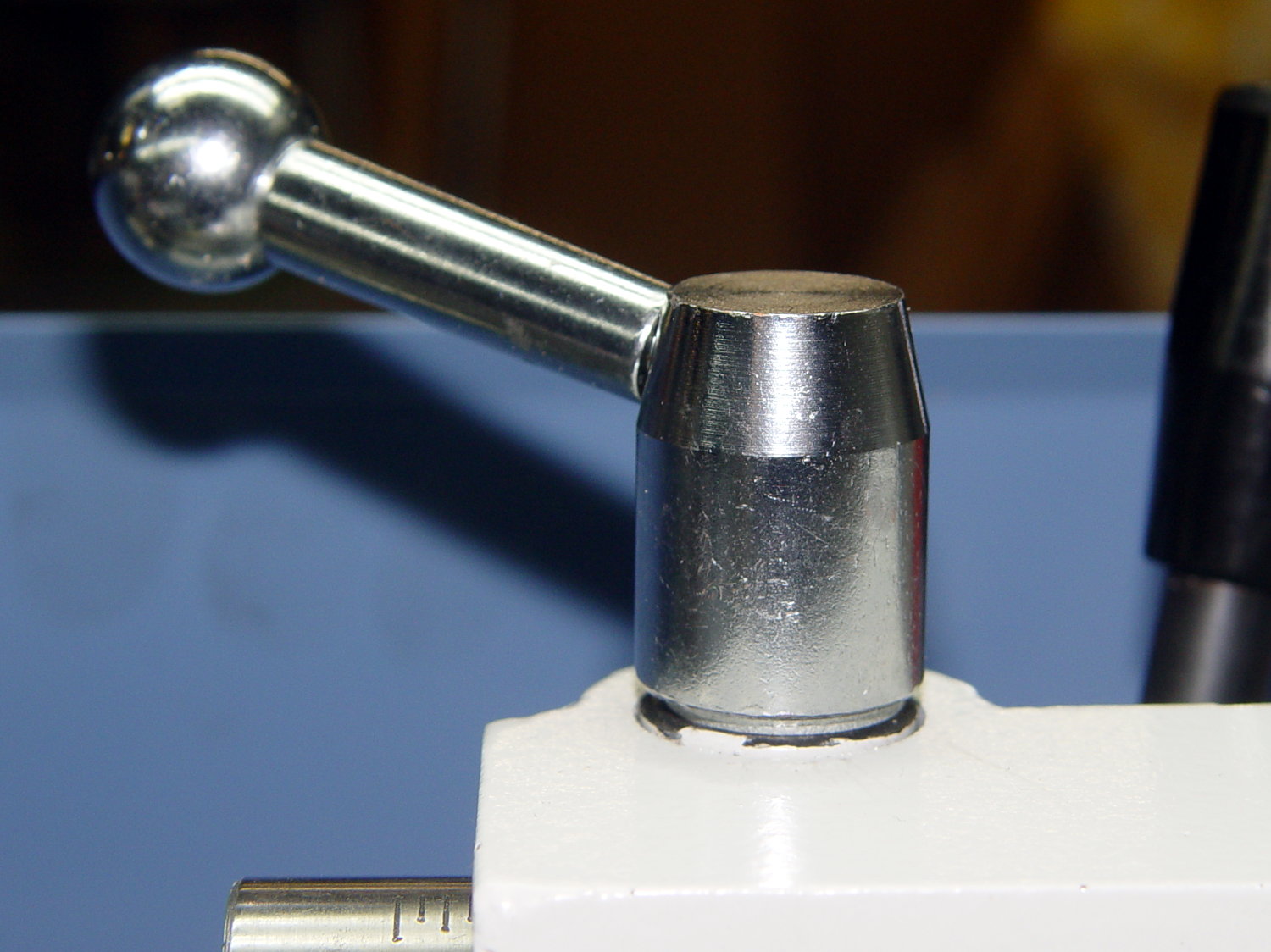
Another washer under the ram lock screw changed the phase enough to keep the knob out of the way in both the fully locked and unlocked positions:
Tailstock ram lock – added washer
I slobbered some Mobil Vactra #2 Sticky Way Oil (thanks, Eks!) on the bed ways, snuggled the tailstock in place, and wow does that thing move! Verily, it slides smoothly and clamps solidly in place: a tremendous improvement over the status quo ante.
Some observations…
The tape (perhaps the adhesive layer) produces a slightly textured epoxy surface
The tailstock way’s small contact points indented the tape, even though it’s only 3 mil thick
Filling the low areas in the way works well
The high areas may not have enough epoxy for good durability
I expect the epoxy will wear faster than steel, so contact should improve with time
This is not a permanent fix
What I’ll do differently next time…
Apply more epoxy to avoid those small gaps along the edges
Use a real release agent: smoothed in place, it might provide a better finish. Might not matter
Verify a good prying spot before epoxying, say, the compound
All in all, though, this worked much better than I expected!
A streaming media player in the Basement Laboratory Warehouse Wing has a concrete block wall between it and the WiFi router, so that even high(er)-gain USB antennas can’t grab enough signal for reliable streaming. After some fiddling, I snaked a cable from a hub, along the floor joints, to the Pi and declared victory. It turned out the Pi, an old Pi 1 Model B, had some trouble keeping up with the times, and I eventually swapped it for a Pi 3.
Forcing a static address for the wired port followed the now-standard recipe, with eth0 instead of wlan0 in /etc/dhcpcd.conf.
However, plugging a network cable into the Pi 3 then produces two network connections: the wired one I wanted and the aforementioned unreliable WiFi link through the built-in hardware. The only reliable way to turn off the WiFi connection seems to require applying The BFH through a line in /etc/rc.local:
sudo ifconfig wlan0 down
Removing my WiFi credentials from /etc/wpa_supplicant/wpa_supplicant.conf prevents the hardware from connecting before the hammer comes down.
This big branch must have landed with a mighty thump across the Maloney Road entrance to the Dutchess Rail Trail:
DCRT – Maloney Rd – tree down – 2017-02-20
Yeah, some jerk ran a snowmobile up the slope around the tree, leaving a pile of dirt on the ramp. So it goes.
We took an alternate route, I emailed The Right Folks, and (most of) the tree vanished two days later; evidently, the property owner gets to deal with everything to the left of the line of trees.
With the WS2812 test fixtureneatly mounted, I plugged it into a six-port USB charger allegedly capable of supplying 2.4 A per port and captured a trace with nearly all 28 LEDs displaying full white:
WS2812 4×7 array – 200 mA VCC – all on
At 200 mA/div, the top trace shows a bit under 1.2 A, a bit under the 1.68 A = 28 × 60 mA you’d expect; in round numbers, each RGB pixel draws 43 mA. Actually, the WS2812 specs don’t specify the maximum / typical LED current and, on belief and evidence, I doubt these units meet any particular specs you’d care to cite.
Also, the supply voltage (measured across the LED array “bus bar” wires) hits 3.37 V, well under the 5 V you’d expect from a USB charger and less than the 3.5 V called for by the WS2812 specs. Although the WS2812 nominally limits the LED current, there’s no telling how it varies with supply voltage.
A cheap USB 1 A wall-wart charger produced far more hash:
WS2812 4×7 array – 200 mA VCC – all on – cheap 1A wart – 20 uF
That’s with an additional 20 µF of tantalum capacitance across the power bus bars. The peak current looks like 1.4 A, with marginally more supply voltage at 3.56 V.
Bumping the trace speed shows the wall wart produces nasty current spikes, at what must be the poor thing’s switching speed, as it desperately tries to produce enough juice for the LEDs:
WS2812 4×7 array – 200 mA VCC 50 us – all on – cheap 1A wart – 20 uF
The step over on the right looks like a single RGB LED going dark, as it’s about 50 mA tall.
The output voltage doesn’t show the same spikes, so the LED array acts like a constant-voltage load. Given that the WS2812 probably connects all the LEDs pretty much straight across the supply, that’s not far from the truth: we’re looking at the forward drop of those blue LEDs.
Now, to let it cook away in the cool and the dark of the Basement Laboratory…
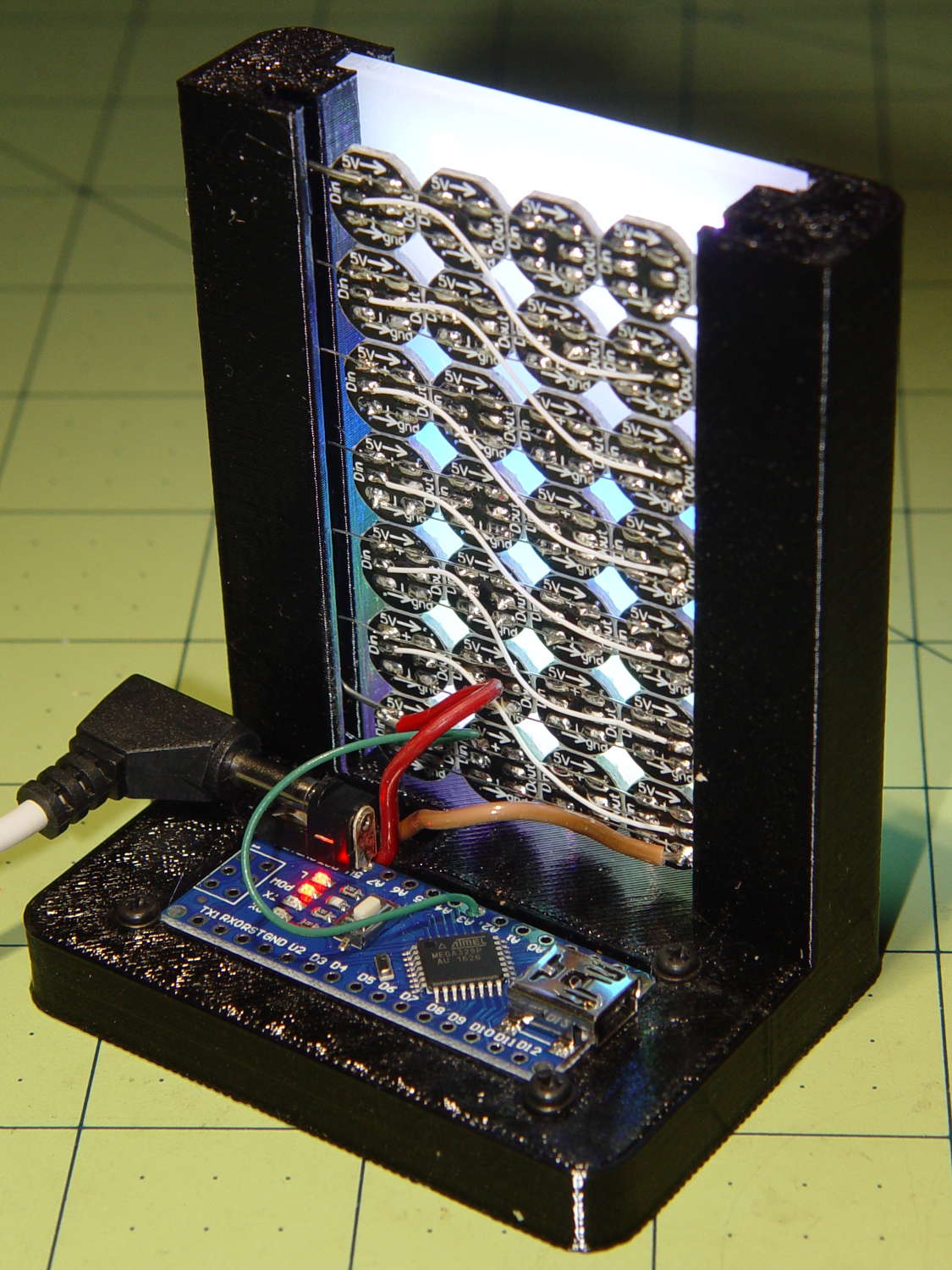
Mounting the ungainly WS2812 LED test fixture seemed like a Good Idea to keep the electricity out of the usual conductive litter:
WS2812 array test fixture – rear
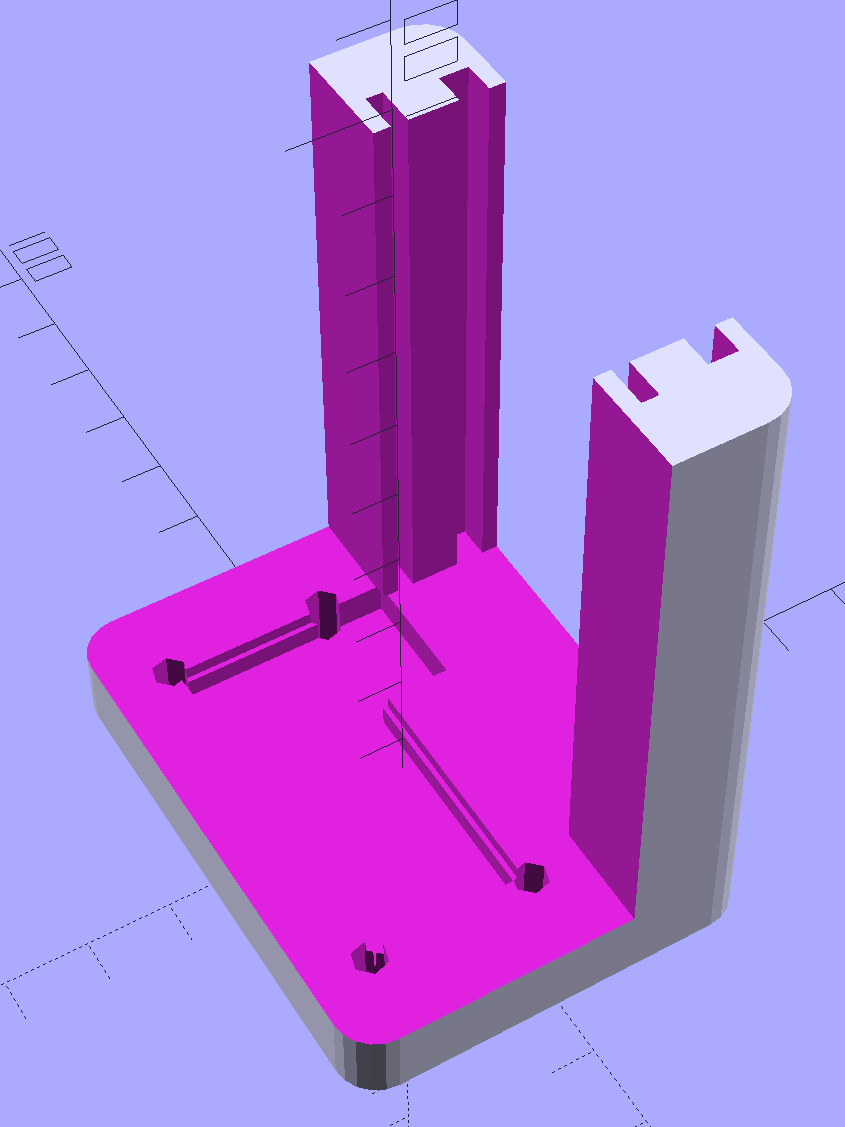
The solid model shows more details:
LED Test Fixture – solid model
The power wires along the array edges slide into the rear (thinner) slot, with enough friction from a few gentle bends to hold the whole mess in place.
The knockoff Arduino Nano rests on the recessed ledge in the pit, with M2 screws and washers at the corners holding it down (the PCB’s built-in holes might work with 1 mm or 0-90 screws, but that’s just crazy talk). I soldered the power wires directly to the coaxial jack pins under the PCB; they snake out to the LEDs through the little trench. There should be another cutout around the USB connector for in-situ programming, although the existing code works fine.
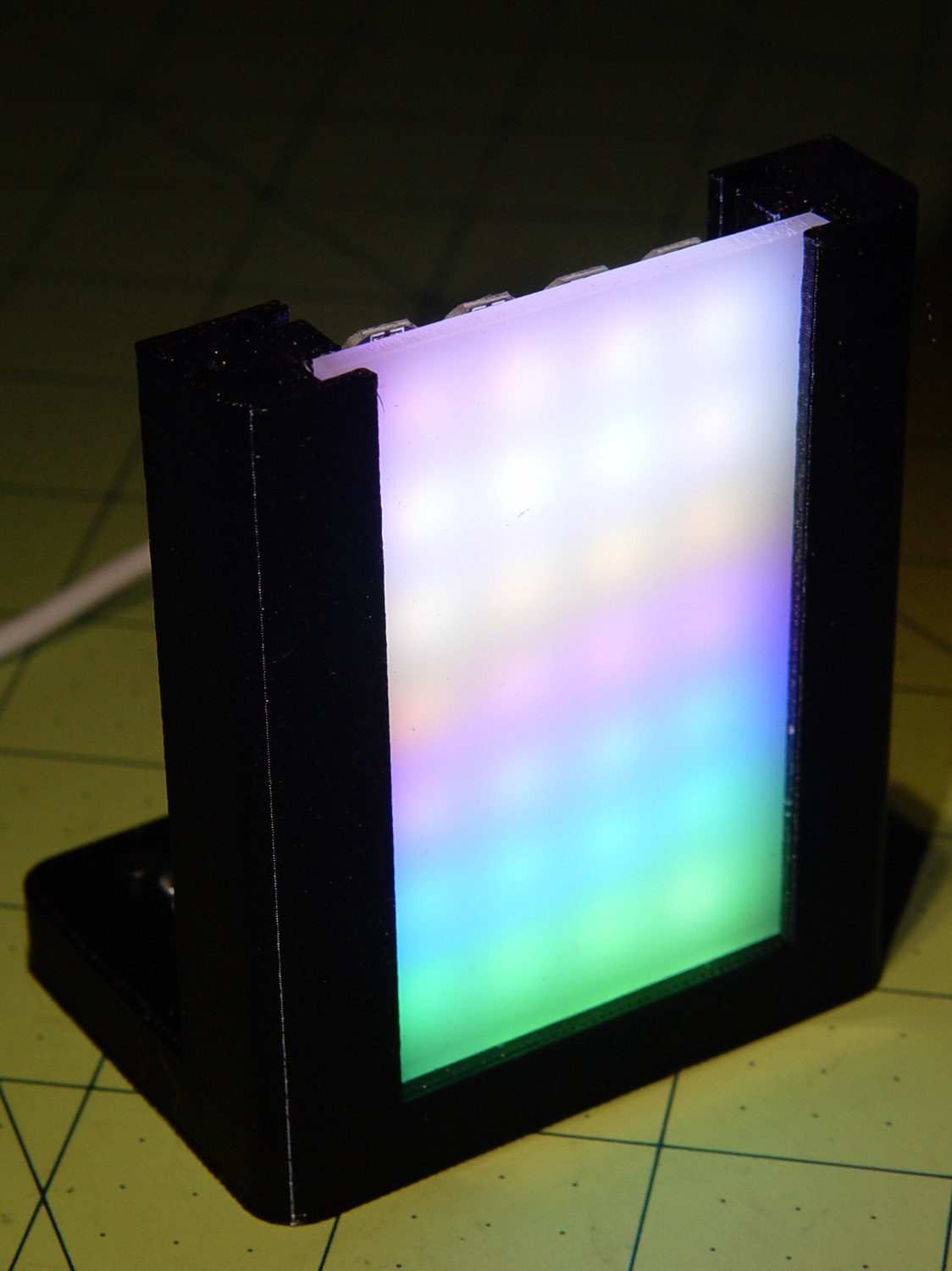
The front (wider) slot holds a piece of translucent white acrylic to diffuse the light:
WS2812 array test fixture – front flash
It’s painfully bright: a few layers of neutral density filter would be appropriate for a desk toy.
The array runs hot enough at MaxPWM = 255 to produce a gentle upward breeze.
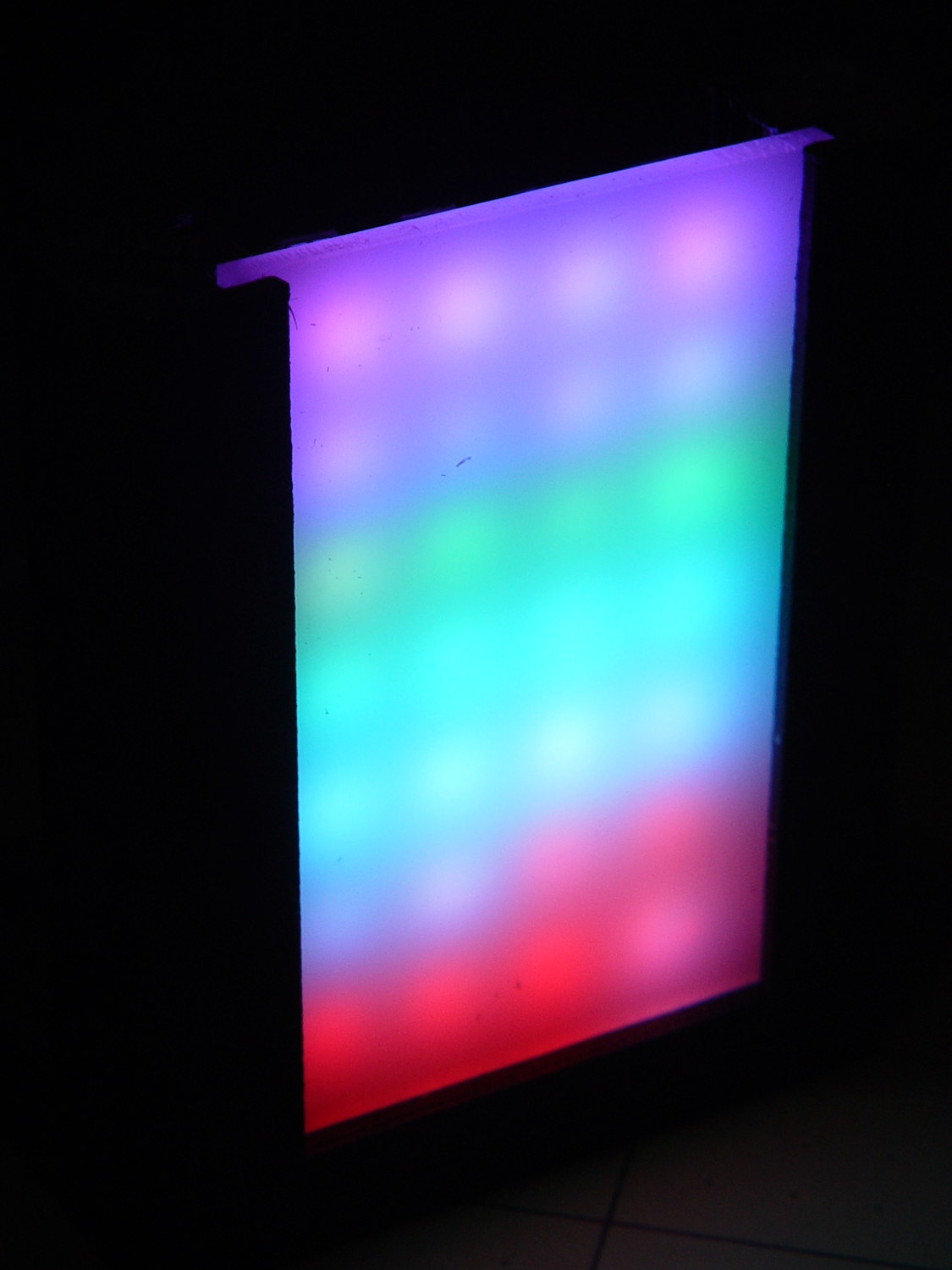
It looks even better without the flash:
WS2812 array test fixture – front dark
You’ll find many easier ways to get RGB LED panels, but that’s not the point here; I’m waiting for these things to die an unnatural death.
This file contains hidden or bidirectional Unicode text that may be interpreted or compiled differently than what appears below. To review, open the file in an editor that reveals hidden Unicode characters.
Learn more about bidirectional Unicode characters
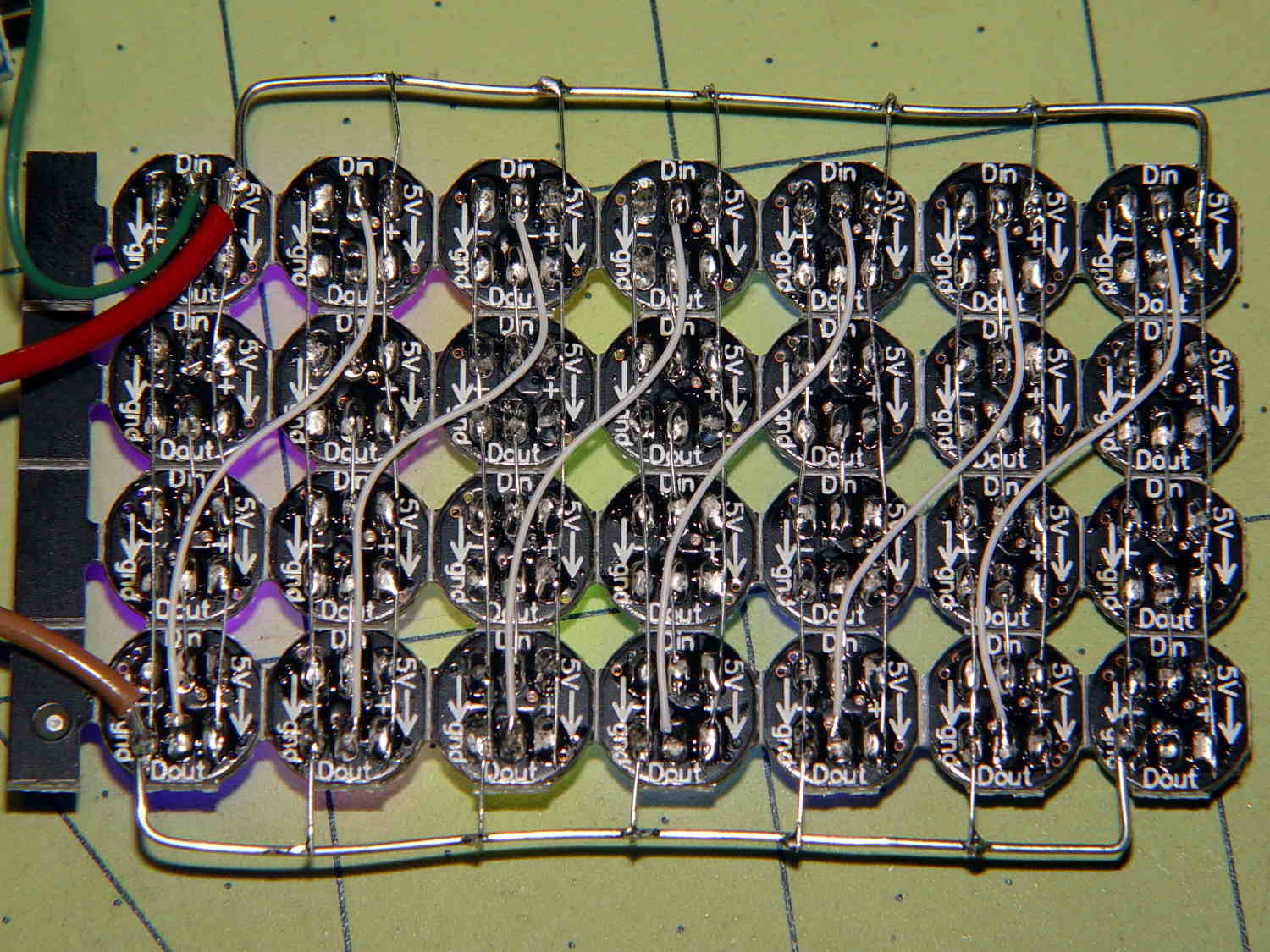
Given that I no longer trust any of the knockoff Neopixels, I wired the remaining PCB panel into a single hellish test fixture:
WS2812 4×7 LED test fixture – wiring
The 22 AWG wires deliver +5 V and Common, with good old-school Wire-Wrap wire passing to the four LEDs betweem them. The data daisy chain snakes through the entire array.
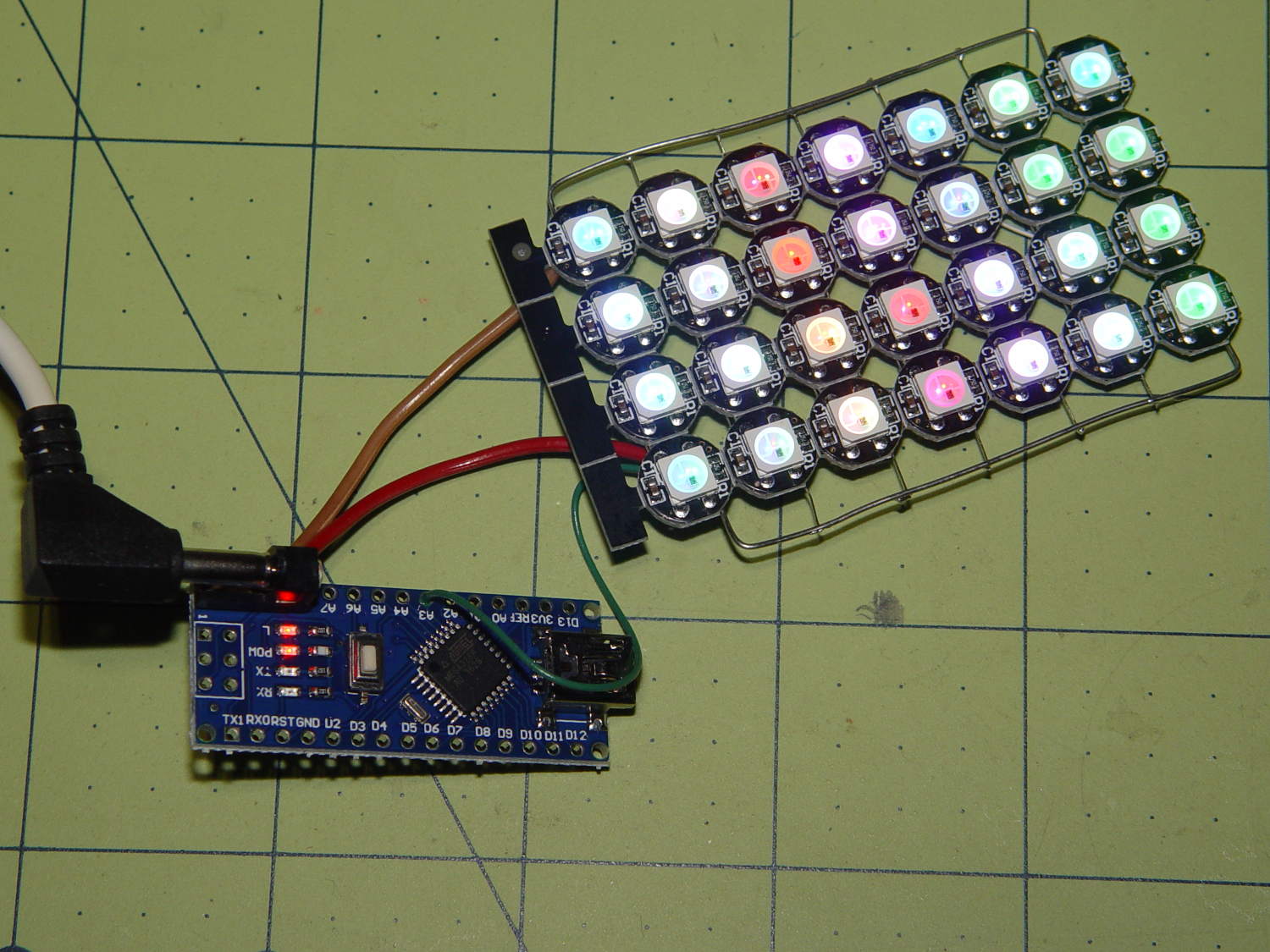
It seems only fitting to use a knockoff Arduino Nano as the controller:
WS2812 4×7 LED test fixture – front
The code descends from an early version of the vacuum tube lights, gutted of all the randomizing and fancy features. It updates the LEDs every 20 ms and, with only 100 points per cycle, the colors tick along fast enough reassure you (well, me) that the thing is doing something: the pattern takes about 20 seconds from one end of the string to the other.
At full throttle the whole array draws 1.68 A = 60 mA × 28 with all LEDs at full white, which happens only during the initial lamp test and browns out the supply (literally: the blue LEDs fade out first and produce an amber glow). The cheap 5 V 500 mA power supply definitely can’t power the entire array at full brightness.
The power supply current waveform looks fairly choppy, with peaks at the 400 Hz PWM frequency:
WS2812 4×7 array – 200 mA VCC
With the Tek current probe set at 200 mA/div, the upper trace shows 290 mA RMS. That’s at MaxPWM = 127, which reduces the average current but doesn’t affect the peaks. At full brightness the average current should be around 600 mA, a tad more than the supply can provide, but maybe it’ll survive; the bottom trace shows a nice average, but the minimum hits 4.6 V during peak current.
Assuming that perversity will be conserved as usual, none of the LEDs will fail for as long as I’m willing to let them cook.
This file contains hidden or bidirectional Unicode text that may be interpreted or compiled differently than what appears below. To review, open the file in an editor that reveals hidden Unicode characters.
Learn more about bidirectional Unicode characters










 The Smell of Molten Projects in the Morning