The Smell of Molten Projects in the Morning

Ed Nisley's Blog: Shop notes, electronics, firmware, machinery, 3D printing, laser cuttery, and curiosities. Contents: 100% human thinking, 0% AI slop.

Author: Ed

  • Monthly Image: Rt 376 Overgrowth Clearing

    Monthly Image: Rt 376 Overgrowth Clearing

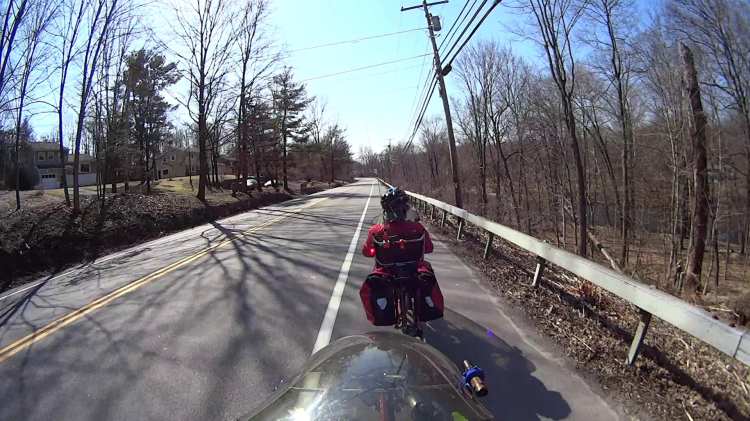
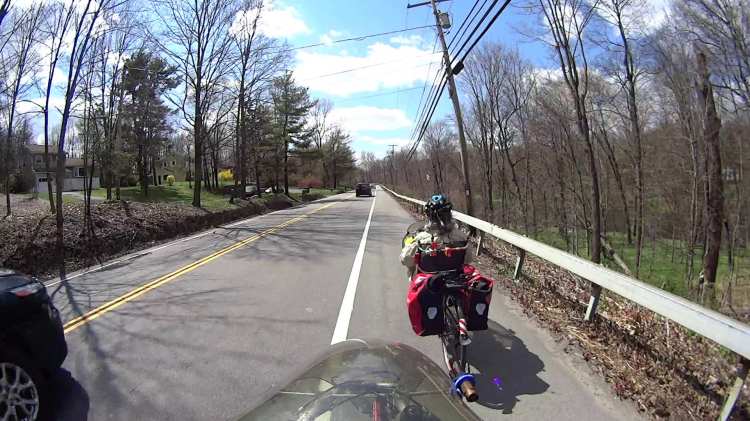
    NYS DOT cleared the Japanese Knotweed from the shoulder along Rt 376 north of Maloney last year:

    The last image in that gallery is from the end of April; you can see the weeds just starting to grow under the guide rail.

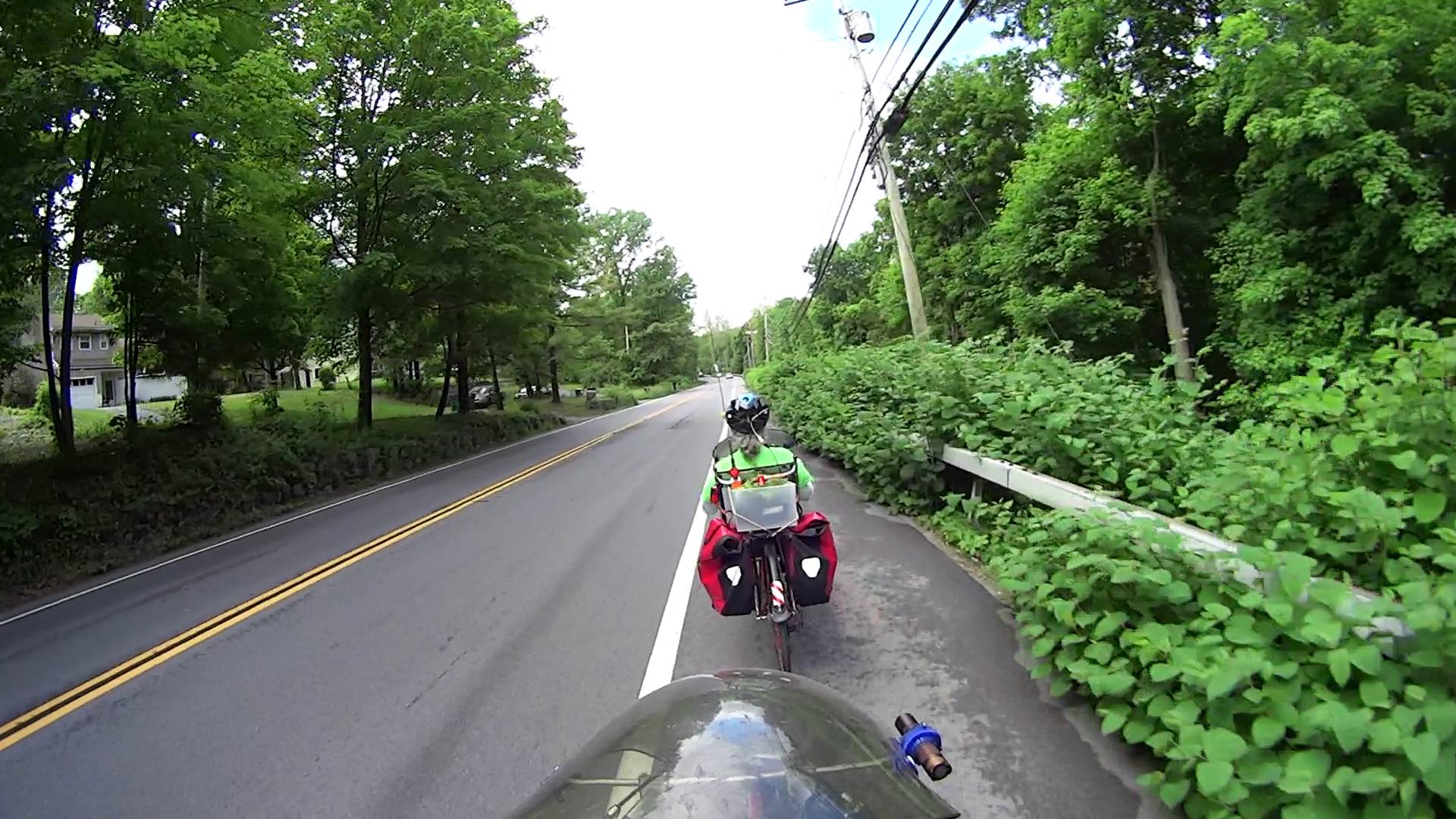
    Japanese Knotweed, being basically a weed on crystal meth, becomes a lush hedge from a standing start in five weeks:

    Knowing how NYS DOT’s Region 8 Dutchess South Residency’s brush trimming has(n’t) worked in previous years, this took us by surprise:

    Rt 376 Marker 1095 - 2020-06-10
    Rt 376 Marker 1095 – 2020-06-10

    Because chopping Japanese Knotweed to the ground doesn’t actually discourage it, we hope they’re scheduled to return every couple of months …

  • Robin Nest: Hatching An Egg A Day

    Robin Nest: Hatching An Egg A Day

    The robin nesting atop the garage door spotlights keeps a careful watch over her surroundings:

    Garage Robin - standing guard
    Garage Robin – standing guard

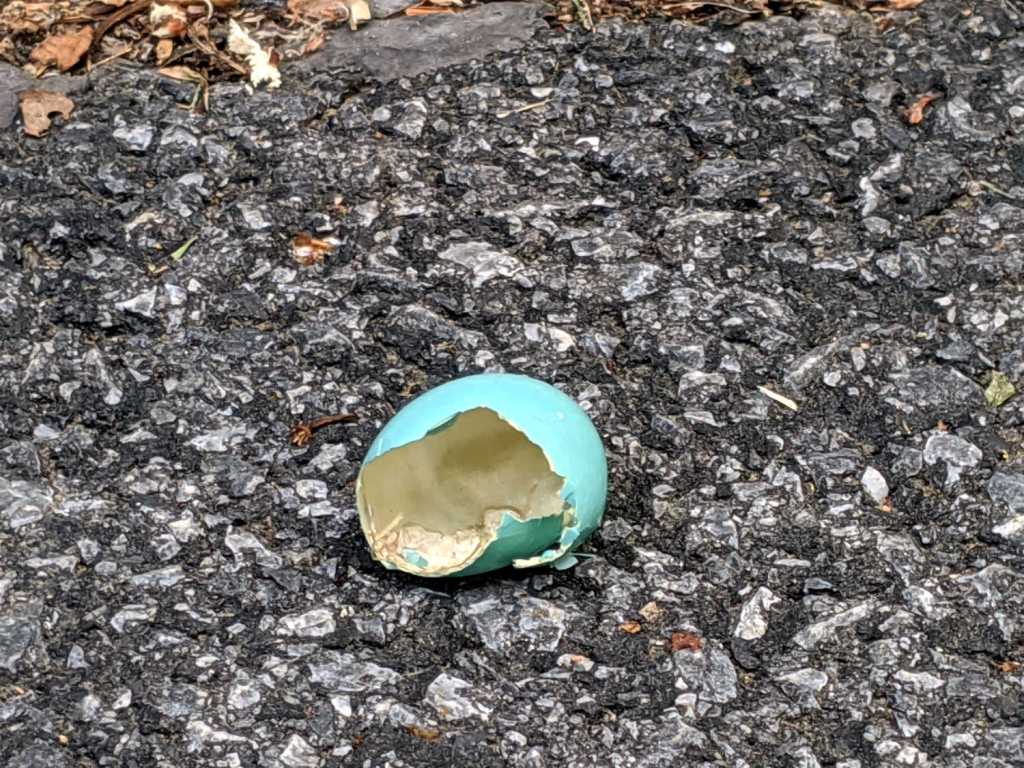
    Based on past experience, we though a blue jay had discovered the nest when we found this in front of the garage door:

    Garage Robin - plundered eggshell
    Garage Robin – plundered eggshell

    A day later, a quick peek when she was off the nest told a different story:

    Garage Robin - 2 hatchlings
    Garage Robin – 2 hatchlings

    As with humans, only parents can love things like that …

    Another pair of robins built a more conventional nest in a small front-yard tree, although they seemed content to start brooding atop only two eggs.

    We wish both families well, along with the wrens nesting in the front bird box.

    Go, birds, go!

  • Stonework FAIL

    Stonework FAIL

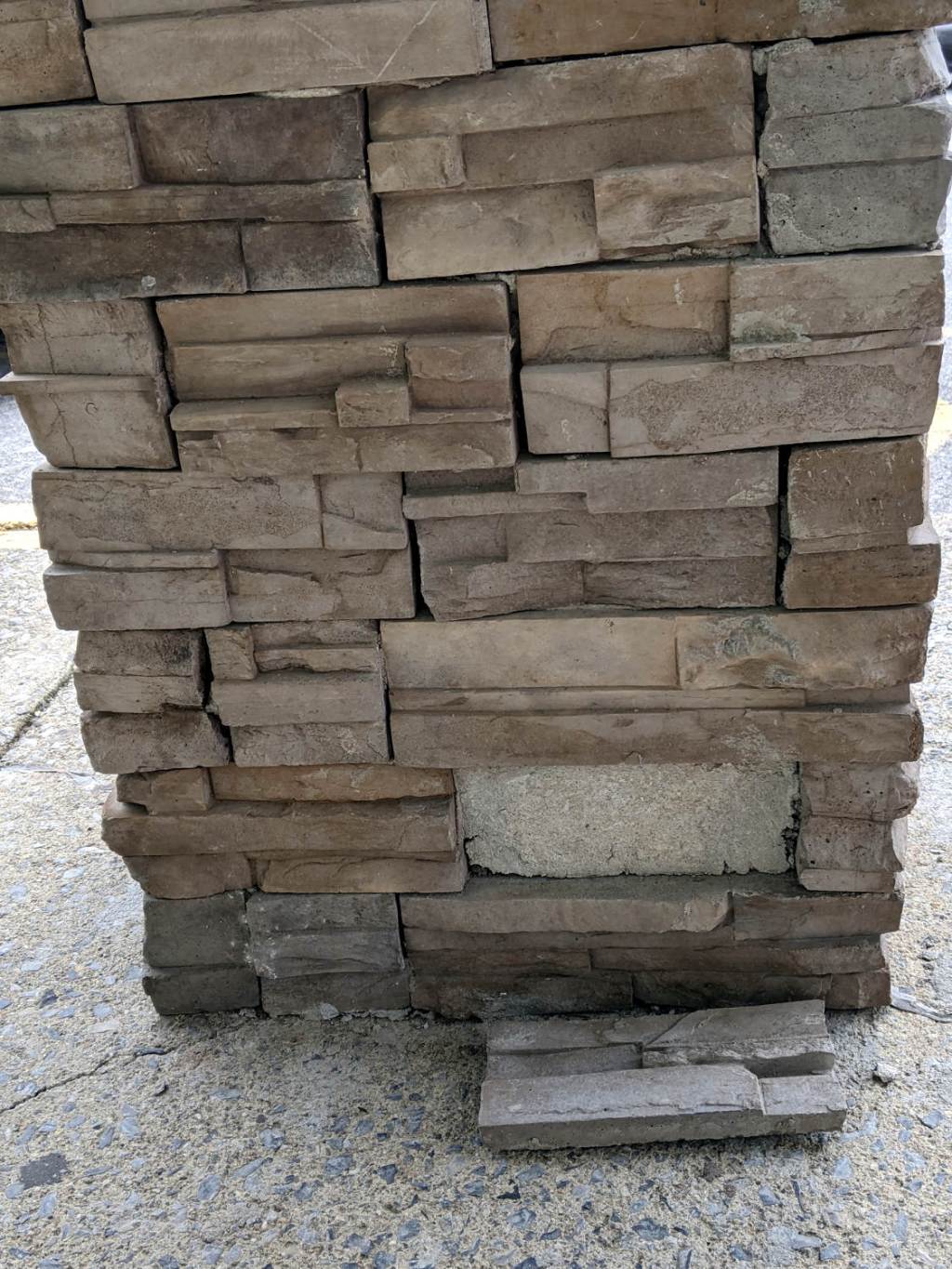
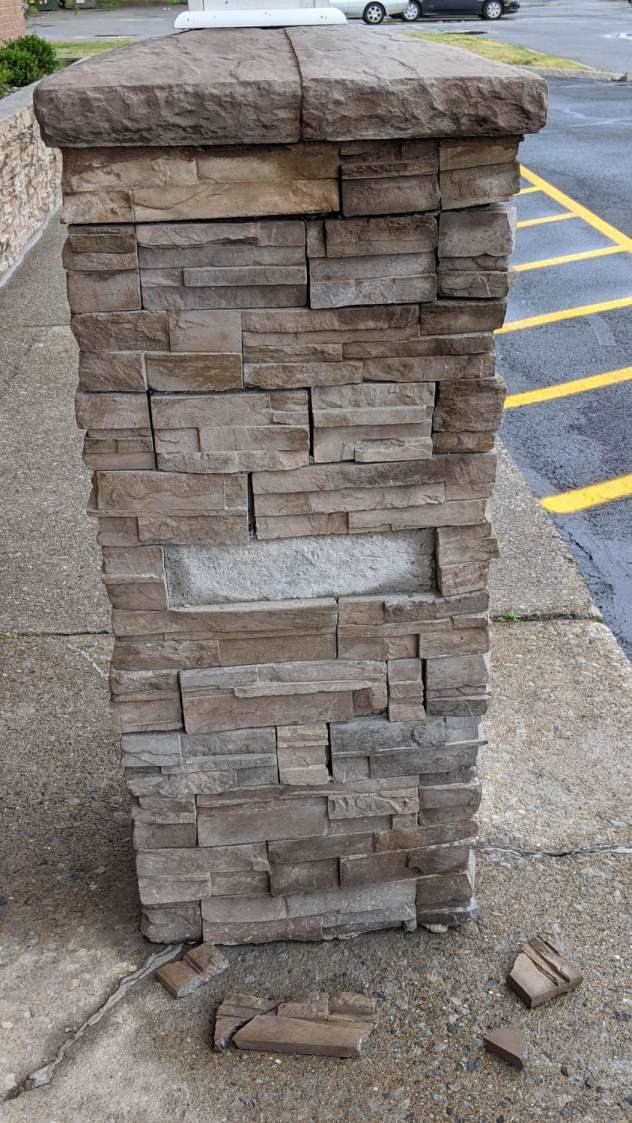
    The strip mall down the road recently sprouted ersatz stone pillars around the steel posts holding up the roof:

    Ersatz stone pillar failure
    Ersatz stone pillar failure

    Six days later, more slabs have fallen off the first pillar in the row:

    Ersatz stone pillar - failure 2
    Ersatz stone pillar – failure 2

    And the second pillar:

    Ersatz stone pillar - failure 3
    Ersatz stone pillar – failure 3

    Those fancy(-ish) bases consist of a wood frame covered with a mortar layer holding tiles of imitation stonework. From what little I know of stonework, mortar works only in compression, so you can’t glue tiles onto the side of a concrete lump using mortar.

    Epoxy, maybe. Silicone snot, probably. Mortar, nope.

    This happened barely weeks after the project’s completion, so I foresee poor ROI for the mall owner and plenty of warranty work for the contractor.

  • Solid Modeling: Support Puzzle

    Solid Modeling: Support Puzzle

    I’ve been putting this type of support structure inside screw holes & suchlike for years:

    Browning Hi-Power Magazine Block - solid model - Generic 1 - support detail
    Browning Hi-Power Magazine Block – solid model – Generic 1 – support detail

    It’s basically a group of small rectangles rotated around the hole’s axis and about one thread thickness shorter than the overhanging interior.

    I’ve found that incorporating exactly the right support structure eliminates Slic3r’s weird growths, eases removal, and generally works better all around.

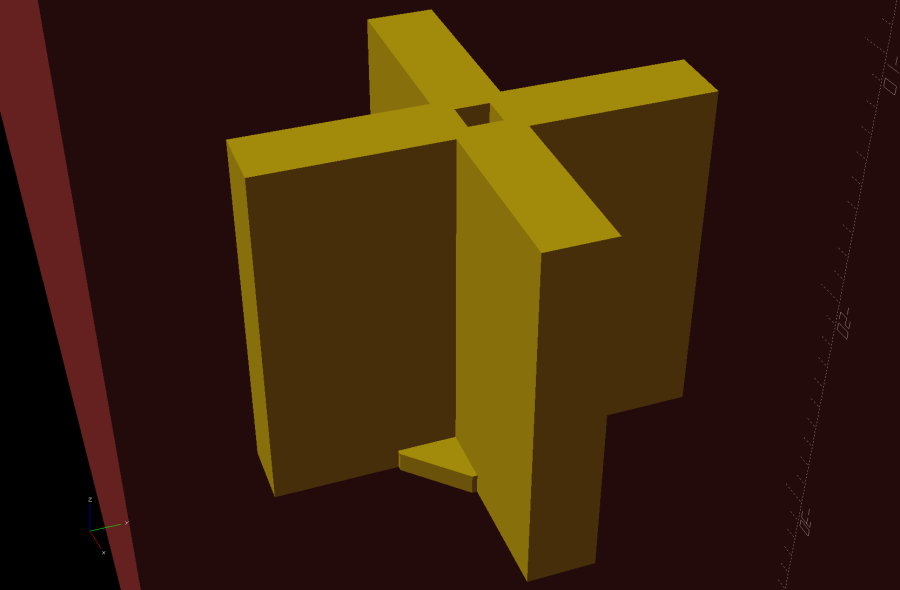
    So doing this for the baseplate of the Glass Tile frame came naturally:

    Glass Tile Frame - octagonal support
    Glass Tile Frame – octagonal support

    This OpenSCAD snippet plunks one of those asterisks in each of four screw holes:

      if (Support)
        color("Yellow")
          for (i=[-1,1], j=[-1,1])
            translate([i*InsertOC.x/2,j*InsertOC.y/2,0])
              for (a=[0:45:135])
                  rotate(a)
                    translate([0,0,(Screw[LENGTH] - ThreadThick)/2])
                      cube([Screw[OD] - 2*ThreadWidth,2*ThreadWidth,Screw[LENGTH] - ThreadThick],center=true);

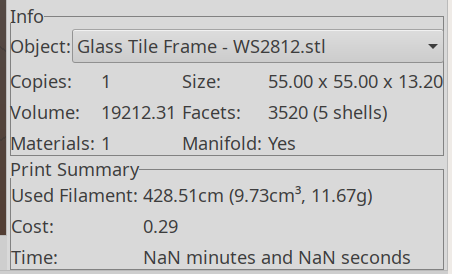
    The “cubes” overlap in the middle, with no completely coincident faces or common edges, so it’s 2-manifold. Slic3r, however, produces a weird time estimate whenever the model includes those structures:

    Slic3r - NaN time estimate
    Slic3r – NaN time estimate

    NaN stands for Not A Number and means something horrible has happened in the G-Code generation. Fortunately, the G-Code worked perfectly and produced the desired result, but I’m always uneasy when Something Seems Wrong.

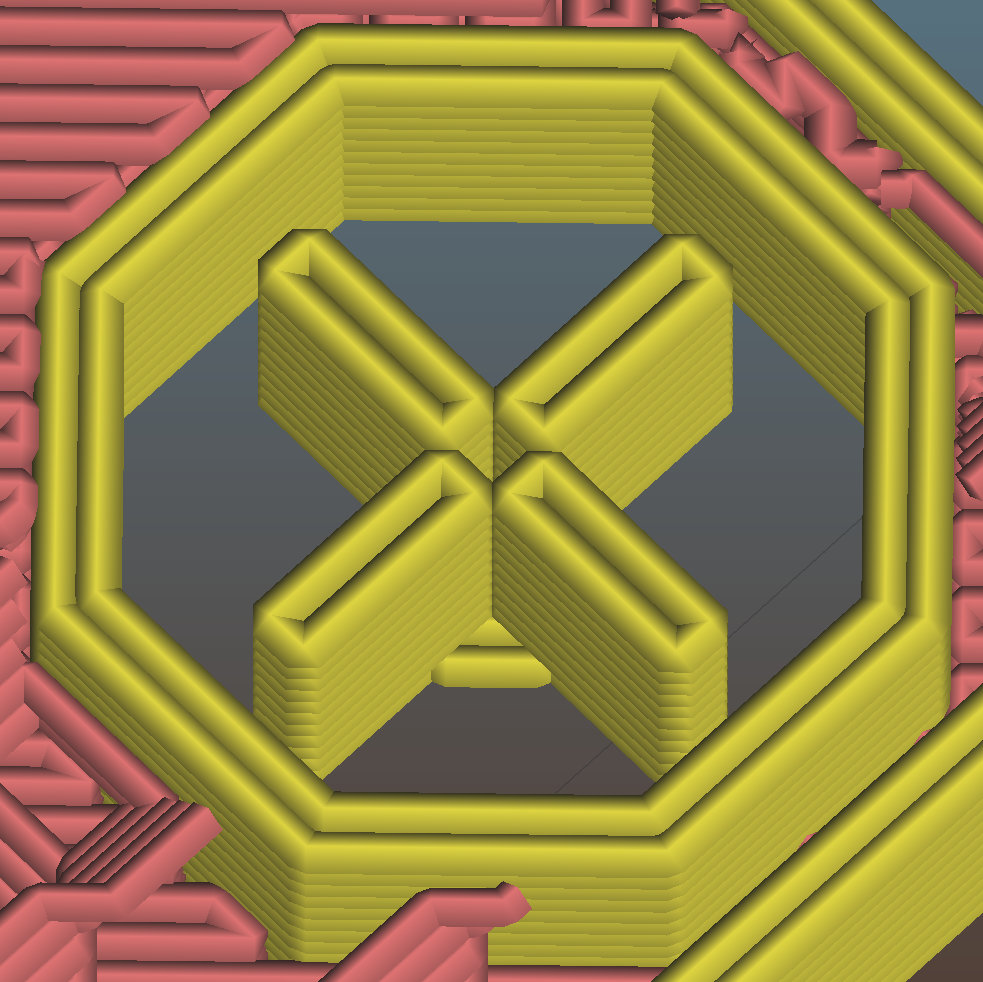
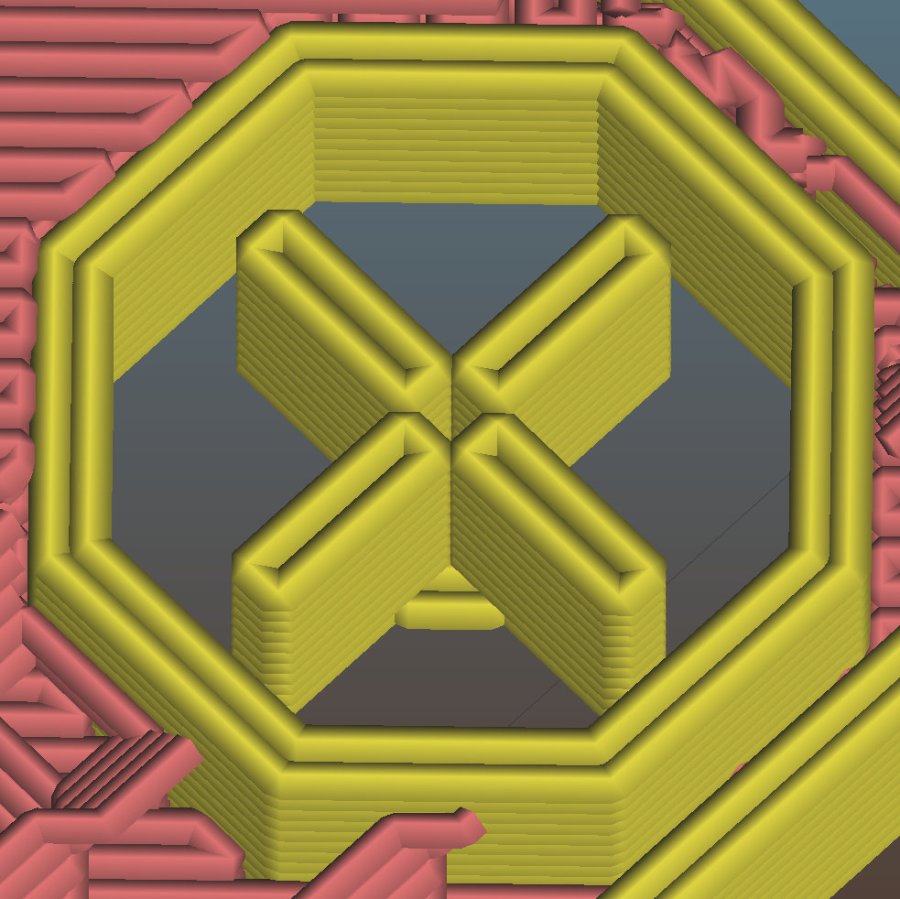
    Messing around with the code produced a slightly different support structure:

    Glass Tile Frame - quad support
    Glass Tile Frame – quad support

    The one thread thick square on the bottom helps glue the structure to the platform and four ribs work just as well as eight in the octagonal hole:

      Fin = [Screw[OD]/2 - 1.5*ThreadWidth,2*ThreadWidth,ScrewRecess - ThreadThick];
      if (Inserts && SupportInserts)
        color("Yellow")
          for (i=[-1,1], j=[-1,1])
            translate([i*InsertOC.x/2,j*InsertOC.y/2,0]) {
              rotate(180/8)
                cylinder(d=6*ThreadWidth,h=ThreadThick,$fn=8);
              for (a=[0:90:360])
                  rotate(a)
                    translate([Fin.x/2 + ThreadWidth/2,0,(ScrewRecess - ThreadThick)/2])
                      cube(Fin,center=true);
            }

    Which changed the NaN time estimates into actual numbers.

    One key difference may be the small hole in the middle. The four ribs (not two!) now overlap by one thread width around the hole, so they’re not quite coincident and Slic3r produces a tidy model:

    Glass Tile Frame - quad support - Slic3r
    Glass Tile Frame – quad support – Slic3r

    The hole eliminates a smear of infill from the center, which may have something to do with the improvement.

    In any event, I have an improved copypasta recipe for the next screw holes in need of support, even if I don’t understand why it’s better.

  • Glass Tiles: Matrix for SK6812 PCBs

    Glass Tiles: Matrix for SK6812 PCBs

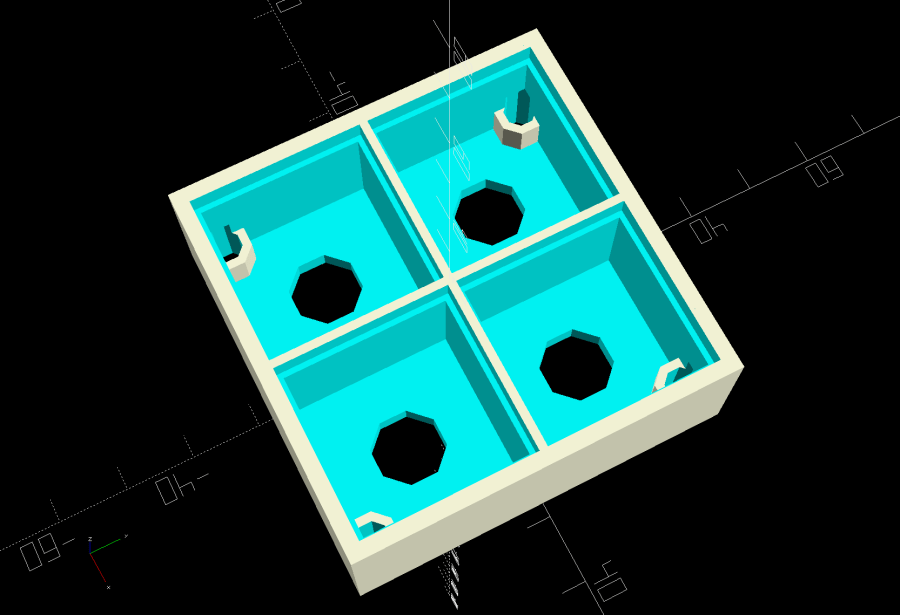
    Tweaking the glass tile frame for press-fit SK6812 PCBs in the bottom of the array cells:

    Glass Tile Frame - cell array - openscad
    Glass Tile Frame – cell array – openscad

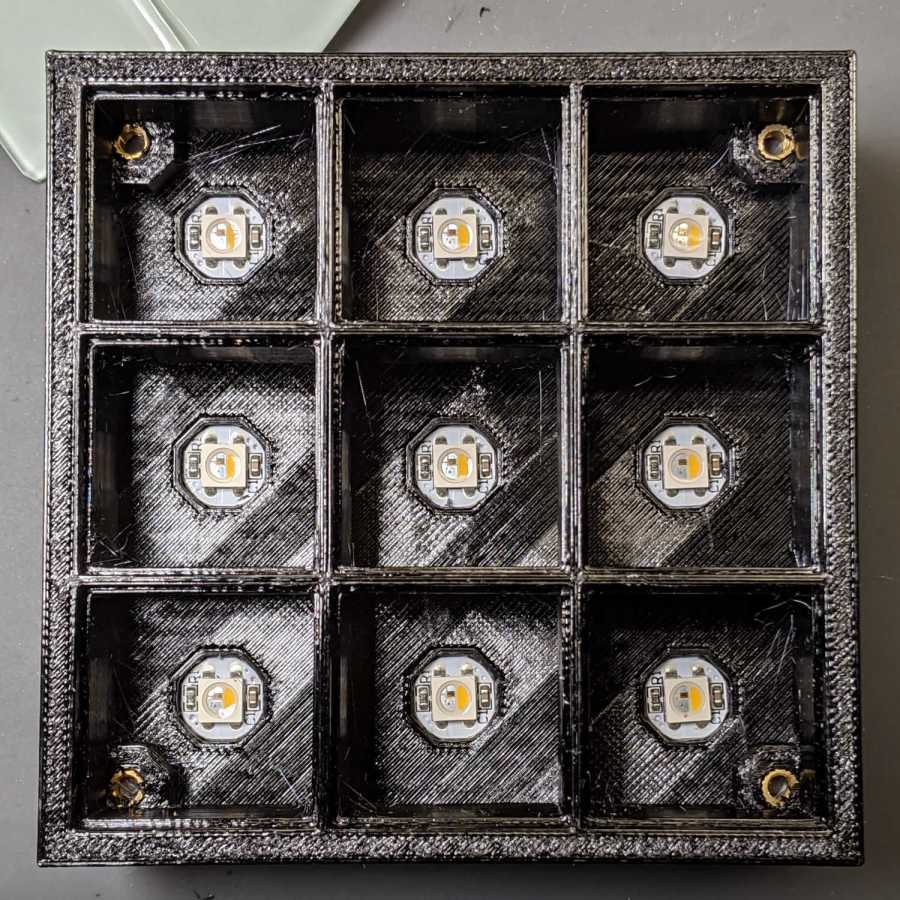
    Which looks like this with the LEDs and brass inserts installed:

    Glass Tile - 2x2 array - interior
    Glass Tile – 2×2 array – interior

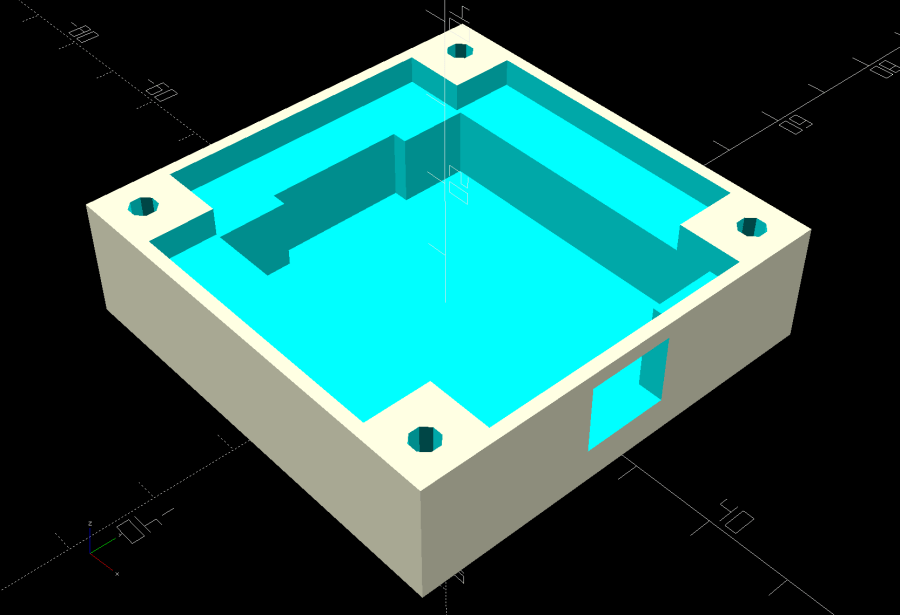
    The base holds an Arduino Nano with room for wiring under the cell array:

    Glass Tile Frame - base - openscad
    Glass Tile Frame – base – openscad

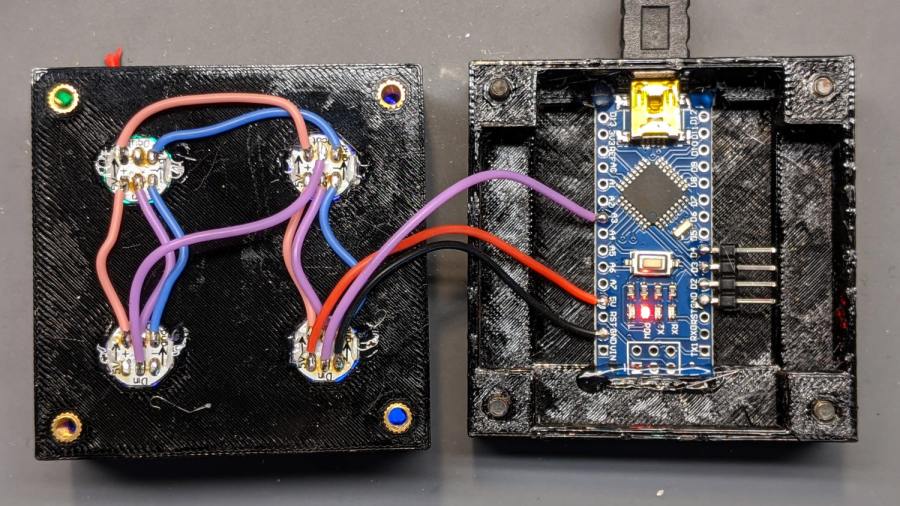
    Which looks like this after it’s all wired up:

    Glass Tile - 2x2 array - wiring
    Glass Tile – 2×2 array – wiring

    The weird colors showing through the inserts are from the LEDs. The red thing in the upper left is a silicone insulation snippet. Yes, that’s hot-melt glue holding the Arduino Nano in place and preventing the PCBs from getting frisky.

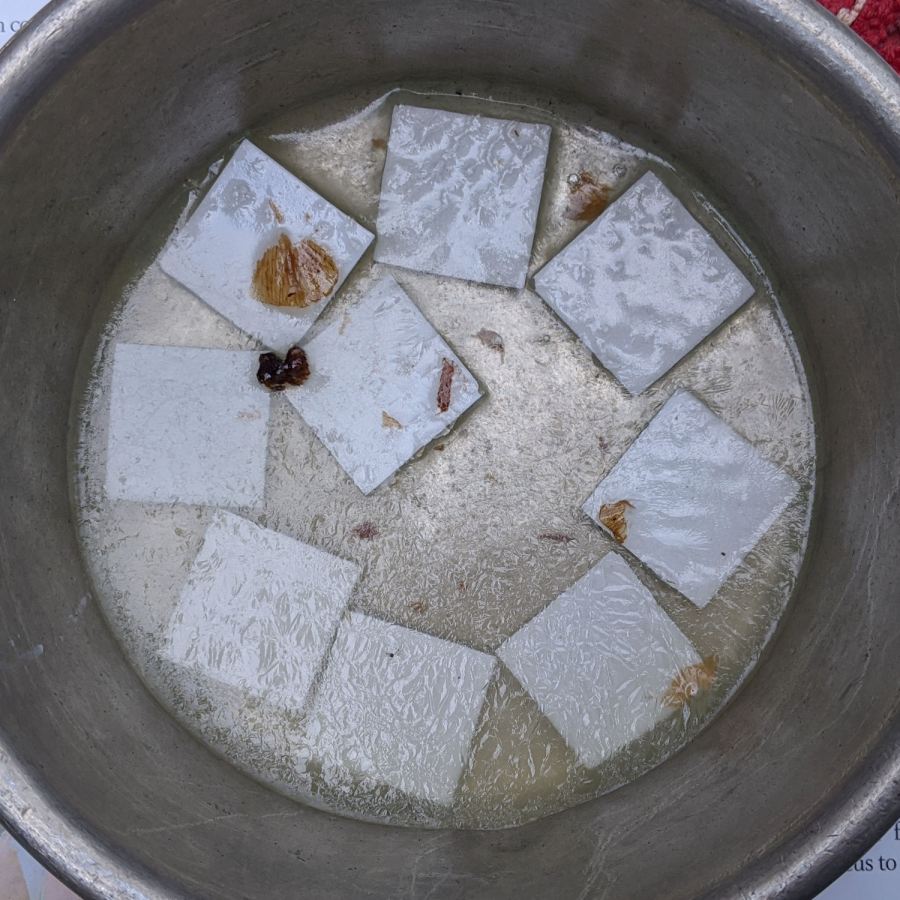
    Soak a handful of glass tiles overnight in paint stripper:

    Glass Tiles - paint stripper soak
    Glass Tiles – paint stripper soak

    Whereupon the adhesive slides right off with the gentle application of a razor scraper. Rinse carefully, dry thoroughly, and snap into place.

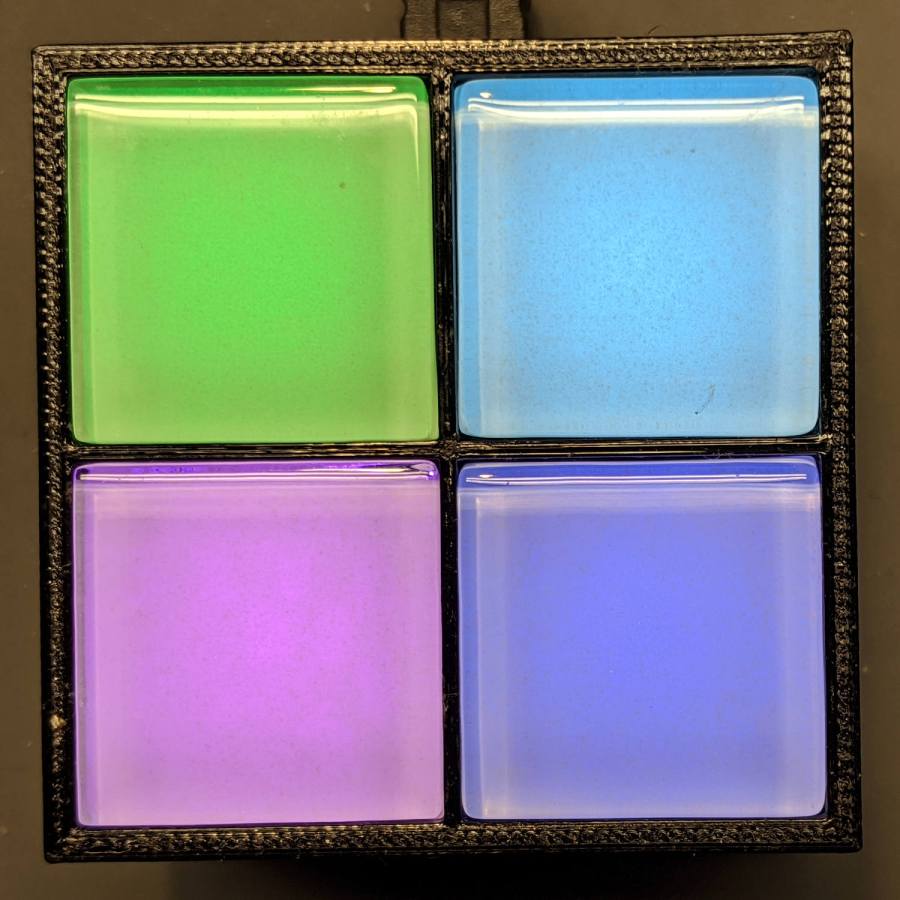
    Tighten the four M3 SHCS and it’s all good:

    Glass Tile - 2x2 array - operating
    Glass Tile – 2×2 array – operating

    So far, I’ve had two people tell me they don’t know what it is, but they want one:

    Glass Tile - various versions
    Glass Tile – various versions

    The OpenSCAD Customizer lets you set the array size:

    Glass Tile Frame - 3x3 - press-fit SK6812 LEDs
    Glass Tile Frame – 3×3 – press-fit SK6812 LEDs

    However, just because you can do something doesn’t mean you should:

    Glass Tile Frame - 6x6 cell array - openscad
    Glass Tile Frame – 6×6 cell array – openscad

    Something like this might be interesting:

    Glass Tile Frame - 2x6 cell array - openscad
    Glass Tile Frame – 2×6 cell array – openscad

    In round numbers, printing the frame takes about an hour per cell, so a 2×2 array takes three hours and 3×3 array runs around seven hours. A 6×6 frame is just not happening.

    The OpenSCAD source code as a GitHub Gist:

    // Illuminated Tile Grid
    // Ed Nisley – KE4ZNU
    // 2020-05
    /* [Configuration] */
    Layout = "Build"; // [Cell,CellArray,MCU,Base,Show,Build]
    Shape = "Square"; // [Square, Pyramid, Cone]
    Cells = [2,2];
    CellDepth = 15.0;
    Inserts = true;
    SupportInserts = true;
    /* [Hidden] */
    ThreadThick = 0.25;
    ThreadWidth = 0.40;
    HoleWindage = 0.2;
    function IntegerMultiple(Size,Unit) = Unit * ceil(Size / Unit);
    Protrusion = 0.1; // make holes end cleanly
    ID = 0;
    OD = 1;
    LENGTH = 2;
    Tile = [25.0 + 0.1,25.0 + 0.1,4.0];
    WallThick = 4*ThreadWidth;
    FloorThick = 3.0;
    Flange = [2*ThreadWidth,2*ThreadWidth,0]; // ridge supporting tile
    Separator = [3*ThreadWidth,3*ThreadWidth,Tile.z – 1]; // between tiles
    Screw = [3.0,6.0,3.5]; // M3 SHCS, OD=head, LENGTH=head
    Insert = [3.0,4.2,8.0]; // threaded brass insert
    ScrewRecess = Screw[LENGTH] + 4*ThreadThick;
    LEDPCB = [9.6,9.6,2.9]; // round SK6812, squared-off sides
    LED = [5.0 + 2*HoleWindage,5.0 + 2*HoleWindage,1.3];
    LEDOffset = [0.0,0.0,0.0]; // if offset from PCB center
    CellOAL = [Tile.x,Tile.y,0] + Separator + [0,0,CellDepth] + [0,0,FloorThick];
    ArrayOAL = [Cells.x*CellOAL.x,Cells.y*CellOAL.y,CellOAL.z]; // just the LED cells
    BlockOAL = ArrayOAL + [2*WallThick,2*WallThick,0]; // LED cells + exterior wall
    echo(str("Block OAL: ",BlockOAL));
    InsertOC = ArrayOAL – [Insert[OD],Insert[OD],0] – [WallThick,WallThick,0];
    echo(str("Insert OC: ",InsertOC));
    TapeThick = 1.0;
    Arduino = [44.0,18.0,8.0 + TapeThick]; // Arduino Nano to top of USB Mini-B plug
    USBPlug = [15.0,11.0,9.0]; // USB Mini-B plug insulator
    USBOffset = [0,0,5.0]; // offset from PCB base
    WiringSpace = 3.5;
    WiringBay = [(Cells.x – 1)*CellOAL.x + LEDPCB.x,(Cells.y – 1)*CellOAL.y + LEDPCB.x,WiringSpace];
    PlateOAL = [BlockOAL.x,BlockOAL.y,FloorThick + Arduino.z + WiringSpace]; // allow wiring above Arduino
    echo(str("Base Plate: ",PlateOAL));
    echo(str("Screw length: ",(PlateOAL.z – ScrewRecess) + Insert.z/2," to ",(PlateOAL.z – ScrewRecess) + Insert.z));
    LegendRecess = 1*ThreadThick;
    //————————
    module PolyCyl(Dia,Height,ForceSides=0) { // based on nophead's polyholes
    Sides = (ForceSides != 0) ? ForceSides : (ceil(Dia) + 2);
    FixDia = Dia / cos(180/Sides);
    cylinder(d=(FixDia + HoleWindage),h=Height,$fn=Sides);
    }
    //———————–
    // Base and optics in single tile
    module LEDCone() {
    hull() {
    translate([0,0,CellDepth + Tile.z/2])
    cube(Tile – 2*[Flange.x,Flange.y,0],center=true);
    if (Shape == "Square") {
    translate([0,0,LEDPCB.z/2])
    cube([Tile.x,Tile.y,LEDPCB.z] – 2*[Flange.x,Flange.y,0],center=true);
    }
    else if (Shape == "Pyramid") {
    translate([0,0,LEDPCB.z/2])
    cube(LEDPCB,center=true);
    }
    else if (Shape == "Cone") {
    translate([0,0,LEDPCB.z/2])
    cylinder(d=1.0*LEDPCB.x,h=LED.z,center=true);
    }
    else {
    echo(str("Whoopsie! Invalid Shape: ",Shape));
    cube(5);
    }
    }
    }
    // One complete LED cell
    module LEDCell() {
    difference() {
    translate([0,0,CellOAL.z/2])
    cube(CellOAL + [Protrusion,Protrusion,0],center=true); // force overlapping adjacent sides!
    translate([0,0,CellOAL.z – Separator.z + Tile.z/2])
    cube(Tile,center=true);
    translate([0,0,LEDPCB.z])
    LEDCone();
    // cube([LED.x,LED.y,CellOAL.z],center=true);
    translate(-LEDOffset + [0,0,-CellOAL.z/2])
    rotate(180/8)
    PolyCyl(LEDPCB.x,CellOAL.z,8);
    }
    }
    // The whole array of cells
    module CellArray() {
    difference() {
    union() {
    translate([CellOAL.x/2 – Cells.x*CellOAL.x/2,CellOAL.y/2 – Cells.y*CellOAL.y/2,0])
    for (i=[0:Cells.x – 1], j=[0:Cells.y – 1])
    translate([i*CellOAL.x,j*CellOAL.y,0])
    LEDCell();
    if (Inserts) // bosses
    for (i=[-1,1], j=[-1,1])
    translate([i*InsertOC.x/2,j*InsertOC.y/2,0])
    rotate(180/8)
    cylinder(d=Insert[OD] + 2*WallThick,h=Insert[LENGTH],$fn=8);
    }
    if (Inserts) // holes
    for (i=[-1,1], j=[-1,1])
    translate([i*InsertOC.x/2,j*InsertOC.y/2,-Protrusion])
    rotate(180/8)
    PolyCyl(Insert[OD],Insert[LENGTH] + FloorThick + Protrusion,8);
    }
    difference() {
    translate([0,0,CellOAL.z/2])
    cube(BlockOAL,center=true);
    translate([0,0,CellOAL.z])
    cube(ArrayOAL + [0,0,2*CellOAL.z],center=true);
    }
    }
    // Arduino bounding box
    // Origin at center bottom of PCB
    module Controller() {
    union() {
    translate([0,0,Arduino.z/2])
    cube(Arduino,center=true);
    translate([Arduino.x/2 – Protrusion,-USBPlug.y/2,USBOffset.z + TapeThick – USBPlug.z/2])
    cube(USBPlug + [Protrusion,0,0],center=false);
    }
    }
    // Baseplate
    module BasePlate() {
    difference() {
    translate([0,0,PlateOAL.z/2])
    cube(PlateOAL,center=true);
    translate([PlateOAL.x/2 – Arduino.x/2 – 2*WallThick,0,FloorThick])
    Controller();
    translate([PlateOAL.x/2 – Arduino.x/2 – 2*WallThick,0,FloorThick + PlateOAL.z/2])
    cube([Arduino.x – 2*2.0,WiringBay.y,PlateOAL.z],center=true); // cutouts beside MCU
    translate([0,0,PlateOAL.z – WiringBay.z + PlateOAL.z/2 – Protrusion])
    cube([PlateOAL.x – 2*WallThick,WiringBay.y,PlateOAL.z],center=true); // cutout above MCU
    translate([0,0,PlateOAL.z – WiringBay.z + PlateOAL.z/2 – Protrusion])
    cube([WiringBay.x,PlateOAL.y – 2*WallThick,PlateOAL.z],center=true); // cutout above MCU
    if (Inserts)
    for (i=[-1,1], j=[-1,1])
    translate([i*InsertOC.x/2,j*InsertOC.y/2,-Protrusion])
    rotate(180/8) {
    PolyCyl(Screw[ID],2*PlateOAL.z,8);
    PolyCyl(Screw[OD],ScrewRecess + Protrusion,8);
    }
    cube([45,17.0,2*LegendRecess],center=true);
    }
    linear_extrude(height=2*LegendRecess) {
    translate([0,1])
    rotate(-0*90) mirror([1,0,0])
    text(text="Ed Nisley",size=6,font="Arial:style:Bold",halign="center");
    translate([0,-6.5])
    rotate(-0*90) mirror([1,0,0])
    text(text="softsolder.com",size=4.5,font="Arial:style:Bold",halign="center");
    }
    Fin = [Screw[OD]/2 – 1.5*ThreadWidth,2*ThreadWidth,ScrewRecess – ThreadThick];
    if (Inserts && SupportInserts)
    color("Yellow")
    for (i=[-1,1], j=[-1,1])
    translate([i*InsertOC.x/2,j*InsertOC.y/2,0]) {
    rotate(180/8)
    cylinder(d=6*ThreadWidth,h=ThreadThick,$fn=8);
    for (a=[0:90:360])
    rotate(a)
    translate([Fin.x/2 + ThreadWidth/2,0,(ScrewRecess – ThreadThick)/2])
    cube(Fin,center=true);
    }
    }
    //———————–
    // Build things
    if (Layout == "Cell")
    LEDCell();
    else if (Layout == "CellArray")
    CellArray();
    else if (Layout == "MCU")
    Controller();
    else if (Layout == "Base")
    BasePlate();
    else if (Layout == "Show") {
    translate([0,0,3*PlateOAL.z])
    CellArray();
    BasePlate();
    translate([PlateOAL.x/2 – Arduino.x/2 – 2*WallThick,0,FloorThick])
    color("Orange",0.3)
    Controller();
    }
    else if (Layout == "Build") union() {
    translate([0,0.6*BlockOAL.y,0])
    CellArray();
    translate([0,-0.6*BlockOAL.x,0])
    rotate(90)
    BasePlate();
    }

  • Glass Tiles: Glow vs. Flash Firmware

    Glass Tiles: Glow vs. Flash Firmware

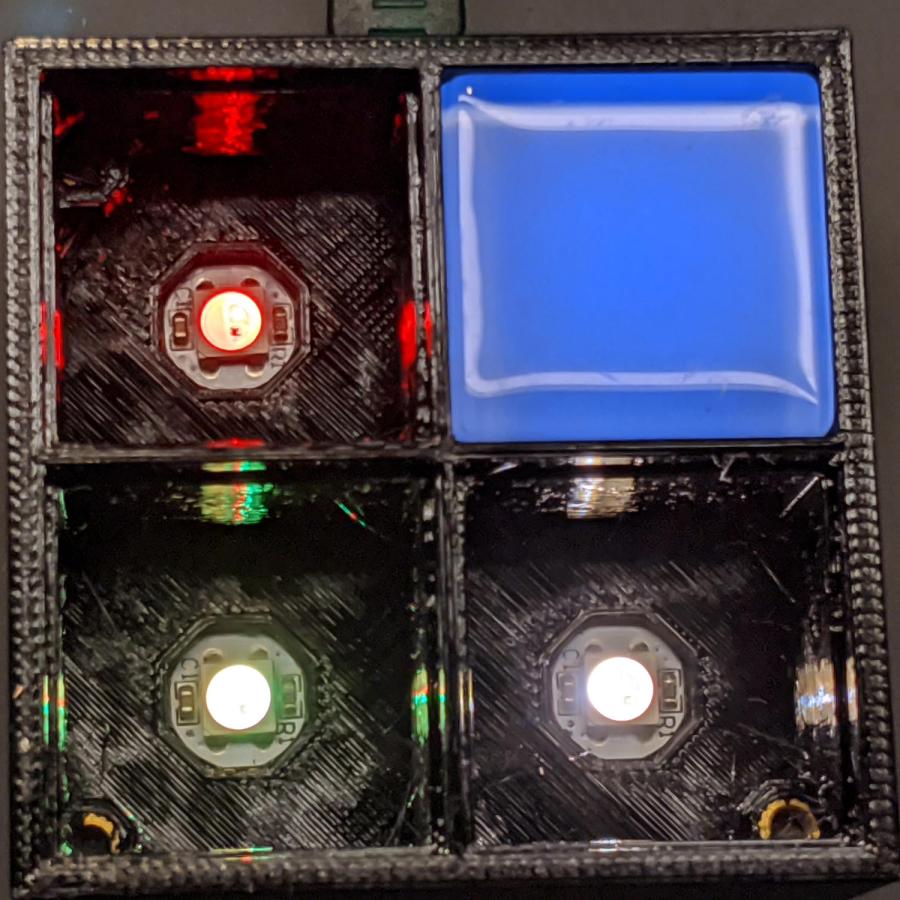
    Although it’s not obvious in a still picture, the firmware now supports both the continuously changing colors of the Nissan fog lamp (mashed with tweaks from the vacuum tube lights) and the randomly changing colors from the LED matrix, both using SK6812 LEDs rather than the failing WS2812 modules:

    Glass Tile - glow vs flash
    Glass Tile – glow vs flash

    Flash is a misnomer, as the tiles simply change from one color to the next, but I’ve never been adept at picking catchy names. In any event, the glass tiles on the left show nice pastel shades, in contrast to the bright primary(-ish) colors appearing on the right.

    The colors are random numbers from 1 to 7, because 0 produces a somewhat ugly dark cell. The SK6812 modules have a white LED in addition to the RGB LEDs in the WS2812 modules, so I replace the “additive white” R+G+B color with the more-or-less true white (warm, for these modules) LED.

    The new color goes into a cell picked at random (0 through 3, for 2×2 frames), except if the cell already holds the same color, whereupon a simple XOR flips the colors, except if the cell is already full-on white, whereupon it becomes half-on white to avoid going completely dark.

    The glass tiles must change colors at a much slower pace than the 8×8 LED matrix, because there are so few cells; a random delay between 500 ms and 6 s seems about right.

    They look really great in a dim room!

    The Arduino source code as a GitHub Gist:

    // Neopixel lighting for glass tiles
    // Ed Nisley – KE4ANU – May 2020
    #include <Adafruit_NeoPixel.h>
    #include <Entropy.h>
    //———-
    // Pin assignments
    const byte PIN_NEO = A3; // DO – data to first Neopixel
    const byte PIN_MODE = 2; // DI – select mode
    const byte PIN_SPEED = 3; // DI – select speed
    const byte PIN_SELECT = 4; // DO – drive adjacent pins low
    const byte PIN_HEARTBEAT = 13; // DO – Arduino LED
    //———-
    // Constants
    // number of pixels
    #define PIXELS 9
    // lag between adjacent pixels in degrees of slowest period
    #define PIXELPHASE 45
    // update LEDs only this many ms apart (minus loop() overhead)
    #define UPDATEINTERVAL 50ul
    // number of steps per cycle, before applying prime factors
    #define RESOLUTION 500
    //———-
    // Globals
    // instantiate the Neopixel buffer array
    Adafruit_NeoPixel strip = Adafruit_NeoPixel(PIXELS, PIN_NEO, NEO_GRBW + NEO_KHZ800);
    struct pixcolor_t {
    unsigned int Prime;
    unsigned int NumSteps;
    unsigned int Step;
    float StepSize;
    float Phase;
    byte MaxPWM;
    };
    unsigned int PlatterSteps;
    byte PrimeList[] = {3,5,7,13,19,29};
    unsigned int MaxTileTime;
    // colors in each LED
    enum pixcolors {RED, GREEN, BLUE, WHITE, PIXELSIZE};
    struct pixcolor_t Pixels[PIXELSIZE]; // all the data for each pixel color intensity
    uint32_t UniColor;
    enum dispmode {GLOW, FLASH}; // based on input pin
    unsigned long UpdateMS;
    unsigned long MillisNow;
    unsigned long MillisThen;
    //– Select three unique primes for the color generator function
    // Then compute all the step parameters based on those values
    void SetColorGenerators(void) {
    Pixels[RED].Prime = PrimeList[random(sizeof(PrimeList))];
    do {
    Pixels[GREEN].Prime = PrimeList[random(sizeof(PrimeList))];
    } while (Pixels[RED].Prime == Pixels[GREEN].Prime);
    do {
    Pixels[BLUE].Prime = PrimeList[random(sizeof(PrimeList))];
    } while (Pixels[BLUE].Prime == Pixels[RED].Prime ||
    Pixels[BLUE].Prime == Pixels[GREEN].Prime);
    do {
    Pixels[WHITE].Prime = PrimeList[random(sizeof(PrimeList))];
    } while (Pixels[WHITE].Prime == Pixels[RED].Prime ||
    Pixels[WHITE].Prime == Pixels[GREEN].Prime ||
    Pixels[WHITE].Prime == Pixels[BLUE].Prime);
    if (!digitalRead(PIN_SPEED)) { // force fast for debugging
    Pixels[RED].Prime = 3;
    Pixels[GREEN].Prime = 5;
    Pixels[BLUE].Prime = 7;
    Pixels[WHITE].Prime = 11;
    }
    printf("Primes: %d %d %d %d\r\n",Pixels[RED].Prime,Pixels[GREEN].Prime,Pixels[BLUE].Prime,Pixels[WHITE].Prime);
    Pixels[RED].MaxPWM = 255;
    Pixels[GREEN].MaxPWM = 255;
    Pixels[BLUE].MaxPWM = 255;
    Pixels[WHITE].MaxPWM = 255;
    unsigned int PhaseSteps = (unsigned int) ((PIXELPHASE / 360.0) *
    RESOLUTION * (unsigned int) max(max(Pixels[RED].Prime,Pixels[GREEN].Prime),Pixels[BLUE].Prime));
    printf("Pixel phase offset: %d deg = %d steps\r\n",(int)PIXELPHASE,PhaseSteps);
    for (byte c=0; c < PIXELSIZE; c++) {
    Pixels[c].NumSteps = RESOLUTION * Pixels[c].Prime; // steps per cycle
    Pixels[c].StepSize = TWO_PI / Pixels[c].NumSteps; // radians per step
    Pixels[c].Step = random(Pixels[c].NumSteps); // current step
    Pixels[c].Phase = PhaseSteps * Pixels[c].StepSize;; // phase in radians for this color
    printf(" c: %d Steps: %5d Init: %5d Phase: %3d deg",c,Pixels[c].NumSteps,Pixels[c].Step,(int)(Pixels[c].Phase * 360.0 / TWO_PI));
    printf(" PWM: %d\r\n",Pixels[c].MaxPWM);
    }
    }
    //– Helper routine for printf()
    int s_putc(char c, FILE *t) {
    Serial.write(c);
    }
    //——————
    // Set the mood
    void setup() {
    pinMode(PIN_HEARTBEAT,OUTPUT);
    digitalWrite(PIN_HEARTBEAT,LOW); // show we arrived
    pinMode(PIN_MODE,INPUT_PULLUP);
    pinMode(PIN_SPEED,INPUT_PULLUP);
    pinMode(PIN_SELECT,OUTPUT);
    digitalWrite(PIN_SELECT,LOW); // drive adjacent pins
    Serial.begin(57600);
    fdevopen(&s_putc,0); // set up serial output for printf()
    printf("\r\nAlgorithmic Art Light – Glass Tiles\r\nEd Nisley – KE4ZNU – May 2020\r\n");
    printf("Display mode: %s\r\n",digitalRead(PIN_MODE) == GLOW ? "Glow" : "Flash");
    printf("Speed: %s\r\n",digitalRead(PIN_SPEED) ? "Normal" : "Override");
    Entropy.initialize(); // start up entropy collector
    // set up pixels
    strip.begin();
    strip.show();
    // lamp test
    printf("Lamp test: flash full-on colors\r\n");
    uint32_t FullRGBW = strip.Color(255,255,255,255);
    uint32_t FullRGB = strip.Color(255,255,255,0);
    uint32_t FullR = strip.Color(255,0,0,0);
    uint32_t FullG = strip.Color(0,255,0,0);
    uint32_t FullB = strip.Color(0,0,255,0);
    uint32_t FullW = strip.Color(0,0,0,255);
    uint32_t FullOff = strip.Color(0,0,0,0);
    uint32_t TestColors[] = {FullR,FullG,FullB,FullRGB,FullW,FullRGBW,FullOff};
    for (byte i=0; i < sizeof(TestColors)/sizeof(uint32_t) ; i++) {
    printf(" color: %08lx\r\n",TestColors[i]);
    for (int j=0; j < strip.numPixels(); j++) {
    strip.setPixelColor(j,TestColors[i]);
    }
    strip.show();
    delay(1000);
    }
    // while (1) {continue;}; // all LEDs constant for burn-in testing
    // get an actual random number
    uint32_t rn = Entropy.random();
    printf("Random seed: %08lx\r\n",rn);
    randomSeed(rn);
    // set up the color generators
    SetColorGenerators();
    MaxTileTime = (digitalRead(PIN_SPEED) ? 6 : 1) * (1000.0 / UPDATEINTERVAL);
    UpdateMS = UPDATEINTERVAL;
    MillisNow = MillisThen = millis();
    }
    //——————
    // Run the mood
    void loop() {
    MillisNow = millis();
    if ((MillisNow – MillisThen) >= UpdateMS) { // time for color change?
    digitalWrite(PIN_HEARTBEAT,HIGH);
    if (digitalRead(PIN_MODE) == GLOW) {
    boolean CycleRun = false; // check to see if all cycles have ended
    for (byte c=0; c < PIXELSIZE; c++) { // compute next increment for each color
    if (++Pixels[c].Step >= Pixels[c].NumSteps) {
    Pixels[c].Step = 0;
    printf("Cycle %5d steps %5d at %8ld delta %8ld ms\r\n",c,Pixels[c].NumSteps,MillisNow,(MillisNow – MillisThen));
    }
    else {
    CycleRun = true; // this color is still cycling
    }
    }
    if (!CycleRun) {
    printf("All cycles ended: setting new color generator values\r\n");
    SetColorGenerators();
    }
    for (int i=0; i < strip.numPixels(); i++) { // for each pixel
    byte Value[PIXELSIZE];
    for (byte c=0; c < PIXELSIZE; c++) { // … for each color
    Value[c] = (Pixels[c].MaxPWM / 2.0) * (1.0 + sin(Pixels[c].Step * Pixels[c].StepSize – i*Pixels[c].Phase));
    }
    byte WhiteBias = min(min(Value[RED],Value[GREEN]),Value[BLUE]); // hack to reduce power
    UniColor = strip.Color((Value[RED] – WhiteBias) * Pixels[RED].MaxPWM/255,
    (Value[GREEN] – WhiteBias) * Pixels[GREEN].MaxPWM/255,
    (Value[BLUE] – WhiteBias) * Pixels[BLUE].MaxPWM/255,
    WhiteBias * Pixels[WHITE].MaxPWM/255);
    strip.setPixelColor(i,UniColor);
    }
    }
    else {
    byte c = random(1,8); // exclude 0 = all off, to avoid darkness
    printf("Color %d ",c);
    byte r = c & 0x04 ? 0xff : 0;
    byte g = c & 0x02 ? 0xff : 0;
    byte b = c & 0x01 ? 0xff : 0;
    byte w = 0;
    if (c == 7) { // use white LED instead of R+G+B
    r = g = b = 0;
    w = 0xff;
    }
    UniColor = strip.Color(r, g, b, w);
    byte i = random(strip.numPixels());
    printf("at %d ",i);
    if (UniColor == strip.getPixelColor(i)) { // flip color
    printf("^ ");
    if (w) { // white becomes dim
    w = 0x7f;
    UniColor = strip.Color(r, g, b, w);
    }
    else
    UniColor ^= 0xffffff00l; // other colors flip
    }
    else {
    printf(" ");
    }
    strip.setPixelColor(i,UniColor);
    UpdateMS = random(10,MaxTileTime) * UPDATEINTERVAL; // pick time for next update
    printf("delay: %6ld ms\r\n",UpdateMS);
    }
    strip.show(); // send out precomputed colors
    MillisThen = MillisNow;
    digitalWrite(PIN_HEARTBEAT,LOW);
    }
    }
    view raw GlassTiles.ino hosted with ❤ by GitHub

  • No-Knead Bread

    No-Knead Bread

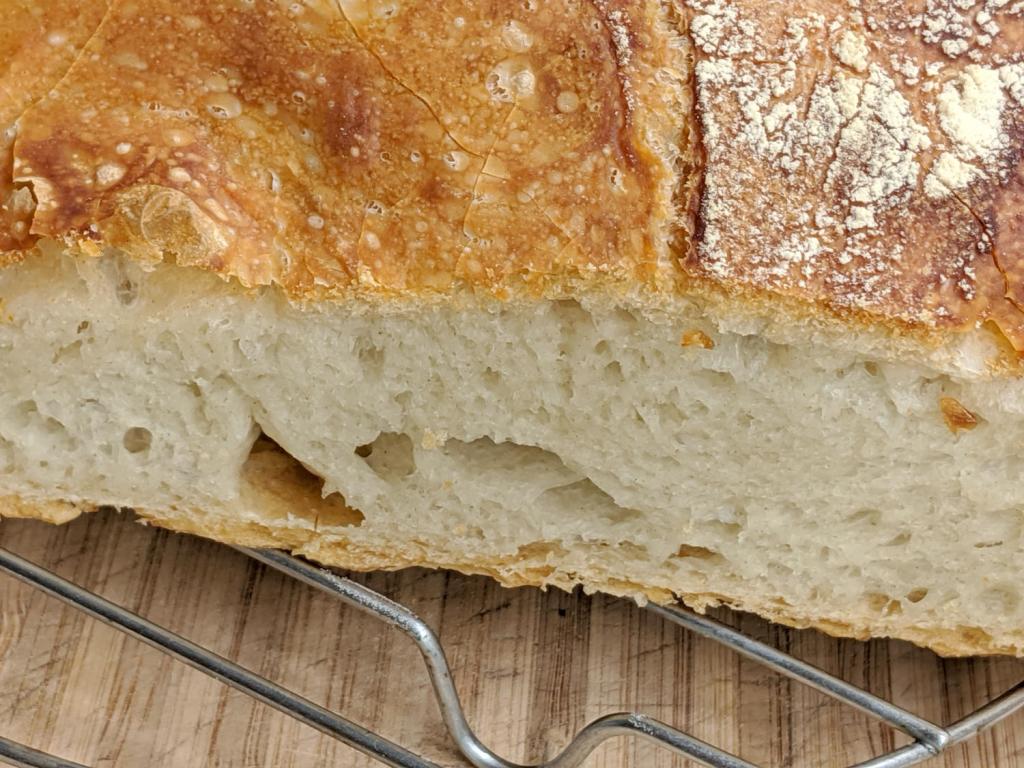
    Although it’s not particularly keto-friendly, I made a loaf of NY Times No-Knead Bread (fine-tuned versions):

    No-knead bread - loaf
    No-knead bread – loaf

    Wow, that tasted good and definitely added a bit more pep to my morning bike rides!

    The receipe produces a rather wet lump of dough in the mixing bowl:

    No-knead bread - mixed
    No-knead bread – mixed

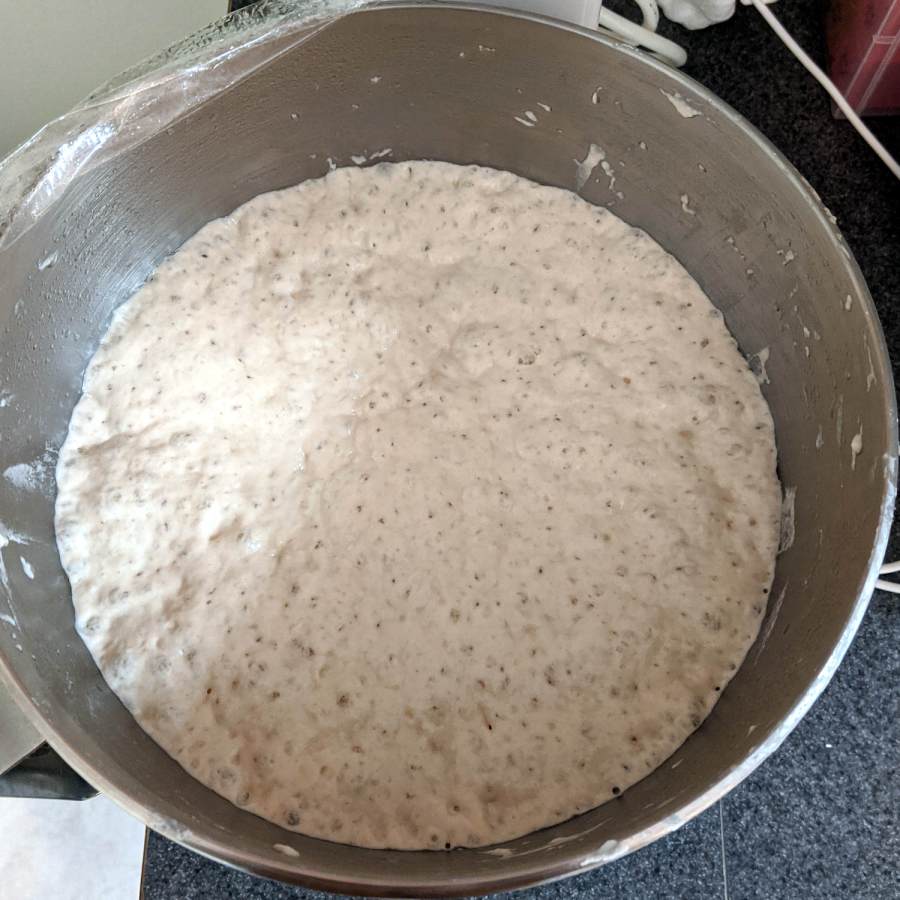
    It looks much more promising after rising for 18 hours:

    No-knead bread - 18 hour rise
    No-knead bread – 18 hour rise

    The recipe calls for a large heavy pot, which produced a long-disused nickel-plated cast iron Wagner Ware No. 8 Drip-Drop Roaster from the attic:

    No-knead bread - Wagner No 8 Roaster
    No-knead bread – Wagner No 8 Roaster

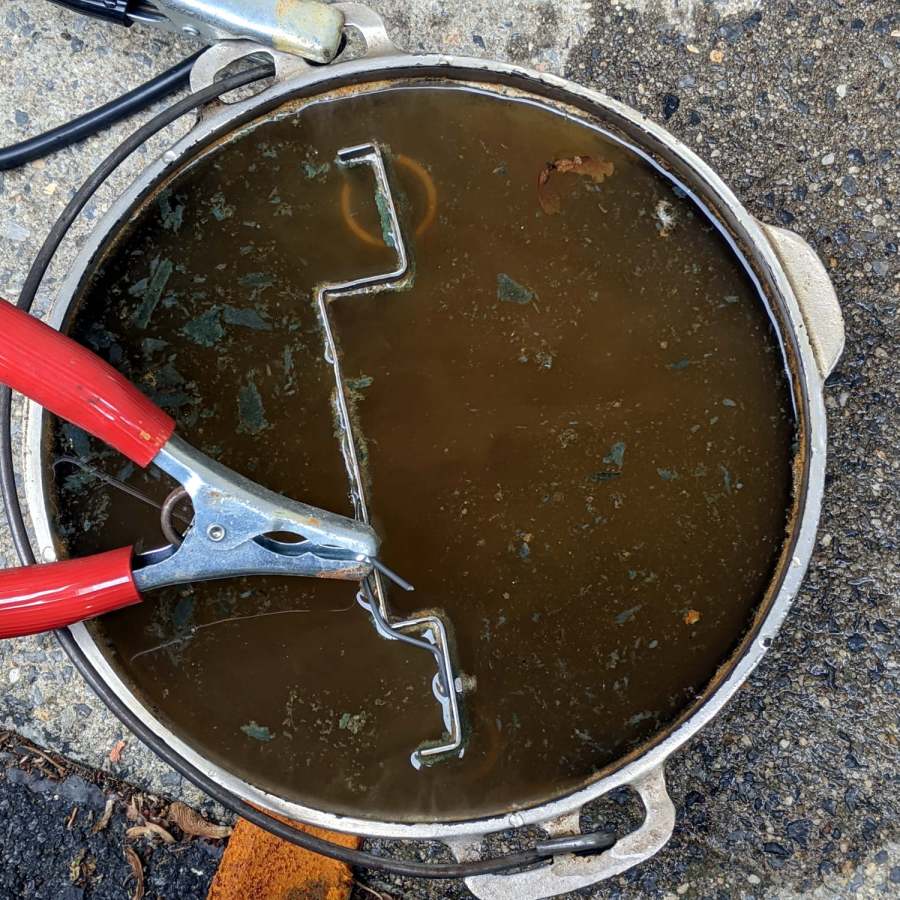
    I scrubbed out the interior and used it as-found to good effect. After the cookin’ was done, a few hours of electrolytic stripping seemed in order:

    No-knead bread - electrolytic pot strip
    No-knead bread – electrolytic pot strip

    The lovely nickel plating on the outside of the pot didn’t need stripping, but the interior is once again a nice flat black surface and the next loaf should drop right out …